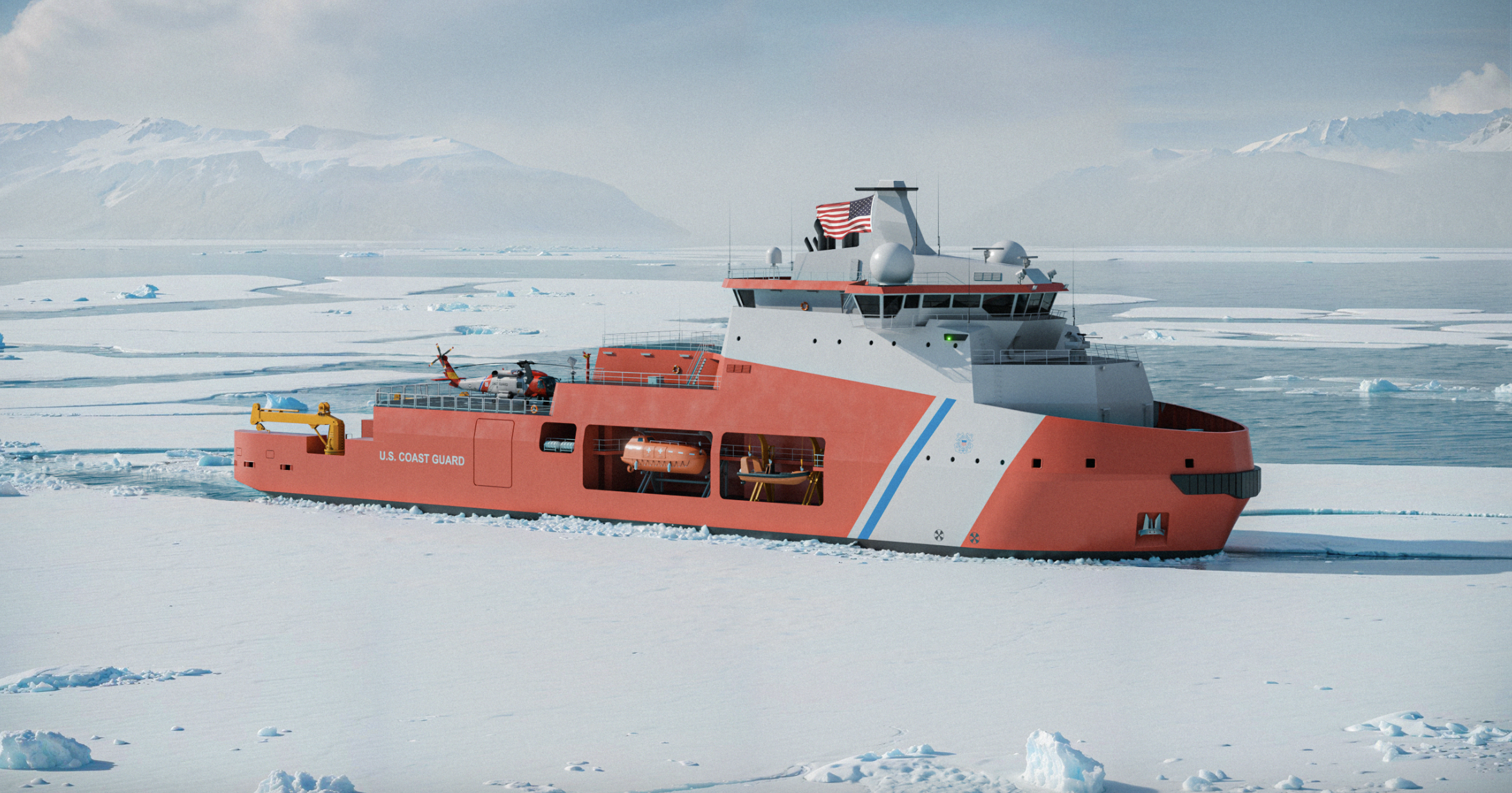
USCGC Pickering Artist rendering starboard quarter. Credit: Austal
Below is a Coast Guard news release. Good to see progress on the Austal portion of the OPC program.
Dec. 9, 2025
U.S. Coast Guard authenticates keel for offshore patrol cutter Pickering
WASHINGTON — The Coast Guard authenticated the keel for the future Coast Guard Cutter Pickering during a ceremony Monday in Mobile, Alabama.
Keel authentication is a time-honored shipbuilding tradition marking the formal start of a vessel’s construction. During the ceremony, the sponsor’s initials are applied to a ceremonial keel plate that will be installed on the cutter, symbolically indicating the keel is “truly and fairly laid.”
Adm. Kevin Lunday, acting commandant of the Coast Guard, attended the event along with Rep. Mike Ezell of Mississippi, chairman of the House Transportation and Infrastructure Subcommittee on Coast Guard and Maritime Transportation; Michelle Kruger, president of Austal USA; and more than 100 guests.
“This event highlights the progress made towards delivering this much-needed asset to the nation,” said Rear Adm. Chad Jacoby, deputy commandant for systems and chief acquisition executive. “With OPC design and modeling activities fully complete and production underway, we are gaining speed towards recapitalization of our medium endurance fleet.”
Ravi Khamsourin, an advanced welder with Austal USA, placed the initials of the sponsor, Dr. Meghan Pickering Seymour, on the ceremonial keel plate. Pickering Seymour is Pickering’s great-great-great-great-great-granddaughter.
Pickering is named after a revenue cutter built in 1798 that bore the same name. The vessel was named in honor of Timothy Pickering, the second secretary of war. Pickering fought in the American Revolution as a colonel and served as adjutant general of Gen. George Washington’s army in 1777. He later served as secretary of state, a U.S. senator and a member of the House of Representatives from Massachusetts. He advocated for construction of the first frigates built to enforce tariff and trade laws and prevent smuggling.
Pickering will be the third Coast Guard vessel to carry the name. In addition to the original revenue cutter Pickering, the Coast Guard operated a concrete-hull floating base bearing the name Pickering during the 1920s.
The OPC acquisition program addresses the Coast Guard’s long-term need for cutters capable of deploying independently or as part of task groups. The cutters provide essential capability for the Coast Guard to control, secure and defend U.S. borders and maritime approaches, facilitate maritime commerce vital to economic security and strategic mobility, and respond to contingencies. Acquisition of 25 OPCs will complement the service’s national security cutters, fast response cutters and polar security cutters as part of the Department of Homeland Security’s layered security strategy.
Below is my input to a discussion among my classmates. It is mostly history, but hopefully useful. As I was preparing this, I was struck by the realization that when the Crew Rotation Concept was thrown out, it should have resulted in a complete revision of our program of record.
When the program of record began, it was to replace 12 WHECs, 32 WMECs, and 49 WPBs, a total of 93 vessels with 8 NSCs, 25 OPCs, and 58 FRCs, a total of 91 vessels.
This plan also assumed the NSCs and OPC would use the Crew Rotation Concept that would have theoretically provided about a third more underway days than conventionally crewed cutters.
The Crew Rotation Concept was ultimately discarded, taking with it about 1980 underway ship days or eleven ship years.
This was partially offset by adding NSCs #9 and #10, but we are still getting the equivalent of nine large patrol cutters less than originally planned.
–
Coast Guard missions seem to be expanding. This has been partially addressed by building more FRCs than originally planned. The FRCs have exceeded our expectations and we are planning to have 77 of them, but we are still looking at only 35 large patrol cutters, 10 NSCs and 25 OPCs. I don’t think that is enough.
–
The Coast Guard has been describing the OPCs this way, “The OPC will provide a capability bridge between the national security cutter, which patrols the open ocean in the most demanding maritime environments, and the fast response cutter, which serves closer to shore.”
That is not really true. The OPC and the NSC are virtually the same size. The OPC may be intended to replace the MECs, but in fact it is 1250 tons larger than the Hamilton class WHECs and 2.5 times the size of a WMEC270. The OPC will also have a crew almost the size of that of the NSC. With a range of over 10,000 nautical miles they are high endurance cutters.
In 2012 the OPCs were expected to cost about half of what an NSC cost, now the costs to build and operate are approaching that of an NSC.
Two years later I did a revised look. https://chuckhillscgblog.net/2014/09/28/cutter-x-revisited/ and along the way, I pointed out several ships that could fill the Cutter X role. Actually they just seem to be the typical Offshore Patrol Vessel.
Since the geopolitical situation has changed and war with China looks more likely I have begun to think we should start building cutters that are more immediately useful in the event of war.
–
Congress has been telling the Navy they need to look at building Corvettes to bulk up their numbers and the next Navy league magazine is supposed to have a story about the proposal. Assuming these are ASW capable corvettes, this might be a class that could be built as a dual service ship, serving in both the Navy and Coast Guard.
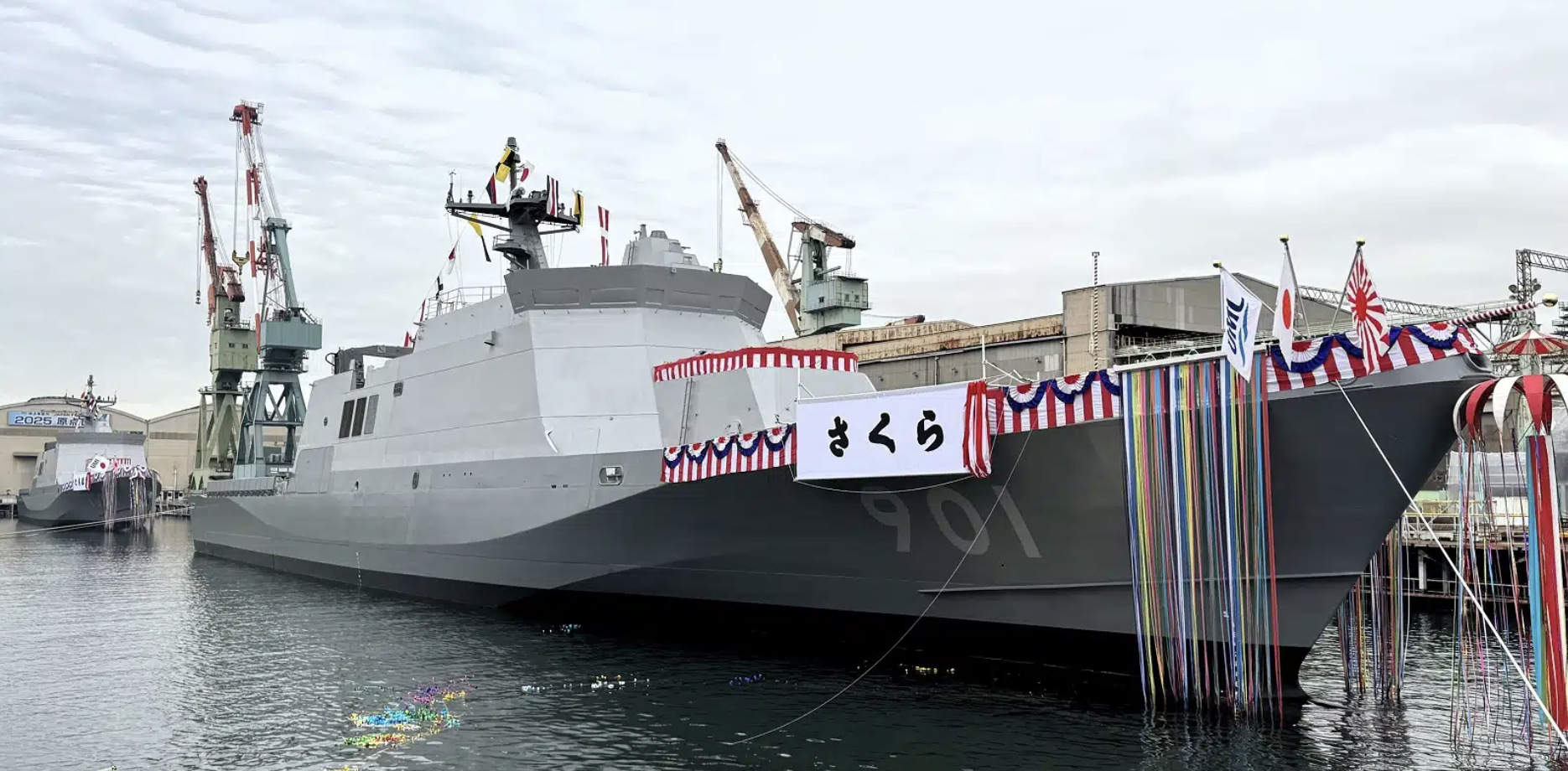
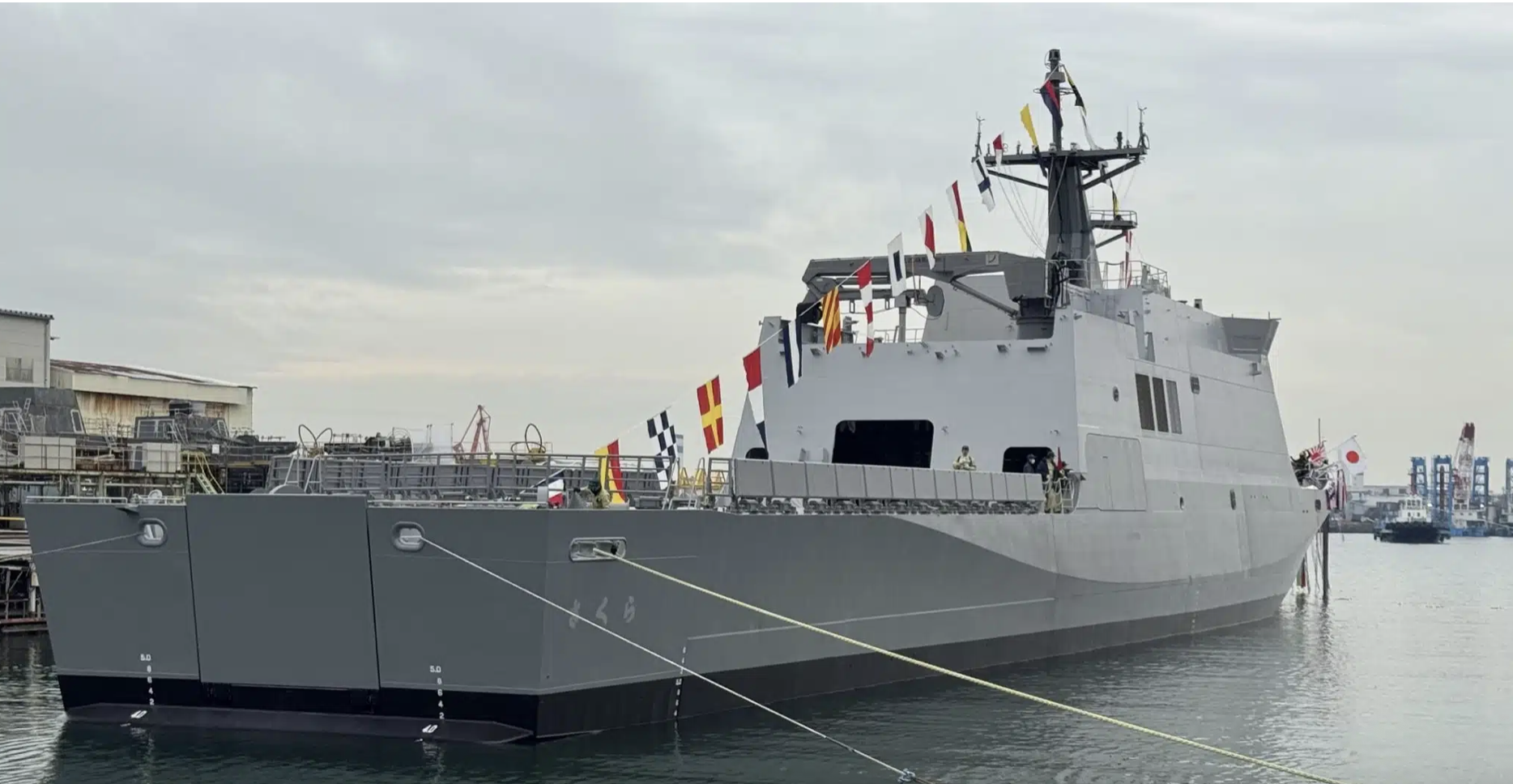
The first and second ships of the Japan Maritime Self-Defense Force’s new patrol vessel class, Sakura and Tachibana, were launched by Japan Marine United (JMU) on November 13, 2025 (photo by Kosuke Takahashi).
“The new patrol vessels measure 95 meters (312 ft) in length, with a standard displacement of 1,900 tons (about 2300 tons full load–Chuck), a depth of 7.7 meters, a draft of 4.2 meters, and a top speed of 25 knots (28.8 mph)…automation technologies have been implemented to reduce crew requirements, limiting the necessary personnel to just 30.”
These ships are particularly interesting because they will operate a relatively large ship with a small crew.
This low crew count is achieved through high levels of automation, including systems like the “Automatic Berthing and Unberthing Function” and an “Integrated Monitoring and Control System” that allows for remote firefighting.
To keep costs down, the ships are relatively simple but include Combined Diesel-eLectric And Diesel (CODLAD) propulsion. The design incorporates space for containerized mission modules below the flight deck.
We have been following this program since its inception.
Over the course of its development, the gun has gotten smaller; the length seems to have been reduced from 100 meters to 95; and the boat and unmanned systems handling facilities have been enclosed as the flight deck was extended to the stern.
Sakura class OPV Japanese Maritime Self Defense Force, at launch. (photo by Kosuke Takahashi).
Two features I was not aware of is that they will use the V-Bat UAS, also used by the USCG and a Mine Counter Measures role has been proposed.
Construction has been very rapid. These two ships were laid down on February 14, 2025. The first four ships are expected to be delivered in 2027.
These will be the first OPVs in Japanese Navy. It is not unusual for navies to include OPVs if they do not have a sea-going Coast Guard, as is the case with the UK, France, and the Netherlands, but Japan has one of the largest Coast Guards in the world, with more large patrol cutters than the USCG. India also has a large Coast Guard and operates OPVs in both its Navy and Coast Guard.
“I intend to closely follow and document construction of the Polar Class 2 ‘heavy’ Polar Icebreaker at Helsinki Shipyard in my continuing effort to correct the false belief that Finnish companies cannot build the types of icebreakers needed by the U.S. Coast Guard…
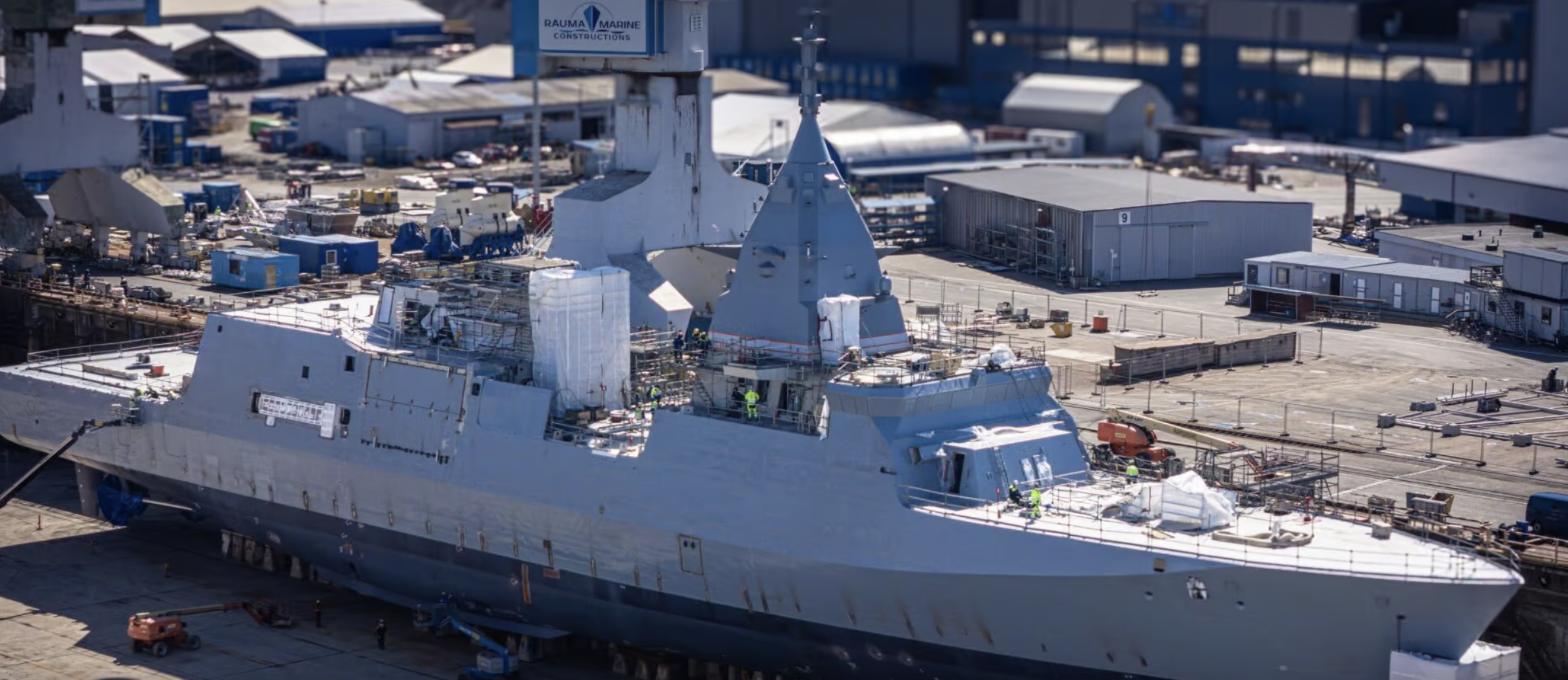
The corvette is also interesting combining significant anti-air, anti-surface, and anti-submarine capability with a hull designed to operate in ice, all in a hull 15% smaller than that of an OPC. I look forward to hearing more about it.
The first multi-purpose corvette built for the Finnish Navy’s Squadron 2020 project was launched at Rauma shipyard on Wednesday 21 May 2025.
220822-A-KS490-1178 STRAIT OF HORMUZ (Aug. 22, 2022) From the left, U.S. Coast Guard fast response cutters USCGC Glen Harris (WPC 1144), USCGC John Scheuerman (WPC 1146), USCGC Emlen Tunnell (WPC 1145) and USCGC Clarence Sutphin Jr. (WPC 1147) transit the Strait of Hormuz, Aug. 22. The cutters are deployed to the U.S. 5th Fleet area of operations to help ensure maritime security and stability in the Middle East region. (U.S. Army photo by Spc. Noah Martin)
Coast Guard Exercises Contract Option for 10 Additional Fast Response Cutters
WASHINGTON — The U.S. Coast Guard has exercised a contract option with Bollinger Shipyards of Lockport, Louisiana, to fund initial construction on 10 additional Fast Response Cutters (FRCs), Tuesday. The $507 million option supports ongoing efforts to modernize the fleet and expand the Coast Guard’s global maritime mission.
The action made possible by the passage of Public Law 119-21, known as the One Big Beautiful Bill Act, increases the total number of FRCs ordered under the current agreement from 67 to 77. Supported by historic investments, this legislation provides nearly $25 billion – the largest single funding commitment in Coast Guard history – including $1 billion dollars for additional FRCs. The first FRC funded through this option is expected to be delivered in fiscal year 2028.
“As the first Coast Guard contracting action to execute over $100 million in reconciliation funds and the first reconciliation-funded action executed by a cutter program, this is a historic accomplishment for the Service,” said Rear Adm. Mike Campbell, the Coast Guard’s Director of Systems Integration and Chief Acquisition Officer. “Since its introduction to the fleet in 2012 as the successor to the 110-foot Island class patrol boat, the Fast Response Cutter has consistently proven its capabilities, adaptability and effectiveness in a wide range of maritime environments and Coast Guard missions.”
Sentinel-class FRCs are critical assets in the Coast Guard’s mission to control, secure and defend the U.S. border and maritime approaches. To date, 59 of these cutters are in service, replacing the aging fleet of 1980s-era Island-class 110-foot patrol boats. The Sentinel-class FRCs feature advanced command, control, communications, computers, intelligence, surveillance and reconnaissance equipment; over-the-horizon cutter boat deployment to reach vessels of interest; and improved habitability and seakeeping. Expanding the FRC fleet continues the Coast Guard’s modernization through Force Design 2028, an initiative introduced by Secretary of Homeland Security Kristi Noem to transform the Coast Guard into a more agile, capable and responsive fighting force.

The FRC fleet will complement the capabilities of the service’s national security cutters (NSCs), offshore patrol cutters (OPCs) and polar security cutters (PSCs) as an essential element of the Nation’s layered maritime security strategy.
In a historic milestone for the Canadian shipbuilding industry, Davie today officially began construction of the Polar Max icebreaker, a vessel that, once delivered by 2030, will redefine Canada’s Arctic capabilities.
Uniquely, Polar Max will be constructed through an innovative industrial collaboration between Canadian-controlled facilities in Helsinki, Finland and Lévis, Canada. Construction on the Polar Max hull will begin at Davie’s Helsinki Shipyard, which has built 100% of the complex medium to heavy icebreakers delivered from Finland over the past 25 years.
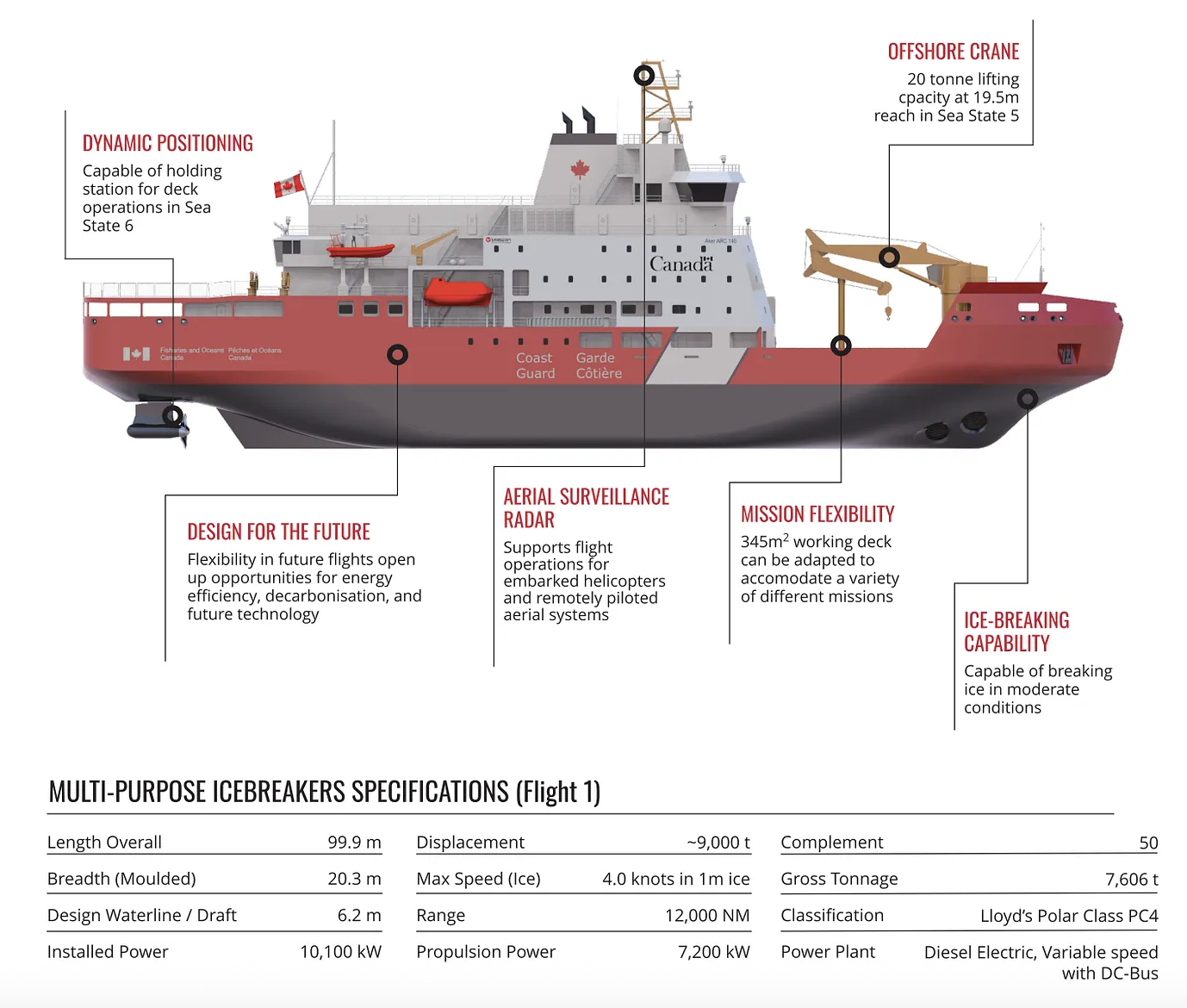
Canadian Coast Guard Multi-Purpose Icebreaker (MPI). Source: Seaspan Note: The MPI image does not show the right propulsors; it will use Steerprop’s contra-rotating propulsors (CRP). Additionally according to Seaspan, the design could easily be upgraded to PC3. Confirmation from Seaspan and Aker Arctic.
I am trying to catch up on things, but while this is an August 4 release from the Acquisitions Directorate, I think it is an important step in integrating the PSC’s machinery and providing training.
Coast Guard announces agreement to construct new polar security cutter shipyard facilities
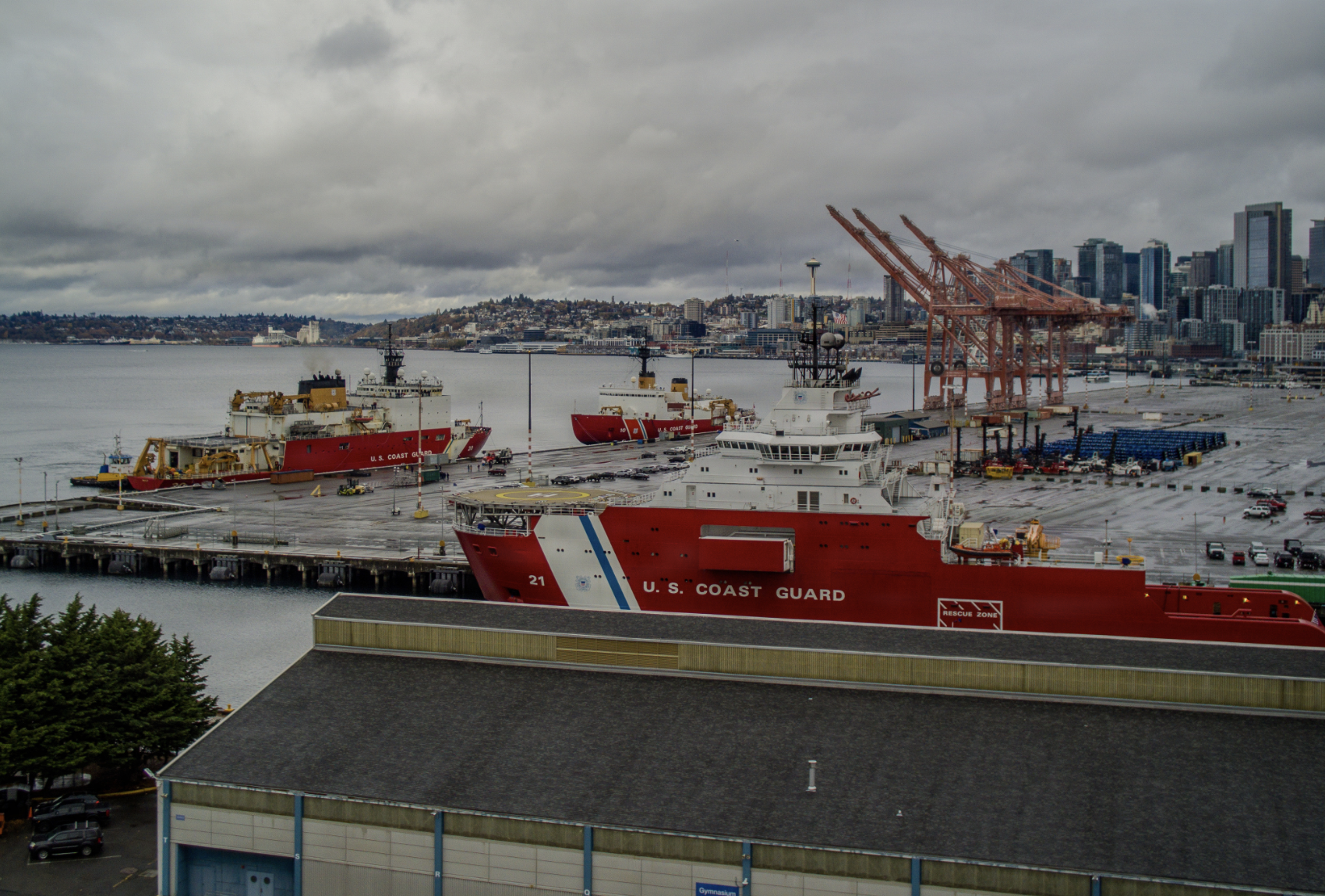
Aug. 4, 2025 —As part of continuing efforts to foster growth within the domestic shipbuilding industry and maintain momentum for acquisition priorities, the Coast Guard on July 23 formalized an agreement with Bollinger Mississippi Shipbuilding (BMS) to construct a production integration facility and land-based test facility at the shipyard in Pascagoula, Mississippi, in support of the Polar Security Cutter (PSC) Program.
This action represents a significant step in the Coast Guard’s continuing investment in the domestic shipbuilding sector and collaboration with industry partners to deliver critical assets to the nation. The construction of both facilities represents a significant capital investment partnership between the Coast Guard and BMS that will support streamlined production and integration of PSC mechanical and communication systems for a simplified installation process.
The Coast Guard modified the construction contract for the first PSC, originally awarded on March 25, 2025, to provide funding for the integration and test facilities via capital expenditure incentives. These incentives benefit the shipyard by providing access to funding for facility upgrades, workforce training and wage increases.
Here we have a post from Peter Rybski (prybski@gmail.com) thought many of my readers might find interesting. It’s reprinted with his permission.
It suggests that a partnership of Canadian and Finnish shipyards may be in the lead to provide two Arctic Security Cutters using the design for the Canadian Coast Guard’s Multi-Purpose Vessel, a light icebreaker, and that follow on ships of this class would be built in the US.
This is not the first time Peter’s analysis has appeared here:
Note also that Canadian Shipbuilder Davie has announced an intention to acquire and modernize Gulf Copper & Manufacturing Corporation with facilities in Port Arthur and Galveston.
Aerial photo of Gulf Copper Dry Dock and Rig Repair in Galveston, Texas. In the dry dock is the former USS Texas, length 573 ft (175 m) (overall), beam 95 ft 2.5 in (29.020 m), displacement 27,000 tons, so big enough for a Polar Security Cutter. Shutterstock photo by Felix Mizioznikov.
Finnish and Canadian Firms Team Up to Offer Arctic Security Cutters to U.S. Coast Guard
According to the proposal, Seaspan’s Multi-Purpose Icebreaker design would be built in Finland by Rauma Marine Constructions (RMC), with Aker Arctic (who did the concept design) providing support.
I’m currently away from Finland, visiting family in the USA. Last week, while I was grilling hamburgers and hot dogs during a family Independence Day Barbecue, a regional Finnish newspaper (Satakunnan Kansa) ran a very interesting article:
RMC’s Nieminen returned from a sales trip to the USA: “Rauma Shipyard is Number One.”
RMC is part of a consortium that is offering two icebreakers to the U.S. Coast Guard, as well as extensive training.
Caption: “We would have the shipyard ready for use at just the right time,” says RMC CEO Mika Nieminen hopefully.
(translation via google, with some corrections for clarification):
A satisfied man walked through Helsinki-Vantaa Airport on Thursday afternoon. RMC CEO Mika Nieminen returned from a sales trip to the USA, where he brought back some good news.
Nieminen was presenting the ship design of the consortium he represents to the US Coast Guard and the reception was excellent.
“Our ship design exceeded expectations and it is the design that the Coast Guard wants. The number one is the Rauma shipyard, which would also build it. The feedback was very positive.”
In addition to RMC, the consortium represented by Nieminen includes the Canadian shipbuilder Seaspan Shipyards and the Finnish ship design firm Aker Arctic Technology Oy.
The Canadian shipyard will start building medium-sized icebreakers based on the same model next year. Canada plans to build 16 icebreakers. This same ship model is now being offered to the US Coast Guard, but with RMC building the ships.
This is clearly referring to Seaspan’s Multi-Purpose Icebreaker (MPI) design, which I discussed in a recent article:
Analyzing the Arctic Security Cutter Request for Information
Canada’s Multi-Purpose Icebreaker (MPI, formerly known as the Multi-Purpose Vessel): Modern design that meets all of the listed requirements [for the U.S. Coast Guard’s Arctic Security Cutters]. The first flight of six vessels (of a planned sixteen) are scheduled to be built by Seaspan at their Vancouver shipyard….
Seaspan’s Vancouver Shipyard is at capacity through approximately 2029. While they will begin building MPIs for the Canadian Coast Guard, there is no room to build one for the U.S. Coast Guard in the relevant timeframe….
Building MPIs at RMC is an interesting idea, but I have no idea if that is actually under consideration.
It is more than just under consideration. According to the Satakunnan Kansa article, RMC would build the first two MPIs for the U.S. Coast Guard in Finland by 2028. The deal would also involve working with U.S. shipbuilders to ensure they had the training and skill to build subsequent vessels of the class in the USA. Cost information is not yet available.
Canadian Coast Guard Multi-Purpose Icebreaker (MPI). Source: Seaspan Note: The MPI image does not show the right propulsors; it will use Steerprop’s contra-rotating propulsors (CRP). Additionally according to Seaspan, the design could easily be upgraded to PC3. Confirmation from Seaspan and Aker Arctic.
In April, Finnish newspaper Helsingin Sanomat published an article about negotiations between the U.S. Coast Guard and RMC to build a significant number of icebreakers, but the details were not subsequently confirmed. Before publishing this article, I reached out to RMC, Seaspan, and Aker Arctic for comments. As of press time, Aker Arctic and Seaspan responded, confirming many of the details in the article.
Arto Uuskallio, Head of Sales at Aker Arctic, commented via e-mail:
It’s natural that we are involved, since the MPI is an Aker Arctic concept, and it’s good to have a partner onboard who understands the possibilities and limitations of the ship concept. More detailed comments will likely come from the shipyards.
Dave Hargreaves, Seaspan’s Senior Vice President for Strategy, Business Development, and Communication, provided the following comments via e-mail:
We have consulted with many U.S. and non-U.S. shipyards regarding their readiness and aptitude to build the MPI design for the U.S. Coast Guard ASC program including Rauma Shipyard in Finland.
Rauma has a track record of delivering ice-capable vessels in less than 36 months — including recent programs. As a fully capable, end-to-end shipyard, Rauma is the lowest risk and best option to meet the 36-month requirement. Unlike other shipyards, Rauma has an active panel line and block fabrication facility that is ready to start production today — it does not require any further investment or ramp up in workforce to begin construction. This significantly lowers the risk of meeting the schedule requirement.
Together, with Rauma and Aker, Seaspan has developed a comprehensive plan detailing how we will work with a U.S. shipyard to transfer the design, knowledge, expertise and build plans to enable future ASC vessels to be built in the United States. This approach will deliver a comprehensive, U.S.-built ASC fleet for the U.S. Coast Guard while enhancing domestic icebreaker shipbuilding — avoiding the delays, costs and risks of long-term, high-investment alternatives.
I take his comment about schedule risk as a subtle dig at Davie/Helsinki Shipyard. I’ve been reading these press releases and comments long enough to see the back-and-forth, sometimes subtle, between Seaspan and Davie, and RMC and Helsinki Shipyard. I expect to read more of this, but am much more interested in tracking the progress of ongoing ship construction (such as the Canadian Polar Icebreakers being built by Seaspan and Davie) than in following their rhetorical barbs.
Helsinki Shipyard has an excellent track record of delivering icebreakers in less than thirty-six months, as I noted here.
Rauma Marine Constructions was unable to provide additional comments by publication time, but did say that more information would be coming out soon.
Thoughts and Comments
The Multi-Purpose Icebreaker is a solid design, and Rauma Marine Constructions is a capable shipyard with a solid track record. As my goal in writing about icebreakers has always been to assist the U.S. Coast Guard in getting the ships that it needs in a relevant timeline, I view the Seaspan/RMC/Aker consortium’s proposal as a positive development.
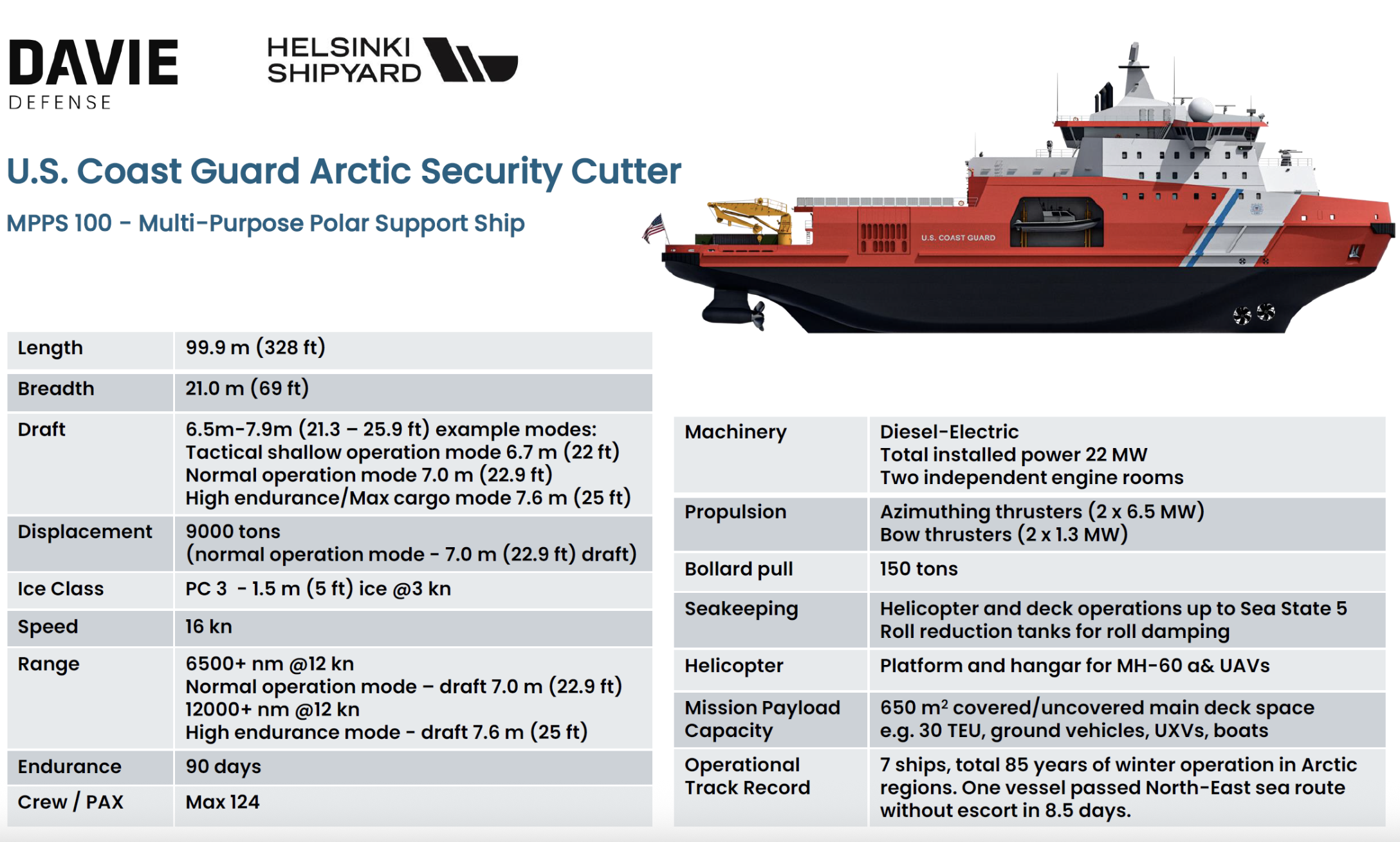
Davie does not comment on any of its ongoing negotiations, but it seems likely that it is offering its MPPS-100 to the U.S. Coast Guard to be built first in Helsinki Shipyard, and later (perhaps) in Texas.
The only announced player without any information about its proposed design is the United Shipbuilding Alliance created by Bollinger and Edison Chouest Offshore.
May the U.S. Coast Guard get the best ships for its needs in the shortest amount of time and at a good price! I’ll certainly be tracking all of these details closely.
Thanks for reading. Be sure to subscribe and share so that you never miss an update on this fast-moving and important topic.
Hopefully, this success suggests the Austal portion of the Offshore Patrol Cutter program will move along faster than the Eastern portion.
This ship, the future USNS Billy Frank, Jr. is the first in the second phase of procurement of a planned class of ten. The first five were contracted to Gulf Island Fabrication. The shipyard and the contract passed to Bollinger, 19 April 2021.
Austal got their contract for up to five in October 2021 (FY2022).
These are simpler ships than the OPCs, costing less than $80M each, but their full load displacement is actually more than that of the OPCs. The rate of progress seems to bode well for the OPCs. Billy Frank was laid down 14 November 2023 and launched 14 June 2025, 17 months later.
Certainly the Independence class trimaran Littoral Combat Ships that Austal has been building for 20 years are at least as complex as the OPC, and the last one, USS Pierre (LCS-38) went from keel laying to launch in only 14 months. We can’t expect construction of the first OPC to go that quickly, but for later ships it might be possible.
Two of the Bollinger ships are reportedly completed, but I have seen no indication they are in service yet. The first took 41 months from laid down to launch, the second took 52 months to reach the same milestones. The third and fourth Bollinger built ships had keels laid in 2022 but have yet to be launched.
“The projected delivery for T-ATS 11 is in early FY 2025, with one more ship delivering in FY 2025, and two ships delivering in FY 2026.”
The Bollinger contract anticipated a slower delivery,
“The projected delivery for T-ATS 6 is in FY 2026, with follow-on Bollinger ships delivering each subsequent FY.”
Offshore Patrol Cutters:
Austal got the Phase II contract for up to eleven OPCs in June 2022 and began building their first OPC in late August 2024. With Austal completing their last LCS, I hope to see rapid progress on OPCs #5-15.
JUNE 18, 2025
AUSTAL USA LAUNCHES FIRST STEEL SHIP FUTURE USNS BILLY FRANK JR. (T-ATS 11)
MOBILE, Ala. – Austal USA successfully launched the company’s first steel ship, the future USNS Billy Frank Jr. (T-ATS 11), on June 14. Named after a native American Korean War veteran who, as an activist, fought for justice and environmental preservation in the Northwest United States, Billy Frank Jr. is a Navy Towing, Salvage and Rescue Ship – one of 3 under construction at Austal USA and the first steel product of the company’s state-of-the-art automated steel panel line.
“It was amazing to see the flawless rollout of our first steel ship,” said Harley Combs, vice president of surface ship programs. “The completion of this milestone is the result of the hard work and dedication of our talented workforce. I am so proud of all they have accomplished.”
At 3,100 metric tons, T-ATS 11 is the heaviest ship Austal USA has launched to date. The launch was executed using the proven process used to launch most of the 32 Navy ships the company has built and delivered to the Navy over the last 15 years.
T-ATS will provide ocean-going towing, salvage and rescue capabilities to support fleet operations. T-ATS will be a multi-mission common hull platform capable of towing U.S. Navy ships and will have 6,000 square feet of deck space for embarked systems. The large, unobstructed deck allows for the embarkation of a variety of stand-alone and interchangeable systems. The T-ATS platform will combine the capabilities of the retiring Rescue and Salvage Ship (T-ARS 50) and Fleet Ocean Tug (T-ATF 166) platforms. T-ATS will be able to support current missions including towing, salvage, rescue, oil spill response, humanitarian assistance, and wide-area search and surveillance. The platform also enables future rapid capability initiatives such as supporting modular payloads with hotel services and appropriate interfaces.
With the ship over 85 percent complete at the time of launch, the future USNS Billy Frank Jr. will now prepare for her next major milestone, engine light off, as she gets ready for sea trials and delivery.