OPC and the LCS Replacement (SSC), Sister Ships?

I am not the only one seeing a possible opportunity for commonality between the Coast Guard’s Offshore Patrol Cutter (OPC) and the Navy’s projected Littoral Combat Ship (LCS) replacement. Here is a comment from Tim Colton’s Maritime Memos.

“The LCS program having proved unaffordable, largely thanks to the Navy’s idiotic passion for bells and whistles, they are now looking for suggestions for what they call a small surface combatant, or SSC. Read the announcement on FedBizOpps… The key words in the RFI are right up front: Small surface combatants enable the Navy to implement the Defense Strategic Guidance (DSG) imperative to develop innovative, low-cost, and small-footprint approaches to achieve our security objectives.

“It sounds as though we now have a potential overlap between the Navy’s SSC and the Coast Guard’s OPC, but that’s not necessarily a bad thing. In fact, it would be nice if, for a change, the Navy could manage to build some affordable ships. I know, shades of Gary Hart, but I think this is what we need, not more SSNs at $1.8 billion a pop. May Day, 2014.”

There is more information on the solicitation here.

Quoting from the solicitation, “This type of ship provides Combatant and Fleet Commanders a uniquely suitable asset for Theater Security Cooperation tasking and select sea control missions. These small surface combatants build and strengthen maritime relationships by operating with partners and allies in various theaters of operation.”

They are “asking for existing and mature design concepts.” The eight shipyards that bid on the OPC, and particularly the three that were selected, should be in a particularly good position to meet the demands of the solicitation.

We know they want more survivability and range, but they also want low cost and small footprint. To me that means a ship of similar size to the existing LCS but without the requirement for extreme speed that has made them high strung, crowded, and fragile. A slightly lengthened OPC can meet the requirements. Replace the 57mm with a larger gun and the Mk38 mod2 with CIWS/RAM/SeaRAM. Install CAPTAS (active/passive variable depth/towed array sonar) aft and use the extra length to add VLS and a second CIWS/RAM/SeaRAM, and you have a very viable, long ranged Small Surface Combatant.

If the Navy and Coast Guard could share a common Small Surface Combatant, they could probably be made in very economically.

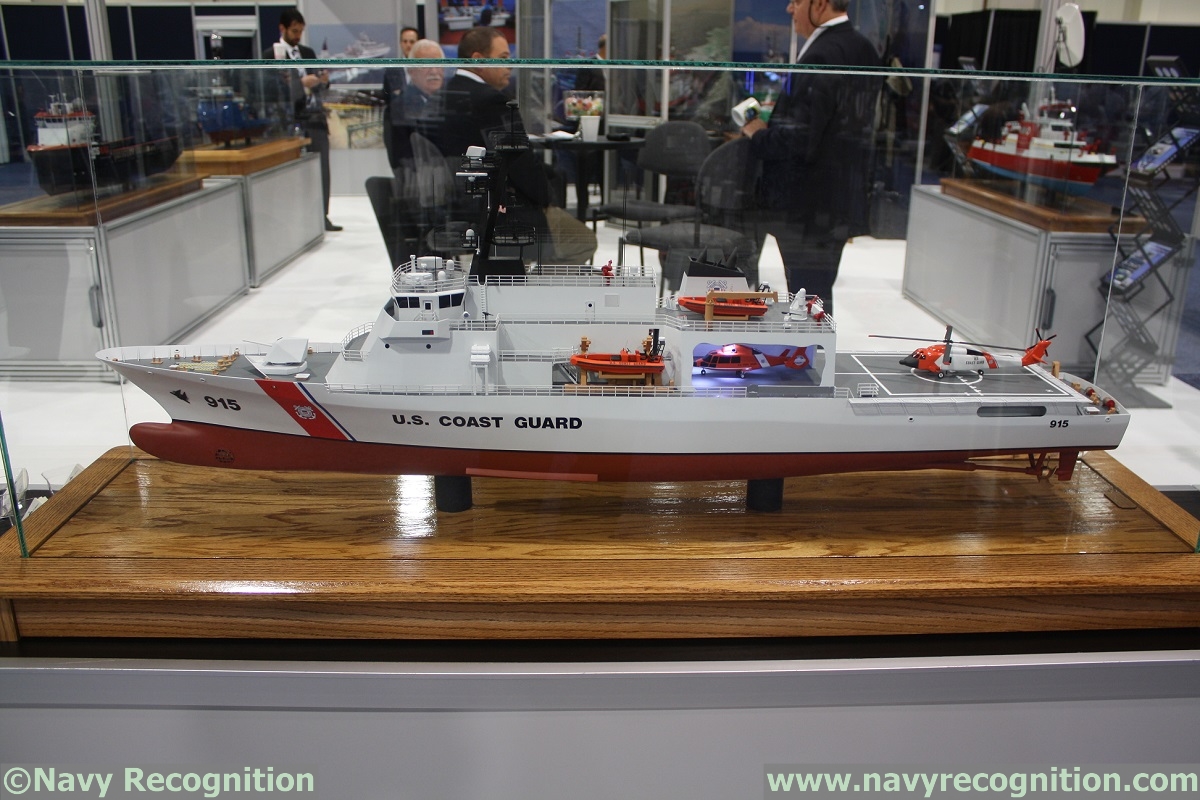
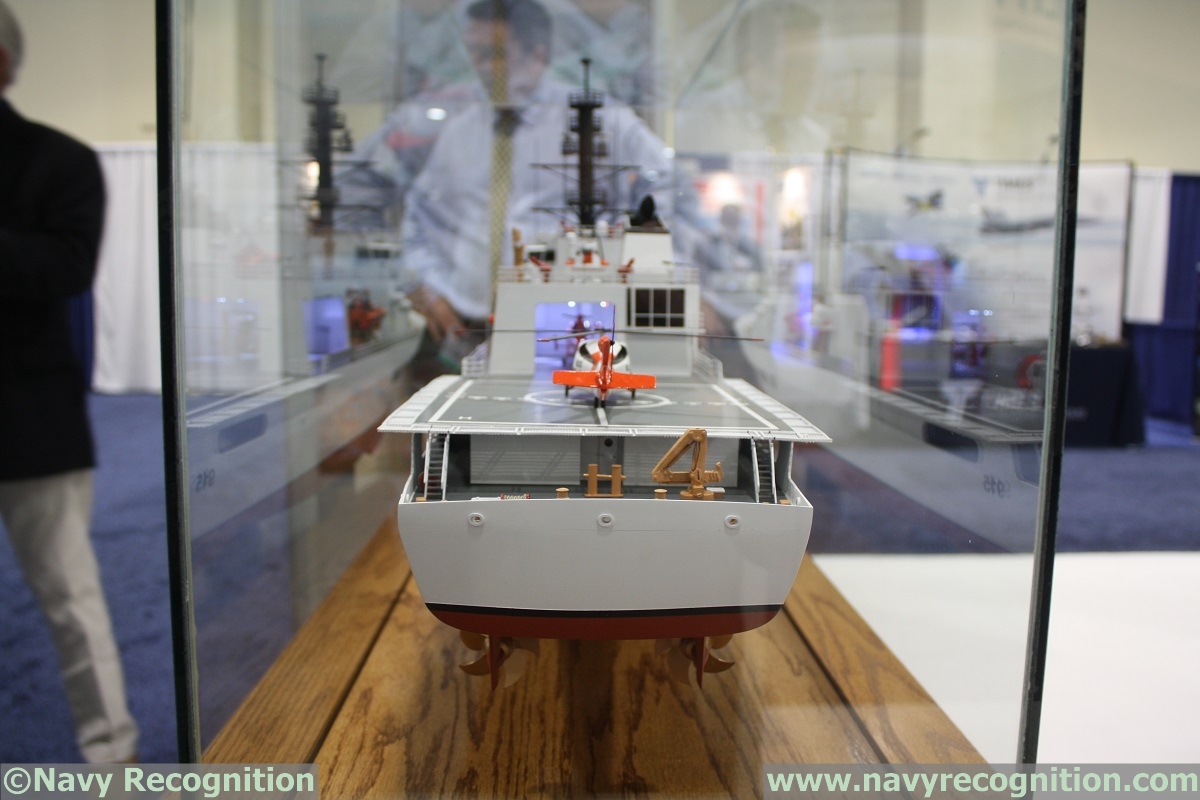
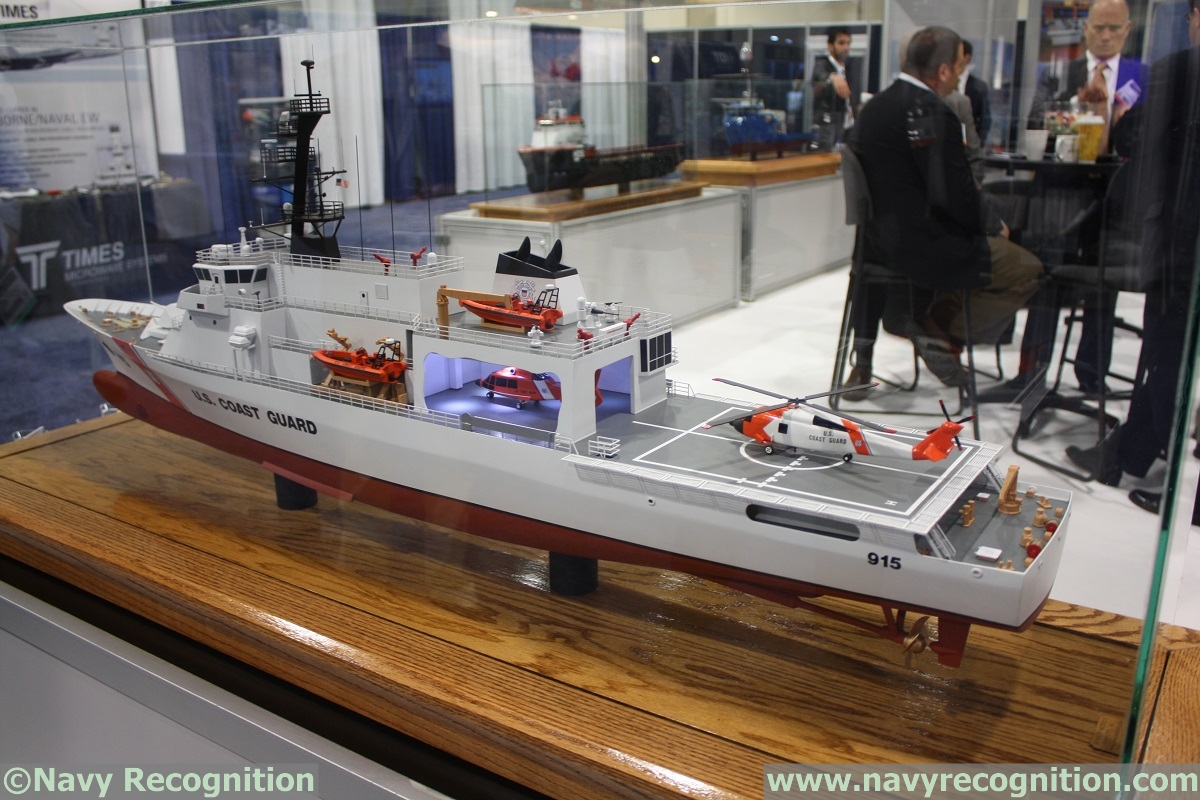
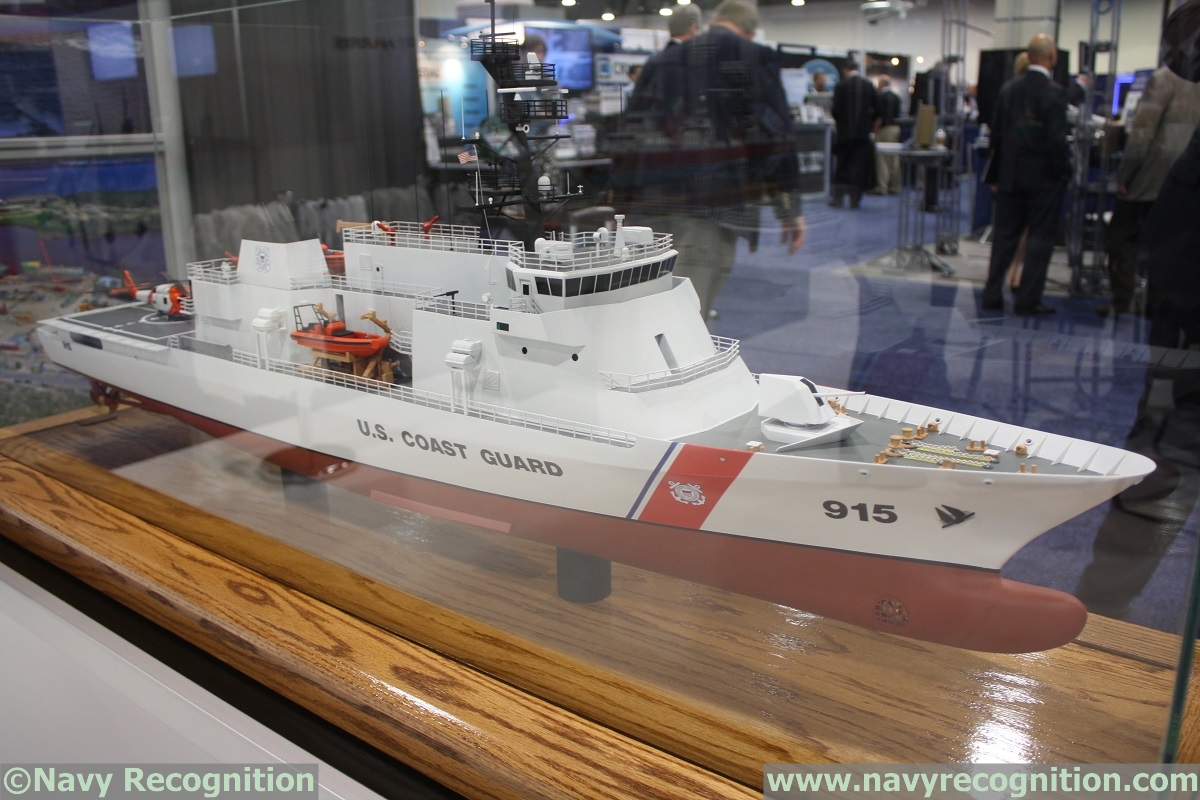
Eastern’s OPC Concept Model

Our friend at NavyRecognition has sent some photos of a model of the Eastern Offshore Patrol Cutter taken at Sea-Air-Space 2014. They have daily coverage of the event you can access here:
http://www.navyrecognition.com/index.php/news/naval-exhibitions/sea-air-space-2014.html

Click on the photo for a larger view.

IMG_4128

IMG_4129

IMG_4131

IMG_4132

IMG_4133

IMG_4134

IMG_4135

(Late addition, duplicating a comment)
One interesting feature I see on the model is that there appear to be four permanently mounted fire monitors, two on the hangar roof O-3 deck and two between the mast and stack on the O-4 deck.

Looks like the two ROSAM Mk49 remote controlled .50 cal. are just forward of the Mk38 mod2 and somewhat restrict its field of fire. I would rather see one or both of them forward, either on the roof of the bridge or on the O-2 deck forward of the bridge and above and behind the 57mm. Actually I would like to have a second Mk38 mod2 forward even if in lieu of the remote .50s. (There are crew served .50s on the bridge wings.)

It appears the SLQ-32 ESM antenna are inside the rails on top of the Bridge. I think they should be outside the rails but that is probably a simple change.

Three Nations Share German OPV Design

Toro_air_view

Toro_+_Dauphin
Photos: Chilean Navy photos of OPV Toro, 2012, note 40mm forward

We have a guest post today, Andres Tavolari, a 1st Lt in the Chilean Marine Corp Reserve talks about the recent christening of the third of a series of five ships that the US Coast Guard would consider Offshore Patrol Cutters. Not only have these ships supported SouthCom missions, Colombia and Argentina are also building ships of this class so cutters are likely to encounter and perhaps work with these or similar ships in their counter drug operations. Of the three countries Chile’s program is the most advance. Chuck

On last April 1st, was christened the third Fassmer-80 OPV for the Chilean navy. Named “Marinero Fuentealba” after a sailor who died trying to rescue the crew of a stranded ship on a storm in 1965, the new OPV will be delivered to the Navy in August 2014.   This is the third ship of a class of five for the Chilean navy, which are built in the ASMAR shipyard, Talcahuano, Chile, a German design selected among several bidders (Fincantieri, Vosper Thornycraft, Kvaerner Masa Marine, Damen and Fassmer). The detailed engineering was done by ASMAR which did 50,000 hours of modeling on the ships’ systems and components. The ships are classified as LRS +100 A1 LMC UMS.

The original design was modified in several aspects, most importantly, the addition of a hangar for a medium size helicopter.   With an overall length of 80,60 meters (264′), a waterline length of 74,40 (244′) and a moulded beam of 13,00 meters (42.6′), the Chilean Fassmer 80 OPV have a full load displacement of 1728 tons. With such a displacement, at 12 knots, their range is 8.000 nautical miles with accommodations for 60 persons including 20 passengers and the helicopter crew. The endurance is 30 days, carrying 298 m3 of fuel oil, 48 m3 of fresh water and 20 m3 of helicopter fuel. Two 12V26 Wärtsilä engines, delivering 4.080 KW (5,471 SHP each) @ 1.000 rpm, work on two 4 blades controllable pitch propelers. At 80% MCR the speed is 20 knots.   The first 2 ships are armed with a 40 mm gun taken second hand from German Type 148 missile boats, and with up to six .50 machine gun, although normally four are embarked. The third ship, the “Fuentealba” will be armed with a 76 mm Oto Melara gun also from a Type 148 missile boat. Some sources indicate its secondary armament will be up to 6 x 20 mm guns (probably old Oerlikon 20mm/70). This third ship has an ice strengthened hull and a different communications set, details have not been released yet. With these modifications “Fuentealba” will cost 43% more than the first two ships of the class, whose cost was less than $50M US each.   The flight deck and hangar are optimized for medium helicopters. Normally an AS-365 N2 Dauphin helicopter, similar to the MH-65, will be embarked. Typically it will be used for MIO and rescue operations.

There are two single points davits for two locally built 7,40 meters RIBs which can be launched and recovered while sailing at up to 12 knots. Under the flight deck is a working space with enough space for up to three 20 foot container sized units. There are four hatches in the flight deck permitting an easy access to the work deck. It is served by a Palfinger Marine PK 60000M crane installed on the flight deck. On the work deck and stern are the necessary fittings for towing other ships, towing being one of the main mission of this class of ships in Chilean service. Notably the second ship in the class (OPV 82 “Toro”) has, on the stern, 2 racks for depth charges!! Although an old weapon, several Chilean navy ships have been equipped with depth charges, as useful weapons for warning shots against submarines.

The Chilean Fassmer 80 OPVs have a Sperry Marine integrated Bridge System, an integrated communication system and an unmanned machinery space, remotely controlled. They are also equipped with the Mobile Maritime Command and Control System “SMC MM” and the ARIES fire control system for the 40 mm gun. Both systems are developed locally by SISDEF and DESA CHILE. It is most probable that the “Fuentealba” will be equipped with the SAETA fire control system, developed by DESA CHILE for the Chilean SA’AR missile boats armed with 76 mm guns.

The Chilean OPVs are operated by the Dirección General del Territorio Marítimo (DIRECTEMAR), a special branch within the Chilean Navy. The missions carried out by this ships are: coast guard, fishery protection, search and rescue, contamination control, training and support of isolated communities. Nevertheless, the first two ships have also deployed to international exercises and operations, such as UNITAS, PANAMAX and MARTILLO, the last one in combination with forces of the US Southern Command for fighting drugs smuggling in the Caribbean. The Colombian navy has received 2 slightly modified ships build locally by COTECMAR and has contracted a third ship, planning to build as many as 6, for operating 3 in the Pacific and 3 in the Caribbean (Argentina is also planning at least four-Chuck). Main modifications are a different mast, a different 40 mm gun, a telescopic hangar for a Bell 412 helicopter and a stern ramp. The stern ramp was considered less important for the Chilean Navy, which opted for improved towing capacity of towing ships and additional space for supporting isolated communities rather than the improved ability to deploy a boat quickly when chasing “go-fast” boats, since this is not a threat in Chilean waters. The OPV “Fuentealba” will be deployed to the Third Naval Zone, with homeport in Punta Arenas, on the Magellan Strait.

Thanks to Andres for his contribution. I noted this in the German Navy blog “Marine Forum” Daily News, 8 April, “CHILE – PERU Probably related to their ongoing dispute over Pacific Ocean sea areas, both the Chilean and Peruvian navy have (temporarily?) removed hull numbers and names from nearly all naval vessels, rendering identification difficult.” Hopefully this will be resolved amicably. Chuck

Addendum:
OPV Colombia 1

OPV Colombia 2

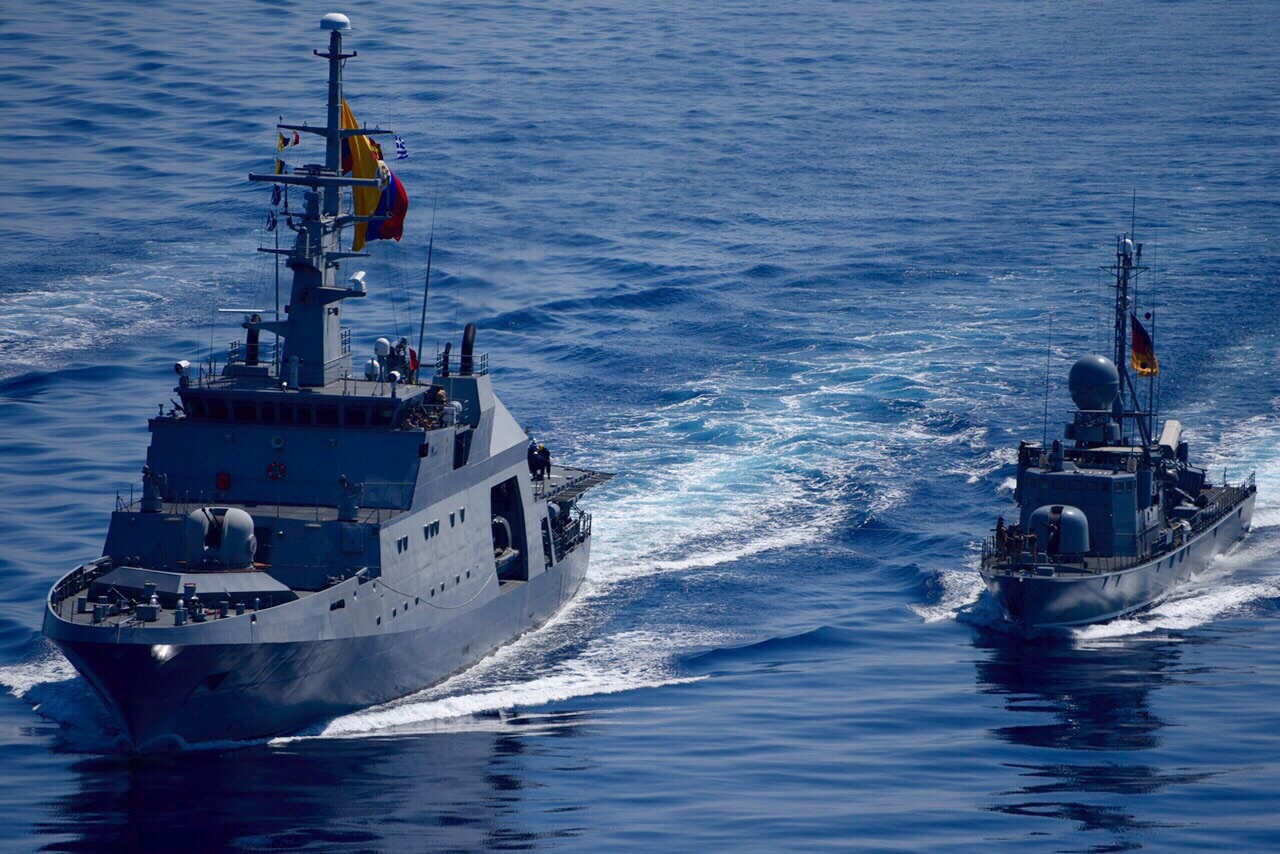
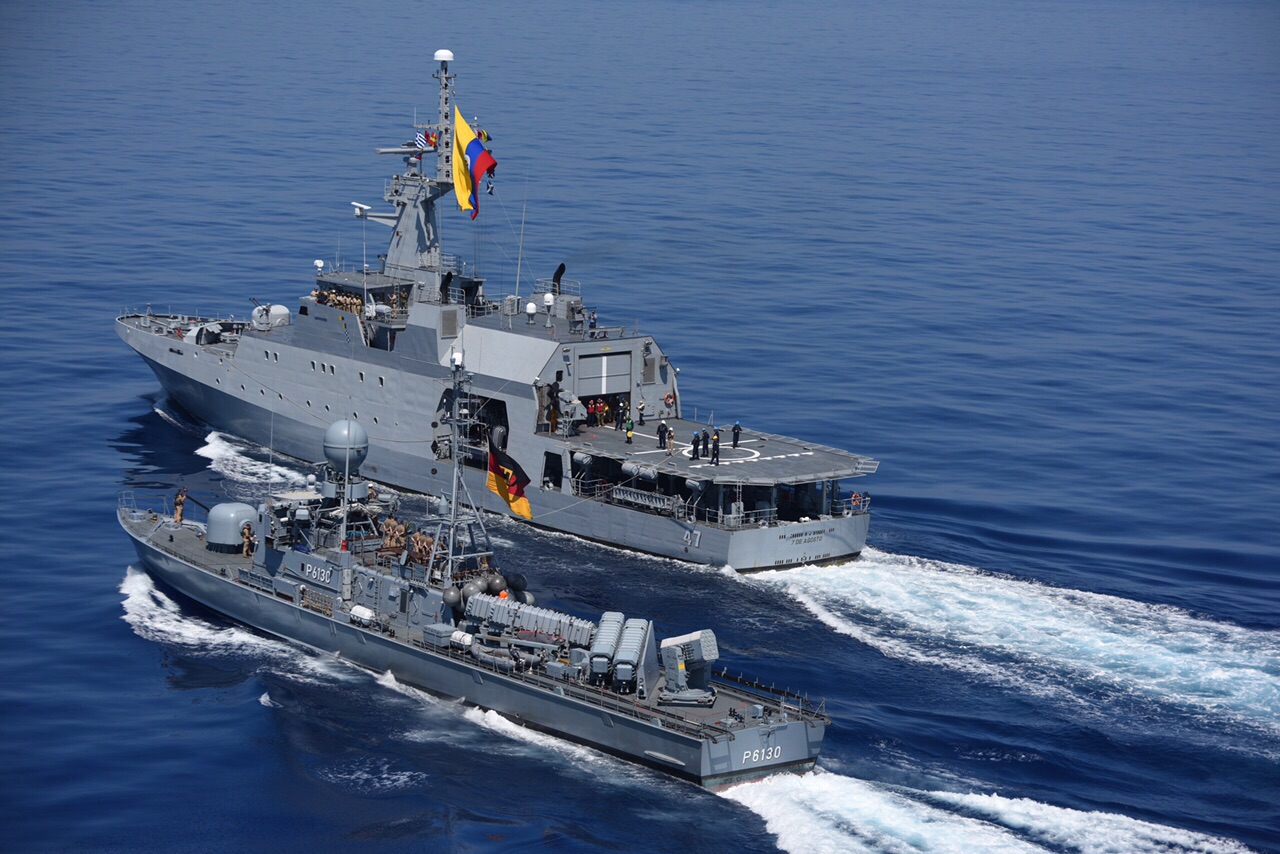
Photos provided Andres Tovalari. Colombian Navy OPV “7 de Agosto” sailing along a German Navy missile boat. Ship is currently part of Operation Atalanta countering piracy in the Indian Ocean.

As noted here,

“With 85 sailors on board, 7 de Agosto is armed with a 40 mm Oto Melara 40L70 twin gun, a 20 mm Oerlikon GAM-BO1 gun, and two Thor T-12 Remote Controlled Weapons Stations (RCWS). The T-12 RCWS includes a .50-calibre M2HB machine gun linked to a Controp SHAPO maritime day/night observation system.”

It is less obvious, but she also has a stern boat  ramp as well.

opv80

UK Border Force

As you may know, while the UK does have a coast guard, it is not much like the US Coast Guard. Nevertheless all the tasks remain. Their UK Border Force, which is part Customs, part TSA, and part Coast Guard, is their organization for addressing drug and alien migrant interdiction problem. Apparently they are using a patrol boat design which is a bit larger than the Webber class WPCs. Specs and video on the last link.

Unfunded Piority List

The US Naval Institute has published an online copy of the DOD’s unfunded priority list. The Navy’s list runs pages 9-13 of the 49 page document reproduced there.

Which got me to thinking, where is the Coast Guard’s unfunded priority list? Do we have one? If not, shouldn’t we? The FY2015 budget proposal includes only two Fast Response Cutters. First on the list, four more. The additional 14 C-27Js still leave us four Maritime Patrol Aircraft short of the program of record. Four more C-144s (or C-27s) please. There is a documented requirement for three heavy and three medium icebreakers. Lets fix the Polar Sea. To do all its statutory missions, the Coast Guard Fleet Mix Study  indicated we need nine National Security Cutters not eight and not 25 Offshore  Patrol Cutters but 57. We are not ready to order the OPCs yet, but a ninth NSC is something we could use right now. Plus the Coast Guard needs replacements or rebuilds for the inland fleet of tenders and the 65 foot icebreaking tugs. Incidentally the Fleet Mix Study says the Coast Guard need 65 Maritime Patrol Aircraft (listed as C-144s in the study) not the 36 in the program of record or the 32 in the works currently.

The Commandant has been saying the Coast Guard needs $2.5B a year in AC&I. Why not tell Congress how we would spend it. If I remember correctly, Congress has in fact asked for this. The Coast Guard would be remiss in not providing it.


Changes in the Fleet

Defense Industry Daily has an update on the status of the National Security Cutter (NSC) program. The seventh (Kimball) has been ordered and they report how the previously ordered cutters are progressing.

HII receives a $497 million fixed-price, incentive-fee contract from the U.S. Coast Guard to build WMSL 756, the 7th Legend Class National Security Cutter. Construction is expected to begin in January 2015, and delivery is scheduled for some time in 2018.

Ingalls has delivered the first 3 NSCs. WMSL 753 Hamilton is 81% complete and will deliver in Q3 2014; WMSL 754 James is 52% complete and will launch in April 2014; and WMSL 755 is scheduled for launch in the Q4 2015.  Sources: HII, “Ingalls Shipbuilding Awarded $497 Million Contract for Seventh U.S. Coast Guard National Security Cutter”.

Hamilton will be the first of two NSCs expected to be based in Charleston. Note the contract prices quoted are not the full cost of the ships.

Gallatin is being transferred to the Nigerian Navy, making this the second 378 transferred there. This leaves the Coast Guard with ten “high endurance cutters”, seven 378s and three NSCs, all on the West Coast.

The eighth Fast Response Cutter (FRC) has been commissioned and the ninth has been delivered.


Decommissioning the 110s

File:USCGC Mustang (WPB-1310).jpg

Photo: USAF photo, USCGC MUSTANG (WPB 1310), underway at Port Valdez, Alaska, while providing harbor security during Exercise NORTHERN EDGE 2002.

The Coast Guard recently commissioned its eighth Webber Class Fast Response Cutter, and it has accepted the ninth. Since these are replacements for the 110 foot Island class, we should not be surprised that Island class cutters are being decommissioned.

This is the first I have heard about since the decommissioning of the 123 conversions: USCGC Bainbridge Island (WPB-1343).

The FY2015 budget provides for decommissioning eight 110s.

The Coast Guard plans on 58 Webber class, so presumably they would want to retain enough 110s to provide a total of 58 larger patrol craft with the 110s filling in until replaced by the new ships. It does not look like this will happen. Since the decommissioning of eight Island class as a result of the failure of the 123 conversion, there have been 41 Island class WPBs. Adding the Webber class WPCs currently commissioned that gives the Coast Guard a total of 49 large patrol craft. It appears the total will not exceed 49 at any time in the foreseeable future.

If 110s are decommissioned at the same rate Webber class are built, the number may stabilize at 49. If on the other hand the Coast Guard is unable to keep these older vessels going, the total is likely to drop. If that happen, as little as I like the idea of multiple crews, perhaps it is time to look at multi-crewing the Webber Class. .

Could This be Bollinger’s OPC Candidate?

During Vietship 2014 Nava Exhibition in Vietnam, Dutch shipyard Damen unveiled for the first time the design of the Sigma 9814 Corvette ordered by Vietnam. It was announced in October 2011 that Damen shipyard in Vlissingen, Netherlands will build four Sigma corvettes for the Vietnamese Navy. The first two ships will be built in Vlissingen (Netherlands), and the last two (options) will be built in Vietnam, under Dutch supervision.

Navy Recognition is showing a photo of a model of a new corvette being built by Bollinger’s partner Damen for the Vietnamese Navy. The ships is the right size, 98 meters long and 14 meters of beam (321 ft x 46 ft).

We already discussed the fact that Damen had built an OPC sized ship for the Vietnamese counterpart of the USCG.

The photo even looks a little like the ships in this earlier illustration from Bollinger. The reported dimensions of the new Vietnamese vessel also correspond to the dimensions given for Damen’s 2600 ton OPV.

An interesting feature is how well armed this Vietnamese Corvette will apparently be. This bodes well for potential upgrades to the OPC. Quoting Navy Recognition:

the new SIGMA 9814 class will be fitted with:
8x MBDA Exocet MM40 Block 3
12x MBDA MICA VL surface-to-air missiles (in VLS)
1x Oto Melara 76mm main gun
2x Oto Melara MARLIN-WS 30mm gun mounts
The corvette will acomodate one anti-submarine helicopters Ka-28. The corvettes are set to receive the latest generation of electronics and sensors from Thales including TACTICOS combat management system,SMART-S Mk 2 radar and STING EO Mk 2 electro-optical fire control system.

Trade-offs in the 378 FRAM

File:USCGC Sherman WHEC-720 Vietnam War.jpg

Coast Guard photograph, PHC Ken Mather, USCGC Sherman (WHEC-720) in her original configuration with a 5″/38 and dual hedgehogs, April 1969. 

This is hardly a current topic, but it is one I have seen discussed several time, most recently in comments on a post about the new Canadian Arctic/Offshore Patrol Ship (AOPS), e.g. why the Coast Guard used the 76mm Mk75 gun on the 378 FRAMs rather than the 5″/54 Mk45.

It is true that, although about four tons heavier, the early model 5″/54 Mk45 mounts were a drop in replacement for the 5″/38 mounts we had on the 378s. It would have appeared an easy choice, but in order to accommodate the additional weight of the Harpoons and CIWS, perhaps the Coast Guard had no choice but to go with a lighter gun. That gun (and its associated firecontrol system) was certainly seen as a significant improvement over what we had had in essentially all respects including reduced manning and maintenance.

If we look at the weights as built that were removed:

one 5″/38 (20.5 tons) and two hedgehogs (14.4 tons), totalling approximately 35 tons

and compare that to some of the weights added

one 76 mm Mk75 gun (8.2 tons), two Mk141 quad harpoon launchers (11.8 tons total), eight Harpoon (6 tons), and a Mk 15 Phalanx CIWS (6.8 tons).  Total approximately 32.8 tons. Plus more weight for the addition of the hangar. Essentially the difference was a wash.

If instead, we had used the 5″/54 Mk45 mod 0 (24.5 tons) in addition to the harpoons and CIWS, the total weight would have been 16.3 tons higher or 49.1 tons.

There are other weights that might be added in calculating the total weight devoted to armaments, but obviously I don’t think this was an excessive amount, there are too many examples of smaller ships with far more weapons. I previously noted, (“OPC-Design for Wartime, Build for Peacetime”) that as built the little 255s had 140 to 150 tons of weapons.

Even so, an additional 16.3 tons topside (even if that is only about 0.5% of the full load displacement) might have been too much for the 378s. I don’t know. Perhaps a former 378 engineer or DCA could enlighten the discussion.

File:USCGC Mellon WHEC-717.jpgPhoto: Navy photo, USCGC Mellon, with 76mm, Harpoon, and Phalanx CIWS

OPC Multi-Year Procurement-a Clarification

I have been made aware that the earlier post on this topic might lead to some confusion. Lets look at it in more detail. This is what the bill actually says about this,

“SEC. 215. MULTIYEAR PROCUREMENT AUTHORITY FOR OFFSHORE PATROL CUTTERS.

” In fiscal year 2015 and each fiscal year thereafter, the Secretary of the department in which the Coast Guard is operating may enter into, in accordance with section 2306b of title 10, United States Code, multiyear contracts for the procurement of Offshore Patrol Cutters and  associated equipment.”

First, it should be apparent that this applies only to the Offshore Patrol Cutter (OPC). This will not help with the Fast Response Cutter (FRC) program.

Second it refers specifically to section 2306b of title 10, the section governing muti-year procurements (MYP), which brings with it some specific requirements, one of which is that to be eligible for consideration for a multi-year procurement, the program must be  “stable.” In the case of shipbuilding, this usually means that the first ship is at least complete. That will probably be in 2020, by which time, at least the first three ships should have already been contracted.

There is a form of contracting that would provide many of the advantages of multi-year procurement (MYP) that can include these first few ships, this is Block Buy Contracting (BBC) as was used at the start of the Navy’s current submarine program, but that was not what was authorized.

Clearly the House Transportation and Infrastructure Committee wants to allow the Coast Guard to exploit potentially more efficient forms of contracting, but the potential of multi-year procurement of OPCs is still years away. If they want to realize savings earlier, they will need to authorize Block Buy Contracting for the Offshore Patrol Cutters and/or Multi-Year Procurement for the Fast Response Cutters.

There is another issue here also. That is the disagreement between the Department and Administration (in the form of OMB) on one side and the Coast Guard and some members of Congress on the other about what elements of the project must be funded before it is considered fully funded and a contract can be awarded. This is a funding approach question. and it is actually not directly connected to the contracting mechanism. Authorizing MYP does not resolve this disagreement. The Department and Administration’s apparent reticence may be symptomatic of a desire to delay committing, which would work against the long term commitment required for a multi-year procurement, but it should be obvious to anyone that while the final number of OPCs may be open for debate, the Coast Guard does need at least the eleven that are currently planned to be included (one contracted and ten as options) in the initial construction contract.