“Coast Guard announces agreement to construct new polar security cutter shipyard facilities” –CG-9

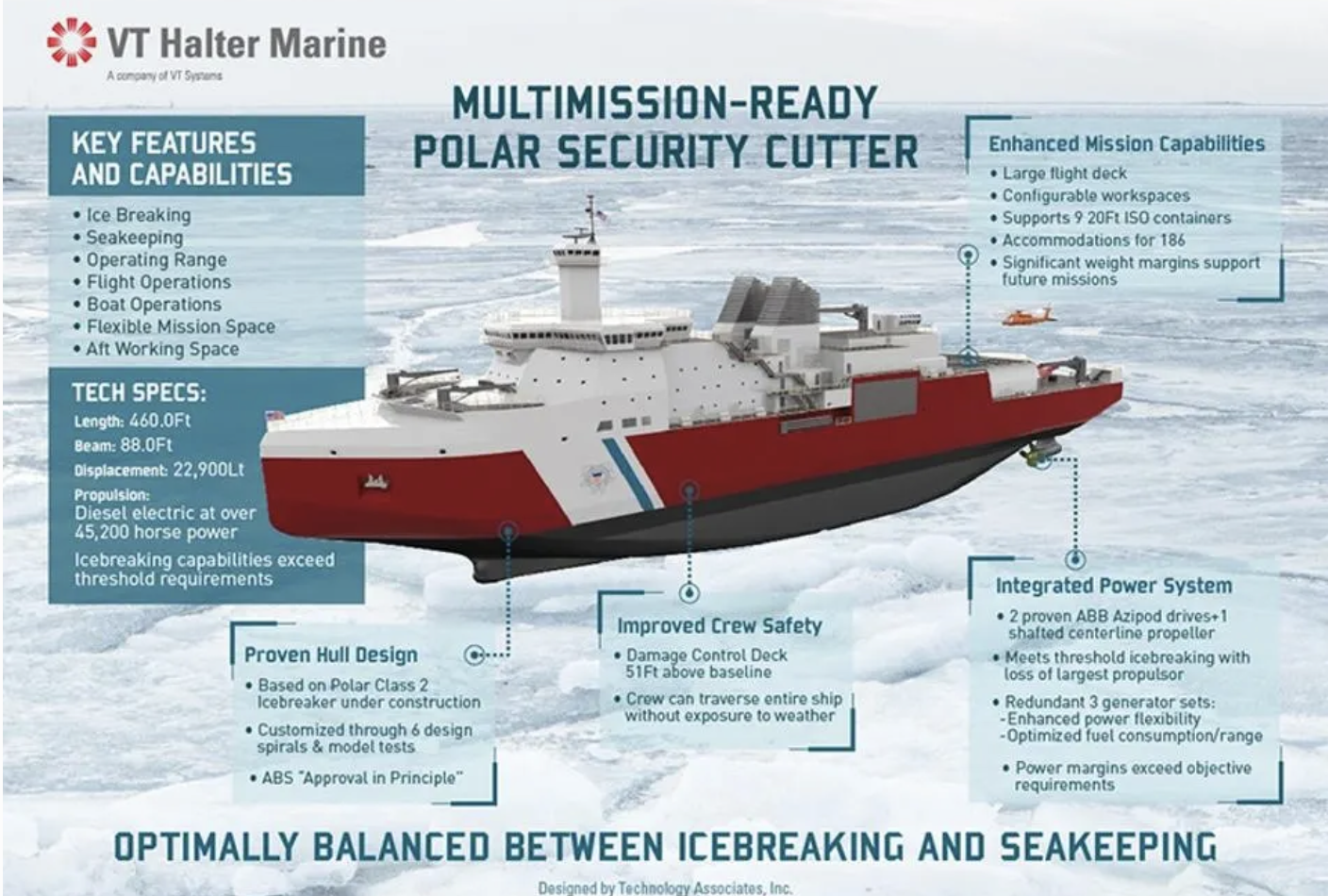
I am trying to catch up on things, but while this is an August 4 release from the Acquisitions Directorate, I think it is an important step in integrating the PSC’s machinery and providing training.


Coast Guard announces agreement to construct new polar security cutter shipyard facilities

As part of continuing efforts to foster growth within the domestic shipbuilding industry and maintain momentum for acquisition priorities, the Coast Guard on July 23 formalized an agreement with Bollinger Mississippi Shipbuilding (BMS) to construct a production integration facility and land-based test facility at the shipyard in Pascagoula, Mississippi, in support of the Polar Security Cutter (PSC) Program.

This action represents a significant step in the Coast Guard’s continuing investment in the domestic shipbuilding sector and collaboration with industry partners to deliver critical assets to the nation. The construction of both facilities represents a significant capital investment partnership between the Coast Guard and BMS that will support streamlined production and integration of PSC mechanical and communication systems for a simplified installation process.

The Coast Guard modified the construction contract for the first PSC, originally awarded on March 25, 2025, to provide funding for the integration and test facilities via capital expenditure incentives. These incentives benefit the shipyard by providing access to funding for facility upgrades, workforce training and wage increases.

For more information: Polar Security Cutter Program page

USINDOPACOM Exercises & Engagements

INDOPACOM Defense Forum Special Features has a post that includes the map above that shows where “Exercise, Joint Combined Exchange or Training Teams” are located.

On the linked post, you can hover over the dots, and it will list activities in that location. Coast Guard is associated with dots identified as Solomon Islands, Federated States of Micronesia (FSM), Guam, Palau, Papua New Guinea, and Australia. It should have included the Marshall Islands as well. All these are also associated with Operation Blue Pacific.

Federated States of Micronesia, the Marshall Islands, and Palau are Compact of Free Association states. Guam and the Northern Mariana Islands are US territory.

The same post also has a different map that shows the location of DOD units normally located in the AOR (area of operations) that may be of interest.

“US Coast Guard Cutter Eagle to Depart on Annual Summer Cruise” –Seapower

The Navy League’s online magazine, Seapower, reports the start of USCGC Eagle’s summer training program and their planned port calls.

“Eagle’s 2024 full summer schedule includes port visits to:   

  • May 11: Departs from New London 
  • May 25 – May 28: Santo Domingo, Dominican Republic 
  • June 4 – June 7: Cartagena, Colombia 
  • June 14 – June 17: San Juan, Puerto Rico 
  • June 24 – June 27: Bridgetown, Barbados 
  • July 7 – July 10: Hamiliton, Bermuda 
  • July 18 – July 21: Halifax, Nova Scotia 
  • July 26 – July 29: Portsmouth, New Hampshire 
  • Aug. 2 – August 5: Rockland, Maine 
  • Aug. 9 – August 12: Boston, Massachusetts 
  • Aug. 16: Returns to New London 

Eagle is scheduled to return to New London on Aug. 16. 

“Boats of the United States Coast Guard” –CG-9

Response Boat, Medium (RB-M). Photo from Vigor

A friend (thanks Lee) brought this little book to my attention.

“Boats of the United States Coast Guard”

Don’t know how I missed this, but seems very comprehensive, 30 pages and 44 different types of craft.

Coast Guard Partners with Army for Green Berets Training

Sea Waves reports,

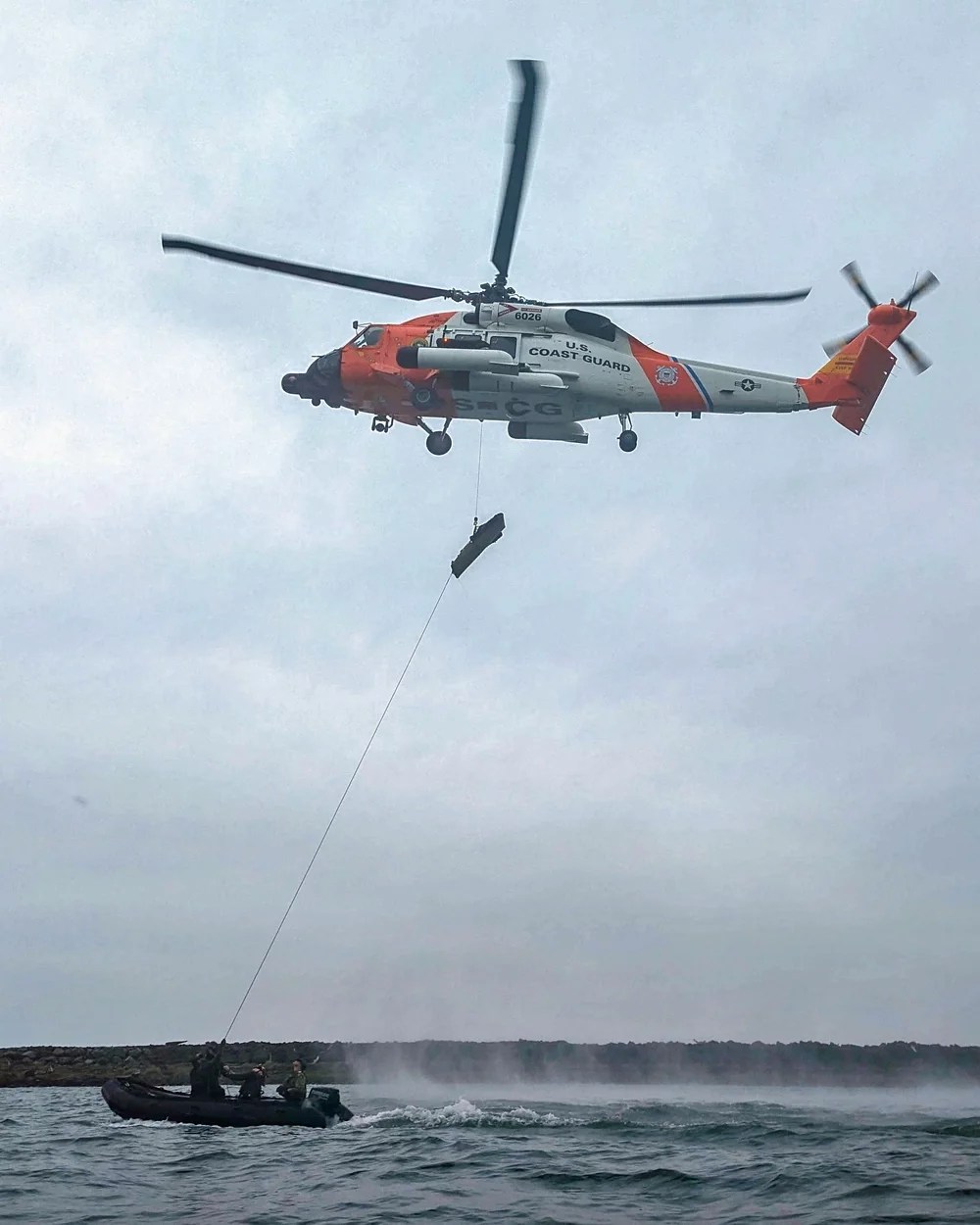
“Combat Divers assigned to the 10th Special Forces Group (Airborne) conducted maritime training in Astoria, Oregon, Oct. 30, 2023. The Green Berets partnered with Coast Guard Air Station Astoria and Coast Guard Station Cape Disappointment for multiple training events, preparing them for a two-week long scenario-based exercise.”

“The Elephant in the Engine Room” –USNI

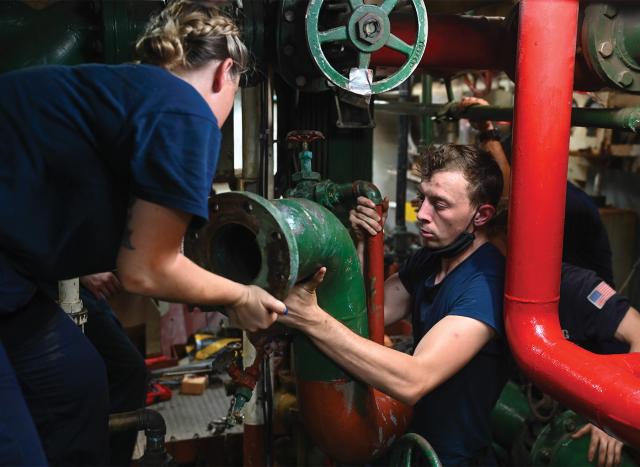
Engineers on board the USCGC Thetis (WMEC-910) work to replace a seawater pump to get the cutter fully mission capable. One way to increase skills and knowledge in the engine room would be platform specialization—having mechanics trained on specific engine models and continuing to work on those models in subsequent tours. U.S. Coast Guard (John Hightower)

The US Naval Institute Proceedings for August 2023 has what appears to be an important discussion of current problems with the way Coast Guard engineers are trained and treated. It was the first prize winner in this year’s Coast Guard essay contest.

The Coast Guard is aware that the surface asset classes coming online have roughly four times as many pieces of equipment installed as the classes they are replacing. The service is beginning to understand the effects of four times as many shipboard points of failure and orders-of-magnitude-more logistics support requirements. Senior leaders are hesitantly embracing the reality that the new ships also are more technically complex, with industrial IT systems connecting every pump, purifier, compressor, and propulsion component.

Some changes are proposed. I would only add that, maintainability and redundancy should be important considerations in ship design, and in regard to this,

 “Cutter crews avoid performing substantial planned maintenance on individual pieces of equipment while underway for fear of being anything less than fully mission capable when tasked with a new and urgent case.”

Most of our ships have redundancies. We need to keep maintenance current even if it means doing it underway and perhaps losing a few knots max speed. These limitations should of course be reported, but they should be expected. National security cutters for instance can take still make 22 to 24 knots even if their gas turbine is taken out of service. They are probably still capable of 26 knots if one of their diesels is down. The OPCs should still be capable of 18 knots if one of their diesels is down.

“US, PH, Japan coast guards hold maritime law enforcement training” –The Manila Times

More than 30 participants from the Philippines, Malaysia, Thailand and Vietnam joined the Multinational Vessel Boarding Officer Course funded by the US Department of State’s Bureau of International Narcotics and Law Enforcement Affairs in Puerto Princesa City, Palawan on May 15-26, 2023. CONTRIBUTED PHOTO

The Manila Times reports on a US sponsored, Philippines hosted, boarding officer course that was also extended to officers from other ASEAN partners.

“Through this course, 33 participants from the PCG, Philippine National Police Maritime Group, Malaysia’s Maritime Enforcement Agency, Thailand’s Maritime Enforcement Command Center, and Vietnam’s Department of Fisheries enhanced their knowledge of the law of the sea and policy on the use of force.”

Thanks to Paul for bring this to my attention. 

“The Coast Guard Must Take Action to Send Women Afloat” –USNI

The US Naval Institute blog has a post entitled “The Coast Guard Must Take Action to Send Women Afloat, writen by Cadet Second Class Kyra Holmstrup, U.S. Coast Guard, who said that she was fortunate to spend a long summer cruise on a National Security Cutter but noted her experience was the exception.

Third-class summer is vital to future career selection in the Coast Guard. Without having gone afloat on an NSC, I would not be at CGA today. Seeing the world from the bridge helped me identify the reason why I joined and solidified the leadership lessons I learned as they guide me through my 200-week leadership journey. If this is not addressed now, our service risks losing the diversity and relevance the Coast Guard has so desperately worked to attain. To the senior leaders at CGA and in the Coast Guard: Make it a priority to send female cadets afloat for summer assignments and provide cadets with opportunities to experience different underway platforms. The focus should be on providing prospective female officers with earlier exposure to the afloat community starting at CGA with cadets like me. Not enough female cadets experience adequate time on board cutters early on in their careers; if female cadets did, the Coast Guard would see an increase in the number that go and—more importantly—stay afloat.

Earlier USNI had another post,“Fixing the Coast Guard Academy’s Priorities” that we discussed here. It appears all cadets, not just female cadets, are not getting enough experience afloat with operational units.

Our credibility in all mission areas is predicated on our experience as a seagoing organization. All Coasties, particularly officers, need at least some experience afloat.

“Fixing the Coast Guard Academy’s Priorities” –USNI

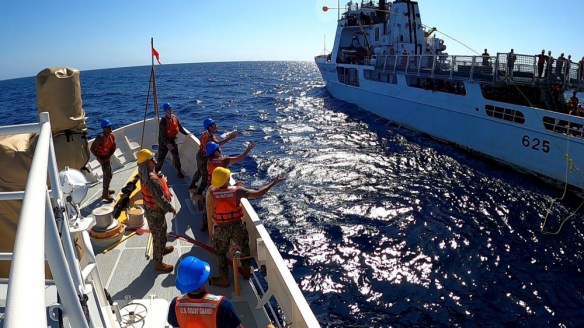
ATLANTIC OCEAN (Feb. 23, 2021) — USCGC Charles Moulthrope (WPC 1141) conducted Astern Refueling at Sea training with the USCGC Venturous (WMEC 625). This evolution provides vital fuel to extend the endurance and range of FRC and provided an excellent training opportunity for both crews. (U.S. Coast Guard photo by Petty Officer 1st Class Sydney Niemi/Released)

US Naval Institute Proceedings has an essay that was chosen as third place winner in their “Midshipmen & Cadets Essay Contest,” written by now Ensign Logan Tobias. He contends, “The U.S. Coast Guard Academy is failing as a commissioning source for future leaders in the maritime domain. “

He suggests that the Academy has prioritized academics over professional training, and further that it is failing to graduate officers with “a love for the sea.” He also suggest that the class ranking system (military precedence average (MPA) calculation) which is weighted to consider suitability for service or military performance (MPI) as only 25% of the total undermines professional development.

 The MPA formula ensures academics always take precedence even though it is widely understood that MPI better encapsulates what it means to be an effective officer. In fact, a study commissioned by the U.S. Military Academy demonstrated that the correlation between academic success and officer effectiveness “did not demonstrate a very high relationship.”

Pointing out that academic performance and leadership do not necessarily go hand in hand he suggests, an evaluative prioritization shift to 55 percent GPA, 40 percent MPI, 5 percent PDC will help cadets reassess their priorities, allowing them to pursue opportunities for professional development not as a tradeoff for MPA points, but to advance both their personal readiness and class rank at the same time.

It does seem like sea-going experience is taking a hit.

In total, cadets accumulate approximately 140 sea days before graduation: 6-weeks on board the USCGC Barque Eagle (WIX-327) during third-class summer, three weeks on board 44-foot sailing yachts during second-class summer, and 11-weeks on board a cutter during first-class summer. However, this practicum is of questionable efficacy, as sailing a yacht to Nantucket is only tenuously related to conning a Coast Guard cutter. Moreover, many first class go to drydocked cutters, never leaving the pier, or only go underway for 6 weeks rather than 11, opting instead for internships and air stations. In summer 2021, more than one third of first-class cadets were assigned to internships or air stations. This apportionment helped contribute to 42 percent of the class not having enough sea time to earn a 100-ton license as of November 2021.

Forgive me, I am going to indulge in a bit of “back in my day,” even though it was long, long ago in a galaxie far, far away.  

My class and those of that now ancient era had an organized training cruise every year.  Newly arrived “swabs” (4th class/freshmen) capped swab summer with a short two week cruise that also included the 2nd class cadets.  3rd class and 1st class cadet had a 10 week cruise. That is 24 weeks afloat compared to the current 20 weeks but there were other significant differences. Even then there were some departures from this typical schedule but these were normally only available to second and first class cadets.

First, we all knew our first assignment would be afloat, so it focused the mind.

The 10 week cruises were organized as a training squadron of several ships whose only mission was training cadets. None of them were tied up in port except for scheduled short port calls.

Academy officers were assigned to the ships to coordinate cadet training with the ships.

The first class cadets began to learn officer duties, OOD, CIC, Navigator, Damage Control and Engineering.

Perhaps most importantly, the third class cadets would stand watches with enlisted sailors as messenger, helm, BMOW, evaporator watch, generators, main prop, mess cook, radarman, quartermaster, etc. We lived in enlisted berthing and eat on the messdeck. We would lower and raise boats and served in the boat crews in different positions. We manned and fired the 5″ gun. We did man overboard drills. We laid out the hawser and did towing drills, towing and being towed. We worked maneuvering board solutions for stationing problems, learning a lot about relative motion. This gave us a good understanding of what we could and should expect of our enlisted personnel. This is something you don’t get on Eagle or on a 44 sloop.

That third class year long cruise may be the most important thing missing now. Being part of a good crew is a great part of the allure of sea duty. That cruise gave us a taste of that.

Bottom line, if the academy does not provide better trained and better motivated Coast Guard officers than other sources, it has no need to exist.

The author may be wrong in his assessment. Current requirement may make it impossible to train everyone to be ship drivers or marine engineers, but the background does provide a degree of credibility for marine inspectors and a better understanding for our aviators. I would think, at least for the first two summers’ training would strongly emphasize an afloat career path.