US Capital West Side, by Martin Falbisoner
Congress has completed action on the Coast Guard Authorization Bill and forwarded it to the President. Note this is an authorization, not a budget. Frequently the budget does not include everything authorized.
An aside: Only our Congress would call the US Coast Guard Authorization bill, “S.140 – A bill to amend the White Mountain Apache Tribe Water Rights Quantification Act of 2010 to clarify the use of amounts in the WMAT Settlement Fund.” Its a mystery how they ever get anything done.
This is the summary of the bill as provided. I will add some more detail below.
Title I reorganizes title 14, Coast Guard, United States Code, the section of the code pertaining to the operation and administration of the U.S. Coast Guard. This section of the code was last reorganized in 1949, and this action will make it easier for the public and the Congress to find the governing laws of the Coast Guard.
Title II authorizes funds for the Coast Guard in fiscal years 2018 and 2019 to provide support for Coast Guard personnel, as well as asset acquisition programs.
Title III makes several changes to laws governing the Coast Guard. It improves training competencies, promotes the use of unmanned technology, and enhances accountability in acquisitions.
Title IV codifies port safety and security together in one chapter of the code.
Title V makes changes to several shipping and navigation laws to improve maritime safety and enhance the efficiency of the maritime transportation system.
Title VI standardizes the rules governing the operations of the Coast Guard’s eight national advisory committees, and authorizes each committee for ten years.
Title VII authorizes funds for the Federal Maritime Commission for fiscal years 2018 and 2019, and amends the Ocean Shipping Act to restrict or prohibit the ability of international shipping alliances from negotiating collectively with U.S. port services providers, unreasonably reducing competition for port services, and participating in multiple agreements that magnify the impact of the use maritime anti-trust exemptions.
Title VIII includes miscellaneous provisions, including a National Academy of Sciences review of existing and emerging unmanned, autonomous, or remotely controlled maritime domain awareness technologies and recommendations on how these technologies can assist the Coast Guard in its mission performance and in more effectively and efficiently allocating its vessels, aircraft, and personnel.
Title IX establishes a regulatory regime to govern discharges incidental to the operation of vessels.
Title X reauthorizes the Hydrographic Services Improvement Act of 1998.
Below are some of the more significant items I found looking through the Senate response to the House version of the Coast Guard authorization bill which was subsequently accepted by the House and forwarded to the President. All references are to that document.
- For the operation and maintenance of the Coast Guard, not otherwise provided for, $7,914,195,000 for fiscal year 2019.
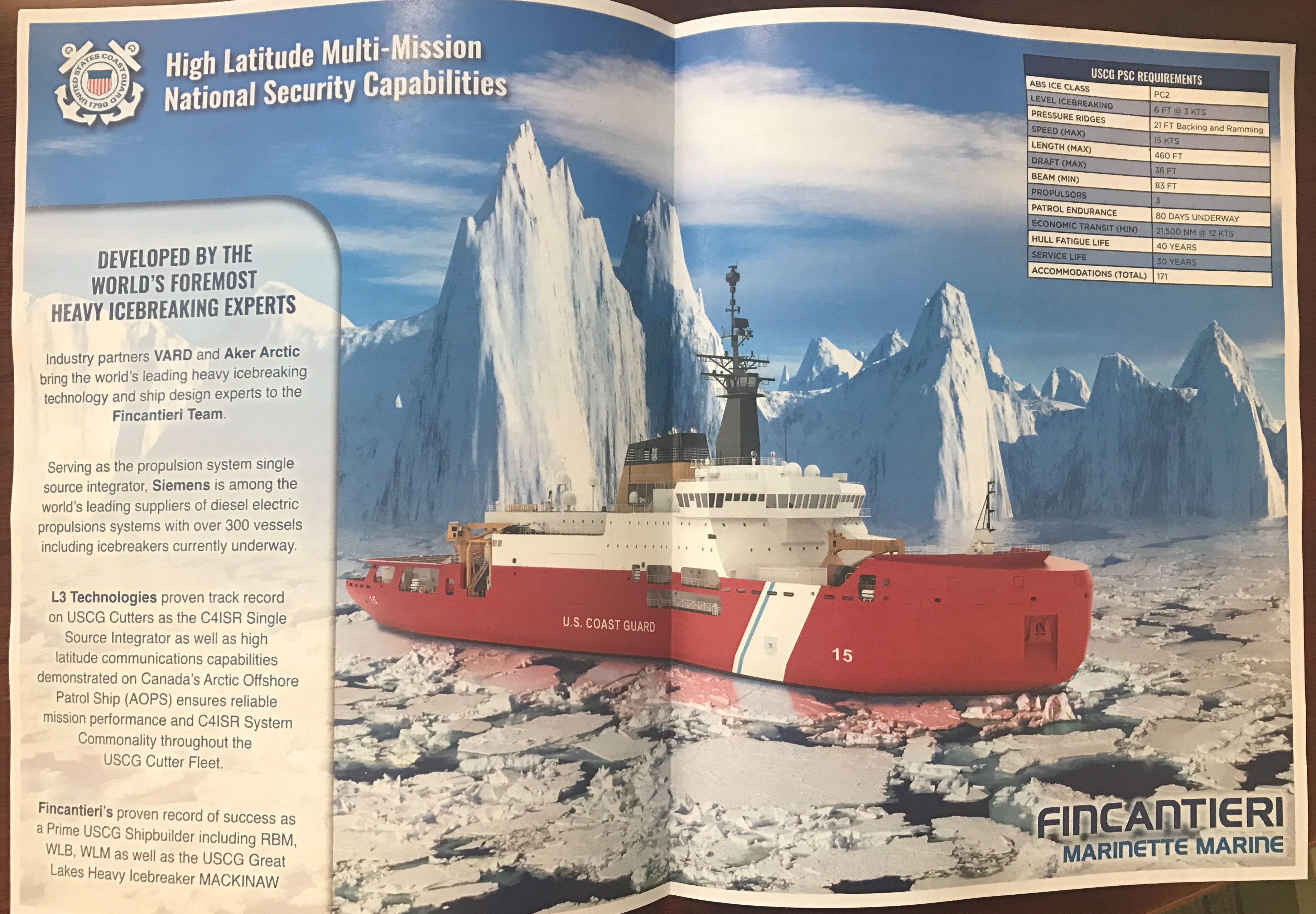
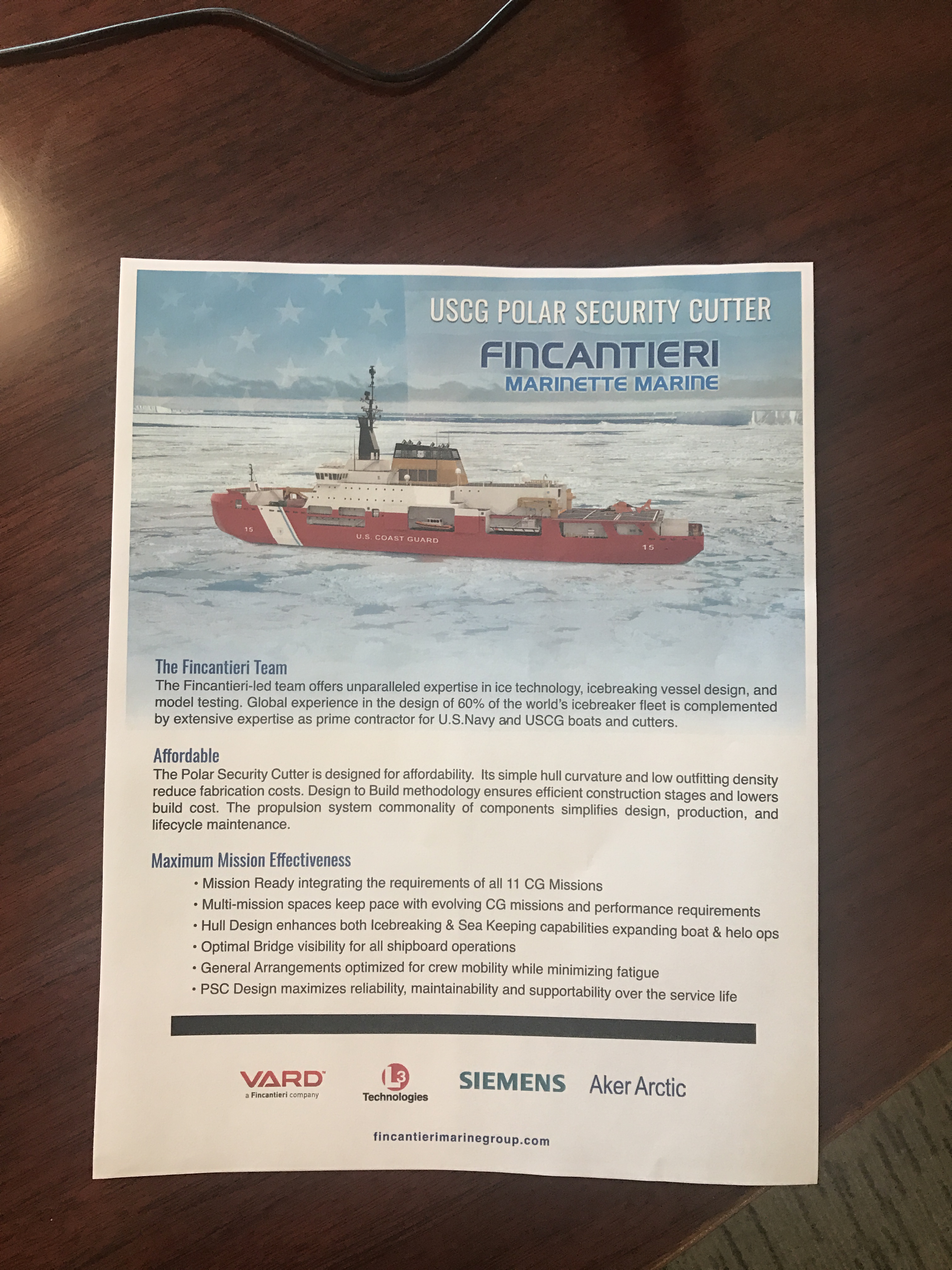
- For the procurement, construction, renovation, and improvement of aids to navigation, shore facilities, vessels, aircraft, and systems, including equipment related thereto, and for maintenance, rehabilitation, lease, and operation of facilities and equipment, $2,694,745,000 for fiscal year 2019. This appears to be enough to include the requested $750M for the first Polar Security Cutter and long lead time items for the second, but the Polar Security Cutter is not mentioned anywhere in the bill. Other specific Shipbuilding is also not mentioned.
Section 204, on page 71 authorizes six additional Fast Response Cutter, over and above the 58 in the program of record, three in FY2018 and three in FY2019.
Section ‘‘§1137. Contracting for major acquisitions programs” on page 86 specifically authorizes Block Buys as an approved method of contracting.
Page 87 beginning at line 20
(f) MULTIYEAR CONTRACTS.—The Secretary of the department in which the Coast Guard is operating is authorized to enter into a multiyear contract for the procurement of a tenth, eleventh, and twelfth National Security Cutter and associated government-furnished equipment.
There is also a requirement that the Commandant submit a prioritized “Unfunded Priorities” List within 60 days of budget approval. Beginning p235
SEC. 818. NATIONAL SECURITY CUTTER. 6 (a) STANDARD METHOD FOR TRACKING.—The Commandant of the Coast Guard may not certify an eighth National Security Cutter as Ready for Operations before the date on which the Commandant provides to the Committee on Transportation and Infrastructure of the House of Representatives and the Committee on Commerce, Science, and Transportation of the Senate— (1) a notification of a new standard method for tracking operational employment of Coast Guard major cutters that does not include time during which such a cutter is away from its homeport for maintenance or repair; and (2) a report analyzing cost and performance for different approaches to achieving varied levels of operational employment using the standard method required by paragraph (1) that, at a minimum— (A) compares over a 30-year period the average annualized baseline cost and performances for a certified National Security Cutter that operated for 185 days away from homeport or an equivalent alternative measure of operational tempo— (i) against the cost of a 15 percent increase in days away from homeport or an equivalent alternative measure of operational tempo for a National Security Cutter; and (ii) against the cost of the acquisition and operation of an additional National 10 Security Cutter; and (B) examines the optimal level of operational employment of National Security Cutters to balance National Security Cutter cost and mission performance.
Looks like there is a requirement to revisit the Fleet Mix Study. Beginning on page 232.
SEC. 817. FLEET REQUIREMENTS ASSESSMENT AND STRATEGY. (a) REPORT.—Not later than 1 year after the date of enactment of this Act, the Secretary of the department in which the Coast Guard is operating, in consultation with interested Federal and non-Federal stakeholders, shall submit to the Committee on Commerce, Science, and Transportation of the Senate and the Committee on Transportation and Infrastructure of the House of Representatives a report including— (1) an assessment of Coast Guard at-sea operational fleet requirements to support its statutory missions established in the Homeland Security Act of 2002 (6 U.S.C. 101 et seq.); and (2) a strategic plan for meeting the requirements identified under paragraph (1). (b) CONTENTS.—The report under subsection (a) shall include— (1) an assessment of— (A) the extent to which the Coast Guard at- sea operational fleet requirements referred to in subsection (a)(1) are currently being met; (B) the Coast Guard’s current fleet, its operational lifespan, and how the anticipated changes in the age and distribution of vessels in the fleet will impact the ability to meet at-sea operational requirements; (C) fleet operations and recommended improvements to minimize costs and extend operational vessel life spans; and (D) the number of Fast Response Cutters, Offshore Patrol Cutters, and National Security Cutters needed to meet at-sea operational requirements as compared to planned acquisitions under the current programs of record; (2) an analysis of— (A) how the Coast Guard at-sea operational fleet requirements are currently met, including the use of the Coast Guard’s current cutter fleet, agreements with partners, chartered vessels, and unmanned vehicle technology; and (B) whether existing and planned cutter programs of record (including the Fast Response Cutter, Offshore Patrol Cutter, and National Security Cutter) will enable the Coast Guard to meet at-sea operational requirements; and (3) a description of— acquisition; and (B) how such acquisitions will change the extent to which the Coast Guard at-sea operational requirements are met.
They are apparently serious about building another Great Lakes icebreaker. Beginning page 238.
SEC. 820. GREAT LAKES ICEBREAKER ACQUISITION. (a) ICEBREAKING ON THE GREAT LAKES.—For fiscal years 2018 and 2019, the Commandant of the Coast Guard may use funds made available pursuant to section 4902 of title 14, United States Code, as amended by this Act, for the construction of an icebreaker that is at least as capable as the Coast Guard Cutter Mackinaw to enhance icebreaking capacity on the Great Lakes. (b) ACQUISITION PLAN.—Not later than 45 days after the date of enactment of this Act, the Commandant shall submit a plan to the Committee on Commerce, Science, and Transportation of the Senate and the Committee on Transportation and Infrastructure of the House of Representatives for acquiring an icebreaker described in subsections (a) and (b). Such plan shall include— (1) the details and schedule of the acquisition activities to be completed; and (2) a description of how the funding for Coast Guard acquisition, construction, and improvements that was appropriated under the Consolidated Appropriations Act, 2017 (Public Law 115–31) will be allocated to support the acquisition activities referred to 7 in paragraph (1).
There is also a requirement for study of Strategic assets in the Arctic that might be included in a new Fleet Mix Study. Beginning page 242.
SEC. 822. STRATEGIC ASSETS IN THE ARCTIC. (a) DEFINITION OF ARCTIC.—In this section, the term ‘‘Arctic’’ has the meaning given the term in section 112 of the Arctic Research and Policy Act of 1984 (15 U.S.C. 16 4111). (b) SENSE OF CONGRESS.—It is the sense of Congress that— (1) the Arctic continues to grow in significance to both the national security interests and the economic prosperity of the United States; and (2) the Coast Guard must ensure it is positioned to respond to any accident, incident, or threat with appropriate assets. (c) REPORT.—Not later than 1 year after the date of enactment of this Act, the Commandant of the Coast Guard, in consultation with the Secretary of Defense and taking into consideration the Department of Defense 2016 Arctic Strategy, shall submit to the Committee on Commerce, Science, and Transportation of the Senate and the Committee on Transportation and Infrastructure of the House of Representatives a report on the progress toward implementing the strategic objectives described in the United States Coast Guard Arctic Strategy dated May 2013.
(d) CONTENTS.—The report under subsection (c) shall include— (1) a description of the Coast Guard’s progress toward each strategic objective identified in the United States Coast Guard Arctic Strategy dated May 2013; (2) an assessment of the assets and infrastructure necessary to meet the strategic objectives identified in the United States Coast Guard Arctic Strategy dated May 2013 based on factors such as— (A) response time; (B) coverage area; (C) endurance on scene; (D) presence; and (E) deterrence; (3) an analysis of the sufficiency of the distribution of National Security Cutters, Offshore Patrol Cutters, and Fast Response Cutters both stationed in various Alaskan ports and in other locations to meet the strategic objectives identified in the United States Coast Guard Arctic Strategy, dated May 2013; (4) plans to provide communications throughout the entire Coastal Western Alaska Captain of the Port zone to improve waterway safety and mitigate close calls, collisions, and other dangerous interactions between the shipping industry and subsistence hunters; (5) plans to prevent marine casualties, when possible, by ensuring vessels avoid environmentally sensitive areas and permanent security zones; (6) an explanation of— (A) whether it is feasible to establish a vessel traffic service, using existing resources or otherwise; and (B) whether an Arctic Response Center of Expertise is necessary to address the gaps in experience, skills, equipment, resources, training, and doctrine to prepare, respond to, and recover spilled oil in the Arctic; and (7) an assessment of whether sufficient agreements are in place to ensure the Coast Guard is receiving the information it needs to carry out its responsibilities.
There is also reference to the establishment of a backup terrestrial based timing service, but it is to established through the Department of Commerce as a Public/Private cooperation and it appears that the only Coast Guard involvement will be in handing over remaining former LORAN facilities.