Mark Tempest’s EagleSpeak is one of my regular reads. He recently did a piece on people smuggling. I think the photographs alone are worth a look.
Maritime Crime Threat: People Smugglers at Sea–EagleSpeak
4

Mark Tempest’s EagleSpeak is one of my regular reads. He recently did a piece on people smuggling. I think the photographs alone are worth a look.
The Naval Institute News Service has provided a copy of “the April, 2014 version of the multi-national Conduct for Unplanned Encounters at Sea (CUES) signed by 21 Pacific nations at the 14th Western Pacific Naval Symposium in Qingdao, China. CUES is a series of non-binding rules-of-the-road to prevent an escalation of tensions between different militaries at sea.”
This is similar to the old INSEA agreement between the Soviets and the US, designed to minimize the possibility of a unintentional incident escalating into a conflict. Particularly any ships operating in the South China Sea, East China Sea, western Pacific, or even the Indian Ocean ought to spend some extra time with this document. Good to see this document emerge, it was needed. Unfortunately it will not prevent intentional provocation, but it may make a determination of accidental or intentional easier.
MarineLog is reporting the issue of the text of the GAO’s decision on the protest of the award of the OPC contract.
“Interestingly, the GAO decision includes a Coast Guard table that indicates that all five shipyards that responded to the RFP got “Superior” ratings for the soundness and mission effectiveness of the concept designs offered and also for their design approach. All were rated “Satisfactory” for organizational management and production capability. On past performance, though, differences emerged. Bollinger and Bath Iron Works were rated ‘Satisfactory,’ Eastern was rated ‘Superior,’ but both Huntington Ingalls and VT Halter got ratings of ‘Marginal.'”
Great story from the Washington Post about LCdr Joel Fisher’s role in the recovery of Nazi loot during the closing days of World War II, as told by his daughter. An unexpected bit of Coast Guard history.
gCaptain has posted news of a new propulsion system developed by Caterpillar Marine in partnership with Odense Maritime Technology (OMT) and Scandinavian Marine Group (SMG) that is claimed to be more efficient, quieter, and suitable for icebreakers and other vessels operating in severe environment, while offering maintenance advantages in terms of accessibility. A more complete view of the system is here.
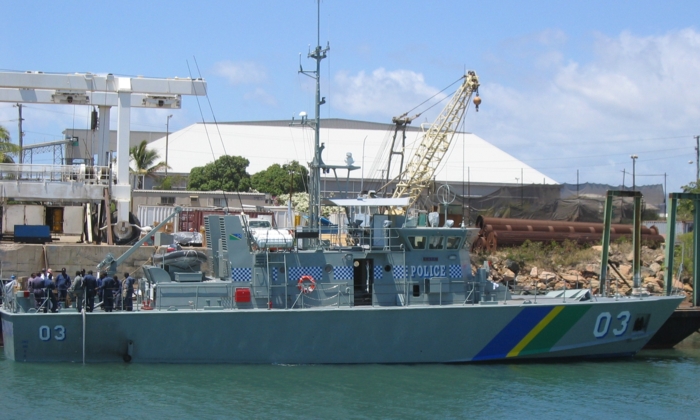
Photo credit: Angra at en.wikipedia: Royal Solomon Islands Police Vessel Lata in Townsville Harbour during a 2005 maintenance visit, one of the boats to be replaced
MarineLink is reporting that Australia is planning to reprise its earlier Pacific Patrol Boat Program of providing patrol boats to island nations in the Pacific. The Program will build over 20 steel hulled patrol boats.
“…the rugged Australian-made patrol boats are worth $594 million with through life sustainment and personnel costs estimated at $1.38 billion over 30 years.
“Replacement patrol boats will be offered to all current participating states including Papua New Guinea, Tonga, Solomon Islands, Fiji, Tuvalu, Kiribati, Samoa, Vanuatu, Federated States of Micronesia, Palau, Republic of Marshall Islands, Cook Islands and new member Timor-Leste.”
Of those 13 states the US has obligations to three of them, the Federated States of Micronesia (FSM), the Republic of the Marshall Islands (RMI) and the Republic of Palau, under the Compact of Free Association.
Characteristics of existing PPB as listed in Wikipedia:
Displacement: 162 tons full load
Length: 31.5 m (103 ft)
Beam: 8.1 m (27 ft)
Draught: 1.8 m (5.9 ft)
Propulsion: 2 Caterpillar 3516TA diesels, 2820 hp (2.1 MW), 2 shafts
Speed: 20 knots (37 km/h; 23 mph)
Range: 2,500 nautical miles @ 12 knots
Endurance: 10 days
Complement: 14-18
Furuno 1011 I band surface search radar
Given the expected price of the new patrol boats, I suspect the new boats may be larger, perhaps similar to the Australian Armidale class.
At the very least we can expect that the US Coast Guard may be involved in training for the crews of some of these boats. There is also a good possibility of cooperative operations.
Interesting short report from Russian Media about how they expect to handle emergencies in the Arctic, including the use of nuclear powered icebreakers.
Somehow this also got inserted into the article, “In April, Russian President Vladimir Putin announced a unified system of deployment for navy surface ships and new generation submarines.” so their kind of emergency may not be the kind of emergency that would first come to the USCG mind.
While this may not reflect only maritime experience, there was also an interesting admission, “According to the Russian Emergency Ministry there are more than 100 emergency situations in the Russian Arctic annually, both natural and man-made. There has been a steady increase in the number of incidents caused by humans, especially transport accidents (30%), and explosions and fires related to technical equipment (24%).”
Given the extent of Russia’s Arctic coast line they have invested heavily in icebreakers.
“Currently, Russia’s nuclear icebreaker fleet consists of four icebreakers, with two reactors each and 75,000 total horsepower (Rossiya, Sovetskiy Soyuz, Yamal and 50 Let Pobedy)(about the same power as the Polar class-Chuck), and two icebreakers, with one reactor each and 40,000 total horsepower (Taymyr and Vaygach).” (a bit less powerful than Healy-Chuck)
DefenseNews has a short interview with outgoing Commandant, Admiral Papp. Generally nothing too surprising except perhaps the statement that he wrote fitness reports for all the CG flag officers every year and followed it up with counseling, certainly an onerous if extremely important task.
Overall an interesting and relatively short read.
I think I’m going to miss Admiral Papp.
Thought I had posted about this ship earlier, but could not find it, if I did. At any rate our friend at Think Defence has done a nice write up. This class (90 meters), may be the evolutionary immediate predecessor of Eastern’s OPC proposal, being a development of the New Zealand Protector class OPV (85 meters), which was in turn a development of the Irish Róisín Class (80 meters). The Samuel Beckett class is notable for their low cost, hybrid propulsion, and small crew size.
NavyRecognition is reporting the launch of the first for a class of ships being built for the Maritime Border Guards of the Federal Security Service of the Russian Federation (FSB, successor of the KGB). The ship is similar in many respect to the projected Offshore Patrol Cutter.
Named “Ocean,” she is reportedly ice strengthened with a displacement of 2,700 tons, a speed of 20 knots, a range of 12,000 miles, and a 60 day endurance. She has a hangar and flight deck, at least two RHIBs, and a 76mm gun. Unlike previous classes used by the Maritime Boarder Guards this is not an adaptation of a Navy design.

