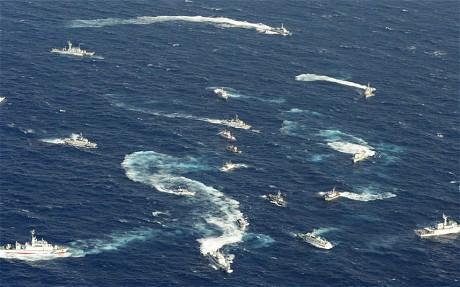
DHS Cutter Fleet Study

FierceHomlandSecuroty brought to my attention a Study by DHS (.pdf) they obtained under the Freedom of information act.

A cursory scan of the study suggest that (at 392 pages), it is a rich source of data and probably of continuing interest, so I have added it to the blog’s references page. I’ll try to give a more in depth review later. I have also added an earlier report–GAO briefing slides for Congressional Committees, April 20, 2012, “Observations on the Coast Guard’s and the Department of Homeland Security’s Fleet Studies”[PDF]

The study helps explain the apparent cancellation of NSCs #7 and 8, in that the DHS study finds very little difference in mission performance between NSCs and OPC, to justify the NSCs apparently much higher price, but it also leaves room for a revision of this decision because, they expect not building NSCs would reduce the fleet’s capabilities at least into the 2030s. The study recognized there remain many unknowns and at least to some extent recognizes the urgency of replacing the cutter fleet, so, at least to my reading, it identifies no definitive single best course of action.

Related:

Azipods, Russian Icebreaker to Get Them

Wanted to make a quick recommendation that you take a look at a post over at gCaptain. It reports that a contract has been issued for Azipods to equip a new Russian icebreaker, but it also has a good video advertisement that explains the systems and shows them in operation including the relatively new method of icebreaking by going astern and its maneuvering advantages on a very large cruise ship. If you are not already familiar with these systems, I think you’ll find it interesting.

The arrangement being used on the icebreaker is interesting, there are two 7.5 MW thrusters and a 10 MW shafted centerline unit. Total output is 25MW or 33,500 HP.

India’s Expanding CG, Soon Three Coast Guards with More Patrol Ships than the USCG

Since the terrorist attack on Mumbai in 2008, the Indians have taken their Coast Guard very seriously, acting to increase its size by 200% and working to provide enhanced Maritime Domain Awareness (MDA) and improved coordination with other agencies.

The MDA system appears to exploit relatively simple and familiar technology, including using light houses as sites for radars and electro-optic devices. (Perhaps some day we will regret disposing of all those old light houses.)

The description is here.

It looks like the Indian Coast Guard may also be on track to create a fleet of large Offshore Patrol Vessels more numerous than that of the USCG, despite the fact that their EEZ is only one fifth the size of that of the US.

With the decline in the number of USCG ships from 39 to at most 33, and perhaps as few as 22, it appears that there may soon be at least three “coast guards” with more large patrol vessels than the USCG: Japan, China, and India (Russia and S. Korea are also not far behind). Certainly China and India have large populations, but the US has a far larger Exclusive Economic Zone than any of these countries.

Size of Exclusive Economic Zone

  • China           877,019 km2 (recognized)  (Claimed: approx. 3,877,019 km2)
  • India          2,305,143 km2
  • Japan        4,479,358 km2 (including some significant disputed areas and areas jointly administered with S. Korea)
  • USA         11,351,000 km2

Each of these organization is organized differently and has different missions, but in general the USCG has the broadest array of responsibilities.

In terms of personnel, the Japanese Coast Guard is less than a third the size of the USCG but they already have more large patrol vessels than the USCG (52), including some that are much larger than even the Bertholf Class. They do have fewer aircraft (73).

There is a Chinese Coast Guard, but it is only one of at least five agencies that do “coast guard” missions. Taken together their personnel far out number the USCG, and their number of ships is rapidly increasing (more here). If they don’t have 40 large patrol ships already they soon will.

India’s Coast Guard is also relatively young. It also seems to be the most closely aligned with its Navy counterparts, being part of the Defense Ministry. Their aviation branch is also smaller than the USCG’s but it is expanding. If their current plans reach fruition, they will have more large cutters than the USCG by 2027.

Do these nations recognize a reality we do not?

Related: “Indian CG Building Ships, Buying Helos, Domain Awareness,” “India on the Challenges of Guarding the Coast

Remembering SM1 Douglas Munro

File:Munro.jpg

US Coast Guard photograph

Today is the 70th anniversary of the death of SM1 Douglas Munro, who died saving 250 Marines from almost certain death, on an isolated beach, on an infamous killing ground called Guadalcanal.

Most all of us who have served in the Coast Guard have heard the story. For background there is also the story of the unit he was part of, NOB Cactus.

I find myself asking again, will there be a Cutter Munro? It was to have been the seventh National Security Cutter, but it has been deferred indefinitely. I still feel, naming the first OPC for our Medal of Honor winner, and giving his name to the entire class, would be most appropriate.

Request for Proposal Issued for Offshore Patrol Cutter

The Acquisition Directorate (CG-9) has announce release of the Request for Proposal for the phase one of the Offshore Patrol Cutter Procurement.http://www.uscg.mil/hq/cg9/newsroom/updates/opc092512.asp

“This is the final Request for Proposal (RFP) for the United States Coast Guard’s requirement for Preliminary & Contract Design (P&CD), Detail Design (DD), and construction of up to 11 Offshore Patrol Cutters (OPC).”

Responses are due by 10 January, 2013.

CG-9 listed eight interested shipyards as of July 2012. These included Bath Iron Works, Bollinger, Eastern Shipbuilding, Huntington Ingalls Industries, Marinette Marine, NASSCO, Vigor shipyards, and VT Halter Marine.

My last update on the status of the project which goes into some depth can be found here.

Webber Class FRCs, Multiyear Procurement in the Future?

File:Proposed modification to the Damen Stan patrol vessel for the USCG.jpg

MarineLog and gCaptain have both recently reported that the Coast Guard has exercised an option for six more Webber class Fast Response Cutters. These will be units 13 through 18 of the class. These are, I believe, all from FY2012 money. The Coast Guard had intended to defer ordering two of these to combine them with two being requested in FY2013 to keep the shipyard working at a consistent minimally sustainable rate of four units per year. That may be what they end up doing anyway, delivering one boat every three months.

I thought it was about time to review the status of the Fast Response Cutter project and look at the future. Where are we and where are we going with this project?

Phase One:

The third vessel of the class, William Flores (WPC-1103), was delivered to the Coast Guard August 17th, and is expected to be commissioned in November. If boats are delivered at three month intervals, the last of the FY2012 boats will be delivered May of 2016. If instead, the shipyard immediately begins to deliver boats at the two month interval they should be capable of, the 18th boat will deliver in February 2015.

The existing contract included options for up to 34 vessels, but because all options were not exercised, the maximum number that can be built under the existing contract would be 30. Two option years remain, FY 2013 and 2014, but because of funding difficulties, it appears unlikely that options will be exercised for all twelve units remaining in the existing contract. The FY2013 budget request included only two vessels, rather than the six that would be provided under full rate production.

So, there will be a second phase procurement aimed at building at least 28 vessels and probably more, perhaps as many as 36, if only two are funded in FY 2013 and two in 2014.

The DHS Inspector General has raised some questions about the progress of the Fast Response Cutter Program. The report faults the Coast guard for accelerating production before the completion of operational test and evaluation, which is not expected to be completed until March 2013. Considering that the program was well behind schedule in terms of replacing 110s, some urgency appears justified. Risk areas the DHS IG pointed out were the stern launching system for the ship’s boat, and that “the service has not verified that the FRC is capable of stowing all its gear.” Since the boat launch arrangement follows that used successfully on the last of the Navy’s Cyclone class PCs, and the vessels have much more volume than the 110s they replaced, it seems unlikely either of these is going to be a real problem.

Phase Two:

In October 2011 the Acquisition Directorate, CG-9, had already begun market research (pdf) for the second phase procurement of Fast Response Cutters that is expected to be awarded in FY2015. I am hoping the Coast Guard will seek Congressional approval to make this a “Multiyear Procurement” as defined here:

“Multiyear Procurement (MYP) and Block Buy Contracting in Defense Acquisition: Background and Issues for Congress” (pdf), Congressional Research Service (CRS), Ronald O’Rourke and Moshe Swartz, June 27, 2012 (Sorry you will need to copy and paste: http://www.fas.org/sgp/crs/natsec/R41909.pdf)

These types of contracts originated in the DOD, but have now been extended to other branches as well. The FRC project seems to meet all the requirements for this type of procurement. This is different from what was done in phase one, which was an annual contract with options for future years. A multiyear procurement offers the Coast Guard at least three possible advantages.

  • Savings as a result of the longer term of the contract,
  • Savings as a result of increased competitiveness in the contract award, and
  • Long term commitment by the Congress and Administration.

The longer term of these contracts, which can commit the government for up to five years, frequently means increased efficiency which can be passed along to the government. The CRS report identifies two primary reasons for the increased efficiency:

  • Contractor can optimize their workforce and production facilities.
  • Long-leadtime components can be procured in Economic order quantity (EOQ)

While it is difficult to know the true savings these advantages offer, they are estimated to be several percentage points.

“Compared with estimated costs under annual contracting, estimated savings for programs being proposed for MYP have ranged from less than 5% to more than 15%, depending on the particulars of the program in question, with many estimates falling in the range of 5% to 10%. In practice, actual savings from using MYP rather than annual contracting can be difficult to observe or verify because of cost growth during the execution of the contract due to changes in the program independent of the use of MYP rather than annual contracting.”

In February 2012, the Coast Guard exercised a $27.2M option to purchase the “Procurement and Data License Package” for the Webber class Fast Response Cutters, so when it is time to award phase two, the Coast Guard can allow other shipyards to bid to build follow-on ships of the same class.

If we don’t go to a multiyear procurement, the current contractor, Bollinger, will certainly have a massive advantage in an annual award process. Awarding a multiyear contract could go a long way toward leveling the playing field, in that other shipyards would see the benefit  in optimizing their facilities for the larger contract.

And last, but by no means least, this strategy would commit the Congress and the Administration to a constant, long term support of the program that is mature and obviously needed.

DC Chapter of CPO Association Asks Your Help to Restore Monument to WWI Dead

In response to my earlier post about the Seneca and Tampa, It was brought to my attention that the Washington, DC Chapter of the Chief Petty Officers Association has taken up the challenge to refurbish the 85 years old monument on Coast Guard Hill in Arlington National Cemetery. They hope to have the first phase, the upper marble portion, completed for Veterans Day this year, with the second phase completed to coincide with the 85th anniversary of its dedication on May 23, 2013. Total project is approximately  $95,000. 

I don’t think they would mind if I quote their site (http://wdccpoa.org/restoration/), so here goes:

U.S. Coast Guard Memorial Restoration

The Chief Petty Officer’s Association (CPOA) needs your help to restore the U.S. Coast Guard Memorial in Arlington National Cemetery. Members of the CPOA Washington D.C. have conducted basic maintenance on the memorial to keep it clean and presentable.

However, time and the elements have taken their toll on this historic monument dedicated to Coast Guardsmen lost during World War I.  It will need significant structural and cosmetic repairs to return the monument to its former glory, and ensure it remains so well into the 22nd century.

We are prohibited from using Coast Guard money to pay for this restoration. So we need support from the public, shipmates, family and friends to fund this important effort.  Even though the memorial is dedicated to those lost during World War I, the memorial also serves as a reminder to everyone who visits our nation’s most prominent national cemetery of all the sacrifices made by Coast Guardsmen during war and peace. We must raise more than $95,000 dollars to conduct the repairs and provide ongoing maintenance to the structure. We can only do this with your help.

A message from our president.

Dear Shipmates, Coast Guard Family & Friends,
Thank you for visiting RESTORATION 2012, the DC-CPOA’s initiative to raise $95,000 to restore the U.S. Coast Guard  Memorial at Arlington National Cemetery. Since becoming President of the DC Chapter of the CPOA I have had the distinct privilege and honor to engage in several events on Coast Guard Hill – with my fellow shipmates, my family, and the entire Coast Guard family.

Through our annual Flags Across America events, I’ve had the opportunity to help maintain the monument and participate in honoring our fallen shipmates. For me, each visit serves as a reminder that although many of our shipmates have been lost, there are many more left to carry on the traditions and memories of “Standing the Watch.”

I am honored to work on RESTORATION 2012 and engage all of you to help us rebuild and restore this great monument to our fallen. In the Coast Guard we are known for our team work and heroic acts; I am confident that we will once again pull together to reach this important goal. Every contribution counts and I ask you to send your donation today.

Thank you for your generosity. Semper Paratus!

Jon Ostrowski, BMCS, USCG

President, Washington D.C. Chapter, Chief Petty Officer’s Association

Please send donation checks to:

Washington D.C. Chapter

Chief Petty Officer’s Association

P.O. Box 70105

Washington, DC 20024

Or


Unconventional Contender for the Offshore Patrol Cutter

http://www.flickr.com/photos/73614187@N03/8003937595/

The first conceptual design for the Offshore Patrol Cutter (OPC) by an American shipbuilder since the demise of the Deepwater program has surfaced, and it is unconventional. Vigor Industrial proposes using the Ulstein X-bow. gCaptain brings us the story.

The proposal is 328 foot long and has a 54 foot beam. More info here.

The information available does not include maximum speed or the configuration of the propulsion systems. On the video it is clear that it has a drop down trainable thruster under the bow, and it appears it may have a single conventional shaft.

It is also unclear if the ship can hangar an H-60.

I like the boat hangar idea, in that it provides some of the flexibility of a reconfigurable space that might be able to use some of the systems being created for the LCS.