The Cutter Jarvis is to be decommissioned on Oct. 2. Anyone know what will happen to her?

Photo: US Coast Guard

The Cutter Jarvis is to be decommissioned on Oct. 2. Anyone know what will happen to her?
Photo: US Coast Guard
Up to six Chinese law enforcement agency vessels, roughly analogous to Coast Guard Cutters, have entered the territorial waters of islands administered by Japan, and Japanese Coast Guard Cutters responded. It does not look like the disagreement is going to go away quietly. Anti-Japanese anger is being nurtured in China. Both China and Japan are preparing for a leadership change, and no one wants to look weak.
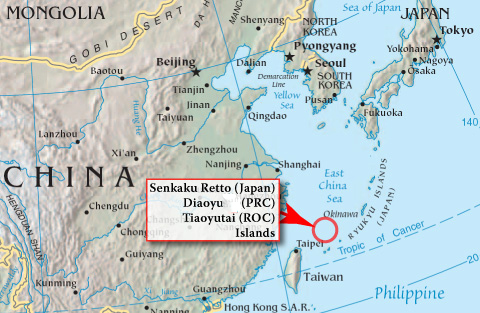
Illustration: from CIA map
A good summary of events is here. A second source indicates the Chinese have “1,000” fishing vessels en route.
“And, whether we like it or not, Washington is involved.“
The Chinese have taken an additional step and filed a claim on the islands with the UN describing its interpretation of where the baselines are drawn and enacted a national law that,
“prohibits foreign warships and vessels from entering the waters around the Diaoyu Islands without permission from the Chinese government.”
This seems to reflect China’s broader interpretation of the ability of a state to restrict access to its EEZ.
If the situation were not complicated enough, don’t forget there is a third party here, who are also inserting themselves in the mix. Taiwan also claims these islands and have also sent their Coast Guard into the area.
Photos of some of the players here.
gCaptain has a report on a proposed new bridge configuration from shipbuilder Ulstein–very futuristic. I liked the chairs.
We may some day get to the point we don’t actually look outside anymore. We might use enhanced synthetic vision that can provides a close up view of what other vessels are doing, annotated with ID, course, speed and CPA (closest point of approach), along with other information retrievable from a data base.
I’m sure there are better ergonomic options that what we are doing today, but sometimes too many options for presentation can lead to confusion. The Ulstein Vision reminded me of the BMW “iDrive” which has gotten a lot of criticism, apparently because it is too unconventional.
Looking at the huge expanses of glass in the animation, I remembered two of my ships that had survived WWII. Their pilot houses were dark with only relatively small round ports. The 327 had not always been that way. When built, like all cutters built between the wars, she had had large square windows on the bridge, but with the war, ports in the hulls were plated over and the large bridge windows replaced by the much smaller round ports–providing more protection from shrapnel.
Bridge configuration is an area that probably doesn’t get as much attention as it should.
(The Navy does love acronyms)
This is the name of a Commercial Off The Shelf (COTS) based system that uses a fiber optic local area network to assemble and evaluate information from sensors, and recommend or even initiate actions to defend ships from cruise missile attack. Apparently the Navy intends to extend it in some form to all non-Aegis ship down to the Littoral Combat Ship.
Systems that have been integrated into the system include the AN/SPQ-9B radar, the AN/SLQ-32 Electronic Attack System, the NULKA missile decoy system, Mk 15 Phalanx Close-In Weapon System. If they sound familiar it may be because they are all on the National Security Cutter and may be on the Offshore Patrol cutter as well.
Defense Industry Daily reviews the program here.
Always thought this was an interesting bit of history, and in view of what is happening in the South China Sea now, perhaps instructive. Three “Cod Wars” between 1958 and 1976, it is a David vs Goliath tale of small (but ice strengthened) ships taking on a much larger and stronger force to protect their fishing industry, and ultimately winning what became the internationally recognized Exclusive Economic Zone.
The Icelandic Coast Guard used net cutters and occasionally opened fire. Ships were intentionally rammed. Ultimately Iceland won because they were needed as a base for NATO operation, otherwise it might have turned out very differently.
At least since 9/11, the Coast Guard has been talking about Maritime Domain Awareness–the ability to keep track of everything approaching our coasts. The effort has used the Automatic Identification System (AIS) which gives the position and identification of cooperating vessels, and also anticipates cooperation with the Navy’s Maritime Patrol Aircraft and Broad Area Maritime Surveillance (BAMS) system which will use large land based unmanned aircraft, in addition to the Coast Guard’s own assets.
Concurrently the US has been developing a defense against ballistic missiles. (More info here on additional effort.) If they go to the trouble and expense of doing that, then they will almost certainly also develop a defense against cruise missiles as well, since it is relatively easy to launch cruise missiles against the US from nondescript container ships. The system that is likely to be used, the Army’s JLENS, has demonstrated a capability to track even small boats.
Sounds like the pieces of a comprehensive system that the Coast Guard may be able to exploit, may be coming together.
Informationdissemination is perhaps the most influential blog addressing the US Naval policy. It has just published a piece titled “Five Points” that is remarkable in its sweep, in that it addresses Defense policy write large. It makes rather bold predictions with audacious specificity.
Four of the five points covered relate to the size of the Army, the pivot to the Pacific (more apparent then real), the pivot to Persia (more real than apparent), and the US’s failure to pay attention to its neighbors to the South.
But the most surprising to me was point four, which I quote below:
The single most important element of United States national power related to National Security in need of increasing in both size and capability lies not in the Department of Defense, nor in the Department of State, but in the US Coast Guard. China is fighting a cold war in the South China Sea using their civilian agency maritime security forces backed by the implied support of military power. Unless the US intends to get asymmetrical in dealing with these tough diplomatic issues – which is sure to create unnecessary tension in the region; the appropriate symmetrical response would be to increase the presence of the US Coast Guard around the world to engage and assist towards the quality improvement of the regional maritime security forces. Whether one looks at Africa, South America (including the US coast), or Asia – the national security solution to most state diplomatic challenges and nearly all non-state security challenges facing the global economy lies at sea, but these are not solely a naval centric challenge. If we really believe the 21st century is going to be a maritime century – and I believe this 100% – the first step is to increase the size of the Coast Guard, and that starts with doubling the size of the large, deployable National Security Cutter fleet that can be sent forward to engage with civilian agencies globally and help improve the capabilities of our partners in Africa, Asia, and South America. I am not opposed to reducing the budget of the DoD, but it only makes sense as long as the civilian agencies needed for peacetime maintenance are funded to increase their capabilities to actually maintain the peace – and that beings with expanding the US Coast Guard. The peacetime Global Fleet Station of the 21st century might be a US Navy amphibious ship in certain situations, but it should also be the National Security Cutter. The maintenance of peace is a manpower intensive, thankless security role that ALSO belongs to the civilian security agencies, not solely the DoD. It is past time the US government forwards national security of this country by recognizing this reality, and balances the reduction of DoD capabilities with an increase in US Coast Guard capabilities for the offshore engagement role the US Coast Guard has a long history of performing. This needs to start now – not later – because while today’s challenges might be piracy and illegal oil bunkering off Africa, territory disputes in the Pacific region, the global narcotics trade that is creating significant challenges off our own southern border, or the polar regions of this planet – there are several regions that are going to get more competitive sooner than later, and the offshore economy is expanding at a pace far greater than maritime security forces globally are adapting. While Mitt Romney wants to reconstitute the US Army by 100,000 and grow the US Navy, President Obama would be wise to counter by expanding the US Coast Guard – because the lesson of 10 years of war has taught us that if the objective is peace, the nation needs strong civilian security capabilities. It is time to apply the lessons of the last war towards the future being shaped.
This is well worth reading in its entirety. Mark your calenders for October 13!
Again we have reached a sad anniversary. But mariners and the Coast Guard in particular had a role. Here is a bit of the story.
The Canadian American Strategic Review is reporting the Canadian Coast Guard is considering replacing their current fleet of 23 helicopters with 24 new helicopters of two different types. They also go on to look at possible alternative replacement helicopters.
When will our own fleet need to be replaced? Unlike the ship building program, our aviation branch has a history of being relatively aggressive in seeking replacements. They promptly replaced the HH-3Fs about the time they reached 30 years of service, and they replaced the HH-52 after an even shorter service life.
Our current helicopter fleet has benefited from aggressive update programs. The H-65s were re-engined beginning in 2004 and upgrades continue to be applied.
“As of September 2012, 36 MH-65 helicopters (of approximately 100–Chuck) have completed the Discrete Segment 4 upgrades. The Coast Guard’s Aviation Logistics Center plans to upgrade 22 aircraft per year.” —source
The H-60s are also being updated
“As of August 8, 2012, 30 of 42 MH-60Ts have been upgraded with new avionics suites and Airborne Use of Force capabilities. Twenty-eight of 42 MH-60Ts also have been upgraded with enhanced electro-optic/infrared sensor systems.”–source
As the USAF has demonstrated with their B-52s, aircraft can last a long time if they are continually rebuilt and updated. Potential replacements for our existing helicopters are not markedly better than the existing models. The budget is extremely tight and is expected to remain so for decades.
Still, it does seem to take approximately ten year to procure new equipment. It may not be many years before it will be time to start looking at replacements for the HH-65 (introduced in 1985) followed by replacements for the H-60 (introduced in the early ’90s).
“Midrats” is a one hour, weekly blogradio talk show that addresses primarily naval topics. Sometimes the topics are Coast Guard related. (Episode 39 was an interview with Cdr. Westfall, then CO of the Escanaba, and the topic was the Coast Guard and Counter-Narcotics.)
This Sunday, Sept. 9, the hosts will interview Brigadier General Donald A. McGregor, the Deputy Director of Operations for Domestic Operations, Headquarters, United States Northern Command (NORTHCOM).
Because the Coast Guard has an on-going relationship with NORTHCOM for counter drug ops, disaster response, counter terrorism, and contingency planning, some of you might find it interesting. In addition there are opportunities to put questions before the guest.
The Sunday’s show will be titled Episode 140: NORTHCOM and Disaster Response.
To listen, clicking here on Sunday at 5pm (Eastern U.S.) or if you miss the live show, you can find it and previous episodes here or on iTunes.
 Chuck Hill's CG Blog