“Royal Bermuda Regiment hosts Caribbean overseas territories to improve SAR capability” –The Watch

British Overseas Territories in the Caribbean in blue. Credit: Bild der Karte:

Royal Bermuda Regiment hosts Caribbean overseas territories to improve SAR capabilities–Jan 5, 2024

Five British Overseas Territories recently took part in a two-week training session led by the United Kingdom Coast Guard and the Royal National Lifeboat Institute (RNLI), a nonprofit that trains coast guards globally, with the goal of improving the interoperability of Caribbean search and rescue (SAR) operations.

Anguilla, the British Virgin Islands, the Cayman Islands, Montserrat, and the Turks and Caicos Islands participated in water-based exercises and tabletop exercises at the Royal Bermuda Regiment’s Coast Guard headquarters in Sandys.

His Majesty’s Coastguard Cmdr. Callum Jarvis said one of the key elements of the training was to introduce new scenarios to the Caribbean coast guards.

A big part of this has been using the experiences of the guys — they’ve worked within their own organizations and had their own experiences, so we’ve been drawing those out of them but also exposing them to things that don’t happen so often, so not your usual type of cases but still a potential threat,” Callum said in a Royal Bermuda Regiment news release.

“We’ve looked at the general trend of what happens in Bermuda — lots of small leisure boats, that sort of thing — and we’ve also covered incidents with merchant vessels, for example, which guys here aren’t quite so used to. We focused on Bermuda as a location, but things can happen anywhere globally and hopefully now if there is something they’re less familiar with, they will be well prepared for it.”
The training scenarios included locating overdue vessels and setting up mayday relay protocols.

Dave Whiddon, a RNLI senior international programs manager, said, “The whole idea of our international work is to help organizations build their search and rescue capacity. We like to be able to share our expertise and knowledge, but also it’s a good opportunity for us to learn as well and bring back learning to our own organizations.”
Royal Bermuda Regiment Lance Cpl. Quinton Burgess said the value of the exercise is that he can now train others.

“They’ve been here training us to be trainers, to take the information and impart it to the rest of our teams. We’ve been doing lots of things: search and rescue coordination, search and rescue tasking, man overboard drills, docking drills, coming alongside, anchoring drills and a lot of class work as well,” said Burgess in the news release.

“These are skills that we will use and they’re also things that we will teach new recruits when they come to the Coast Guard.”

Midshipman Ericka Rockett-McBean of the Cayman Islands Coast Guard enjoyed the opportunity to learn next to crews from different jurisdictions.

“It’s nice to know and relate to people in other overseas territories.”
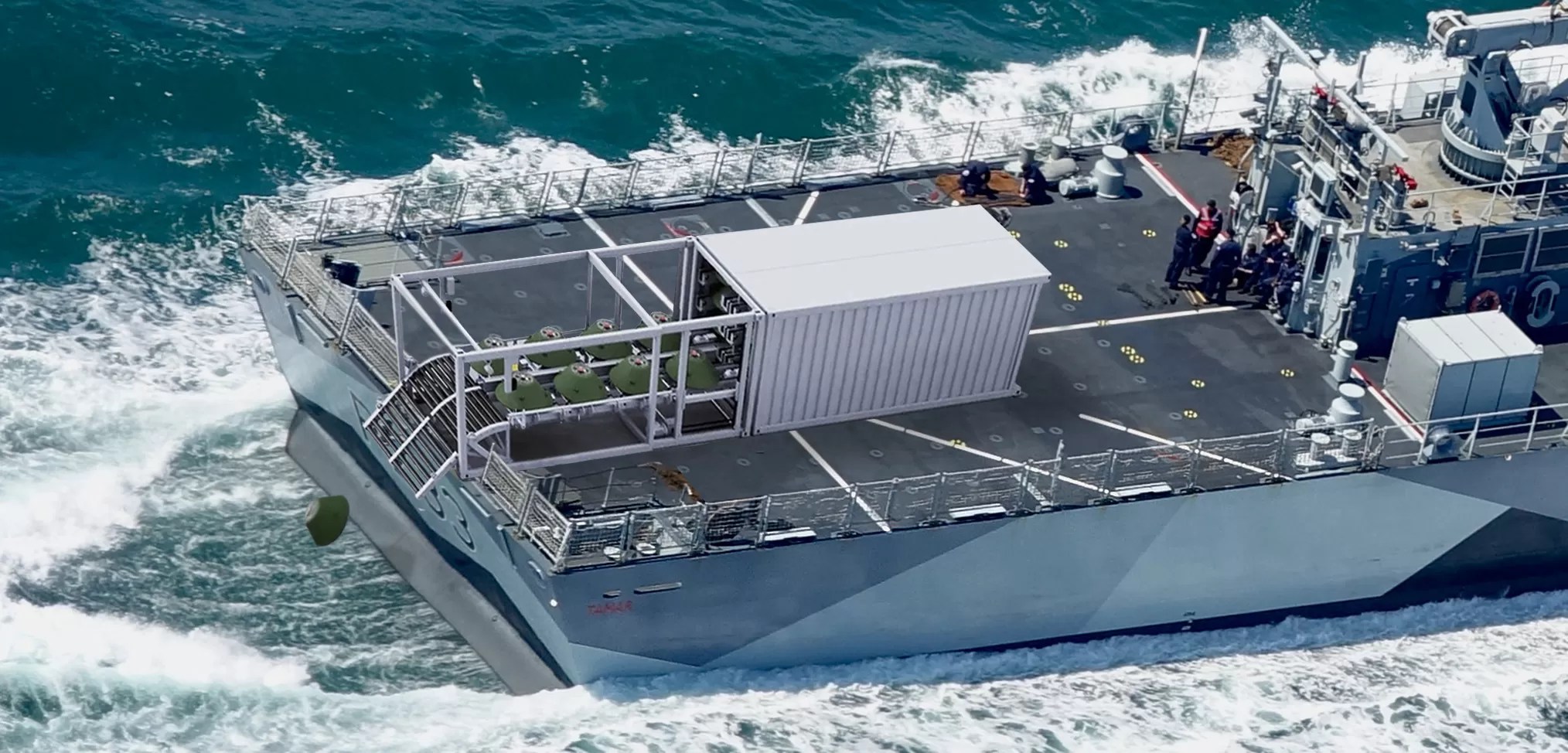
When is a Flight Deck Not a Flight Deck?

Containerized minelaying system on a River Batch 2 Offshore Patrol Vessel

It has been said that aircraft carriers are the ultimate modular warships because their primary weapons (aircraft) are interchangeable.

A flight deck on an Offshore Patrol Vessel (OPV) certainly offers a degree of aviation options. General purpose, cargo, ASW, and ASuW helicopters and a range of Unmanned Air Systems, but it appears our allies, the UK and particularly Australia may be looking at other ways to use this large open space.

Royal Navy:

Navy Lookout had a post that talked about restoring a naval mining capability in the Royal Navy. There was no specific reference to using flight decks or to Offshore Patrol Vessels.

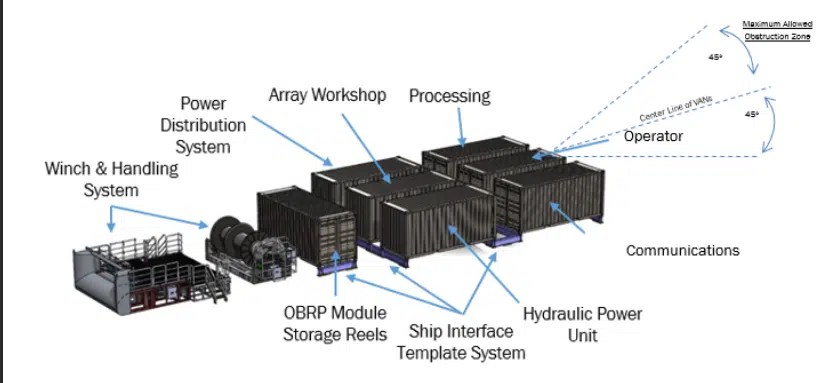
The RN does not need dedicated minelaying vessels. The SSNs have a theoretical minelaying capability but XLUUVs are a much lower risk and stealthier solution for covert and sensitive missions. Where stealth is less important, containerised minelaying solutions are being developed that can be secured to the deck and dispense mines over the stern. (emphasis applied–Chuck)

But the photo, above, definitely got my attention. There we see an SH Defence “CUBE” containerized mine laying system developed by RWM Italia S.p,A. (Rheinmetall). on the flight deck of a River Batch 2 Offshore Patrol Vessel (HMS TAMAR).

Australian Navy:

Australia is planning to produce up to 14 flight deck equipped Arafura class OPVs including two intended specifically for Mine Counter Measures (MCM). These ships were always intended to accept containerized mission loads. It appears they are now planning what these ships will do in wartime.

Missile Launcher:

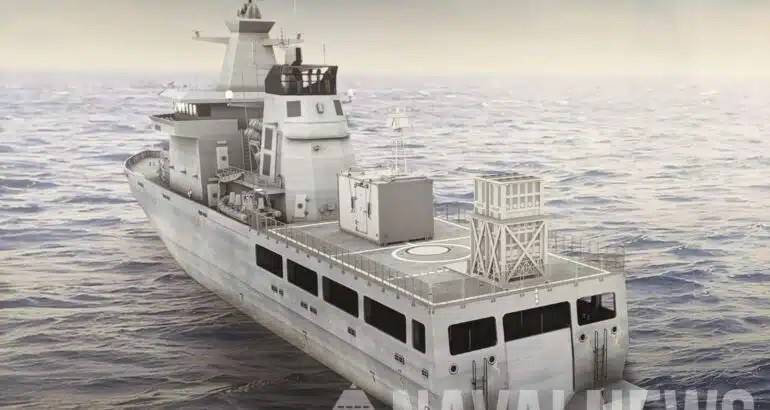
We already saw “Australia Considering Modular C-Dome For Arafura OPVs” –Naval News

Australia Considering Modular C-Dome For Arafura OPVs
Illustration of Arafura-class OPV fitted with C-DOME

Mine Layer:

As noted in the Navy Lookout, Australia is planning to buy and produce large numbers of mines. Naval News reports,

“Australia is set to accelerate the procurement of sea mines as part of Project SEA 2000…The decision to rapidly procure the capability, reportedly from a European supplier, will deliver a ‘significant’ deterrent effect according to Defence…it’s understood that the government has budgeted approximately $500 million to 1 billion Australian dollars for the acquisition…the weapons being brought are smart mines, able to disseminate between civilian vessels and a variety of military targets, allowing a strategic anchorage to be denied to hostile forces, all the while preserving access for aligned vessels(emphasis applied–Chuck)

This all points to large numbers of mines being used in defensive fields. Such minefields will almost certainly be laid by surface vessels. Australia does have some civilian crewed support ships that might be used for mine laying, but as the Arafura class comes online, they will be the most likely surface minelayers.

SURTASS-E:

SURTASS-E. (U.S Department of Defense)

Then there is these reports from Naval News and The Drive that Australia is getting SURTASS-E systems.

SURTASS-E is expected to provide long range detection and cuing for tactical weapons, against both diesel- and nuclear-powered submarines. Again, the Arafura class seems a likely host, because the system is intended for military crew manning and, unlike the civilian manned National Support Squadron ships, these ships are armed and have communication systems that include tactical data link.

Now About the Coast Guard:

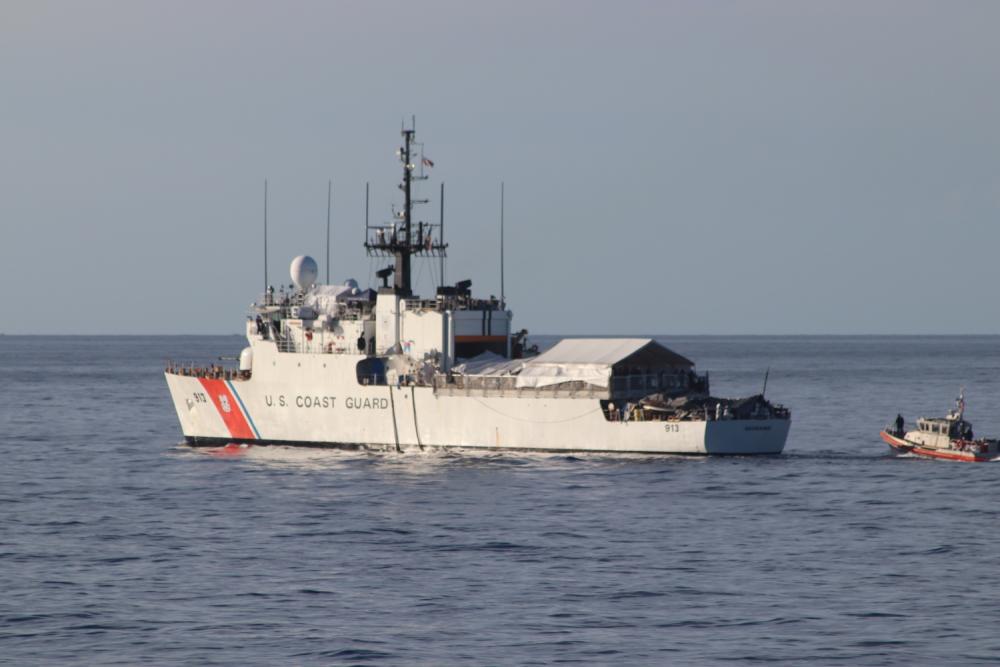
Using a flight deck for non-aviation purposes is not a foreign idea to the Coast Guard. They do it all the time to provide a holding area for migrants. 

USCGC Mohawk’s (WMEC 913) crew patrols the South Florida Straits during Operation Vigilant Sentry, Jan. 5, 2023. Mohawk’s crew patrolled the Florida Straits and Caribbean Sea in support of Homeland Security Task Force—Southeast and Operation Vigilant Sentry in the Coast Guard Seventh District’s area of operations for a 46-day patrol. (U.S. Coast Guard photo by USCGC Legare (WMEC 912)

Royal Navy Deploys Two OPVs for Five Years to No Base in Particular

We have deployed cutters to the Western Pacific for months at a time, and PATFORSWA kept its 110s operating out of Bahrain for years, but the Royal Navy seems to be doing something different and I believe remarkable.

Naval News reports they are sending a pair of River Batch II class ships, HMS Tamar and HMS Spey, well beyond the Suez. It sounds all very 18th Century Star Trek, “Our Five Year Mission, Proceed into the Indian and Pacific Oceans and act in the Queen’s Interests.” (No, not a real quote.)

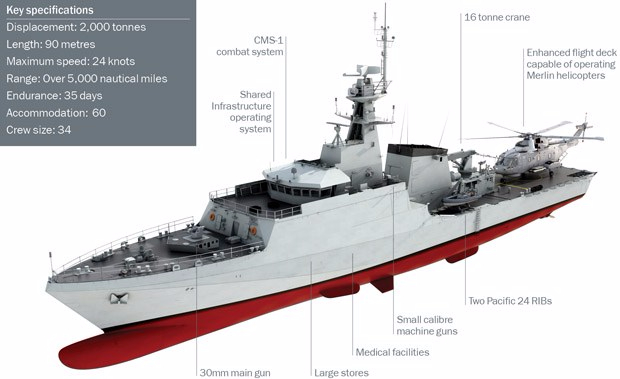
If these ships were in the US Coast Guard we would see them as MECs. They are slightly larger and faster than the 270s, but are not as well equipped in some respects. They are armed only with a 30mm gun and no helicopter hangar. I don’t believe they have any ESM/ECM. Their crew is also considerably smaller, smaller in fact than that of a 210. (I have seen various numbers for the crew size, 34 in the infographic above, 58 in Wikipedia, 46 as reported below, but all well below the 75 common on a 210 or the 100 typical of a 270.)

“Each ship is crewed by 46 sailors, with half the crew trading places with shipmates from the UK every few weeks.”

The Royal Navy actually has considerable experience keeping OPVs deployed for long periods with austere support.

We might even see one of these helping with drug interdiction in the Eastern Pacific, more likely they will be countering piracy and drug or arms trafficing in the Indian Ocean or capacity building in East Africa or SE Asia. Maybe we could make a multi-national Freedom of Navigation transit of the Taiwan Strait.