“U.S. Coast Guard announces new Robotics Mission Specialist Rating”

The Coast Guard has announced a new Robotics Mission Specialist Rating.

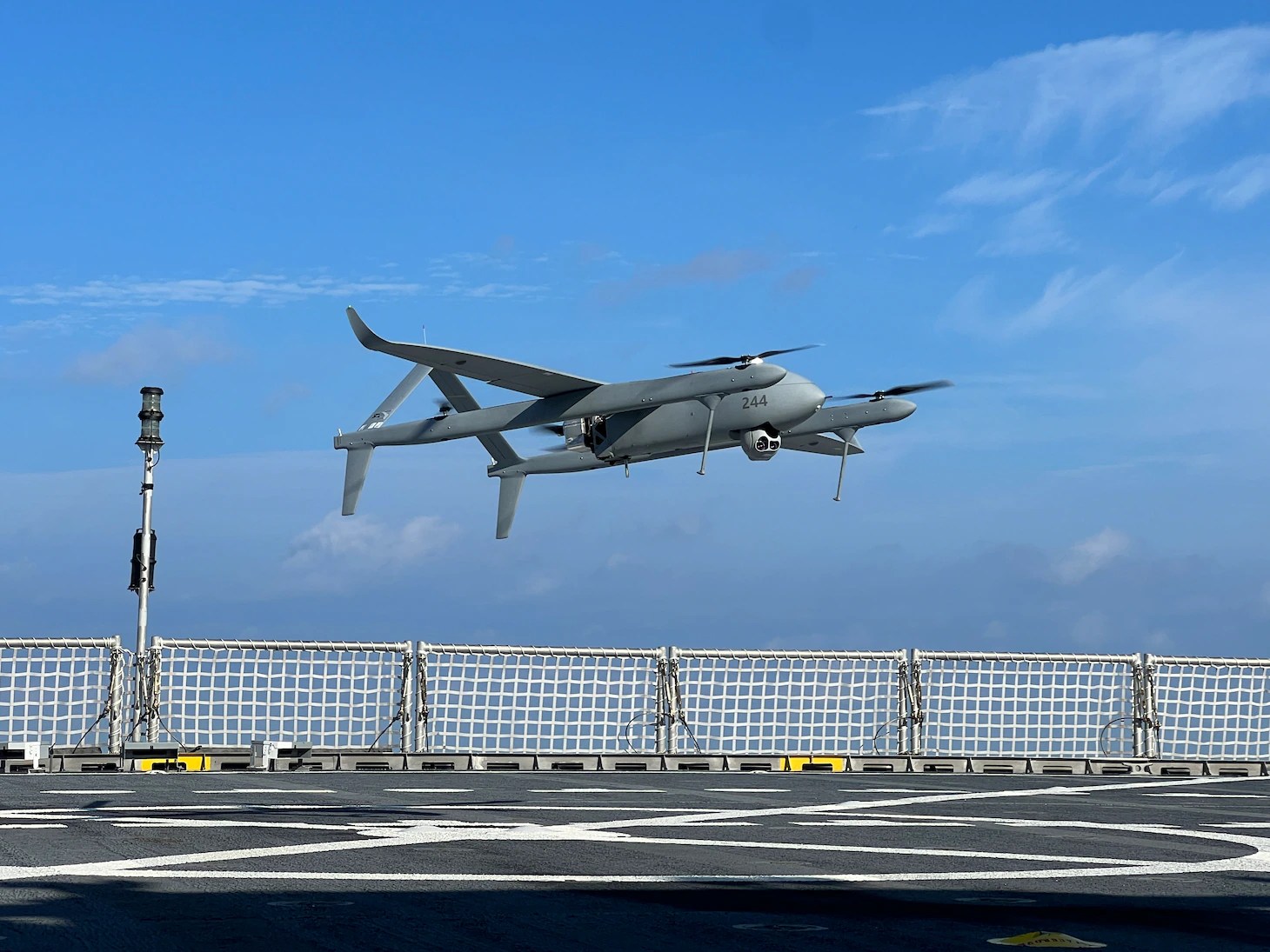
U.S. Coast Guard Adm. Kevin Lunday, Acting Commandant of the Coast Guard, and Master Chief Petty Officer of the Coast Guard Phillip Waldron announce the new Robotics Mission Specialist (RMS) rating at Coast Guard Headquarters in Washington, D.C., Nov. 12, 2025. The RMS rate will comprise enlisted robotics and autonomous system (RAS) operators, maintainers and innovators. Coast Guard RAS encompasses, but is not limited to, aerial and submersible drones, as well as unmanned surface and ground vehicles. (U.S. Coast Guard video by Petty Officer 2nd Class Gabriel Wisdom)

Below is a news release that outlines intended acquisition of robotic systems. I have added links to the news release so you can see what these systems are.


Sept. 24, 2025

Coast Guard to invest $350 million in robotics and autonomous systems

WASHINGTON — The Coast Guard announced Wednesday it will invest nearly $350 million to expand robotics and autonomous systems, strengthening mission execution and operational capabilities.

The funding, provided under the One Big Beautiful Bill Act (OBBBA), includes $11 million in fiscal year 2025 for immediate upgrades to critical autonomous systems.

Initial investments include:

These investments are the first in a series of robotics and autonomous systems projects the Coast Guard will pursue using OBBBA funding. The technologies will meet immediate mission needs, improve personnel safety and strengthen the Coast Guard’s capabilities to control, secure, and defend U.S. borders and maritime approaches.

“These unmanned systems provide increased domain awareness, mitigating risk and enhancing mission success as the Coast Guard continues to operate in hazardous environments,” said Anthony Antognoli, the Coast Guard’s first RAS program executive officer. “The Coast Guard’s mission demands agility, awareness and adaptability. Robotics and autonomous systems deliver all three, enabling us to respond faster, operate smarter and extend our reach where it matters most. We are not waiting for the future to arrive. We are delivering it to the fleet today.”

The Coast Guard’s Deployable Specialized Forces will use the new ROVs for waterfront and pier inspections, hull assessments, subsurface infrastructure surveys, disaster response and search and rescue missions. Their use will reduce reliance on Coast Guard divers, improving efficiency and safety.

Coast Guard Strike Teams, which respond to hazardous materials spills, major marine casualties, groundings, natural disasters, chemical, biological, radiological or nuclear (CBRN) incidents and national special security events, will use the new UGVs to access and sample air in confined spaces aboard commercial vessels.

The SR-UAS will support operations including infrastructure inspections, environmental observation, pollution response, post-storm surveys, ice surveys and communications.

The Program Executive Office for Robotics and Autonomous Systems is part of the Coast Guard’s Force Design 2028 plan, which aims to fully integrate capabilities across the service. Focused on four campaigns – people, organization, contracting and acquisition and technology – Force Design 2028 is an accelerated effort to establish a blueprint for change and transform the Coast Guard into a more agile, capable, and responsive force.
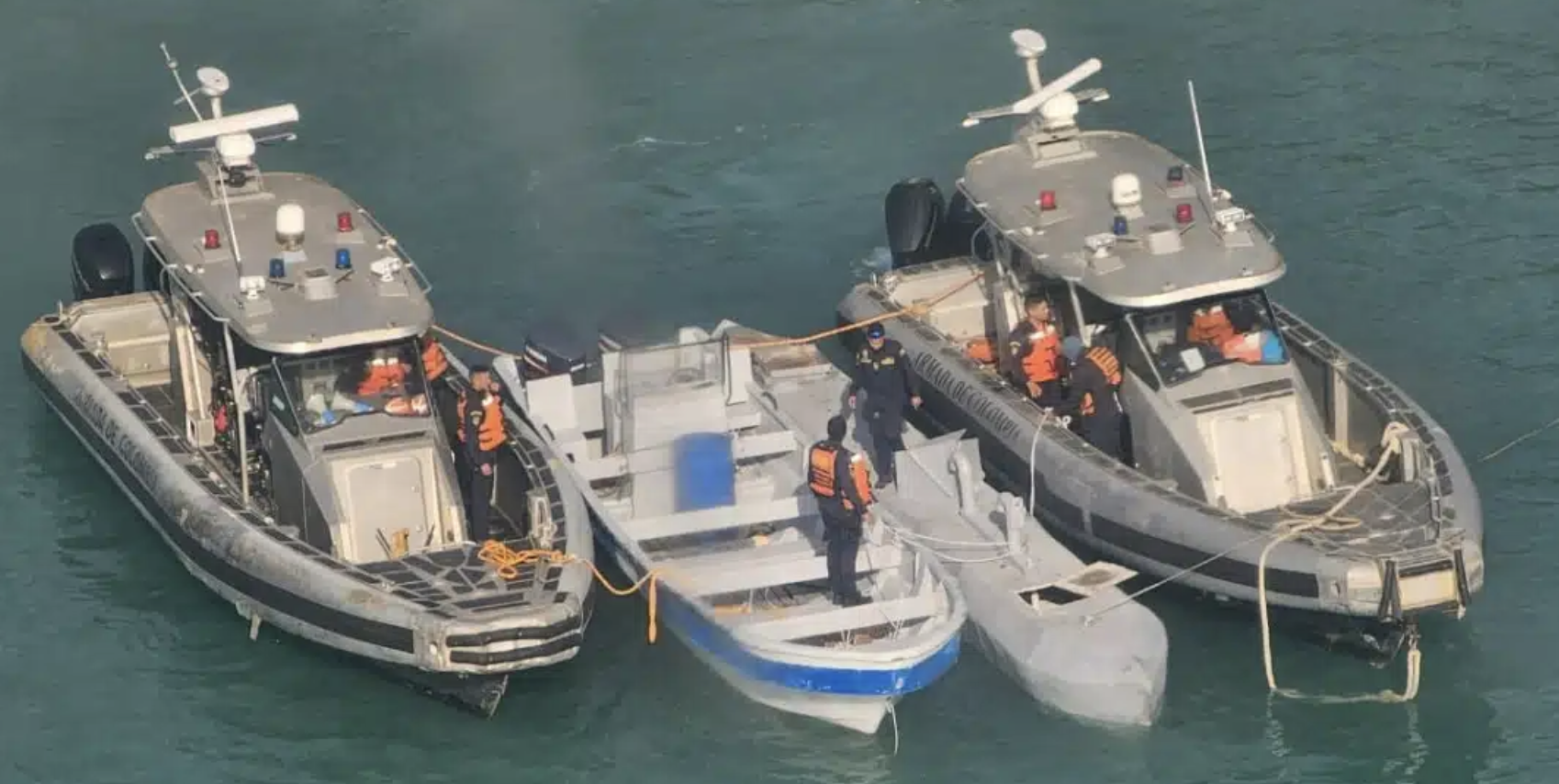
“Colombian Navy captures unmanned narco submarine in Caribbean Sea” –Naval News

Unmanned Narco-submarine seized by the Colombian Navy boats (Credit: Colombian Navy)

Naval News reports the seizure of an unmanned low profile, semi-submersible that was used to transport illegal drugs.

Not only would semi-autonomous operation eliminate the cost of hiring a crew and the space requirements for accommodations to support the crew, it would also eliminate the possibility of a captured crew becoming a source of intelligence for law enforcement.

It also means that upon boarding there is no one to tell to stop the engines, meaning boardings may be more dangerous than ever.

I would not be surprised to see a remote scuttling option incorporated into future designs.

“Operation Southern Spear: Latest Development in Operationalizing Robotic and Autonomous Systems” –4th Fleet

Commercial operators deploy Saildrone Voyager Unmanned Surface Vessels (USVs) out to sea in the initial steps of U.S. 4th Fleet’s Operation Windward Stack during a launch from Naval Air Station Key West’s Mole Pier and Truman Harbor, Sept. 13, 2023. (U.S. Navy photo by Danette Baso Silvers/Released)

Below is a news release from U.S. Naval Forces Southern Command/U.S. Fourth Fleet.

This involves the Coast Guard and the opposing forces are drug smugglers.


Jan. 27, 2025

By U.S. Naval Forces Southern Command/U.S. 4th Fleet Public Affairs

U.S. Naval Forces Southern Command/U.S. 4th Fleet is advancing the Navy’s Hybrid Fleet Campaign through Operation Southern Spear, which will start later this month in U.S. Southern Command Area of Responsibility (USSOUTHCOM AOR) and at U.S. 4th Fleet Headquarters at Naval Station Mayport.

“Southern Spear will operationalize a heterogeneous mix of Robotic and Autonomous Systems (RAS) to support the detection and monitoring of illicit trafficking while learning lessons for other theaters,” said Cmdr. Foster Edwards, 4th Fleet’s Hybrid Fleet Director. “Southern Spear will continue our (4th Fleet’s) move away from short-duration experimentation into long-duration operations that will help develop critical techniques and procedures in integrating RAS into the maritime environment.”

Specifically, Operation Southern Spear will deploy long-dwell robotic surface vessels, small robotic interceptor boats, and vertical take-off and landing robotic air vessels to the USSOUTHCOM AOR. 4th Fleet will operationalize these unmanned systems through integration with U.S. Coast Guard cutters at sea and operations centers at 4th Fleet and Joint Interagency Task Force South. Southern Spear’s results will help determine combinations of unmanned vehicles and manned forces needed to provide coordinated maritime domain awareness and conduct counternarcotics operations.

U.S. 4th Fleet is conducting Operation Southern Spear in support of our Navy’s Project 33 targets to operationalize RAS. Using RAS to increase presence in, and awareness of, strategically and economically important maritime regions will help decision-making, strengthen sovereignty, and facilitate regional cooperation.

“Operation Southern Spear is the next step in our Hybrid Fleet Campaign,” said Rear Adm. Carlos Sardiello, Commander, U.S. Naval Forces Southern Command/U.S. Fourth Fleet. “We look forward to the results of Southern Spear. Hybrid Fleet operations increase our collaboration with partners in the region while furthering the Navy’s tactics, techniques, procedures, and processes.”

U.S. Naval Forces Southern Command/U.S. 4th Fleet is the trusted maritime partner for Caribbean, Central and South America maritime forces leading to improved unity, security and stability.

“Army Cancels High-Speed Armed Reconnaissance Helicopter Program” –The WarZone

Sikorsky’s Raider X, advanced compound helicopter design (FARA prototype)

The Warzone reports,

The U.S. Army says it is cancelling its Future Attack Recon Aircraft (FARA) program which had been centered on the acquisition of a new type of high-speed armed scout helicopter. This is part of a larger restructuring the Army plans for its future fleets of helicopters and other crewed and uncrewed aircraft.

This is essentially half of the Army’s Future Vertical Lift program. The Coast Guard has been following the program in anticipation of development of vertical takeoff and landing aircraft that would offer “twice the range and twice the speed” of existing helicopter types. We might still see that in a version of the Bell V-280 for land-based operations.

Note this video is four years old, so the prototype has been flying for a long time. I have heard concern about the downwash, but if you look at the windsock visible from time 2:20, downwash does not seem to be excessive. My back of the envelope calculations suggests the overpressure directly under the rotor discuses would be about 67% higher under the V-280’s props compared to the H-60J’s rotor. That might be mitigated at the hoist pickup point because, unlike in the H-60, the props are not rotating over the fuselage of the V-280.

It does appear that the H-60s may have a new engine option in the future.

The FARA cancellation is part of what the Army is currently calling the Aviation Investment Rebalance. The service says it will delay production of the General Electric T901 turboshaft engine developed under the Improved Turbine Engine Program (ITEP), which had been heavily tied to FARA, as part of this plan. The immediate focus will now be on integrating T901s onto existing AH-64 Apache attack helicopters and UH-60 Black Hawk utility helicopters.

GE Aerospace claims, “The T901 engine provides 50% more power 25% better specific fuel consumption, and reduced life cycle costs -with fewer parts, a simpler design, and proven, reliable technology.” 

Basically, the Army has decided that Unmanned aircraft and Satellites can do the job of scouting better and cheaper, as well as safer, than a helicopter. This means they will be putting more money into those areas.

The Coast Guard might still benefit in its maritime domain awareness and its search function. I have not put much thought into the possibility that UAS (and perhaps satellites) might supplement or replace fixed wing for the SAR search function or MEP detection, but those are real possibilities.

I am disappointed that we are not likely to see a ship-based helicopter with twice the range and twice the speed any time soon, but on the other hand, we are already using UAS for search that have many times the endurance of the H-65 or even the H-60. For that function, endurance is more important that speed.

“Coast Guard releases request for proposal for maritime unmanned aircraft system services” –CG-9

The unmanned aircraft sensor payload capability is varied based on the Coast Guard’s desired mission and search conditions: MWIR 3.5 is a mid-wave infrared for thermal imaging capability, for use at night or periods of low visibility; EO-900 is a high-definition telescopic electro-optical (EO) imager to zoom in on targets at greater distance; and ViDAR is a visual detection and ranging wide-area optical search system that is a comprehensive autonomous detection solutions for EO video. Courtesy Photo.

Below is a news release from the Acquisitions Directorate (CG-9). The solicitation is for Group 2 or 3 UAS.

The minimum performance specifications are not particularly demanding, including:

  • 50 knot cruise speed,
  • 70 knot dash speed,
  • 12 hours daily continuous coverage, but that could include two sorties,
  • Range 40 nmi in clear conditions, 35 nmi in light rain,
  • Operate from a flight deck 80 x 48 feet (Host Cutter drawings provided are for NSC, but also presumably OPCs. Not likely for icebreakers or Alex Haley because they have no air search radar, see below) within limits:  pitch +/- 3 degrees, roll +/- 5 degrees.
  • The UA must have space, weight, and power to concurrently operate vendor
    provided: Electro-Optical (EO) sensor, Infra-Red (IR) sensor, AIS, VHF/UHF
    communications relay, aeronautical transponder, and non-visible IR marker for
    the required flight endurance. (I found no minimum payload weight.)

There are some interesting specifications that may reflect how the systems are used.

  • The UA must provide a non-visible, near-IR marker or FDA approved illuminator to
    aid manned assets using NVDs for target acquisition at night
  • The UAS must be capable of operations in light icing conditions defined as
    accumulation of ¼ inch of ice in 15-20 minutes (Objective)(so not a minimum requirement–Chuck)
  • The UA must have an Infrared (IR) anti-collision lighting subsystem (providing a night visibility range of 3+ statute miles) producing energy emitted in a 360-degree pattern around the UA +30 degrees (above) and -30 degrees (below) the horizontal plane of the UA. The IR-light intensity must be at least of a Class B Night Vision Imaging System (NVIS) radiant intensity (NRIb) of 2.31 E -04 NRI. The Ground Control Station must have the capability to turn the IR anti-collision light on or off.
  • In addition to other sensor requirements identified in this document, when such a
    system is commercially available, the UA must be capable of incorporating a
    collision avoidance system (i.e. Detect and avoid (DAA) or Sense and avoid (SAA)
    systems) to extend the UA’s range beyond the host cutter’s air search radar
    envelope while maintaining compliance with international due regard. (Objective) (Not a minimum requirement. Meaning we will likely be operating these systems without a sense and avoid system, so will have to operate within the range of the cutter’s air-search radar. Also precludes operating these systems on vessels without an air-search until such a system is installed–Chuck)
  • At an operating altitude of 3,000 feet when the UAS is directly overhead of the target of interest (no slant range), the UA must be acoustically non–detectable per MIL STD-1474 (series), Level 1, requirements (quiet rural area with the closest heavily used highway and community noises at least 2.5 miles away)
  • The Contractor provided Datalinks must be capable of operating, with
    unobstructed Line of Sight (LOS), at a minimum range of 40 nautical mile
    (NM) (threshold) / 100 NM (Objective).

This sounds very much like a continuation of the Scan Eagle operations already being conducted on National Security Cutters (here, here, here, here, and here). Forgive me if I point out that I recommended we try this system back in 2011, five years before we actually did.


Coast Guard releases request for proposal for maritime unmanned aircraft system services

The Coast Guard released a request for proposal (RFP) Dec. 12 for maritime unmanned aircraft system (MUAS) services capable of deploying from Coast Guard cutters. The services sought are for contractor-owned, contractor-operated intelligence, surveillance and reconnaissance.

Requirements for the MUAS include fully automated flight operations, a minimum 12 hours of flight time a day, ability to be launched and recovered from the host cutter flight deck, and ability to provide services 24 hours a day, seven days a week. The MUAS must be capable of carrying a payload including electro-optical and infrared sensors and communications relay and be capable of providing surveillance, detection, classification and identification for all of the host cutter’s operational missions.

The Coast Guard plans to award one indefinite-delivery, indefinite-quantity firm fixed price contract. Initially, the contract will be used to continue UAS capability on the national security cutter (NSC) class; however, the contract could be used to support additional cutter classes in the future.

The full RFP is available here. Responses are due by 1 p.m. EST Jan. 11, 2024.

For more information: Unmanned Aircraft Systems Program page

VTOL System for ScanEagle and RQ-21 / ScanEagle3

A new post from “The Drive,” “RQ-21 Blackjack Can Now Strike With Miniature Precision Munitions,” prompted me to take another look at Insitu’s line of Unmanned Aircraft Systems (UAS). The weapons dropped from the RQ-21 are GPS guided, so not of much use against the moving targets the Coast Guard is more likely to be interested in, but the vertical Takeoff and Landing (VTOL) system (also usable with ScanEagle) and the RQ-21 might be useful.

There are of course other competitive systems from other vendors that also might be worth considering but Insitu’s product line is familiar and representative of possible alternatives.

The Coast Guard is currently using Insitu’s ScanEagle UAS on the National Security Cutters. It is a handy size and has good endurance. New photos show that the design has been modified with a third, central vertical stabilizer added. Still, we might benefit from a more capable UAS.

The area a UAS (or any search aircraft) can cover, looking for a moving target, is a function of the speed of the target, the speed of the search aircraft, the effective sweep width of the sensors, and the duration of the search. Greater endurance, higher search speed and greater sweep width generally allow a greater search area.

Better sensors for greater search width or increased fuel for greater endurance may be possible if the payload of the UAS is increased. In addition to the current tailless ScanEagle, Insitu now makes a ScanEagle3 with separate tail surfaces that is claimed to be capable of carrying double the payload.

The RQ-21A is now a standard US Navy UAS. It is in many ways similar to ScanEagle, but it’s an upgrade in speed, endurance, and with its greater payload, potentially better search width without much increase in footprint.

Effective search radius of a UAS may also be limited by the range of its data link but there are ways to obtain much greater range if sufficient payload is available.


“U.S. 4th Fleet’s Maritime Synchronization Symposium: Focus on China and Scaling the Hybrid Fleet”

U.S. 4th Fleet’s Maritime Synchronization Symposium: Focus on China and Scaling the Hybrid Fleet

Below is a USNAVSOUTH/4TH FLEET PUBLIC AFFAIRS news release.

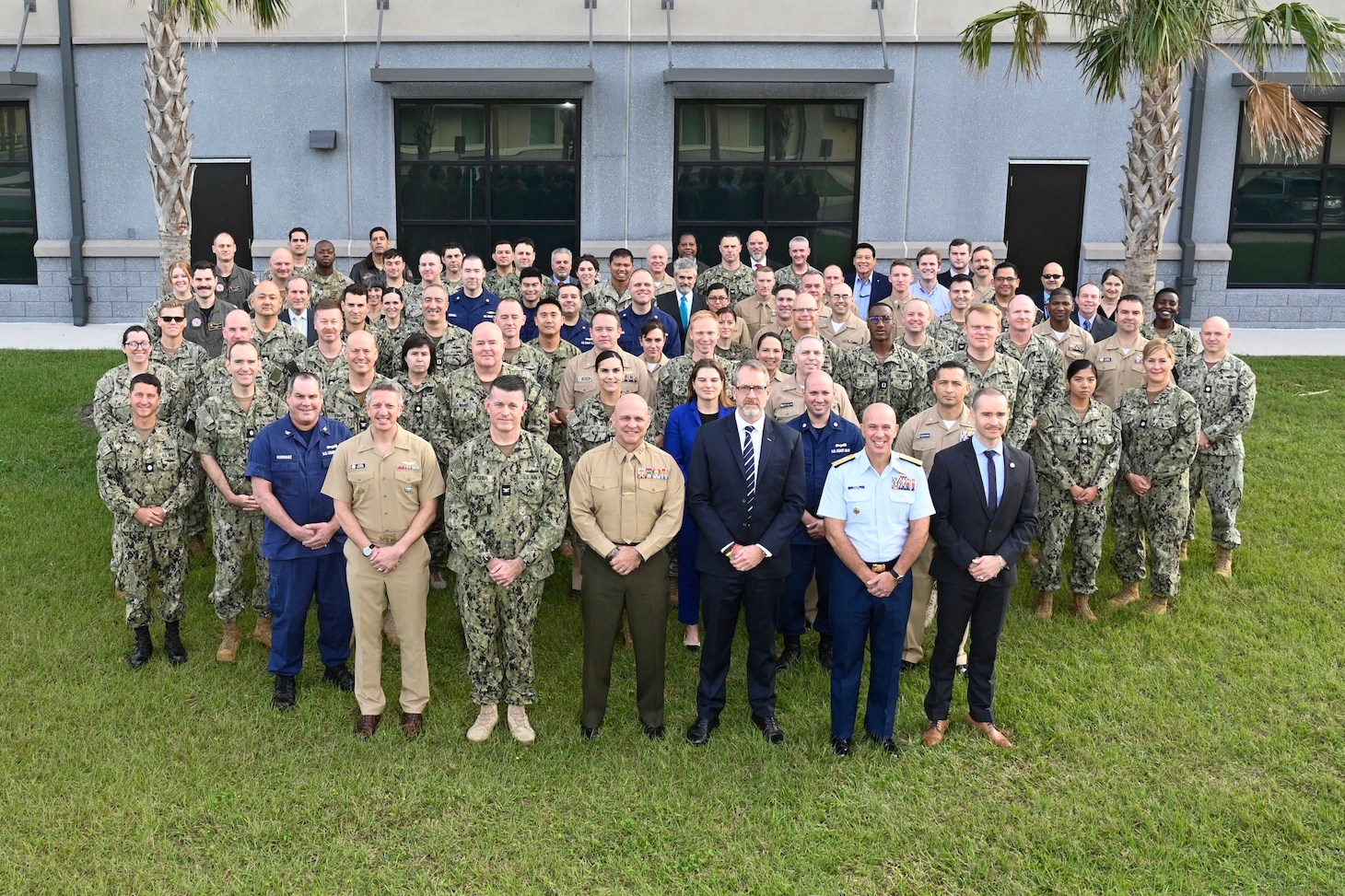
It does not mention the Coast Guard specifically, but the uniforms are recognizable in the photo above.

Surprising news is that USS George Washington (CVN 73) will deploy to the area next year. Presumably some escorts will come with her. Maybe they will do some drug interdiction along the way. (Wonder if this might be a signal to Venezuela.)

Significantly, 4th Fleet is now a center for experimentation with manned/unmanned hybrid operations that hopefully will ultimately also benefit the Coast Guard.


Dec. 12, 2023
U.S. Navy Attachés and U.S. Navy Section Chiefs serving in partner nations in the Caribbean, Central and South America gathered at Naval Station Mayport Dec. 5-8, 2023, for the annual U.S. Naval Forces Southern Command/U.S. 4th Fleet Maritime Synchronization Symposium.

This year’s symposium featured four guest speakers, expert panels, and question-and-answer sessions for the region’s Foreign Area Officers (FAOs) to discuss mutual challenges and opportunities, get the latest information on strategy, operations and exercises, and learn more about the Navy’s strategic competition with the People’s Republic of China and U.S. 4th Fleet’s campaign to inform the hybrid fleet.

The first guest speaker was Ambassador James Story, who most recently served as U.S. Ambassador for the Venezuela Affairs Unit, located at the United States Embassy in Bogotá, Colombia, and is currently a State Department Fellow at Georgetown University. Other guest speakers included Dr. Miles Yu, Professor of East Asia and Military History at the U.S. Naval Academy, Lt. Gen. David Bellon, Commander, U.S. Marine Corps Forces Reserve and U.S. Marine Corps Forces South, and Mr. Chris Diaz, Secretary of the Navy Carlos Del Toro’s Chief of Staff.

“We brought in dynamic speakers who gave our Navy Foreign Area Officers (FAOs) much to think about as they return to their respective countries,” said Cmdr. Stephanie Lastinger, U.S. 4th Fleet Theater Security Cooperation (TSC) Director. “They serve on the front lines of strategic competition and are successfully advancing American interests abroad.”

Participants were able to learn more about and provide input to staffers planning the upcoming Southern Seas and Continuing Promise deployments, which will feature USS George Washington (CVN 73) and USNS Burlington (T-EPF 10) deploying to the region next year. They also heard from Cmdr. David Edwards, U.S. 4th Fleet’s Technology and Innovation Director, who briefed Operation Windward Stack, the Fleet’s current operation in the Caribbean.

We are operationalizing technology in a campaign of learning where sometimes we win and sometimes we learn,” said Cmdr. Edwards. “We are sharing our results with the other fleets already and look forward to integrating hybrid fleet information with our partners.”

“This year’s symposium provided all of our FAOs, service providers, and stakeholders an opportunity to spend time together and develop relationships which will help them get better as members of their respective U.S. country teams,” said Rear Adm. Rich Lofgren, USNAVSOUTH/FOURTHFLT Reserve Vice Commander. “We know the critical work our FAOs perform in making the U.S. the maritime partner of choice in the Caribbean, Central and South America.”

U.S. Naval Forces Southern Command/U.S. 4th Fleet supports U.S. Southern Command’s joint and combined military operations by employing maritime forces in cooperative maritime security operations to maintain access, enhance interoperability, and build enduring partnerships in order to enhance regional security and promote peace, stability and prosperity in the Caribbean, Central and South American region.

Learn more about USNAVSOUTH/4th Fleet at https://www.fourthfleet.navy.mil, https://www.facebook.com/NAVSOUS4THFLT and @NAVSOUS4THFLT.

“Hybrid Fleet Campaign Event Evaluates Technology For Future Operations” –4th Fleet

U.S. Naval Forces Southern Command/U.S. 4th Fleet demonstrated unmanned air and surface capabilities from expeditionary fast transport USNS Burlington (T-EPF 10) during the command’s Hybrid Fleet Campaign Event (HFCE) in Key West Oct. 4-13, 2023.

Below is a news release from 4th Fleet. Notably, 4th Fleet is approaching the problem of operationalizing unmanned systems in a different way from that of 5th Fleet.

“A key detail in SECNAV and CNO’s vision was that 4th Fleet would not stand up a separate task force like U.S. 5th Fleet did in Bahrain in 2021, but would develop the hybrid fleet from inside the staff already in place.”


 Oct. 20, 2023

Hybrid Fleet Campaign Event Evaluates Technology For Future Operations

By USNAVSOUTH/4TH FLEET PUBLIC AFFAIRS

U.S. Naval Forces Southern Command/U.S. 4th Fleet demonstrated unmanned air and surface capabilities from expeditionary fast transport USNS Burlington (T-EPF 10) during the command’s Hybrid Fleet Campaign Event (HFCE) in Key West Oct. 4-13, 2023.

This is the most recent event in U.S. 4th Fleet’s campaign to operationalize cutting edge technologies. After successful rollout of the Campaign at UNITAS in July 2023 and the beginning of operation WINDWARD STACK in September, the Science and Technology event in Key West this past week focused on the evaluation of unmanned systems in advanced kill chains, contested littoral operations, survivability, and sustainment at sea.  It served as both a proving ground for emerging technologies and an opportunity for senior leaders to see for themselves the capabilities of systems that could support the hybrid fleet.

“One of the best ways to change our force is to rapidly operationalize new technologies, new systems, and new tactics, techniques, and procedures,” said Adm. Lisa Franchetti, Vice Chief of Naval Operations. “Whether you’re talking about artificial intelligence, cyber, unmanned platforms, directed energy, or hypersonic missiles, we are on the cusp of technological breakthroughs that are going to define future conflict.”

“This week’s technology evaluation event will push boundaries and risk failure in order to allow us to evaluate unmanned technology and then move to operationalize that technology to inform the hybrid fleet,” Rear Adm. Jim Aiken, Commander U.S. Naval Forces Southern Command (USNAVSOUTH) & U.S. 4th Fleet, said in advance of the event. “We have many events scheduled and in some of those events we will win, and in some of them we will learn. In both cases, the Hybrid Fleet will be informed, and the Navy will continue to push forward at the speed of technology.”

The campaign to inform the hybrid fleet calls for the combination of manned and unmanned systems to allow U.S. 4th Fleet to execute its larger missions of defending the southern approaches to the United States, countering malign activity in the region with our partners, and supporting the detection and monitoring of illicit trafficking in the region.

“Broad partnership across DoD and industry partners has allowed 4th Fleet to mature operational capabilities rapidly fostering innovation and providing informed recommendations to the parties involved in creating the Disruptive Capabilities Office,” said Dr. Chris Heagney, the Naval Air Systems Command Fleet/Force Advisor to USNAVSOUTH/4th Fleet.

In April 2023 at the Navy League of the United States’ annual Sea Air Space Symposium, Secretary of the Navy (SECNAV) Honorable Carlos Del Toro and then Chief of Naval Operations Adm. Michael Gilday announced that USNAVSOUTH/4th Fleet would operationalize hybrid fleet operations. A key detail in SECNAV and CNO’s vision was that 4th Fleet would not stand up a separate task force like U.S. 5th Fleet did in Bahrain in 2021, but would develop the hybrid fleet from inside the staff already in place.

“This technology evaluation event is a continuation of the campaign we began in April,” said Cmdr. David Edwards, USNAVSOUTH/4th Fleet’s technology and innovation director. “We evaluate these technologies in focused events like this, then operationalized the technology quickly to fulfill operational requirements in the U.S. Southern Command Area of Responsibility (AOR). While we operate these systems to fulfil the 4th Fleet mission, the evaluation continues over months and years, not just hours and days. Those operational evaluations inform future acquisitions to ensure the Navy is ready to fight and win with these technologies.

HFCE was 4th Fleet’s largest technology event yet with 305 participants including VCNO and Master Chief Petty Officer of the Navy James Honea and 26 other U.S. government distinguished visitors, 10 foreign partners, 18 industry partners, and 47 Department of Defense Commands participating.

U.S. Naval Forces Southern Command/U.S. 4th Fleet supports U.S. Southern Command’s joint and combined military operations by employing maritime forces in cooperative maritime security operations to maintain access, enhance interoperability, and build enduring partnerships in order to enhance regional security and promote peace, stability, and prosperity in the Caribbean, Central and South American region.

“AEROVIRONMENT’S JUMP 20 MEDIUM UAS DEMONSTRATES MARITIME AUTONOMOUS TAKEOFF AND LANDING AT VESSEL SPEEDS OVER 20 KNOTS” –News Release

Below is a news release from AeroVironment reporting autonomous takeoff and landing from USNS Burlington (T-EPF-10), pictured below, at speeds of over 20 knots. I also found the video above that shows operation from a smaller vessel and provides more detail of how the unmanned aircraft is operated and supported.

CARIBBEAN SEA (Aug. 25, 2021) The Spearhead-class expeditionary fast transport ship USNS Burlington (T-EPF 10) operates off the coast of Haiti, Aug. 25, 2021. Burlington is deployed to U.S. Naval Forces Southern Command/U.S. 4th Fleet to support humanitarian assistance and disaster relief (HADR) efforts in Haiti following a 7.2-magnitude earthquake on Aug. 14, 2021. (U.S. Navy photo by Mass Communication Specialist 2nd Class Jack D. Aistrup)

Another good video here:

It appears 4th Fleet is trying to fulfill their self proclaimed role as the Fleet for Innovation.


AEROVIRONMENT’S JUMP 20 MEDIUM UAS DEMONSTRATES MARITIME AUTONOMOUS TAKEOFF AND LANDING AT VESSEL SPEEDS OVER 20 KNOTS

NOVEMBER 07, 2023

ARLINGTON, Va., November 07, 2023 – AeroVironment, Inc (NASDAQ: AVAV) today announced the company’s JUMP 20 VTOL Medium UAS exceeded expectations during the recent U.S. Naval Forces Southern Command/4th Fleet Hybrid Fleet Campaign Event (HFCE) that demonstrated human-machine teaming in the maritime domain. The JUMP 20 provided ship-based intelligence, surveillance, reconnaissance, and targeting (ISR-T) support to USFOURTHFLT and USSOUTHCOM during the week-long, at-sea exercise onboard USNS Burlington. The JUMP 20 has previously flown over 130,000 land-based hours in support of U.S. Special Operations Command combat deployments, and the expansion of JUMP 20 operations into the shipboard environment allows AeroVironment to provide these services globally.

During HFCE, JUMP 20 showcased its ability to launch and recover at vessel speeds over 20 knots, with fully autonomous flight from takeoff to landing.  The JUMP 20 requires neither launch or recovery equipment, nor personnel on the flight deck during launch and recovery, maximizing operational safety and flexibility for users. JUMP 20’s vertical takeoff and landing (VTOL) capability, and class-leading endurance and payload capacity expand the operational capabilities of U.S. and allies to compete and win in the era of great power competition.  The JUMP 20 demonstrated how uncrewed systems will support distributed operations across multiple domains, supporting national security objectives and our warfighters.

“The shipboard flight environment is dynamic and challenging. JUMP 20 is a proven combat-effective platform, and the system’s performance during HFCE illustrates the value to maritime operations.  JUMP 20’s ability to launch and land at speed, and without personnel intervention, enhances the ship’s operational effectiveness and enables operators to focus on important mission tasking,” said Shane Hastings, AeroVironment’s vice president and product line general manager for Medium UAS. “As we continue to demonstrate and prove the effectiveness of the JUMP 20 platform, we look forward to getting this capability in the hands of our sailors, Marines, and allies operating in the maritime environment.” AeroVironment JUMP 20 is deployed to U.S. and allied militaries around the world, and it can be provided on a contractor-owned / contractor-operated (COCO) basis to maximize operational flexibility.

“Inside the U.S. Navy’s Cutting-Edge Drone Boat Tech”–WSJ

A reader brought the video above to my attention, recognizing the significant Coast Guard participation in the program. 

Below I have reproduced the text that accompanied the video on YouTube. 


Drone boats appear to be on the cusp of a revolution. The U.S. Navy’s Task Force 59 has been pairing cutting-edge unmanned surface vehicles with artificial intelligence to expand the military’s eyes and ears in the Middle East. Now, similar efforts will be rolled out in the Pacific and Central and South America. The military’s objective is to leverage machine learning to detect and anticipate threats before they occur. Experts say the U.S. is currently the leader in this field, but competitors like China and Russia are racing to catch up. I traveled to Manama, Bahrain to see the high-tech drones in action and speak to officials about how they’re preparing for a future with robots in the world’s waters. 0:00 A rare look at the U.S. Navy’s drone boat operation 0:30 Meet the Navy’s Task Force 59 2:14 Drone boat capabilities 4:05 How artificial intelligence is layered with the drone boats 5:11 The global race to advance unmanned marine vehicles 7:23 What’s next for the U.S. military? Check out more from my exclusive interview with Vice Admiral Brad Cooper, commander of U.S. Naval forces in the Middle East, about unmanned vessels and the Navy’s future fleet:    • Drone Boats, AI and the Future of Mar…   I’m Shelby Holliday, a reporter for WSJ. Subscribe to join me as I explain some of today’s most pressing geopolitical events, from superpower showdowns and conflicts to supply chain snarls and natural resource struggles.


The link embedded above was to this video. 

Thanks to David for bringing this to my attention.