Navy Chooses Longbow Hellfire

Lockheed Martin animation of Hellfire employment from an LCS

The US Naval Institute Proceedings is reporting that Navy has committed to selection of the Longbow Hellfire as an interim missile to arm the Littoral Combat Ships.

“For the LCS deployment, a single Longbow Hellfire launcher with a 24-missile capacity will be integrated with the LCS SSMM, which will be part of one of three weapon stations. Navy officials point out that Longbow Hellfire integration for the LCS SSMM will require only software modifications; no changes to the missile hardware or to the Army launcher or gas-containment system will be needed.

“In selecting the Longbow Hellfire, the Navy also will be able to draw from an available inventory of thousands of missiles already stockpiled for the Army, avoiding the need to spend money on new production.

“Navy officials emphasize that the Longbow Hellfire meets the requirement of the LCS Capabilities Description Document for a standoff-engagement capability for fast inshore attack craft.  An “increment 3” of the SSMM, while still going through modifications, now is expected to be ready to deploy aboard LCSs with the Longbow Hellfire in 2017.”

As we have discussed before, this weapon system seems like a good one for arming cutters against the possibility of an attack by highly maneuverable, high speed craft. In quantity the missiles might also be effective against larger targets.

It is likely the Coast Guard could add this capability at relatively low cost, if they made a case for it. As noted there are already large stocks of the missile. It seems likely that these weapons will be replaced on the LCSs before all the Offshore Patrol Cutters are complete. There are likely to be large numbers of Hellfire considered semi-obsolescent as they are replaced by the JAGM.

Poland looking for OPCs

ProposedPolishCorvette

Rolls Royce proposal

Poland is planning some ships that have many similarities to the Offshore Patrol Cutters. We have talked about these a little already, in the context of an unconventional hull form offered by ThyssenKrupp Marine Systems (TKMS) that promises better fuel economy. Our friend at Thinkdefence talks about another proposal from Rolls Royce. He also provided a link to a more detailed description of the program.

The intention is apparently to produce three “Miecznik” corvettes and three “Czapla” patrol ships (with mine countermeasures) with the two classes sharing a common platform. ThinkDefence reports the key features of Rolls Royce’s corvette version as follows:

“It is 99.7 metres long and displaces just over 2,400 tonnes. Accommodation for 60 crew and an additional 30 personnel is included and the ship is said to have a 28 day endurance. With a CODLOD propulsion system its design top speed is 25 knots. Weapons and sensors include a 76mm Oto Melara gun, twin MSI 30mm automatic cannons, two quad NSM missile launchers, MU90 torpedo launchers and four Sylver A35 cells for quad packed VL-MICA anti-aircraft missiles; Smart-S 3D radar, Thales optronic systems and Kingclip sonar.”

Substituting some equivalent US systems, I think that would represent a good approximation of how a war ready OPC might be equipped.

Apparently they intend to order one ship a year beginning with the corvettes in 2017. That starts them on nearly the same schedule as the OPCs. Which will be finished first? Unfortunately the Poles will probably see their first ship before we see the first OPC.

Rolls Royce CDV 4


A Possible New Threat to Ports

UAEseahakemod4ERtorped

Photo: “A computer-generated image of a purpose-built SeaHake mod4 ER torpedo launch vessel that is similar to the ones that Atlas Elektronik said were delivered to its undisclosed launch customer. The two Rmah-class vessels that were delivered to the UAE in 2014 have the same stern hatches and seemingly ordinary shipping containers on their decks. (Atlas Elektronik)”

Jane’s 360 reports that the UAE, “The United Arab Emirates (UAE) is probably operating innocuous-looking vessels that are armed with the world’s longest-range torpedo: a capability that would enable it to target Iranian Kilo-class submarines at their base.”

This is based on a report that German torpedo manufacturer Atlas Elektronik had exported two “floating platform[s] with torpedo-launching gear….to the UAE in 2014, along with underwater detection equipment.”

Atlas Elektronik is the manufacturer of the world’s longest ranged torpedo, the SeaHake Mod4 ER, with a range of 140 kM (75.6 nautical miles). The manufacturer claims the torpedo is “fitted with innovative navigation and communications technology, enabling extremely precise navigation and control of the torpedo over the entire distance.”

Now, I doubt we have any reason to fear an attack by the UAE Navy, but if they have the capability it cannot be long before others do as well. If a torpedo can be precisely guided to a specific geographic location, it would be fairly easy to target almost anything in a port. It could be done by small UAV, but even that is unnecessary. An agent in port could identify the location of targets by observation and reference to google maps.

During WWII the Soviets commonly attacked Axis held ports by launching unguided torpedoes into them. This could take the concept to a whole new level.

(It may be that the UAE is pioneering a new austere type of ASW vessel equipped only with a towed array for detection and targeting and torpedoes to engage the target. They do not need underwater detection equipment to attack subs in port.)

Armed Helos on Philippine 378s

a

Photo: A Philippine Navy weaponized AW109 helicopter on board the frigate BRP Ramon Alcaraz (formerly the USCGC Dallas (WHEC-716)). Source: Philippine Navy

Janes is reporting that the two former USCG 378s, that are now in the Philippine Navy, will be operating “weaponised” AW109 helicopters.

This is the same helicopter that saw service as the U.S. Coast Guard MH-68A Stingray airborne use of force helicopters. It is smaller than the MH-65, with about two thirds the gross weight and horsepower.

The weaponised versions carry two 12.7 mm machine gun pods, each with launchers for three 70 mm laser-guided rockets (on each pod–Chuck). The aircraft can also be configured to carry a sonobuoy dispenser for anti-submarine warfare operations.

The laser guided rockets will probably be “APKWS II” used by the USN and US Marines, but there are a number of similar systems that convert unguided 70 mm Hydra rockets to small passive laser-guided missiles.

It is not clear if these aircraft will also have the .50 cal. sniper rifle or door mounted 7.62 mm machine gun like those on Coast Guard airborne use of force helos. If they have at least the door mounted machine gun, I would think that seven round rocket pods would be preferable to the .50 cal. gun pods with only three missiles each. If there is no door-mounted machine gun and there is a need to fire warning shots, then perhaps use only one .50 cal gun pod and one seven round rocket pod.

ASuW Hellfire Test Success–Operational Late 2017

Navyrecognition reports that a successful test of modified Hellfire missiles for use in the Surface to Surface Missile Module (SSMM) planned for the Littoral Combat Ship has paved the way for operational deployment of the system in late 2017.

We have talked about these missiles before. They seem to be an ideal way to deal with the threat of small, fast, highly maneuverable boats that might be employed by terrorists, and absent more effective weapons, may provide some capability against even large vessels. Unlike gun systems, they promise high first round accuracy and lethality, with very little chance of a round going astray and hitting something unintended.

The projected SSMM would provide storage and launch facilities for up to 24 rounds. 24 rounds would weigh only about 2500 pounds. The launcher and support systems is unlikely to weigh more than that, suggesting and all up weight of about 5000 pounds, far less than either the 76mm Mk75 gun or the 57mm Mk110 (two and a half tons compared to eight or nine tons). Both of these guns are commonly used on missile and patrol boats smaller than the Webber class WPCs. Also unlike a gun system, the SSMM is unlikely to require any significant deck reinforcement.  It would almost certainly fit on all large cutters and perhaps the WPCs and WPBs as well. (It should be included on Offshore Patrol Cutters from day 1.) If the 24 round system is too large to be comfortably carried by smaller cutters, it is likely a smaller, say four round, system could be quickly and economically developed for Coast Guard use and perhaps for the Navy’s MkVI patrol boat as well.

If we take the Ports, Waterways, and Coastal Security mission seriously we really should be looking seriously at acquiring these systems, not just for the new ships as they are built, but also for the existing fleet with the idea that the systems would be transferred to the newer ships as the older ones are replaced.

The Navy should be willing to pay for these systems under existing inter-service agreements.

As noted before, if we need to stop a terrorist attack, we are far more likely to have a WPC or WPB on scene than a larger cutter. For this reason, arming some the Webber class in each homeport should be the first priority. Unfortunately the Webber Class are not geographically wide-spread, so we should look at mounting systems on existing MECs and WPBs to insure all potential targets have some protection until the entire fleet is armed.

I would say there are places where they might be mounted on Coast Guard stations ashore, to act as gate keepers for the ports against clandestine attacks, but coast defense is still an Army mission. Perhaps this is something we should be talking about too. If not Coast Guard manned defenses (which is probably the proper solution), then perhaps placement of unused SSMMs with their associated Navy crews on Coast Guard facilities or small detachments of army troops with their weapons to perform this function.

Document Alert–National Military Strategy, 2015

The US has issued a new National Military Strategy. You can see it in pdf form here, or you can see it on the Naval Institute News Service here.

Its not really very long. There are only 18 pages of text. Even so, I will provide a “Readers’ Digest” version, or perhaps more properly, a powerpoint version, in that it is in outline form, and offer only limited Coast Guard related comment.

U.S. ENDURING NATIONAL INTERESTS

  • The security of the United States, its citizens, and U.S. allies and partners.
  •  A strong, innovative, and growing U.S. economy in an open international economic system that promotes opportunity and prosperity.
  • Respect for universal values at home and around the world.
  • A rules-based international order advanced by U.S. leadership that promotes peace, security, and opportunity through stronger cooperation to meet global challenges.

NATIONAL SECURITY INTERESTS 

  • The survival of the Nation.
  • The prevention of catastrophic attack against U.S. territory.
  • The security of the global economic system.
  • The security, confidence, and reliability of our allies.
  • The protection of American citizens abroad.
  • The preservation and extension of universal values.

NATIONAL MILITARY OBJECTIVES 

  • Deter, deny, and defeat state adversaries.
  • Disrupt, degrade, and defeat violent extremist organizations.
  • Strengthen our global network of allies and partners.

PRIORITIES

  1. Maintain a secure and effective nuclear deterrent 
  2. Provide for military defense of the homeland 
  3. Defeat an adversary 
  4. Provide a global, stabilizing presence 
  5. Combat terrorism 
  6. Counter weapons of mass destruction 
  7. Deny an adversary’s objectives 
  8. Respond to crisis and conduct limited contingency operations 
  9. Conduct military engagement and security cooperation 
  10. Conduct stability and counterinsurgency operations 
  11. Provide support to civil authorities 
  12. Conduct humanitarian assistance and disaster response

There is nothing here that adds to the Coast Guard’s “to do list.” There is no specific mention of the Coast Guard or any other service for that matter. They do talk about working with DHS partners, and a couple of times they mention Coast Guardsmen along with an enumeration of all other types of US military personnel.

There is a recognition of the “Violent Extremist Organization” either acting alone or with support of a Nation State in a form of “Hybrid Warfare.”

DEFENSE OF THE HOMELAND

There may be more emphasis on “defense of the homeland,” but we are a long way from providing the kind of commitment to this, that we saw in the late 1950s and early 60s when we had Nike missile launchers around every US city and hundreds of interceptors on strip alert around the country. At that time there were also Naval Sea Frontiers that were ready to respond to naval threats.

DOD has recently begun to talk about defense against cruise missiles, but really, it is easier to get a weapon of mass destruction into the country by boat than by missile or aircraft.

I would like to particularly highlight the explanation that accompanies the #2 priority, after #1–maintaining a nuclear deterrent,  because it certainly involves the Coast Guard,

Provide for Military Defense of the Homeland.  Emerging state and non-state capabilities pose varied and direct threats to our homeland.  Thus we are striving to interdict attack preparations abroad, defend against limited ballistic missile attacks, and protect cyber systems and physical infrastructure.  Key homeland defense capabilities include resilient space-based and terrestrial indications and warning systems; an integrated intelligence collection, analysis, and dissemination architecture; a Ground-Based Interceptor force; a Cyber Mission Force; and, ready ground, air and naval forces, (emphasis applied–Chuck).  We also are leveraging domestic and regional partnerships to improve information sharing and unity of effort.  These capabilities will better defend us against both high technology threats and terrorist dangers.

Make no mistake, for countering any covert maritime surface threat to the US, the Coast Guard is the “ready naval force,” that is ready to investigate possible hostile contacts. Even if the US had aircraft armed and ready to engage surface vessels, which I doubt, I don’t think anyone is going to send aircraft to sink a ship based on a suspicion, however well founded, that the ship has some nefarious intent. Someone is going to have stop the vessel and attempt a boarding.  Navy Bases are few and far between. The only Navy surface combatant on the Atlantic coast based North of the Norfolk complex is the USS Constitution. The only surface ships based on the East Coast are around Norfolk and Jacksonville. On the West Coast they are either in Everett or San Diego. There are none based in Alaska and none on the Gulf Coast. Unless they are holding a Navy Day, celebration the majority of US ports are hundreds of miles from the nearest Navy surface combatant.

The Coast Guard’s position ought to be that we see a problem here, and the Coast Guard is the solution (and here I am not talking about the larger cutters, because they are either going to be deployed or in some sort of stand down if they are in port). The vessels that are going to do the stopping and boarding are most likely to be WPCs or WPBs, but currently they are not really armed to handle anything much more threatening than an angry outboard.

In addition to better weapons, we certainly need to continue to exploit the DOD’s intelligence organization and the Navy’s Maritime Domain Awareness hopefully including JLENS if they become more than prototypes.

REACTION. Of course the Chinese had a comment, as did Russia, “Clearly Anit-Russsian.”

China’s Naval Militia–A Coast Guard Auxiliary and Much More

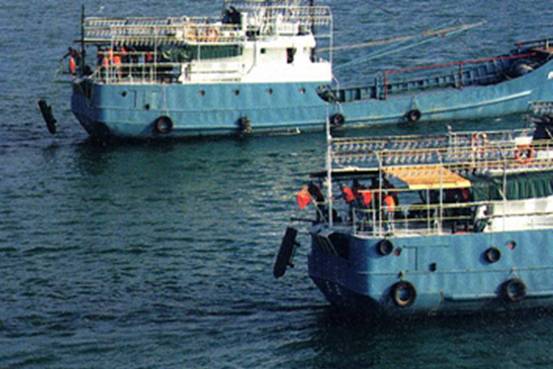
A photo published in a report on Chinese mine warfare by the U.S. Naval War College shows Chinese civilian fishing vessels practicing deploying sea mines at a naval base in Sanya in 2004. —Courtesy of U.S. government

A photo published in a report on Chinese mine warfare by the U.S. Naval War College shows Chinese civilian fishing vessels practicing deploying sea mines at a naval base in Sanya in 2004. —Courtesy of U.S. government

The Wall Street Journal has an interesting story about China’s Naval Militia. It employs not only the crews of their fishing industry, but also their vessels, to support China’s Navy and Coast Guard. It certainly blurs the line between government and non-government vessels.

Presumably this organization also extends to include their ocean going vessels and their crews as well. This is all the more interesting because of China’s recent announcement that they would require the incorporation of military characteristics in newly constructed container, roll-on/roll-off, multipurpose, bulk carrier and break bulk civilian vessels.

LCS/SSC/Frigate and the OPC

DefenseNews is reporting that “Pre-preliminary design and system selection for the frigate will be completed in October 2015,” Chris Johnson, a spokesman with the Naval Sea Systems Command, said May 28.

I don’t think it should be too much of a stretch, that the systems on the OPC should include a subset of those to be used on the frigate, with another subset of the frigate’s systems planned into the ships for inclusion if conditions warrant the upgrade. Design for Wartime, but equip for peacetime.