Missing Anti-Ship Cruise Missiles

Long Range Anti-Ship Missile (LRASM)

Myself and others have suggested that it might be a good idea to equip US Coast Guard cutters with anti-ship cruise missiles (ASCMs).

While I think cutters should be fitted for launchers of at least eight ASCMs, so that in wartime they might swamp the defenses of an enemy combatant with a relatively robust air defense, they don’t need to carry that many all the time. (The new FFGs will carry up to 16 ASCMs.) For defense against a possible terrorist attack using a medium to large ship, two LRASM, AGM-158C Long Range Anti-Ship Missile, with their large warhead and target selectivity, would probably suffice. For sensitive international peacetime missions, they might need or want to carry none at all.

Certainly not everyone agrees, “U.S. Coast Guard’s VADM Linda Fagan (Pacific Command) answers why the Large Coast Guard Cutters Do Not Up-Arm” by Peter Ong, but there may be another reason the idea has not been accepted.

A Defense News report has a revealing quote,

“We need about 1,000 to 1,200 [long-range anti-ship missiles] if you believe the unclassified wargames,” Gallagher adding, noting the U.S. currently has less than 250 in its inventory.

That may only refer to the Long Range Anti-Ship Missile, but there may be a shortage of anti-ship missiles. That could explain a lot, including why no ASCMs on cutters; why no ASCM armed surface combatants; why so slow to arm LCS with cruise missiles, why many Destroyers apparently have no ASCMs. DOD is going to fill their highest priority needs first.

The US Navy has about 110 surface combatants (cruisers, destroyers, and LCS). If each were armed with 8 ASCMs that would require 880. Submarines may carry a relatively small number of ASCMS, but ships are not the primary users of ASCMs. Aircraft have that role.

Each Air Force B-1Bs can carry up to 24 LRASMs. LRASM and NSM are also to be carried by Navy F/A-18s and Air Force, Navy, and Marine F-35, and by P-8 Maritime Patrol Aircraft. A fully loaded Aircraft Carrier might require well over a hundred missiles.

Until recently, ASCM procurement rates have been modest. Apparently, more missiles are coming.

The rapid consumption of high-tech munitions in Ukraine has apparently convinced many we need deeper magazines.

The Pentagon’s $170 billion procurement budget request ― touted as the largest ever ― would use a new “large lot procurement pilot” strategy to maximize production capacity for several munitions used across the services: Lockheed Martin’s Joint Air-to-Surface Standoff Missile Extended Range (JASSM-ER) and Long-Range Anti-Ship Missile (LRASM) ― and the Raytheon Technologies-made RIM-174 Standard Missile (SM-6), AIM-120 Advanced Medium Range Air-to-Air Missile (AAMRAM).

Though not in the pilot program, the Pentagon is also using multiyear contracting to buy roughly 103 Naval Strike Missiles at $250 million. The Marine Corps’ new, low-signature Marine Littoral Regiments and their Navy/Marine Corps Expeditionary Ship Interdiction System are slated for 90 of the ground-based missiles, which Raytheon manufactures.

Procuring 103 missiles over five years still looks like a pretty slow pace to me, considering China is apparently threatening to attack Taiwan in 2027 and we have a capacity for producing hundreds of missiles per year. If Taiwan is attacked in 2027, it will be a target rich environment and those missiles in the out years will be too late.

In 2021 Defense News reported, there is no production bottleneck delaying the rapid deployment of large numbers of Naval Strike Missiles (NSM).

“Demand is not an issue. If they suddenly come out and they say we need 200 a year, 300 a year, 500 a year, we can do that,” Schreiber added.

Lockheed is doubling their production capacity.

Perhaps when magazines are filled, the question of missiles for cutters will be reconsidered.

“In focus: the 50 cal heavy machine gun in Royal Navy service” –Navy Lookout

British navy sailor fires burst using gun mounting system ASP (Agile, Small-deflection, Precision) armed with a .50 heavy machine gun. (Picture source British Royal Navy)

Navy Lookout has a post about .50 cal guns that goes into the history of the caliber in the Royal Navy, but the real news is that they have made the decision to completely replace the 7.62mm Mk44 (M134) mini gun, which as a rate of fire of 2,000 to 4,000 rounds per minute, with the .50 caliber effective March 2023.

The post makes reference to the 2021 tests of the “Agile, Small-deflection, Precision (ASP)” mounting on board HMS Argyll, but apparently there has been no decision regarding upgraded mounts for the gun.

China’s PLAN Surface and Sub Order of Battle

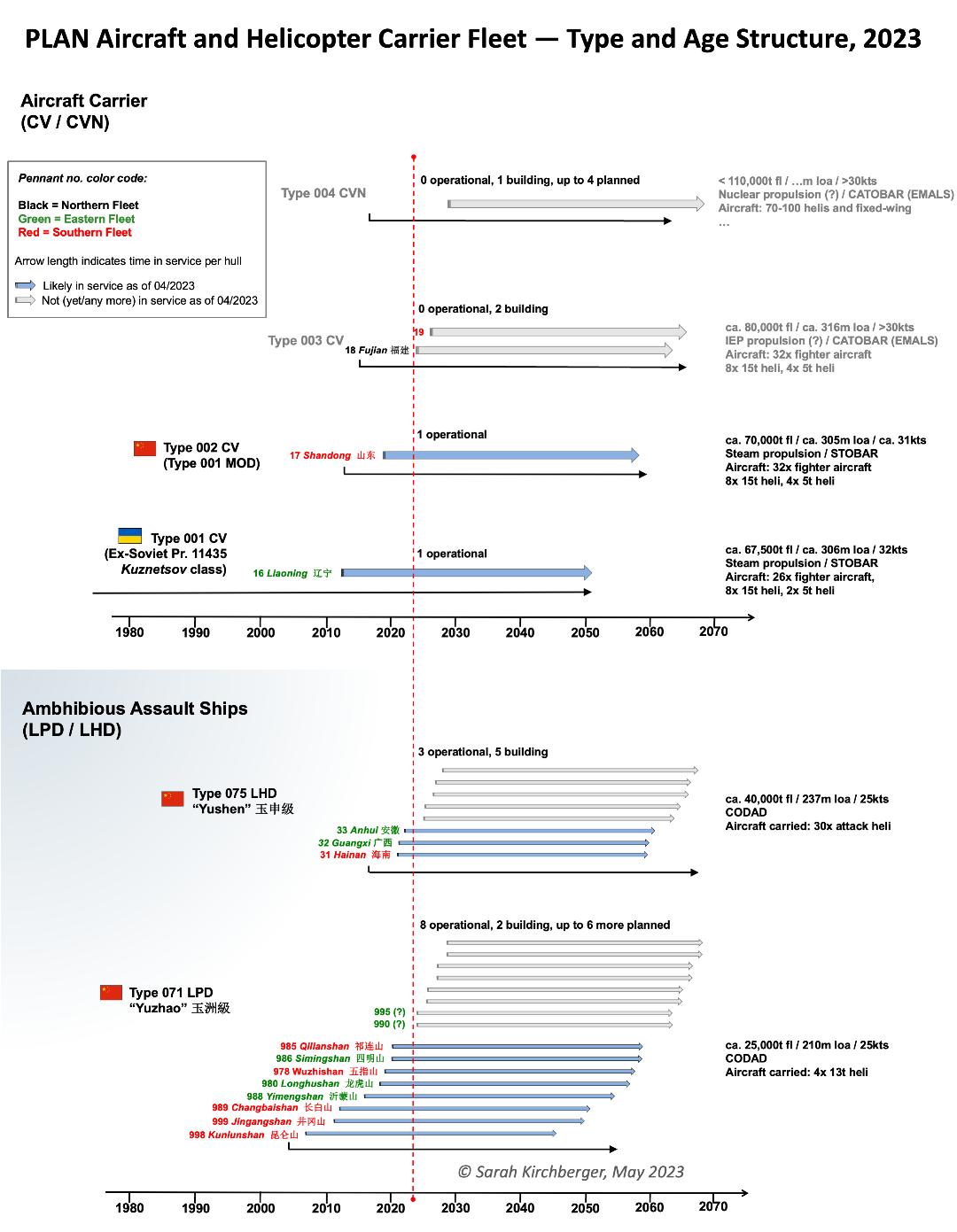
Earlier I published “Chinese Navy Submarine and Major Surface Ship Order of Battle,” that included three infographics prepared by Dr. Sarah Kirchberger that I found on the CIMSEC Internal Discussions Facebook page. At the time I noted that they did not include Chinese aircraft carriers, amphibs, and numerous frigates, corvettes, and other small combatants.

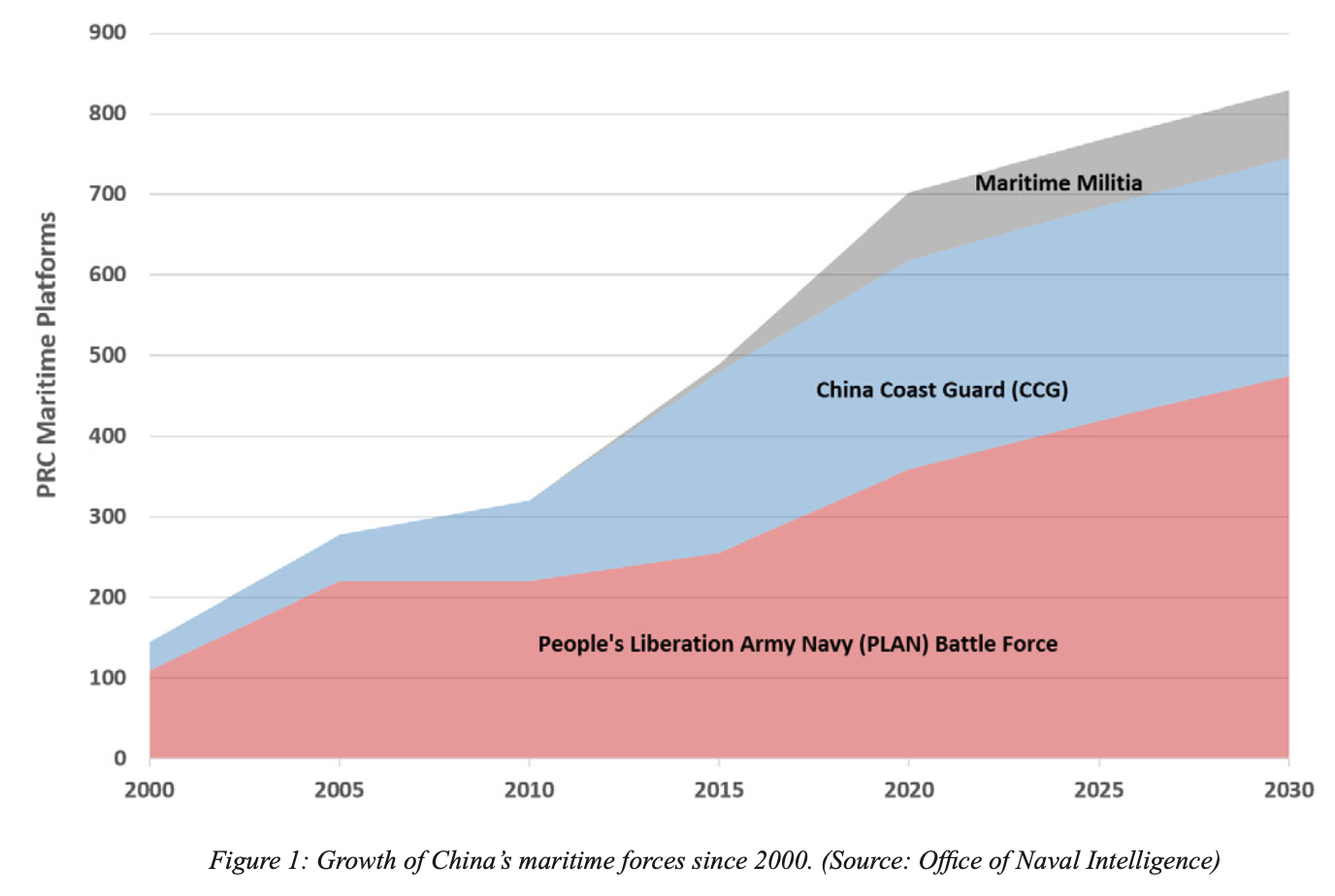
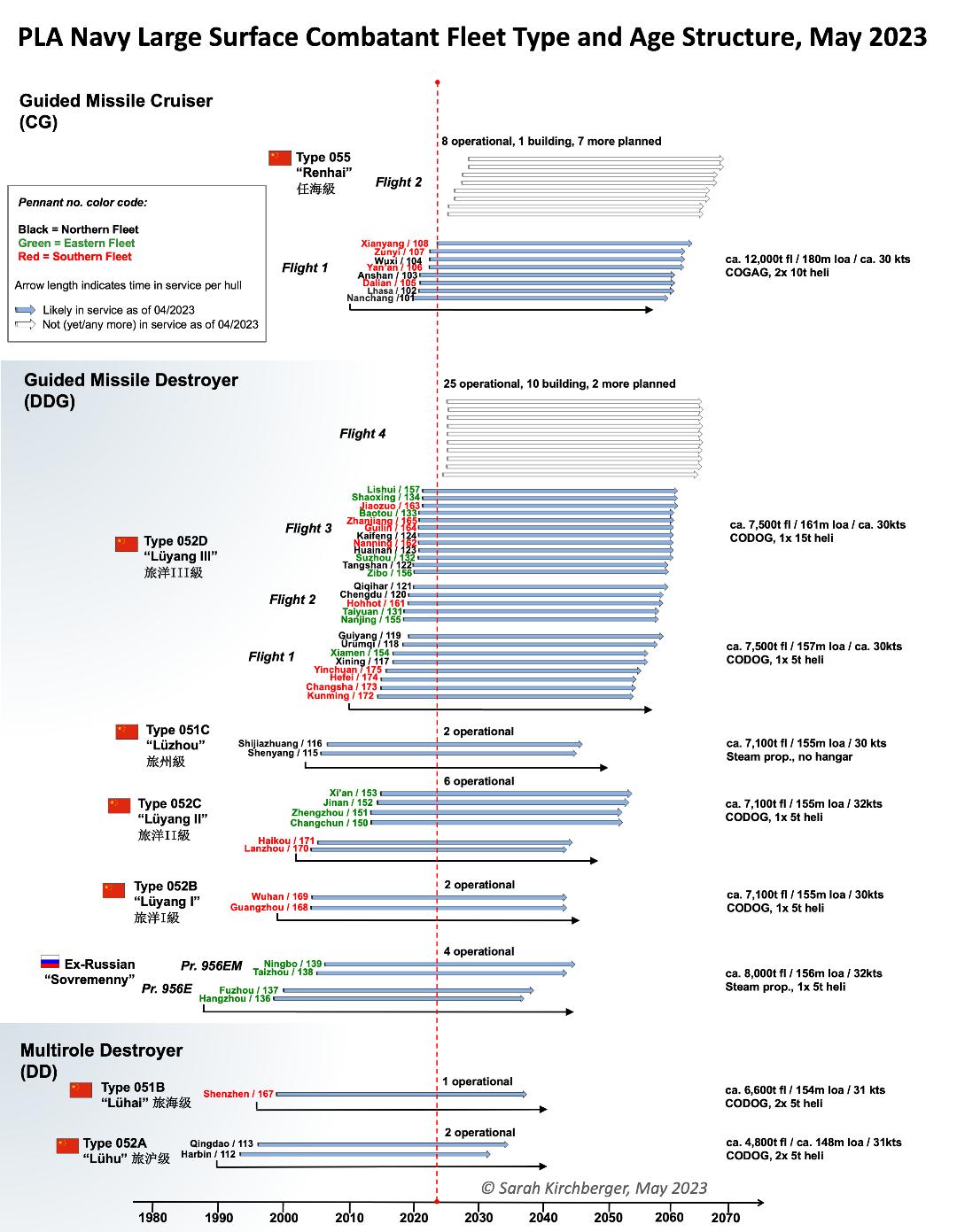
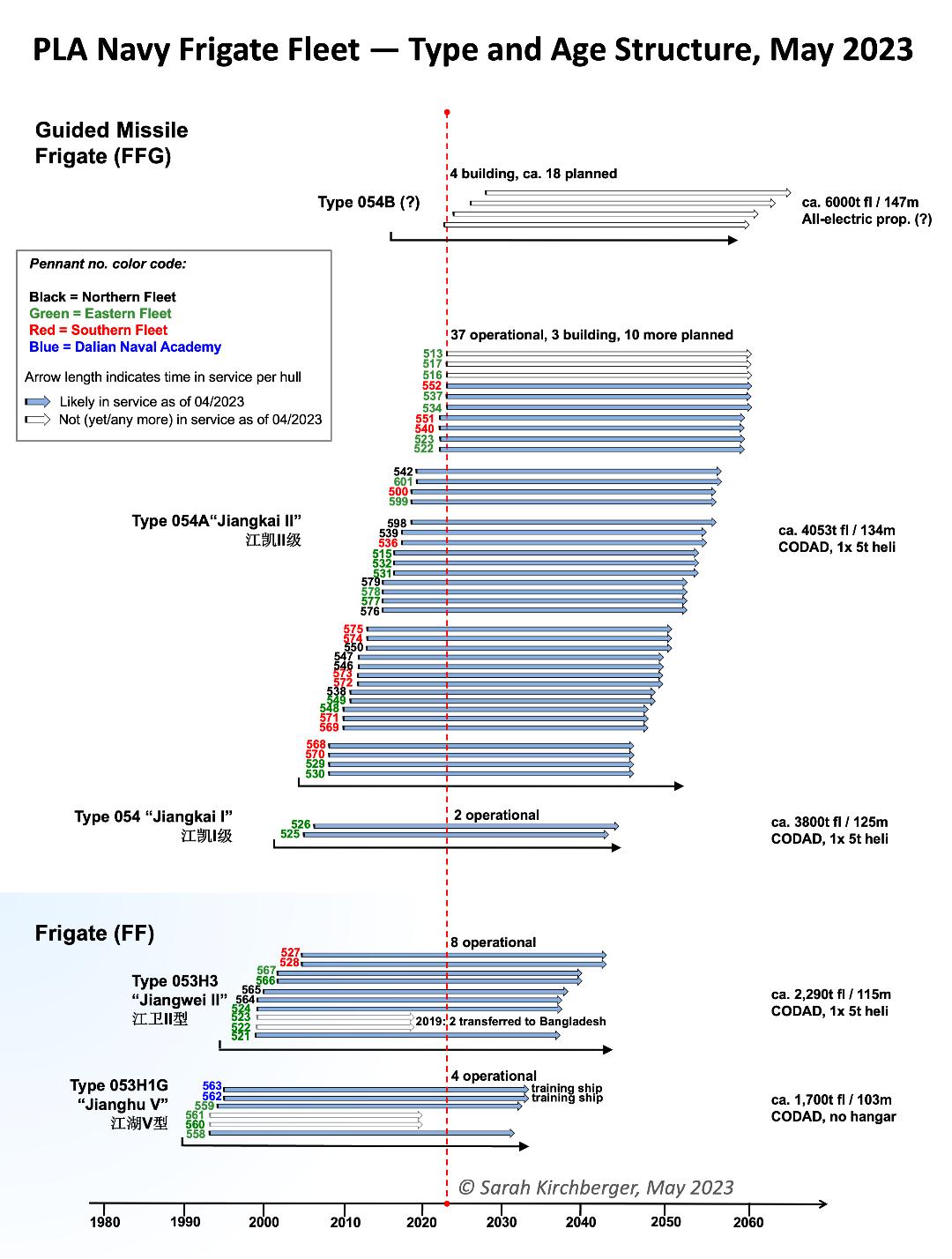
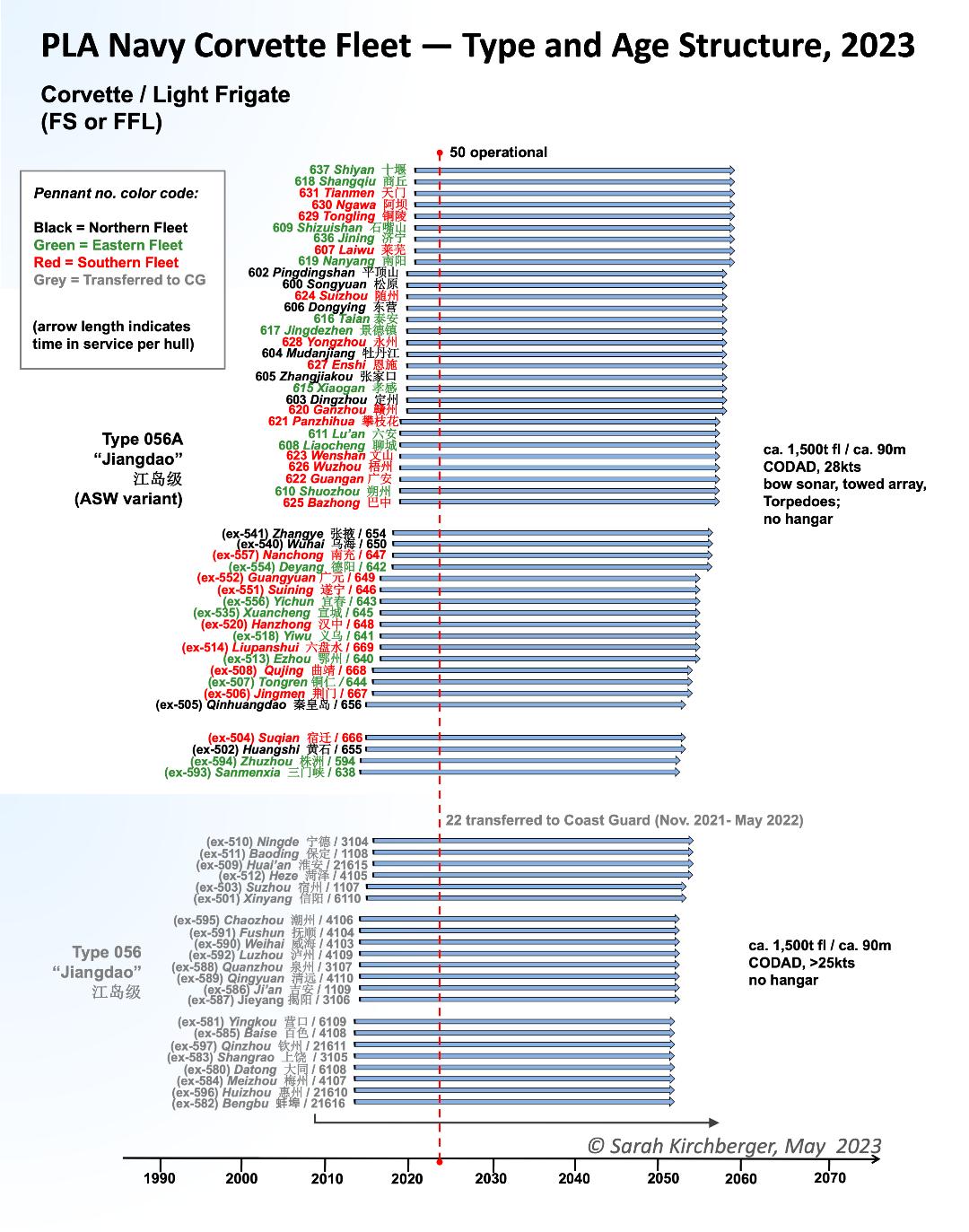
Dr. Kirchberger recently emailed me additional and updated infographics that provide a more complete picture of the People’s Liberation Army Navy’s rapid growth. I have included them all below, including updated versions of the three previously published.

Another resource available is the “Office of Naval Intelligence’s Chinese People’s Liberation Army Navy, Coast Guard, Ship Identification Guide.”

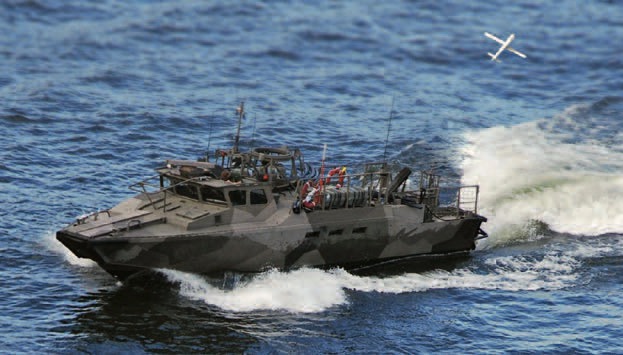
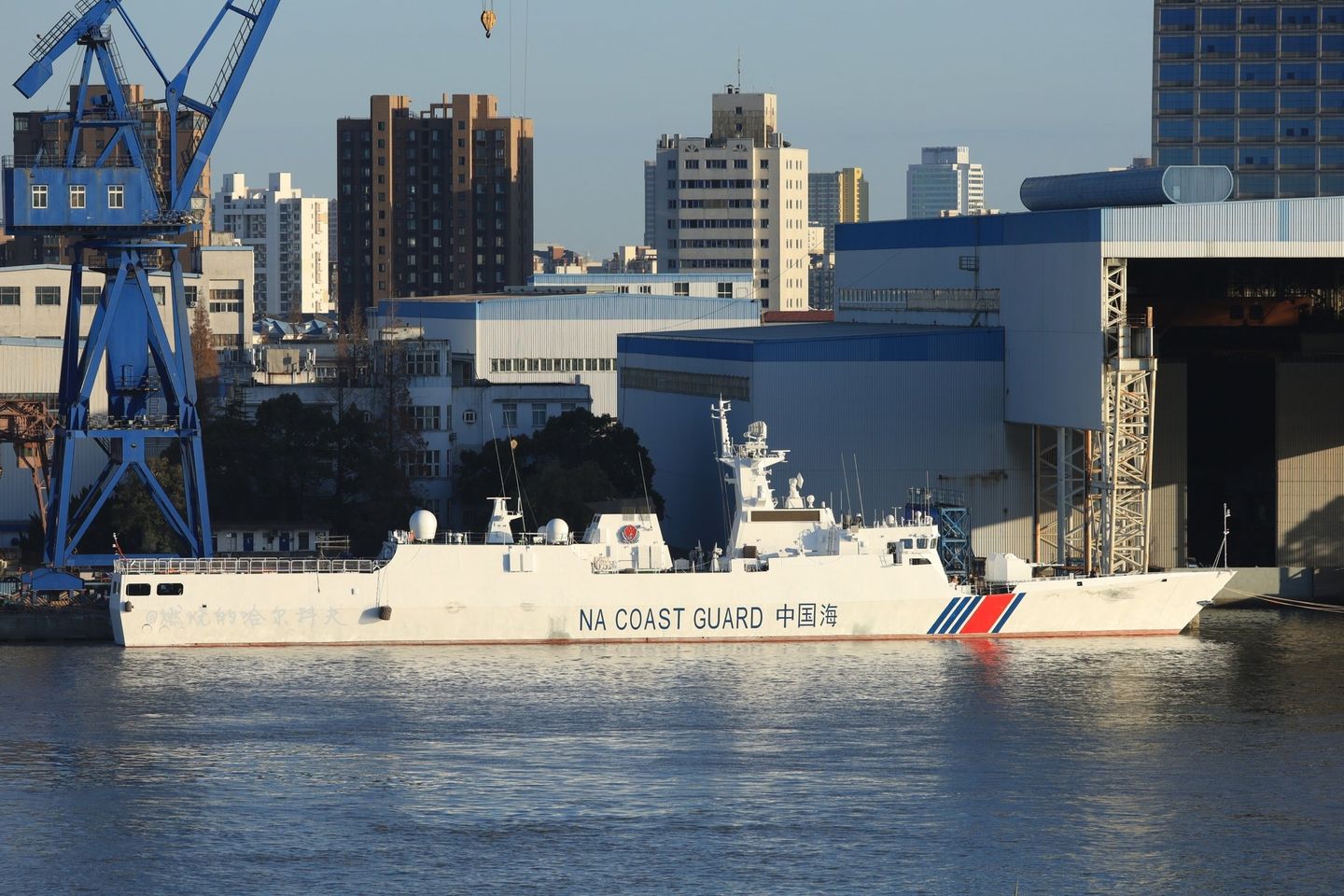
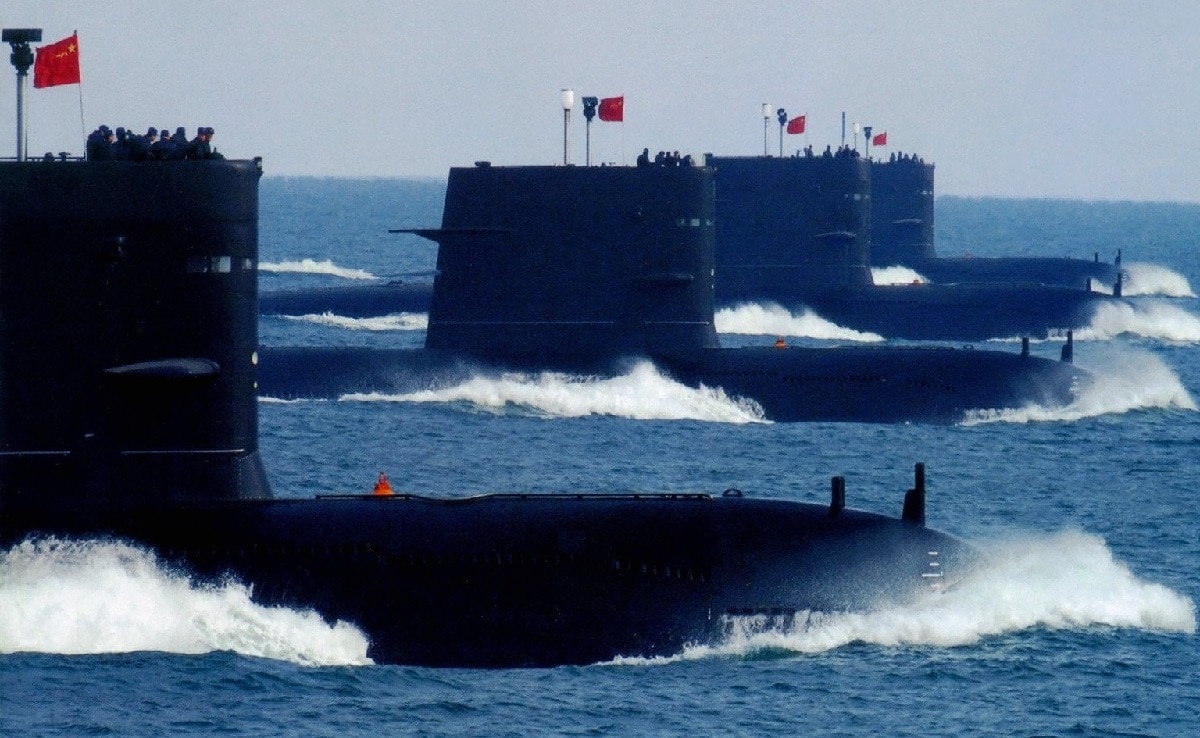
From a Coast Guard perspective, the most interesting development sighted below was the transfer of 22 Type 056 corvettes {photo above) from the Navy to the China Coast Guard. This follows the earlier transfer of four type 053H2G frigates (NATO designation Jiangwei I). In both cases heavier weapons were removed but significant gun armament remained. These added significantly to the China Coast Guard’s close in firepower. When the new China Coast Guard was formed in 2013, very few of their ships were armed with anything larger than 14.5mm machine guns.

Chinese H/PJ-17 30mm

That has changed, particularly since the China Coast Guard was absorbed into the country’s Central Military Commission (CMC), effective July 2018. The standard fit now seems to be a 76m gun and one or two 30mm H/PJ-17.

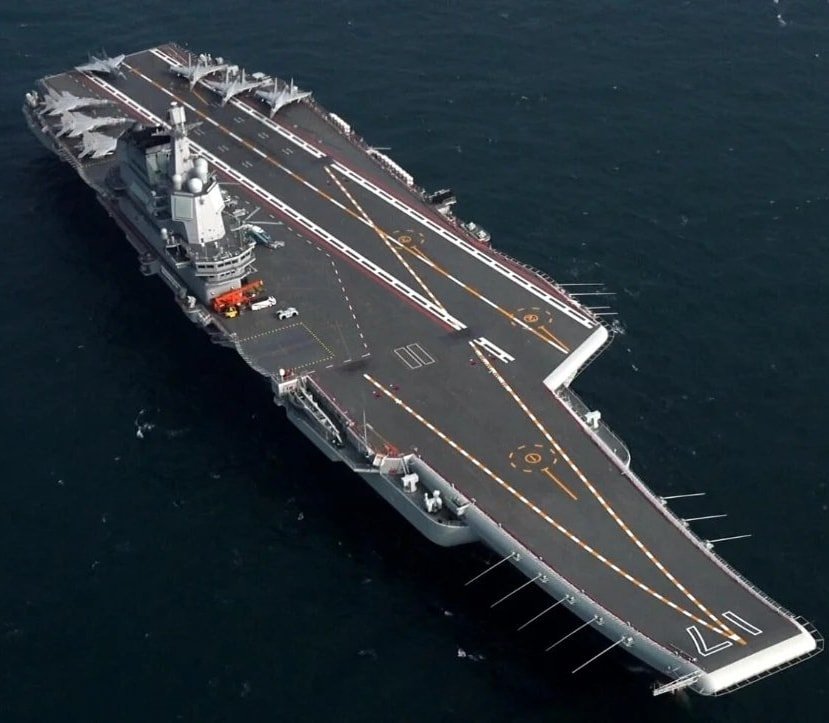
Undated photo of carrier Shandong. PLA Photo

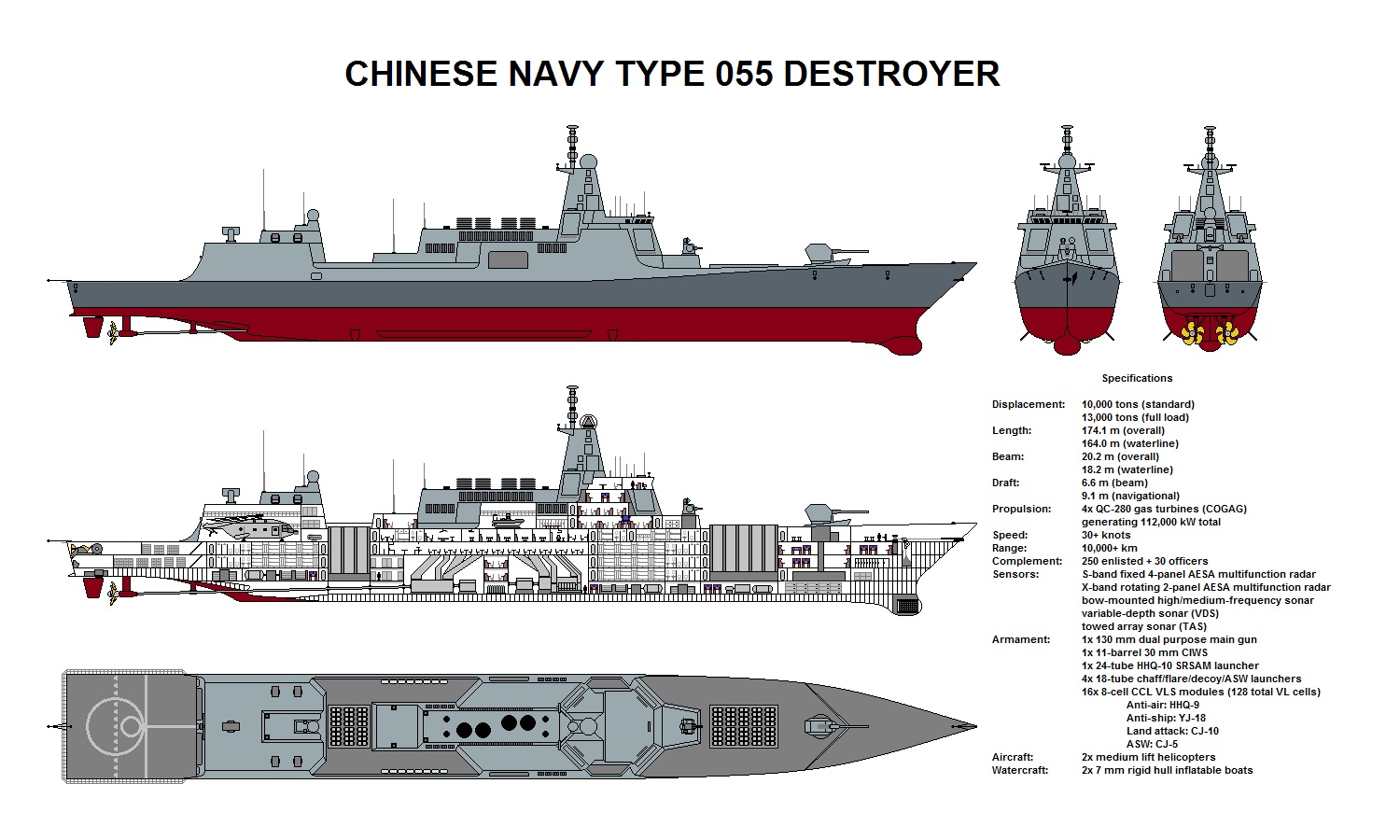
Type 055 Destroyer (Cruiser) SeaWave.com image

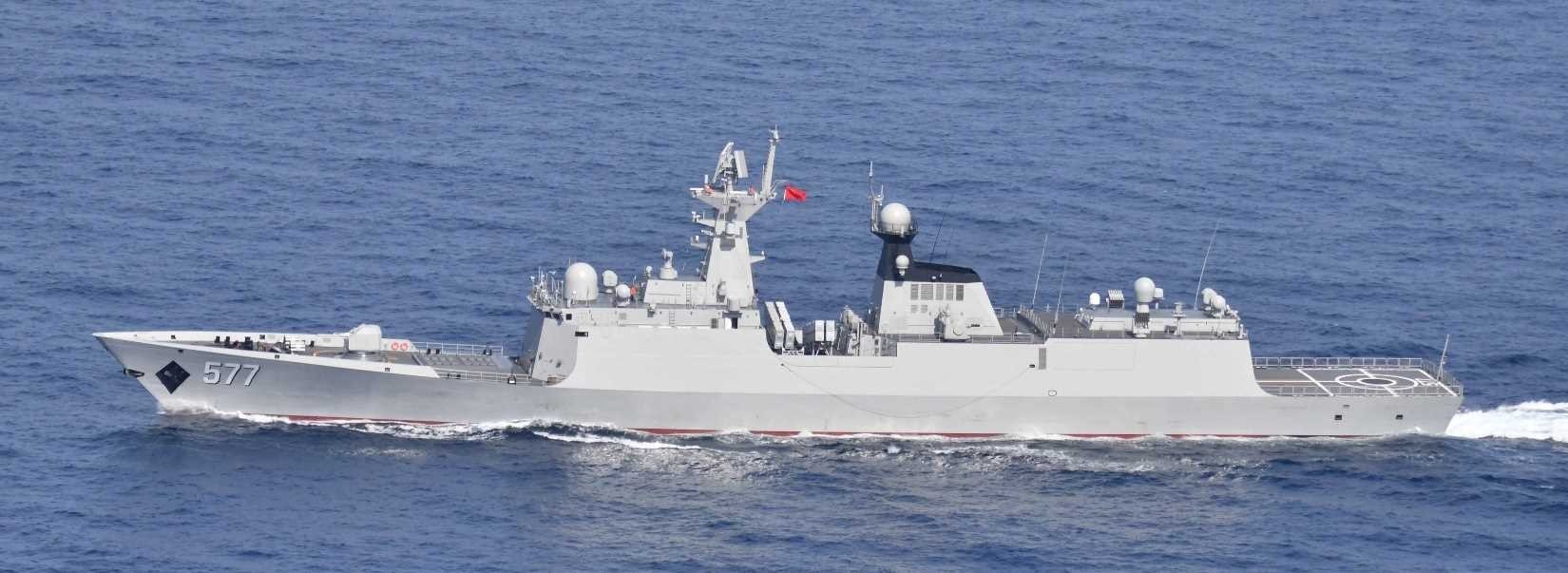
PLAN Type 054A Huanggang (FFG-577), Japanese Self Defense Force photo.

Type 056 corvette, credit 樱井千一

Image: Creative Commons.

CSR Report RL33153 China Naval Modernization: Implications for U.S. Navy Capabilities—Background and Issues for Congress by Ronald O’Rourke dated February 28, 2014. Page 8 – Figure 1. Jin (Type 094) Class Ballistic Missile Submarine Source: Photograph provided to CRS by Navy Office of Legislative Affairs, December 2010.

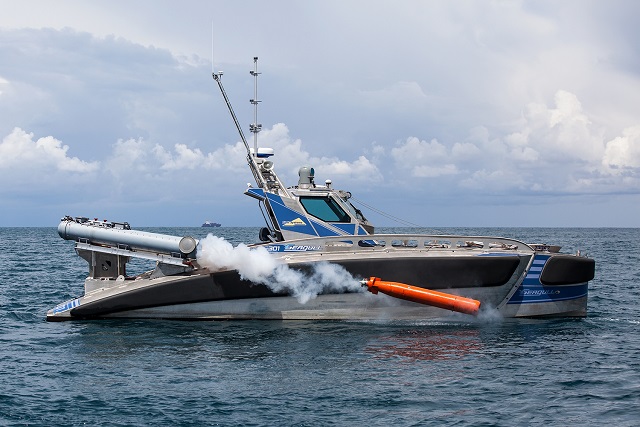
“Turkish “MIR” USV Test-Fires Torpedo For The First Time” –Naval News

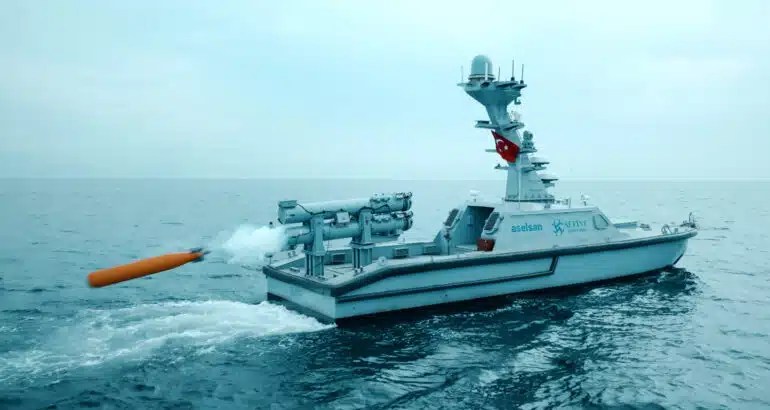
MIR USV firing torpedo (Screenshot from SSB video)

Naval News reports,

On April 18, 2023, the Turkish armed unmanned surface vessel (USV) “MIR” fired a light torpedo from a double torpedo tube at the stern of the ship. The test firing was the first torpedo launch from a Turkish USV.

This is offered as an ASW system, but if you are a regular reader here, you know I had to show the photo to illustrate how even a very small vessel can launch light weight torpedoes. (Of course, we have had previous examples, see photos at the end of the post.)

This is important because the Coast Guard has an unaddressed Required Operational Capability implicit in its Ports, Waterways, and Coastal Security Mission, that the Coast Guard needs to be able to forcibly stop any vessel regardless of size. A lightweight torpedo that targets a ship’s propeller(s) seems to be the best solution for stopping larger vessels (hopefully without sinking it and causing a major pollution incident).

Existing lightweight ASW torpedoes, like those launched from the USV illustrated above, might do the job if they also have an anti-surface capability. Distribution to Coast Guard units might be thought of as a storage option for a war reserve, in that, while the Coast Guard would need to have them widely distributed, even in the worst case the Coast Guard would actually use very few.

The author notes,

“…submarines are unlikely to engage these small units because of the limited minimum depth of some torpedoes or the limited amount of torpedoes the submarines have loaded.”

But if USVs become a threat to submarines, it will not be long before there is a counter. In fact, the already existing 6.75″ diameter (171.45mm), 220 pound (100 kilos), Very Light Weight Torpedo that would not displace any existing submarine weapons might anticipate this need. This weapon system might meet the Coast Guard’s needs.

A Navy briefing slide showing the internal components and describing the various features of the PSU_ARL Common Very Light Weight Torpedo (CVLWT) design

Camera drone’s-eye view of IRGC boats on display, March 2023. A) The air defense boat. B) Light missile boat with Bladerunner hull. C) light missile boats on Interceptor hull. D) light missile boats on Interceptor hull (alternative design). E) Missile boat, with type of missile unclear. F) RIB, possibly explosive boat or uncrewed. G) RIB with lightweight anti-ship torpedoes, can be carried aboard a Shahid Soleimani-class missile corvette. H) Interceptor boat. I) Interceptor boat with new type of missile.

Elbit Systems’ Seagull unmanned surface vessel launching a lightweight torpedo. 

Chinese Navy Submarine and Major Surface Ship Order of Battle

Image: Creative Commons.

Below are some info-graphics provided by Sarah Kirchberger on the CIMSEC Internal Discussions Facebook page. I wanted to share them with you. (Not included in the listings are Chinese aircraft carriers, amphibs, and numerous frigates, corvettes, and other small combatants.) I have also provided her notes included with the three Facebook posts, but first some observations.

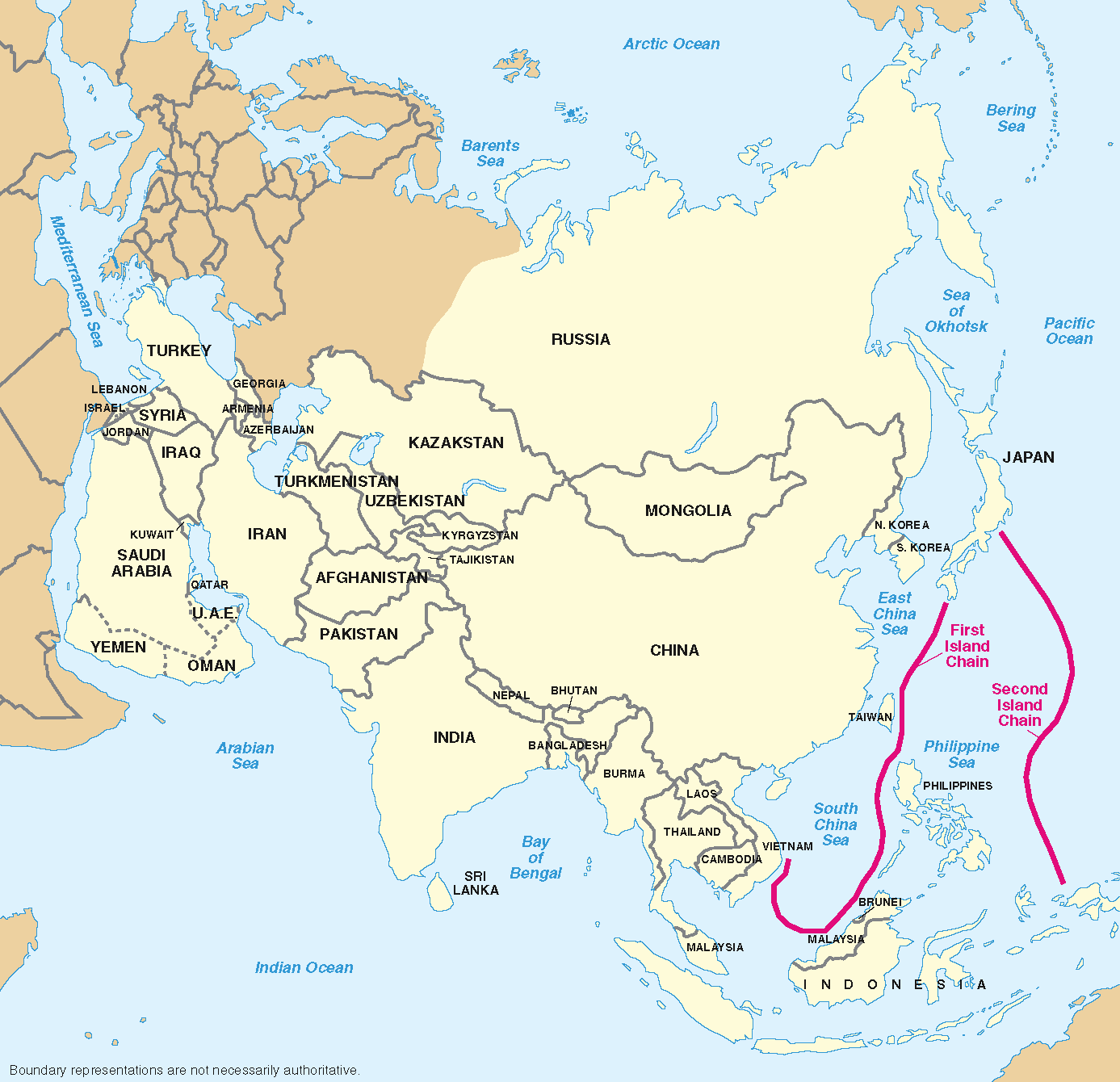
Geographic Boundaries of the First and Second Island Chains. Image:China Report 2006.pdf. DOD.

What does this have to do with the Coast Guard?

My expectation is that, if there is a major prolonged conflict with the Chinese, that the primary theater of operations will be inside and around the “First Island Chain” with Taiwan the critical center (Think Malta in the Mediterranean during WWII). The Chinese surface fleet is not likely to make significant operations outside this area. Chinese conventional submarines will also concentrate in this area but will also operate in the Straits that access the South and East China Seas.

The Chinese will make air and missile attack out to at least the “Second Island Chain,” including Guam.

The Chinese will want to attack US logistics and underway replenishment ships outside the Second Island Chain, both for the direct effect of reducing logistics available and for the secondary effect of drawing off units from the primary theater of action.

In the initial phase, the Chinese merchant and fishing fleets might be used to lay mines or even directly attack unarmed logistics and underway replenishment ships using containerized weapon systems supported by satellite targeting. (They might also launch cruise missiles into US ports as an opening salvo.) The Coast Guard Maritime Domain Awareness systems and cargo tracking programs will have a role in neutralizing the Chinese Merchant and distant fishing fleets.

The Chinese will operate at least some of their nuclear submarines (SSNs) (which would have difficulty dealing with USN SSNs) outside the Second Island Chain, perhaps as far East as the US West Coast. While MSC has been told not to expect escorts, the benefits of cutters with embarked Navy (probably Navy Reserve) ASW helicopters (and ultimately towed array systems) within effective helicopter range of a dispersed group of logistics ships to provide at least minimal ASW protection and rescue for the crews of the ships that are inevitably sunk, will quickly become evident. The cutters would hopefully be aided by Navy P-8 maritime patrol aircraft and any combatants making the transit trans-Pacific.

(None of the above reflects anything official, it is just the logic of the geography and the capability of the participants.)

Incidentally the format use below would be a good way for the Coast Guard to present its plans for major cutters.

Now to the Kirchberger posts:


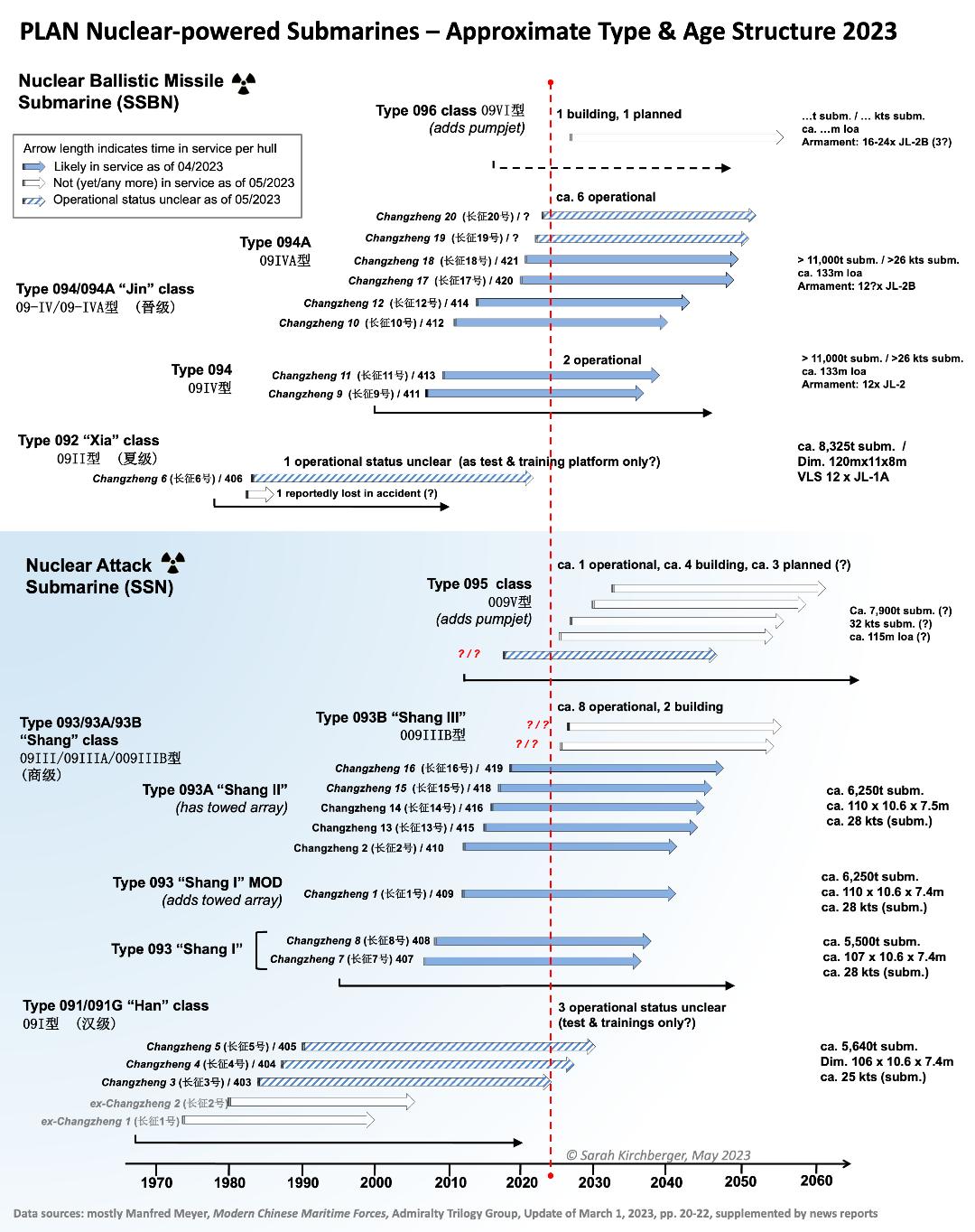
After a long pause in making these info graphics, here is an overview of the *approximate* type and age structure of Chinese nuclear-powered submarines. I am decidedly less confident than with the surface fleet graphs about the accuracy of the information, which is why it took so long. Basically, I have decided to just visualize the data given in Manfred Meyer’s book ‘Modern Chinese Maritime Forces’ (March 2023 update) with some minor adjustments based on cross-checking with own research in Chinese newspaper reports. Despite the caveat, the graph might be useful to some, therefore posting it. I will periodically update as more information becomes available.

Blue arrow means boat is (most likely) in service as of April 2023, white means not yet or not any more in service, but may already be launched. Striped means: status unknown.

Feel free to use and republish (unaltered) with attribution. In case you find mistakes, I’d appreciate a note so I can make corrections during the next round!

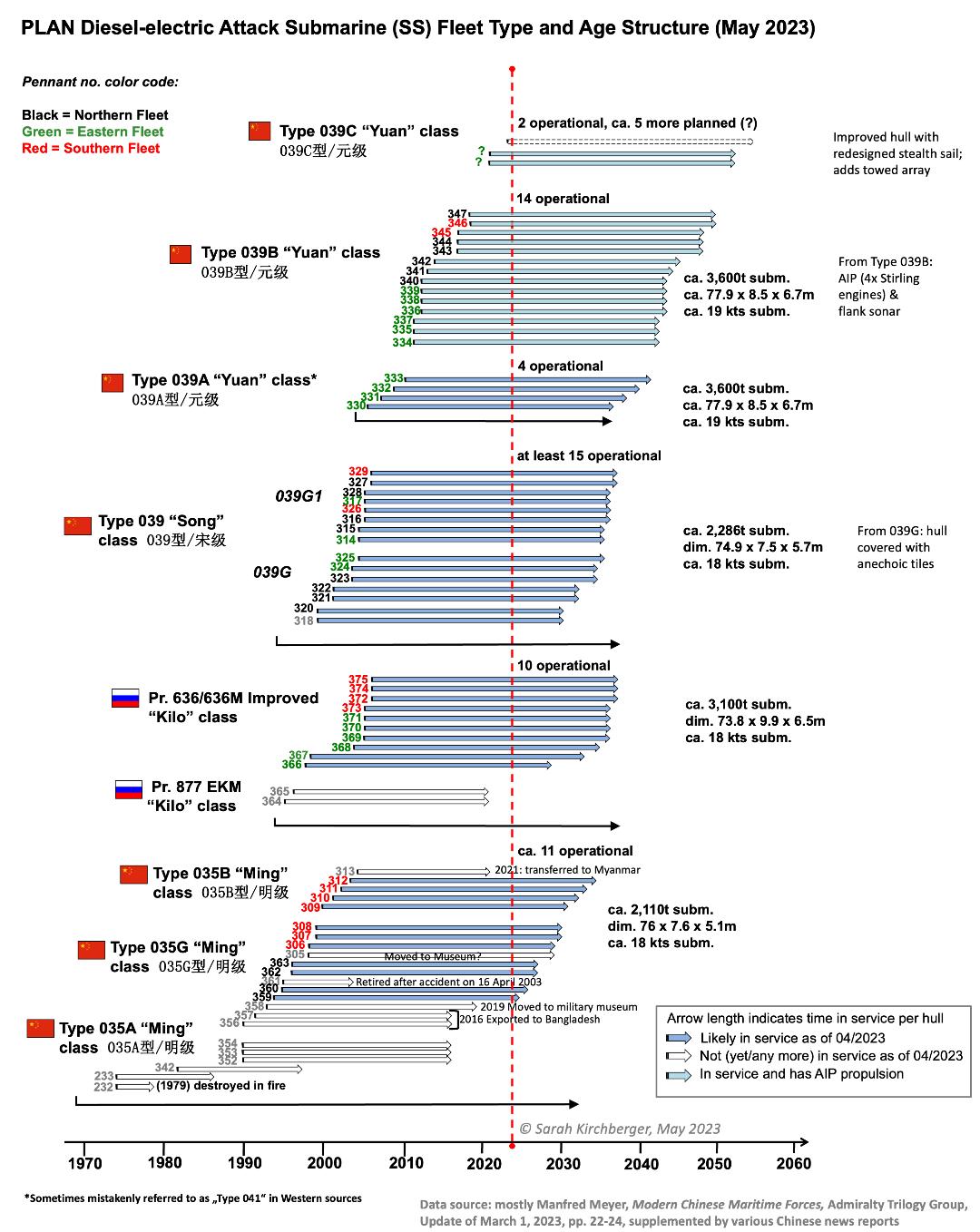
Here is now also a visual overview of the PLA Navy’s conventionally powered submarine fleet. Blue arrow means boat is most likely in service as of April 2023, white arrow means not yet, or not any more, but may already be launched. The teal color indicates boats equipped with a (Stirling) AIP. Does not include test submarines (such as the Type 032), the unknown type sailless submarine, nor midget submarines.

Feel free to use and republish (unaltered) with attribution. In case you find mistakes, I’d appreciate a note so I can make corrections during the next round!

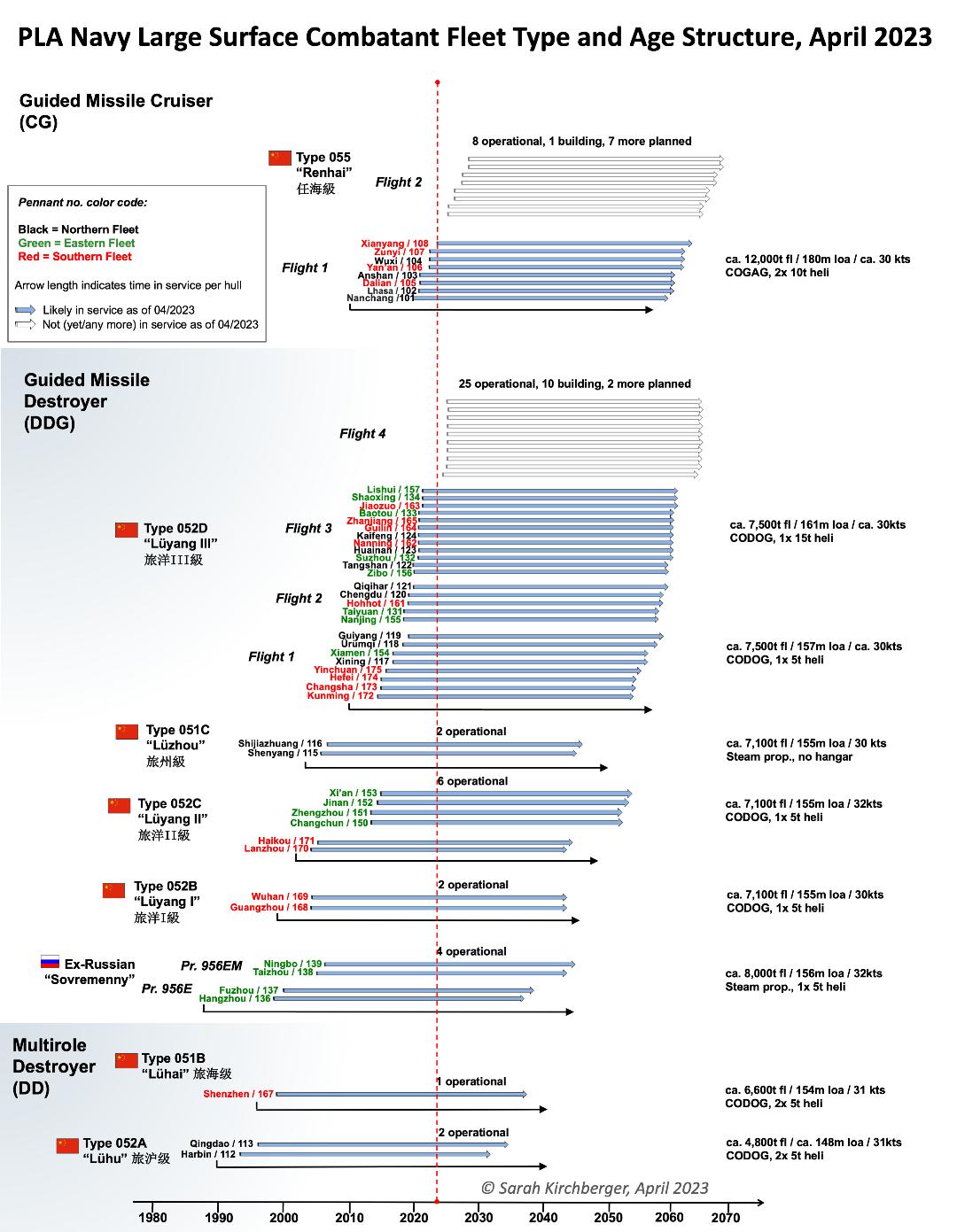
The speed of naval shipbuilding in China is such that it is easy to overlook that China has earlier this year commissioned the eighth and last of Flight 1 of its new cruiser, the Type 055 (never mind that the PLAN refers to it as a destroyer – at >12,000t full load, 180m length, and given its armament, it looks like a cruiser more than a destroyer).

Since the lead ship entered service in early 2020, China has commissioned altogether 8 of these Type 055 cruisers within a timespan of just 3 years! Further, 8 more are apparently already in the works, for a class of at least 16.
Here is an updated graphic overview of the type and age structure of China’s large surface combatants. Arrows indicate maximum time in service from commissioning until decommissioning – program start and build start is therefore not shown. 40 years per hull may be a bit long (30 years is common practice in most advanced navies), but in practice some navies have operated their surface combatants that long, so I choose to give the maximum conceivable length.
It is interesting to see how the arms embargo since 1989 initially disrupted naval shipbuilding, leading to multiple classes of just one or two hulls being built next to a Russian import, and how mass production finally took off from the Type 052D onward.
The Chinese official newspaper Global Times commented on the completion of the Type 055 class here: https://www.globaltimes.cn/page/202304/1289571.shtml
Feel free to use and reproduce this graph for non-commercial purposes (with attribution) and please let me know in case of mistakes so I can make corrections during the next iteration!

“US Navy Promises To Strengthen Merchant Marine And Coast Guard Partnerships” –gCaptain

The U.S. Coast Guard Cutter Waesche (WMSL 751) conducts a replenishment-at-sea with the fleet replenishment oiler USNS Laramie (T-AO 203) while patrolling the Eastern Pacific Ocean, April 20, 2020. Waesche was deployed to the U.S. Southern Command area of responsibility to support Joint Interagency Task Force South’s mission, which included counter illicit drug trafficking in the Caribbean and Eastern Pacific. U.S. Coast Guard photo by Chief Petty Officer Dave Horning.

gCaptain reports,

“U.S. Navy Undersecretary Erik Raven spoke today at the opening ceremony of the US Navy League’s Sea Air Space conference in Maryland, emphasizing the importance of the United States Coast Guard (USCG) and the United States Maritime Administration (MARAD) in naval planning and strategy.”

It’s always nice to be appreciated.

There is more of course. The Navy sees the Coast Guard as doing much of the peacetime housekeeping that Royal Navy gunboats did prior to WWI. If you want a rules-based international order, you have to have someone enforce the rules.

I get the feeling the Navy is glad they don’t have to do much IUU fisheries or Alien Migrant Interdiction. They only do enough drug interdiction to say they are doing something.

I am a bit perplexed by the degree of naval warfare equipment provided for the NSCs and OPCs by the Navy. They have spent a great deal of money equipping Coast Guard ships with sensors, communications and electronic warfare equipment, and defensive systems like Phalanx and the 57mm Mk 110. They take us 80 to 90% of the way to being useful warships. Cutters are adequately equipped to do something like the Market Time operation the Coast Guard participated in during the Vietnam war, but other than perhaps boarding merchant ships to help enforce a blockade, I don’t see that we have a mission in the most likely near peer conflict, a fight with China. We have defensive equipment, but the Chinese really would not have any reason to shoot at us, because we are not a threat.

Is there a classified plan to up arm Coast Guard cutters to turn them into viable and useful warships? The fact that NSCs have hosted Navy helicopters during the last two RIMPACs, an MH-60S in 2020 and an MH-60R in 2022, suggest they may be thinking about the question, but I don’t see any evidence there is such a plan.

From the end of WWII until the breakup of the Soviet Union, the most capable Coast Guard cutters had a recognized wartime role. They would escort the reinforcement convoys that would provide logistics support for US and Allied forces resisting a Soviet invasion. They were not the only escort vessels or the best equipped, but they had role.

That role was practiced and exercised.

There is a lot we could do to improve coordination with the Navy Reserve to provide a mobilization potential.

Perhaps equally importantly, the weapons the Coast Guard does have, do not allow our cutters to fully execute their peacetime duties.

Where are the weapons to quickly and reliably stop small fast highly maneuverable craft? The big cutters are not likely to be around. A 7.62mm machine gun on a Response Boat Medium or a .50 cal. on a WPB are inadequate. We might even be out-gunned. Even a 25mm on a FRC doesn’t provide much reassurance because it is a short-range weapon with limited penetrating power on a platform that can be outrun by many potential threats. Using any of the three weapons inside a US port presents a danger of collateral damage.

How is the Coast Guard supposed to forcibly stop a medium to large ship, with a crew that refuses to be stopped? Even the 57mm and 76mm guns are inadequate in the unlikely event a large cutter is in the area. In the more likely event only a WPB or WPC is in the area we are essentially helpless.


Hero 120 Loitering Munition

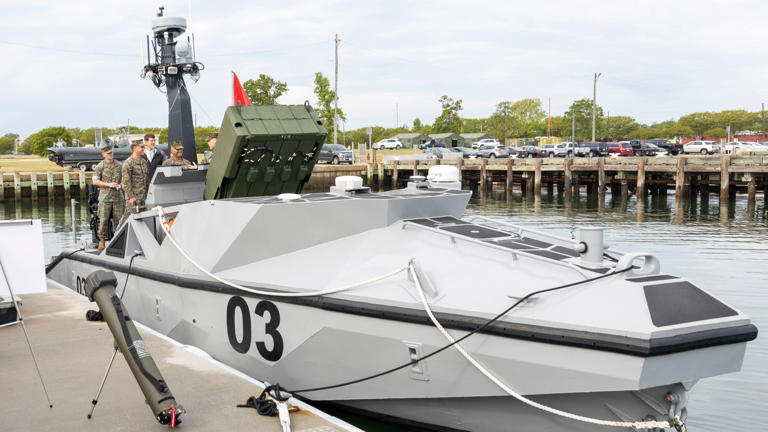
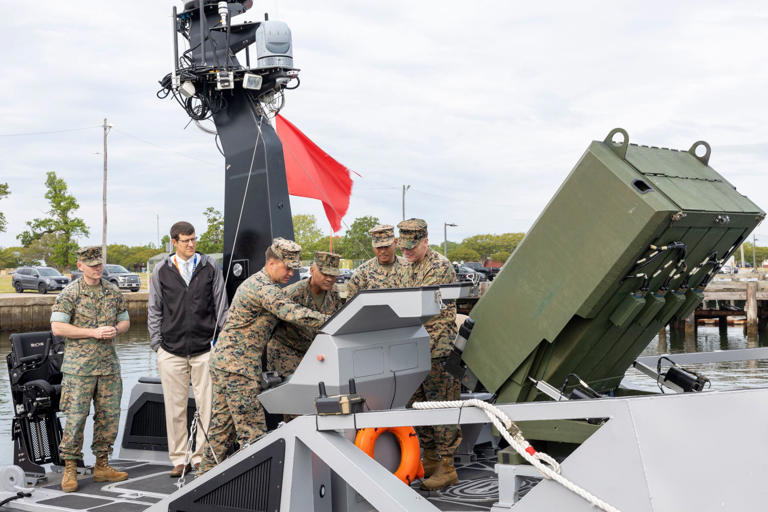
The Navy/Marine Corps has a new weapon in their inventory, and it may be just what the Coast Guard needs to deal with the potential threat of small, fast, highly maneuverable craft. It is a loitering munition, a drone with a warhead, making it a kind of slow cruise missile with an ability to abort.

Hero 120 will be going on the Marine Corps Long Range Unmanned Surface Vessel (LRUSV) as well as Marine manned ground vehicles.

Weight (with canister): 18 kg (40 pounds)
Warhead: 4.5 kg (10 pounds)
Range: 60+ km (32.4 nautical miles)
Endurance: 60 min
Engine: Electrical
Launch method: Single/Multi-Canister

Range is to some extent apparently limited by line of sight, but this could be used from land or from virtually any patrol boat.

Take a look.

“Iran Reveals World’s First Air Defense Small Boat” –Covert Shores

Camera drone’s-eye view of IRGC boats on display, March 2023. A) The air defense boat. B) Light missile boat with Bladerunner hull. C) light missile boats on Interceptor hull. D) light missile boats on Interceptor hull (alternative design). E) Missile boat, with type of missile unclear. F) RIB, possibly explosive boat or uncrewed. G) RIB with lightweight anti-ship torpedoes, can be carried aboard a Shahid Soleimani-class missile corvette. H) Interceptor boat. I) Interceptor boat with new type of missile.

Covert Shore has a post about a new Iranian Revolutionary Guard Corps (IRGC) Navy boat armed with vertical launch anti-aircraft missile, believed to be the first such craft in the world, but I found the photo above and the accompanying caption particularly interesting.

These are far different from the familiar, prototypical IRGC boats armed with a single machine gun and a few unguided rockets.

“How Lockheed Doubled The Range Of Its Joint Air-To-Ground Missile” –The Drive

16 tube patrol boat installation. 32 tube surface vessel installation. Eight tube vehicle installation.

(I meant to post this weeks ago, but I must have been distracted)

The Drive reports on tests of an upgraded Joint Air Ground Missile (JAGM) that will be replacing the Hellfire. While originally conceived as an air launched anti-surface weapon, both Hellfire and JAGM have proven more flexible, being launched from the surface and being used against low altitude air targets. I found these comments particularly relevant to possible Coast Guard use.

As to the platforms that could potentially fire JAGM-MR, the fact that early tests have been from ground launchers reflects the fact that the initial priority is to field it in a land-based form.

“We’re looking at various ground-based capabilities and looking to demonstrate vertical launch in the 2023 timeframe, although I don’t have specific dates,” Drake adds. “That could naturally transition into, you know, launch from an LCS [Littoral Combat Ship], as an example. And then other unique ideas that I really can’t speak to today.”

There is good information here about both Hellfire improvements and JAGM.

I must admit, I think these weapons would be a good fit for the Coast Guard, allowing even relatively small Patrol Boats (WPBs) to have the punch of a medium caliber gun, and with the range improvements coming, even greater effective range, at far less total cost. They should be particularly effective against small, fast, highly maneuverable surface threats and might be useful against larger vessels as well, all while minimizing the possibility of collateral damage. Importantly, these weapons are already in the Navy’s inventory.

Some previous discussion of Hellfire and JAGM:


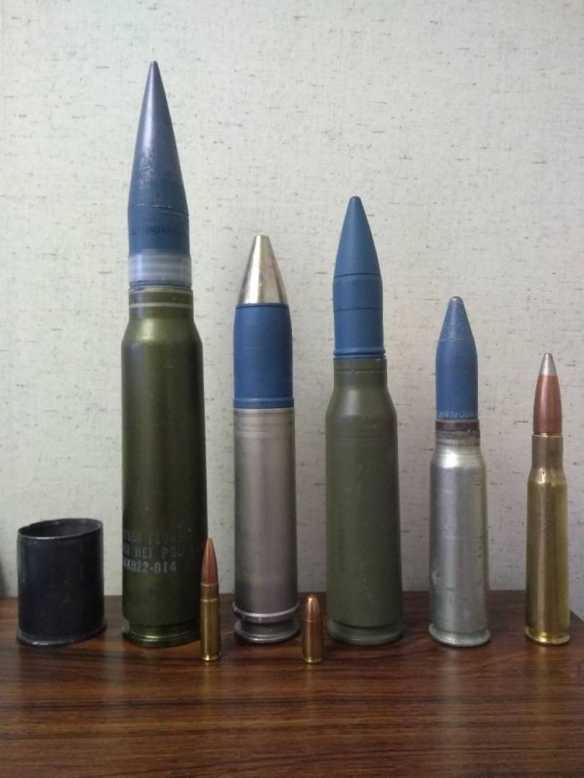
Why we, and the US Navy, need the 30mm

I found the video above through a post from Defense News “Rafael unveils video of counter-drone capability on Typhoon weapon.” The vessel in the video is, I believe, the Israeli built, Shaldag V class, Philippine Navy patrol boat BRP Lolinato To-Ong (PG-902). Presumably the video was taken during the vessel’s trials.

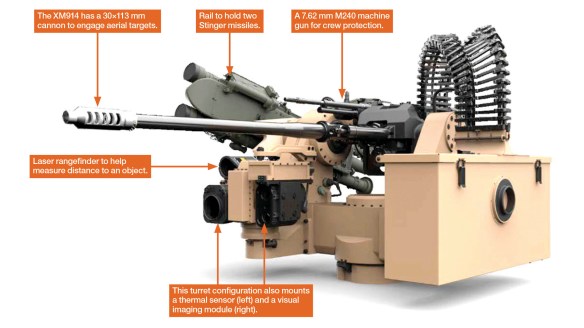
While the story is about the latest 30mm version of the Typhoon Remote Weapon Station, the lesson for the Coast Guard (and the Navy) seems to be that the new 30mm air burst ammunition fired from the Mk44 Bushmaster II gun, which is also part of the M38 Mod4 system, provides a Counter UAS capability that is not possible with our current 25mm guns.

If that were not enough, we have known for a long time that the 30mm is much more effective than the 25mm against even small surface craft.

The air burst is not the only type of round that is available for the 30mm but not the 25mm. There is the swimmer round that makes it more likely the gun can punch a hole in the hull below the water line. It is also likely to be more effective against ships’ propulsion machinery.