“Northrop Grumman to Develop New Guided Ammunition for the US Navy” (57mm) –News Release

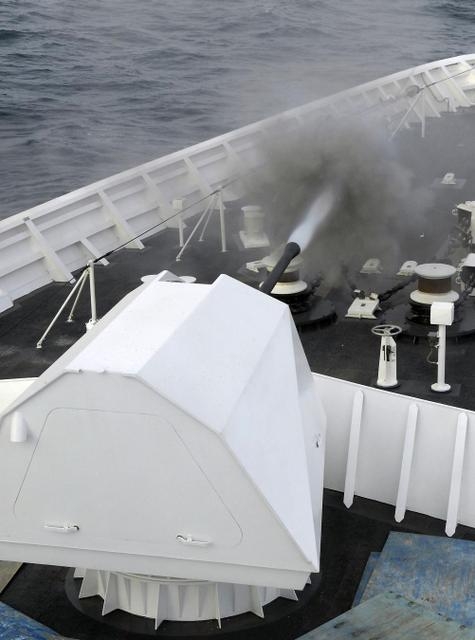
Test firing of the 57mm Bofors aboard USCGC Bertholf, photo by MMagaro

Below is a news release from Northrop Grumman. I have to ask what is going on? The L3 developed 57MM MK 332 Mod 0 (ALaMO) guided round, meant to address the same type targets the Northrop Grumman news release talks about, is already in service and available for export. Additionally, Raytheon was developing MAD-FIRES as a guided round to engage the more difficult cruise missile threat. I still have not heard anything that would indicate MAD-FIRES is in service.

Is this Northrop Grumman round cheaper? More capable? Or is the Navy just diversifying sources? The news release below does claim, “Utilizing seekers and an aft-maneuver system, the round provides continuous trajectory guidance no matter how often the target may pivot. (emphasis applied) That might be a difference.

My last post on ALaMO here.

(The 57mm Mk110 is mounted on both types of LCS, the National Security Cutters and will be mounted on the Offshore Patrol Cutters and the Navy’s new frigate)


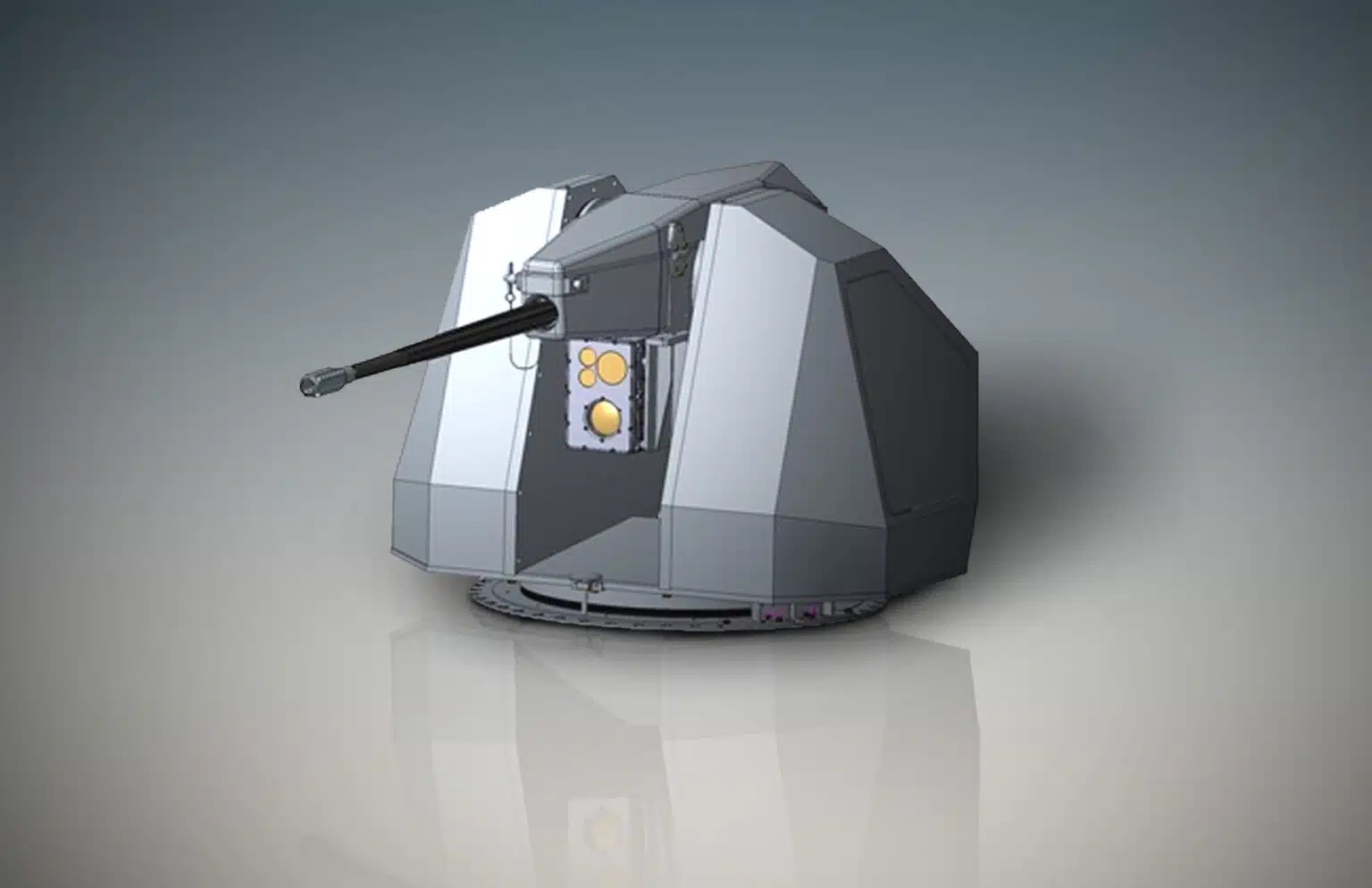
PLYMOUTH, Minn. – Oct. 4, 2023 – The U.S. Navy has awarded Northrop Grumman Corporation (NYSE: NOC) a development contract for the company’s newly designed 57mm guided high explosive ammunition. Designated for use with the Mk110 Naval Gun Mount, the company will test and mature the munition for qualification.

The 57mm guided high explosive ammunition has the unique ability to continuously maneuver in-flight as it moves toward a designated target. Designed to defend against fast moving surface threats, drones and swarming threats, the guided 57mm ammunition features an on-board seeker to acquire moving targets and a fuze with the ability to self-select for either proximity or point-detonation mode to best engage and defeat the intended target.

“Our new 57mm guided ammunition is truly innovative in its ability to identify, track and guide itself to a target,” said Dave Fine, vice president, armament systems, Northrop Grumman. “The Navy will gain a greater capability to defend against moving threats and a new level of accuracy to defeat them.”

As the newest addition to Northrop Grumman’s advanced ammunition portfolio, the 57mm round leverages the company’s expertise in guided munitions, such as the Precision Guidance Kit. Utilizing seekers and an aft-maneuver system, the round provides continuous trajectory guidance no matter how often the target may pivot. This new guided ammunition will give the Navy greater stand-off range and a cost-effective solution against small, fast-moving threats, without any weapon system modifications.

Northrop Grumman is a leading global aerospace and defense technology company. Our pioneering solutions equip our customers with the capabilities they need to connect and protect the world, and push the boundaries of human exploration across the universe. Driven by a shared purpose to solve our customers’ toughest problems, our 98,000 employees define possible every day.

“MSI Defence Systems to supply MK 48 Mod 2 EOS to US Navy & US Coast Guard” –Navy Recognition

MK48 Mod2 EOS MSI-DS Electro-Optical Sight System. (Picture source: MSI Defence Systems)

Navy Recognition reports,

According to information published by the US DoD on September 29, 2023, MSI-Defence Systems has been granted a contract worth $29,263,267 for the supply of the MK 48 Mod 2 Electro-Optical Sight (EOS).

This electro-optic system is associated with the 30mm Mk38 Mod4 gun weapon system.

30mm Mk38 Mod4

As far as we know, the first Coast Guard ships to get the Mk38 Mod 4 will be the Polar Security Cutters. I am hoping we will see the weapon on some of the Offshore Patrol Cutters.

I found it interesting that this contract provides not only for the Navy and Coast Guard but also the Military Sealift Command, because, currently, none of their ships have installed weapon systems.

“This initiative is in line with the enhancement of the MK 38 Mod 4 Machine Gun System, which will benefit the Navy, Coast Guard, and Military Sealift Command.”

“U.S. Marine Corps And The New Long-Range Attack Munition” –Naval News

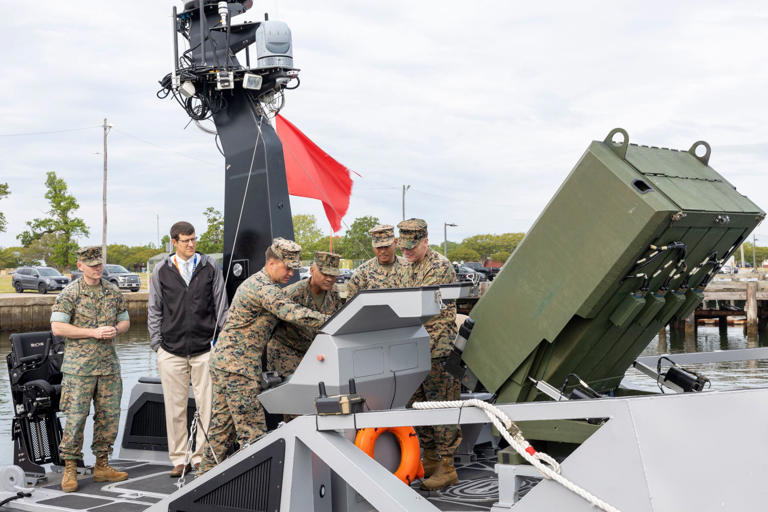
Not exactly the same, but you get the idea:   U.S. Marine Corps Lt. Gen. Brian W. Cavanaugh, the commanding general of Fleet Marine Force, Atlantic, Marine Forces Command, Marine Forces Northern Command, and Marines with 3d Marine Littoral Regiment, 3rd Marine Division, examine the manual controls to the Long Range Unmanned Surface Vessel, Joint Expeditionary Base Little Creek-Fort Story, Virginia, April 27, 2023. A LRUSV is an optionally manned vessel capable of extended travel and transporting loitering munitions that accurately track and destroy targets on sea or land. Metal Shark is designing, building, testing and implementing the LRUSV system under an other transaction authority aggrement with Marine Corps Systems Command to primarily serve as an intelligence, surveillance, and reconnaissance platform.
© Provided by The Drive

Naval News reports the Marines hope to develop a new long range loitering munition. It would take off vertically, be relatively inexpensive, be usable against both moving and fixed targets, on land or at sea, with a “minimum total payload weight capacity of 25 pounds (lbs) to include weapon seeker and warhead (but excludes fuel weight)” and have a range of about 150 nautical miles.

This might be something the Coast Guard could use. Single rounds should be effective against small, fast, highly maneuverable threats, while multiple hits might be effective against larger threats.  The relatively long range would mean it would not have to be widely distributed. A few, held as group assets, might be sufficient to deal with a terrorist threat.

Containerized SM-6 Launcher

The Navy Leagues on-line magazine, Seapower, has a recent post, U.S. Naval Forces Europe and Danish Defense Forces Train on SM-6 Missile Launcher Together.

Allies training together is routine, but there was a real surprise in the story,

The containerized configuration of the SM-6 launcher augments the U.S. Navy’s operational flexibility, facilitating rapid deployment and utilization in diverse theaters of operation, thereby underlining the commitment of the United States to ensure the security interests of itself and its allies.

—There is a containerized launch system for SM-6—

This means any ship with a good air search radar, sufficient deck space, and can handle the additional topside weight (like perhaps an NSC, OPC, or even an LCS) can have both a long range AAW missile system and a long range high supersonic anti-ship/anti-surface missile system.

As an Anti-Air system, the SM-6 incorporates an active radar seeker, so it does not require the radar illuminators that dominated the architecture of most AAW missile ships which used semi-active homing.

Quoting Wikipedia,

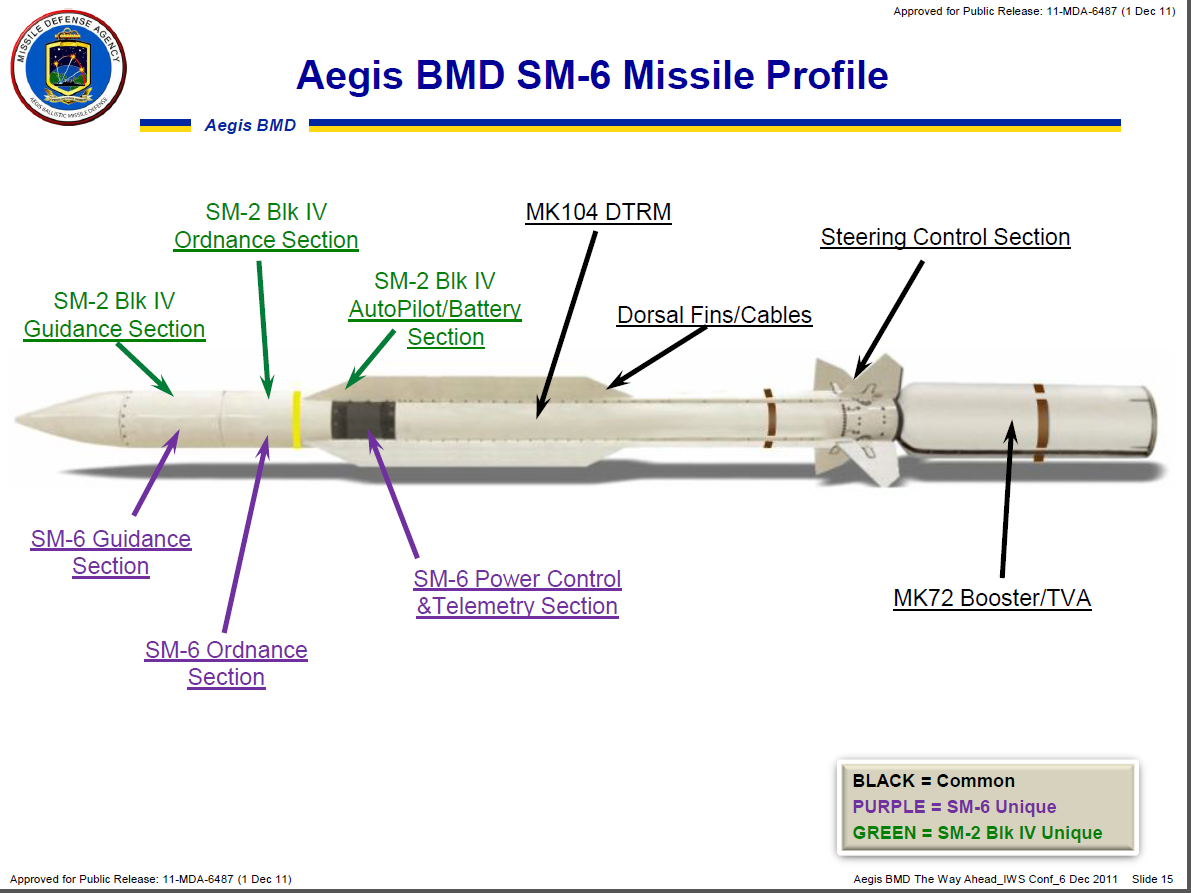
The RIM-174 Standard Extended Range Active Missile (ERAM), or Standard Missile 6 (SM-6), is a missile in current production for the United States Navy. It was designed for extended-range anti-air warfare (ER-AAW) purposes, providing capability against fixed and rotary-wing aircraft, unmanned aerial vehicles, anti-ship cruise missiles in flight, both over sea and land, and terminal ballistic missile defense. It can also be used as a high-speed anti-ship missile. The missile uses the airframe of the earlier SM-2ER Block IV (RIM-156A) missile, adding the active radar homing seeker from the AIM120C  AMRAAM in place of the semi-active seeker of the previous design. This will improve the capability of the Standard missile against highly agile targets and targets beyond the effective range of the launching vessels’ target illumination radars. Initial operating capability was planned for 2013 and was achieved on 27 November 2013.

I probably should not have been surprised by this since the army is planning on towed launchers for both Tomahawk and SM-6.

Presumably the launcher is based on the Mk41 VLS and if so, it should be able to launch a variety of weapons including ESSM, a shorter ranged, smaller, much cheaper missile that can be quad packed into the launcher, and vertical launch ASROC.

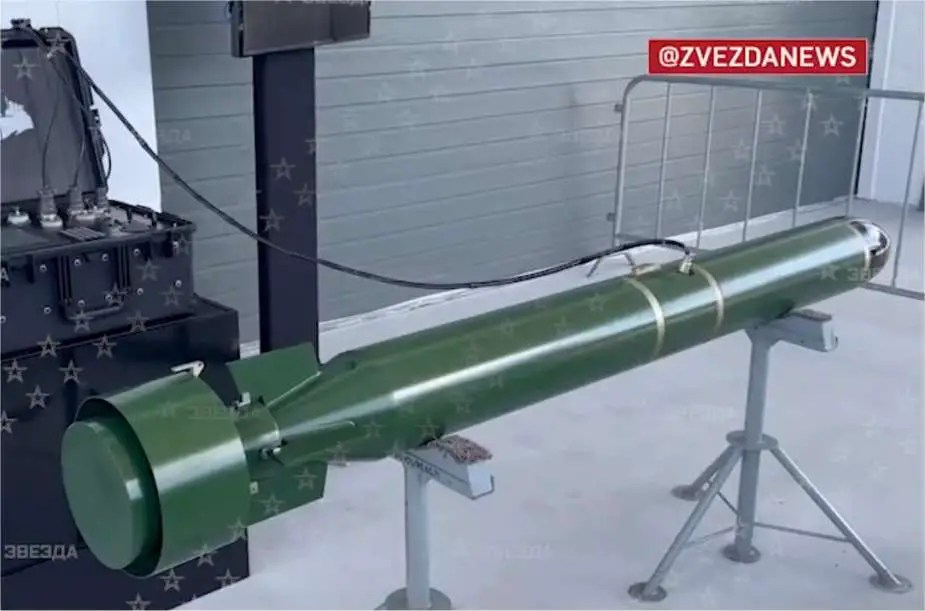
“Army 2023: Russian firm Gidropribor displays new torpedo” –Navy Recognition

New torpedo on the Gidropribor booth at Army 2023. (Picture source: Zvezda)

Navy Recognition reports, a Russian firm has developed a compact torpedo,

“It can target submarines, unmanned underwater vehicles, which is very relevant today, and surface ships…220mm in caliber, varies in length from 2.1 to 2.4 meters and weighs between 100 and 140 kg.”

I suspect the Russians saw what the US was doing with the Common Very Light Weight Torpedo (CVLWT) and figured we had a good idea.

The CVLWT is reportedly 6.75″ (171mm) in diameter, about 85″ (2.16 meters) in length, and weighs about 220 pounds (100 kilos).

I contend the Coast Guard could use the CVLWT to forcibly stop even large merchant ships that might be used by terrorists or for other nefarious purposes, probably without sinking it, which might lead to serious unintended consequence.

“Army Long Range Missile Launcher Spotted on Navy Littoral Combat Ship” –USNI

An Army MK 70 missile launcher on the flight deck of Littoral Combat Ship USS Savannah (LCS-28) in San Diego, Calif. Photo obtained by USNI News

The USNI News Service reports,

A portable missile launcher capable of firing a combination of long-range anti-ship and anti-air weapons was spotted this week undergoing testing aboard a Littoral Combat Ship in San Diego, Calif., according to photos provided to USNI News.

Based on a series of photos reviewed by USNI News, the launcher is a Lockheed Martin MK 70 containerized vertical launching system that is capable of firing both a Raytheon Standard Missile 6 and a Tomahawk Land Attack Missile. It was spotted on the flight deck of Independence-class LCS USS Savannah (LCS-28), which was pier-side in San Diego, according to a USNI News review of the images.

If you can operate Army missile launchers from an LCS you can also operate them from a Coast Guard cutter.

This could be particularly useful in Alaska where there are no Navy ships and limited road infrastructure. Launchers could be flown to meet cutters already in Alaskan waters long before Navy ships could reach the area.

Guns as Counter-UAS Weapons

A couple of videos from a The Drive post, “Gepard’s 35mm Cannons Blast Russian Drones Out Of The Sky In First-Person Video.”

TheFlakpanzer Gepard was not designed specifically for UAS. It was designed in the ’60s and fielded in the ’70s to protect against low flying aircraft like attack helicopters and the Soviet counterpart of the A-10 attack aircraft, the SU-25 Frogfoot.

The twin 35 mm guns are much more powerful weapons than the 25 and 30 mm weapons mounted on the Mk38 gun systems. Presumably in the counter UAS role they are using the “AHEAD” anti-missile rounds, rounds that might have been designed specifically to take out UAS, that fire 152, 3.3 gram tungsten metal sub-projectiles. The guns have a very high muzzle velocity (3,400 ft/sec for the AHEAD round) and a much higher rate of fire (550 rounds per minute per gun).

With the AHEAD round, the projectile weight is 1.65 lbs. (0.750 kg) compared with 0.406 lbs. (0.184 kg) for the 25mm HEI and HEI-T rounds, and 0.79 lbs. (0.362 kg) 30mm HEI-T round so the potential radius of destruction is substantially greater.

Still the 30mm with airburst ammunition should be effective, but it will probably require more rounds to get the job done and will have shorter effective range. Unless the 25mm has an airburst round it is unlikely to be effective.

It might be worth considering that while the Gepard’s firecontrol is radar, the Mk38 firecontrol is electrooptic. I can’t say unequivocally that that is a disadvantage, but it might be. Surely the drone builders will attempt to include countermeasures against both types of firecontrol.

How Bofors 57 mm Mk3/Mk110 Naval Gun Reload Works –Video

Thought this video was interesting enough to pass along.

This makes it clear why the nominal “220 round per minute” rate of fire for the 57mm Mk110 is only good for short periods. There can be up to 120 rounds on the mount but there may be interruptions to reload after 20 or fewer rounds. Frequently different types of ammunition are loaded in the left and right sides of the mount ammunition feed system, so there may be only 60 or fewer rounds of a particular ammunition type on the mount.

The linked information above includes a note for the 57mm Bofors 57 Mk2 which appears to share the same reload mechanism as the Bofors 57mm Mk3 (Mk 110 in US service) “Time to reload 120 rounds: 2 minutes”. It appears reloading the two 20 round ready service cassettes that move with the gun requires the gun to at or near maximum elevation. It is not clear if partially filled ready service cassettes can be topped off, I would hope that would be the case. The time to elevate, reload and return to firing position could be critical. Hopefully you will not wait until all 120 rounds on the mount are expended before reloading.

Thanks to Lee for bringing this to my attention.

Guns for Ukrainian Island Class Patrol Boats.

Ukrainian Navy Island-class patrol boats, formerly of the U.S. Coast Guard, conduct maritime security operations in the Black Sea off the coast of Odesa, Ukraine.
UKRAINIAN NAVY

This was on the U.S. Department of Defense Daily Digest Bulletin for Aug. 7, 2023.

Safe Boats International LLC,* Bremerton, Washington, is awarded a $22,271,829 firm-fixed-price modification to previously-awarded contract N00024-21-C-2201 for the exercise of options for procurement and installation of six Gun Weapon Systems onto the Island Class patrol boats with spares. Work will be performed in Tacoma, Washington, and is expected to be completed by October 2024. Foreign Military Financing (Ukraine) funds in the amount of $22,271,829 will be obligated at time of award and will not expire at the end of the current fiscal year. The Naval Sea Systems Command, Washington, D.C., is the contracting activity. (Awarded Aug. 3, 2023)

Five Island class 110 foot patrol boats were transferred to Ukraine.  One of them has been sunk.

Previously vessels of this class were armed with crew served Soviet era 25 mm guns.

This is reported as modification of an existing contract, so I presume at least one vessel has already been rearmed. Thinking two guns per vessel, then six gun systems will go on three additional vessels. So, at least four ships with two guns each. Presumably, they would be 25 or 30 mm guns, hopefully the new 30mm Mk38 Mod4.

The announcement does say, “Work will be performed in Tacoma, Washington, and is expected to be completed by October 2024.” If this is true, these are additional boats. The Coast Guard still has many available for transfer. It is also possible there might be only one gun per vessel. All we know for sure is in the quote above.

In Dec. 2019 there was a suggestion that these vessels might be fitted with anti-ship cruise missiles, but there has been nothing further to indicate it has or will happened.

“Coast Guard begins production phase of medium endurance cutter service life extension program” –CG-9

Coast Guard Cutter Spencer approaches the pier at Coast Guard Yard in Baltimore. Service life extension program work on the medium endurance cutter will last 15 months. U.S. Coast Guard photo.

Below is a release from the Acquisitions Directorate, CG-9.

I would note that all six ships getting this service life extension are “B class” 270s, built by Robert Derecktor Shipyard, Middletown, RI, numbers 905, 907, 908, 909, 911, and 912. Unlike the first four “A class,” these have a stronger flight deck, capable of supporting H-60s.

This release clarifies a lot about the SLEP program, but there are still some unknowns.

Reportedly the 76mm Mk75 gun and presumably the associated Mk92 firecontrol system will be removed. A Mk38 gun mount would presumably replace the 76mm, but it is not clear if any additional radar would be added to replace the air search and approach control functions that were provided by the Mk92. “Harriet Lane served as the gun weapons system prototype,” but I have not seen any post conversion photos of Harriet Lane that might show us the new sensor/weapon combination. Harriet Lane is expected to change homeports from Norfolk to Honolulu early in FY2024. Harriet Lane is an “A class” 270.

I also wonder if the SLQ-32 electronic warfare systems will be retained? Will the gun be the same 25 mm we have on the Webber class, or will at least some get the 30mm Mk38 mod4?


Coast Guard begins production phase of medium endurance cutter service life extension program

July 14, 2023

The service life extension program (SLEP) for the 270-foot Famous-class medium endurance cutters (MECs) moved to the production phase July 1 with the start of industrial work on Coast Guard Cutter Spencer.

Four main areas are being addressed during this SLEP, encompassing electrical, weapons system, engine and structural areas. Coast Guard Cutters Seneca and Harriet Lane served as prototypes for the electrical and structural work; Harriet Lane served as the gun weapons system prototype. Work on Seneca ran from July 2021 to March 2022; Harriet Lane work began March 2022 and is scheduled to be completed in August 2023.

Spencer will be the first hull to receive all major work items, including new main diesel engines. The work is scheduled to last 15 months.

SLEP work on the 270-foot MECs is planned through spring 2028 on five additional hulls: Legare, Campbell, Forward, Escanaba and Tahoma. The work involves targeted system replacement to address system reliability, supportability and obsolescence. SLEP work is completed at Coast Guard Yard concurrently with regular maintenance activities to achieve overall schedule and cost savings. The work will facilitate continued MEC operations during the service’s transition to the future offshore patrol cutter class.

In-Service Vessel Sustainment is the Coast Guard’s strategic class-by-class evaluation of its vessels to determine what major maintenance and upgrades are necessary for them to reach or extend their service lives.

For more information: In-Service Vessel Sustainment Program page