Chuck Hill's CG Blog

Chuck Hill's CG Blog

“U.S. Coast Guard Cutter Harriet Lane arrives at new homeport in Pearl Harbor” –News Release

USCGC Harriet Lane arrives Pearl Harbor. USCG Photo.

Below is a news release from CG News (more photos there). As part of the prototype SLEP, her 76mm Mk75 gun and Mk92 fire control system have been removed. The AN/SLQ-32 has been retained. It appears there are now additional communications antenna in place of the fire control system, and a 25mm Mk38 gun weapon system is mounted on a bandstand in place of the 76mm.


Dec. 13, 2023

U.S. Coast Guard Cutter Harriet Lane arrives at new homeport in Pearl Harbor

HONOLULU – U.S. Coast Guard Cutter Harriet Lane (WMEC 903) and crew arrived at its new homeport at Joint Base Pearl Harbor-Hickam, Wednesday, after transiting more than 8,000 nautical miles over 36-days from Portsmouth, Virginia.

The Harriet Lane is U.S. Coast Guard Pacific Area’s newest Indo-Pacific support cutter and spent more than 15 months in a Service Life Extension Program (SLEP) in Baltimore, Maryland, to prepare for the transition in missions and operations. Following reconstitution of the crew in July and returning to Portsmouth in August, the crew went through an extensive dockside period, ensuring the cutter was ready for the transit from the Atlantic Ocean to the Pacific Ocean.

“Re-homeporting U.S. Coast Guard Cutter Harriet Lane is indicative of the Coast Guard’s commitment to the Indo-Pacific – the most dynamic region in the world,” said Rear Admiral Brendan McPherson, deputy commander, U.S. Coast Guard Pacific Area. “Harriet Lane will work by, with, and through allies and partners within the Indo-Pacific region to promote capacity building and model good maritime governance.”

“The crew and I look forward to building partnerships in Oceania to enhance our capabilities, strengthen maritime governance and security while promoting individual sovereignty,” said Cmdr. Nicole Tesoniero, commanding officer of the Harriet Lane. “We plan to build upon many decades of enduring support, operating in concert with the needs of our partners.”

Harriet Lane and crew departed Coast Guard Base Portsmouth, November 2023, and during the transit, the crew conducted trainings for upcoming operations along with professional development for crewmembers. Harriet Lane transited through the Panama Canal, and had port calls in Golfito, Costa Rica and San Diego.

Harriet Lane, commissioned in 1984, is a 270-foot medium endurance cutter now homeported in Honolulu to support Coast Guard missions in the Pacific region. The service’s medium endurance cutter fleet supports a variety of Coast Guard missions including search and rescue, law enforcement, maritime defense, and protection of the marine environment.

“U.S. 4th Fleet’s Maritime Synchronization Symposium: Focus on China and Scaling the Hybrid Fleet”

U.S. 4th Fleet’s Maritime Synchronization Symposium: Focus on China and Scaling the Hybrid Fleet

Below is a USNAVSOUTH/4TH FLEET PUBLIC AFFAIRS news release.

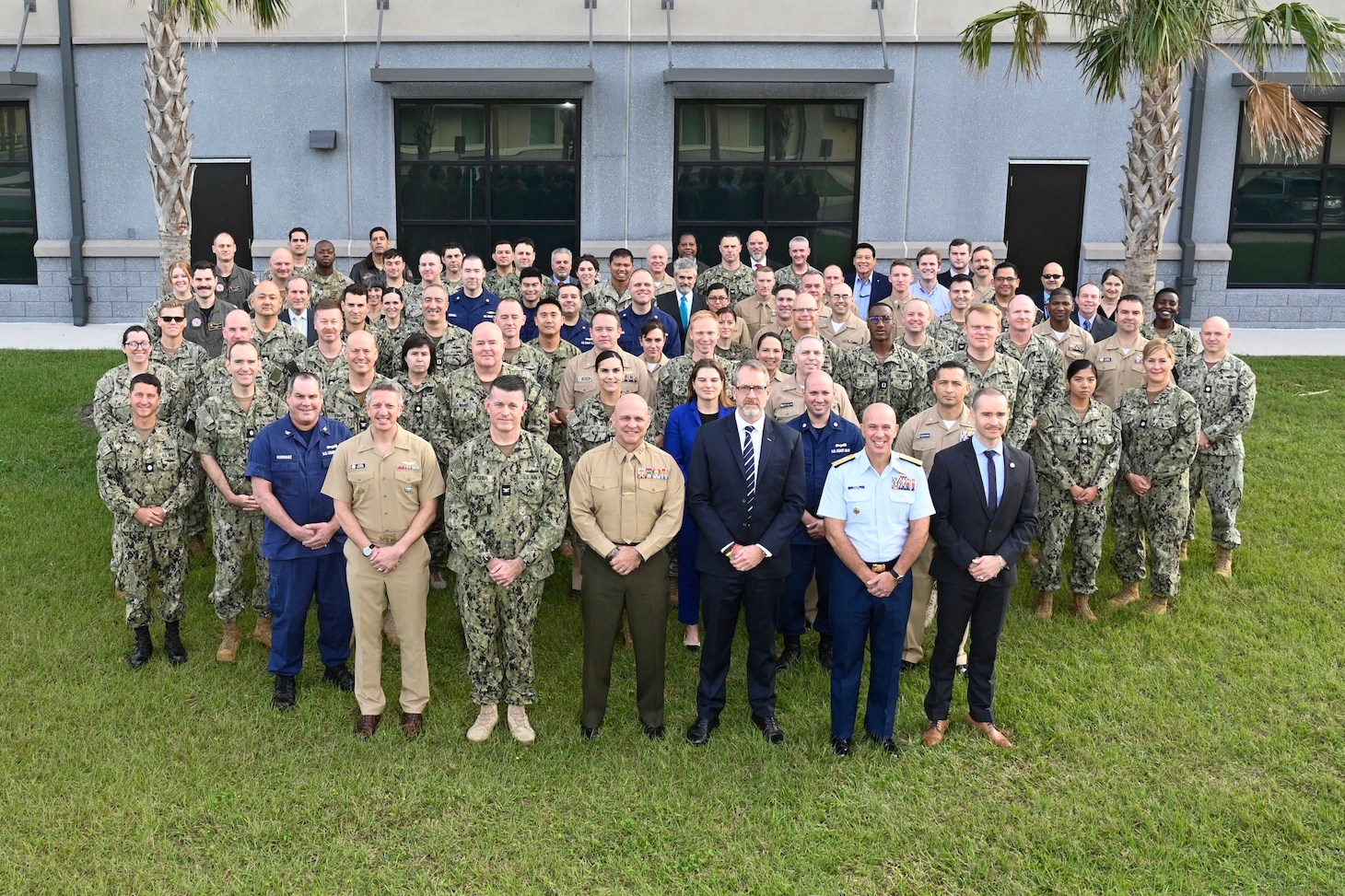
It does not mention the Coast Guard specifically, but the uniforms are recognizable in the photo above.

Surprising news is that USS George Washington (CVN 73) will deploy to the area next year. Presumably some escorts will come with her. Maybe they will do some drug interdiction along the way. (Wonder if this might be a signal to Venezuela.)

Significantly, 4th Fleet is now a center for experimentation with manned/unmanned hybrid operations that hopefully will ultimately also benefit the Coast Guard.


Dec. 12, 2023
U.S. Navy Attachés and U.S. Navy Section Chiefs serving in partner nations in the Caribbean, Central and South America gathered at Naval Station Mayport Dec. 5-8, 2023, for the annual U.S. Naval Forces Southern Command/U.S. 4th Fleet Maritime Synchronization Symposium.

This year’s symposium featured four guest speakers, expert panels, and question-and-answer sessions for the region’s Foreign Area Officers (FAOs) to discuss mutual challenges and opportunities, get the latest information on strategy, operations and exercises, and learn more about the Navy’s strategic competition with the People’s Republic of China and U.S. 4th Fleet’s campaign to inform the hybrid fleet.

The first guest speaker was Ambassador James Story, who most recently served as U.S. Ambassador for the Venezuela Affairs Unit, located at the United States Embassy in Bogotá, Colombia, and is currently a State Department Fellow at Georgetown University. Other guest speakers included Dr. Miles Yu, Professor of East Asia and Military History at the U.S. Naval Academy, Lt. Gen. David Bellon, Commander, U.S. Marine Corps Forces Reserve and U.S. Marine Corps Forces South, and Mr. Chris Diaz, Secretary of the Navy Carlos Del Toro’s Chief of Staff.

“We brought in dynamic speakers who gave our Navy Foreign Area Officers (FAOs) much to think about as they return to their respective countries,” said Cmdr. Stephanie Lastinger, U.S. 4th Fleet Theater Security Cooperation (TSC) Director. “They serve on the front lines of strategic competition and are successfully advancing American interests abroad.”

Participants were able to learn more about and provide input to staffers planning the upcoming Southern Seas and Continuing Promise deployments, which will feature USS George Washington (CVN 73) and USNS Burlington (T-EPF 10) deploying to the region next year. They also heard from Cmdr. David Edwards, U.S. 4th Fleet’s Technology and Innovation Director, who briefed Operation Windward Stack, the Fleet’s current operation in the Caribbean.

We are operationalizing technology in a campaign of learning where sometimes we win and sometimes we learn,” said Cmdr. Edwards. “We are sharing our results with the other fleets already and look forward to integrating hybrid fleet information with our partners.”

“This year’s symposium provided all of our FAOs, service providers, and stakeholders an opportunity to spend time together and develop relationships which will help them get better as members of their respective U.S. country teams,” said Rear Adm. Rich Lofgren, USNAVSOUTH/FOURTHFLT Reserve Vice Commander. “We know the critical work our FAOs perform in making the U.S. the maritime partner of choice in the Caribbean, Central and South America.”

U.S. Naval Forces Southern Command/U.S. 4th Fleet supports U.S. Southern Command’s joint and combined military operations by employing maritime forces in cooperative maritime security operations to maintain access, enhance interoperability, and build enduring partnerships in order to enhance regional security and promote peace, stability and prosperity in the Caribbean, Central and South American region.

Learn more about USNAVSOUTH/4th Fleet at https://www.fourthfleet.navy.mil, https://www.facebook.com/NAVSOUS4THFLT and @NAVSOUS4THFLT.

“Lockheed’s helicopter-borne jammer ‘defeats threats’ in US Navy test” –C4ISRnet

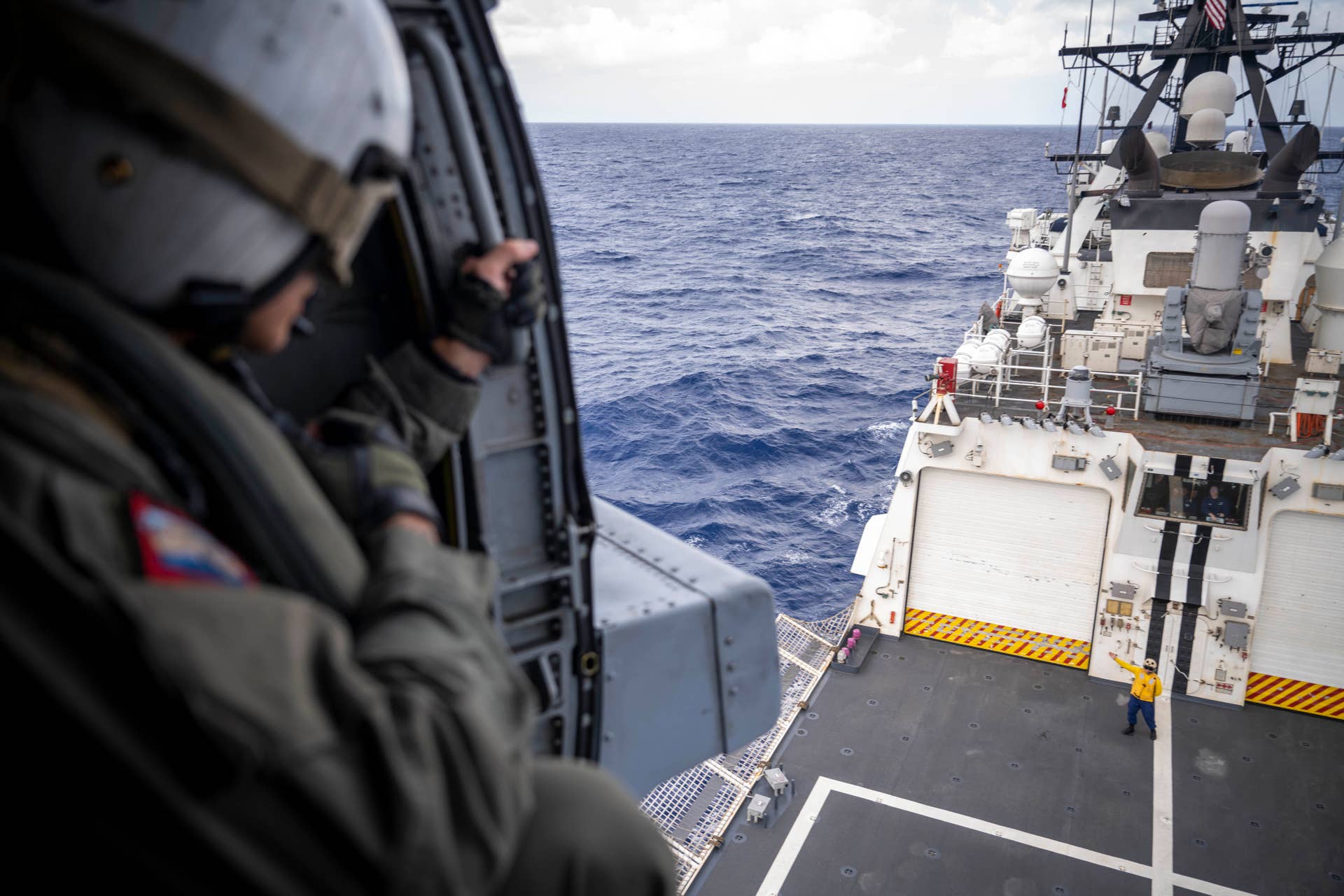
PACIFIC OCEAN (July 30, 2022) U.S. Navy Petty Officer 1st Class Humberto Alba, a naval aircrewman tactical-helicopter, attached to Helicopter Maritime Strike Squadron (HSM) 37, deployed on U.S. Coast Guard Legend-class cutter USCGC Midgett (WMSL 757), looks down at a USCGC crewmember after taking off during flight operations during Rim of the Pacific (RIMPAC) 2022. (U.S. Coast Guard photo by Petty Officer 3rd Class Taylor Bacon)

C4ISRnet reports,

“Lockheed Martin said it successfully tested an electronic warfare pod it’s developing for use in helicopters to detect and deceive anti-ship missiles.”

This is a big deal as it allows escorts and other ships (including maybe Coast Guard cutters) operating independently of aircraft carriers to enjoy the protection of airborne electronic warfare countermeasures.

“US Coast Guard Seeks Bigger Role to Search, Board Vessels in Pacific” –gCaptain

PERU, 10.07.2023, Courtesy Photo, USCG District 11
A Coast Guard boarding team member catches a view looking aft across the deck of a squid jigger vessel during a boarding inspection, with Coast Guard Cutter Alder in the background, during Operation Southern Shield 2023, October 2023. The Coast Guard recently completed the first high-seas boardings and inspections off the coast of Peru under a newly adopted multi-lateral agreement to monitor fishing and transshipment operations within the South Pacific Regional Fisheries Management Organization (SPRFMO) Convention Area. (U.S. Coast Guard photo)

gCaptain gives us a sort of status report on the Coast Guard’s emerging role in Western Pacific international fisheries enforcement.

“USNI News Fleet and Marine Tracker: Dec. 11, 2023”

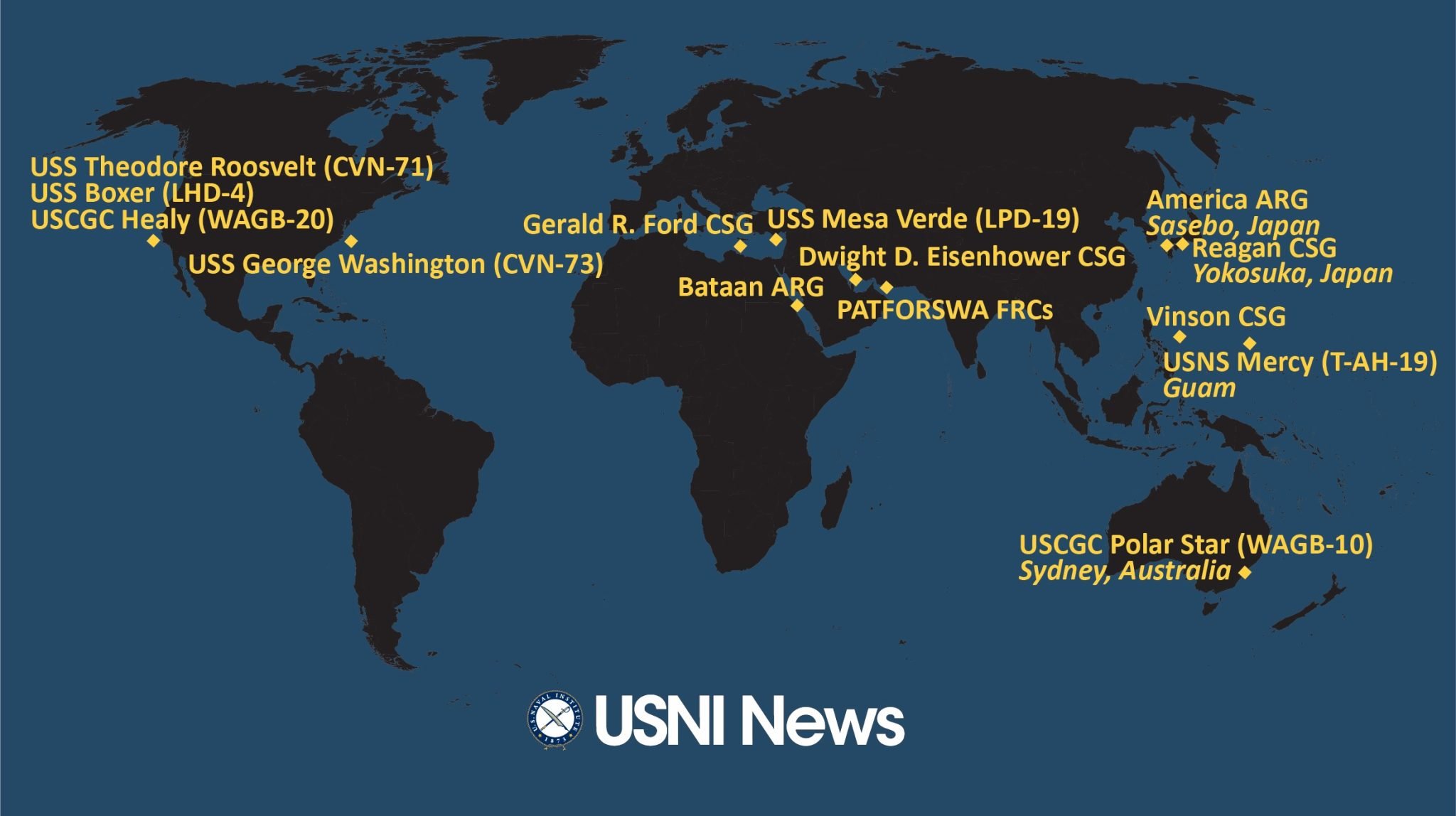
The latest USNI Fleet and Marine Tracker still does not include any indication of how many Navy ships are deployed to which fleets, but it does indicate that the Fleet is more active than usual with more than a third of the fleet deployed 109 out of 291 (37.5%) and more than the normal number of ships underway. Normally about a quarter are underway, but now 81 or 28% of the “battle force.” Not a huge jump but a noticeable increase.

Looks like USCGC Healey will be home for the holidays. Polar Star is down under.

“USCGC Healy (WAGB-20) is on its way to Seattle, Wash., expected to arrive on Dec. 18.”

“USCGC Polar Star (WAGB-10) arrived in Sydney, Australia on Dec. 9, 2023.” 

“Venezuela’s Border Dispute with Guyana Explained” –gCaptain

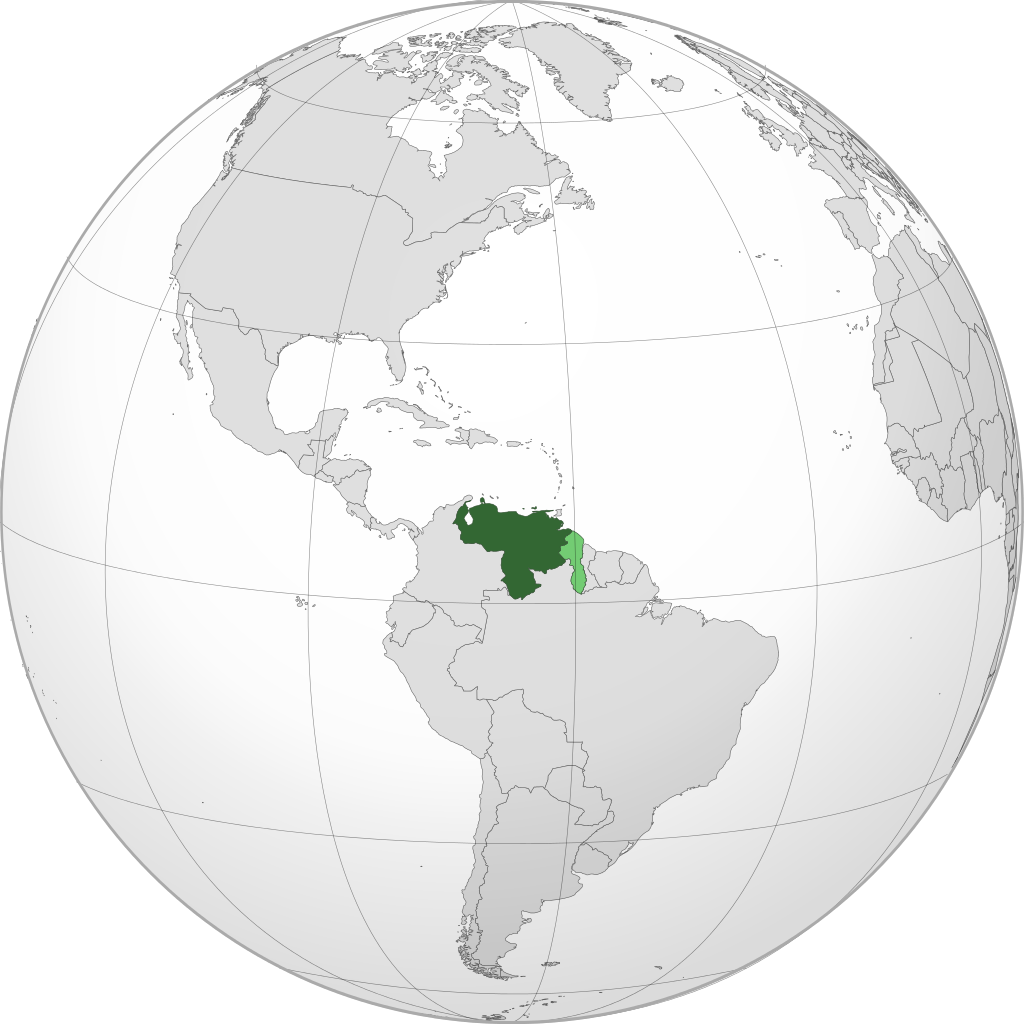
Orthographic map of Venezuela centered on Caracas Controlled territory in dark green. Claimed territory in light green.
From Wikipedia, author: Addicted04

gCaptain reports,

Tensions between neighbors Venezuela and Guyana have ratcheted up in recent weeks over a long-running territorial dispute.

At issue is a 160,000-square-km (62,000-square-mile) border territory around the Esequibo river, which is mostly jungle, and an offshore area where massive discoveries of oil and gas have been made.

The area in question has been recognized as part of Guyana since 1899, but Venezuela is making threatening noises. “A consortium by Exxon Mobil, China’s CNOOC and U.S. Hess began oil production in Guyana in 2019,” so the US has both economic and political interests in maintaining the status quo.

Since Coast Guard units routinely operate in the area and constitute the bulk of immediately available 4th Fleet assets, the Coast Guard may want to follow events there.

“GAO denies bid protest of waterways commerce cutter award” –Marine Log

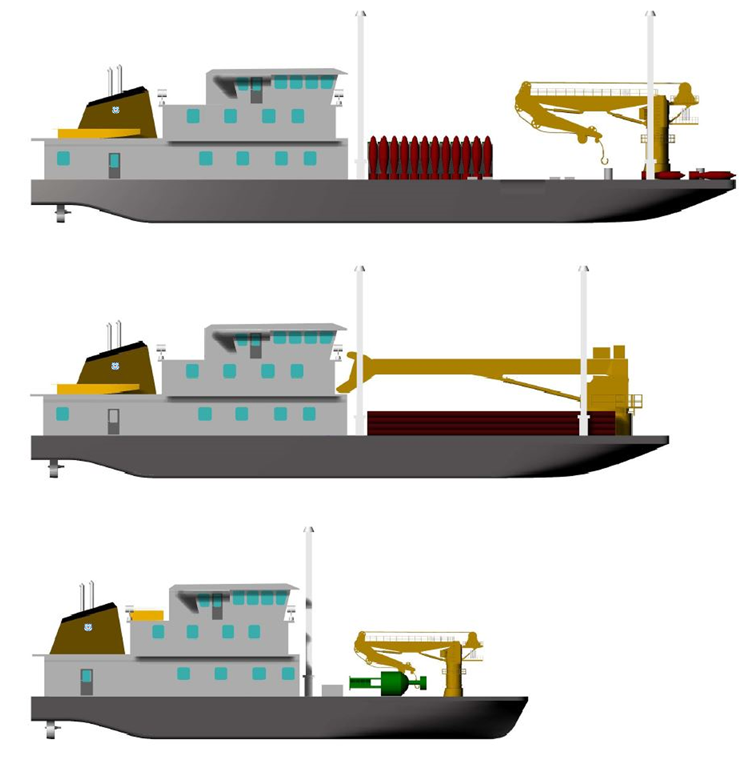
Shown above are Coast Guard indicative designs of a river buoy tender, inland construction tender and inland buoy tender.

Marine Log reports,

The Government Accountability Office (GAO) has rejected a bid protest filed by Steiner Construction Company, Inc., a small business of Bayou La Batre, Alabama, against the continued performance of a contract awarded to Birdon America, Inc. under solicitation No. 70Z02321RPRT00300, issued as a small business set-aside by the Department of Homeland Security, United States Coast Guard (USCG) for the design and production of 27 vessels for its waterways commerce cutter program.

Footwear Fashion for Boarding Drug Subs

Members of the Coast Guard Cutter Waesche (WMSL-751) law enforcement boarding team inspect a self-propelled semi-submersible (SPSS) in international waters of the Eastern Pacific Ocean, Nov. 20, 2023. The interdiction of the SPSS yielded more than 5,500 pounds of cocaine. In November 2023, Waesche crewmembers seized approximately 18,219 pounds of cocaine, with an estimated street value of over $239 million, during four separate suspected drug smuggling vessel interdictions or events off the coasts of Mexico and Central and South America. (U.S. Coast Guard photo)

It is a small thing but must be slippery boarding one of these at sea. Took a close look at their footwear. Was a bit surprised, but this would make sense. (Click on the photo to enlarge)

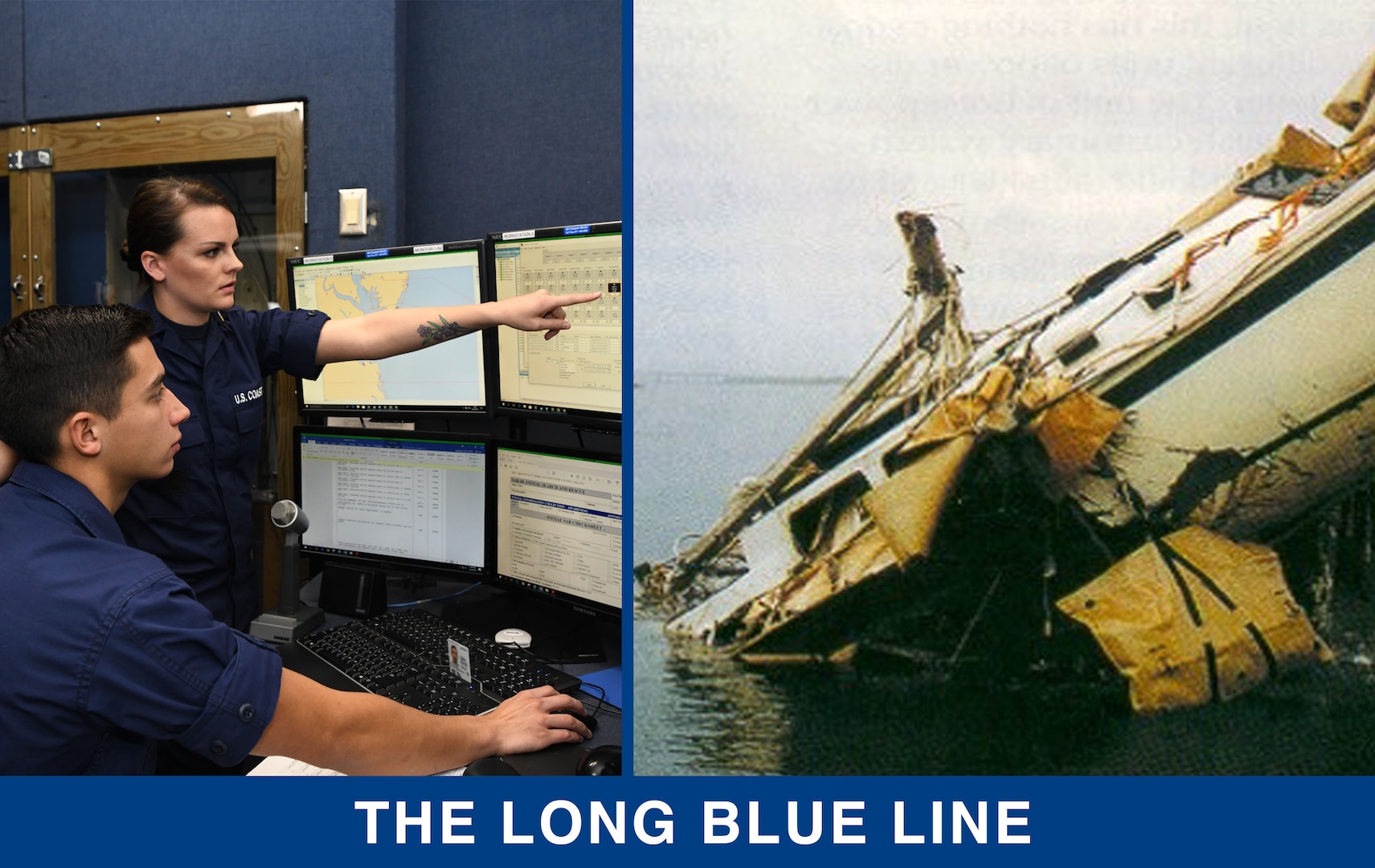
“The Long Blue Line: The loss of Morning Dew and genesis of Rescue 21” –MyCG

This is from MyCG. I am very proud that the Coast Guard did not simply say, “With as many calls as we get, it is inevitable that we will miss few.” Yes, we are human, but we can recognize and account for that. No call should go unanswered.

Dec. 8, 2023

The Long Blue Line: The loss of Morning Dew and genesis of Rescue 21

By Capt. W. Russell Webster (Ret.), United States Coast Guard

The Long Blue Line blog series has been publishing Coast Guard history essays for over 15 years. To access hundreds of these service stories, visit the Coast Guard Historian’s Office’s Long Blue Line online archives, located here: THE LONG BLUE LINE (uscg.mil) 

It was low tide in Charleston Harbor at 1:55 a.m. on Dec. 29, 1997 when 13-year-old Daniel Cornett’s anguished voice slashed the quietude of Coast Guard Group Charleston’s Watch Center:

“May … Mayday, U.S. Coast Guard, come in,” on Channel 16 (the distress channel) on VHF-FM marine radio.

The Sailing Vessel Morning Dew had just crashed into Charleston’s North Jetty. Daniel, his brother and cousin were jolted from a sound sleep. Daniel’s father, 49-year-old Michael Cornett, who had been steering the boat under engine power for the last eight hours, was ejected from the vessel, according to government reports.

At Coast Guard Group Charleston (later Sector Charleston), the regional maritime rescue headquarters, this particular four-second mayday radio call by the youngest Cornett family member was heard and automatically recorded by Stancil technology, a device designed to preserve critical radio messages. Unfortunately, the Coast Guard’s sole radio watchstander, a twenty-three-year-old petty officer, was 17-feet away from the radio console refilling his coffee mug as an otherwise quiet late-night shift drew on.

In his later testimony with the National Transportation Safety Board (NTSB), the petty officer said he heard only the tail end of the heavily garbled distress message, “U.S. Coast Guard, come in.” The radio watchstander had completed telecommunications school just a few months prior and only recently been qualified to stand watches without supervision. Despite what the NTSB would later call an extraordinary training program, he was unprepared for the circumstances that were about to unfold.

Following standard radiotelephone protocol, the watchstander responded fourteen seconds later: “Vessel calling Coast Guard, this is Coast Guard Group Charleston, over.” He then repeated his call using multiple radio transmission towers in different locations along the South Carolina shore. He also invited conversation on VHF-FM channel 16. But there would be no two-way interactive radio calls from the 34-foot sailboat Morning Dew on this fateful night.

Despite the odd time of night and prevailing weather conditions, the group’s radio watchstander quickly returned to the normal humdrum of off-season and late-night routine. This included monitoring as many as ten different frequencies that, during busy times, sometimes blared from an equal number of speakers mounted throughout the communications center. In the summer, radio watchstanders were constantly managing their time and involved in various conversations, often near simultaneously.

 Four minutes later, at 2:21 a.m., the crackle of an unintelligible burst of static was recorded on Group Charleston’s Stancil recorder. The watchstander, believing the earlier call and this one might be from the same source, again tried the radio without success. “Vessel calling Coast Guard, this is Coast Guard Group Charleston, over.” There was no response, and no log entries were made of the calls.

Given the state of the Coast Guard’s National Distress System network of VHF-FM near-shore system in late 1997, the Morning Dew’s only chance at this point in the distress would have been if the watchstander had been looking directly at the Direction-Finding equipment at the exact moment when the first distress call and the second follow-up static burst were heard. Even so, rewinding the tape and determining the word Mayday had been used would have only elevated awareness and mandated a call to his supervisor, the group duty officer (GDO) who was seeking authorized rest. Not hearing the initial word Mayday and theorizing a mariner was just testing his radio or the call had “skipped” from many miles away, and not following procedure to rewind the tape to conduct further investigation, the watchstander returned to other duties.

The radio watchstander would soon become involved with the Morning Dew again when he took a call from the local harbor pilot’s organization about four hours later, relaying a report from an inbound vessel of shouts being heard from the vicinity of Charleston Channel Buoy #22. He quickly relayed the information to his 17-year experienced GDO, who asked a pilot boat to investigate on behalf of the Coast Guard. Tragically, no additional assets were dispatched, and the GDO suspended further efforts before sunrise.

Around 11 a.m., tourists visiting from Atlanta would find bodies from the sailing vessel Morning Dew as two of the teenage boys washed ashore on a nearby beach. The Coast Guard then responded in full force, only to find a third body. Weeks later, the body of Morning Dew’s operator would wash ashore on a nearby island.

Within weeks, amid the growing hue and cry of the grieving family members, a major 18-month-long search and rescue analysis would be undertaken and begin to address difficult shortcomings in human behavior, procedures, and technology. Key gaps were the failings of the VHF-FM National Distress System (NDS) radio system, the backbone of the Coast Guard’s near-shore (20 miles) rescue communications system. Coast Guard Commandant James Loy would later go on to publicly speak about the Morning Dew case at a search and rescue conference entitled The Value of a Life. He would later say that, “there are two capstone issues that must be addressed by our service. There are issues of leadership and communications systems.”

 The original NDS in use for the Morning Dew case was built in the 1970’s, and was designed to provide Very High Frequency–Frequency Modulated (VHF-FM) radio coverage of 95,000 miles of coastline and connect mariners in distress to each other, point-to-point, and Coast Guard rescue services. After 25 years, the NDS’s problems were well known and documented in a Mission Needs Statement that, “formally acknowledged that a materiel solution is required to address the capability gaps.”

At the time of the Morning Dew case, there were as many as 68 known coverage areas where service was either poor quality or non-existent. The NDS was also supported by an antiquated tape-recording system that was both manually intensive and cumbersome. Additionally, the direction-finding system at the time had no recording capability. This meant that if a watchstander was not looking at the direction indicating compass rose at the time of the distress call and a different call came in, only the new call’s direction would be displayed.

According to Coast Guard sources, the Morning Dew case, “validated the need for a new VHF-FM system for the Coast Guard.”

The Morning Dew case was a collection of human and technological errors. Despite the original early morning call not having enough information to launch a rescue, the relatively junior Telecommunications Specialist failed to rewind the audio tape, make required log entries, or notify his supervisor. He also could not note the bearing of the call because he was recharging his coffee cup. Even if he had done all of that, the quality of the recording and in the insufficiency of locating information still might not have made a difference at that moment.

It would have, however, put rescuers on alert that they were dealing with an unresolved Mayday call, perhaps altering their response to the later cries heard from the Charleston channel area. The Coast Guard would eventually develop a new procedure in 2005 called, “range ring analysis” based on signal strength that could have provided a rough estimate of the caller’s position and a start point for a searchable area. But the Morning Dew case was in 1997.

Significant procedural changes would later be made. Among them, adding new watchstanders, always providing for at least three personnel on watch, on average. Additionally, experienced, permanent civilian search and rescue personnel would be provided in every sector for continuity and training purposes. Today’s watch centers still, however, feature a single communications operational specialist in a booth, but there are always more senior people around to discuss issues if there is any doubts about what to do.

The single most significant technological change the Coast Guard would make is the replacement of the NDS with the Rescue 21 (R21) near shore communication system. The system, an advanced command, control, and direction-finding communications system, was created to better locate mariners in distress and save lives and property at sea and on navigable rivers.

By harnessing state-of-the-market technology, Rescue 21 enables the Coast Guard to execute its search and rescue missions with greater agility and efficiency. Rescue 21 helps identify the location of callers in distress via towers which generate lines of bearing to the source of VHF radio transmissions reducing search time. It extends coverage to a minimum of 20 nautical miles from the coastline, improves information sharing and coordination with the Department of Homeland Security and other federal, state, and local first responders, and can also help watchstanders recognize potential hoax calls by identifying discrepancies between what a caller is reporting in distress and the actual transmission site, thus conserving, and reducing risk to valuable response resources.

 Relative to its predecessor systems, R21 can provide reliable and redundant capabilities to determine where some calls originate, rapid retrieval and position fixing, and ruling out the need for searches for obvious hoax callers. It also facilitates near shore distress cases in areas where the Coast Guard performs 90% of its rescues.

According to the Coast Guard’s Joe Ayd from the Office of C5I Capabilities, today’s Rescue 21 system implements, “the Coast Guard’s ability to receive VHF-DSC [Digital Selective Calling], which allows a vessel like the Morning Dew to simply press a button on their radio to [digitally] transmit a distress call and provide a position [if connected to the boat’s GPS] to the Coast Guard command center.” VHF-FM DSC took coastal rescue communications from a point-to-point system (distressed mariner – Coast Guard) to a virtual paging system where any boat receiving the DSC distress call is duty bound to digitally relay it to a Coast Guard shore rescue facility on behalf of the troubled mariner.

Ayd added that, “R21 made significant improvements to the ability of the watchstander to not only retrieve the audio of a call, but to also conduct some basic cleanup of the call to better understand what is being said through all the noise or garble.”

This means that an already busy Coast Guard watchstanders can economize on the effort to scan the recording within the confines of an already busy environment with the best chance of understanding the content of the call.

It took an 18-month exhaustive search and rescue system investigation, a 20/20 television expose and a $19.5 million-dollar civil judgment and more than two decades to complete R21 along U.S. coastlines and in Alaska’s remote and rugged areas. “The final tower in the Rescue 21 system was accepted in October 2017, completing a design and installation process spanning more than 20 years.”

The Coast Guard has made significant progress with the R21 VHF-FM system since the 1997 Morning Dew case. However, the venerable service faces new challenges and opportunities to improve near shore rescue communications. For example, over the last two years (Fiscal years 22 and 23), the Coast Guard has annually responded to between 15,000 and 16,000 calls for assistance with just over half being received by phone. During that same time, only between 1,200 and 1,500 rescues were initiated each year with radio notifications. Over the last decade, the number of rescue calls initiated by radio has declined while phone and other smart technology notifications have increased.

Captain Webster writes about contemporary Coast Guard rescues. Readers may contact him and access or order his published works, including Lost in Charleston’s Waves, detailing the Morning Dew tragedy, at https://www.wrussellwebster.com

“COAST GUARD Asset, Workforce, and Technology Challenges Continue to Affect Law Enforcement Missions” –GAO

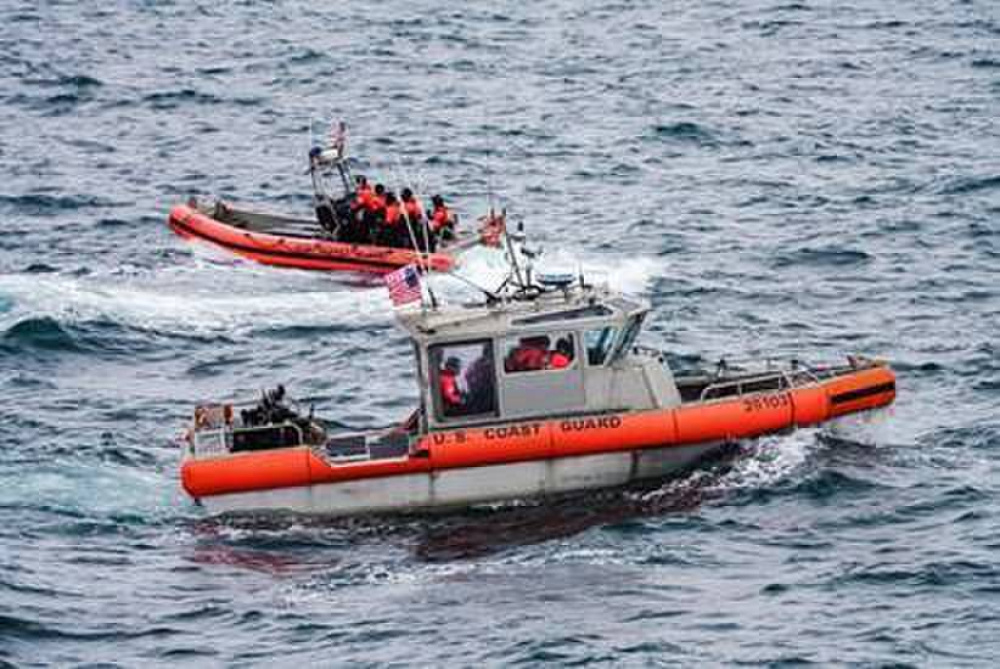
Two small boat crews from Coast Guard Cutter Stratton are underway for operations in the Bering Sea, April 30, 2021. Cutter crews use the small boats to conduct a variety of missions including search and rescue and law enforcement. U.S. Coast Guard photo courtesy Ensign Molly Dolan.

As if we did not know, the GAO is telling us the Coast Guard (unlike the rest of the Government) is having problems–OK I will stop being snide.

I really have not read any more than the highlights of this report, but there is something troubling here that might be turned to an opportunity.

GAO has found that the Coast Guard has not adequately determined its workforce needs. The Coast Guard has reported to Congress that it faces challenges meeting its daily mission demands because of workforce shortfalls. For example, in February 2020, GAO found that the Coast Guard had assessed a small portion of its workforce needs. GAO recommended that Coast Guard update its workforce plan with timeframes and milestones to meet its workforce assessment goals. As of May 2023, Coast Guard officials said they had not yet taken these steps but indicated it could be feasible to develop a rough estimate of how many positions it plans to assess in the next five years.

What I think this means is that not only has the Coast Guard been unable to fill its authorized billets, but the number of billets may be less than it should be. It may also mean the distribution of personnel may put too many people in some places and too few in others.

I think we have all seen this happen, no matter where we work.

But GAO is saying tell us what you really need. No doubt we should have been doing that all along, but it’s hard, and apparently it will take years to get an approximation.