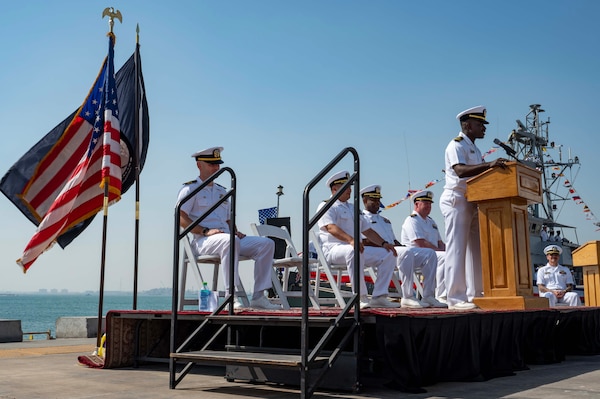
“U.S. Coast Guard, U.S. Navy, Mexican Navy and Royal Canadian Navy participate in North American Maritime Security Initiative” –D11

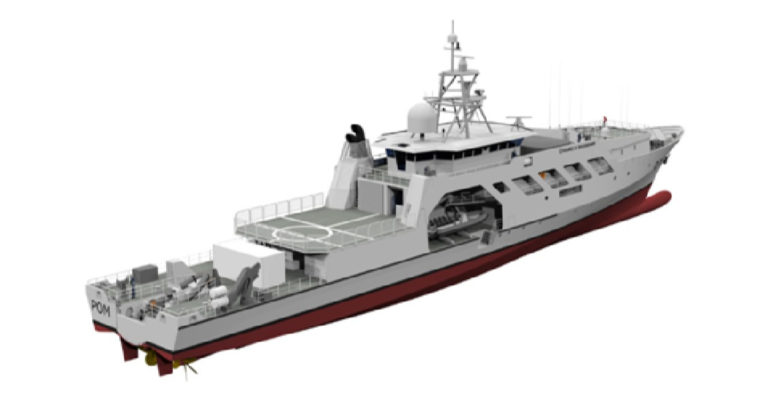
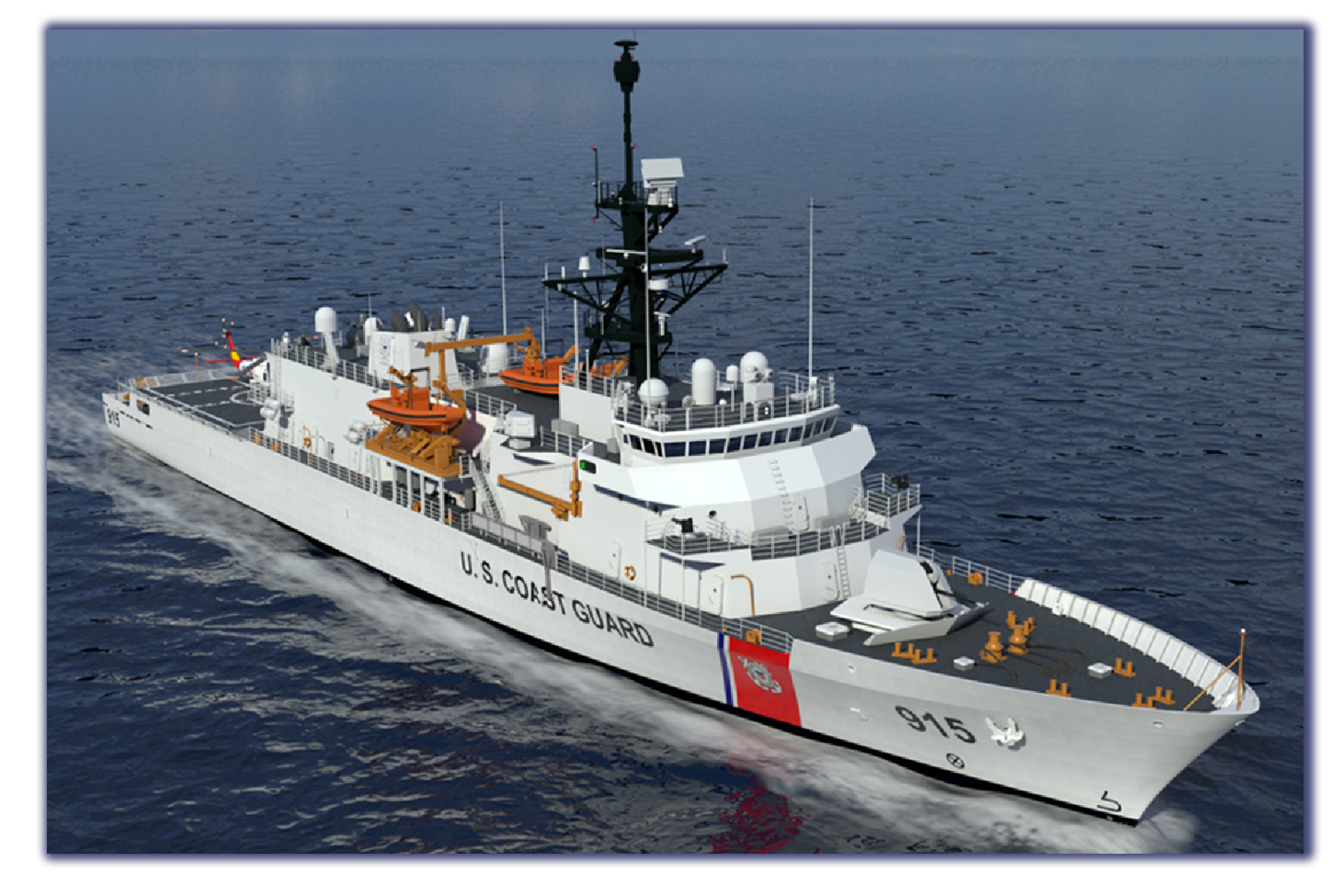
Illustration of a Mexican Navy Oaxaca class Offshore Patrol Vessel. ARM Hidalgo is a vessel of this class.

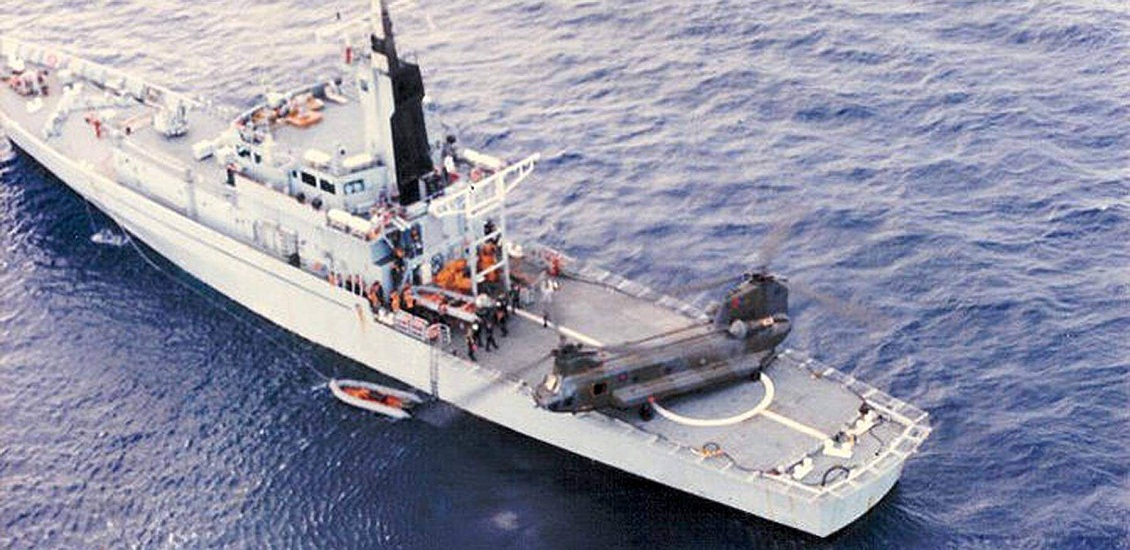
Below is a news release from District 11 you can also see on the Coast Guard News website. There are additional photos there. I have put together photos to illustrate the type vessels involved.

190729-N-AD499-1166 SEATTLE (July 29, 2019) The Royal Canadian Navy Kingston-class coastal defence vessel HMCS Edmonton (MM 703) participates in a parade of ships in Elliott Bay during the 70th annual Seattle Fleet Week. Seattle Fleet Week 2019 is a time-honored celebration of the sea services and provides an opportunity for the citizens of Washington to meet Sailors and Coast Guardsmen, as well as witness firsthand the latest capabilities of today’s maritime services. (U.S. Navy photo by Mass Communication Specialist 3rd Class Victoria Foley/Released)

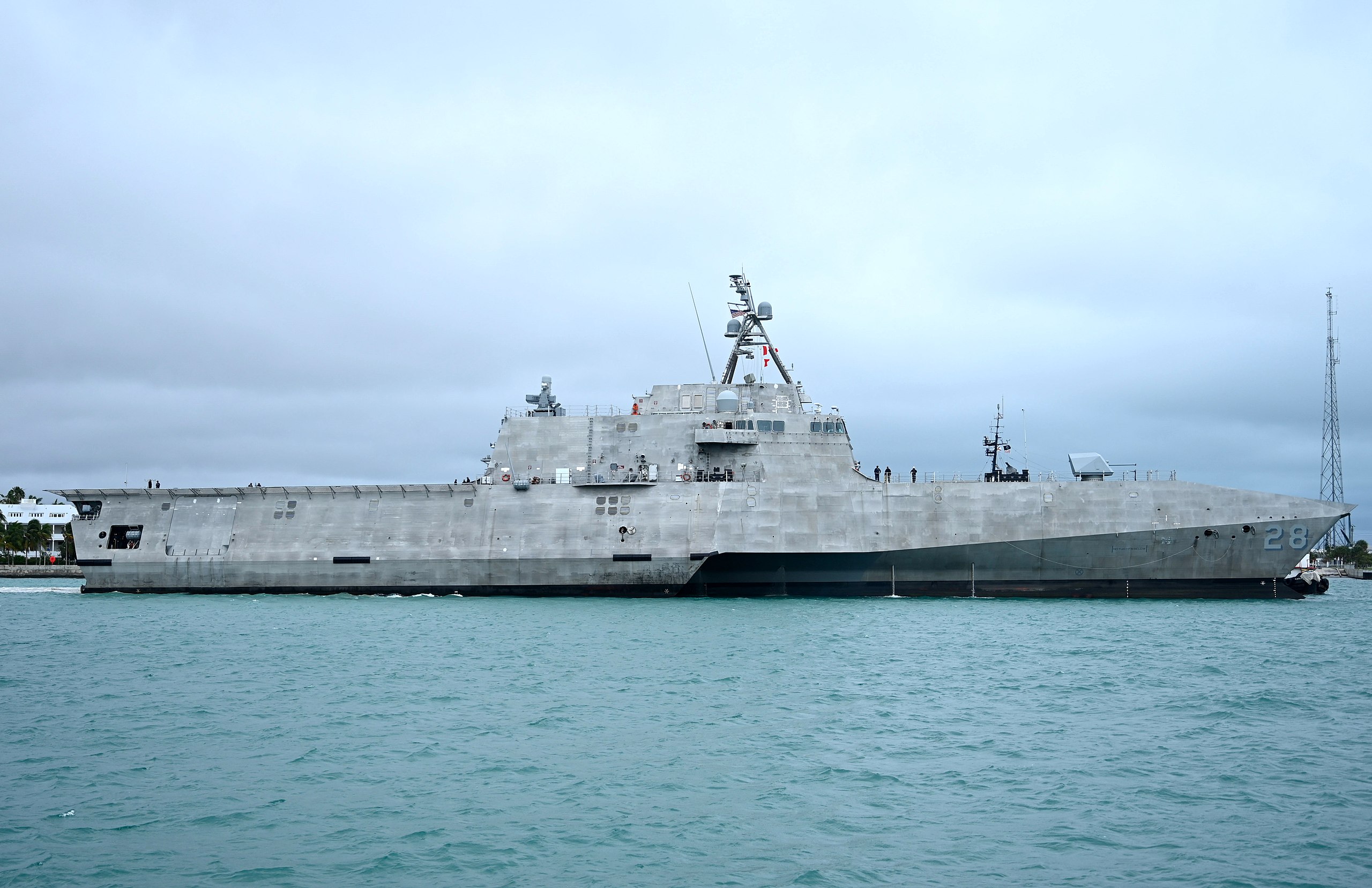
220209-N-IW125-1091 KEY WEST, Fla. (Feb. 9, 2022) The Navy’s 14th Independence-variant littoral combat ship, USS Savannah (LCS 28), pulls into Truman Harbor in Key West, Fla. Feb. 9, 2022. (U.S. Navy photo by Mass Communication Specialist 2nd Class Nicholas V. Huynh)

NEWPORT, OR, UNITED STATES
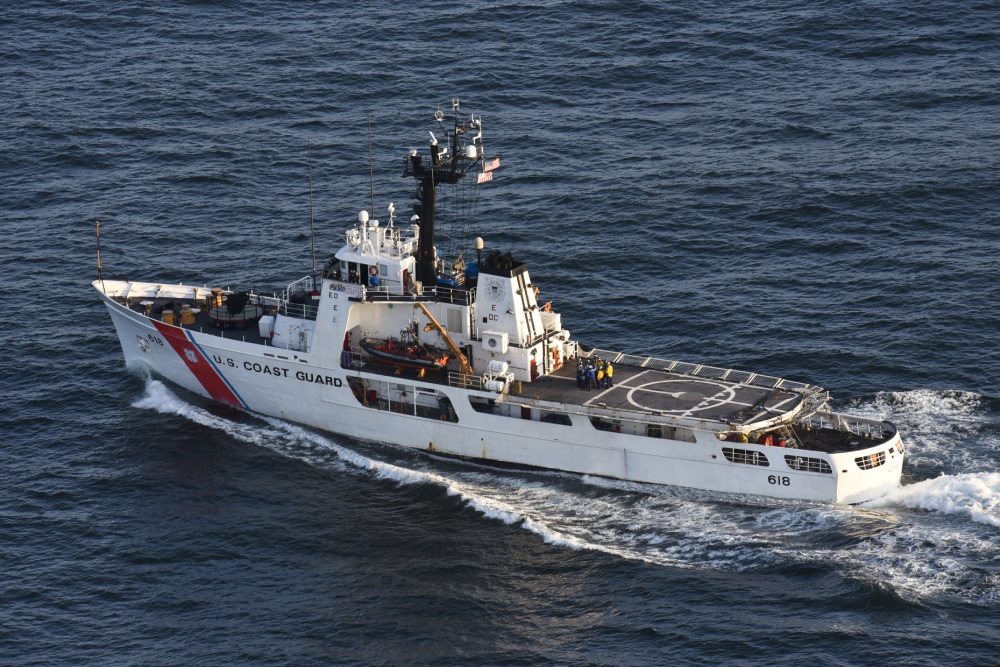
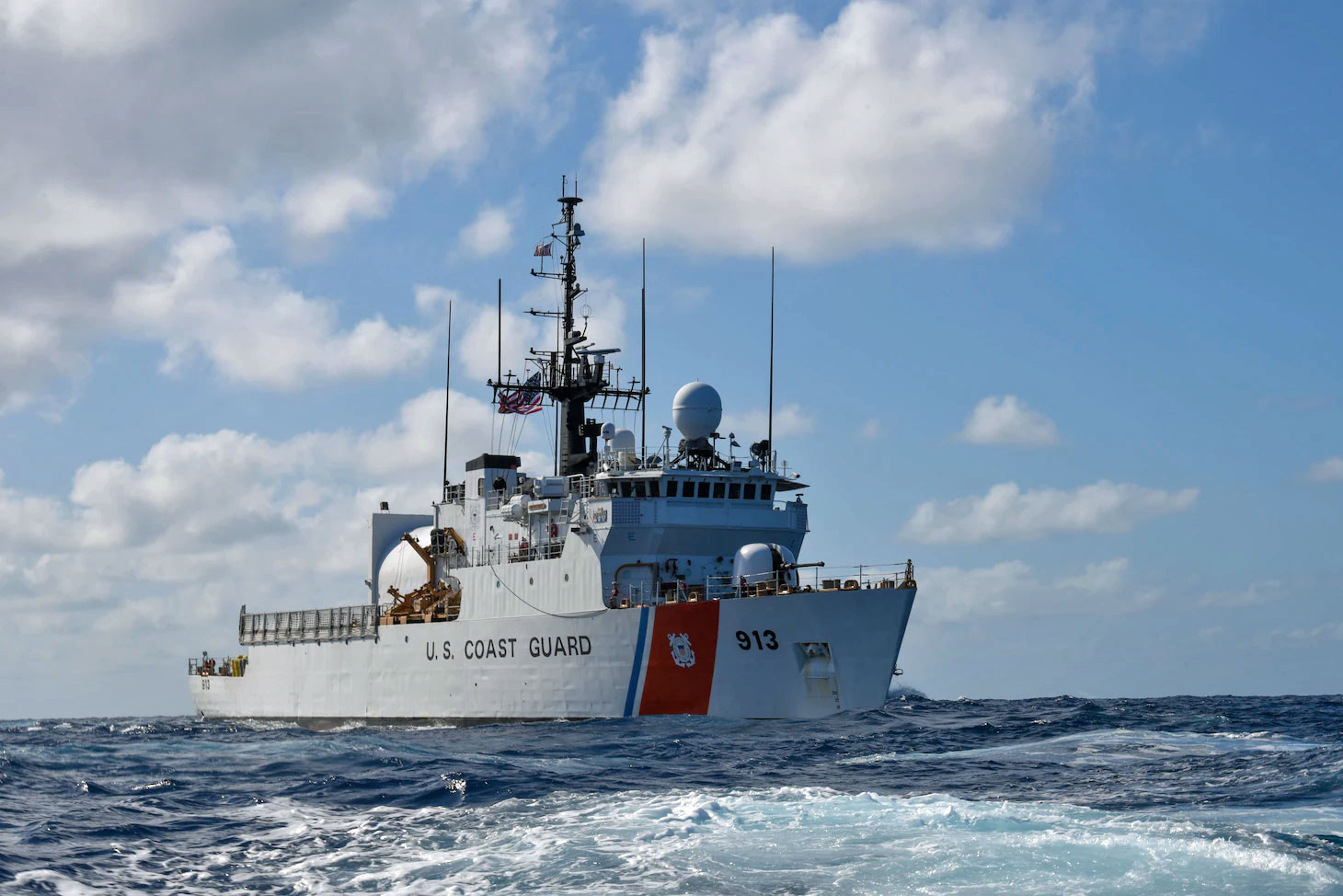
08.16.2019, Coast Guard Cutter Active (WMEC 618) transits across the Pacific Ocean near Newport, Ore., in support of Operation Pacific Fortune on Aug. 16, 2019. The Active is a 210-foot Medium Endurance based out of Port Angeles, Wash. (U.S. Coast Guard photo by Petty Officer 2nd Class Steve Strohmaier)

 April 6, 2023

U.S. Coast Guard, U.S. Navy, Mexican Navy and Royal Canadian Navy participate in North American Maritime Security Initiative

ALAMEDA, Calif. — The U.S. Coast Guard, along with the U.S. Navy, Mexican Navy (SEMAR) and the Royal Canadian Navy (RCN) participated in the North American Maritime Security Initiative (NAMSI) exercise off the coast of Manzanillo, Mexico March 27-31.

First instituted in 2008, NAMSI is an interagency and tri-lateral forum among U.S., Mexican and Canadian maritime commands intended to develop and refine maritime operations, as well as synchronize training and operational interoperability amongst forces of the three nations. The three participating nations actively seek opportunities to operate together and strengthen their cohesive approach to enhance regional maritime security in North America.

The U.S. Coast Guard District 11 and SEMAR collaborate extensively under NAMSI, conducting an average of four multinational passing exercises each year. The NAMSI Pacific Exercise (PACEX) 2023 is a full-scale Maritime Law Enforcement (MLE) based exercise that facilitates MLE operations with a SAR nexus built in. The exercise is intended to strengthen the crew’s knowledge in handling various situations and offers unique training scenarios like communication drills or maneuvering exercises.

“This exercise provides U.S., Mexico and Canada the opportunity to develop and refine our training and operations as partner nations,” said Rear Adm. Andrew Sugimoto, commander, U.S. Coast Guard District 11. “We take pride in our ability to strengthen partnerships and interoperability among the nations’ sea services.”

The U.S. Coast Guard Cutter Active and the U.S. Navy Independence-variant littoral combat ship USS Savannah (LCS 28), joined the SEMAR ship ARM Hidalgo and the RCN ship HMCS Edmonton, off the coast of Manzanillo in support of the NAMSI PACEX 2023. The operational units were supported by aviation assets from the U.S. Coast Guard and SEMAR, as well as the respective command centers in U.S. Coast Guard District 11, U.S. Navy 3rd fleet, SEMAR Tenth Naval Region and SEMAR headquarters.

The crews of Active and U.S. Coast Guard cutter Benjamin Bottoms also deployed in support of Operation GREEN FLASH (OGF). OGF is the operationalization of NAMSI procedures leveraging U.S., Canadian, and Mexican maritime forces, with the intent of disrupting transnational criminal organization activity that occurs in the shared maritime environment. U.S. Coast Guard District 11 organizes annual iterations of OGF which strengthens the relationship between the major stakeholders under NAMSI. Historically, there have been two iterations of OGF a year, averaging 30 days each.

“The cutter Active’s crew was excited to conduct this mission alongside our partners given its importance for the safety and security of the shared maritime environment,” said Cmdr. Brian Tesson, commanding officer, U.S. Coast Guard Cutter Active. “The partnerships between the U.S., Mexico and Canada strengthened our overall maritime security posture while reinforcing the mutual esprit de corps between our services.”

Hero 120 Loitering Munition

The Navy/Marine Corps has a new weapon in their inventory, and it may be just what the Coast Guard needs to deal with the potential threat of small, fast, highly maneuverable craft. It is a loitering munition, a drone with a warhead, making it a kind of slow cruise missile with an ability to abort.

Hero 120 will be going on the Marine Corps Long Range Unmanned Surface Vessel (LRUSV) as well as Marine manned ground vehicles.

Weight (with canister): 18 kg (40 pounds)
Warhead: 4.5 kg (10 pounds)
Range: 60+ km (32.4 nautical miles)
Endurance: 60 min
Engine: Electrical
Launch method: Single/Multi-Canister

Range is to some extent apparently limited by line of sight, but this could be used from land or from virtually any patrol boat.

Take a look.

“USS Farragut, Coast Guard offloads more than $69 million in illegal narcotics” –D7

190914-N-KK394-029.MAYPORT, Fla. (Sept. 14, 2019) The Arleigh Burke-class guided-missile destroyer USS Farragut (DDG 99) departs Naval Station Mayport. (U.S. Navy photo by Mass Communication Specialist 2nd Class Anderson W. Branch/Released)

Below is a District Seven News Release. Just wanted to point out a couple of things.

Unlike most of these offloads, this one involved only drugs seized by a single ship. Second it is unusual that drugs are offloaded from a Navy ship. Probably a good idea to let them get the more visible credit that comes with the offload once in a while. 

This destroyer did four intercepts, so they certainly deserve a lot of credit, along with the HSM-60 helicopter and CG LE detachments.

Would have been nice to know how many days they were doing the drug interdiction mission.


 April 5, 2023

USS Farragut, Coast Guard offloads more than $69 million in illegal narcotics

Seventh Coast Guard District

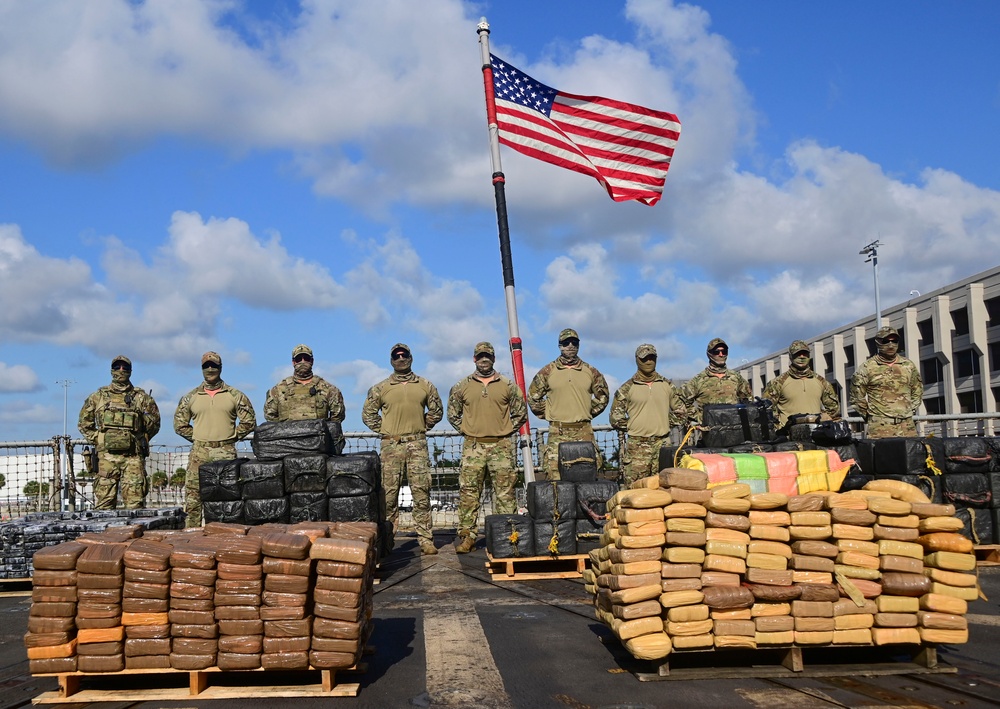
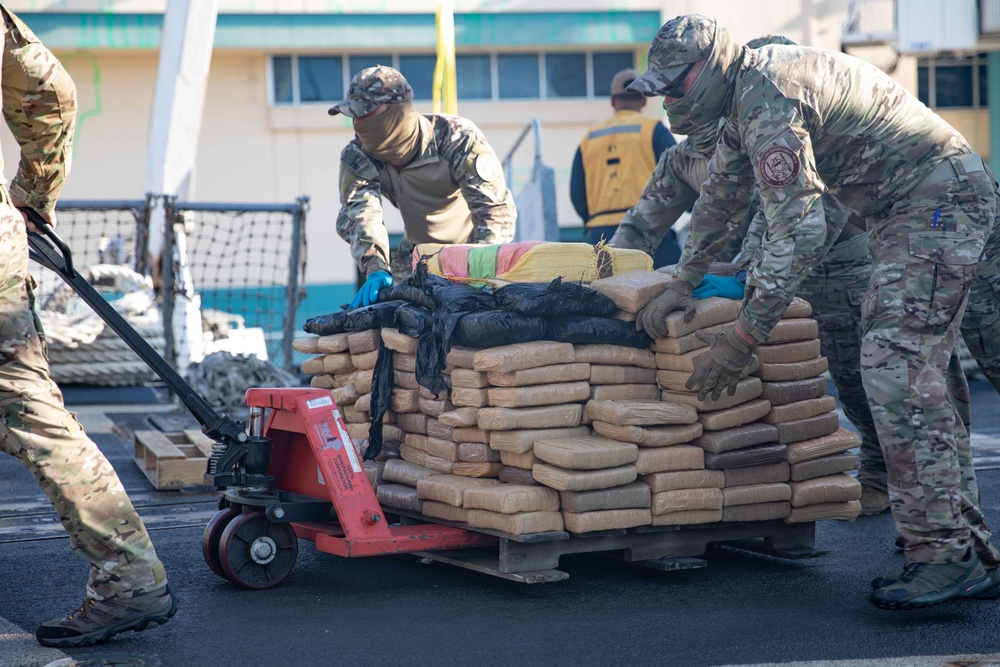
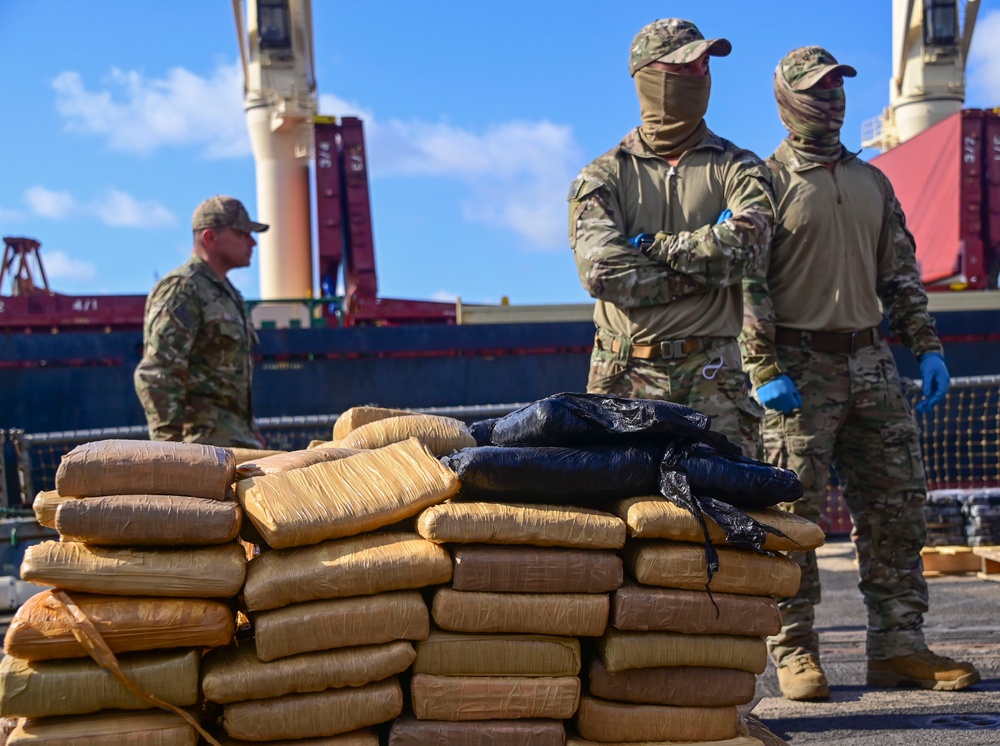
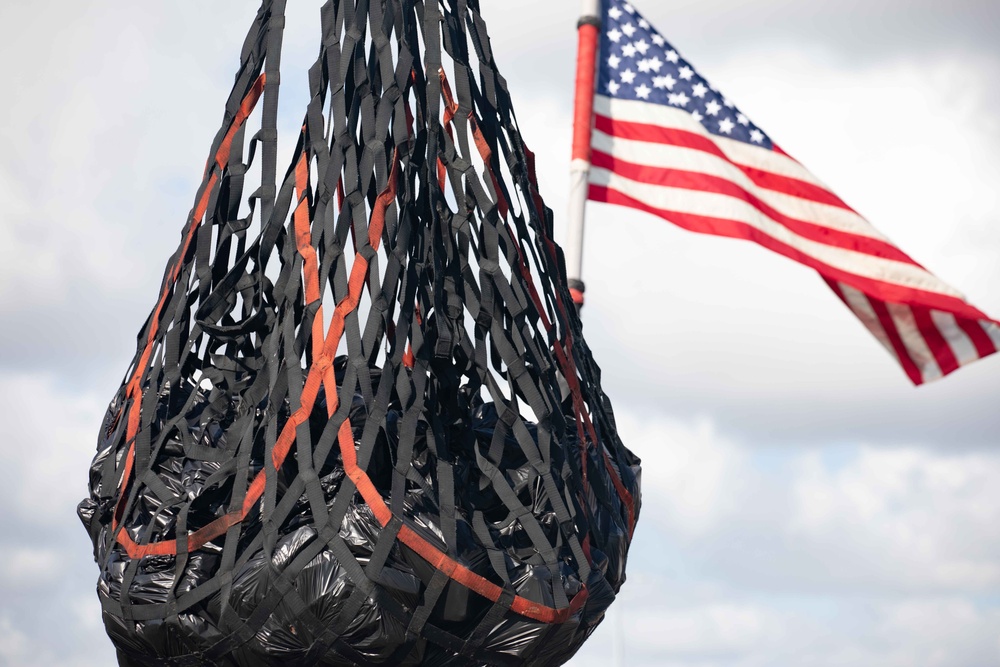
A member of U.S. Coast Guard Law Enforcement Detachment 406 offloads interdicted narcotics aboard USS Farragut (DDG 99) in Port Everglades, Florida, April 4, 2023. The offloaded drugs were seized from four go-fast smuggling interdictions by crew members of Coast Guard LEDET 406, Navy Combat Element (CEL) and Helicopter Maritime Strike Squadron Six Zero (HSM-60) in the Eastern Pacific Ocean. (U.S. Coast Guard photo by Petty Officer 2nd Class Laticia Sims)Members of U.S. Coast Guard Law Enforcement Detachment 406 pose for a photo with $69 million in illegal narcotics aboard USS Farragut (DDG 99) in Port Everglades, Florida, April 4, 2023. The offloaded drugs were seized from four go-fast smuggling interdictions by crew members of Coast Guard LEDET 406, Navy Combat Element (CEL) and Helicopter Maritime Strike Squadron Six Zero (HSM-60) in the Eastern Pacific Ocean. (U.S. Coast Guard photo by Petty Officer 3rd Class Eric Rodriguez) Members of U.S. Coast Guard Law Enforcement Detachment 406 push bales of illegal narcotics aboard USS Farragut (DDG 99) for a drug offload in Port Everglades, Florida, April 4, 2023. The offloaded drugs were seized from four go-fast smuggling interdictions by crew members of Coast Guard LEDET 406, Navy Combat Element (CEL) and Helicopter Maritime Strike Squadron Six Zero (HSM-60) in the Eastern Pacific Ocean. (U.S. Navy photo by Mass Communication Specialist 2nd Class Chelsea Palmer) https://d1ldvf68ux039x.cloudfront.net/thumbs/photos/2304/7724658/1000w_q95.jpg Bales of illegal drugs, worth an estimated $69 million, are offloaded off USS Farragut (DDG 99) in Port Everglades, Florida, April 4, 2023. The offloaded drugs were seized from four go-fast smuggling interdictions by crew members of Coast Guard LEDET 406, Navy Combat Element (CEL) and Helicopter Maritime Strike Squadron Six Zero (HSM-60) in the Eastern Pacific Ocean. (U.S. Navy photo by Mass Communication Specialist 2nd Class Chelsea Palmer)


MIAMI — The crew of USS Farragut (DDG 99) offloaded approximately 2,314 kilograms of cocaine and 1,986 pounds of marijuana worth a combined $69 million in Port Everglades, Florida Tuesday. The suspected smugglers will face prosecution in federal court by the Department of Justice.

The offloaded drugs were seized from four go-fast smuggling vessel interdictions by the Farragut crew with an embarked Coast Guard Law Enforcement Detachment (LEDET) 406 and Navy Combat Element (CEL) One from the “Jaguars” of Helicopter Maritime Strike Squadron Six Zero (HSM-60) in the Eastern Pacific Ocean.

“We were proud to work with the U.S. Coast Guard on the frontline of the threat that transnational drug trafficking presents to national security,” said Cmdr. Nicholas Gurley, commanding officer of USS Farragut. “Our experienced crew, HSM-60 CEL One and the members of our LEDET were essential to the success of this operation.”

Numerous U.S. agencies from the Departments of Defense, Justice, and Homeland Security, along with allied and international partners, cooperate in the effort to combat transnational organized crime. The fight against drug cartels in the Caribbean and Eastern Pacific Ocean is coordinated by Joint Interagency Task Force-South, based in Key West, and requires a unity of effort in all phases, from detection and monitoring to interdiction and apprehension and finally to criminal prosecution by international partners and U.S. Attorneys’ Offices. The law enforcement phase of counter-smuggling operations in the Eastern Pacific Ocean is conducted under the authority of the Eleventh Coast Guard District, headquartered in Alameda, California. The interdictions, including the actual boardings, are led and conducted by members of the U.S. Coast Guard.

The Coast Guard is both a military service and the nation’s primary maritime law enforcement agency. For information on how to join the U.S. Coast Guard, visit www.GoCoastGuard.com to learn about active duty and reserve officer and enlisted opportunities. Information on how to apply to the U.S. Coast Guard Academy can be found at http://www.uscga.edu. For breaking news, follow us on Twitter. For additional information, find us on Facebook and Instagram.

“Navy Expands Unmanned Operations to 4th Fleet” –Defense One

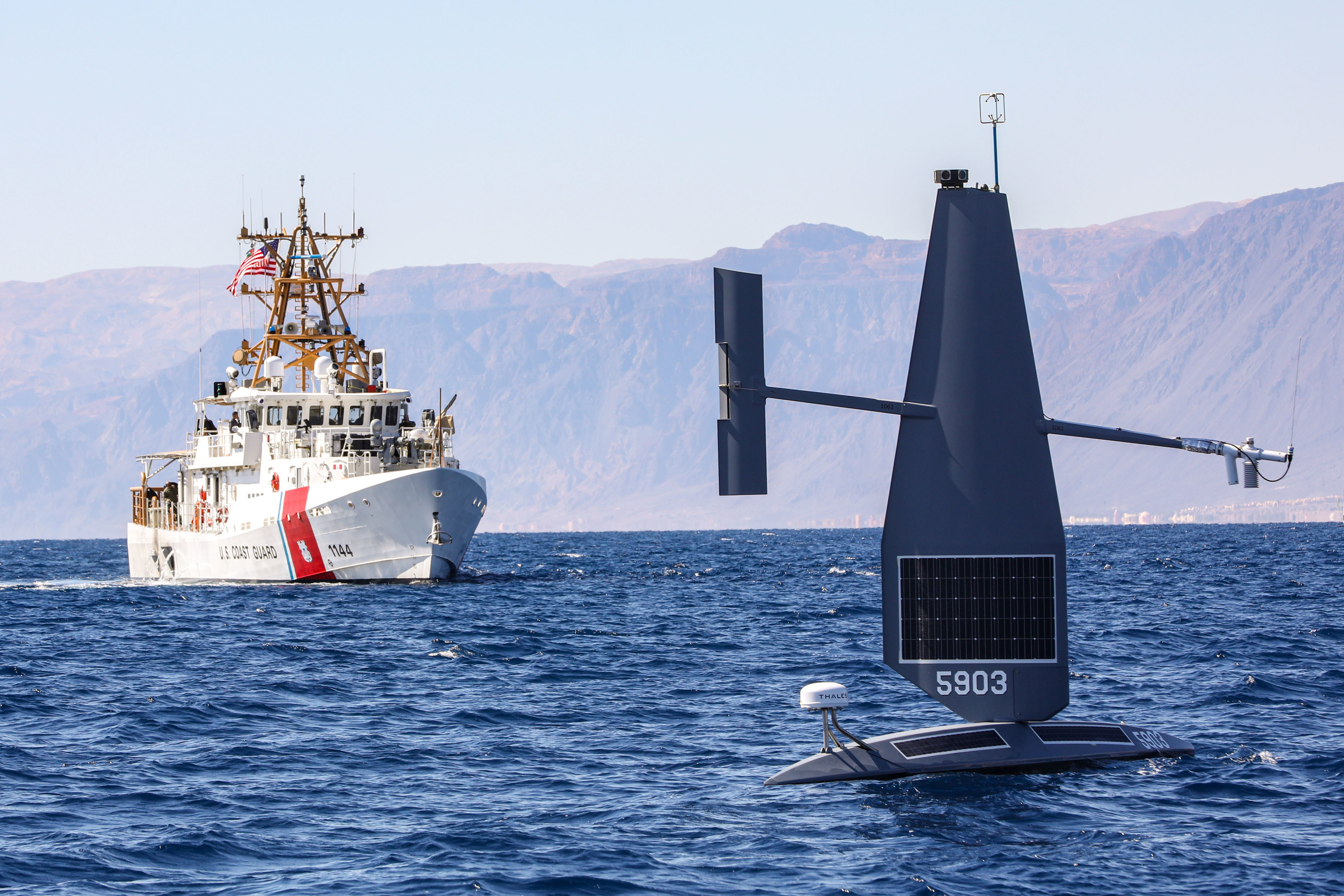
GULF OF AQABA (Feb. 13, 2022) The U.S. Coast Guard Sentinel-class cutter USCGC Glen Harris (WPC 1144) sails near a U.S sail drone explorer during the International Maritime Exercise/Cutlass Express (IMX) 2022, Feb. 13, 2022. IMX/CE 2022 is the largest multinational training event in the Middle East, involving more than 60 nations and international organizations committed to enhancing partnerships and interoperability to strengthen maritime security and stability. (U.S. Army photo by Cpl. DeAndre Dawkins)

Defense One reports,

“Drones are heading to the southern waters of 4th Fleet, which will follow 5th Fleet’s pioneering experiments with unmanned craft in the Middle East, Navy Secretary Carlos Del Toro announced Tuesday at the Navy League’s 2023 Sea-Air-Space Conference.”

This is great, and not unexpected, but I noted two things that concern me. First there was not mention of making this an international effort, as has been the case in 5th Fleet, and second, that they want to start in the Caribbean where we already have excellent maritime domain awareness, instead of the eastern Pacific drug transit zone where these are really needed.

Del Toro added, “it’s fair to say however, you want to start small and build upon it, obviously. And so you know, focus perhaps on the Caribbean Basin first, and then expand beyond that in the future.”

I can see that they would be more comfortable operating UxVs in the Caribbean, because it is closer to home, but in the Eastern Pacific we could look at Uncrewed Surface Vessels (USV) using acoustic sensors to help detect semisubmersibles. This is something that is not being done in 5th Fleet so it would provide a different sensor and target set and perhaps an opportunity to cross over some of the learning to ASW.

Of course, most of the 4th Fleet’s surface ships are Coast Guard Cutters.

“US Sending Experimental Anti-Drone Weapons to Ukraine” –DefenseOne

Shahed 136 drones. Iranian military photo

Defense One has a post about a new anti-drone system that is expected to be sent to Ukraine to counter Russia’s Iranian made Shahed-136 suicide drones.

In addition to APKWS laser guided rockets,

“The system also includes a M240 machine-gun mount and an electronic warfare system that can take control of a commercial drone, including any DJI-brand system not operating with advanced encryption…”

The Coast Guard should have an interest in a counter drone capability both for the Webber class WPCs based in Bahrain and for domestic counter terrorism. Such a system, combining APKWS with a 30mm gun, would also be useful against other potential threats as well.


How Long Should an OPV be? Is There a Minimum?

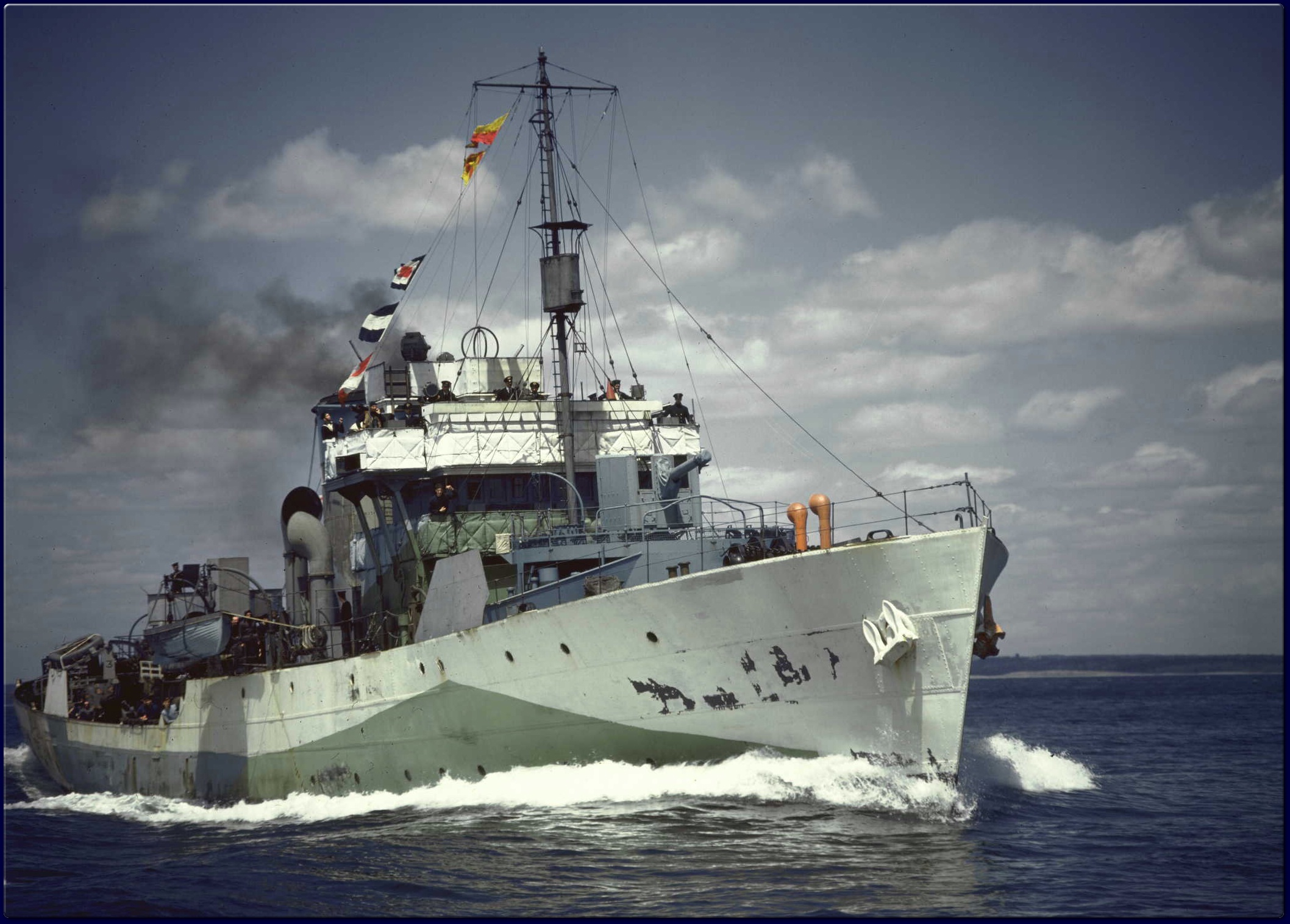
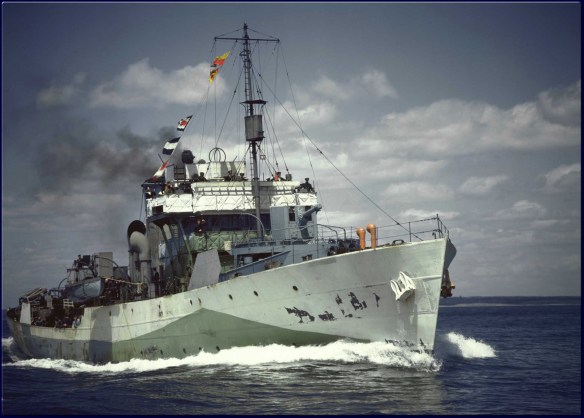
Flower class corvette HMCS REGINA (K234) circa 1942 – 1943
Source:Canadian Navy Heritage website. Image Negative Number CT-252

Decades ago, I read a Royal Navy research paper that asked essentially, “What is the proper length for a corvette?” A balance of adequate seakeeping and minimum cost? The report had originated shortly after World War II when the British had operated hundreds of 205 foot (62.5 meter) long Flower class and 252 ft (77 m) Castle class corvettes. Their answer was 270 feet (82.3 meters, probably they were talking waterline length. In this post, I will be using length overall (loa) and full load displacement (fl)), but there was a caution, that while that was appropriate for the Atlantic, operation in the Pacific would require a larger ship because of the longer swells prevalent in the Pacific.

This introduced me to the idea that there might be a step function in effectiveness based on length, and that it might vary with the environment.

A very pleasant experience with the 327 foot (100 meter) cutter Duane also seemed to suggest there might be a sweet spot where ships become much more seaworthy.

Is there a minimum length for a vessel to function effectively as an Offshore Patrol Vessel? There is room for some scholarly research into the question.

Lacking a naval engineering background, I approach the question in a different way. On the assumption that given experience, OPV users move toward an optimum balance of capability and cost, let’s look at the experience of navies and/or coast guards of five nations that have created more than one class of OPV over the last 30 or so years, the US Coast Guard, French Navy, UK Royal Navy, Japan CG, and Indian Navy and Coast Guard. We will look at the ships created about 30 years ago and the ships they have chosen to build most recently.

FRANCE

France has the largest EEZ of any nation, 11,691,000 km2, about 103% that of the US, most of it in the Pacific and Indian Oceans.

The Old
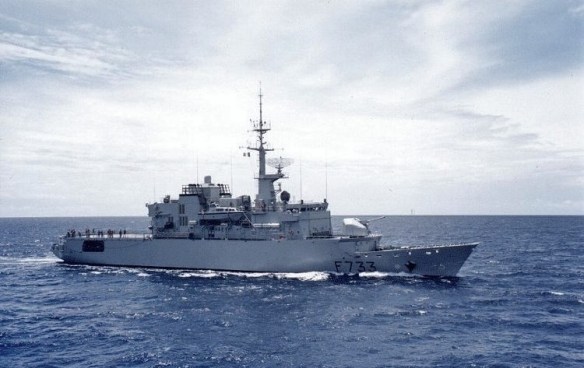
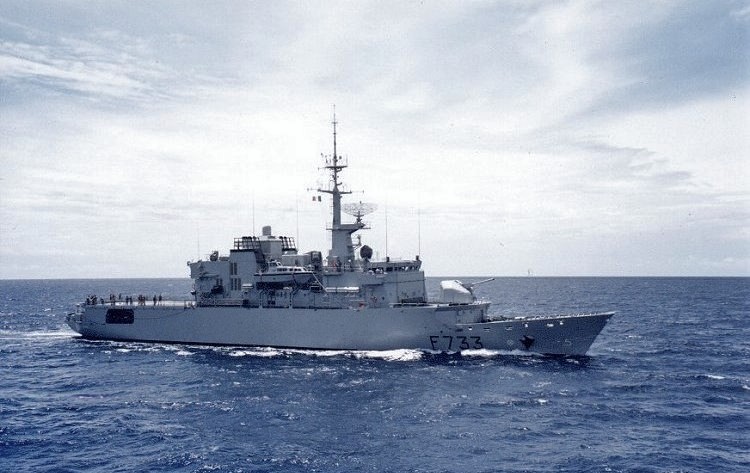
Floreal class. Six ships (plus two for Morocco) commissioned 1992-1994: 93.5 meter, 307 feet, 3000 ton, 20 knots. FS Ventose pictured. 

The New
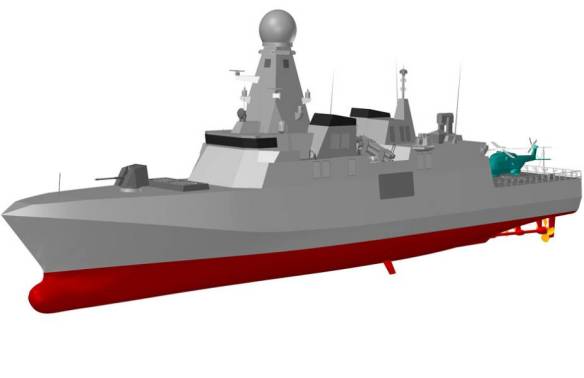
Artist drawing of the future Modular and Multirole Patrol Corvette MMPC. (Picture source: Navy Recognition)

European Patrol Corvette. First Delivery expected 2030: 110 meters. 361 feet. 3,000 tons, 24+ knots.

France has their open ocean coast guard functions performed by their navy. In 1992 the French Navy commissioned the first of six Floréal class “surveillance frigates” pictured above. These are expected to be replaced by a version of the 110 meter, approx. 3,000 ton, 24 knot European Patrol Corvette.

The Old
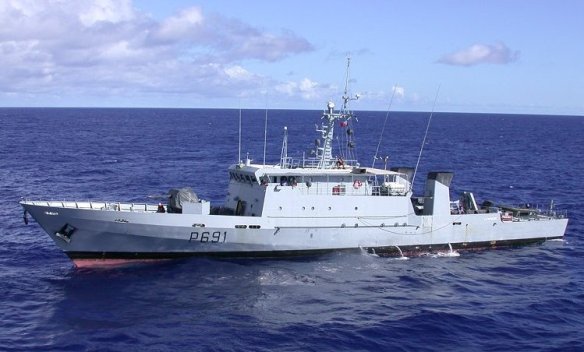
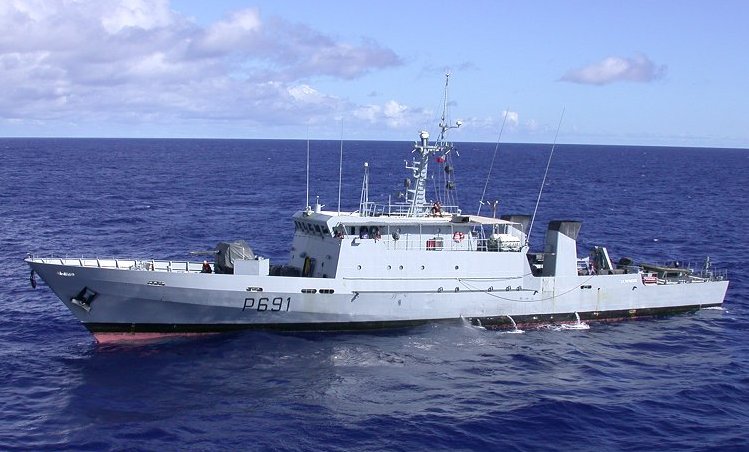
Patrol ship Tapageuse at sea near Tahiti (18 June 2003). Photographer: Jean-Michel Roche

P400 class of ten vessels. Commissioned 1986-88, 54.8 m (179 ft 9 in). 480 tons fl. 24 knots. 

The New
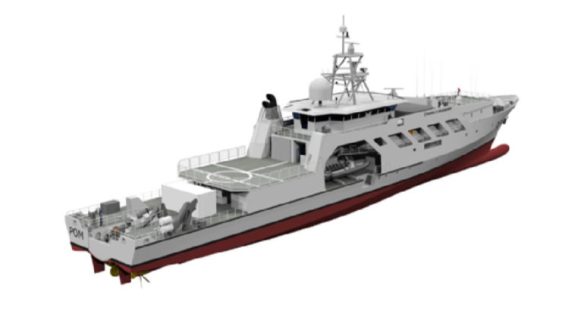
Rendering of the future “POM” OPV of the French Navy

Patrouilleurs Outre-mer (POM), or Félix Éboué class: Six ships to be commissioned 2023-25, 80 m (262’6″), 1300 tons fl.

Their latest acquisitions are six 80 meter Offshore Patrol Vessels (Patrouilleur d’Outre-Mer – POM).

They replace the P400 class. Like the Floreals, these ships and their replacements are of simple design intended to operate for long periods from austere bases in French overseas territories. Most of the P400s were operating in the Western Pacific in the same environment where we currently operate the smaller Webber class FRCs. Significantly, “Since late 2008, ships of the D’Estienne d’Orves class, with their heavy armament removed, were planned to replace the P400 in the high sea patrol role, a task for which the P400 class have proved to be underweight.” This was 20 years after the the vessels were commissioned but clearly the French thought they were “going to need a bigger boat.” The replacement POM class turned out to be very similar to the D’Estienne d’Orves class in length and displacement, 80 m and 1,300 tons.
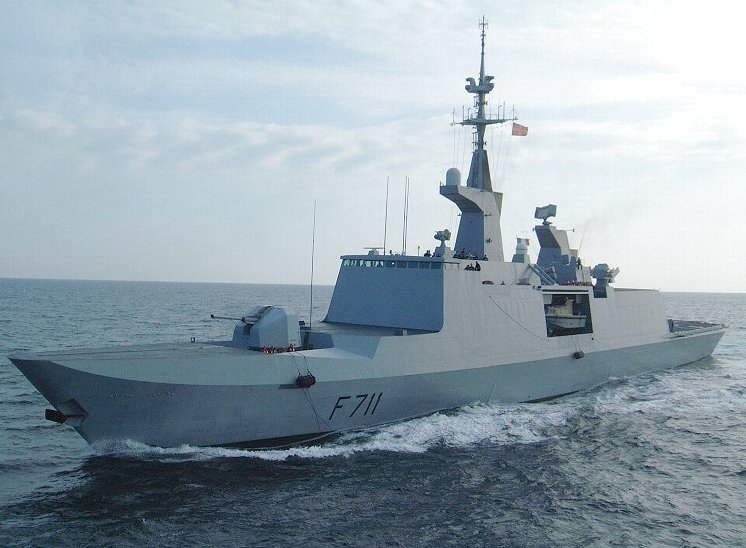
File:FS Surcouf.jpg

La Fayette class Frigate Surcouf 

In 1996 France commissioned the first of five nominally general purpose 125 m (410 ft 1 in), 3,800 ton, 25 knot La Fayette class frigates, but as built, they had no ASW capabilities, so they were more high performance OPVs not unlike the USCG Hamilton class WHECs. France’s EEZ is widely distributed and varied. The French seem to have a wide array of solutions to their patrol requirements. They seem to produce designs for specific outposts. In addition to those discussed above they have built these relatively unusual OPVs: here and here.
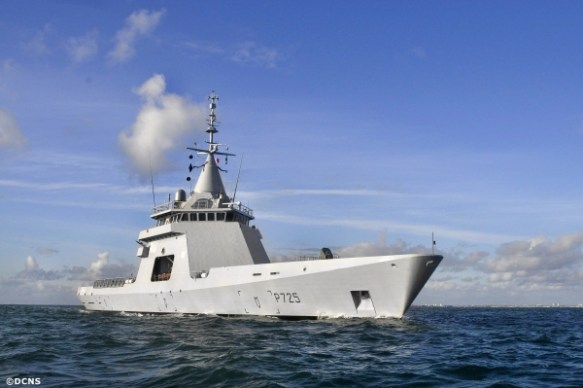
The former French Ship L’Adroit, now the Argentinian OPV, ARA Bouchard (P-51)

Perhaps it is telling that, when French shipbuilder Naval Group built an OPV on speculation for a world market, the result was the 87 meter L’Adroit, which after service with the French Navy was sold to Argentina along with three new construction near sisters. Recently France contracted for ten Offshore Patrol vessels that have been reported to be 90 meters in length. I suspect these will be similar to L’Adroit

US Coast Guard:

The US EEZ, the second largest, is very nearly as large as that of France at 11,351,000  km2.

The Old
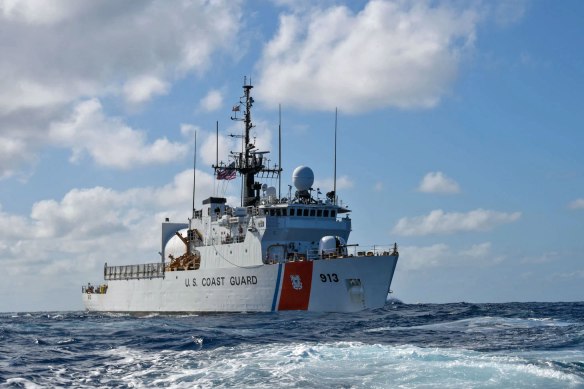
Bear class Medium Endurance Cutters, class of 13, commissioned 1984-1991, 82 m (270′), 1800 tons, 19.5 knots.

The New
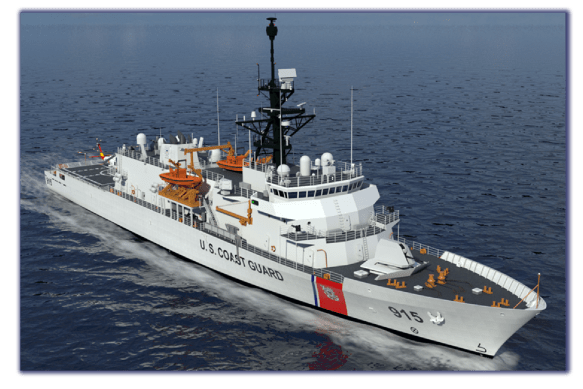
Offshore Patrol Cutter, Artist’s Rendering, Credit Eastern Shipbuilding

Offshore Patrol Cutter, projected class of 25, projected delivery 2025-2038, 110 m (360′), 4,500 tons, 22+ knots

Thirty years ago, the US Coast Guard had just completed the 82 meter, 270 foot, 1,800 ton, 19.5 knot Bear class, the first of which was commissioned in 1984, the newest, Mohawk in 1991. They replaced 143-, 205-, 213-, 311-, and 327-foot cutters built during and before the Second World War.

The US Coast Guard would not build any additional Offshore Patrol vessels until the 127 meter, 4,500 ton Bertholf class National Security Cutters (NSCs), the first of which was commissioned in 2008. Despite the age difference, the NSCs were not replacements for the WMEC270s, but rather the twelve 115 meter (378-foot) Hamilton class commissioned 1967 to 1972.

The direct replacement for the Bear class WMEC270s (as well as the 64 meter, 210 foot Reliance class) is the 110 meter Argus class Offshore Patrol Cutter, (OPC).

The relatively large size of both the NSC and the OPC, displacing at least 4,500 tons full load, reflect demanding requirements for launch and recovery of boats and helicopters in heavy weather.

These requirements seem to reflect experience on Alaska Patrol. While the Bear class seem to have served well in the Atlantic and the equatorial Eastern Pacific they were found to be inadequate for operations in Alaskan waters.

The 64 meter Reliance class were never really designed to be offshore patrol cutters in the modern sense. Designed before the United Nations Convention on the Law of the Sea, when the territorial sea was still three miles, and before the advent of the 200 mile Exclusive Economic Zone, they were only expected to go out 50 miles offshore.

Meanwhile, the relatively small 47 meter Webber class have proven remarkably capable but are operated with an eye on their endurance and weather limitations.

Looking at the large cutters that were in the fleet when I entered the service in the ’60s, we had three classes of ships that stood weather station patrol, demanding long open ocean patrols. Of these, the 100 meter Secretary class 327s were considered the most successful. The 95 meter Casco class “311s” were also successful and their huge fuel capacity allowed great operational flexibility. The 77.7 meter Owasco class “255s” operated at significant disadvantage, in that they were rough riding and their limited fuel capacity forced them to drift when being able to maintain a favorable heading would have been desirable.

United Kingdom’s Royal Navy: 

The UK’s EEZ is the fifth largest in the world at 6,805,586 km2 (60% that of the US).

The Old
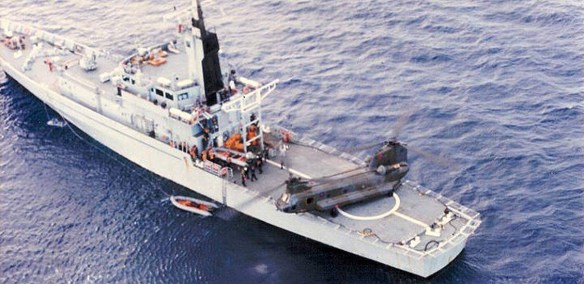
HMS Leeds Castle during the Falklands War.

Castle Class, two ships, commissioned 1981 and 1982, 81 m (266′), 1,550 ton fl, 20 knot 

The New
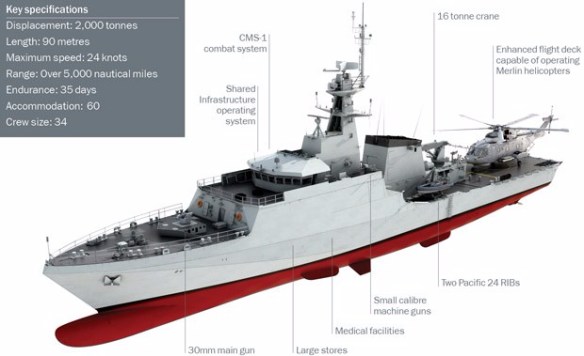
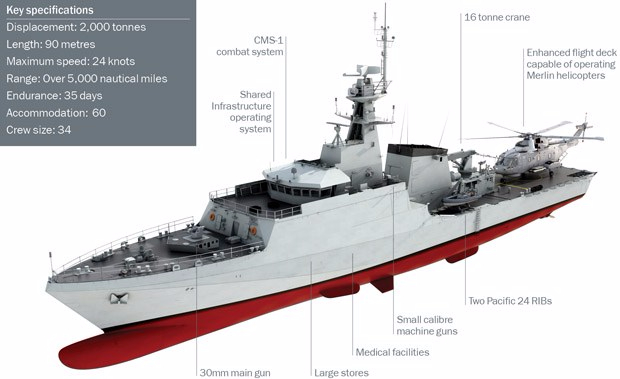
River Class (Batch II), 5 ships, commissioned 2017 to 2021, 90.5 m (297′), 2,000 tons fl, 25 knots

The Royal Navy has never had a great many OPVs. They currently have eight in commission. They have tended to use frigates and MCM vessels to perform coast guard duties.

The Castle class were designed to replace the 61.1 m (200′), 1,280 ton, 16 knot Island class OPVs commissioned 1977 to 1979, that were criticized as unseaworthy, too slow, and lacking a flight deck. Originally it was to have been a class of six, but only two were completed and the Island class soldiered on into the 21st century. The two Castle class served the Royal Navy for 28 and 29 years before being sold to Bangladesh in 2010 where they still serve.

The Castle class was followed by three 79.5 m (261′), 1,700 ton, 20 knot River class (Batch I) and a forth modified, slightly longer River class the 81.5 m (267 ft 5 in) HMS Clyde that unlike the earlier ships included a flight deck. Initially the River class Batch 1 ships were leased, but the first three were subsequently purchased and continue to serve as fisheries protection vessels. HMS Clyde has been sold to Bahrain.

These were followed by five 90 m River class Batch II ships. Despite the similar nomenclature, these are an entirely different class.

Japan Coast Guard: 

Japan’s EEZ is 4,479,388  km2 (39.5% that of the US) and is the eighth largest in the world. Their entire EEZ is in the North Pacific, which can be a challenging environment.

The Old
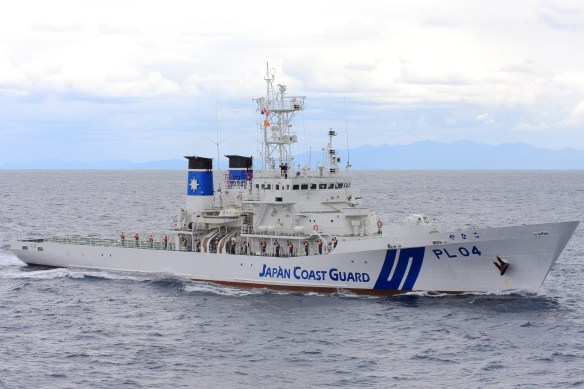
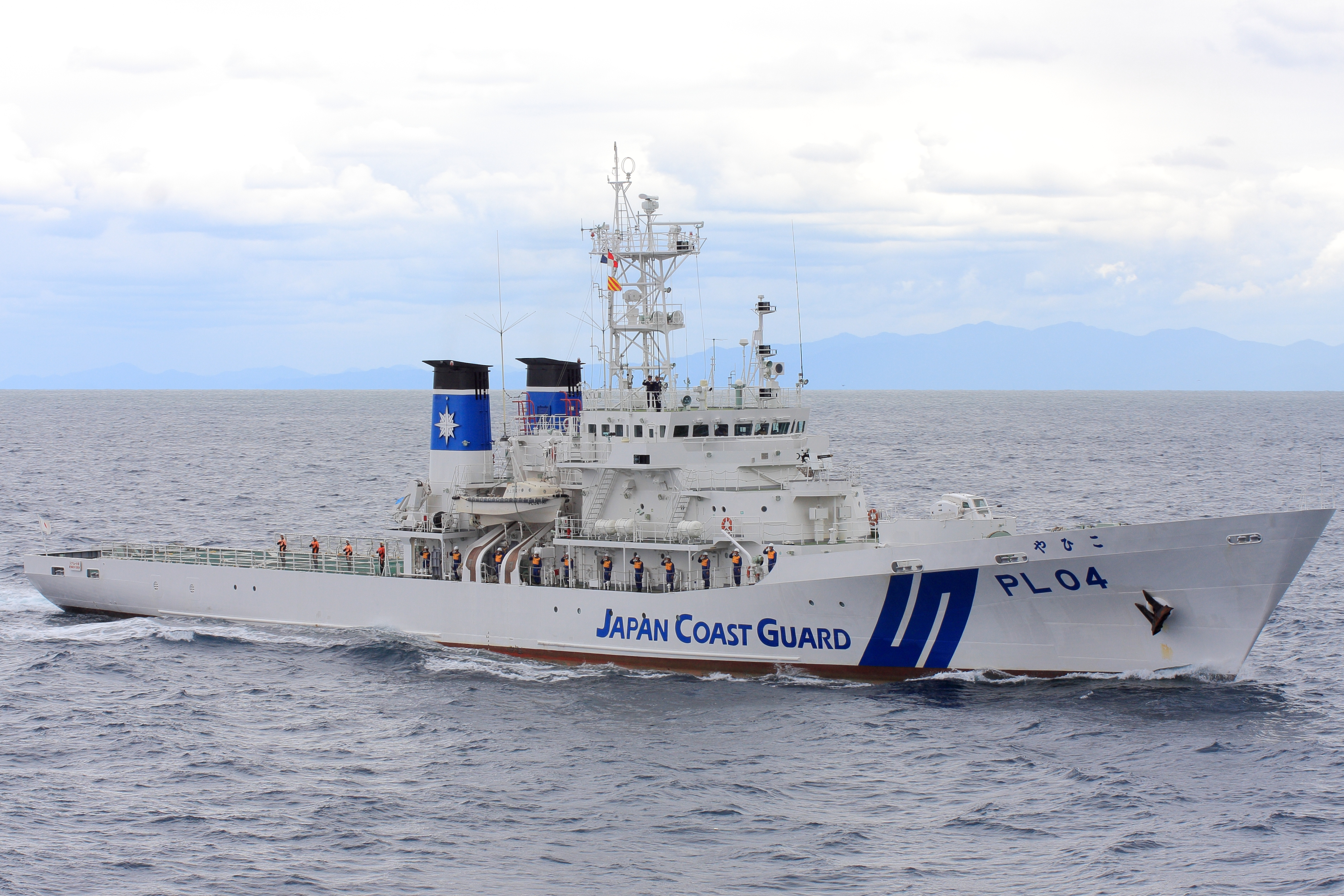
Ojika-class patrol vessel Yahiko (PL-04). First of clasPhoto credit: Cp9asngf though Wikipedia

Ojika class, seven ships, commissioned 1991 to 2000, 91.5 m (300′), 2,006 tons fl, 20 knots

The New
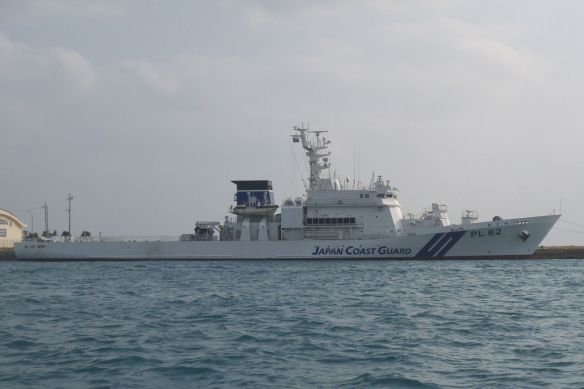
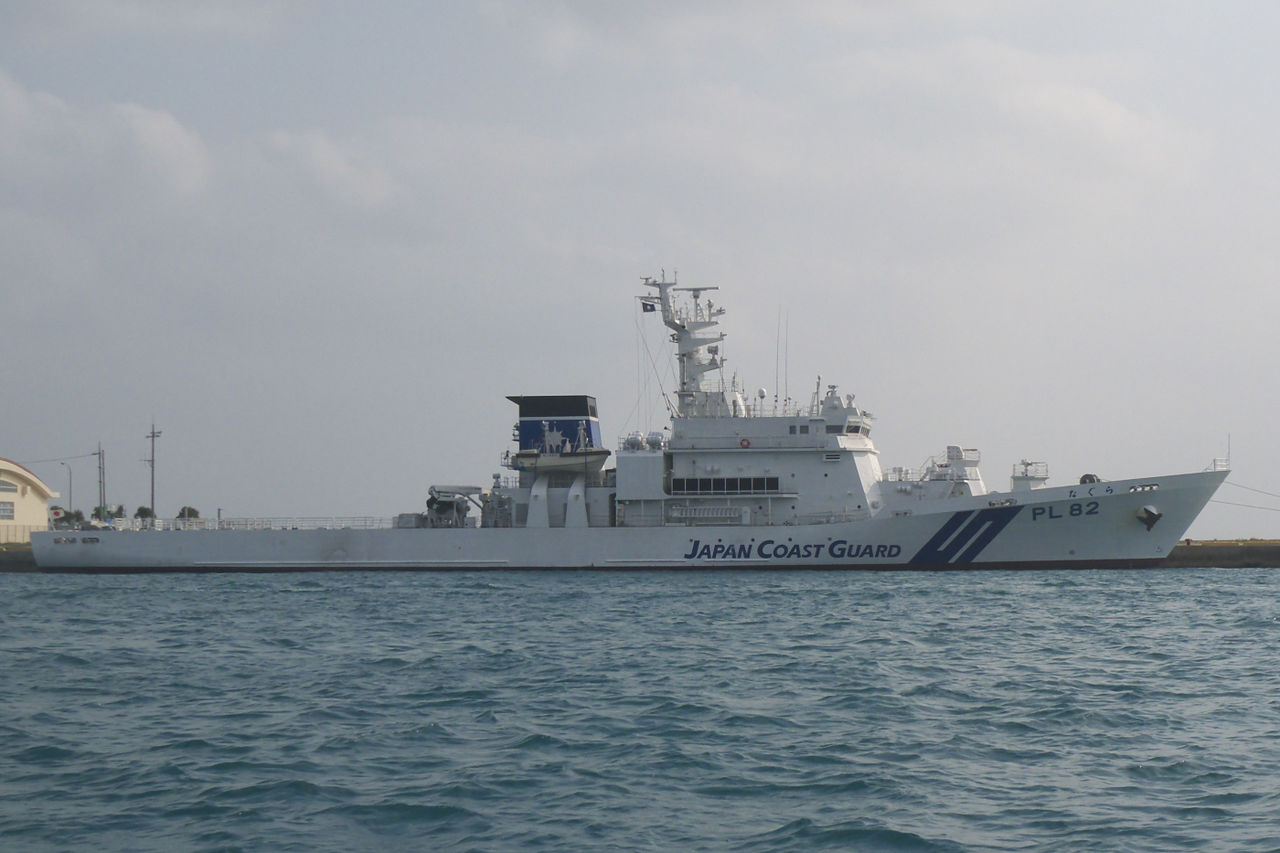
JCG Kunigami class cutter PL82 Nagura. Photo from Wikipedia Commons, by Yasu

Kunigami-class, 20 ships+1 building (+ 2 for the Philippine CG, commissioned 2012 to 2020, 96.6 m (317′}, 2260 tons, 25 knots

Unlike the US Coast Guard, the Japan Coast Guard produced “High Endurance Cutters” (PL and PLH) continuously over the last 30 years, 62 ship in 13 classes, including some very large cutters, some up to 150 meters and approaching 10,000 tons.

Thirty years ago, the Japan Coast Guard was building the Ojika class, seven ships commissioned 1991 to 2000. Six of the seven are still in service, they are 91.5 meters (300 feet) in length, with a full load displacement of 2,006 tons, a max speed of 20 knots, and a crew of 34.

The most recent, general-purpose “High Endurance Cutters” built by the Japan Coast Guard have been the 96.6 m (317 ft) Kunigami-class. There are currently 20 of these cutters in service with three more on the way. In addition, Japan has built two modified versions of this class for the Philippine Coast Guard. With no end in sight for their construction, these may become the most produced OPVs of the 21st century.

These are relatively simple ships, not much different from the Ojika class.
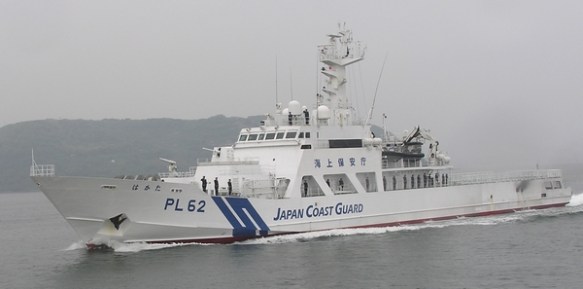
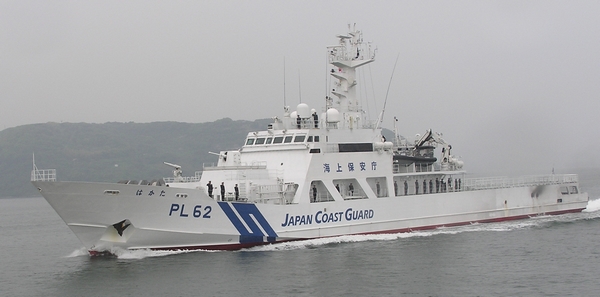
JCG Hateruma class cutter Plhakata. One of a class of nine commissioned 2008-2010. 89.0 m (292.0 ft) loa. 1350 tons fl. 30 knots max speed. Crew of 30. Photo by Takaaki.

Frequently cutters of different classes have been built concurrently rather than consecutively.  Aside from three 79 meter Aso class, commissioned 2005/2006, designed as high-speed interceptors of North Korean spy ships, the smallest “high endurance cutters” built in the last 30 years are the nine ship, 89 meter Hateruma class pictured above, commissioned 2008 to 2010.

The JCG cutters discussed here, unlike their larger PLH cutters, have no hangar, only basic weapon and sensor suites. Their size is not determined by features incorporated in the design. It appears their size is a reflection of the environment where they operate, the North Pacific.

India:

India’s EEZ is 2,305,143 km2, 20.3% that of the US, but still more than the entire EEZ under the Atlantic Area.

In 1986 the Indian Coast Guard had 80 officers and 400 men. They have come a long way. The Indian Coast Guard got a big boost after the 2008 Mumbai Terrorist Attack, which came by sea. The Indian Coast Guard operates 27 Offshore Patrol Vessels, all commissioned within the last 28 years, 18 since 2015.

The Old
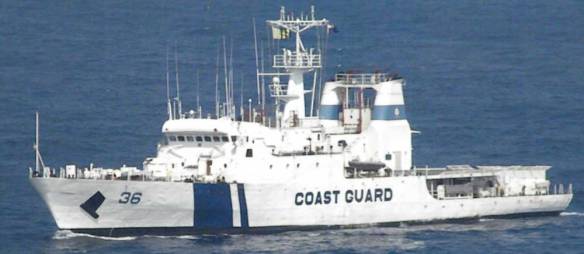
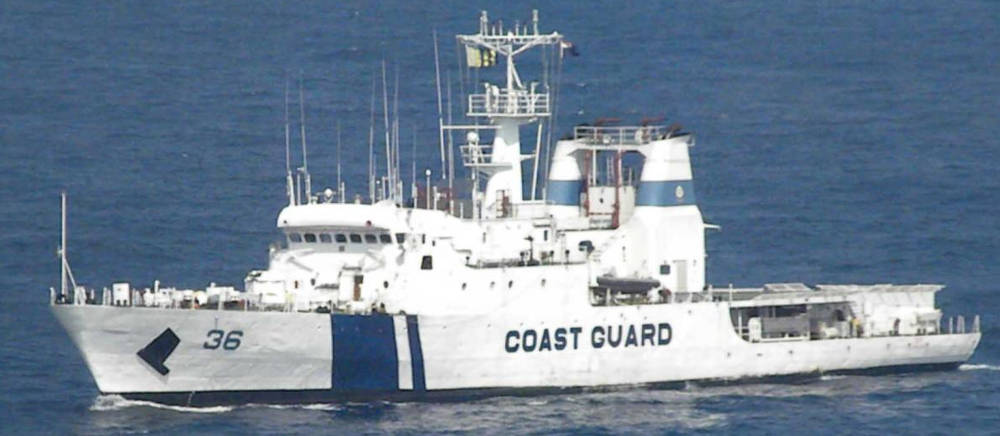
Indian Coast Guard Ship Varuna. Indian Government photo.

Vikram-class offshore patrol vessels, nine ships commissioned 1983-92, 74 m (243′), 1,224 tons, 22 knots.

The New
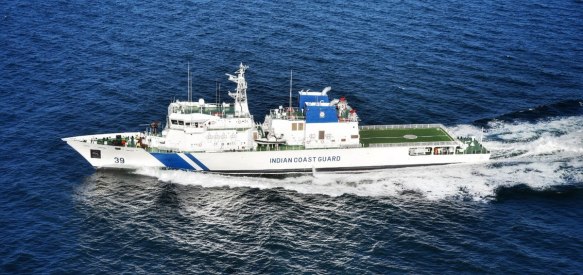
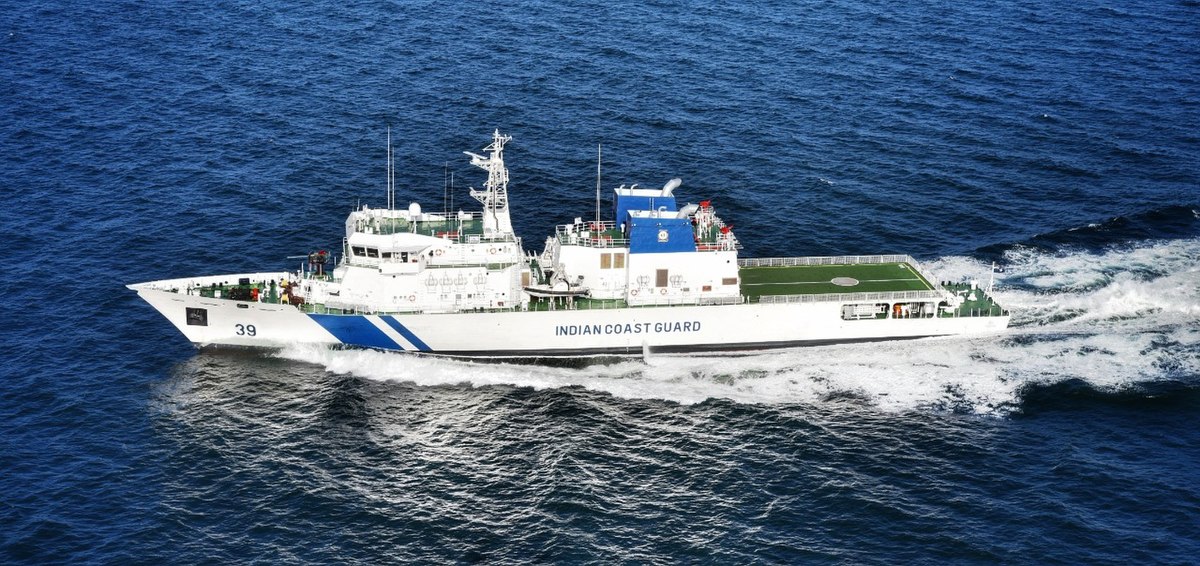
ICGS Vigraha (39) during sea trials, 28 August 2021, Indian Coast Guard photo.

Vikram-class (different Vikram class) offshore patrol vessels, Class of seven ships commissioned 2018-2021, 97 m (318’3″), 2140 tons, speed 26 knots.

And
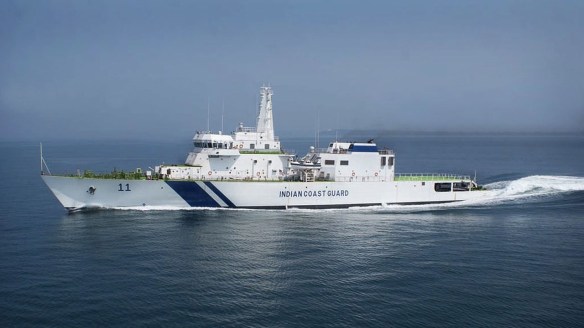
105 meter, Off Shore Patrol Vessel (OPV) ICGS Samarth, 10 November 2015, photo Indian Coast Guard

Samarth-class, 11 ships, commissioned 2015 to 2022, 105 m (344.5′), 2450 tons fl, 23 knots

The first Vikram class was not considered entirely successful because they could not operate helicopters in heavy weather because of the ships’ roll characteristics. The class is no longer in service with the Indian Coast Guard, but two ships were transferred to Sri Lanka.

Since 1990 the Indian CG has not commissioned an OPV of less than 93 meters. Their largest are 105 meters. None of their smaller patrol craft (WPCs) exceed 51.1 meters so there is a clear distinction between OPVs and Inshore Patrol Vessels.

INDIAN NAVY

The Indian Navy operates 12 Offshore Patrol Vessels, six of each of the two class below.

The Old
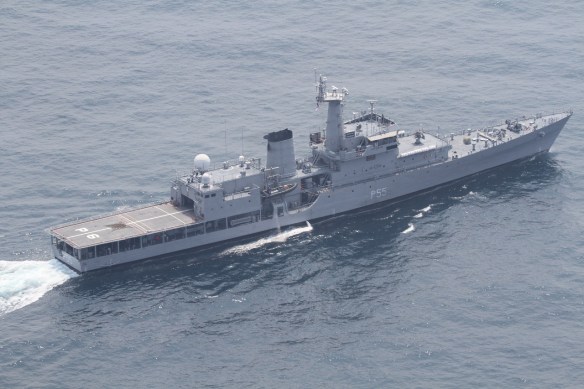
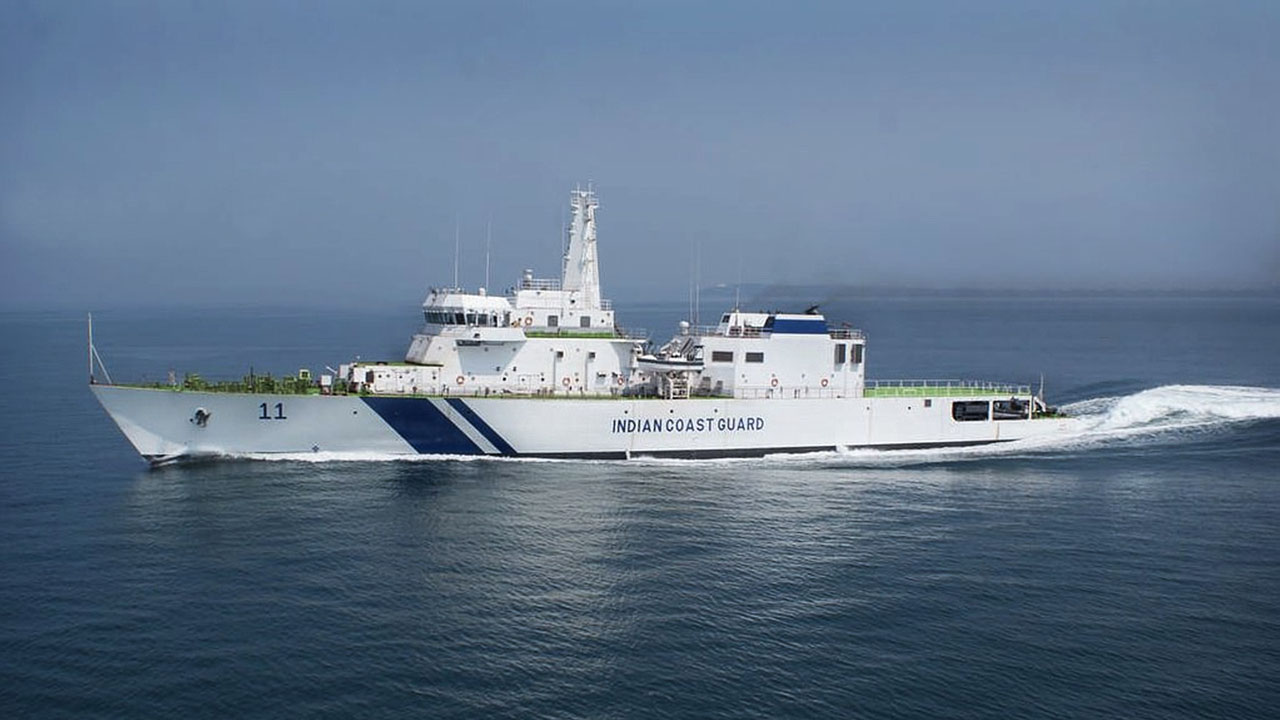
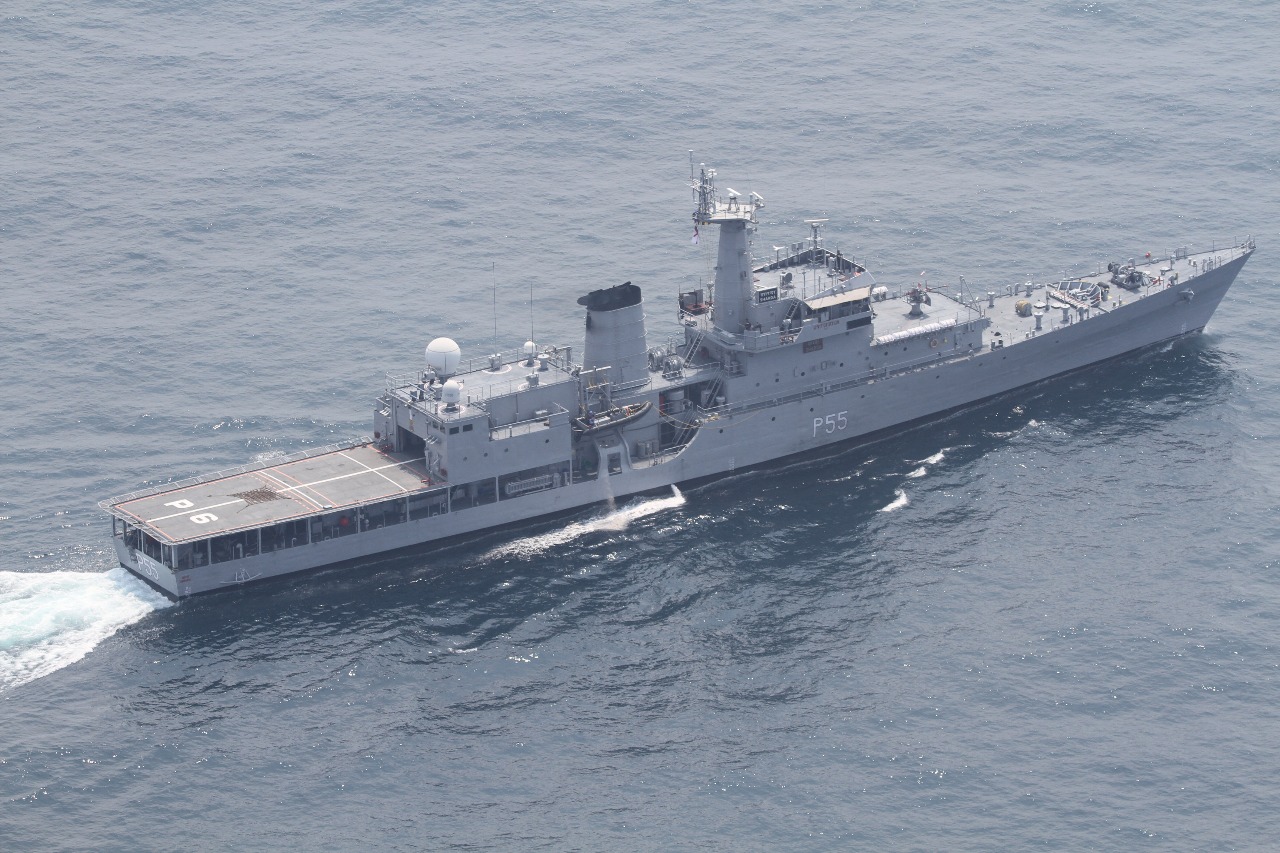
Sukanya class OPV INS Sharda (P55). Indian government photo.

Sukanya-class, seven ships, commissioned 1989 to ’93, 101 m (332′), 1,890 tons fl, 21 knots

The New
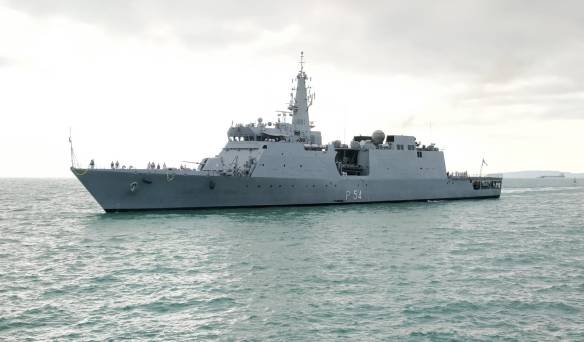
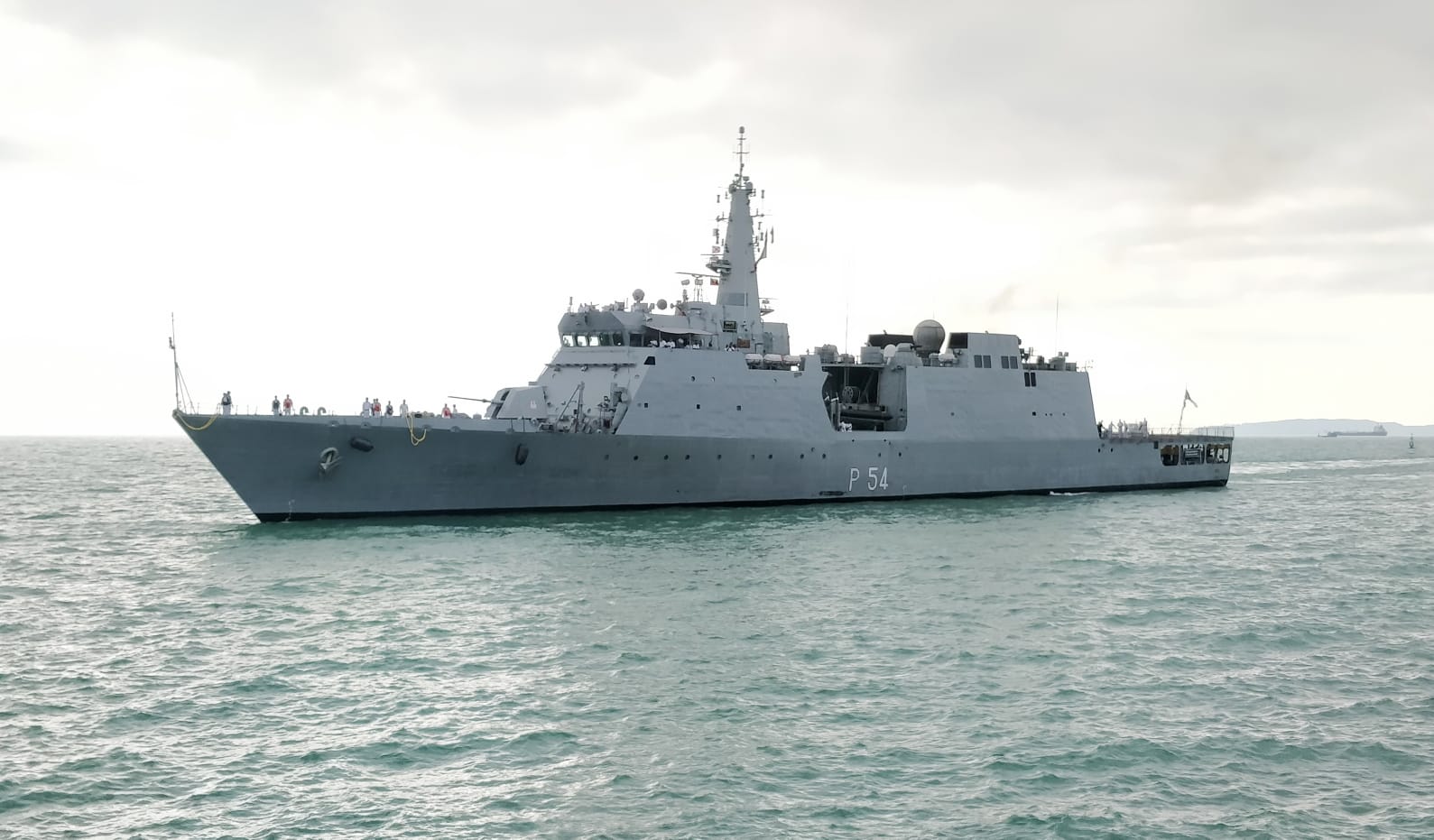
INS Saryu. Indian Government phot

Saryu class, six ships, commissioned 2013-2018, 105 m (344′), 2,230 tons, 25 knots

OBSERVATIONS

Speed: Speed has typically increased by about four knots. The trend seems to be to a maximum speed of 24-26 knots. Increasing speed is made easier by increasing waterline length. It may not be an accident that a waterline length of 97.8 m (320.8′) provides a hull speed of 24 knots, typical max speed for a modern OPV, while 20 knots, the typical speed for an OPV 30 years ago, only required a waterline length of 67.9 m (222.8′).

There is now little or no difference between the speeds of OPVs and corvettes or light frigates. For warships, except those that have to be able to keep up with nuclear powered carriers, the value of absolute top speed has diminished while the value of high sustained cruising speed has increased. This is apparent if you compare the Oliver hazard class FFGs with the new Constellation Class. Top speed is down 3-4 knots to 26 knots, but range is up with a powerplant designed for economical cruising.

Aircraft: Flight decks are now ubiquitous. Hangars are common but are not included in every new design. Designs that support two embarked helicopters are still the exception. The French POM, which seems to be a minimalist approach, bucks the trend and includes aviation facilities for only unmanned air systems.

Length: Of the current generation OPVs, none of those discussed is less than 80 meters (262,4) and only the minimalist French POM was that small.

The Royal Navy study I mentioned seems to have gotten it right, that 270 feet (82.3 m) is a reasonable minimum and in some environments, length should be greater. Desire for greater capabilities (e.g., greater speed, better aviation facilities, more weapons and sensors} may to be driving designs of greater length than would be required simply for seakeeping, but the choices made by the Royal Navy and Japan and Indian Coast Guards tend to confirm that about 90 meters or more and at least 2,000 tons is the new norm.

“Shipbuilder Austal executives accused of inflating earnings” –MSN

Future USCGC Pickering (Image: Austal USA)

MSN reports,

“Three current and former former executives of a shipbuilder that constructs vessels for the U.S. Navy have been indicted on accounting fraud charges accusing them of falsely inflating the company’s reported earnings, federal prosecutors said.”

Austal also has the second phase contract to build Offshore Patrol Cutters. Their alleged actions, which were reputedly intended to mislead shareholders and investors, even if proven, don’t necessarily affect the shipbuilder’s pricing or product, but the report goes on to note,

The U.S. Securities and Exchange Commission said in a news release that the three “engaged in a scheme to artificially reduce the cost estimates to complete certain shipbuilding projects for the U.S. Navy by tens of millions of dollars.”

Could they mislead shareholders and investors without also falsifying publicly available contract information?

U.S. Navy Decommissions Last Patrol Craft Stationed in Bahrain –NAVCENT

DAHLGREN, Va. (Nov. 6, 2004) Coast Guard Cutter Shamal (WPC-13) patrols the Potomac River near the Naval Surface Warfare Center in Dahlgren, VA. On Sept. 29, 2004, USS SHAMAL was transferred to the U.S. Coast Guard in Little Creek, VA and placed in Commission Special status. After a two-month dockside availability at Integrated Support Command Portsmouth, SHAMAL will make itstransit to her new homeport of Pascagoula, MS., where it will be officially commissioned on December 6, 2004. SHAMAL’s planned major missions will be alien migrant and drug interdiction operations within the D7 and D8 AORs. MS. USCG photo by Joseph P. Cirone,USCGAUX

Below is a NAVCENT news release. More a Navy story than a Coast Guard one, but a class of ships the Coast Guard not only worked closely with, but also operated. Their departure puts an even greater load on the six Patrol Forces SW Asia Webber class cutters.

U.S. Navy Decommissions Last Patrol Craft Stationed in Bahrain

By U.S. Naval Forces Central Command Public Affairs | March 28, 2023

The U.S. Navy decommissioned the last two Cyclone-class patrol coastal ships stationed at Naval Support Activity Bahrain, March 28, during a pierside ceremony attended by U.S. 5th Fleet officials.

Leaders and crewmembers of USS Monsoon (PC 4) and USS Chinook (PC 9) marked the end of nearly three decades of U.S. naval service.

“I’m honored to be a part of the legacy on this waterfront,” said Lt. Cmdr. Dre Johnson, during the ceremony. “PC Sailors are a unique bunch, and only they can understand the amount of work they’ve done and the pride they have in what they’ve accomplished.”

Johnson is Monsoon’s last commanding officer. The U.S. Navy initially commissioned the ship in 1994 and then recommissioned it in 2008 after Monsoon served four years in the U.S. Coast Guard. Chinook was commissioned in 1995.

“With 28 years of crew covering multiple generations, each one was dedicated to the mission, adapting to rapidly changing mission sets, and working together as a team to accomplish whatever obstacle that came their way,” said Lt. Cmdr. David Hartmann, Chinook’s commanding officer.

Monsoon and Chinook are the last of a group of 10 ships designed for shallow-water operations that were stationed in Bahrain. The Middle East region includes 5,000 miles of coastline from the northern Arabian Gulf, around the Arabian Peninsula, through the Red Sea and Suez Canal.

Last year, the U.S. Navy decommissioned and transferred five patrol craft to the Royal Bahrain Naval Force: former ships USS Tempest (PC 2), USS Typhoon (PC 5), USS Squall (PC 7), USS Firebolt (PC 10) and USS Whirlwind (PC 11). Additionally, the U.S. Navy decommissioned and transferred former ships USS Hurricane (PC 3), USS Sirocco (PC 6) and USS Thunderbolt (PC 12) to the Egyptian Navy last week during a formal ceremony in Alexandria, Egypt.

Monsoon and Chinook are slated for transfer to the Philippine Navy. Officials from the Philippines attended the ceremony.

“I’m proud of our crews for reaching this milestone and representing our nation and Navy with utmost pride and professionalism,” said Capt. Anthony Webber, commander of Task Force 55, which oversees operations for U.S. 5th Fleet’s surface forces. “I’m also proud that we are turning over great ships to our Philippine partners.”

Bahrain, Egypt and the Philippines are members of the largest multinational naval partnership in the world called Combined Maritime Forces (CMF). Led by the United States, forces from the organization’s 38 nations operate across approximately 3.2 million square miles of international water space in the Middle East. The partnership ensures maritime security and stability in some of the world’s most important shipping lanes.

Another Rotary Wing Air Intercept (RWAI) Mission

MH-65E interior.

Below is a news release from the Acquistions Directorate (CG-9). This is only the second “Rotary Wing Air Intercept” (RWAI) unit that I have heard of, but this may be a trend. The first unit has been flying over the Washington DC area since the 9/11 attack. Over time, it is likely the realization of a need for air policing will grow, and it looks like at the low and slow end of the spectrum, the Coast Guard is getting the job. 


Air Station Savannah plays key role in airspace security during SpaceX launches

SpaceX Crew-6 launch

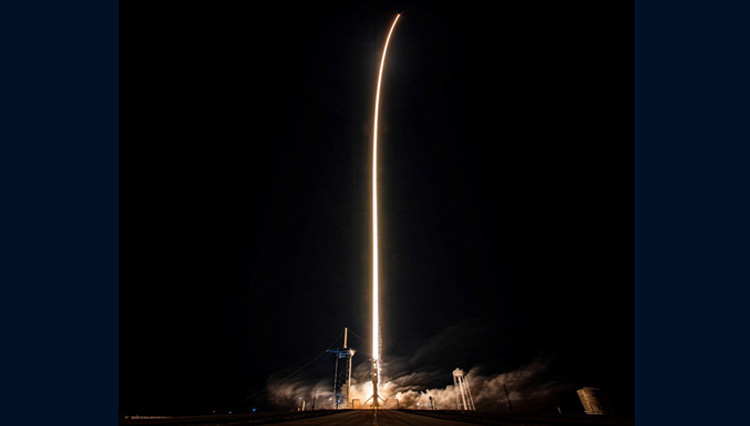
The SpaceX Crew-6 launch underway March 2, 2023. Photo courtesy of SpaceX.


Pilots from Air Station Savannah’s Rotary Wing Air Intercept (RWAI) unit stood ready to take to the skies March 2 in the air station’s new MH-65E Dolphin helicopter to provide security support for the manned SpaceX launch from Cape Canaveral, Florida. While this is the first time that the new Echo model was deployed, it marked the seventh launch for which the air station has provided critical flight restriction enforcement since NASA resumed manned space flights in 2020.

All airspace surrounding a space launch is restricted by the Federal Aviation Administration. The highly trained RWAI crew is poised to fly in very close quarters and intercept any unfamiliar aircraft that might trespass into the restricted airspace during a launch. Pilots who fly for the unit possess exceptional flight skills and decision-making abilities as the mission dictates pilots fly in extremely close quarters with other aircraft in order to intercept them.

The upgraded MH-65E helicopter is also more qualified for the task – the Echo configuration automates more flight control functions through use of the Common Avionics Architecture (CAAS) and Automatic Flight Control systems, allowing pilots to set parameters like altitude limits to prevent accidental overclimb into uncontrolled airspace. This and other upgrades ensure that pilots are able to focus on flying the mission with heightened awareness.
“The Echo drastically increases situational awareness and allows for much more complex mission calculations,” says RWAI pilot Lt. Cmdr. Sam Ingham. “This creates larger safety margins in an inherently dangerous environment.”

According to Aviation Special Missions policy director Lt. Cmdr. Mike Gibson, Air Station Savannah has sent NASA-requested RWAI resources to every official U.S. Government human spaceflight launch as part of Operation Noble Eagle. The latest launch was supported by Lt. Cmdr. Felipe Guardiola, Lt. Cmdr. Michael Gonzales and Petty Officer 2nd Class Connor Covert.

“NASA and the Coast Guard have a great relationship, and we’re happy to come down and help where we can,” said Ingham. “Also, it’s cool to have front row seats to watch rockets go to space.”

The MH-65 Conversion and Sustainment Program regularly receives feedback from the operational fleet on how the capabilities of the upgraded Echo allow the crew to continually be safer and more efficient when executing the mission. “It’s really incredible to hear from these crews that the upgrades to the Echo model are increasing their situational awareness,” said Cmdr. Karyn Forsyth, acquisition program manager for the MH-65. “Crews have more confidence in CAAS and its capabilities, especially when performing these special missions.”

The Coast Guard short range recovery helicopter program delivered the fifth and final MH-65E to Air Station Savannah Jan. 18, making it the ninth air station to fully transition to the upgraded configuration.

For more information: MH-65 Short Range Recovery Helicopter Program page

The National Fleet Plan–Redux

US Coast Guard cutter Munro transits the Taiwan Strait with US Navy destroyer USS Kidd in August. US Navy

A recent discussion with frequent contributor Peter Ong, lead to Peter pointing to “The National Fleet Plan.

It was an important publication for the Coast Guard and its interface with the Navy. It portended the FRCs in Guam and WMECs in Pensacola. Among other things, it listed equipment to be included in cutter classes, much of it supplied by the Navy (p.24). I did a post on it.

Trouble is, while much of the information is probably still accurate, it was published in August 2015. Maybe it is time for new edition.