“Coast Guard awards contract for work on coastal buoy tenders” –CG-9

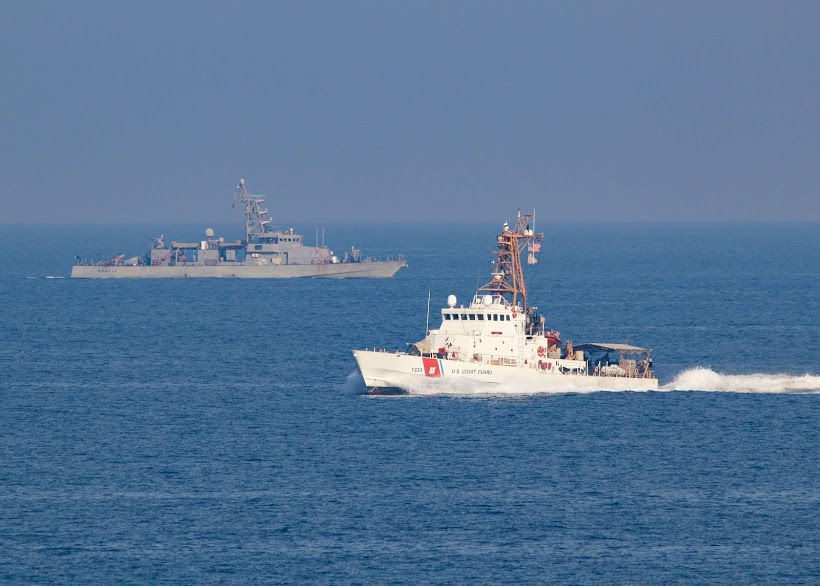
USCGC Ida Lewis

Below is a news release from the Acquisition Directorate (CG-9) about the next class of ships that will go through the “In-Service Vessel Sustainment Program,” the 175 foot, 840 ton, Ida Lewis or “Keeper” class 175 foot Coastal Buoy Tenders.

“…the primary objective of the MMA is to ensure that the 14 tenders reach the end of their 30-year designed service life…The 175-foot coastal buoy tenders were commissioned between 1996 and 2000. Work on the first hull, Coast Guard Cutter Ida Lewis, is scheduled to begin in July 2025 at Coast Guard Yard in Baltimore. The estimated project completion date for all 14 cutters is early 2036.”

There is a bit of double speak there, in that the program will not be finished until well after the “30-year designed service life” of all 14 tenders.  Even in the case of the first ship, USCGC Ida Lewis, she will have been in commission more than 28 years by the time her MMA starts and possibly 29 years before it is completed.

Obviously, these ships are expected to serve well past 30 years. That is not an unreasonable assumption. Many of the 180-foot WLBs built during WWII served more than 50 years, with the last, USCGC Acacia, decommissioned in 2006.

Nevertheless, with it taking 10 years from initial requirements to commissioning for new classes of ships, and both classes of large buoy tenders rapidly approaching 30 years in commission, it does seem like it may be time to start thinking about replacements.


Coast Guard awards contract for work on coastal buoy tenders
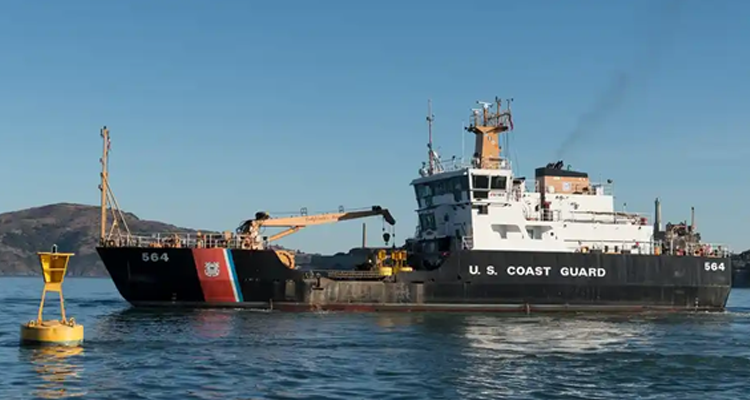
A 175-foot coastal buoy tender sets up a security zone for an event in San Francisco Bay. The 14 Keeper-class tenders will undergo a major maintenance availability starting in 2025. U.S. Coast Guard photo by Petty Officer 2nd Class Cory Mendenhall.


The Coast Guard awarded a contract to Adrick Marine Group of Cocoa, Florida, March 23 to procure HVAC systems as part of the upcoming 175-foot coastal buoy tender major maintenance availability (MMA). The contract has a total potential value of $5 million and supports continued operation of these Coast Guard surface assets through the remainder of each cutter’s expected service life.

This follows another important MMA contract awarded Dec. 19, 2022, for the main crane and central hydraulic system that was awarded to Appleton Marine of Appleton, Wisconsin, for $18.8 million.

A project of the In-Service Vessel Sustainment Program, the primary objective of the MMA is to ensure that the 14 tenders reach the end of their 30-year designed service life. MMA work facilitates fleet maintenance and increased mission availability during a cutter’s later years of service. MMA work focuses on hull and structural repairs and the replacement of obsolete, unsupportable or maintenance-intensive equipment.

The 175-foot coastal buoy tenders were commissioned between 1996 and 2000. Work on the first hull, Coast Guard Cutter Ida Lewis, is scheduled to begin in July 2025 at Coast Guard Yard in Baltimore. The estimated project completion date for all 14 cutters is early 2036.

Coastal buoy tenders play a vital role in directing the traffic of the nation’s Marine Transportation System and support the U.S. economy by maintaining aids to navigation critical in facilitating the safe and efficient flow of over $5.4 trillion worth of goods annually. These cutters also support the Coast Guard in various other missions including search and rescue, law enforcement, migrant interdiction, marine safety inspections, environmental protection and natural resources management. Keeper-class cutters are also used for light ice breaking operations.

For more information: In-Service Vessel Sustainment Program page

“China Coast Guard’s New ‘Monster’ Ship Completes Maiden Patrol in South China Sea” –The Diplomat

Photo credit: China Defense Blog

The Diplomat reports the maiden patrol of China Coast Guard’s second monster 12,000 ton cutter.

The patrol was only 19 days, but no telling how quickly they will come out again.

When you want to play bumper boats, size really does matter and the Chinese have raised the stakes considerably. Meanwhile the Japan Coast Guard (and here) and South Korean Coast Guard also have some very large cutters.

“Navy, Coast Guard Begin Oceania Maritime Security Initiative Patrol” –DVIDS

USS Mobile (LCS 26), an Independence-class littoral combat ship, was commissioned in 2021 and is homeported in San Diego. (U.S. Navy photo by Eric Parsons/Released)

Below is a press release from the Defense Visual Information Distribution Service (DVIDS). This may not be much different from the previous times Coast Guard Law Enforcement Detachments (LEDETs) were assigned to Navy units transiting to the Western Pacific. It is not at all clear how long they will be doing IUU fisheries enforcement.

SAN DIEGO— The U.S. Navy and U.S. Coast Guard began their joint patrol in the Western Pacific under the Oceania Maritime Security Initiative (OMSI) to reduce and eliminate illegal, unregulated, unreported fishing, combat transnational crimes, and enhance regional security, March 20.

“OMSI is imperative to ensure that the Western and Central Pacific Fisheries Commission Convention (WCPFC) agreement is upheld within the Indo-Pacific region,” said Cmdr. Richard Skinnell, commanding officer of the Navy’s primary participating unit, the Independence-variant littoral combat ship USS Mobile (LCD 26). “This initiative allows us the opportunity to work jointly with other branches of the military as well as our allies and partners.”

OMSI, a Secretary of Defense program, improves maritime security and domain awareness by enabling Coast Guard law enforcement personnel to conduct maritime law enforcement operations from Navy ships. These joint and combined operations ensure the U.S. military honors its security commitments to allies, partners, and friends.
“Collaborating with our partners throughout Oceania is essential in ensuring a free and open Blue Pacific,” said Cmdr. Jeff Bryant, chief of enforcement, U.S. Coast Guard District Fourteen. It is a privilege and we are proud to support the Federated States of Micronesia through dedicated partnership in the effort to maintain maritime governance and preserve maritime sovereignty.”

The WCPFC international fisheries agreement prioritizes the long-term conservation and sustainable use of highly migratory fish stocks in the Western and Central Pacific Ocean.

“The U.S. Coast Guard is always ready and looking forward to executing the OMSI mission alongside our U.S. Navy partners,” said Bryant.

Independence-variant littoral combat ship USS Mobile (LCS 26), with an embarked Coast Guard law enforcement detachment from the Pacific Tactical Law Enforcement Team, supports maritime law with partner nations by enforcing the WCPFC agreement and by suppressing illicit activities. Independence-variant LCS is the platform of choice for this mission due to its fast and agile maneuvering capabilities, large flight deck with manned and unmanned aviation assets and surface warfare mission set.

An integral part of U.S. Pacific Fleet, U.S. 3rd Fleet operates naval forces in the Indo-Pacific and provides the realistic, relevant training necessary to flawlessly execute our Navy’s role across the full spectrum of military operations–from combat operations to humanitarian assistance and disaster relief. U.S. 3rd Fleet works together with our allies and partners to advance freedom of navigation, the rule of law, and other principles that underpin security for the Indo-Pacific region.

I only saw this press release because this was buried in this US Naval Institute News Service article, “Makin Island ARG Docks in Busan, 3 LCS Now Underway in Indo- PACOM,”

“Meanwhile, a third U.S. Littoral Combat Ship, USS Mobile (LCS-26), is now deployed to the Indo-Pacific, joining USS Charleston (LCS-18) and USS Oakland (LCS-24), according to a 3rd Fleet release on Thursday.

The LCSs are taking part in U.S. Navy and U.S. Coast Guard joint patrol in the Western Pacific under the Oceania Maritime Security Initiative (OMSI) to reduce and eliminate illegal, unregulated, unreported fishing, combat transnational crimes and enhance regional security with the patrol being conducted by Mobile with an embarked Coast Guard law enforcement detachment from the Pacific Tactical Law Enforcement Team. Charleston is currently operating around the Indian Ocean while Oakland is around the South China Sea.”

The USNI article may give the impression that all three LCS have Coast Guard LEDETs aboard and that all three are countering IUU, but the referenced news release only mentions USS Mobile. 

It may be significant that USS Mobile is conducting these operations under 3rd Fleet rather than 7th Fleet. Recently 3rd Fleet, which previously was primarily a training and readiness organization, has been taking on more operational responsibility. We may start seeing more of this kind of activity. 

“Ministers Seek to Combat Organized Crime in Global Fisheries” –gCaptain

gCaptain reports,

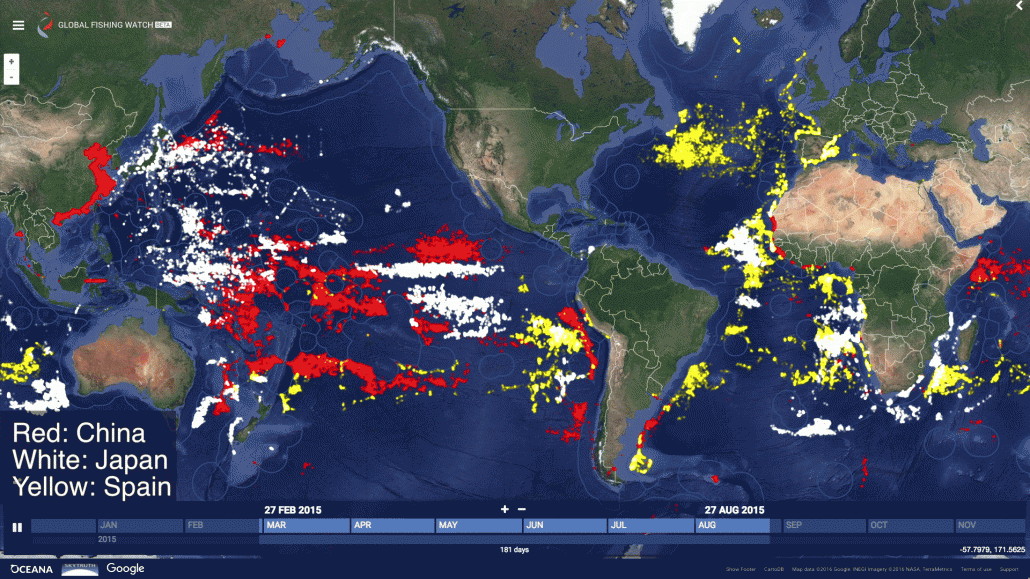
Government ministers and delegates attended a conference by the Blue Justice Initiative, backed by 60 coastal states as of Thursday, including Brazil, South Africa, Norway and Indonesia, to jointly eradicate transnational crime in global fisheries.

The report gives a good overview of the size and difficulties of this problem that the Coast Guard is attempting to address not just in the US but globally.

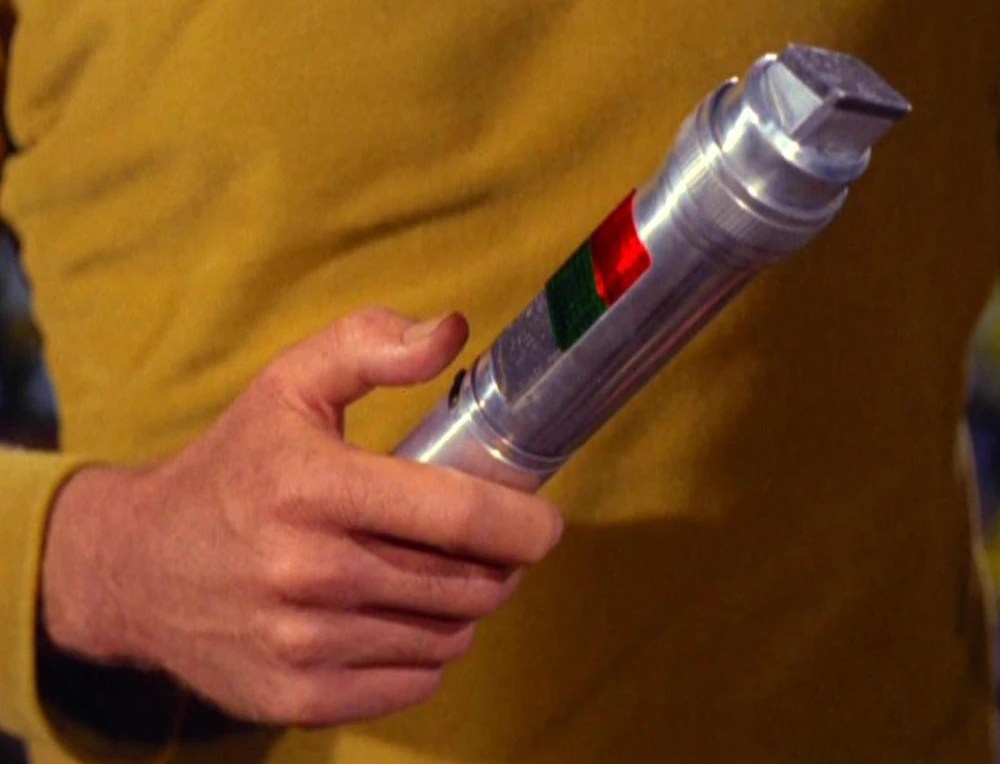
As Seen On Star Trek, Coast Guard to Get Universal Translator

Well, maybe not quite, but MyCG reports,

The customized translator is expected to be roughly the size of a standard phone and provide instant translations for 16 different languages. The initial prototypes – developed by myLanguage and Kynamics – are at different stages of completion. Coast Guard officials expect some devices could be available for testing on cutters as early as third quarter fiscal year 2023.

Coast Guard in the Iraq War

USCGC Adak Persian Gulf

MyCG has two posts about the Iraq war and the Coast Guard’s part in it.

Thought it odd we would have two so closely related posts, by the same author. Actually, the first was done some time ago but internet access was lost when the Coast Guard changed servers.

Both are now linked on my Heritage page.

“How Big is Big?”

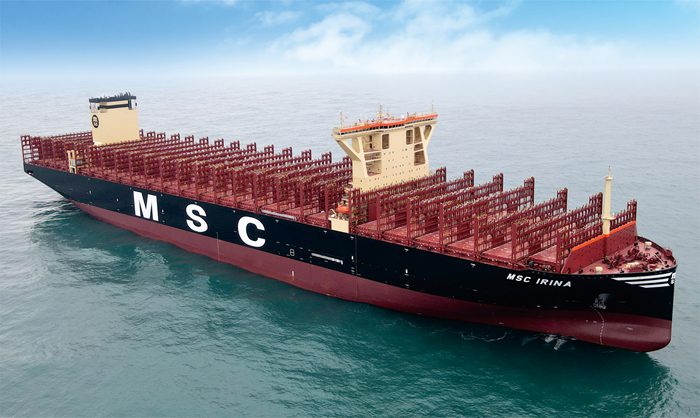
Yangzijiang Shipbuilding Photo

gCaptain reports,

Chinese Shipyard Delivers ‘World’s Largest Containership’ at 24,346 TEUs… 399.99 meters in length…61.3 meters in beam…”

So, if you put a Reliance class WMEC 210 on deck cross wise, it would only overhang about 9.4 feet. It is more than six times the length of a 210. You could put six 210s side by side across the beam of the ship. It would take almost 36 WMEC210s just cover the deck.

Think the Coast Guard could forcibly stop one of these? Just food for thought.

“Austal USA Taps Fairbanks Morse Defense to Equip OPC WMSM-919” –Marine Link

Future USCGC Pickering (Image: Austal USA)

Marine Link reports,

Fairbanks Morse Defense (FMD)…which has been expanding its offering as single-source maritime defense contractor, said its cross-company package for WMSM-919 includes two main propulsion diesel engines through Fairbanks Morse Defense, a hangar door and stores elevator through Federal Equipment Company (FEC), reverse osmosis system through Maxim Watermakers, two all-electric davits through Welin Lambie, and various electrical components (cable trays, light supports, piping supports, down commers, stuffing tubes, etc.) through Research, Tool & Die (RT&D).

Not unexpected, but good to see movement on the project, plus, it is a good excuse to publish the graphic.

Looking closely at the graphic, on the fantail, I see two buff-colored pieces that look like the lifting equipment. I am curious about what they are for?


“U.S. Coast Guard in Review” –USNI

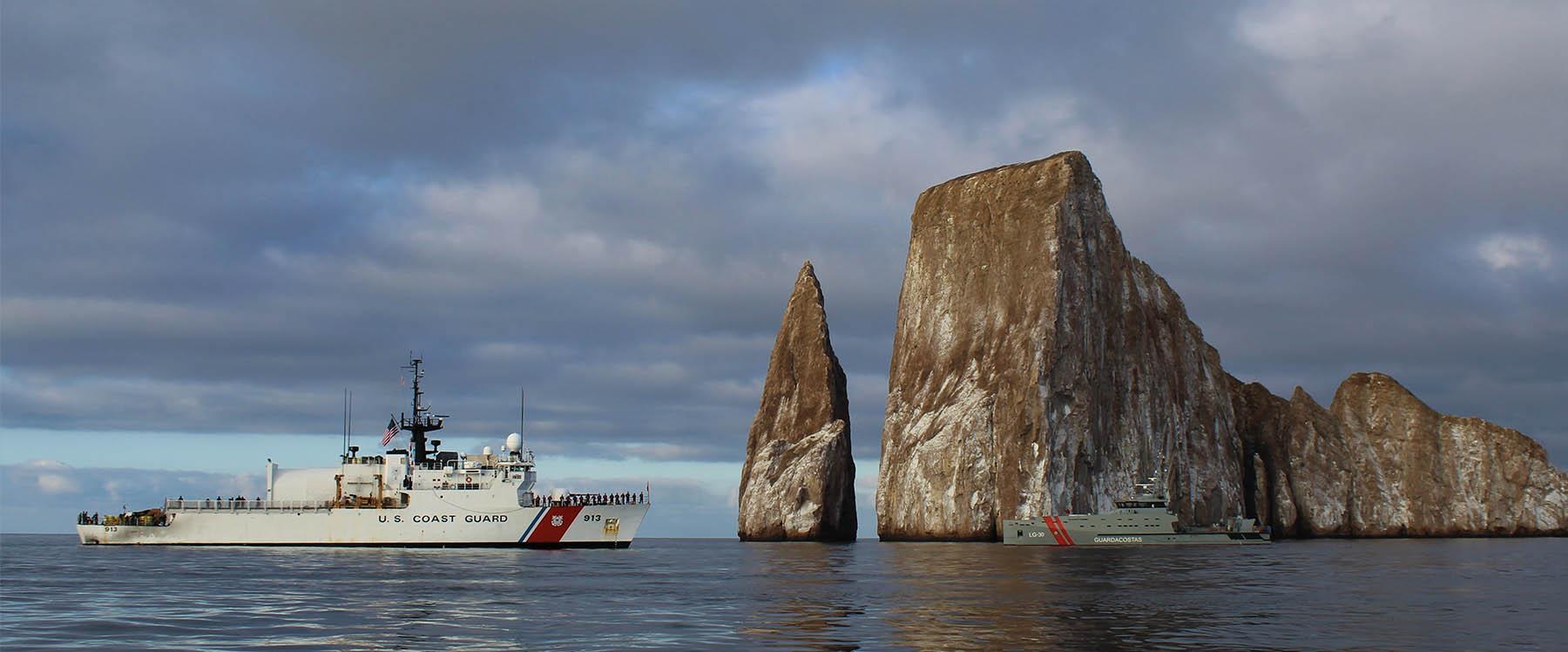
The USCGC Mohawk (WMEC-913), here with the Ecuador Navy offshore patrol vessel Isla San Cristobal, was the first cutter to anchor and visit Ecuador’s Galapagos Islands.
U.S. COAST GUARD

The March issue of US Naval Institute Proceedings is the annual Naval Review Issue, and as always they have a recounting of Coast Guard activities. It may be behind the pay wall, but you really should be a member. It is worth a look if only as a reminder of how many irons we have in the fire.

“Coast Guard Cutter Steadfast returns home following counternarcotics patrol” / Mexican Navy Assistance

Below is a CG News article. What makes this remarkable is the degree of cooperation with the Mexican Navy. It refers to a Mexican Navy MPA (maritime patrol aircraft). There is no indication of type, but the Mexican Navy acquired EADS CN-235 (C-144 in USCG) for use as MPA. The sale was coordinated through USCG Foreign Military Sales (see notes on the link). 

March 16, 2023

Coast Guard Cutter Steadfast returns home following counternarcotics patrol

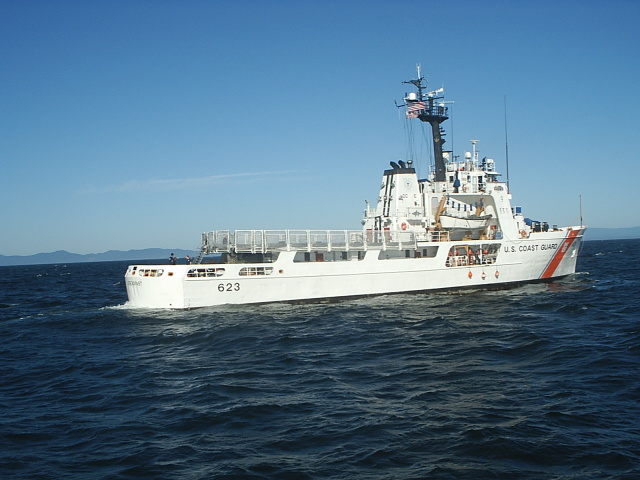
ASTORIA, Ore. — The Coast Guard Cutter Steadfast (WMEC 623) and crew returned to their Astoria homeport, Tuesday, following a 69-day counternarcotics patrol in the Eastern Pacific Ocean.

Steadfast’s crew disrupted the flow of illegal narcotics on three separate occasions during their patrol preventing a combined total of more than 7,500 pounds of cocaine, valued at $85.6 million, from reaching the U.S. maritime borders.

The crew steamed more than 12,000 nautical miles conducting training, law enforcement missions, providing search-and-rescue coverage, and conducting helicopter operations while patrolling the waters from their Astoria homeport to international waters off the coast of Central America.

The Steadfast deployed with a Jacksonville, Florida, based Helicopter Interdiction Tactical Squadron MH-65 Dolphin helicopter and aircrew along with temporarily assigned crewmembers from the Coast Guard Cutter Harriet Lane (WMEC 903) (getting a SLEP–Chuck), and soon-to-be-commissioned Coast Guard Cutter Argus (WMSM 915).

During nighttime patrol operations, Steadfast personnel were notified by a Maritime Patrol Aircraft (MPA) of a suspected narcotics-smuggling vessel transiting international waters. Steadfast personnel launched an Over-the-Horizon (OTH) crew and boarding team who interdicted the vessel after a multi-hour pursuit. The suspected smugglers jettisoned contraband, resulting in the disruption of 2,260 pounds of cocaine, valued at $25.6 million.

Additionally, Steadfast’s crew tracked another suspected narcotics-smuggling vessel with the assistance of a Mexican Navy (SEMAR) surveillance aircraft and aircrew. Steadfast personnel launched an OTH boat crew and HITRON helicopter aircrew while the Mexican MPA tracked the vessel. Steadfast’s small boat and helicopter crews interdicted the suspected narcotics-smuggling vessel and seized 3,300 pounds of cocaine valued at $37.5 million.

“The successful coordination between a U.S. Coast Guard cutter and Mexican MPA was a significant step in advancing our strategic partnerships in combatting the flow of illicit narcotics in Eastern Pacific,” said Cmdr. Brock S. Eckel, Steadfast’s commanding officer.

The next day, Steadfast crew launched an OTH boat crew and HITRON aircrew to intercept another suspected smuggling vessel. The aircrew located the suspected smuggling vessel and worked with a nearby Mexican Naval vessel to vector in a Mexican Naval helicopter. This multi-national effort resulted in the seizure of 1,984 pounds of cocaine valued at $22.5 million.

“From battling heavy seas off the Oregon and California coasts, to overcoming equipment casualties, and multiple smuggling vessel interdictions in the darkest of nights, the determination, resilience, and professionalism of the Steadfast crew was simply exceptional,” said Eckel. “The crew’s operational success was matched only by the strengthening of international and inter-agency relationships along the way. Steadfast’s crew once again proved their proficiency in working with partner nations jointly executing the counternarcotics mission successfully.”

The fight against drug cartels in the Eastern Pacific Ocean requires unity of effort in all phases from detection, monitoring, and interdictions, to criminal prosecutions for these interdictions by United States Attorney’s Offices throughout the country.

Commissioned in 1968, Steadfast is one of two 210-foot medium endurance cutters homeported in Astoria. The cutter and crew deploy along the western seaboard of North and Central America enforcing living marine resource laws and regulations, detecting and interdicting narcotics and migrant smuggling, and conducting search-and-rescue operations.