“Fixing the Coast Guard Academy’s Priorities” –USNI

ATLANTIC OCEAN (Feb. 23, 2021) — USCGC Charles Moulthrope (WPC 1141) conducted Astern Refueling at Sea training with the USCGC Venturous (WMEC 625). This evolution provides vital fuel to extend the endurance and range of FRC and provided an excellent training opportunity for both crews. (U.S. Coast Guard photo by Petty Officer 1st Class Sydney Niemi/Released)

US Naval Institute Proceedings has an essay that was chosen as third place winner in their “Midshipmen & Cadets Essay Contest,” written by now Ensign Logan Tobias. He contends, “The U.S. Coast Guard Academy is failing as a commissioning source for future leaders in the maritime domain. “

He suggests that the Academy has prioritized academics over professional training, and further that it is failing to graduate officers with “a love for the sea.” He also suggest that the class ranking system (military precedence average (MPA) calculation) which is weighted to consider suitability for service or military performance (MPI) as only 25% of the total undermines professional development.

 The MPA formula ensures academics always take precedence even though it is widely understood that MPI better encapsulates what it means to be an effective officer. In fact, a study commissioned by the U.S. Military Academy demonstrated that the correlation between academic success and officer effectiveness “did not demonstrate a very high relationship.”

Pointing out that academic performance and leadership do not necessarily go hand in hand he suggests, an evaluative prioritization shift to 55 percent GPA, 40 percent MPI, 5 percent PDC will help cadets reassess their priorities, allowing them to pursue opportunities for professional development not as a tradeoff for MPA points, but to advance both their personal readiness and class rank at the same time.

It does seem like sea-going experience is taking a hit.

In total, cadets accumulate approximately 140 sea days before graduation: 6-weeks on board the USCGC Barque Eagle (WIX-327) during third-class summer, three weeks on board 44-foot sailing yachts during second-class summer, and 11-weeks on board a cutter during first-class summer. However, this practicum is of questionable efficacy, as sailing a yacht to Nantucket is only tenuously related to conning a Coast Guard cutter. Moreover, many first class go to drydocked cutters, never leaving the pier, or only go underway for 6 weeks rather than 11, opting instead for internships and air stations. In summer 2021, more than one third of first-class cadets were assigned to internships or air stations. This apportionment helped contribute to 42 percent of the class not having enough sea time to earn a 100-ton license as of November 2021.

Forgive me, I am going to indulge in a bit of “back in my day,” even though it was long, long ago in a galaxie far, far away.  

My class and those of that now ancient era had an organized training cruise every year.  Newly arrived “swabs” (4th class/freshmen) capped swab summer with a short two week cruise that also included the 2nd class cadets.  3rd class and 1st class cadet had a 10 week cruise. That is 24 weeks afloat compared to the current 20 weeks but there were other significant differences. Even then there were some departures from this typical schedule but these were normally only available to second and first class cadets.

First, we all knew our first assignment would be afloat, so it focused the mind.

The 10 week cruises were organized as a training squadron of several ships whose only mission was training cadets. None of them were tied up in port except for scheduled short port calls.

Academy officers were assigned to the ships to coordinate cadet training with the ships.

The first class cadets began to learn officer duties, OOD, CIC, Navigator, Damage Control and Engineering.

Perhaps most importantly, the third class cadets would stand watches with enlisted sailors as messenger, helm, BMOW, evaporator watch, generators, main prop, mess cook, radarman, quartermaster, etc. We lived in enlisted berthing and eat on the messdeck. We would lower and raise boats and served in the boat crews in different positions. We manned and fired the 5″ gun. We did man overboard drills. We laid out the hawser and did towing drills, towing and being towed. We worked maneuvering board solutions for stationing problems, learning a lot about relative motion. This gave us a good understanding of what we could and should expect of our enlisted personnel. This is something you don’t get on Eagle or on a 44 sloop.

That third class year long cruise may be the most important thing missing now. Being part of a good crew is a great part of the allure of sea duty. That cruise gave us a taste of that.

Bottom line, if the academy does not provide better trained and better motivated Coast Guard officers than other sources, it has no need to exist.

The author may be wrong in his assessment. Current requirement may make it impossible to train everyone to be ship drivers or marine engineers, but the background does provide a degree of credibility for marine inspectors and a better understanding for our aviators. I would think, at least for the first two summers’ training would strongly emphasize an afloat career path.

“Mexican Navy Helicopter Crashes During U.S. Extradition Hunt” –USNI

The US Naval Institute news service reports the loss of a Mexican Navy Helicopter with 15 Mexican Marines aboard. There was only one surviror.

Mexican law enforcement were looking for someone with two warrants out for his arrest in Mexico and an extradition order for the United States, according to the release.

The loss was related to the capture of convicted Mexican drug kingpin Rafael Caro Quintero, wanted by US authorities for allegedly kidnapping and conspiring to murder Drug Enforcement Administration (DEA) Special Agent Enrique Camarena Salazar in 1985.

The Mexican Navy and Marine Corps have proven to be one of the most reliable and incorruptable institutions in Mexico. Hopefully the USCG will extend its sympathies to our partners in Mexico. We know how devastating such a loss can be.

“EASTERN SHIPBUILDING GROUP ANNOUNCES KEEL AUTHENTICATION FOR THIRD UNITED STATES COAST GUARD OFFSHORE PATROL CUTTER INGHAM (WMSM-917)” –News Release

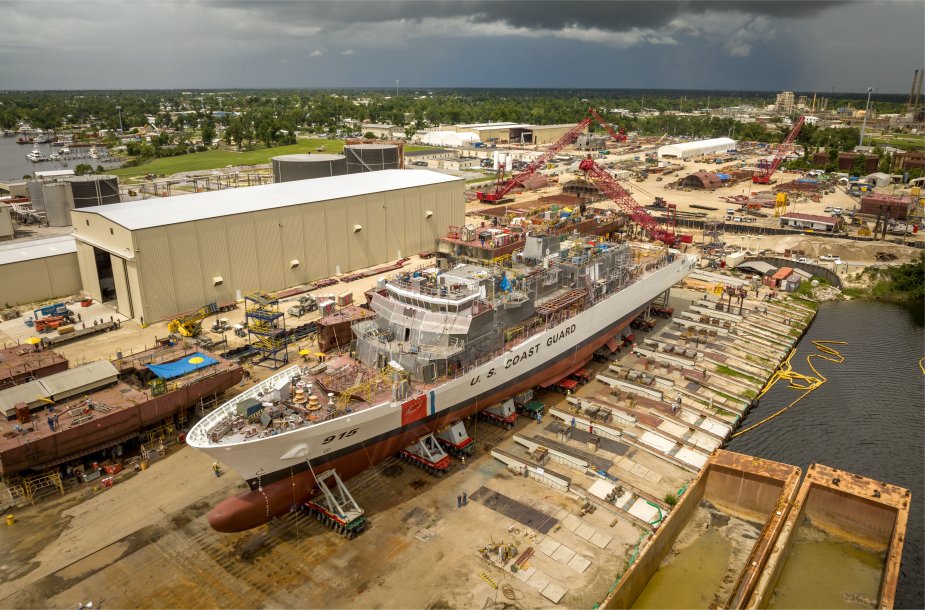
Eastern Shipbuilding Group, Inc. photo

Below is a news release from Eastern Shipbuilding, quoted in full.

FOR IMMEDIATE RELEASE

         July 15, 2022

EASTERN SHIPBUILDING GROUP ANNOUNCES KEEL AUTHENTICATION FOR THIRD UNITED STATES COAST GUARD OFFSHORE PATROL CUTTER INGHAM (WMSM-917)

PANAMA CITY, FL – Today, Eastern Shipbuilding Group, Inc. (ESG) hosted the keel authentication ceremony for the U.S. Coast Guard’s future Offshore Patrol Cutter (OPC), USCGC INGHAM (WMSM-917), the third vessel in the new Heritage Class built at the Nelson Street facility. The presiding official for the U.S. Coast Guard was Rear Admiral Chad L. Jacoby, Director of Acquisition Programs & Program Executive Officer (CG-93). Congressman Neal Dunn (FL – 2nd District) was the senior official in attendance.

“Today marks another pivotal milestone in the legacy of the Heritage Class Offshore Patrol Cutters constructed here in Panama City as we now have three OPCs in full production on time and on budget. I’m proud of our workforce for delivering shipbuilding excellence to the men and women of the USCG,” said ESG President Joey D’Isernia.

The ship’s sponsor is Alaskan Senator Lisa Murkowski, a member of the Senate Appropriations Committee, and strong advocate for the national defense and coastal priorities in the Pacific and Arctic regions. USCGC INGHAM will be homeported in Kodiak, Alaska with Senator Murkowski’s signature welded on the keel. She has worked to ensure that those stationed there will have new housing, an updated Child Development Center, and a new fuel pier.

“Thank you to the U.S. Coast Guard and Eastern Shipbuilding Group for inviting me to join a maritime honored tradition—by serving as the ship’s sponsor to the newest Coast Guard Cutter Ingham. I commend the hundreds of skilled professionals at Eastern Shipbuilding Group there in Panama City, Florida building this vessel. You are experts at your craft and have shown true resilience through the pandemic, supply chain challenges, and a category 5 hurricane. The Offshore Patrol Cutter Ingham will have tremendous capabilities and will be protecting our interests in the Pacific Ocean for decades to come,” said Senator Murkowski.

Each of the new Heritage Class Offshore Patrol Cutters aptly represent a naval tradition of naming ships for previous vessels. Three U.S. Revenue Service Cutters and one highly distinguished U.S. Coast Guard Cutter bearing the name Ingham are etched in United States history. The first Ingham was named in honor of U.S. Secretary of the Treasury Samuel D. Ingham and was bestowed with the axiom “semper paratus” in 1836, nearly 60 years before the U.S. Coast Guard adopted this motto in 1896. The most recent, USCGC Ingham (WHEC 35), served for over 50 years from 1936 to 1988 in the North Atlantic, Pacific and Caribbean during World War II, executing vessel escorts, weather patrols and anti-submarine missions. It assisted weather stations and performed search and rescue during peacetime, and it conducted dozens of naval gunfire support missions during the Vietnam War. At her decommissioning, she was the oldest cutter in commission, the most decorated vessel in the U.S. Coast Guard fleet, the last active warship to sink a WWII U-boat, and was the only cutter to be awarded two Presidential Unit Citations. The future USCGC INGHAM (WMSM-917) will carry that legacy for the next forty years.

“Over the course of the life of the USCG there have been four vessels to proudly carry the name INGHAM. Those vessels were crewed by sailors that were hardened by the sea and strove to accomplish their missions to the best of their ability, often at their own peril. These feats were accomplished using knowledge, skill, and a desire to do the best in all situations. Excellence is the direct outcome of their culture and a legacy we pass to the newest vessel to bear the great name INGHAM; WMSM-917. Semper Paratus,” said Bruce “Beemer” Yokely,  President  of Ingham Association.

Joey D’Isernia was accompanied on the podium by Rear Admiral Jacoby and Karlier Robinson, the expert welder charged with welding the sponsor’s initials onto the ceremonial keel authentication plate.

The keel authentication, also known as keel laying, represents the ceremonial start of a ship’s life by commemorating the assembly of the initial modular construction units. Historically, to attest that the keel was properly laid and of excellent quality, the shipbuilder would carve their initials into the keel. This practice is commemorated by welding the ship’s sponsor’s initials into the keel authentication plate.

About Eastern Shipbuilding Group, Inc.

Eastern Shipbuilding Group, Inc. (ESG) is a leading shipbuilder with operations on the Florida Gulf Coast. ESG is the largest private sector employer in Bay County and is a 2017 recipient of the U.S. Department of Homeland Security Small Business of the Year award. They build world class vessels for national defense and commercial clients, including the U.S. Coast Guard’s Heritage Class Offshore Patrol Cutters. With three shipyards and a portfolio of over 350 vessels, ESG is known as one of the most diverse vessel construction companies. www.easternshipbuilding.com

To download photos (credit Eastern Shipbuilding Group, Inc.): https://www.dropbox.com/t/IQ45S8jy2FPw8pDQ

“JUST IN: Coast Guard Aims to Learn from Navy at RIMPAC” –National Defense

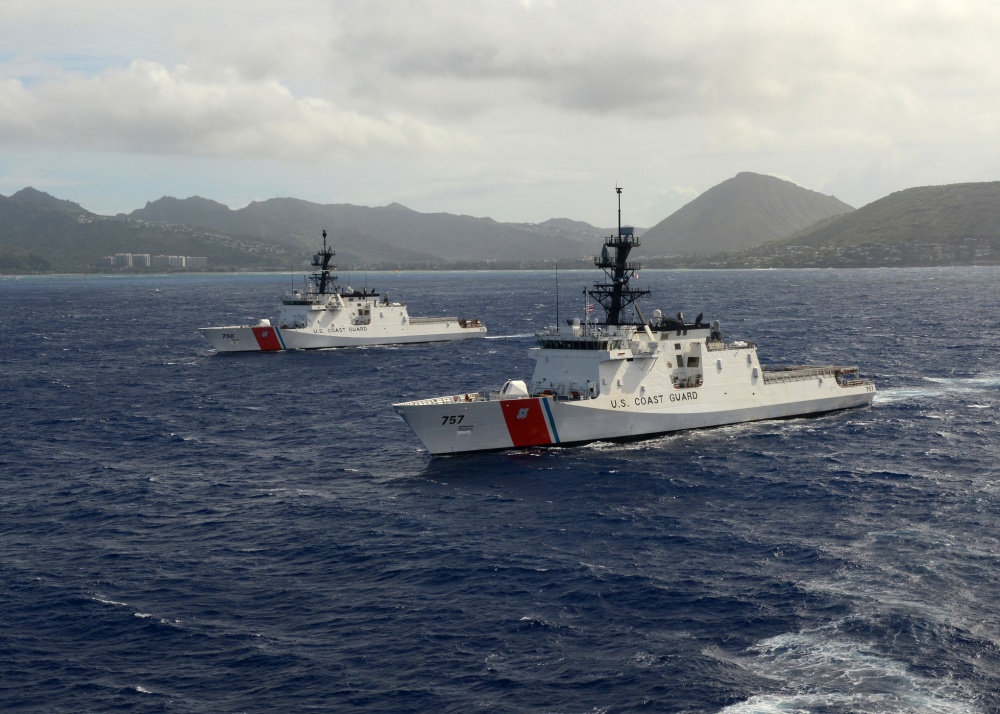
The crews of the Coast Guard Cutters Midgett (WMSL 757) and Kimball (WMSL 756) transit past Koko Head on Oahu, Hawaii, Aug. 16, 2019. The Kimball and Midgett are both homeported in Honolulu and two of the newest Coast Guard cutters to join the fleet. (U.S. Coast Guard photo by Petty Officer 3rd Class Matthew West/Released)

We are finally getting some information about the Coast Guard’s participation in RIMPAC 2022, and some of it may be a bit surprising.

A Coast Guard CO will command a task force,

Coast Guard Cutter Midgett is commanding Combined Task Force 175, which includes ships from France, Peru and the U.S. Navy, and is conducting air and missile defense, gunnery, mass rescue and anti-submarine warfare exercises.

The surprise, of course, is anti-submarine warfare. Midgett might simply simulate the high value unit to be protected, but Midgett will embark an MH-60R. The “Romeo” version is an ASW helicopter.

The 418-foot Midgett, a national security cutter and the largest class in the Coast Guard fleet, will also sail with a Navy MH-60R helicopter on board.

“Part of that is, how do you sustain that particular airframe? How do you support it for a long-range, two-month or three-month deployment?” he said. The Coast Guard is hoping to convert some of its airframes to ones used by the Navy going forward.

I might add, where do you store the sonobuoys, torpedoes, and other weapons?

(I have felt for a long time there are opportunities for attaching Navy Reserve units, that might include ASW Helicopters and their crews and sonar equipment and supporting personnel, to Coast Guard cutters as mobilization assets.)

Will the helicopter operate from Midgett as part of a Sink-Ex? Will Midgett get to participate in a Sink-Ex?

All the Sink-Exs seem to target ships of frigate size or larger. It would be good to have some smaller targets for less capable weapon systems.

What about the USCGC William Hart (WPC-1134), that will also be participating? Her only activity mentioned is to help set up a SAR exercise,

“As part of RIMPAC, the Hart will deploy two groups of mannequins at sea for the Midgett and a Japanese cutter to find and recover in a mass-rescue operation.”

Hope Hart and Midgett get to exercise against high speed small surface targets.

“Russian Overreach Gives New Urgency To Arctic Emergency Drills” –Forbes

Exercise Argus 2022 participants USCGC Oak and HDMS Ejnar Mikkelsen (P571) meet off Greenland. U.S. COAST GUARD

Forbes gives us a look at Exercise Argus which was sponsored by Denmark and conducted off Greenland. Author Craig Hooper also looks at the challenges facing Greenland as tourism and offshore traffic increase exponentially.

Off Greenland, the Danish Joint Arctic Command just finished hosting Exercise Argus, an annual Danish-led training event. The exercise, designed to enhance search-and-rescue and marine environmental responses in the Arctic, offers the U.S. Coast Guard an opportunity to obtain some experience operating in Polar waters.

For the exercise, a range of U.S. Coast Guard elements, joined by units from France—an Arctic Council observer state—worked with Danish and Greenland-based assets. The international team prepared for a complex maritime accident, a catastrophe that most Arctic observers suspect will be inevitable in the years ahead.

Before the exercise commenced, a 225-foot seagoing buoy tender, the Coast Guard Cutter Oak (WLB 211) arrived in Sisimiut, Greenland, becoming one of only a handful of U.S. ships that have operated north of the Arctic Circle. At sea, the tender was joined by a French patrol boat, FS Fulmar (P740), and the capable Danish Knud Rasmussen-class patrol boat, HDMS Ejnar Mikkelsen (P571), as well as by smaller local law enforcement and pollution-response craft.

For a view of an earlier similar exercise, a comparison of the Knud Rasmussen class OPV with the 270 foot WMECs, and some great photographs take a look here.

“Eastern Shipbuilding Group takes next step for first Heritage class cutter Argus” –Navy Recognition

Future US Coast Guard’s Heritage class cutter Argus (Picture source: Eastern Shipbuilding Group)

Navy Recognition reports,

According to a tweet published by Eastern Shipbuilding Group on July 12, 2022, the company successfully transferred Offshore Patrol Cutter (Heritage class cutter) Argus Hull 1 to launch position and shifted Hull 2 for the next phase of production at Berard Transportation.

This is a routine report of progress, though it has been a long time coming, but one thing caught my eye,

“She is able to reach a top speed of 24.5 knots (45.4 km/h)…”

I had been disappointed when the request for proposal specs identified 22 knots as the acceptable threshold for speed. 25 knots was identified as the goal and I always felt it should have been the threshold. Even a couple of knots makes a big difference in their potential use as escort vessels. What we have seen repeatedly is 22.5 knots from official sources. Official sources do tend to be very conservative. Looking at the combination of length, displacement, horsepower, it has always seemed to me, they should make 24 to 25 knots max, at least in most circumstances. (Some WWI light cruisers were closely analogous.)  The Wikipedia entry for the Heritage class cutters has reported a maximum speed of 24.5 for some time. Hopefully the Navy Recognition report is based on an Eastern Shipbuilding news release and represents their best estimate of maximum speed. I am hoping we get some reports of actual maximum speed from the sea trials.

New Format–USNI News Fleet and Marine Tracker: July 11, 2022

The latest “USNI News Fleet and Marine Tracker” includes additional summary information that is more informative.

Ships Underway

Total Battle Force Deployed Underway
298
(USS 241, USNS 57)
110
(USS 73, USNS 37)
 60
(44 Deployed, 16 Local )

Ships Deployed by Fleet

2nd Fleet 3rd Fleet 4th Fleet 5th Fleet 6th Fleet 7th Fleet Total
0 11 2 13 26 58 110

For the last several weeks, information about how many ships were deployed and how many underway was missing entirely.

I had been following how many ships were deployed to 4th Fleet because in most cases those ships were assisting in drug interdiction, but recently that information was not listed. That is back. Two ships are deployed to 4th Fleet which was typical of earlier information.

From prior information, I had concluded that US Navy ships were deployed about a third of the time and underway about a quarter of the time. That is far less underway time than I believe is typical for Coast Guard cutters. We frequently hear that US Navy ships are overworked. I would not dispute that, but it does seem that underway time is not the reason they are overworked. New information included in this latest “Fleet and Marine Tracker” gives even clearer insight into how much time US Navy’s commissioned ships spend deployed and underway. For the first time there is a breakdown of ship type as either USS or USNS.

USNS ships are only 19.1% of the “Battle Force.” but they are 33.6% of the ships deployed. 64.9% of USNS ships are deployed.

Commissioned ships (USS) are 80.9% of the “Battle Force,” but only 66.4% of those deployed. Less than a third, 30.3% of commissioned ships, are deployed.

Only 20.1% of the “Battle Force” was underway. We don’t have a USS/USNS breakdown for ships underway. If we assume the 44 ships deployed and underway was in the same proportion as those simply deployed, then there were probably 29 USS ships deployed and underway. While unlikely, the 16 ships underway locally might all be USS ships, so at most 45 USS ships, 18.7% of commissioned ships might have been underway.

If the Navy wants to reduce the workload on their sailors, they probably cannot do it by reducing deployments and underway time. My own experience was that we got a lot more done while underway than while inport.

There is a second observation that is particularly important for war planning. The USNS fleet is strained to support current deployment levels. If we have a near peer conflict in the Western Pacific, we would probably want to approximately double the number of commissioned ships deployed to about 60% with about 50% of commissioned ships actually continuously underway, almost three times what we are seeing now.

Those ships will need underway replenishment.

That means that both, we need to substantially increase the number of support ships, just to fully use the combatants we already have, and that the support ships we do have are precious and need to be protected. The Coast Guard may have a role in providing at least some of that protection.

Fincantiari of Italy Builds Two Small but Powerful OPVs

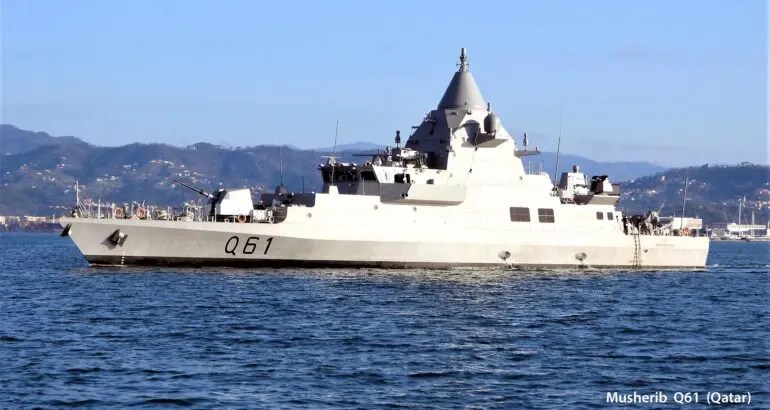
The Qatari Navy OPV is about 63 meters long, 9.2 meters wide, with a maximum speed of 30 knots. Giorgio Arra picture.

Naval News has done a couple of posts on a pair of Offshore Patrol Vessels (OPV) built in Italy for the Qatar Emiri Naval Forces by Fincantieri (owner of Marinette Marine in Wisconsin):

These are not your typical OPV. They look more like FAC(M) i.e fast attack craft, missile, but they trace their linage back through the UAE’s Falag 2 class to the Italian Coast Guard’s Diciotti class. Let’s compare to a typical OPV and talk about why they are so different.

First what is a typical OPV?

  • Displacement: at least 1,500 tons full load, typically less than 3,000
  • Length: at least 75 meters (246 ft), typically less than 100 meters (328 ft)
  • Range: at least 3500 nautical miles, typically 5,000 or more
  • Endurance: at least three weeks
  • Speed: 20-25 knots
  • Aviation: At least flight deck for medium helicopter
  • Boats:  at least two RHIB of 7 meters or larger
  • Weapons: one deck gun of 76mm or less plus two to four guns .50 cal to 30mm guns with one or two typically mounted in remote weapon stations. Anti-Ship Cruise missiles are rare and Anti-Aircraft missile systems more capable than MAPADS rarer still.

Examples include ships building or in service with Argentina, Australia, Britain, India, Japan, Malta, the Philippines, Singapore, Türkiye, the Fassmar designs used by Chile, Colombia, and German, and Damen designs used by Malaysia, the Netherlands, Pakistan, and Vietnam.

The 270 foot Bear class WMECs fit the profile pretty well, if you ignore the fact they can’t quite reach 20 knots. In some respects they are still more sophisticated that some of the newer OPVs.

The 210 foot Reliance class WMECs fall outside the current norm, being smaller and slower than typical, but they otherwise fit the profile. Of course even the newest is 53 years old.

Now let us compare the new Qatar OPV.

Range/Endurance:

Their range is only 1500 nautical miles at 15 knots, that is even less than that of the smaller Webber class cutters’ 2500 at 14 knots. Their seven day endurance is more typical of the smaller Inshore Patrol Vessel class. As a patrol vessel, it is closer to the Webber class WPCs than even the Reliance class.

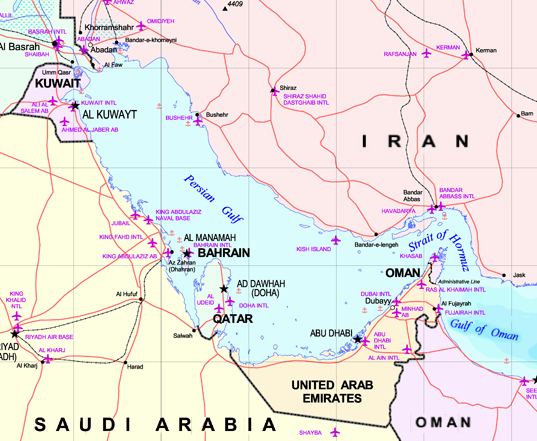
Persian Gulf. US Government work product in the public domain.

Geography is the reason. Qatar’s coast line is only 563 km and its EEZ is 31,819 sq km (that of the US is 11,351,000 sq km, 357 times greater). They just don’t have to go very far. It may also be that these ships will be used more in reaction than as actual patrol vessels.

Size:

Full load displacement is 725 tonnes, with a length of 63.80 (209 feet) (59.60 meters or 195.5 feet between the perpendiculars) and a beam of 9.20 meters/30 feet. This makes them smaller than the Reliance class and only about half the size of the smallest of the typical OPVs. Rough seas are probably less of a concern than in more open areas.

Speed:

Their speed of 30 knots, rather than the typical 20 to 25, also seems to suggest their role is one of rapid reaction rather than persistant patrolling.

Aviation:

Unlike most modern OPVs, there is no apparent provision for supporting aviation assets, not even UAS. That is presumably because land based air is always close.

Starboard quarter of second Musherib-class OPV “Sheraouh” for the Qatar Emiri Naval Forces. Visible are the ship’s boat, two twin Exocet launchers and two 30 mm Marlin-WS secondary gun systems. Picture by Luca Peruzzi

Boats:

The OPV has a stern area with crane for launch and recovery of a RHIB. This is not an arrangement that suggests the boat would be used frequently or that boat ops is a high priority.

The second Musherib-class OPV “Sheraouh” for the Qatar Emiri Naval Forces. Fincantieri picture.

Amaments:

“…in addition to the NA-30S Mk2 FCS for the Leonardo Super Rapido 76/62 mm Multi-Feeding main calibre gun, the Leonardo-provided  EO/IR suite also includes two SASS IRSTs and a single Medusa Mk4B FCS for the two 30 mm Marlin-WS secondary gun systems. The missile armament package also includes two four-cell VLSs for the MBDA VL MICA surface-to-air system in the bow area and two twin-launchers for the MBDA Exocet MM40 Block 3 anti-ship missiles in the stern area.”

The Persian Gulf is a rough neighborhood. Qatar faces Iran across the relatively narrow Gulf. Potentially hostile craft are always close. Shore based anti-ship cruise missiles are always within range. Iranian surface units are at most only hours away, aircraft and missiles only minutes.

The vertical launch MICA missile system and Super Rapid 76mm gun provide credible defense against aircraft and cruise missiles.

While normally I would not feel four Exocets would be enough to provide two salvos of adequate size, against the potential Iranian opposition, four are probably adequate for two engagements.

It is not surprising these ships are better armed than any US Coast Guard cutter, including the more than six times larger National Security Cutters. They may be the most heavily armed “OPVs” in the world.

Two four-cell VLSs for the MBDA VL MICA surface-to-air system mounted between the bridge and a Leonardo 76mm gun forward. Picture by Luca Peruzzi

“Japan Awards Contract to Shipbuilder JMU for 12 New Offshore Patrol Vessels” –The Diplomat

A concept image of a next-generation offshore patrol vessel (OPV) for the Japan Maritime Self-Defense Force (JMSDF) made by JMU. Image courtesy of Japan’s Acquisition, Technology, and Logistics Agency.

The Diplomat reports,

The Japanese Ministry of Defense announced on June 30 that it has awarded a contract to shipbuilding company Japan Marine United (JMU) Corporation to build a next-generation offshore patrol vessel (OPV) for the Japan Maritime Self-Defense Force (JMSDF).

We had an earlier report about this project.

The project is for 12 Offshore Patrol Vessels of 1920 tons standard displacement. Their full load displacement will be higher, probably in the neighborhood of 2,200 to 2,400 tons.

  • Length: 95 meters  (312 feet)
  • Beam: 12 meters (39’4″)
  • Speed: 20 knots (slower than the 25+ knots reported earlier)
  • Crew: 30
  • Average Cost: $66.6M

The design is said to offer modular adaptability.

Combined diesel-electric and diesel (CODLAD) propulsion promises very economical slow cruising.

Presumably these will be used to shaddow the movements of potentially hostile vessels transiting in or near Japanese waters.

They might also be used to provide counter piracy protection off the Horn of Africa. This would free more capable (and much more expensive) warships to be in position to deal with more significant threats.

The design looks to be almost ideal for export as part of Japan’s on going program to strengthen the maritime law enforcement capabilities of friendly Asian nations.

It does appear there might be some overlap between the missions of this class and those of the Japan Coast Guard.

This combination of sea worthy hull, simple systems, and small crew sounds a lot like my Cutter X proposal to put the machinery, equipment, and crew of the Webber class cutters in a larger, more seaworthy, and longer range hull.