“Japan Awards Contract to Shipbuilder JMU for 12 New Offshore Patrol Vessels” –The Diplomat

A concept image of a next-generation offshore patrol vessel (OPV) for the Japan Maritime Self-Defense Force (JMSDF) made by JMU. Image courtesy of Japan’s Acquisition, Technology, and Logistics Agency.

The Diplomat reports,

The Japanese Ministry of Defense announced on June 30 that it has awarded a contract to shipbuilding company Japan Marine United (JMU) Corporation to build a next-generation offshore patrol vessel (OPV) for the Japan Maritime Self-Defense Force (JMSDF).

We had an earlier report about this project.

The project is for 12 Offshore Patrol Vessels of 1920 tons standard displacement. Their full load displacement will be higher, probably in the neighborhood of 2,200 to 2,400 tons.

  • Length: 95 meters  (312 feet)
  • Beam: 12 meters (39’4″)
  • Speed: 20 knots (slower than the 25+ knots reported earlier)
  • Crew: 30
  • Average Cost: $66.6M

The design is said to offer modular adaptability.

Combined diesel-electric and diesel (CODLAD) propulsion promises very economical slow cruising.

Presumably these will be used to shaddow the movements of potentially hostile vessels transiting in or near Japanese waters.

They might also be used to provide counter piracy protection off the Horn of Africa. This would free more capable (and much more expensive) warships to be in position to deal with more significant threats.

The design looks to be almost ideal for export as part of Japan’s on going program to strengthen the maritime law enforcement capabilities of friendly Asian nations.

It does appear there might be some overlap between the missions of this class and those of the Japan Coast Guard.

This combination of sea worthy hull, simple systems, and small crew sounds a lot like my Cutter X proposal to put the machinery, equipment, and crew of the Webber class cutters in a larger, more seaworthy, and longer range hull.


“U.S. aims at PRC in new illegal fishing policy framework” –Indo-Pacific Defense Forum

Fijian law enforcement officers and U.S. Coast Guard personnel from USCGC MUNRO board a Chinese-flagged vessel off the coast of Fiji in April 2022 during patrols to counter illegal, unreported and unregulated fishing. IMAGE CREDIT: PO1 Nate Littlejohn, U.S. COAST GUARD

Indo-Pacific Defense Forum passed along an Associated Press report on US efforts to forge an international consensus to combat Illigal, Unreported, Unregulated (IUU) fishing, including  poor labor and environmental practices, first by applying a standard nationally,

It was expected to be followed quickly by new rules from the U.S. National Oceanic and Atmospheric Administration expanding the definition of illegal fishing to include related labor abuses, a first step to the eventual blacklisting of flag states that fail to comply.

Followed by work on an international treaty.

Significantly subsidies are now seen as unfair trade practice with disasterous impact on fish stocks. China has used subsidies to build the world’s largest fishing fleet, and they use it for more than just catching fish.

President Biden’s administration’s announcement came as the World Trade Organization (WTO) heralded a historic agreement, reaching a deal during its June 2022 conference in Geneva, Switzerland, to curb IUU fishing, reduce the strain on dwindling fishing stocks, and ensure more transparency and accountability through improved conservation and management measures. The WTO deal explicitly prohibits subsidies, considered by environmentalists to be the biggest contributing factor to depleting fish populations globally.

“U.S. Navy Offers Cash Reward For Tips On Illegal Maritime Activity And Cargo” –gCaptain

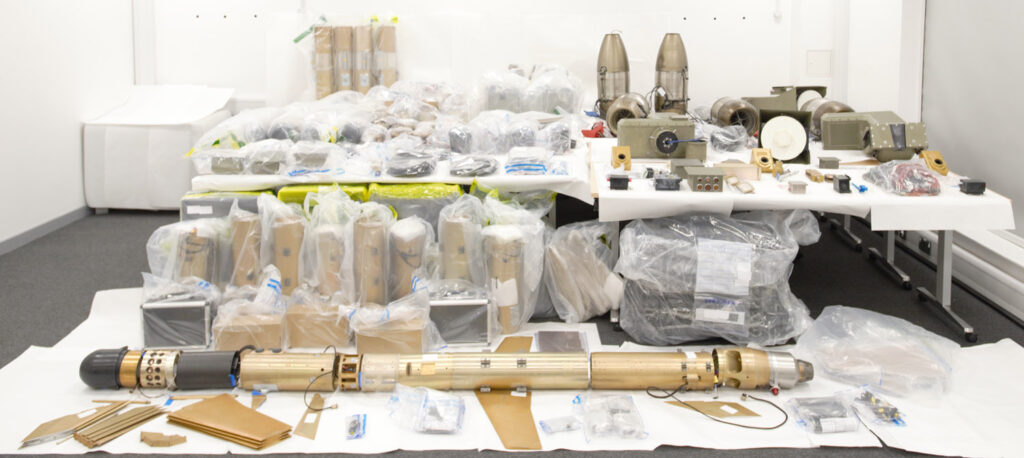
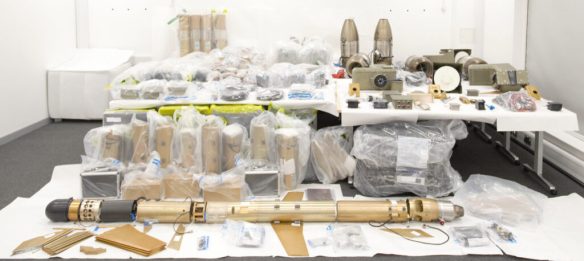
Some of the weaponry and missile parts seized by HMS Montrose in early 2022.

gCaptain reports,

The U.S. Navy will for the first time reward individuals for reporting information that leads to the detection of illegal maritime activity or seizure of illicit cargo in waters across the Middle East.

The first-of-its-kind program, established by the U.S. Naval Forces Central Command (NAVCENT), could potentially reward a maximum $100,000 cash payout or non-monetary items, like boats, vehicles, food or equipment, for tips that support counterterrorism operations or leads U.S. naval forces to successfully seize illicit cargo, such as illegal weapons or narcotics.

This may provide work for the newly arrived Webber class WPCs of PATFORSWA.

In 2021,

U.S. 5th Fleet warships seized nearly 9,000 illicit weapons, three times the amount seized in 2020. Additionally, the U.S.-led Combined Maritime Forces seized illegal drugs worth $500 million in street value, a higher amount than the previous four years combined.

We have a report of Royal Navy seizures in January and February that seems to show there is ample reason to be concerned. (Photo above.)

Below is the original news release. It has been very widely reported.


NAVCENT to Reward Individuals for Tips on Illegal Maritime Activity

By NAVCENT Public Affairs | July 05, 2022

MANAMA, Bahrain —

U.S. Naval Forces Central Command (NAVCENT) announced July 5 that it will begin rewarding individuals for voluntarily providing information that leads to the detection of illegal maritime activity and seizure of illicit cargo in waters across the Middle East.

NAVCENT is establishing a program for the first time to reward individuals who voluntary report information that meets specific criteria under the Department of Defense Rewards Program.

“Launching this program represents another example of our commitment to this region and its security,” said Vice Adm. Brad Cooper, commander of NAVCENT, U.S. 5th Fleet and Combined Maritime Forces. “This also enhances our vigilance and supports counterterrorism efforts, which are essential to safeguarding the free flow of commerce.”

NAVCENT could potentially reward a maximum $100,000 payout for information or nonlethal assistance that supports counterterrorism operations or leads U.S. naval forces to successfully seize illicit cargo such as illegal weapons or narcotics. Rewards can also be non-monetary and include items like boats, vehicles, food or equipment.

U.S. citizens are not eligible for rewards under the program.

Last year, illicit cargo seizures in the Middle East skyrocketed after U.S. and multinational forces increased patrols in the Gulf of Oman and Arabian Sea.

U.S. 5th Fleet warships seized nearly 9,000 illicit weapons, three times the amount seized in 2020. Additionally, the U.S.-led Combined Maritime Forces seized illegal drugs worth $500 million in street value, a higher amount than the previous four years combined.

The U.S. 5th Fleet area of operations encompasses about 2.5 million square miles of water area and includes the Arabian Gulf, Gulf of Oman, Red Sea and parts of the Indian Ocean. The region is comprised of 21 countries and includes three critical choke points at the Strait of Hormuz, the Suez Canal and the Strait of Bab al-Mandeb at the southern tip of Yemen.

Tips can be reported by calling +973 3914-5845. The phone line is staffed by personnel with regional language expertise. Individuals with information can also report online by going to https://dodrewardsprogram.net.

For additional information on how to report a tip or reward eligibility criteria, go to NAVCENT’s website at https://www.cusnc.navy.mil/DoD-RP/.

“Media Advisory: Coast Guard Forces Micronesia/Sector Guam to host Skinner Building ribbon cutting ceremony” –D14

The former USS White Cloud. During the war its sails, most of its masts, and bow sprit were removed.

Below is a News Release regarding the opening a new support facility for Webber class WPCs in Guam. As has become common, a group of three of the class are homeported together, facilitating support functions.

The crew of Guam based USCG Cutter Oliver Henry participated in an integrated exercise alongside Navy Maritime Expeditionary Security Squadron TWO in the Philippine Sea under the direction of U.S. 7th Fleet.

The ship referenced in the news release, USS White Cloud, a Coast Guard manned yatch converted to a patrol gunboat, was unique in WWII, in that it was the first truly racially integrated ship in the US Navy and it was then Carlton Skinner, USCGR’s idea, not as a social experiment, but simply as the best use of available manpower.

News Release

U.S. Coast Guard 14th District Hawaii and the Pacific

Media Advisory: Coast Guard Forces Micronesia/Sector Guam to host Skinner Building ribbon cutting ceremony

SANTA RITA, Guam — Coast Guard Forces Micronesia/Sector Guam invite the media to attend the ribbon cutting ceremony for the newly built Fast Response Cutter (FRC) facility known as the Skinner Building in honor of Guam’s first Governor, Carlton Skinner.

Gov. Skinner also served in the Coast Guard and was the commanding officer of the Coast Guard Cutter Sea Cloud when it integrated into the Navy during World War II for combat services.

The Sentinel-class FRC is the Coast Guard’s next generation of patrol boat and replaced aging Island-class vessels which had been in service since 1985. The FRC boasts advanced command, control, communications, computer, intelligence, surveillance, and reconnaissance systems while providing a larger, more stable, and safer platform from which to conduct operations. The Skinner Building will house personnel and equipment to manage maintenance and maximize FRC operational readiness.

Please contact Lt. j.g. Edward Oingerang via email (Edward.M.Oingerang@uscg.mil) by 4 p.m. on July 6, 2022 as guest passes need to be requested for access to the base.

  • Who: The media
  • What: Skinner Building Ribbon Cutting Ceremony
  • Where: Coast Guard Forces Micronesia/Sector Guam located on Navy Base Guam by Victor Pier
  • When: July 14, 2022
  • Time: 1:00pm

For breaking news follow us on twitter @USCGHawaiiPac

-USCG-

“USCGC Mohawk (WMEC 913) arrives in Lisbon, Portugal”–Navy.mil–and Two More FRCs for PATFORSWA

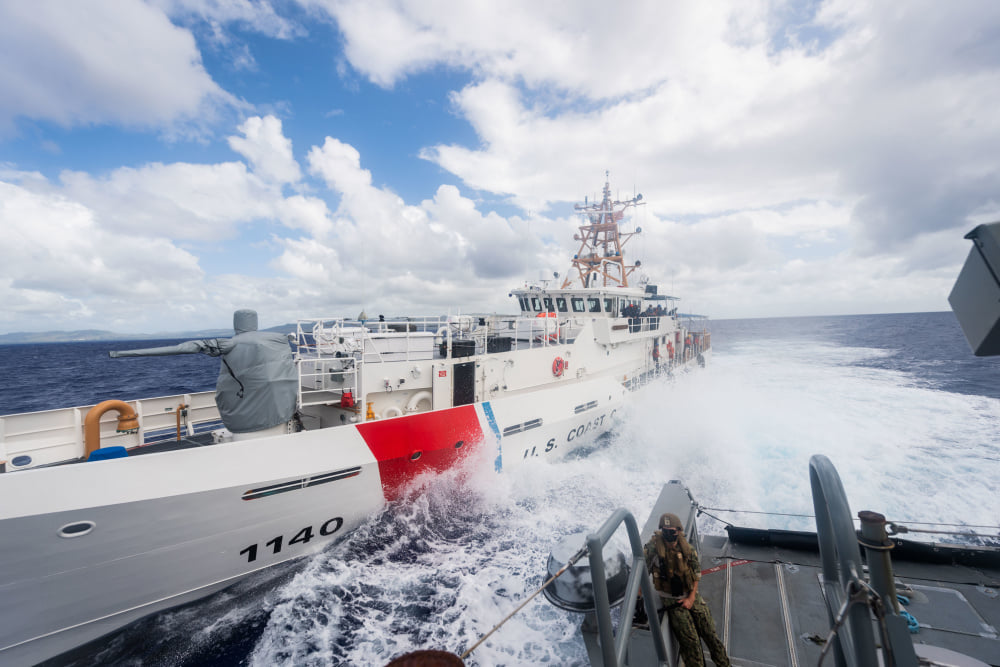
USCGC John Scheuerman (WPC-1146) and USCGC Clarence Sutphin Jr. (WPC-1147) enroute PATFORSWA

Below is a Navy news release reporting the arrival of USCGC Mohawk in Lisbon. Somewhat surprisingly there is no mention of the two Webber class cutters pictured in an attached photo (above) and no photo of Mohawk.

Looking closely at the photo above, you can see they have the Counter Drone upgrades seen on other FRCs that have been assigned to PATFORSWA.

Obviously this is the last pair of Fast Response Cutters (FRCs) being transferred to Patrol Forces SW Asia (PATFORSWA). They were escorted across the Atlantic by Mohawk. Can’t believe I did not see the gorgeous photo below earlier. Perfect for 4th of July.

The USCGC Mohawk (WMEC 913), USCGC John Scheuerman (WPC 1146), and USCGC Clarence Sutphin Jr. (WPC 1147) sail in formation in the Atlantic Ocean, June 22, 2022. The John Scheuerman and the Clarence Sutphin Jr. are the 46th and 47th Sentinel-class fast response cutters, respectively. They will become the fifth and sixth FRC’s to be homeported in Manama, Bahrain. (U.S. Coast Guard photo by Petty Officer 3rd Class Jessica Fontenette)


USCGC Mohawk (WMEC 913) arrives in Lisbon, Portugal

29 June 2022

From U.S. Naval Forces Europe-Africa Public Affairs

LISBON, Portugal – The Famous-class medium endurance cutter USCGC Mohawk (WMEC 913) arrived in Lisbon, Portugal for a scheduled port visit, June 29, 2022.

This port visit marks the first stop for Mohawk, while employed by U.S. Sixth Fleet in the U.S. Naval Forces Europe and Africa (NAVEUR-NAVAF) area of operations. During the visit, Mohawk leadership will meet government leaders and military maritime counterparts, while the crew enjoys the rich cultural history of Portugal.

“It is a tremendous privilege to be here in Lisbon,” said Cmdr. Andrew Pate, commanding officer aboard USCGC Mohawk (WMEC 913). “Like the United States, Portugal has a rich and deep maritime history and combined maritime operations provide a critical opportunity to improve interoperability with our partners, and prove that we are stronger together.”

Earlier this month, Adm. Linda Fagan, commandant of the U.S. Coast Guard, visited Lisbon and met with Ambassador Randi Charno Levine and Portugal’s Chief of Naval Staff, Adm. Henrique Eduardo Passaláqua de Gouveia e Melo. Fagan is also the first woman, and first mother, to lead any of the U.S. Armed Forces.

Portugal has a long maritime history and their navy boasts 705 years of continuous service.

“Portugal is an important ally of the United States and plays a pivotal role in the security and cohesion of the Alliance,” said Rear Adm. Chase Patrick, director of maritime headquarters, U.S. Naval Forces Europe and Africa. “Mohawk’s visit to Portugal demonstrates our shared goals for regional peace and stability.”

Mohawk is the 13th and last of the Famous-class cutters. It is named for the Algonquin tribe of Iroquoian Indians who lived in the Mohawk Valley of New York. Mohawk is the third cutter to bear the name. Mohawk’s parent command is U.S. Coast Guard Atlantic Area.

The U.S. Coast Guard Atlantic Area command oversees all domestic Service operations east of the Rocky Mountains, including the Arctic, Atlantic, Gulf of Mexico, Caribbean, and out-of-hemisphere operations in Europe, Africa, and Southwest Asia. Atlantic Area is responsible for coordinating and deploying cutters, aircraft, pollution response equipment, and thousands of personnel throughout the globe to ensure resources, equipment, and personnel are available to support the Coast Guard’s statutory missions.

For over 80 years, U.S. Naval Forces Europe-U.S. Naval Forces Africa (NAVEUR-NAVAF) has forged strategic relationships with allies and partners, leveraging a foundation of shared values to preserve security and stability.

Headquartered in Naples, Italy, NAVEUR-NAVAF operates U.S. naval forces in the U.S. European Command (USEUCOM) and U.S. Africa Command (USAFRICOM) areas of responsibility. U.S. Sixth Fleet is permanently assigned to NAVEUR-NAVAF, and employs maritime forces through the full spectrum of joint and naval operations.

“Police seize underwater drones from drug dealers for the first time” –Der Spiegel

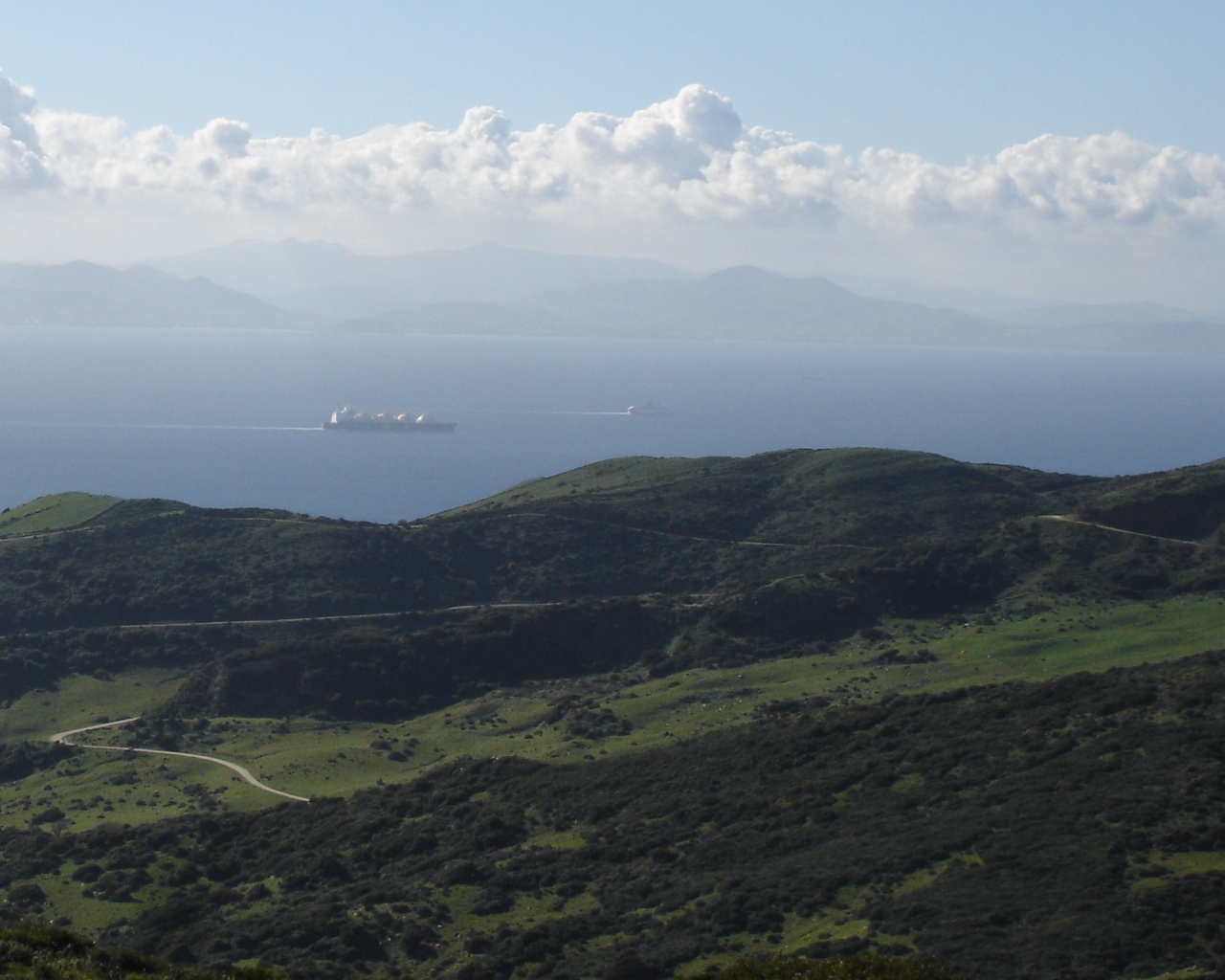
A view across the Strait of Gibraltar taken from the hills above Tarifa, Spain. Photo by Rob3fish at en.wikipedia

Der Spiegel reports that Spanish police have arrested eight and confiscated six underwater drones. The drones were being used to transport drugs from Morocco to Spain across the Straits of Gibraltar.c

Thanks to Sven for bringing this to my attention. 

“Israeli Naval Ship Intercepts Drones Launched At Gas Rig” –gCaptain

The C-Dome air defense system mounted on Sa’ar 6 corvette includes a 40-round canister located at the front deck and loaded with vertically-launched Tamir surface-to-air missiles for 360-degree coverage. (Picture source NavalAnalyses.com) Note Harpoon missiles have been replaced by Israeli developed Gabriel V anti-ship missiles. 

gCaptain reports,

JERUSALEM, July 2 (Reuters) – Lebanon’s Hezbollah said on Saturday it had sent three unarmed drones towards an Israeli Mediterranean gas rig, which the Israeli military said it had intercepted.

Israel has been expecting attacks on its offshore energy facilities. Providing a counter was a primary justification for their new Sa’ar 6 corvettes (earlier discussion here).

My presumption is that the intercepts were made by C-Dome, the a sea-going version of the Iron Dome, an AAW missile system that has had a high degree of success in countering unguided rocket attacks on Israel and can serve as a Counter-rocket, artillery and mortar (C-RAM) system. Each of the Sa’ar 6 corvettes has vertical launch systems for 40 interceptors. At least one of the three Sa’ar 5 corvettes has also been fitted with C-RAM.

All four of the Sa’ar 6 have been delivered and at least two of them are reported to be active. In addition to C-Dome the Israeli corvettes are also equipped with Barak missile systems.

Offshore assets appear to be appealing terrorist targets, usually undefended and vulnerable, with potentially high public visibility, if it results in an environmental disaster.

A number of things remain unclear at this point. The type of drones used in the attack, the Israeli system used to bring down the drones, the range at time of intercept, and which vessel or vessels fired the weapons.

Actually it is not clear if the drones were brought down by missiles.

An Israeli security source also said the drones had been unarmed. Saturday’s interceptions were the first time an air defense system (emphasis applied–Chuck) mounted on an Israeli naval ship had downed an incoming target, the military said. 

Could it have been a gun or even a soft kill system?

Japan’s Shunkou Class Cutters

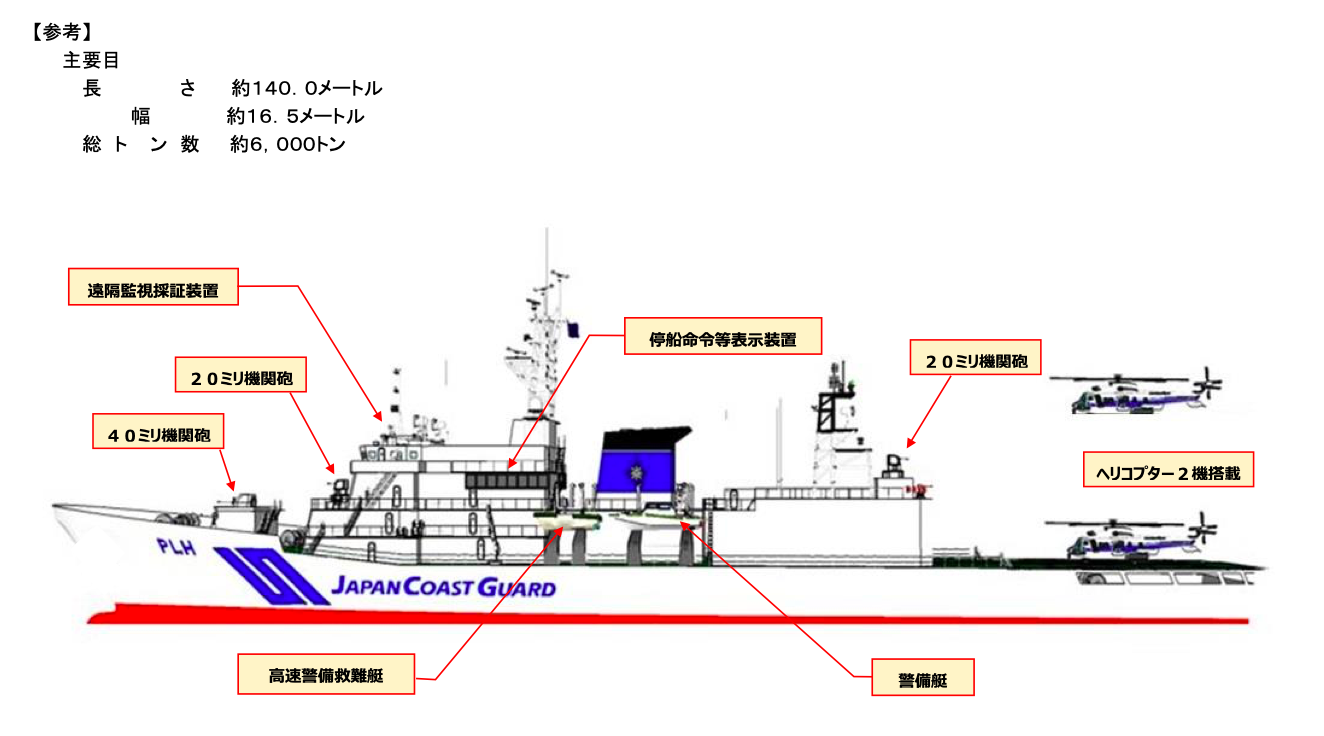
Technical drawing of the Shunkou-class patrol vessel (Credit : JCG)

A couple of posts from Naval News gives us a look at the latest cutters being delivered to the Japan Coast Guard. They typlify an apparent trend to larger, faster cutters with more extensive aviation facilities.

Speed is a respectable 25 knots. The reported displacement of 6,700 tons may be deceptive. Asian navies and coast guards tend to minimize the size of their ships. These ships are about 9,000 tons full load, making them about twice the size of the Bertholf class NSCs and Argus class OPCs.

Dimensions are:

  • Length: 140 meters (459.2 feet–100 feet more than the Offshore Patrol Cutter)
  • Beam: 16.5 meters (54.12 feet–20 inches more than the OPC)

The reported range is a phenominal 20,000 nautical miles.

Their hangar and flight deck can accommodate two helicopters larger than H-60s.

The Japan Coast Guard, unlike the USCG, is not a military service. They have not followed China Coast Guard in becoming more heavily armed. Several China Coast Guard cutters are armed with guns up to 76mm. The 40mm guns that arm these ships are the largest caliber in the Japan Coast Guard. They are backed up by two 20mm Gatling Guns, one forward and one aft. This armament reflects the lessons of their difficulties in stopping a small North Korean spy ship with only 20mm Gatling guns. It is still clearly inadequate for forcibly stopping larger vessels.

I would like to point out a paragraph from the first of the two linked reports, dated 5 Feb., 2020.

In 2012, the JCG had 51 patrol vessels displacing more than 1,000 tons. The service has now 63 large vessels, and the goal is to operate 12 more ships by the end of FY 2023 to deal with new threats.

That the Japanese see a need for 75 large cutters, even though their EEZ is only 39.5% that of the US, and that their cutter fleet is far younger that ours, may say something about the adequacy of the USCG’s large cutter fleet, even when the currently planned fleet of 36 NSCs and OPCs is complete. (Keep in mind that if we proceed as planned, when the last OPCs is completed, the first NSC, Bertholf, will be 30 years old.)

I like the way the Japan Coast Guard designates their cutter types. These are PLH, e.g. Patrol, Large, Helicopter, that is simple, descriptive, truthful, and in accordance with the US Navy type designation system.

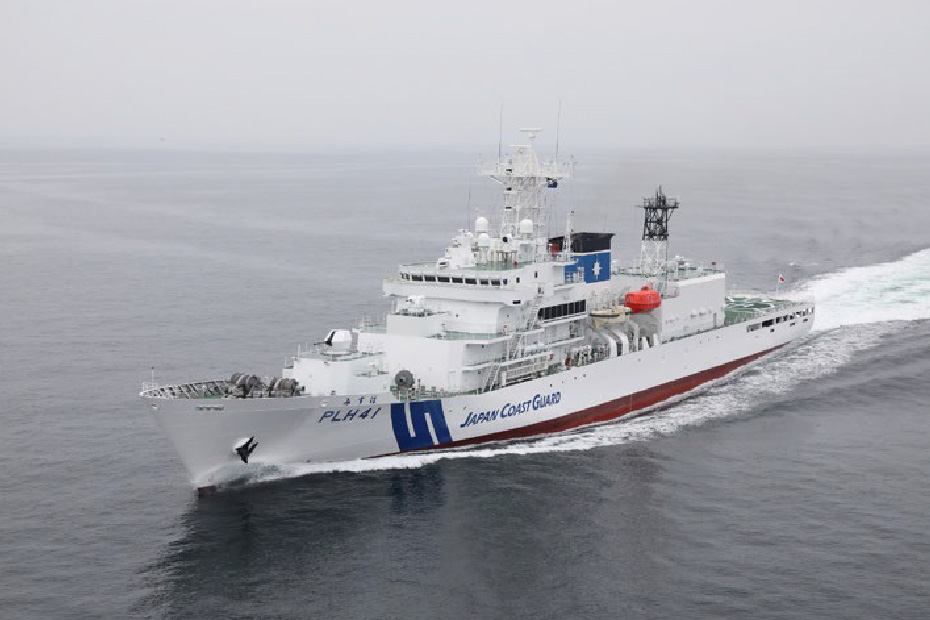
The similar, but 10 meter shorter PLH-41

Japan CG cutter Shunkō PLH-42

“Coast Guard teams to deploy for summer operations in Kotzebue, Alaska” –D17

Northwest Arctic Borough Alaska incorporated and unincorporated areas Kotzebue highlighted. From Wikipedia by Rcsprinter123

Below is a D17 news release reporting deployments to Kotzebue, AK. Thought you might want to know where that is.

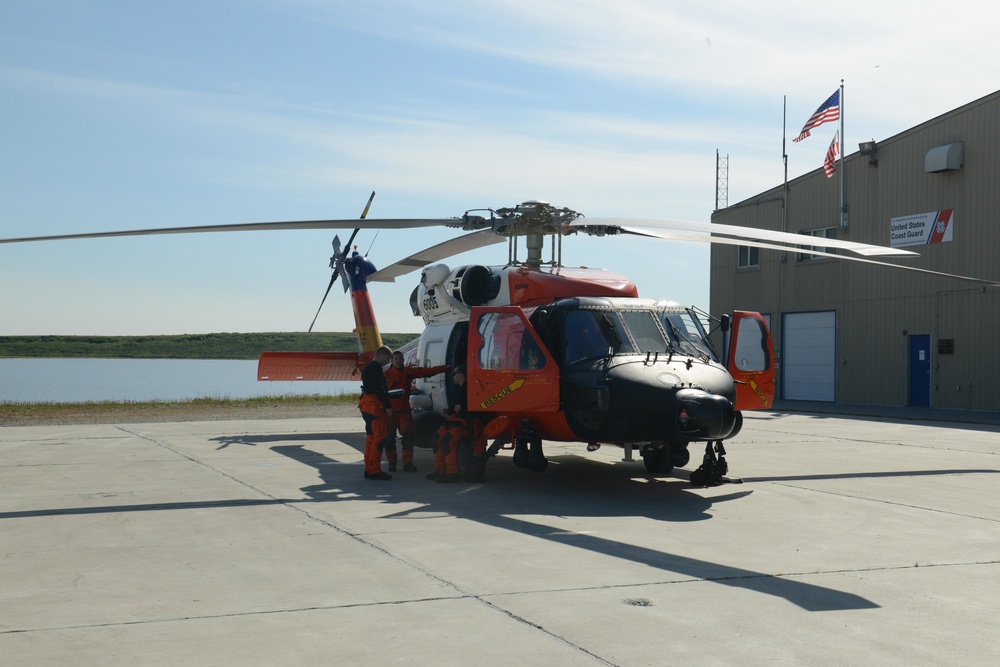
A Coast Guard Air Station Kodiak MH-60 Jayhawk aircrew, deployed to forward operating location Kotzebue, Alaska, conducts a pre-flight brief before flying a mission to Point Lay, July 13, 2017. FOL Kotzebue houses two Air Station Kodiak MH-60 Jayhawk helicopters and crews in support of Operation Arctic Shield. U.S. Coast Guard photo by Lt. Brian Dykens.

This is not the first time helicopters have heen deployed to Kotzebue, here and here. If this follows the previous pattern, the deployment will last until about the end of October.

News Release

U.S. Coast Guard 17th District Alaska

Coast Guard teams to deploy for summer operations in Kotzebue, Alaska

Coast Guard Marine Safety Task Force conducts inspections during 2021 season  Coast Guard FOL Kotzebue Operations

Editors’ Note: Click on images to download high resolution version.

ANCHORAGE, Alaska — Coast Guard teams to deploy to Kotzebue, Alaska, in support of 2022 summer operations. 

Members of Sector Anchorage’s Marine Safety Task Force (MSTF) will be in the region July 6-16, 2022, for a multi-mission deployment focused primarily on facility inspections. 

“Facility inspections help mitigate the potential for oil pollution in the region,” said Petty Officer 1st Class Christopher Houvener, a marine science technician and team lead. “These facilities are crucial for providing oil to warm homes during winter months. Alaska experiences harsh environmental conditions, so it’s important to inspect the safety and integrity of such waterside facilities to decrease the risk of an oil spill.”

Coast Guard Air Station Kodiak crews are also scheduled to open a seasonal forward-operating location for aircraft mid-July in Kotzebue to reduce response time to the Bering Strait and Northern Slope regions in anticipation of historically increased maritime activity there. 

The use of forward operating locations in Alaska helps the service make the best strategic use of limited resources.

Austal Awarded Contract for Offshore Patrol Cutter Stage 2

Below is the announcement from Coast Guard headquarters. Some comments first.

The contract award, $208.26 million, does not actually include construction of the first cutter, presumably that will be included in the FY2023 budget. The potential value of up to “$3.33 billion if all options are exercised” equates to an average cost for 11 ships of $303M each. Keep in mind, that does not include government furnished equipment and other cost that go along with building new ships, including the precommissioning crew and its support and infrastructure improvements that may be required to accommodate these substantially larger ships. 

Given that Eastern, builder of the first four OPCs, did not win the contract, and the contract allows “flexibility to propose and implement new design elements that benefit lifecycle cost, production and operational efficiency and performance” then we can expect to have A-class and B-class OPCs. 

Considering that the Independence class LCS program is ending, this is an extremely important win for Austal and vendicates their decision to invest in steel shipbuilding.


 News Release

U.S. Coast Guard Headquarters

Coast Guard awards contract for Stage 2 of the Offshore Patrol Cutter Acquisition

WASHINGTON – The Coast Guard awarded a fixed-price incentive (firm target) contract to Austal USA of Mobile, Ala. to produce up to 11 offshore patrol cutters (OPCs). The initial award is valued at $208.26 million and supports detail design and long lead-time material for the fifth OPC, with options for production of up to 11 OPCs in total. The contract has a potential value of up to $3.33 billion if all options are exercised.

In 2019, the Coast Guard revised the OPC acquisition strategy to mitigate emergent cost and schedule risk by establishing a new, full and open competition for OPCs five and through 15, designated as Stage 2 of the overall program. Informed by industry feedback received through a robust engagement strategy, the Coast Guard released a request for proposal Jan. 29, 2021, for OPC Stage 2 detail design and production. The Coast Guard’s requirements for OPC Stage 2 detail design and production were developed to maintain commonality with earlier OPCs in critical areas such as the hull and propulsion systems, but provide flexibility to propose and implement new design elements that benefit lifecycle cost, production and operational efficiency and performance.

“The offshore patrol cutter is absolutely vital to Coast Guard mission excellence as we recapitalize our legacy medium endurance cutters, some of which are more than 50 years old,” said Adm. Linda Fagan, commandant of the Coast Guard. “The OPCs are the ships our crews need to protect our national security, maritime safety and economic prosperity. I look forward to the new cutters joining our fleet.”

The 25-ship OPC program of record complements the capabilities of the service’s national security cutters, fast response cutters and polar security cutters as an essential element of the Department of Homeland Security’s layered maritime security strategy. The OPC will meet the service’s long-term need for cutters capable of deploying independently or as part of task groups and is essential to stopping smugglers at sea, interdicting undocumented non-citizens, rescuing mariners, enforcing fisheries laws, responding to disasters and protecting ports.

More information about the award can be found here.