OK, this is just a little feel good story, but a little good news may be what we need.
Thanks to Paul for bringing this to my attention.

OK, this is just a little feel good story, but a little good news may be what we need.
Thanks to Paul for bringing this to my attention.

Bairdmaritime provides a review of Australia’s new icebreaking research and supply vessel.
Looking for more information, I found a very extensive description here (click on the menu tab on the upper right). This is a big, powerful, very versitile ship, but I wonder about the choice of propulsion and hope our resident icebreaker expert, Tups, will comment.
First, at 25,500 tons, it is much larger than either Healy (16,000) or Polar Star (13,623 tons). It is way longer as well at 160.3 m (526 ft), compared to Healy (420 ft / 128 meters) and Polar Star (399 ft / 122 meters). She is even larger than the Polar Security Cutter PSC (22,900 tons and 460 ft / 140 meters in length).
A good part of the ship’s size is due to the fact that this ship is more than an icebreaker. While a typical US support mission to Antarctic would envolve three ships, an icebreaker, a supply ship, and a tanker, this ship is a combined icebreaker, dry cargo ship, tanker, and research vessel. The crew is small, 32, but there are accommodations for an additional 117 expeditioners plus 1200 tonnes of cargo and 1.9 million litres of fuel.
Aviation facilities are generous. The hangar can accommodate four small AS350 B3 helicopters or two Sikorsky S-92 that are larger than the H-60s.
It has a large number of boats including a pair of barges. Each barge has two 448 kilowatt (600 horsepower) engines and a water jet propulsion system that provides greater manoeuvrability than propellers. The barges carry general cargo from ship to shore in Antarctica.
On the cargo hatch covers near the bow of RSV Nuyina are two 16.3 metre-long, 6.2 metre-wide barges, each capable of carrying more than 45 tonnes of cargo.
The aluminium barges can operate in calm seas and up to 50 knots of wind, at a speed of eight knots.
Propulsion:
What I found most surprising was the choice of propulsion systems. This is a seriously powerful icebreaker, but unlike most modern icebreakers, it does not use steerable podded diesel electric systems (such as Azipods). Instead all power goes through two shafts to controlable pitch propellers. Both the sources reported power comes from two V16 diesel engines (19,200 kW each) geared diesels and 4 diesel generators (7,400 kW each) powered by diesel generators. From the https://www.antarctica.gov.au/ site which Bairdmaritime seems to have copied.
RSV Nuyina can cruise efficiently in open water, operate silently (in ‘Silent R’ mode) during scientific operations, or continuously break ice up to 1.65 metres thick.
RSV Nuyina has a diesel-electric propulsion system that provides different levels of power depending on the task.
In icebreaking mode RSV Nuyina uses its full propulsion system – two V16 diesel engines (19,200 kW each), and 4 electric motors (7,400 kW each) powered by diesel generators.
In its 12–14 knot cruising mode, the ship relies on the electric motors.
There are two engine rooms to provide an enhanced level of safety and redundancy. Each room houses a V16 diesel engine and two diesel generators.
That seemed like an awful lot of power for the modest maximum and cruising speed reported. The descrtiption sounded like a total of 68,000 KW total (about 92,000 HP) but that seemed unlikely.
Wikipedia indicates they max total power is a still very respectable 26,600 KW or 35,657 HP (confirmed here). This would make her slightly more powerful than Healy (2 × 11.2 MW (15,000 hp).
Something did not sound right.
Looking up the MAN 16V32/44CR engines reportely installed I found that they were rated at 9600 KW not 19,200 each, rather that would be the total for the two. Given a total output in the icebreaking mode, of 26,600 KW, 19,200 of which comes from the two main diesels, that means the electric motors would provide an additional 7400 KW total, or probably 3700 KW each which be enough for a 12 knot cruise. That makes sense.

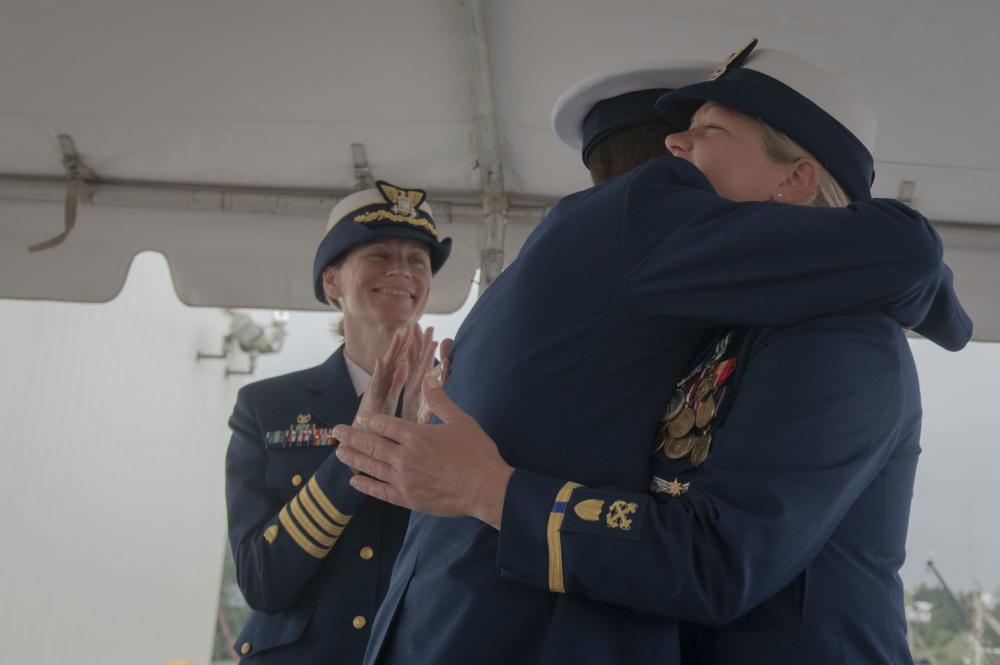
Capt. Breanna Knutson (left), commander, Coast Guard Sector North Bend, claps as Master Chief Scott Slade (middle) embraces his wife Chief Warrant Officer Beth Slade (right) during a change of command ceremony at Coast Guard Station Coos Bay in Coos Bay, Oregon, June 10, 2022. The Coast Guard spouses are both surfmen. (U.S. Coast Guard Photo by Petty Officer 3rd Class Diolanda Caballero)
Just passing this along because it is so remarkable. Only in the Coast Guard.
| News Release |
U.S. Coast Guard 13th District PA Detachment Astoria |
Coast Guard holds change of command for husband and wife
 |
 |
 |
 |
Editors’ Note: Click on images to download high resolution version
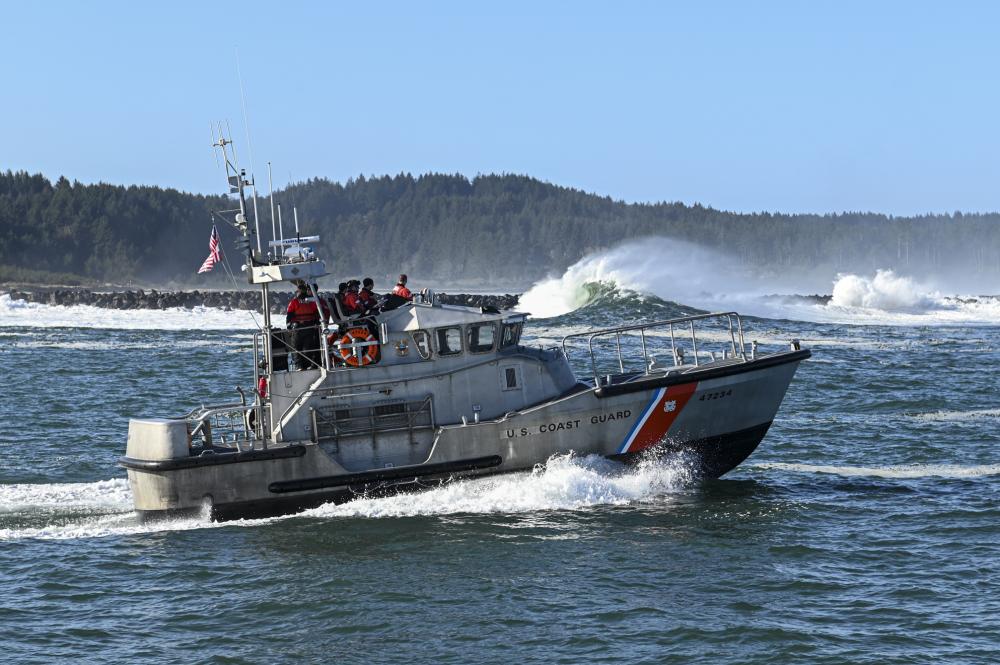
NORTH BEND, Ore. — Coast Guard Station Coos Bay held a change of command ceremony Friday morning at the rescue station in Charleston, Ore.
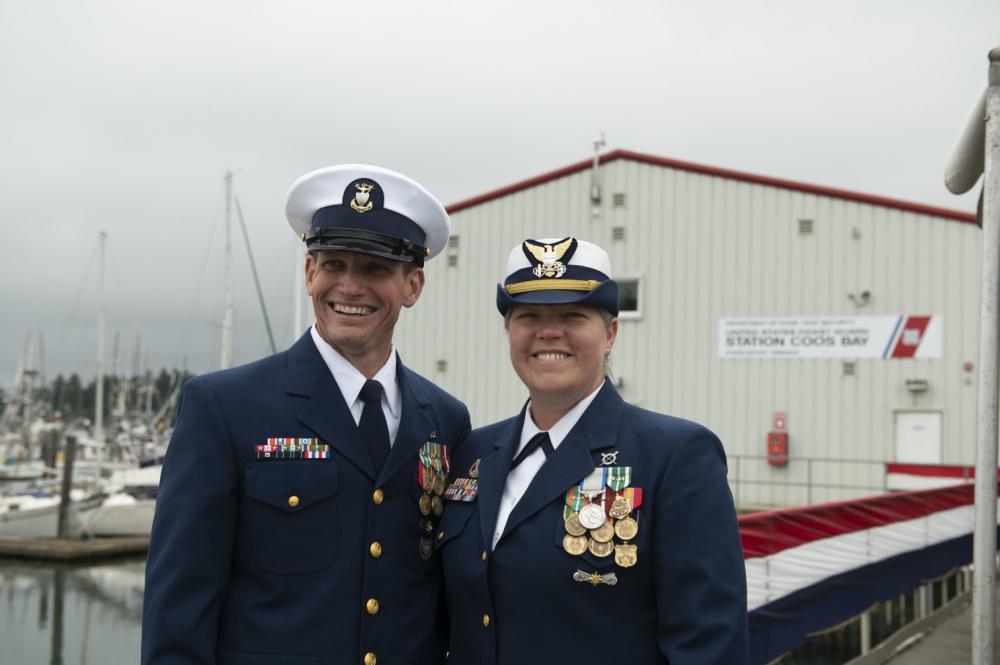
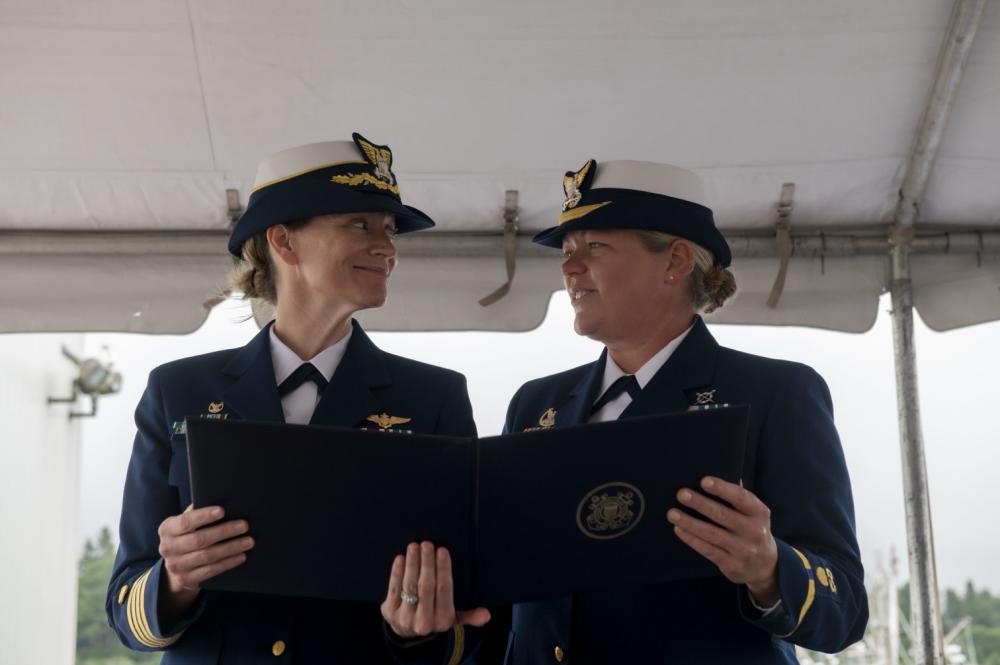
It was a unique ceremony where Master Chief Scott Slade assumed command of Station Coos Bay from his wife, Chief Warrant Officer Beth Slade.
Capt. Breanna Knutson, commander, Coast Guard Sector North Bend, presided over the event.
Master Chief Slade will now oversee the operations of the 45 crew members stationed at the rescue boat unit in Charleston. He will also oversee Station Coquille River, a seasonal station located in Bandon.
CWO Slade is slated to assume command of Coast Guard Station Yaquina Bay during a ceremony scheduled later this month in Newport. Master Chief Slade was previously the Officer in Charge at Station Umpqua River in Winchester Bay.
“They are an amazing crew,” said CWO Slade. “And this was probably the easiest change of command since we are both so familiar with everyone and they already know their new commanding officer. I’m glad to be handing off such a top-notch crew because I fully believe they are at their best right now.”
Both Beth and Scott Slade enlisted in the Coast Guard nearly 25 years ago. Almost all of their time in the Coast Guard so far has been spent at units on either the Oregon or Washington Coast.
The Slade’s honed their boat-handling skills here in the Pacific Northwest and trained at the National Motor Lifeboat School at Cape Disappointment. Beth and Scott both received the distinguished title of Surfman, #321 and #324 respectively. CWO Slade received her commission as an officer in 2013.
“It’s so special to be taking over the crew from my wife,” said Master Chief Slade. “The expectation is high and the crew is ready. It’s amazing what Beth has done and built here. Sort of intimidating taking over after someone who is so squared away but I am so excited to see what the future has to offer.”
A Coast Guard rescue unit has been present in the Coos Bay area since 1878 when the first life-saving station was located at Cape Arago.
The change of command ceremony is a time-honored military tradition that marks a transfer of total responsibility and authority from one individual to another. The ceremony is conducted to formally demonstrate the continuity of authority within a U.S. military command.

BRP Ramon Alcaraz sporting her new Sea Giraffe radar in Cebu.
When the US Coast Guard Hamilton class 378 foot WHECs were decommissioned and transferred to other nations, the AN/SPS-40 air search radars were removed, along with the Phalanx close in weapon system. At least one of the three former cutters, in service with the Philippine Navy, has been upgraded with the addition of a Sea Giraffe multi-mode radar and a pair of 25mm Mk38 guns as can be seen on these photos of BRP Ramon Alcaraz (former USCGC Dallas). There were plans to acquire at least two Sea Giraffe radars. I can’t say how far they have gotten.
The Sea Giraffe, USN designation AN/SPS-77, is the radar that will equip the Argus class OPCs. It is also currently installed on Independence class LCS.
I found these on Facebook, but apparently they came from Daryll Evan Mancao’ Flickr page.

BRP Ramon Alcaraz (former USCGC Dallas) equipped with new Sea Giraffe multi-mode radar in Cebu.

Japanese built Philippine CG cutter BRP Teresa Magbanua during sea trials off Japan (Photo: Philippine Coast Guard)
The US Naval Institute News Service reports on a speech by Japan’s Prime Minister Fumio Kishida before the Strategic Studies Shangri-La Dialogue forum in Singapore.
During his speech, Kishida also spoke about Japan’s planned efforts to strengthen nations in the Indo-Pacific both in security and economic aspects. The security side will include transferring patrol boats in the region, strengthening regional maritime law enforcement capabilities (emphasis applied–Chuck) and providing defense equipment and technology transfers. Singapore is one of the countries that will sign a defense equipment and technology transfer agreement with Japan.
As China has become more agressive in its behavior, Japan has been a lot more active in reaching out to help friendly nations. It appears they have decided to provide an Asian nation alternative to Chinese hegemony. One of the ways they have done this is transfer of vessels to conduct coast guard functions on favorable terms. We have already seen this with the Philippines (and here), Indonesia, Malaysia, and Vietnam.
We have also seen increased interaction between the Japan Coast Guard and the USCG here, here, here, and here. Japan seems to be promoting coast guards as a way to maintain rules based international norms and may be looking to create an international consensus on coast guard behavior to promote cooperation and interoperability. They are looking at their own Coast Guard’s role as well. They seem to be looking to the USCG as an allied, internationally recognized example of proper coast guard functions to help achieve this consensus.

Hull Vane hydrofoil solution integrated on a Holland-class OPV model (Credit: Dutch Ministry of Defense)
Naval News reports that,
Today, June 8th, the first Hull Vane for the Royal Netherlands Navy has been delivered in Den Helder. This Dutch invention consists of a submerged transom wing which renders ships more efficient and quieter, while improving their seakeeping.
This Hull Vane will be installed in early 2023 on the aft ship of the HNLMS Groningen, an ocean-going patrol vessel of 108 meter, pertaining to the Holland Class.
This decision is a strong endorsement for an innovation that appears directly applicable to US Coast Guard cutters. The Holland class Offshore Patrol Vessels are similar in size, power, speed, and hull form to the Bertholf class NSCs and particularly to the Argus class Offshore Patrol Cutters.
The hull vane reportedly recovers some of the energy that would normally be lost in creation of the wake. Fuel savings of 10% or more are reported. It also is reported to reduce pitch make for improved boat and helicopter operations.
Besides energy saving, which automatically leads to a reduction of CO2 emissions, the Hull Vane® also offers many tactical advantages for the ship. Due to the suppressed stern wave, the vessel leaves much less visible wake, making her less visible to satellites, drones and even certain types of torpedoes. Helicopter landings will be safer in rough weather, and it is expected that the slipway in the stern can be used more frequently to launch and recover the FRISC, a fast daughter craft. The ship will have a higher top speed, and will be able to cross a long distance faster, e.g. when being deployed for calamities. But above anything else, the goal is to reduce the dependency on diesel fuel. That is valuable in peace time, but even more so during war.

“Wake behind transom on patrol boat at 11 kn without Hull Vane® (left) and with Hull Vane® (right), leading to 25% lower fuel consumption”
We have been following this promising innovation for the last seven years. Previous posts on this topic were:

French OPV Themis fitted with Hullvane. Source: https://www.hellenicshippingnews.com/mv-themis-hull-vane-retrofit-improves-opvs-performance/
Results of a 2018 test on the 172 foot, 409 ton French patrol vessel Themis, a vessel similar to the Webber class FRCs, included a “comparison with the benchmark sea trials – conducted in January in exactly the same conditions – by CMN’s sea trial team showed a reduction in fuel consumption of 18% at 12 knots, 27% at 15 knots and 22% at 20 knots. The top speed increased from 19.7 knots to 21 knots.”

The U.S. Coast Guard Cutter Oliver Henry sails alongside the Japan Coast Guard patrol vessel Mizuho during an exercise off Guam, June 7, 2022. The U.S. Coast Guard and Japan Coast Guard completed the joint counter-narcotics exercise SAPPHIRE which stands for Solid Alliance for Peace and Prosperity with Humanity and Integrity on the Rule-of-Law Based Engagement 2022. (U.S. Coast Guard photo courtesy of U.S. Coast Guard Forces Micronesia/Sector Guam)
An interesting development in US and Japanese Coast Guard cooperation. This is apparently the first implementation of Operation SAPPHIRE announced in May.
This exercise does not seem to be an end in itself. It seems more like a tune-up for follow-on operations.
| News Release |
U.S. Coast Guard 14th District Hawaii and the Pacific |
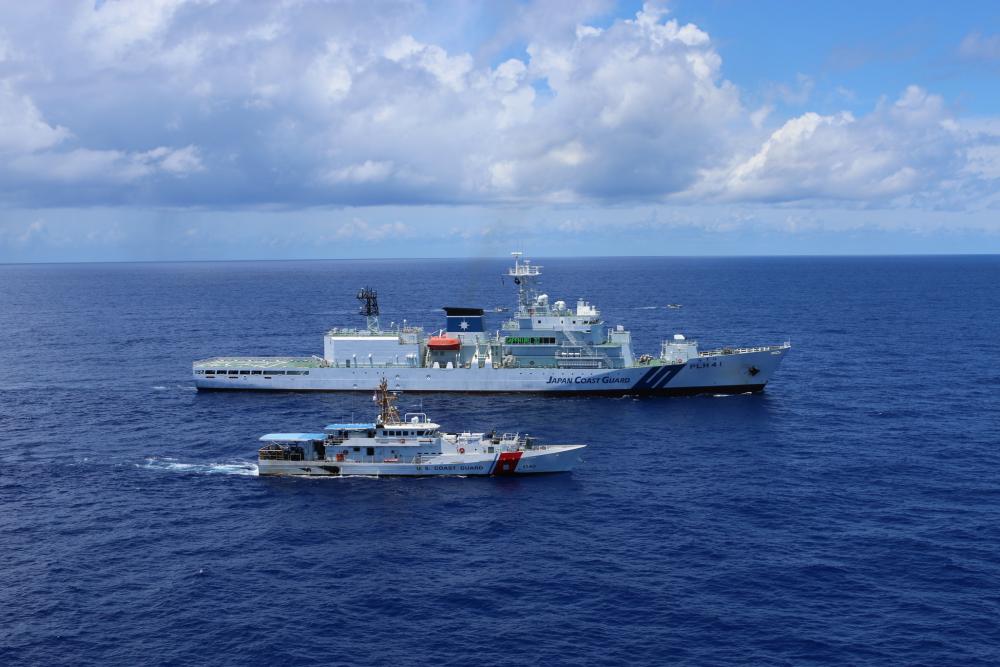

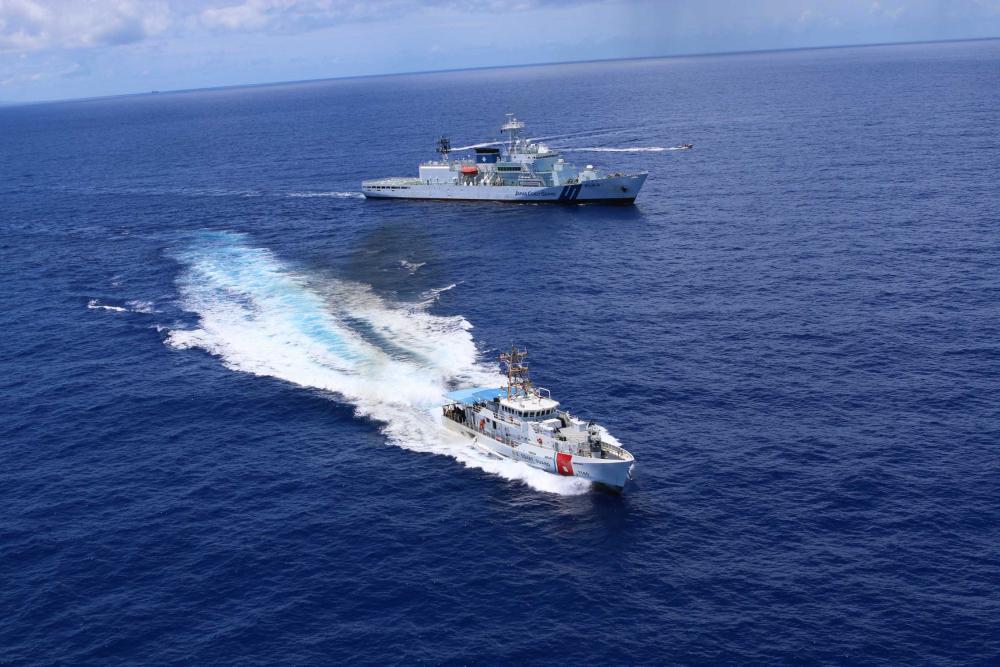
Editors’ Note: Click on images to download a high-resolution version.
SANTA RITA, Guam — The U.S. Coast Guard and Japan Coast Guard completed a joint counter-narcotics exercise off Guam, Tuesday.
The exercise was the first operational exchange between U.S. Coast Guard Forces Micronesia/Sector Guam and the Japan Coast Guard and was designed to promote cooperation between the partners in areas of mutual interest including maritime security and counter-smuggling operations.
“What an incredible opportunity to conduct joint training with the Japan Coast Guard and be able to share law enforcement capabilities which will enhance future joint mission planning,” said Capt. Nicholas Simmons, commander of Coast Guard Forces Micronesia/Sector Guam. “These exercises further solidify our great maritime relationship and will prove to be invaluable during future missions.”
The exercise was conducted between the crews of the Japan Coast Guard patrol vessel Mizuho, U.S. Coast Guard Cutter Oliver Henry, and U.S. Coast Guard Forces Micronesia/Sector Guam.
On Monday, the participants met at Coast Guard Forces Micronesia/Sector Guam for tours of the participating vessels and tabletop discussions to plan the at-sea exercise the next day.
“Conducting exercises based off of real-world scenarios will boost opportunities to respond more effectively,” said Lt. Jack Hamel, the commanding officer of the Oliver Henry. “The cohesion and teamwork on display showcased that both Coast Guards have mutual interest in keeping the maritime commons safe and secure.”
On Tuesday, the crews deployed for the at-sea exercise consisting of two counter-narcotics drills where the crews simulated locating and boarding a target of interest fishing vessel suspected of drug smuggling.
The drills focused on methods of information sharing, vessel tracking, stopping measures, and inspection procedures for greater interoperability between the partners in the future.
The two crews also conducted a personnel exchange and rendered passing honors between the vessels.
The exercise was a part of the Japan Coast Guard and U.S. Coast Guard Operation SAPPHIRE 2022, which stands for Solid Alliance for Peace and Prosperity with Humanity and Integrity on the Rule-of-Law Based Engagement 2022, and was the second such operation held between the U.S. Coast Guard and the Japan Coast Guard, the first being held in San Francisco in May.
SAPPHIRE was created during a joint document signing ceremony and celebration at Japan Coast Guard Headquarters earlier this year and was an annex to a memorandum of cooperation between the sea services which has existed since 2010.
The purpose of Operation SAPPHIRE is to standardize operating procedures for combined operations, training and capacity building, and information sharing between the partners.
The U.S. Coast Guard and Japan Coast Guard have been bolstering each other’s capabilities and effectiveness since the founding of the Japan Coast Guard in 1948. The agencies work together to counter illegal maritime activity and assist foreign maritime agencies in the Indo-Pacific region in improving their own capabilities necessary for maritime law enforcement.

Masked members of the cutter James crew and Commandant Adm. Karl L. Schultz (front, center), along with interagency partners, stand among interdicted narcotics at Port Everglades, Florida, on June 9. U.S. COAST GUARD / Petty Officer 3rd Class Brandon Murray
The US Naval Institute Proceedings June 2022 issue includes an article that looks at how the retention and training of afloat personnel might be improved. There are a number of suggestions here including ending the up or out convention, lessons from the CG aviation community, and maritime credentialing.

Royal Navy sailors are getting new uniforms that are more practical, cooler and fire-resistant as a prelude to a £78 million revamp of their clothing.
Those are certainly laudible goals. Having served in uniforms what were more fire friendly than fire resistant (double knit), I like these ideas. This appears to be a progressive improvement over the 2015 uniform change (seen in the photo above).
Generally, it appears that the Coast Guard has been more successful with their work uniforms than the USN. Thankfully the Navy “Blueberries” were never a common sight on cutters. Still the current uniform appears heavy for work in hot environments. I can’t speak from personal experience, but I would be happy to hear feedback from those who have had experience with the current uniform. (Complaints and suggestions about the Navy work uniform here.)
Still there is a good possibility there is something we can learn from the Royal Navy’s research into new working uniforms. We might want to look at their conclusions. In addition to HQ to HQ contact on the subject, we currently have Coast Guard enlisted seconded to service with the Royal Navy. Some of them will probably see this new uniform. They are a resource. We ought to debrief them when they return, not just about the uniforms, but about what we might learn from our Old World cousins.
Apparently the new RN uniform will include Goretex and Nomex uniform items. They are likely to be expensive, but worth the cost. That could put a burden on our personnel, particularly junior personnel. The aviation community recognizes the need for special clothing for their special environment. The afloat environment, where you are the fire department, is also much different from that ashore. It may be appropriate to provide an additional clothing allowance if additional expensive clothing items are required for service afloat, or otherwise provide specialized clothing.
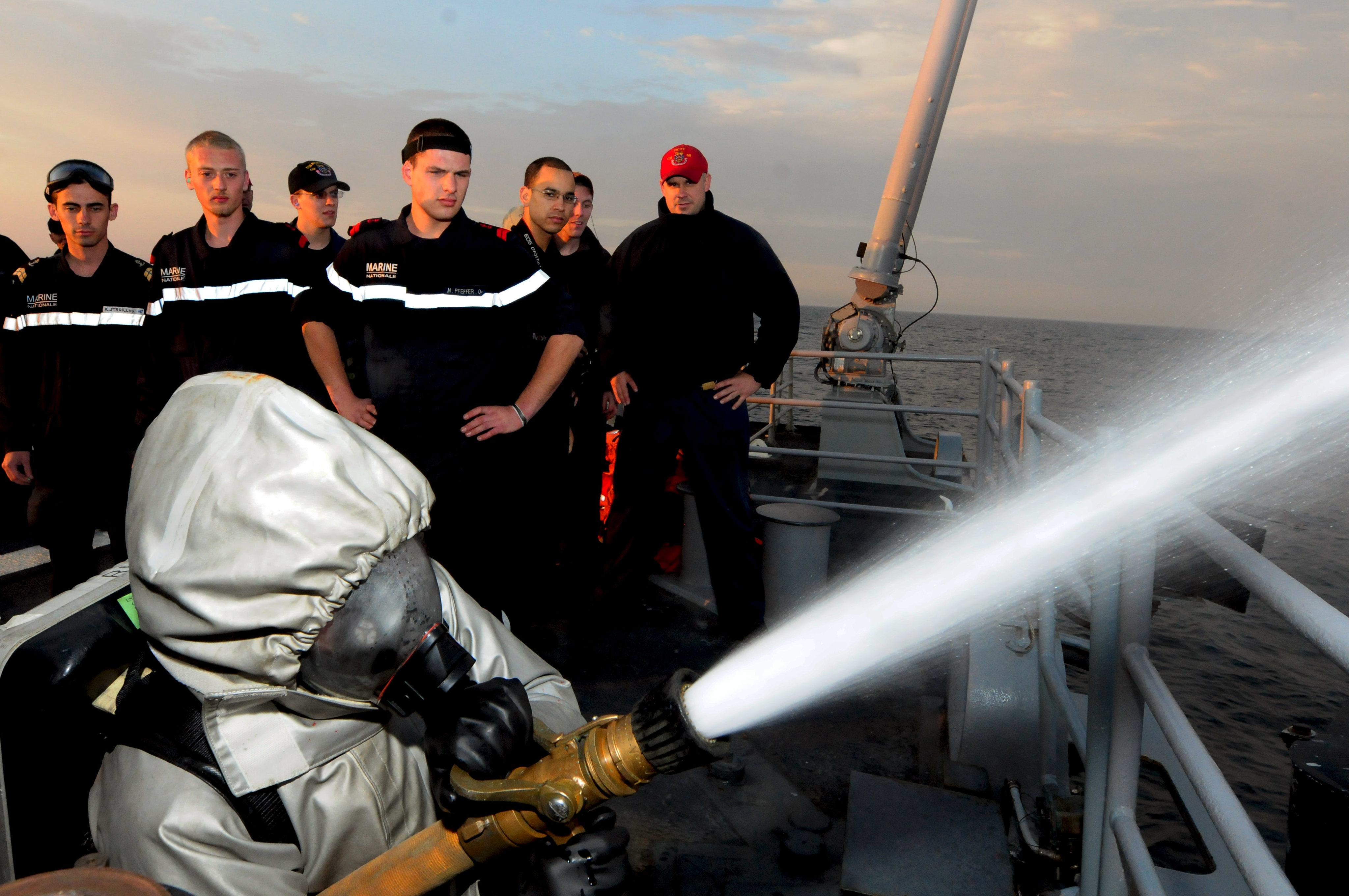
Thinking about uniforms, I would like to point out a feature I like, on the French Navy’s work uniform. That is the bright stripe that appears to be reflective on the upper part of the uniform. In the case of a man over board or an abandon ship, this could mean the difference between being found or missed. It is also probably more visible in a smoke filled compartment.

From RIMPAC 2018: USS Sterett (DDG-104), front, participates in a photo exercise with Chilean Frigate Almirante Lynch (FF-07), second, Royal Canadian Navy Halifax-class frigate HMCS Ottawa (FFH-341), third, French Navy Floreal-class frigate FS Prairial (F-731), fourth, United States Coast Guard Cutter USCHC Bertholf (WMSL-750), fifth, the dry cargo and ammunition ship USNS Charles Drew (T-AKE 10), sixth, and Royal Canadian Navy commercial container ship Asterix. US Navy Photo
Below is the Navy’s News Release outlining the RIMPAC 2022 exercise. The Coast Guard normally participates in this exercise. Hopefully we will hear more about the Coast Guard participation.
RIMPAC 2022 is the 28th exercise in the series that began in 1971.
As the world’s largest international maritime exercise, RIMPAC provides a unique training opportunity designed to foster and sustain cooperative relationships that are critical to ensuring the safety of sea lanes and security on the world’s interconnected oceans.
The theme of RIMPAC 2022 is “Capable, Adaptive, Partners.” Participating nations and forces will exercise a wide range of capabilities and demonstrate the inherent flexibility of maritime forces. These capabilities range from disaster relief and maritime security operations to sea control and complex warfighting. The relevant, realistic training program includes amphibious operations, gunnery, missile, anti-submarine and air defense exercises, as well as counter-piracy operations, mine clearance operations, explosive ordnance disposal, and diving and salvage operations.
This year’s exercise includes forces from Australia, Brunei, Canada, Chile, Colombia, Denmark, Ecuador, France, Germany, India, Indonesia, Israel, Japan, Malaysia, Mexico, Netherlands, New Zealand, Peru, the Republic of Korea, the Republic of the Philippines, Singapore, Sri Lanka, Thailand, Tonga, the United Kingdom, and the United States.
Hosted by Commander, U.S. Pacific Fleet, RIMPAC 2022 will be led by Commander, U.S. 3rd Fleet, who will serve as Combined Task Force (CTF) commander. Royal Canadian Navy Rear Adm. Christopher Robinson will serve as deputy commander of the CTF, Japan Maritime Self-Defense Force Rear Adm. Toshiyuki Hirata as the vice commander, and Fleet Marine Force will be led by U.S. Marine Corps Brig. Gen. Joseph Clearfield. Other key leaders of the multinational force will include Commodore Paul O’Grady of the Royal Australian Navy, who will command the maritime component, and Brig. Gen. Mark Goulden of the Royal Canadian Air Force, who will command the air component.
During RIMPAC, a network of capable, adaptive partners train and operate together in order to strengthen their collective forces and promote a free and open Indo-Pacific. RIMPAC 2022 contributes to the increased interoperability, resiliency and agility needed by the Joint and Combined Force to deter and defeat aggression by major powers across all domains and levels of conflict.
Media interested in covering the exercise should contact the C3F Public Affairs Office at (619) 524-9868 or C3F.PAO@navy.mil. Contact information for the RIMPAC Combined Information Bureau will be made available prior to the beginning of the exercise.
 Chuck Hill's CG Blog