Why It Would Make Sense to Award Two OPC Contracts.

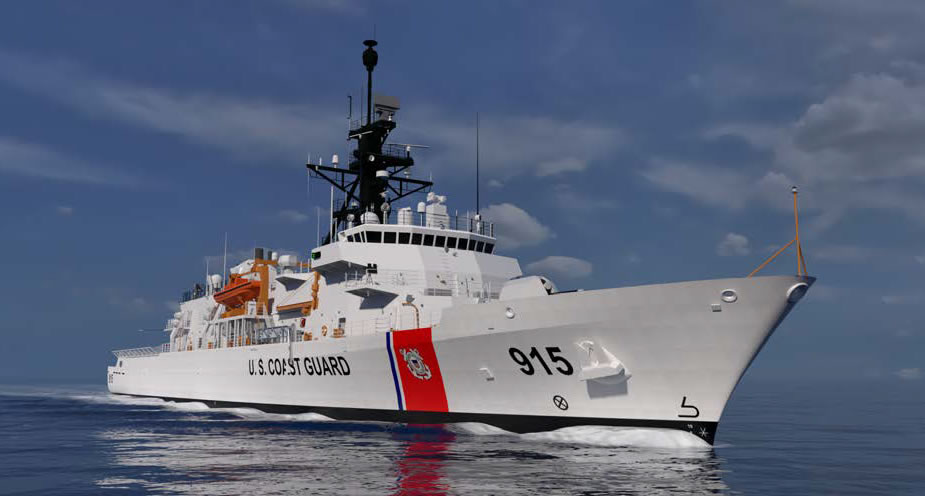
Artists rendering from Eastern Shipbuilding Group

The Navy League’s online magazine “Seapower” reports,

 Bollinger Shipyards submitted on March 18 its final proposal to the United States Coast Guard to build Stage 2 of the Heritage-class Offshore Patrol Cutter program. If chosen, Bollinger would construct and deliver a total of 11 vessels to the U.S. Coast Guard over the next decade, helping to sustain the Bollinger workforce through 2031.

It is obviously a Bollinger press release, talking about how much good it would do for the local economy, but it does occur to me…

If we have two truly competitive bids, this could be an opportunity to have two shipyards building Offshore Patrol Cutters.

The program is already too long delayed. The phase II contract proposals are likely to be very competitive. In March 2020, contracts for industry studies were awarded to nine different yards.

  • Austal USA of Mobile, AL
  • General Dynamics/Bath Iron Works (GD/BIW) of Bath, ME
  • Bollinger Shipyards Lockport of Lockport, LA
  • Eastern Shipbuilding Group (ESG) of Panama City, FL
  • Fincantieri Marinette Marine (F/MM) of Marinette, WS
  • General Dynamics/National Steel and Shipbuilding Company (GD/NASSCO) of San Diego, CA
  • Huntington Ingalls Industries/Ingalls Shipbuilding (HII/Ingalls) of Pascagoula, MS
  • Philly Shipyard of Philadelphia, PA
  • VT Halter Marine Inc. of Pascagoula, MS

I know at least three yards, Eastern, Huntington Ingalls and Bollinger, and probably more, are submitting proposals for building first a single OPCs with options to build ten more. With Eastern already building the first four, this gives the Coast Guard the opportunity to contract for the remaining 21 ships based on the bids that will be received this year.

We could have the entire program completed by 2032 instead of 2038 and avoid the complication of a probably much less competitive phase III competition to build the last ten ships. Six years earlier completion would also probably allow us to avoid the expense of the life extension program planned for six of the WMEC 270s.

It would cost more in those years but this project really should have been funded ten to twenty years ago. It would be a big plus up for the PC&I budget but only a few percent increase compared to the Coast Guard’s total budget, small compared to the DHS budget and microscopic to the entire federal budget. It would align with the national objective of growing our naval shipbuilding capabilities, and further stimulate the economy. It might not be too hard to get Congressional support.

It would also provide a hedge against a natural disaster further delaying construction.



“Arctic Council boycotts Russia meetings over Ukraine invasion” –The Watch

This map show the exclusive economic zones (EEZs) within the Arctic: Canada (purple), Greenland (orange), Iceland (green), Norway (turquoise), Russia (light blue), and USA (dark blue). As sea ice reduces there will be more opportunity for ice to drift from one EEZ to another, which has implications for the potential spread of pollutants.
Credit: DeRepentigny et al., 2020

This looks important. NORTHCOM’s online magazine “The Watch” reports,

Countries of the Arctic Council declared March 4, 2022, they would boycott future talks in Russia over its Ukraine invasion, throwing international cooperation in the region into upheaval at a time when climate change is opening it up to resource exploitation.

The countries — Canada, Denmark, Finland, Iceland, Norway, Sweden and the United States — said they were suspending their work indefinitely and would skip planned talks in May 2022 in the northern Russian city of Arkhangelsk due to Moscow’s “flagrant violation” of Ukraine’s sovereignty and territorial integrity.

While the action is perfectly justifiable, and marks unity between the non-Russian Arctic nations, unfortunately, it further isolates Russia and cuts another line of communications.

“Develop an Indo-Pacific Fishing Security Apparatus to Compete with Illegal Chinese Fishing Fleets and Maritime Militia” -USNI

Chinese fishing vessel fleet (Photo: The Maritime Executive)

The US Naval Institute Blog has a short post recommending,

“…the United States…should spearhead the establishment of an Indo-Pacific Fishery Security Cooperation (IPFSC) that includes nations from Asia, South America and Africa. This organization would enable the member states to ensure territorial and economic integrity through diplomatic pressure, the sharing of intelligence and the sharing of security forces…The ultimate goal of the IPFSC would be to combat illegal, unreported, and unregulated fishing throughout the Indo-Pacific region. As the majority infringer, the PRC would have a unified treaty organization economically and diplomatically pushing back against their illicit activities and enforcing international decisions such as the South China Seas Arbitration case… This would be somewhat similar to the North Atlantic Treaty Organization…except with an economic and law enforcement focus rather than a military focus.”

A law enforcement alliance would seem to be much easier to sell than a military one.

There are a few multi-national fisheries management organizations already, but to my knowledge none of them involve sharing of enforcement assets, though, I believe Australia, New Zealand, France, and the US have all aided smaller countries in fisheries enforcement.

The fishing fleets ravaging the worlds oceans are mobile and so large that when they move into an area, they overwhelm the local enforcement agencies. Like military organizations, you can be sure fishing fleets share information about the location and practices of their adversaries–the fisheries enforcement agencies. That is why enforcement agencies need to coordinate and share resources.

Earlier I proposed something like the sharing of security forces proposed here, “Combined Maritime Security Task Force, Pacific,” that could be implemented using an expanded multilateral “ship-rider” program–a multi-ship, multi-national, highly mobile law enforcement task force that can follow the fishing fleets from one nations EEZ to the next. The advantages of having third party witnesses when there is a contentious law enforcement action is undertaken should not be underestimated.

The afloat assets should be supported by shore based aviation and intelligence assets all in support of a multi-laterally developed fisheries management plan.

The USNI blog proposal refers to the Indo-Pacific, and my earlier post was in regard to the Western Pacific. Frankly, similar organizations could be organized in several areas, including the Gulf of Guinea, the South China Sea, the Western Pacific, the West coast of South America, and the Caribbean. It’s likely if we could form one such law enforcement alliance somewhere, and it worked, others would follow the example.


“CANADIAN COAST GUARD ICEBREAKER MODERNISATION CONTRACT AWARDED TO QUEBEC SHIPYARD” –Baird Maritime

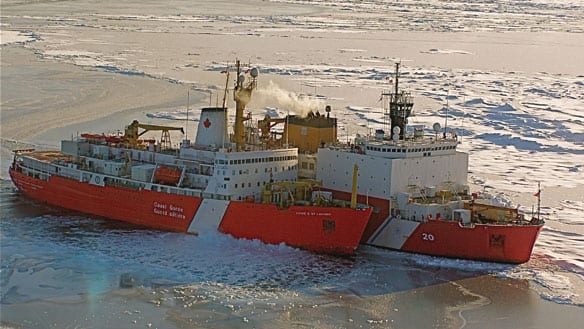
CCGS Louis S. St-Laurent alongside USCGC Healy

Baird Maritime reports Quebec shipbuilder Chantier Davie Canada has been awarded a contract to complete a service life extension program on Canada’s largest, most powerful, and oldest icebreaker, CCGS Louis S St-Laurent.

This ship entered service in 1969, about six and a half years earlier than Polar Star. Reportedly the modifications will be conducted in three phases in 2022,2024, and 2027.

The Canadian Coast Guard rates the ship a heavy icebreaker, but by current USCG standards, she is a medium icebreaker. Her size, power (27,000 HP), diesel electric propulsion, and large lab spaces, make her more similar to Healy than to the Polar Star.

The ship has already been extensively modified. In a major refit 1987-1992 the hull was lengthened about 24 feet. A new bow was fitted and her original steam turbines were replaced with diesels. A bubbler system was added and a new hangar forward of the flight deck replaced the previous below deck hangar and elevator system.

The ship has a crew of only 46 but accommodations for 216.

In 2008, a program was initiated to replace the St-Laurent with a 2017 expected in service date for the new icebreaker. After a series of delays and false starts new Polar Icebreakers are not now expected until 2030 (at least).

I wonder if perhaps the Canadian Coast Guard will attempt to keep the St-Laurent in service until their second polar icebreaker is completed, much as the USCG intends to keep Polar Star in service until the second Polar Security Cutter is delivered.

Polar Security Cutter Command and Control

Photo of a model of Halter Marine’s Polar Security Cutter seen at Navy League’s Sea-Air-Space Exhibition have surfaced. Photo credit Chris Cavas.

I just received my February/March issue of “The Bulletin,” the Coast Guard Academy Alumni Association magazine. It has a good article on the Polar Security Cutter, “The Future is Upon Us,” pages 48-54, by LCdr David Radin, class of 2009.

Unfortunately there are a lot of readers who might be interested in this that don’t have access to the magazine.

Most of it was information I had seen elsewhere, but there was a short paragraph headed “Modern C2” that had some information that was new to me, so I am reproducing it below.

“To meet the modern mission demands, PSC  will be equipped with a highly capable Command and Control (C2) suite for full fleet integration. Additionally, PSC will feature the capability for oceanographic operations, a unique capability for the Coast Guard. This capability far exceeds POLAR STAR’s and comes in the form of a robust sonar suite, over 2000 square feet of reconfigurable science space and room for up to nine 20-foot portable scientific vans, an impressive load-out for science focused missions. This capability is critical for the United States to assert  and enforce legal authority over the increasingly accessible northern edge of the exclusive economic zone.”

These are very large ships with relatively small crews (accommodations for 136 permanent crew and up to 50 additional persons). It looks like we are building in flexibility for the future. That should prove a wise decision.

“Biden to Tap Colombia As Next Major Non-NATO Ally” –Defense One

The crews of U.S. Coast Guard Legend-class national security cutter USCGC Stone (WMSL 758) and the Colombian navy OPV-80 offshore patrol vessel ARC Victoria (PZE-48) conduct passing exercises in the Eastern Pacific Ocean, Dec. 4, 2021. The U.S. and Columbia have signed agreements on trade, environmental protection, asset sharing, chemical control, ship-boardings, renewable and clean energy, science and technology, and civil aviation. (U.S. Coast Guard photo by Petty Officer 2nd Class Shannon Kearney)

Defense One reports that it appears Colombia will soon become the US’s third “major non-NATO ally” in South America (after Argentina and Brazil).

“Colombia will bring the total to 19 countries that get access to increased collaboration on the development of defense technologies; privileged access to the U.S. defense industry; increased joint military exchanges, exercises, and training; special access to military equipment financing; and more.

The other major non-NATO allies are Afghanistan, Argentina, Australia, Bahrain, Brazil, Egypt, Israel, Japan, Jordan, Korea, Kuwait, Morocco, New Zealand, Pakistan, the Philippines, Thailand, and Tunisia.”

What major non-NATO ally means is explained here.

I am a bit surprised Chile and Mexico are not on the list. Maybe time to remove Afghanistan from the list.

“Omnibus Bill Will Add To Coast Guard’s Fast Response Cutter Program” –Defense Daily

Coast Guard Cutters Emlen Tunnell and Glen Harris are moored pierside in Beirut, Lebanon, Jan. 31, 2022. The two fast response cutters are deployed to the U.S. 5th Fleet area of operations to help ensure maritime security and stability in the Middle East region. U.S. Army photo by Cpl. DeAndre Dawkins.

Defense Daily reports,

“An omnibus spending bill to fund the federal government for fiscal year 2022 would add $130 million for two Coast Guard fast response cutters (FRCs), continuing the program beyond its planned buy of 64 vessels…”

This is not too surprising considering the frequently sighted need for additional Coast Guard resources in the Western Pacific. This will probably allow the Coast Guard to place two of the cutters in American Samoa. These two additional vessels are part of a option for up to twelve vessels that will expire May 2023. I am a bit surprised Congress did not choose to buy more than two. Presumably that option will still be open for a bit more than a year.

Thanks to Lee for bringing this to my attention.

Sea-Air-Space (SAS) Global Maritime Exposition, 04-06 April 2022 –ALCOAST

Photo of a model of Halter Marine’s Polar Security Cutter seen at Navy League’s Sea-Air-Space Exhibition have surfaced. Photo credit Chris Cavas.

Just passing this along for those who might not normally get the word. Should be some interesting information coming out of the expo less than a month from now.

united states coast guard

R 102106Z MAR 22 MID200001573619U
FM COMDT COGARD WASHINGTON DC
TO ALCOAST
BT
UNCLAS
ALCOAST 082/22
SSIC 5700
SUBJ: 2022 SEA-AIR-SPACE (SAS) GLOBAL MARITIME EXPOSITION
1. The annual Sea-Air-Space (SAS) Global Maritime Exposition will be
held 04-06 April 2022 at the Gaylord National Resort and Conference
Center, located in National Harbor, MD. SAS was founded in 1965 as
a means to bring the U.S. defense industrial base, private-sector
United States companies and military leaders together for an annual
educational, innovative, and professional event located in the heart
of Washington, DC. Sea-Air-Space is now the largest maritime
exposition in the U.S. and continues as an invaluable extension
of the Navy League’s mission of maritime policy, education, and
sea service support.
2. This year’s exposition will feature U.S. Coast Guard senior
leaders participating in panel discussions on the Arctic domain
readiness; Indo-Pacific security strategy; cybersecurity; women’s
leadership; illegal, unreported, and unregulated fishing; energy
and climate response; and more. This event will provide USCG
participants’ professional development opportunities with the most
up-to-date information regarding the current state of the defense
industry, as well as a vision of the future. Dynamic luncheon and
keynote speakers will provide members an open forum to fully
disclose up-to-the-minute information relevant to CG missions
which will improve CG processes and ensure we set the conditions
for a better CG future.
3. In conjunction with Sea-Air-Space 2022, the annual Navy League
STEM Expo will also be at the Gaylord National Resort and Conference
Center on Sunday, 03 April. Anyone attending SAS is welcome at the
STEM Expo.
4. Subject to command approval, attendance is allowed at no cost to
the government. Supervisors should ensure attendance aligns with an
employee’s primary duties. Employees who wish to attend for personal
interests may use annual leave, accrued compensatory time off or
earned credit hours (if available), or leave without pay. Commands
outside the National Capital Region may submit no-cost permissive
orders for military members who attend.
5. Registration information and exposition details are available on
the SAS website:
(Copy and Paste Below URL into Browser)

www.seaairspace.org

6. There is no charge to attend SAS for Coast Guard military members
or Coast Guard civilian employees.
7. A shuttle will run from Coast Guard Headquarters to SAS and back
regularly Monday, Tuesday, and Wednesday of the exposition. The
shuttle schedule, parking rates, and other logistical details are
available on the SAS website.
8. Uniform is Tropical Blue or equivalent for uniformed attendees
and professional business attire for civilians.
9. The COMDT (CG-0923) POC is LCDR Emily Brockway, 202-372-4602,
Emily.H.Brockway@uscg.mil.
10. RDML M. M. Dean, Director, Governmental and Public Affairs
(CG-092), sends.
11. Internet release is authorized.

“Alameda-based Coast Guard K-9 recognized with Distinguished Service Medal” –D11

Petty Officer 1st Class Cory Sumner, a Maritime Enforcement Specialist at Maritime Safety and Security Team San Francisco, holds K9 Feco at the Animals in War and Peace Medal of Bravery and Distinguished Service Medal Ceremony March 9, 2022 at the Rayburn House Office Building in Washington, D.C. Sumner is K9 Feco’s handler and trainer at the Canine Explosive Detection Team at Maritime Safety and Security Team San Francisco. (U.S. Coast Guard photo by Petty Officer 3rd Class Kimberly Reaves)

Had to pass this along. I note the dog is a Chief and the handler is a First Class, so the Dog out ranks the handler?

News Release

U.S. Coast Guard 11th District Pacific Southwest

Alameda-based Coast Guard K-9 recognized with Distinguished Service Medal

Editor’s Note: Click on images above to download full-resolution version.

ALAMEDA, Calif. – Coast Guard K-9 Chief Feco, a 9-year-old Hungarian Vizsla, stationed at Coast Guard Marine Safety and Security Team San Francisco, was presented the Animals in War and Peace Distinguished Service Medal Wednesday in Washington, D.C.

Members of Congress recognized and honored six animal heroes for their accomplishments in both war and peace at the second annual Animals in War and Peace Medal Ceremony.

The ceremony highlights America’s appreciation of the sacrifices and heroism of American animals who served the United States and advances the effort toward the creation of an annual process to nominate animals for the Medal of Bravery and Distinguished Service Medal.

Feco joined the Coast Guard in late 2014 and is stationed at the Marine Safety and Security Team San Francisco K-9 Unit where his main responsibility is explosives detection at the Ports of San Francisco and Oakland.

Feco has participated in 1,467 events. Notable events include:

  • Presidential security details for former President Barack Obama
  • Judicial and Supreme Court security details
  • 2016 Summer Olympic Track & Field Trials
  • The National Football League Superbowls L, LII, and LIII
  • The National Baseball League World Series
  • The National Basketball League Playoffs
  • The National Hockey League Stanley Cup
  • San Francisco and Los Angeles Fleet Weeks

The Coast Guard has 16 canine explosive detection teams around the country made up of one human handler and one working dog.

2022 Coast Guard Essay Contest –USNI

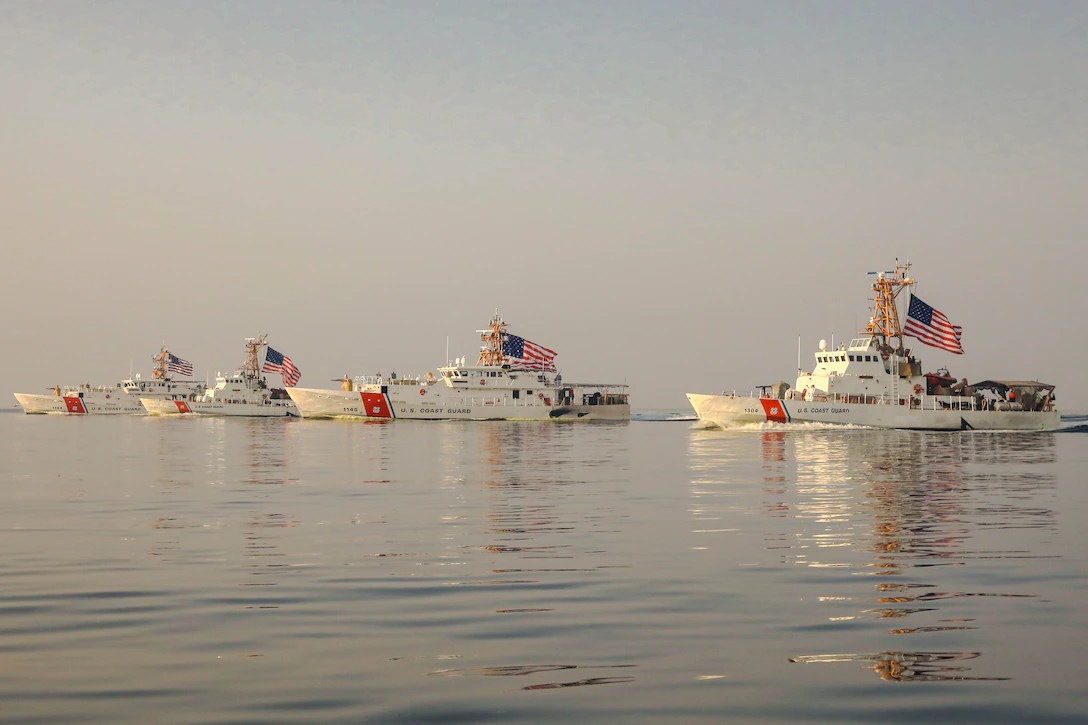
Coast Guard cutters Glen Harris, Wrangell, Emlen Tunnell and Maui transit in formation in the Gulf of Oman, Feb. 26, 2022. Photo by Army Cpl. DeAndre Dawkins. 220226-A-AI379-760M.JPG

The US Naval Institute (USNI) has announced its 2022 Coast Guard Essay Contest.  Prizes are $5000, $2500, and $1500, but more important is the opportunity to get you ideas aired.


Submission Guidelines

  • Open to all contributors — active-duty, military, reservists, veterans, and civilians.
  • Essays must be no more than 2,500 words, excluding end notes and sources. Include word count on title page of the essay.
  • Essays are judged in the blind. Do not include author name(s) on the title page or within the body of the essay.
  • Submit essay as a Word document at http://www.usni.org/cgessay no later than 30 April 2022.
  • Essay must be original and not previously published (online or in print) or being considered for publication elsewhere.

If you make a submission, and if it is not accepted for publication by the USNI, send it to me, and I will consider publishing it.