Top Ten Navies by Aggregate Displacement, 1 January 2022. Analysis and diagram by u/Phoenix_jz

You may need to click on this to make it readable. 

(There is an updated 2024 version of this post here)

Ran across this on Facebook, posted by Buddy Stewart, an administrator at the “Navy General Board” page. He found it here. Thought it might be of interest. I can’t vouch for the accuracy, but it looks credible to me.

The creator’s notes are below. 

I figured with all the discussion flying around over the past year over the sizes of various navies – particularly with regards to the greater-than-ever attention being paid to the growth of the PLAN – I would ‘publish’ some of the data from my own navy tracking spreadsheet to give everyone an idea of the relative sizes of the top ten navies, by aggregate displacement of commissioned ships, which I tend to find is a better way of measuring the sizes of navies than my mere ship counts. Figures are aggregates of full load displacement in metric tonnes.

To break down what each of these categories mean;

  • Surface Warships is an aggregate of all above-water warships and major aviation and amphibious assault platforms. This category includes CVNs, CVs, CVLs, LHDs, LHAs, LPDs, CGs, DDGs, FFGs, corvettes, OPVs, CPVs, lighter patrol craft, and MCM vessels.

  • Submarines is what it says on the tin – SSBNs, SSGNs, SSNs, SSKs, and for select nations where applicable (and where information is available), special purpose submarines.

  • AORs includes all major fleet replenishment vessels (coastal vessels do not count, however).

  • Other Auxiliaries is a very wide net that essentially captures everything else. Special mission ships, support vessels, minor amphibious assault vessels (LSDs, LSTs, LCAC’s, LCM’s, LCU’s), training vessels, tugs, coastal support vessels, hydrography ships – all essential parts of navies, but generally stuff that isn’t paid too much attention to as its far less flashy than the warships proper.

Interesting trends in data that I thought I would share for various navies;

Though much has been said about the PLAN ‘overtaking’ the USN in number of ships, the actual data is not so friendly. A large part of the PLAN’s numerical ‘edge’ comes from the larger number of smaller platforms they operate, be it corvettes like the Type 056/56A (50+22), or missile boats like the Type 22 (83). Much of this numerical strength was pre-existing relative to the last few years – what is really notable is the fact much of the PLAN’s growth is now driven by larger warships – such as the two LHDs, eight DDGs, and SSBN commissioned in 2021 (but nine Type 056A corvettes were still commissioned), as the PLAN is finding its pace with constructing large numbers of major surface combatants. However, they still have a long way to go in all categories before they really match the USN in size, if they ever do – as it stands the 22 cruisers and 69 destroyers of the American escort fleet clock in at 870,000 tons to the aggregate 474,000 tons of the PLAN’s destroyers and frigates – many of which are still older types of limited utility compared to even something as old as a Flight I Burke.

That said, the USN will see some notable contraction in tonnage over the next few years as many older Ticonderoga-class cruisers and several LCS’s are retired, while new frigates are still about five years away from seeing service. That said, given the availability issues of the Ticonderoga’s, this isn’t really much of a practical reduction in strength.

The VMF remains comfortably as the third largest navy. Though its surface fleet has seen better days, things are slowly improving as new frigates commission and older surface combatants get through their refits. It is worth noting that the VMF is still disproportionately powerful underwater with its large fleet of SSGNs, SSNs, and SSKs, though still somewhat smaller than the USN’s fleet in displacement (it appears larger here because of the significant special purpose submarine fleet). The PLAN may be the world’s second largest navy, but underwater, the VMF is on deck and the PLAN is in the hold.

The British Royal Navy remains in the number four spot, as we step down from the ‘million plus’ club of the top three navies. British aggregate displacement remains notable with regards to its low ratio of combatant tonnage to support fleet, a testament to the size of the RFA. This, combined with the large displacement of the Queen Elizabeth-class carriers (about 140,000t of carriers, temporarily second only to the USN’s 1.14 million tons of carriers) puts the British ahead of the JMSDF, which otherwise still has a significantly larger surface fleet, but is much shallower in terms of support ships (reflective of the different environments the two navies operate in).

There’s not much to say about the Indian Navy, other than to expect a significant increase this year when Vikrant commissions. Steady, if slow, construction has seen them replace older destroyers and frigates, though the true long-term challenge will be their SSN program. The Marine Nationale still comfortably holds its seventh-place position, though it is somewhat at an ebb given its AOR fleet is at an all-time low with just two Durance-class tankers in commission. This trend will continue through 2022, as the first Vulcano-class LSS for the Marine Nationale will not enter service until 2023. The MN can, however, boast of having one of the most modern surface combatant fleets anywhere – by the end of 2022, when the last Georges Leygues-class frigate leaves service and the new Lorraine commissions, it will have not a single ship commissioned before 2000 in its front-line escort fleet of Horizon and FREMM.

The ROKN is something of a rising star, though this year they’ve poked their head into the top eight briefly thanks to stagnation in the displacement of the normal number eight, the Marina Militare – the latter is down two frigates from a sale to Egypt, and a new ‘OPV’ due to delays brought on by Covid. The ROKN is an example of another navy heavy in combatant displacement but shallow in support ships, reflective of its operating environment. Though the Korean carrier program has so far stolen much of the attention of the ROKN’s development, that remains a long way off and for now the more notable areas of growth are the steady frigate program, and indigenous submarine program.

The Marina Militare, as mentioned before, is at something of a low ebb, though they will likely regain the number eight position as a new LHD and two OPVs will net them about 35,000 tons in 2022 (as the carrier Giuseppe Garibaldi will leave service this year). The first half of the 2020s will see the delivery of a significant number of surface combatants – two FREMM and six ‘OPVs’ of the PPA type – as well as another LSS of the Vulcano-class.

The Indonesian Navy is an unlikely tenth, but they are still very much present – albeit this is primarily the responsibility of their five Makassar-class LPDs that net them the 57,000 tons that, in combination with an unusually large fleet of LSTs and LSMs, puts them over the Turkish Navy (which just misses our list at 258,048 tonnes). That said, even if they were to fall out of their current ‘position’ in the short term, they are likely to remain in the top ten in the long term, due the large expansion planned for their surface fleet of at least ten frigates by the end of the decade.

“Unmanned and on Guard: A New Approach to Coast Guard Operations” –USNI Blog

The US Naval Institute Blog has a post by LCdr John H Walters, USCG, who is the MQ-9A platform manager within the CG Office of Unmanned Aircraft Systems.

It pleads the case for unmanned systems (and satellite systems). The author is obviously a true believer (as am I to an extent).

The thing that I find encouraging is that there is a Coast Guard Office of Unmanned Aircraft Systems. What I find discouraging is that the Coast Guard has yet to procure its own shore based UAS and is still riding the coat tails of the Customs and Border Protection program that is still operating old versions of the MQ-9 that are not optimized for the Marine environment and do not have the “see and avoid” capability that would allow them to operate in airspace where mid-air collision is a possibility. There may be operational reasons to continue a relationship with the CBP unit, but as a learning experience, it has served its purpose. DBP has been operating their MQ-9s for 16 years. It is time for the Coast Guard to field its own land based unmanned air systems.


“Use the Coast Guard for Freedom of Navigation Operations” –USNI

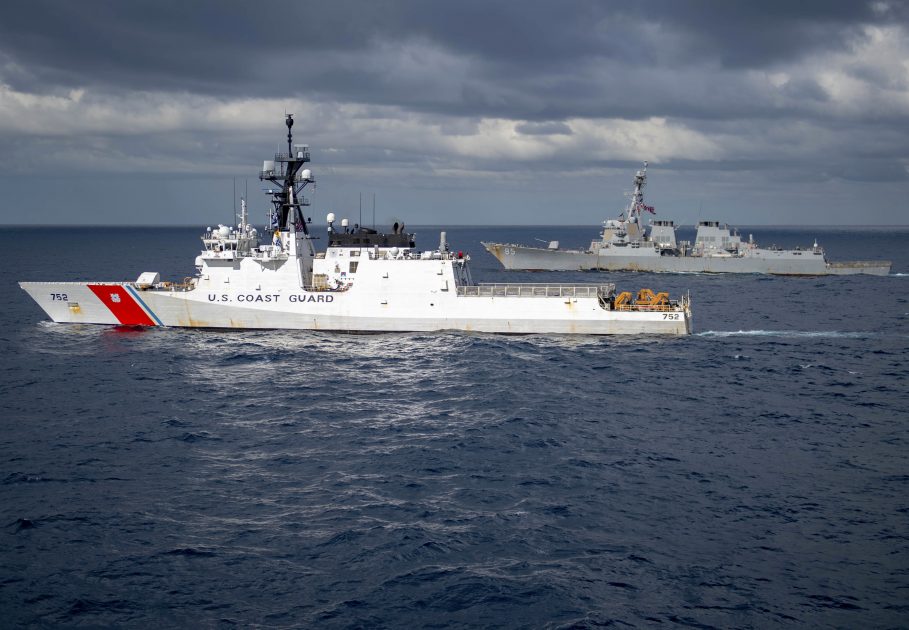
USCGC Stratton (WMSL-752), left, and the U.S. Navy Arleigh Burke-class guided-missile destroyer USS McCampbell (DDG-85) maneuver in formation during Talisman Sabre 2019 on July 11, 2019. US Navy Photo

The December 2021 issue of US Naval Institute Proceedings has an article that suggests, “NSCs and OPCs are ideal vessels to take over FONOPs.”

Why do the authors, two Navy LCdr. and a Marine Capt., think this? They contend:

  • Their destroyers are overworked.
  • The Navy is having a hard time keeping their ships maintained.
  • Cutters are less intimidating
  • and less expensive
  • If the Chinese start playing bumper boats with Destroyers, they might damage expensive equipment. “…if a ship from the Chinese Navy, Coast Guard, or maritime militia were to ram a U.S. vessel conducting a FONOP, the ensuing visuals, narratives, and potential loss of combat capability would be starkly different between a Navy gray hull and a Coast Guard white hull.”

They talk about using LCS as an alternative, but then denigrate the possibility,

The Navy has rightfully used littoral combat ships (LCSs) to conduct limited FONOPs in the South China Sea, somewhat relieving overworked destroyers like the USS John S. McCain. However, the smaller LCS’s myriad of problems, curtailed acquisition numbers, and early retirement of the first four hulls mean the Navy will soon have to lean even more heavily on larger and generally older ships. With only 10 to 14 cruisers and destroyers available to Seventh Fleet at any given time, the Navy can ill-afford to use these high-demand, low-density, Aegis ships for FONOPs.

This, in spite of the fact, that LCS have only recently begun making regular deployments to the Western Pacific and LCSs are being added to the fleet at a rate of four per year.

First, I have no problem with Cutters doing FONOPs when they are in the Western Pacific, but that should not be the only reason, they are there.

US Navy ships are not overworked. That is a fiction. Having looked at the “USNI News Fleet and Marine Tracker” over many years, I can say, Navy ships are typically deployed about one third of the time, and they are underway only about 25% of the time, far less than Coast Guard cutters. That is not to say the people are not overworked, by burdensome administrative and overly broad qualification requirements for their junior officers. The ships are behind in maintenance because of lack of support, not time underway. Ships don’t need to spend 75% of their time, tied up in maintenance, to remain effective.

In war time, well over half the navy should be underway and forward deployed. The fact that they cannot support a much smaller forward presence, of which much of the time is not underway, in peacetime, points to a serious deficit in the Navy’s support structure. Where are the repairs ships, the tenders, the floating dry docks that allow a navy to be truly expeditionary?

If the Navy does not want to use carriers, cruisers, or destroyers for FONOPs because they are afraid of having them damaged, there are other alternatives. They could use amphibs: LHAs, LHDs, LPDs, and LSDs. They could use Military Sealift Command ships. MSC ships are clearly not as intimidating as carriers, cruisers, and destroyers. Were they to be damaged “the ensuing visuals, narratives, and potential loss of combat capability would be starkly different…” 

I would suggest using the new Navaho class tug and salvage ships. They are an excellent choice for playing bumper boats. They have strong steel hulls and are powerful enough to tow a nuclear-powered carrier. Their hulls are reinforced to allow hull to hull contact with other ships. Plus, they are a lot less expensive. Even less expensive than a Coast Guard cutter.

But really, using tugs or cutters to do FONOP kind of misses the point. The Chinese and the Russians are not upset because foreign ships are transiting waters they claim. They are upset because foreign warships are transiting the waters the claim. If we stop sending warships into the waters they claim, we are creating a defacto case that they have a right to such exclusion. That Coast Guard cutters may not be considered warships would weaken our case that, foreign warships in these waters is the norm.

At CGA, 20 Jan., General Paul M. Nakasone, USA Commander, US Cyber Command, Director, NSA/Chief, Central Security Service

The US Naval Institute has announced a special event to be held at the US Coast Guard Academy on 20 January.

General Paul M. Nakasone, U.S. Army, Commander, U.S. Cyber Command and Director, National Security Agency/Chief, Central Security Service will be the featured speaker at an annual event hosted by the Naval Institute and the Loy Institute for Leadership at the U.S. Coast Guard Academy on Thursday, 20 January, in New London, CT. Admiral Charles W. Ray, U.S. Coast Guard (Retired),former Vice Commandant and current Tyler Chair in Leadership Studies at the U.S. Coast Guard Academy, will lead this engaging discussion with General Nakasone on all things cyber. This special event is made possible through support from the William M. Wood Foundation.

The link in the quote above notes:

Please contact conferences@usni.org with questions about this event.

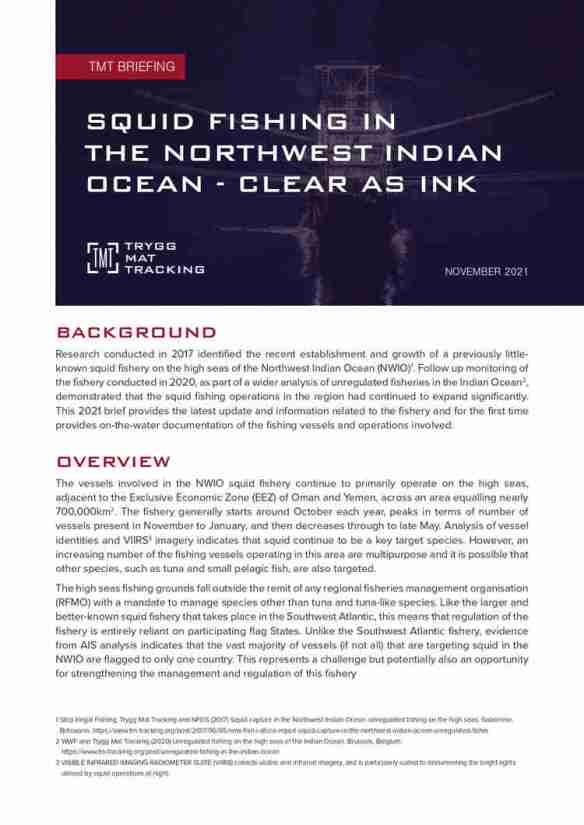
“New Analysis: Squid Fishing North West Indian Ocean: Clear as Ink” –Trygg Mat Tracking

Below is an announcement of publication of a brief from Trygg Mat Tracking (TMT), regarding Illegal, Unregulated, Unreported (IUU) fishing in the Northwest Indian Ocean.

I think this is something the Coast Guard units of PATFORSWA might become involved with, at least in a training and capacity building role.

This is a quote from the website explaining how TMT sees its mission.

“TMT provides national fisheries authorities and international organisations with fisheries intelligence and analysis, to assist enforcement actions and broader improvements in fisheries governance.  While TMT works with governments and organisations worldwide, particular focus is on targeting illegal fishing and associated fisheries crime in and near African waters and assisting coastal African States.”


New Analysis: Squid Fishing North West Indian Ocean: Clear as Ink

December 8th 2021: TMT has been monitoring the high seas squid fishery taking place in the northwest Indian Ocean since 2017. The fishery is currently unregulated and has seen significant expansion year on year.

Earlier this year we were able for the first time to ground truth and document the activities of some of the vessels involved at sea – rather than relying on AIS and other satellite sources only – and have produced a brief: Squid Fishing in the North West Indian Ocean: Clear as Ink.

The brief provides extensive images of the fishing activities taking place. This has provided us with extensive new understanding of this operation, but also raises many new questions and concerns.

Key findings of our analysis include:

·        There are very low levels of AIS transmission by some vessels – a significant number of vessels were identified which transmitted over AIS whilst en route to the region and then switched AIS off or transmitted only very intermittently whilst on the fishing ground. Further to this, the quality of identifying information transmitted over AIS was often poor, making it challenging to monitor the fishery.

·        Transshipment at sea was documented from fishing vessels to reefers, confirming that this is an important component of the operation.

·        There are indications of potential EEZ incursions into Oman and Yemen by vessels in the fleet, but no clarity if these are licensed or not.

·        The vast majority of the vessels were identified as Chinese. Equally the majority of relevant port calls by both fishing vessels and reefers are in China. Chinese research vessels have also been active in the area.

·        All vessels documented in the fishery are using a type of gear we have not previously observed, involving large ‘dip’ nets. Many of the vessels appear to be able to deploy multiple gear types. This is significant for several reasons, including that recent announcements by the Chinese Government to limit high seas squid fishing specified that this applies to squid jigging vessels only.

Recently high seas squid fisheries in the Atlantic and Pacific have quite rightly received significant attention. Quietly however a major fishery in the northwest Indian Ocean has also been growing year on year, but was previously only visible using satellite data. Now we have a snapshot of the operations at sea for the first time – and while some of our questions about this operation have been answered, many more are raised. The vessels observed were not jiggers as expected, but are using a new type of net gear. As well as squid the vessels are taking on board bycatch, including tuna species, fish the vessels are not authorised to catch. We hope this new analysis will help to shape appropriate policies and inform further action that will have real and lasting impacts on the sustainability of the North West Indian Ocean squid fishery and all those that depend upon it” said Duncan Copeland, Executive Director Trygg Mat Tracking.

The fishery is now starting up again for the 2021-2022 fishing season. As they do so it is important to note that this northwest Indian Ocean squid fishery continues to be subject to very little management and limited regulatory oversight. This represents a threat, not only to the sustainability of squid stocks in the region but potentially also to other regional fisheries, given the key role that oceanic squid plays in the marine food chain.

There is a clear need to address the current management gap as this fishery falls outside the geographical scope of the Southern Indian Ocean Fisheries Agreement (SIOFA) and outside the species mandate of Indian Ocean Tuna Commission (IOTC). Positive engagement by China in this process is crucial, as flag state for the fleet and port state receiving the catches, and as the only party with relevant information on the species, catch levels and fishing operations.

This briefing has been produced by Trygg Mat Tracking (TMT), with data and analytical support from Global Fishing Watch. At-sea documentation of vessels and fishing operations conducted in cooperation with Greenpeace International.

Download the 2021 brief: Squid Fishing in the North West Indian Ocean: Clear as Ink.

Potential Terrorist Threat Weapons

Regular readers know I have long been concerned that our cutters may not be adequately armed, if they are placed in a situation where they need to forcibly stop almost anything larger than a large cabin cruiser. It is not just that larger vessels are hard to sink. They may shoot back.

While I regard this as possible, but unlikely to occur in US waters (sort of like 9/11 was unlikely), it’s even more of concern, for countries with ongoing insurgencies, like the Philippines. Still, I don’t want to see the Coast Guard tested and found unprepared.

It becomes more likely to affect USCG personnel if they are overseas, doing counter piracy, doing counterinsurgency as we did in Vietnam, looking for weapons smugglers, or if we just stumble across terrorists enroute to their target and mistake them for drug smugglers. It also might be the work of an overconfident, vengeful drug lord.

In all probability, the situation will begin with an attempt to board a vessel of interest. It is probably most dangerous if they feign compliance, and the cutter comes close alongside. If the cutter sends a boarding party, it may be ambushed while they also attempt to disable the cutter. They would almost certainly make an effort to kill any exposed gunners.

That we might encounter small arms is a given, but I will look at other weapons, that might give them an edge, particularly if the cutter is surprised.

Any weapon that is man-portable, can be mounted on a pickup truck, or can be towed by one, can certainly be mounted on a vessel.

An aviation overwatch–fixed wing, helicopter, or UAV–could help us detect the presence of weapons, but it is not too hard to conceal weapons behind crates, in containers, or under canvas.

The most likely candidates are rocket propelled grenades, recoilless rifles/guns, heavy machine guns and autocannon, and Anti-Tank Guided Missiles (ATGM).

I will be using primarily Wikipedia and NavWeaps for reference. First, I will talk about the weapon type in general and then offer examples. Most of the examples are of Russian/Soviet or Chinese origin. They were chosen because these types seem very widely distributed and frequently fall into the hands of non-state actors.

Many of these weapons go back many decades, but that does not make them any less effective. Remember, we are still using the .50 caliber, a design that goes back to WWI.

As you go through the examples, I think you will see why I have advocated for weapons that can engage effectively from at least 4,000 yards.

Rocket Propelled Grenades:

From Wikipedia:

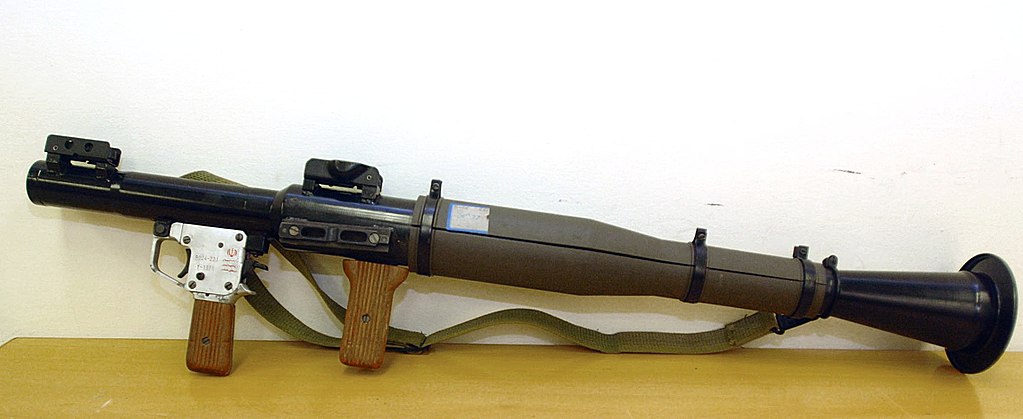
rocket-propelled grenade (often abbreviated RPG) is a shoulder-fired missile weapon that launches rockets equipped with an explosive warhead. Most RPGs can be carried by an individual soldier and are frequently used as anti-tank weapons. These warheads are affixed to a rocket motor which propels the RPG towards the target, and they are stabilized in flight with fins. Some types of RPG are reloadable with new rocket-propelled grenades, while others are single-use.”

These were initially designed as anti-tank weapons but there are warheads optimized for other targets as well. Reportedly fifteen different countries have made dozens of different weapons of this type.

An RPG missile found in Lebanon with a manufacturing symbol of the Iranian Army displayed by the IDF intelligence branch. Photo: Israeli Defense Force

The RPG-7

The ruggedness, simplicity, low cost, and effectiveness of the RPG-7 has made it the most widely used anti-armor weapon in the world. Currently around 40 countries use the weapon; it is manufactured in several variants by nine countries. It is popular with irregular and guerrilla forces. The RPG has been used in almost all conflicts across all continents since the mid-1960s from the Vietnam War to the ongoing Syrian Civil War.

Reportedly 9,000,000 of these have been produced. After the AK-47, it may be the most ubiquitous weapon in the world. A version is even made in the US. Different projectiles are available with different warheads. Projectile weight varies from 2 kg (4.4 pounds) for the fragmentation round to 4.5 kg (9.9 pounds) for those with a thermobaric warhead. Effective range is 300 meters or about 330 yards. Accuracy is affected significantly by crosswind.

The weapon has been used by ISIS and Al Qaeda.

Recoilless Rifles/Guns: 

recoilless riflerecoilless launcher or recoilless gun, sometimes abbreviated “RR” or “RCL” (for ReCoilLess) is a type of lightweight artillery system or man-portable launcher that is designed to eject some form of countermass such as propellant gas from the rear of the weapon at the moment of firing, creating forward thrust that counteracts most of the weapon’s recoil. This allows for the elimination of much of the heavy and bulky recoil-counteracting equipment of a conventional cannon as well as a thinner-walled barrel, and thus the launch of a relatively large projectile from a platform that would not be capable of handling the weight or recoil of a conventional gun of the same size. Technically, only devices that use spin-stabilized projectiles fired from a rifled barrel are recoilless rifles, while smoothbore variants (which can be fin-stabilized or unstabilized) are recoilless guns. This distinction is often lost, and both are often called recoilless rifles.

These weapons have generally been replaced by ATGMs except in the case of the Carl Gustaf, which is now being assigned, one to every US Marine infantry squad, and one to every US Army infantry platoon. Still, there are many of these weapons in circulation and they are commonly used mounted on the technicals of various non-state actors.

Forces belonging to the Iranian Navy using SPG-9. Velayat 94 Military exercise that held in February 2016 in the range of Strait of Hormuz and northern Indian Ocean. Tasmin News Agency.

The SPG-9:

“The SPG-9 Kopyo (Spear) is a tripod-mounted man-portable, 73 millimetre calibre recoilless gun developed by the Soviet Union. It fires fin-stabilised, rocket-assisted HE and HEAT projectiles similar to those fired by the 73 mm 2A28 Grom low pressure gun of the BMP-1 armored vehicle. It was accepted into service in 1962, replacing the B-10 recoilless rifle.”

Wight of the projectile is from 3.2 to 6.9 kg and range is reported up to 7500 meters, but effective range is 700 to 1300 meters. Rate of fire is 5-6 rounds per minute.

Heavy Machine Guns and Autocannon:

The modified pick-up truck, or “technical,” is a trademark of modern, unconventional warfare. Both rebels and government forces have used them extensively during the conflict. This one is carrying an anti-aircraft gun, ammunition, and petrol stored in plastic barrels. Photo Ajdabiya technical – Flickr – Al Jazeera English.jpg
Created: 23 April 2011

Moroccan ZPU-2, April 2006, Photo credit: Dieter Vogeler via Wikipedia

The ZPU-2 (more here) was developed as an antiaircraft mount and entered service in 1949. Projectile weight is 2.08 to 2.25 oz (64.0 gms), It has a range of 8,000 meters and an effective range of 1.4 km or about 1,500 yards (also reported as 2,400 yards). Each of its KPV heavy machine guns has a cyclical rate of fire of 600 rounds per minute and a practical rate of about 150 rpm.  “Muzzle energy of the KPV reaches 31 kJ (for comparison, the 12.7 mm Browning M2HB machine gun has 17 kJ…)” .

Reportedly, in 2007 ammunition for the weapon was still being produced in Bulgaria, Egypt, People’s Republic of China, Poland, Romania and Russia.

The ZU-23-2 was developed as an anti-aircraft gun, first deployed in 1960. It fires a 186 g (6.27 oz) projectile to an effective range of 2-2.5 km or 2200 to 2750 yards. The cyclical rate of fire is 2,000 rounds per minute, but the practical rate is 400 rpm. It is employed by over 70 users including Boko Harum.
“In the Soviet Union, some 140,000 units were produced. The ZU-23 has also been produced under licence by Bulgaria, Poland, Egypt and the People’s Republic of China.”

Soviet S-60 57 mm AA gun at Muzeyon Heyl ha-Avir, Hatzerim airbase, Israel. 2006. This gun was sold to 37 different countries during the Soviet era and has been used by “Islamic State of Iraq and the Levant.” Photo credit Bukvoed via Wikipedia.

The 57mm S-60 goes back to the World War II. The gun was manufactured in the USSR, China, Poland, and Hungary. Reportedly it is still used by 35 nations and was previously operated by many more.
The projectile weighs 6.17 lbs. Rate of fire is 120 rounds per minute cyclic, but 70 rpm sustained.
The Islamic State allegedly shot down a Cessna 208 Caravan operated by the Iraqi Air Force near Hawija, Iraq on 16 March 2016 with a truck-mounted S-60.
There are a huge number of Anti-Tank Guided Missiles (ATGM) available, any of which could ruin your entire day. “As of 2016, ATGMs were used by over 130 countries and many non-state actors around the world.” I’ll just talk about a couple.

9K111 Fagot in Polish service. Photo credit: Ministerstwo Obrony Narodowej

The missile weighs 12.5 kg (28 lbs) and the warhead is 1.7 kg or 3.7 lbs. It has an effective range of 70-2500 meters, about 77 to 2750 yards.
IDEF ’07, Baktar Shikan, original Wikipedia upload by KIZILSUNGUR at Turkish Wikipedia,1 June 2007.
The HJ-8 or Hongjian-8 (Chinese Red Arrow-8) and Bhaktar Shikan (Pakistani version) was developed in China. This tube-launched, optically tracked and wire-guided missile weighs 24.5 kg, has a range of up to 4,000 meters (one version reportedly 6,000 meters). It entered mass production in 1984 and has been operated by 21 countries and by non-state actors including ISIS. There is even a variant (HJ-8S) with an anti-ship warhead. Versions are also made in Pakistan and Sudan. Reportedly, in 2009, the Sri Lankan Army used these weapons against fast attack craft of the Tamil separatist LTTE’s Sea Tigers naval wing.

“Naval shipyard Tandanor to build new icebreaker for Argentina” –Navy Recognition

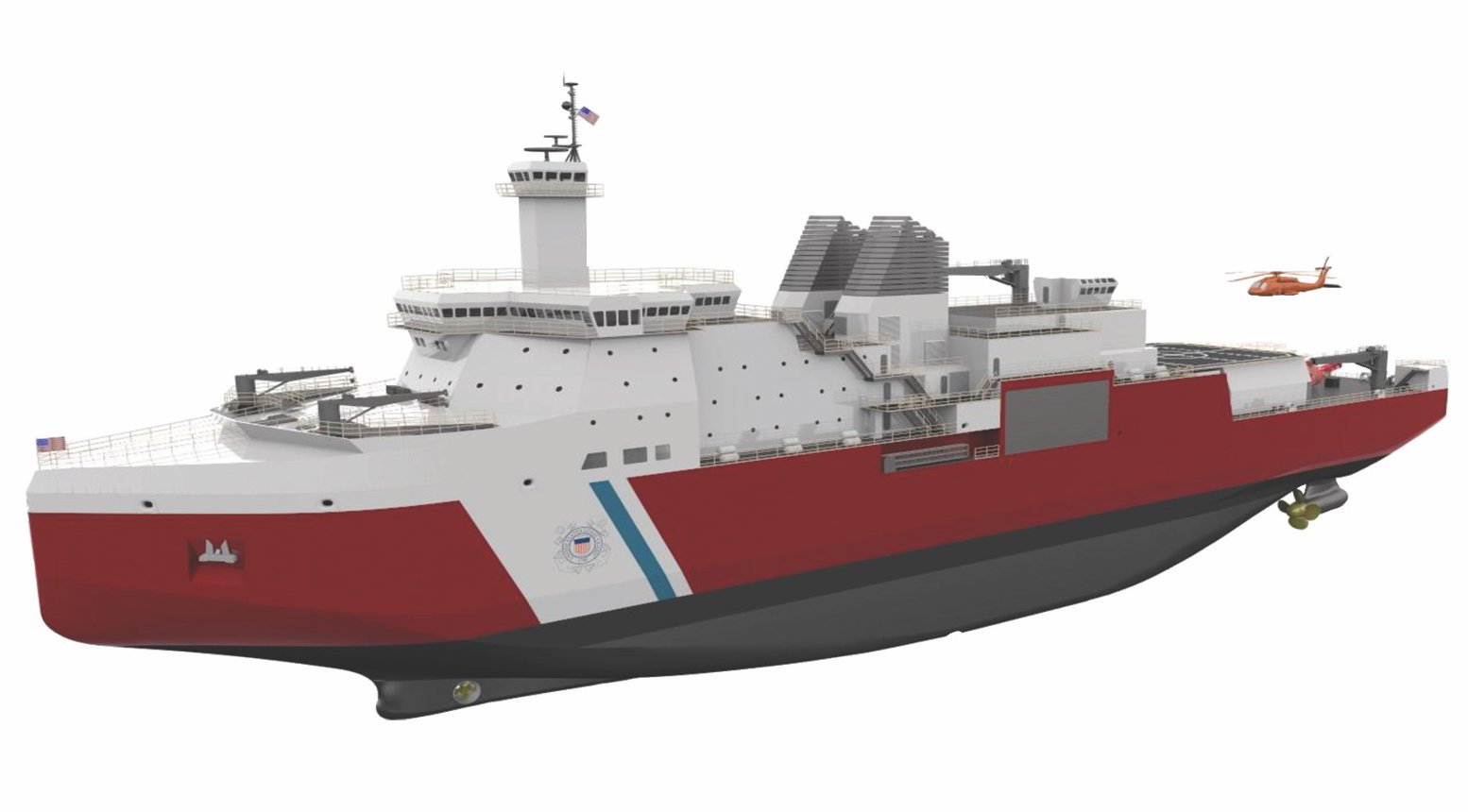
Artist rendering of the future icebreaker for Argentinian Navy (Picture source: Argentinian MoD)

Navy Recognition reports, state owned “Tandanor Naval Shipyard will proceed to the construction of a polar ship for the Argentinian Navy.”

“The new polar ship will have a length of 131,5 m, a beam of 23,6 m, and could reach a top speed of 16 knots.”

That is 431’4″ long and 77’5″ of beam.

Argentina is moving to strengthen their claim on territory in Antarctica.

In 2015 they completed repairs on their only icebreaker which had suffered a serious fire in 2007.

In 2019 Argentina contracted for four Offshore Patrol Vessels, three of which were to be ice-strengthened. Two of the ice-strengthened OPVs have already been delivered and the third should be delivered this year.

Argentina’s claim on Antarctica overlaps those of the UK and Chile.


Contract Option for Second Polar Security Exercised

DOD reports a contract option for design and construction of the Second Polar Security Cutter has been exercised. Notably this is a Navy contract. Completion expected Sept. 2026.

VT Halter Marine Inc., Pascagoula, Mississippi, is awarded a $552,654,757 fixed-price incentive modification to previously awarded contract N00024-16-C-2210 to exercise an option for the detail design and construction of the second Coast Guard Polar Security Cutter. Work will be performed in Pascagoula, Mississippi (61%); Metairie, Louisiana (12%); New Orleans, Louisiana (12%); San Diego, California (4%); Mossville, Illinois (4%); Mobile, Alabama (2%); Boca Raton, Florida (2%); and other locations (3%), and is expected to be completed by September 2026. Fiscal 2021 procurement, construction, and improvement (Coast Guard) funds in the amount of 485,129,919 (80%); fiscal 2020 procurement, construction, and improvement (Coast Guard) funds in the amount of $100,000,000 (17%); and fiscal 2019 procurement, construction, and improvement (Coast Guard) funds in the amount of $20,000,000 (3%) will be obligated at time of award and will not expire at the end of the current fiscal year. The Naval Sea Systems Command, Washington, D.C., is the contracting activity.

Thanks to Paul for bringing this to my attention.

“This company’s drone set flight-time records. But what it really wants is more work with the Pentagon” –Defense News

A Vanilla ultra endurance land-launched unmanned aerial vehicle (UAV) operates during U.S. Pacific Fleet’s Unmanned Systems Integrated Battle Problem (UxS IBP) 21 at Naval Base Ventura County, Point Mugu, on April 24, 2021. UxS IBP 21 integrates manned and unmanned capabilities into challenging operational scenarios to generate warfighting advantages. (MC2 Michael Schutt/U.S. Navy)

Defense News report,

WASHINGTON — Small business Platform Aerospace continued to set records in 2021 with its Vanilla Unmanned family of drones, but the company says it’s working to ensure it’s building a relevant warfighting platform, not just an aerospace novelty.

The Vanilla UAV in its long-endurance configuration set a world record in September and into October, when it flew for eight days, 50 minutes and 47 seconds out of Edwards Air Force Base in California. The aircraft had previously demonstrated a five-day flight.

We talked about this UAS, from veteran-owned small business Platform Aerospace, when it set the earlier record. Since then, there have been some significant developments including a drug interdiction capability test with SOUTHCOM.

“… in July with U.S. Southern Command. The vehicle flew out of Key West with a mesh radio, satellite communications, a radar pod and an electro-optical/infrared camera, demonstrating what a multi-day drone with a complex payload package could accomplish.”

There is also this mention of a sensor, that might be applied to other UAS, that could come in handy for icebreakers.

“While the bulk of Platform Aero’s work has been with the military, and chiefly the Navy, Pappianou said the aircraft flew a mission with a proprietary radar designed by the University of Kansas to measure snow and ice depths in the Arctic Circle.”