The Coast Guard took full advantage of the “peace dividend” when the Soviet Union collapsed back in 1991 (the year I retired). All ASW equipment was removed. That was 30 years ago, so virtually every active duty Coast Guardsman has never been in the service when it had a defined war time mission.
Coast Guard Special Purpose Craft Law Enforcement Generation II (SPC-LE II)

Photo: Not positive, but this seems to be the boat we are talking about.
The DOD recently announced a boat contract, awarded through the Navy, that involves boats for the Coast Guard (you have to look pretty far down to find it).
Silver Ships Inc.,* Theodore, Alabama, was awarded an $8,239,095 firm-fixed price, indefinite-delivery/indefinite-quantity single award contract (N00024-21-D-2205) for design and construction of up to 110 Navy 8-meter and 11-meter Surface Support Craft and Coast Guard Special Purpose Craft Law Enforcement Generation II (SPC-LE II). Work will be performed in Theodore, Alabama, and is expected to be completed in August 2023. This contract includes options which, if exercised, would bring the cumulative value of this contract to $51,663,787. Fiscal 2020 other procurement (Navy) funds in the amount of $3,242,628 (39%); fiscal 2021 other procurement (Navy) funds in the amount of $3,187,680 (39%); and fiscal 2021 other procurement (Coast Guard) funds in the amount of $1,808,787 (22%) will be obligated at time of award and will not expire at the end of the current fiscal year. This contract is a small business set-aside. This contract was competitively procured via the beta.sam.gov website, with four offers received. The Naval Sea Systems Command, Washington, D.C., is the contracting activity. (Awarded Sept. 30, 2021)
This is Silver Ships’ announcement.
This appears to be the boat the Coast Guard will be getting. The Coast Guard will get the “Open Center Console (Open) variant.”
Each boat will use three outboards. These are the engines specified in the contract.
Thanks to Paul for bringing this to my attention. He also provided the following that gives more detail:
C-1 PART 1 – GENERAL STATEMENT OF WORK
This Statement of Work (SOW) defines the effort required for the, design, construction, testing, configuration control, documentation, and program management for the acquisition of the 8m variant,11m variant of the Naval Special Warfare (NSW) Surface Support Craft (SSC) and the United States Coast Guard (USCG) 11m variant (Special Purpose Craft Law Enforcement).
C-1.1 BACKGROUND
The 8m variant and 11m variant NSW SSC boats operate from inshore littorals to blue water, over the horizon locations, in and up to moderate sea states (NSW) in widely diverse climatic conditions (tropical to arctic). They provide over-watch and coverage for diverse NSW waterborne operations, such as: transit for at sea personnel, water parachute jump, diving, surface swimmer support, medical evacuation and command, control, communications, computers, and intelligence duties. The SSCs also provide support for all NSW garrison locations and allow NSW to certify units for deployment in support of Navy and COMNAVSPECWARCOM requirements.
The USCG will use the 11m SSC variant to conduct counter-smuggling, search and rescue (SAR), recreational boating safety (RBS), and ports and waterways coastal security (PWCS) missions and will operate in higher sea states than the USN variants.
All boat variants are desired to provide comparable to enhanced performance of current capabilities while focusing on commonality to maintain reduction in Total Ownership Costs (TOC).
The NSW SSC requires two configuration variants of the 8m and 11m, Open Center Console (Open) and Enclosed Cabin (Cabin), to support mission needs.
The USCG requires the 11m Open Center Console (Open) variant to support mission needs.
C-1.2 QUANTITIES
The resulting contract will be a 5-year Indefinite Delivery, Indefinite Quantity (IDIQ) contract for an estimated one hundred and ten (110) total craft. The initial award is for an estimated fourteen (14) boats.
C-2.2.1 Boat – The Contractor shall provide the boat and trailer in accordance with the Specification
(Attachment 1).
C-2.2.2 UID – The Contractor shall provide UIDs for each boat in accordance with Attachment 6.
C-2.2.3 Boat Specific Technical Data Package (TDP) – The contractor shall provide for each boat one (1) hard copy and one (1) electronic copy (CD/DVD) of the Final 11m OPEN USCG Variant TDP developed under CLIN 1022 specific to each boat.
C-2.2.4 Mercury Verado Engines– The Contractor shall provide three (3) Mercury Verado engines per boat in accordance with the Specification (Attachment 1). The Contractor shall complete the engine break-in in accordance with the Specification (Attachment 1) as part of the boat CLIN.
C-2.14 CLIN 1014 AND IF EXERCISED, CLINs 2014, 3014, 4014 AND 5014 – SHIPPING – USCG
STATION SAN DIEGO, CA and also USCG STATION SOUTH PADRE ISLAND, TX; USCG STATION MIAMI, FL; USCG MARITIME LAW ENFORCEMENT ACADEMY, CHARLESTON, SC.
The Contractor shall deliver the boat to the location specified in Section F (Deliveries or Performance) and in accordance with Section C, Part 3. Items not integrated into the boat shall be wrapped in protective packaging or container and shall be shipped to the same location either with the boat or via separate shipping.
C-2.18 CLIN 1018 AND IF EXERCISED CLIN 4018 – CREW FAMILIARIZATION (USCG) SAN DIEGO (and the locations listed above)
The Contractor shall provide crew familiarization and training for USCG personnel at San Diego, CA. Crew familiarization shall include craft operations, main equipment operations and maintenance. This shall include Contractor and/or OEM training and component change out for engines, electrical, and HM&E systems. At a minimum training shall be two (2) full days at End User‘s location for up to ten (10) students. The Contractor shall provide all training materials.
“Elbit Systems To Supply ASW Capabilities To An Asian-Pacific Navy” –Naval News
Naval News Reports, Israeli defense contractor, Elbit Systems has been awarded contracts totaling about $56M to provide ASW capabilities to an unnamed Asia-Pacific country (my guess, the Philippines).
Elbit Systems will provide the Seagull™ USVs (Unmanned Surface Vessels) configured to perform ASW missions and the Towed Reelable Active Passive Sonar (TRAPS) systems. The Seagull USVs will integrate Helicopter/Ship Long-Range Active Sonars (HELRAS) and will be equipped with the Company’s autonomous suite, Combat Management System and Satellite Communication capability. The TRAPS systems, which will be installed onboard the customer’s corvettes, are low frequency variable-depth-sonars intended for detection, tracking and classification of submarines, midget submarines, surface vessels and torpedoes.
I love to see this stuff because it means there are ASW systems out there that are appropriate for cutters from the largest down to relatively small.
Using helicopter style dipping sonars on surface vessels is not new. The Soviets built a number of corvettes that used this approach (Petya, Mirka, and Koni classes), but the dipping sonars have gotten much better since then.
We have talked about TRAPS before:
- Towed Reelable Active Passive Sonar
- Acoustic Systems from Our Canadian Friends
- “GeoSpectrum Launches Low Frequency Active VDS Deployable by USVs”
- “Elbit Systems Integrates Active Towed Array Sonar onboard its Seagull USV” –Naval News
HELRES, Helicopter Long Range Active Sonar, is a product of L3Harris, headquartered in Melbourne, FL.

Elbit Systems’ Seagull unmanned surface vessel. I do love this photo because it shows that even a very small vessel can launch light weight torpedoes.
“In Forbes: An Irked Senator Roger Wicker Goes “On Record” Over The Coast Guard” –Next Navy

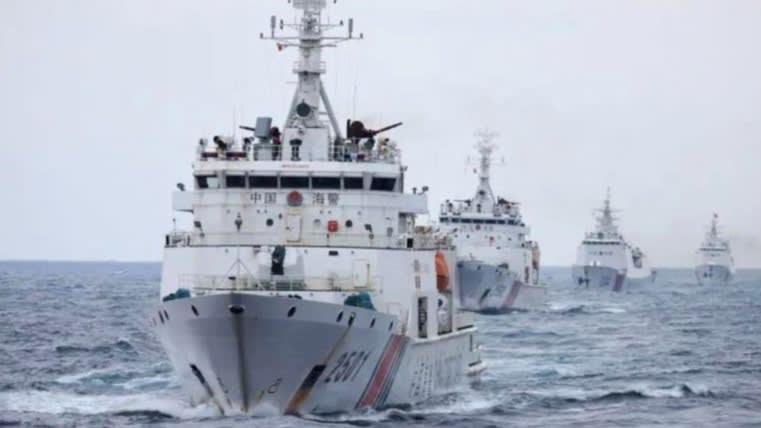
Coast Guard Cutter Hamilton leads the way for cutters Robert Goldman and Charles Moulthrope as they depart Puerto Rico April 1. National security cutter Hamilton is escorting the two fast response cutters (FRCs) across the Atlantic to Rota, Spain. From there, the FRCs will continue to their homeport of Manama, Bahrain. U.S. Coast Guard photo by Petty Officer 3rd Class Sydney Phoenix.
Next Navy comments on why despite great support in Congress, the Coast Guard is still not getting full funding.
There are other reasons, but it is hard for our friends to advocate for full funding when essentially, we don’t know what full funding is.
The current “Program of Record” dates from 2004. The last Fleet Mix Analysis, which essentially only served to show, “Yes, we really do need the Program of Record and a lot more,” was done in 2011.
Much has changed.
- We are using the Webber class WPCs in ways not imagined in 2011.
- We still don’t have the land based UAS that were included in the Program of Record.
- Improved sensors and platforms, including unmanned air, surface, and subsurface are now available.
- The Coast Guard’s aviation fleet, both fixed wing and rotary are not what was envisioned in the Program of Record.
- The Navy’s own Maritime Domain Awareness capabilities have changed. Presumably they will share with the Coast Guard.
- Illegal Unregulated Unreported fishing has emerged as a national security threat.
- The Chinese have been using their Coast Guard to intimidate our friends and allies.
- Combatant Commanders are constantly seeking Coast Guard assistance in Capacity Building in their AORs.
In spite of these substantial changes, we have not changed our Program of Record in 17 years.
By contrast the US Navy publishes a new Fleet Plan almost annually.
Congress has repeatedly directed the Coast Guard to complete a new Fleet Mix Analysis, but they have yet to see anything beyond the one ten year old study. I don’t know who is to blame for this. Is it the Coast Guard, the Department, or the Administration(s)?
The Congress is apparently not satisfied with the frequency of Navy updates.
I think they are going to have to demand the Coast Guard present a regular report bypassing the Department.
There is no way we should go more than four years between rigorous analysis of our needs. It is essential for risk analysis by all concerned parties, the Coast Guard, the Department, the Administration, and the Congress.
Proceeding without analysis is just whistling in the dark.
“Coast Guard Cutter Juniper completes patrol in Oceania” –D14

The crew of the Coast Guard Cutter Juniper (WLB 201) return to Honolulu after completing a 45-day patrol in Oceania in support of Operation ‘Aiga, Oct. 1, 2021. The Juniper is a 225-foot Juniper-Class seagoing buoy tender home-ported in Honolulu, the crew is responsible for maintaining aids to navigation, performing maritime law enforcement, port, and coastal security, search and rescue and environmental protection. (U.S. Coast Guard photo courtesy of Coast Guard Cutter Juniper)
Another out of the ordinary patrol and an indication of interest in both illegal, unreported, and unregulated fishing (IUU) and our Oceania partners.
Note also used to refuel Webber class WPC USCGC Oliver Berry, also involved in the operation.
Coast Guard Cutter Juniper completes patrol in Oceania Editors’ Note: Click on images to download a high-resolution version. HONOLULU — The crew of the Coast Guard Cutter Juniper (WLB 201) returned to Honolulu after completing a 45-day patrol in Oceania in support of Operation ‘Aiga on Friday. During the 10,000 nautical-mile patrol, the cutter’s crew conducted operations to counter illegal, unreported, and unregulated fishing (IUU) and strengthened relations with foreign allies while promoting the collective maritime sovereignty and resource security of partner nations in the Indo-Pacific. Operation “Aiga,” the Samoan word for family, is designed to integrate Coast Guard capabilities and operations with our Pacific Island Country partners in order to effectively and efficiently protect shared national interests, combat IUU fishing, and strengthen maritime governance on the high seas. “During our deployment in Oceania, Juniper conducted fisheries enforcement in an effort to counter and deter illegal fishing activities in the Central Pacific,” said Cmdr. Chris Jasnoch, the Juniper’s commanding officer. “We were able to establish a presence on the high seas and in the U.S. Exclusive Economic Zone (EEZ) in American Samoa while also patrolling our partner nation’s EEZs.” The Juniper’s crew worked under the Western and Central Pacific Fisheries Commission (WCPFC), which strives to protect the region’s fish stocks on the high seas. The WCPFC has 26 member nations and 7 participating territories, 18 of which have enforcing authority. The United States is both a WCPFC member and an enforcing nation. “We get to take part in a unique, rewarding mission in the Pacific,” said Lt. j.g. Ryan Burk, the operations officer on the Juniper. “We have the privilege of building and strengthening relationships with our Pacific Island partners, while protecting and preserving global resources.” During the patrol the Juniper embarked a Mandarin linguist from the U.S. Marine Corps to query 11 foreign fishing vessels and board 4 fishing vessels, generating vital information reports for IUU in the region. The crew also conducted joint operations with a French Navy Falcon-200 aircraft to identify and intercept vessels on the high seas. They also conducted a fueling evolution with the Coast Guard Cutter Oliver Berry’s crew, another participant in Operation ‘Aiga. “We strengthened our joint capabilities with the French Navy in the fight against IUU fishing activities on the high seas in support of the WCPFC,” said Jasnoch. To promote American Samoa’s maritime transportation system, the Juniper crew serviced vital aids to navigation in Pago Pago Harbor and in neighboring islands, demonstrating the cutter’s multi-mission capabilities. In addition to normal buoy maintenance, Juniper accomplished the first Waterways Analysis and Management System Report for Pago Pago since 2003. This report integrates the opinions of Pago Pago Harbor’s regular users to review the relevance of existing aids and reevaluate where new aids would be useful, ensuring the sustainability and safety of the waterway. Juniper’s crew also put together a donation box for the children in Pago Pago, including: sporting equipment, books and toys for the Boys and Girls Club of American Samoa. “Despite COVID restrictions preventing an in-person event, it felt good to know that we made a difference,” said Ensign Elaine Weaver, the Juniper’s community relations officer. The Juniper is a 225-foot seagoing buoy tender home-ported in Honolulu and is responsible for maintaining aids to navigation, performing maritime law enforcement, port and coastal security, search and rescue and environmental protection. For breaking news follow us on twitter @USCGHawaiiPac |
“SOVEREIGN IMMUNITY POLICY” and a Bad Example
A recent ALCOAST restates the Sovereign Immunity Policy with regard to Coast Guard vessels and aircraft. This is particularly relevant for units operating in the Persian Gulf and South China Sea, but it applies everywhere.
Since we operate mostly in US waters or nearby high seas, application may seem unlikely to most, but this is not just academic. For a real world example that caused the Coast Guard great embarrassment, let’s not forget the Simonas “Simas” Kudirka incident.
R 061626Z OCT 21 |
“NORAD’s Maritime Mission” –The Watch
This is old, but I just found it and it looks like it is essential to understanding the US maritime domain awareness system.
I have also added “The Watch,” which is the USNORTHCOM magazine, to my Recommended Blogs page.
“Coast Guard releases request for information for boats to support waterways commerce cutters” –CG-9

Shown above are Coast Guard indicative designs of a river buoy tender, inland construction tender and inland buoy tender.
The Coast Guard seems to be taking a real interest in new boats recently. This from the Acquisitions Directorate (CG-9).
The boats are expected to be a maximum of 21’6″ length over all and powered by two outboards
Coast Guard releases request for information for boats to support waterways commerce cutters
A single-design cutter boat is needed to support the 30 new WCCs. The WCC fleet will consist of river buoy, inland construction and inland buoy tenders. The Coast Guard intends to outfit each river buoy tender with two cutter boats and each inland construction tender and inland buoy tender with one cutter boat, totaling up to 56 cutter boats including spare hulls, over approximately 10 years.
The Coast Guard is seeking information about domestic firms’ capabilities and experience in designing and building boats that meet the top-level WCC cutter boat requirements provided in the RFI.
The full RFI is available here. Responses are due at 11 a.m. Eastern time Nov. 1, 2021.
For more information: Waterways Commerce Cutter Program page
“Royal Canadian Navy ship completes Northwest Passage journey for first time since 1954” –CBCNEWS
CBCNews reports that the Canadian Navy Artic and Offshore Patrol Ship HMCS Harry DeWolf has completed its East to West transit of the Northwest Passage as part of a planned circumnavigation of North America.
For the first time since 1954, a Royal Canadian Navy ship has completed the journey through the Northwest Passage.
“It was the longest time a Canadian navy ship has operated in the Arctic in consecutive days in more than 50 years,” said Cmdr. Corey Gleason, commanding officer of HMCS Harry DeWolf.
USCGC Healy is also conducting a similar circumnavigation of North America, but moving clockwise, while the Canadian vessel is moving counter-clockwise. If they get together, they should have some interesting stories to exchange.
I would think the Canadian experience with this class is also informing the Coast Guard’s acquisition process for the “Arctic Security Cutter,” our planned medium icebreaker.
There is also this D17 report of her PassEx with USCGC Kimball near Dutch Harbor.
U.S. Coast Guard Kimball, Royal Canadian Navy crews conduct joint exercise near Dutch Harbor
The Coast Guard Cutter Kimball crew and a Royal Canadian Navy crew, aboard the military vessel Harry DeWolf, transit alongside one another off the coast of Dutch Harbor, on Sept. 23, 2021. The crews exchanged radio communications after rendering honors along the ship railings. U.S. Coast Guard photo. JUNEAU, Alaska – U.S. Coast Guard Cutter Kimball and Royal Canadian Navy (RCN) crews conducted a joint exercise off the coast of Dutch Harbor, Alaska, on Sept. 23, 2021. The Coast Guard Cutter Kimball crew and an RCN crew, aboard the military vessel Harry DeWolf, operated alongside one another to exchange radio communications after both crews lined their respective ship’s port railings to properly salute in formation, rendering honors. The joint exercise was a significant opportunity that allowed the crews to demonstrate international operability and reaffirms the longstanding relationship between the U.S. and Canada. The mutually beneficial alliance between the two Arctic nations continues to contribute to maritime security in this increasingly critical region. “Our exercise with the Harry DeWolf is just the latest in a long history of maintaining a strong bond with our close friend, Canada, as well as our commitment to work with all the Arctic nations,” said Capt. Thomas D’Arcy, the Kimball’s commanding officer. “The maritime partnership between the United States and Canada enhances each nation’s regional stability, while providing mutually beneficial economic opportunities. With the increased importance of the Arctic and activity in the region, our trust and partnership in the maritime domain will promote each nation’s interests and provide opportunities to protect the environment.” The Coast Guard provides a continuous physical presence in the Bering Sea and throughout Alaska to carry out search and rescue and law enforcement missions and to conduct interagency and international cooperation, building on current regional partnerships. The Bering Sea, considered the gateway to the Arctic, encompasses 900,000 square miles of the U.S. exclusive zone off the Alaskan coast. The joint operations conducted by the U.S. Coast Guard and the Royal Canadian Navy bolster the ability to operate in this critical region at a time when the Arctic is becoming increasingly accessible. The Kimball, homeported in Honolulu, Hawaii, is one of the Coast Guard’s newer 420-foot Legend-class National Security Cutters and boasts a wide array of modern capabilities helping the crew to complete their varied missions. |
“Interview: Joey D’Isernia, President, Eastern Shipbuilding” –Marine Link
Marine Link has an interview with the President of Eastern Shipbuilding, builder of at least the Stage One Offshore Patrol Cutters and one of eight contenders to build those to be build under Stage Two. It is clearly intended to “accentuate the positive,” but still interesting.