This is the only thing I have found so far on Coast Guard participation in what may be the largest US Naval exercise since World War II.
Note, I don’t believe this is a Coast Guard video, it appears to have been made by the Marines.

This is the only thing I have found so far on Coast Guard participation in what may be the largest US Naval exercise since World War II.
Note, I don’t believe this is a Coast Guard video, it appears to have been made by the Marines.

Photo of a model of Halter Marine’s Polar Security Cutter seen at Navy League’s Sea-Air-Space Exhibition have surfaced. Photo credit Chris Cavas.
The Congressional Research Service has once again updated their look at the Polar Security Cutter (heavy icebreaker) program. (See the latest version here.) My last look at this evolving document was in regard to the July 1,2021 revision.
Changes are few. There is continued concern caused by the late start in construction of the first Polar Security Cutter. There is affirmation of House Appropriations Committee support for the Administrations proposal to fund $170,000,000 for a portion of the long lead time materials for a third PSC. While there was no change to the Administration proposal, there were some interesting comments.
(From p.13/14) “In a letter dated August 16, 2021, the House Transportation and Infrastructure Committee requested the Government Accountability Office (GAO) to review the management of the PSC acquisition program and the Coast Guard’s efforts to address icebreaking capability gaps until the PSCs are fully operational. The letter stated:
“The PSC’s shipbuilder, VT Halter, [has] begun designing the [Polar Security] cutters but challenges, including impacts from the COVID-19 pandemic, have delayed these efforts as well as the start of lead ship construction. To mitigate the effect of these delays, DHS and the Coast Guard may authorize the start of construction before the design is stabilized—a practice that has resulted in poor outcomes, including cost growth, for other shipbuilding programs. Further, with the delivery of the first cutter delayed, the Coast Guard must continue to rely on the aging Polar Star—the U.S.’s only operational heavy icebreaker—and explore other options to address the capability gaps, which could be costly.
“Given the schedule delays and potential for cost growth, continued oversight of the PSC program is critical. As such, the Committee requests that the Government Accountability Office (GAO) review the management of the PSC acquisition program and the Coast Guard’s efforts to address icebreaking capability gaps until the PSCs are fully operational, including but not limited to:
The status of the PSC acquisition program and Coast Guard’s efforts to manage schedule delays and cost growth;
The status of efforts to maintain and extend the life of the Polar Star; and
The status of the Coast Guard’s efforts to explore other icebreaking alternatives.
As for the comments, first there was the perennial attempt to get more icebreaking assets for the Great Lakes.
Great Lakes Icebreaker Program.—The Coast Guard is tasked by Executive Order to carry out icebreaking efforts in support of commerce. The Committee is concerned that in recent years, performance metrics for icebreaking on the Great Lakes has been redefined by the availability of assets, rather than mission requirements, often with severe economic impacts. As the Coast Guard begins to define its requirements for the recapitalization of ice breaking assets in the Great Lakes, the Committee directs the Coast Guard to incorporate historical measures of performance. Not later than 180 days after the date of enactment of this Act, the Coast Guard is directed to brief the Committee on such performance measures and other considerations for planning the recapitalization of assets in the Great Lakes. (p. 28)
Then there was a comment addressed to the Navy,
The Committee understands that the Coast Guard is expanding its fleet of polar icebreakers but is disappointed that the Navy has not also considered purchasing either new or used icebreakers. The Committee directs the Secretary of the Navy to submit a report to the congressional defense committees not later than 60 days after the enactment of this Act which details the Navy’s plan to address this capability requirement in fiscal year 2022 and the future years defense program.
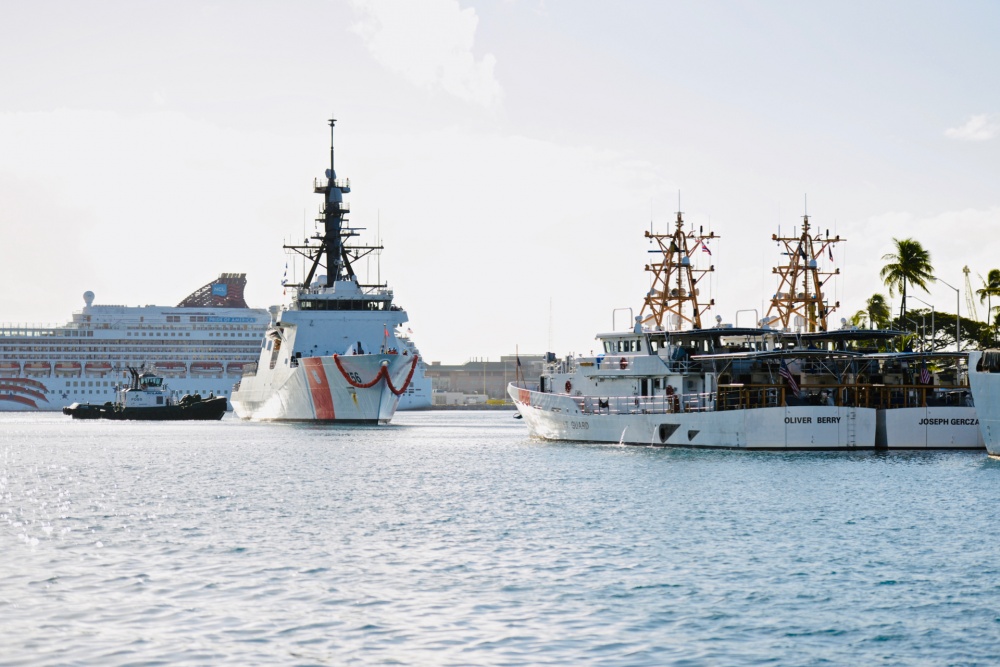
The crew of USCGC Kimball (WMSL 756) arrive in Honolulu for the first time Dec. 22, 2018. Known as the Legend-class, NSCs are designed to be the flagships of the Coast Guard’s fleet, capable of executing the most challenging national security missions, including support to U.S. combatant commanders. (U.S. Coast Guard photo by Chief Petty Officer Sara Muir/Released)
The Congressional Research Service has again updated their “Report to Congress on Coast Guard Cutter Procurement”. (This link will always take you to the most recent edition of the report.) My last post on this evolving document was in reference to an 8 June 2021 update. I have reproduced the one page summary in full below. But first,
Comments:
It appears this report is little changed from the previous edition. The significant change is a reflection of the actions of the House Appropriations Committee and this change is relatively small. The Administration’s FY2022 Procurement Funding Request was:
The House Appropriations Committee mark up increased the total to $716M adding $21M to the NSC program.
An explanation included in House Report 117-87 of July 15, 2021 states
“National Security Cutter (NSC).—The Committee provides $99,000,000, which is $21,000,000 above the request, for the NSC program. This funding will support Post Delivery Activities to missionize and operationalize NSCs 10 and 11. The shortfall for these activities is currently over $200,000,000. The $21,000,000 is funded in the bill as a rescission and re-appropriation of prior-year funds to extend their availability.” (Page 57)
So while construction of the eleven National Security Cutters have be funded, we can expect to see future funding requests totaling over $100M to make #10 and #11 fully operational.
The rescission referred to is from funds earmarked for long lead time items for a possible future NSC#12. This seems to put an end to any possibility of a NSC.
The House Appropriations Committee action leaves in place the Administration’s plan to fund OPC#4 and procure long lead time items for OPC#5, but adds no additional NSCs or FRCs.
Summary (Below is the one page summary contained in the report–Chuck)
The Coast Guard’s program of record (POR), which dates to 2004, calls for procuring 8 National Security Cutters (NSCs), 25 Offshore Patrol Cutters (OPCs), and 58 Fast Response Cutters (FRCs) as replacements for 90 aging Coast Guard high-endurance cutters, medium-endurance cutters, and patrol craft. The Coast Guard’s proposed FY2022 budget requests a total of $695.0 million in procurement funding for the NSC, OPC, and FRC programs, including $597 million for the OPC program.
NSCs are the Coast Guard’s largest and most capable general-purpose cutters; they are replacing the Coast Guard’s 12 Hamilton-class high-endurance cutters. NSCs have an estimated average procurement cost of about $670 million per ship. Although the Coast Guard’s POR calls for procuring 8 NSCs to replace the 12 Hamilton-class cutters, Congress through FY2021 has fully funded 11 NSCs, including the 10th and 11th in FY2018. In FY2020, Congress provided $100.5 million for procurement of long lead time materials (LLTM) for a 12th NSC, so as to preserve the option of procuring a 12th NSC while the Coast Guard evaluates its future needs. The Coast Guard’s proposed FY2022 budget requests $78.0million in procurement funding for activities within the NSC program; this request does not include further funding for a 12th NSC. The Coast
Guard’s proposed FY2022 budget also proposes rescinding $65.0 million of the $100.5 million in FY2020 funding for LLTM for a 12th NSC, “allowing the Coast Guard to focus investments on building, homeporting, and crewing Polar Security Cutters and Offshore Patrol Cutters.” The remaining $35.5 million appropriated in FY2020 for LLTM would be used to pay NSC program costs other than procuring LLTM for a 12th NSC. Nine NSCs have entered service; the ninth was commissioned into service on March 19, 2021.
OPCs are to be less expensive and in some respects less capable than NSCs; they are intended to replace the Coast Guard’s 29 aged medium-endurance cutters. Coast Guard officials describe the OPC and PSC programs as the service’s highest acquisition priorities. OPCs have an estimated average procurement cost of about $411 million per ship. The first OPC was funded in FY2018. The Coast Guard’s proposed FY2022 budget requests $597.0 million in procurement funding for the fourth OPC, LLTM for the fifth, and other program costs. On October 11, 2019, the Department of Homeland Security (DHS), of which the Coast Guard is a part, announced that DHS had granted extraordinary contractual relief to Eastern Shipbuilding Group (ESG) of Panama City, FL, the builder of the first four OPCs, under P.L. 85-804 as amended (50 U.S.C. 1431-1435), a law that authorizes certain federal agencies to provide certain types of extraordinary relief to contractors who are encountering difficulties in the performance of federal contracts or subcontracts relating to national defense. The Coast Guard is holding a full and open competition for a new contract to build OPCs 5 through 15. On January 29, 2021, the Coast Guard released a Request for Proposals (RFP) for this Stage 2 contract, as it is called. Responses to the RFP were due by May 28, 2021. The Coast Guard plans to award the Stage 2 contract in the second quarter of FY2022.
FRCs are considerably smaller and less expensive than OPCs; they are intended to replace the Coast Guard’s 49 aging Island-class patrol boats. FRCs have an estimated average procurement cost of about $65 million per boat. A total of 64 have been funded through FY2021, including four in FY2021. Six of the 64 are to be used by the Coast Guard in the Persian Gulf and are not counted against the 58-ship POR quantity for the program, which relates to domestic operations. Forty-four of the 64 have been commissioned into service. The Coast Guard’s proposed FY2022 budget requests $20.0 million in procurement funding for the FRC program; this request does not include funding for any additional FRCs.
Just passing this along.

Vice Adm. Steven Poulin to speak at August 2021 Arctic eTalks
Editors’ Note: To view more or download high-resolution imagery from PORTSMOUTH, Va. — Please join us for the August 2021 Arctic eTalks distinguished speaker presentation on “The United States Coast Guard – Our Arctic Partnerships: Safety, Security, and Environmental Stewardship” by Vice Adm. Steven Poulin, commander, Coast Guard Atlantic Area, Coast Guard Defense Force East. *Attendees must register ahead to ensure delivery of Zoom information! Registration is free. The Arctic eTalks is a monthly forum for open discussion (non-attribution, Chatham House Rule) in key issues affecting the Circumpolar Arctic for academics, defense and security professionals, and military leaders from Canada, Finland, Kingdom of Denmark (Greenland and Faroe Islands), Norway, Sweden, and the United States, as well as the United Kingdom and Germany. This event is presented by our valued Arctic eTalks partners U.S. Northern Command and the command’s “The Watch” Magazine, U.S. European Command, U.S. Indo-Pacific Command, and the Center for Arctic Security and Resilience (CASR) – the University of Alaska Fairbanks. Vice Adm. Poulin will provide a 30-minute presentation with slides followed by a 60-minute Q&A session (non-attribution) moderated by Mr. Shannon Jenkins, U.S. Coast Guard, and Dr. Adam Lajeunesse, Irving Shipbuilding Chair in Canadian Arctic Maritime Security Policy, St. Francis Xavier University, Canada. Note: Past Arctic eTalks presentations are posted on our Arctic eTalks website. However, the Q&A discussions are not posted and are open only to registered Arctic eTalks participants during the live event. Please register at the following link: https://alaska.zoom.us/…/regi…/WN_I1uUp6HIRvSAIXiWzXEmgg Event website: https://www.uaf.edu/casr/activities/etalks_aug_2021.php |
Just passing this along.

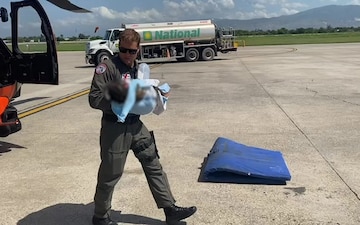
Coast Guard continues providing lifesaving support to Haiti following 7.2 earthquake
Editor’s Note: Click on images to download high-resolution video.
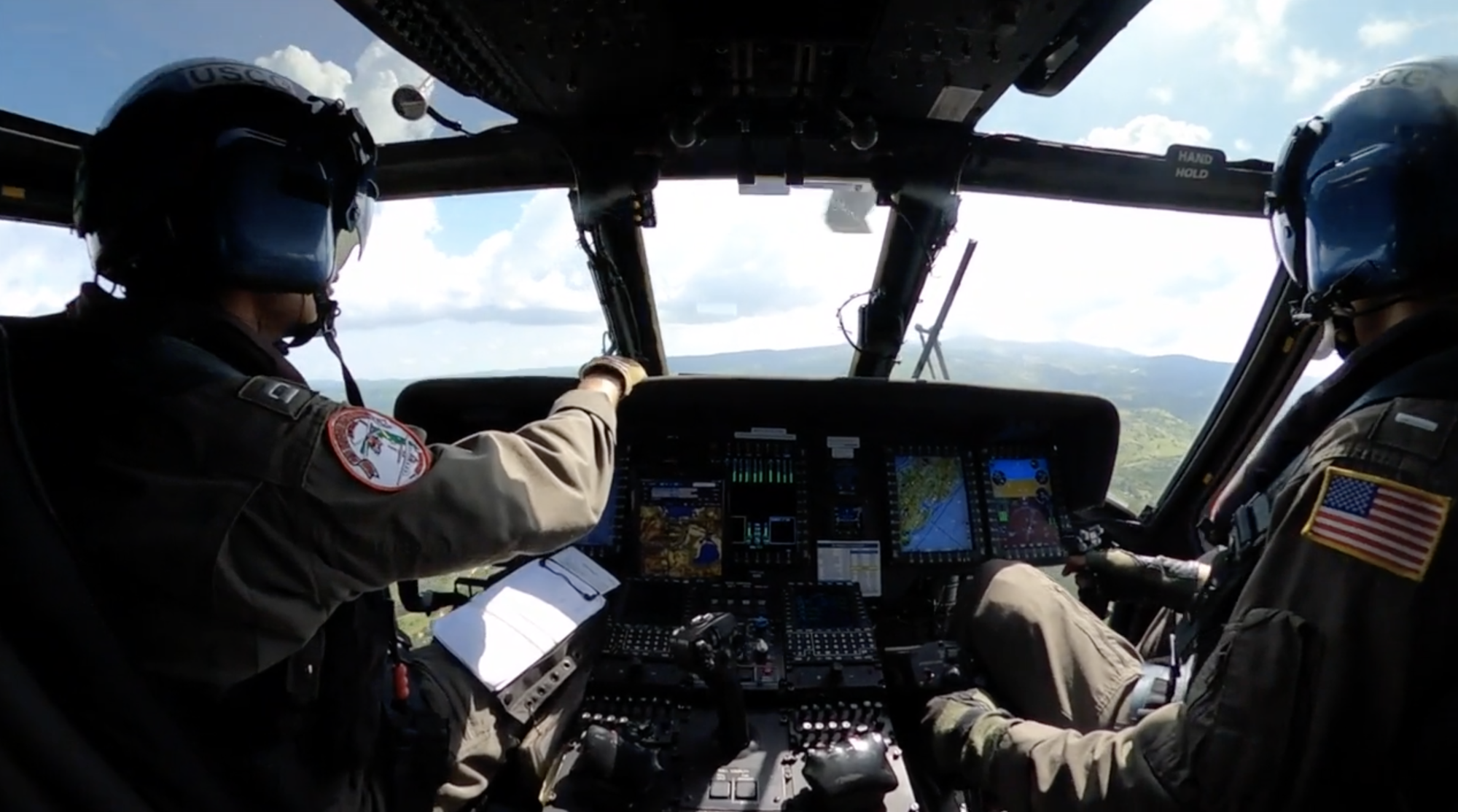
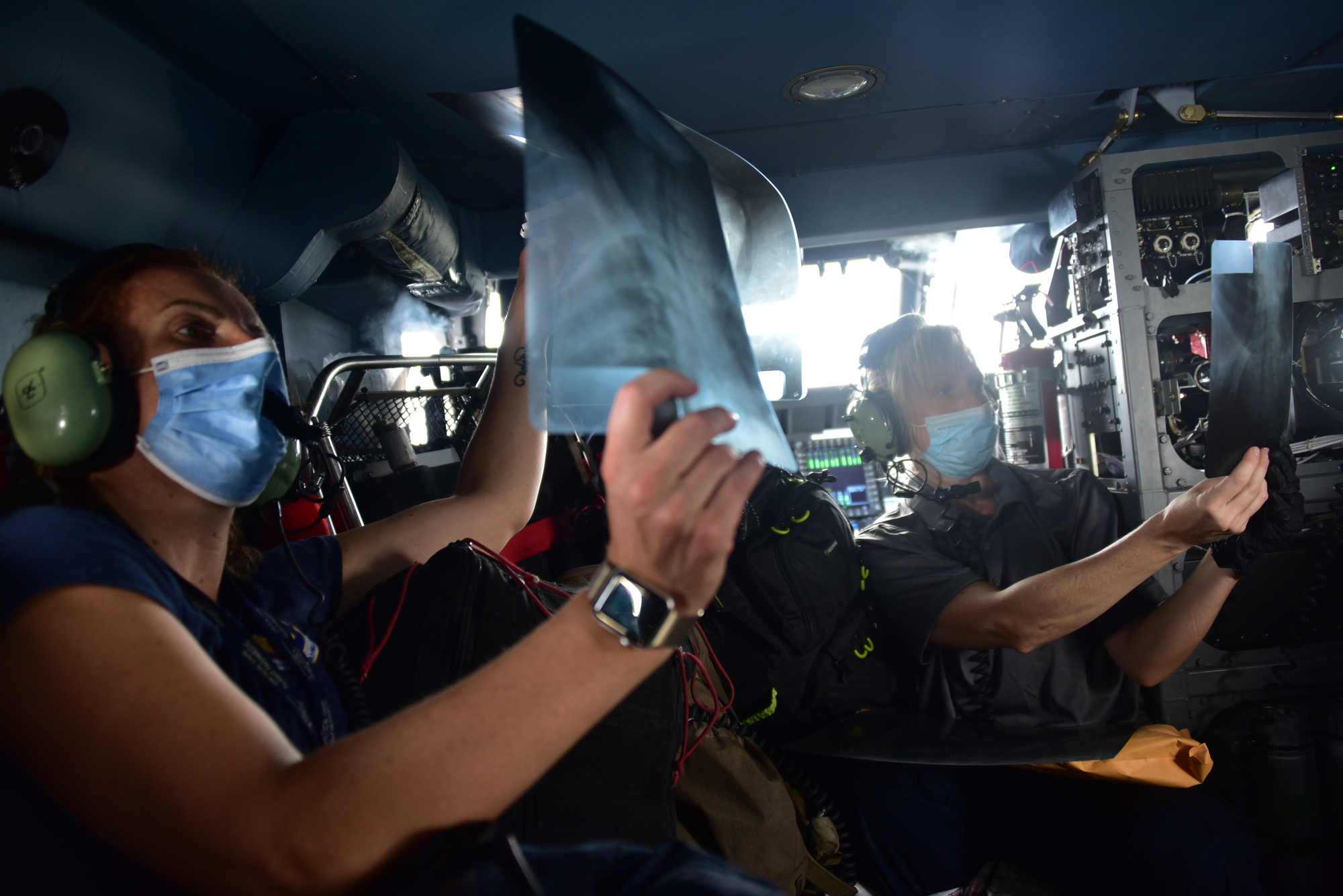
Editor’s Note: Click on images to download high-resolution version. MIAMI — The Coast Guard continues humanitarian efforts in impacted areas of Haiti following a magnitude 7.2 earthquake, Saturday. “On August 15, at the request of the Haitian Government, the Coast Guard surged aircraft and personnel to help critically injured patients from impacted areas to Port au Prince where they may obtain higher levels of care,” said Coast Guard Seventh District Commander, Rear Adm. Brendan C. McPherson. “Additionally, we are coordinating with USAID and U.S. Southern Command to move urban search and rescue responders, medical personnel and supplies to impacted areas. Our crews are trained and empowered to use sound on-scene initiative to judge the risks as they respond to the most urgent requests for help. Our people have a true bias for action and know how to lead through a crisis.” Coast Guard efforts from Sunday to Monday evening include more than:
Coast Guard assets includes:
|

NUUK, Greenland — (Aug. 13, 2021) The USCGC Richard Snyder (WPC 1127) transits by an iceberg in the Labrador Sea. The Richard Snyder is a 154-foot Sentinel-class fast response cutter with a crew of around 24. (U.S. Coast Guard photo by Petty Officer 3rd Class Dyxan Williams.)
Below is an Atlantic Area news release. Perhaps the photo above best conveys the importance of the release. We sent a Webber Class cutter from North Carolina, accompanied by a 270 foot WMEC, North through the Labrador Sea, through the Davis Strait into the Arctic waters of Baffin Bay.

Courtesy Photo | USCGC Escanaba (WMEC 907) and USCGC Richard Snyder (WPC 1127) practice maneuvering with the Royal Canadian Navy’s HMCS Goose Bay (MM 707) in the Davis Strait on Aug. 13, 2021. In Operation Nanook, the U.S. Coast Guard seeks to work collaboratively with other international partners to enhance collective abilities to respond to safety and security issues in the High North through the air and maritime presence activities, maritime domain defense, and security exercises. (Photo courtesy Royal Canadian Navy)
This follows Nanook 2020 when 270 foot WMECs operated North of the Arctic Circle of the first time (and here). This is also part of the first operational deployment of Canada’s Arctic Offshore Patrol Ship, class leader HMCS Harry DeWolf as she begins a circumnavigation of North America.
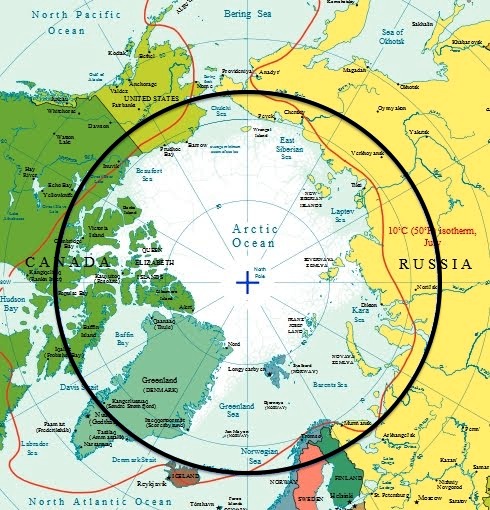 Map of the Arctic, with the Arctic Circle in blue and the 10°C July mean isotherm in red
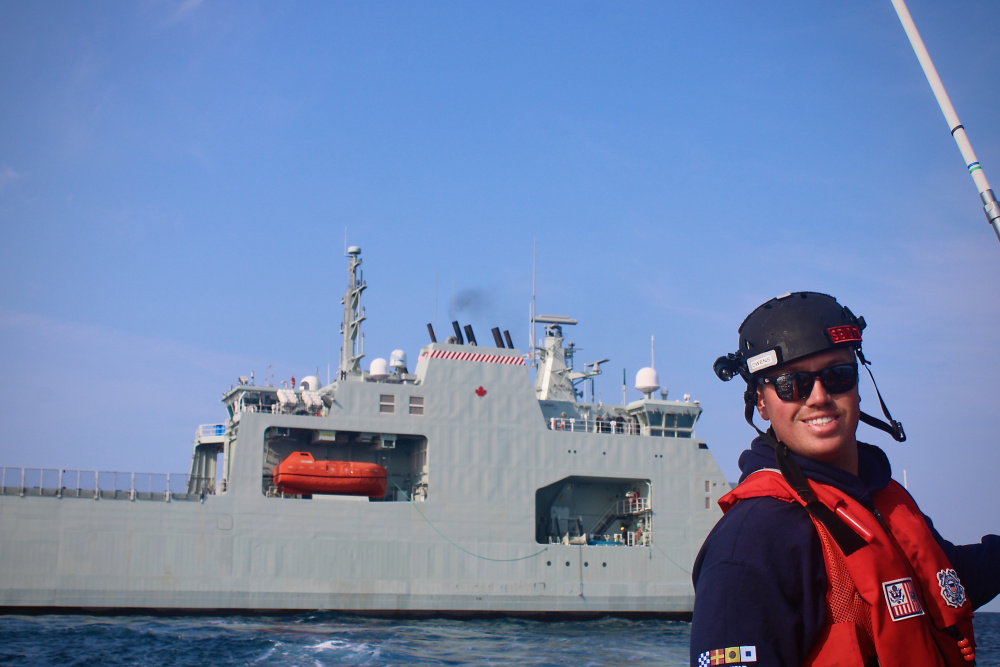
USCGC Richard Snyder (WPC 1127) participates in Operation Nanook in the Davis Strait on Aug. 4, 2021. Snyder worked alongside USCGC Escanaba (WMEC 907), the Royal Canadian Navy’s HMCS Harry Dewolf (AOPV 430), and HMCS Goose Bay (MM 707) in Operation Nanook to enhance collective abilities to respond to safety and security issues in the High North through air and maritime presence activities, maritime domain defense, and security exercises. (U.S. Coast Guard photo by USCGC Richard Snyder)
I note, unlike 2020, the Danes and French are not participating, at least in this “incident management and search and rescue” portion of the exercise.
Resupply in Greenland following the exercise renews a long association between the Coast Guard and Greenland.

U.S. Coast Guard completes Operation Nanook 2021
Editors’ Note: To view more or download high-resolution imagery, click on the photos above. NUUK, Greenland — Strengthening partnerships and testing interoperability, the USCGC Escanaba (WMEC 907) and USCGC Richard Snyder (WPC 1127) participated in Operation Nanook in early to mid-August. Operation Nanook is the Canadian Armed Forces’ signature Arctic operation, comprising a series of comprehensive, joint, interagency, and multinational activities designed to exercise the defense of Canada and security in the region and incident management response and search rescue capabilities. With commercial traffic and cruise ships increasingly visible in the Arctic, international collaborations are necessary to meet this increased traffic’s potential search and rescue challenges. Nanook-Tuugaalik is the maritime component of the Nanook series of deployments and training events intended to be an Arctic naval presence operation and domain awareness of the waters in and around Baffin Bay and Davis Strait. Nanook-Tatigiit is the incident management and search and rescue exercise portion. “We had excellent training with the crews of HMCS Harry Dewolf (AOPV 430), HMCS Goose Bay (MM 707), and Richard Snyder. The joint effort during Tuugaalik and Tatigiit included multi-ship small boat training, formation steaming, hailing and signals exercises, and more. Weather, especially in the Arctic, is a genuine consideration, and increasing sea state and fog tested us,” said Cmdr. Ben Spector, the commanding officer of Escanaba. “The U.S. Coast Guard remains committed to conducting operations and combined maritime exercises throughout the Atlantic and the Arctic region, ensuring mission capacity and future force readiness. Training with our partners and allied nations ensure all countries are ready, relevant, and responsive in an ever-evolving maritime environment.” This operation is also the first time the U.S. Coast Guard deployed a 154-foot Sentinel-class fast response cutter to the region – USCGC Richard Snyder. As the inventory of FRCs grows, the U.S. Coast Guard continues to test the full range of their capability, including operations in high latitude environments. While these ships are not ice-strengthened, units observed mitigations, such as the deployment time of year and carefully considering operating areas. “The FRC has fared exceedingly well in the Arctic. Our major concerns were fuel and food, and there have been no issues with either as the cutter continues to steam through the operational area and complete all training and interactions with stellar results,” said Lt. Cmdr. Gregory Bredariol, the commanding officer of Richard Snyder. “We’ve done some once-in-a-lifetime activities including Fjords transits, getting close aboard icebergs much larger than the cutter; restricted waters transits in harsh conditions and deployment to an unfamiliar but mission-critical area. Our colleagues aboard the Escanaba were critical in our deployment, assisting with logistics and operational support. I can’t express enough our appreciation as we deployed far from our normal operations area and completed mission sets that we don’t generally practice. As a cutter based in Atlantic Beach, North Carolina, we primarily focus on living marine resources and search and rescue.” Following Nanook, both ship’s crews are conducting engagements and resupplying in Nuuk (Greenland–Chuck). Snyder will return home. Escanaba will transition to support Frontier Sentinel, an annual exercise between the U.S. Coast Guard, U.S. Navy, and Royal Canadian Navy, ensuring the ability of the Tri-Party Staff and tactical assets to work together. This year’s live exercise uses feedback from the prior year’s tabletop discussion. Participants in all exercises are observing COVID-19 protocols to mitigate exposure and comply with host nation guidelines. Exercise scenarios took into account our COVID restrictions and respective realities. Operation Nanook is the third of four major deployments of the U.S. Coast Guard’s Atlantic Arctic Season. In June, the USCGC Eagle (WIX 327) visited Iceland, where Vice Adm. Steven Poulin, the Atlantic Area commander, hosted Icelandic officials for Arctic discussions. Also, in June, the USCGC Maple (WLB 207) participated in the Danish Joint Arctic Command’s annual exercise, Ex Argus, in Southern Greenland with international partners. Later this fall, the USCGC Healy (WAGB 20) will make stops along the U.S. East Coast after transiting the Northwest Passage on their circumnavigation of North America. Operation Nanook has been held annually since its inception over a decade ago. Last year’s exercise was scaled down due to the COVID-19 pandemic. While participants could not conduct port visits, the activity focused on naval readiness, ship tracking, and gunnery operations between multinational partners, including the United States, Canada, Denmark, and France. The U.S. sent the USCGC Tahoma (WMEC 908) and USCGC Campbell (WMEC 909) to participate. USCGC Escanaba is a 270-foot Famous-class medium endurance cutter with a crew of about 100 operating for the U.S. Coast Guard Atlantic Area. USCGC Richard Snyder is a Fifth Coast Guard District 154-foot Sentinel-class fast response cutter with a crew of about 24 also operating for U.S. Coast Guard Atlantic Area. The Atlantic Area commander and staff oversee all Coast Guard domestic operations east of the Rocky Mountains, including the Arctic, Caribbean, and Southern Atlantic and Coast Guard out-of-hemisphere operations in Europe, Africa, and Southwest Asia. |
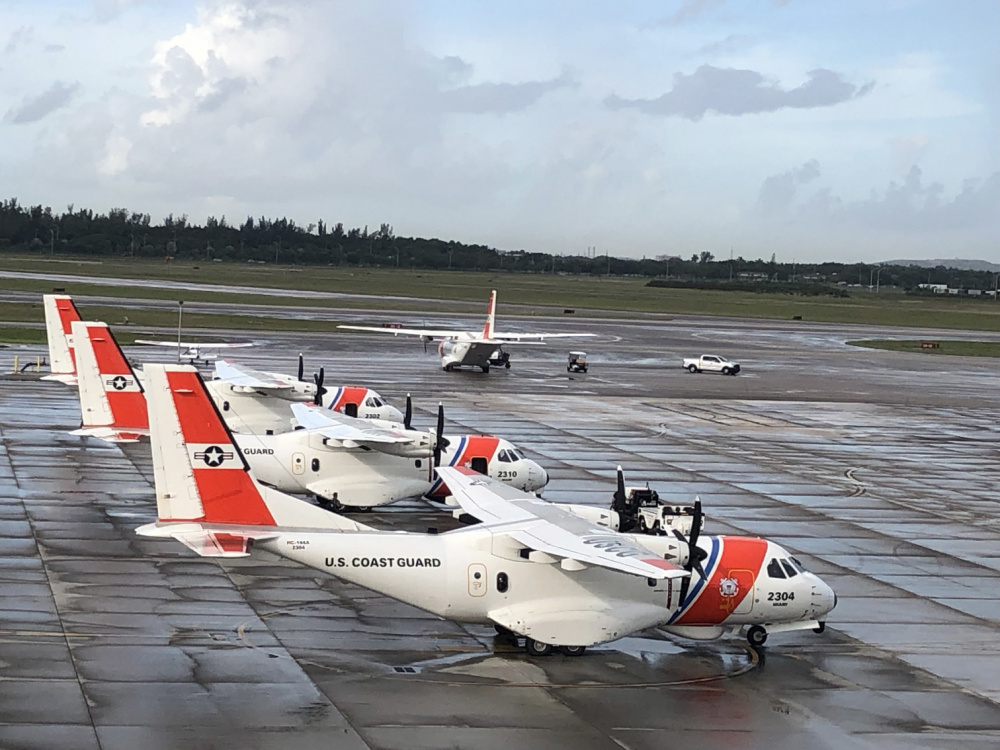
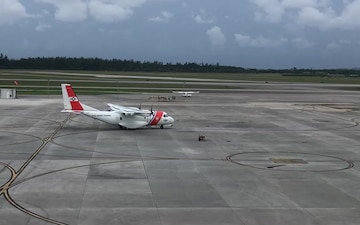
Coast Guard HC-144 Ocean Sentries at Air Station Miami are staged to deploy to Haiti to assist in response efforts, Opa-locka, Florida, Aug. 15, 2021. The Coast Guard committed numerous aircraft and surface ships to assist and surge to support critical live saving missions. (U.S. Coast Guard photo)
Figured the Coast Guard had responded to the Earth Quake in Haiti. Some info in this news release from D7.
U.S. Coast Guard sent this bulletin at 08/15/2021 05:33 PM EDT
| Multimedia Release |
U.S. Coast Guard 7th District |
Coast Guard responds to Haiti for humanitarian aid following 7.2 earthquake
 |
 |
Editor’s Note: Click on images to download high-resolution video.
 |
 |
 |
 |
 |
 |
 |
 |
 |
 |
 |
Editor’s Note: Click on images to download high-resolution version.
MIAMI — Haitian’s government requested Coast Guard assistance following a magnitude 7.2 earthquake. The Coast Guard committed numerous air and surface assets to help in transporting medical personnel and supplies, and transporting critically injured citizens to facilities needing a higher level of care in Port au Prince, Haiti.
“On behalf of the United States Coast Guard I express our deepest sympathies to the people of Haiti,” said Coast Guard District Seven Commander, Adm. Brendan McPherson. “Our hearts go out to our Haitian diaspora here in Miami and to those tragically impacted in Haiti. We are supporting USAID humanitarian relief efforts, U.S. Southern Command’s ENDURING PROMISE, and coordinating closely with Ambassador Sison and her country-team to assist in every way that we can. Our helicopters and aircrews are transporting medical personnel and evacuating those requiring higher levels of care. Our cutters remain offshore and on standby to assist the citizens of Haiti and to support agency response locally. Our unity of effort, our commitment to our neighbors, and our ability to lead through a crisis will help see us all through this tragic event.”

Bloomberg has an editorial by Admiral James Stavridis, USN (retired), former United States Southern Command (2006 to 2009) and commander, United States European Command and NATO Supreme Allied Commander Europe (2009 to 2013) that suggests the smugglers’ methods now increasingly include shipping by container in otherwise legal shipping. He goes on to suggest some possible countermeasures.
Surprisingly there is no mention of Fentanyl which appears to be an emerging drug of choice. Fentanyl is still primarily a prescription drug abuse problem, but that may be changing. Its strength in even very small quantities makes it an almost ideal drug for smuggling.
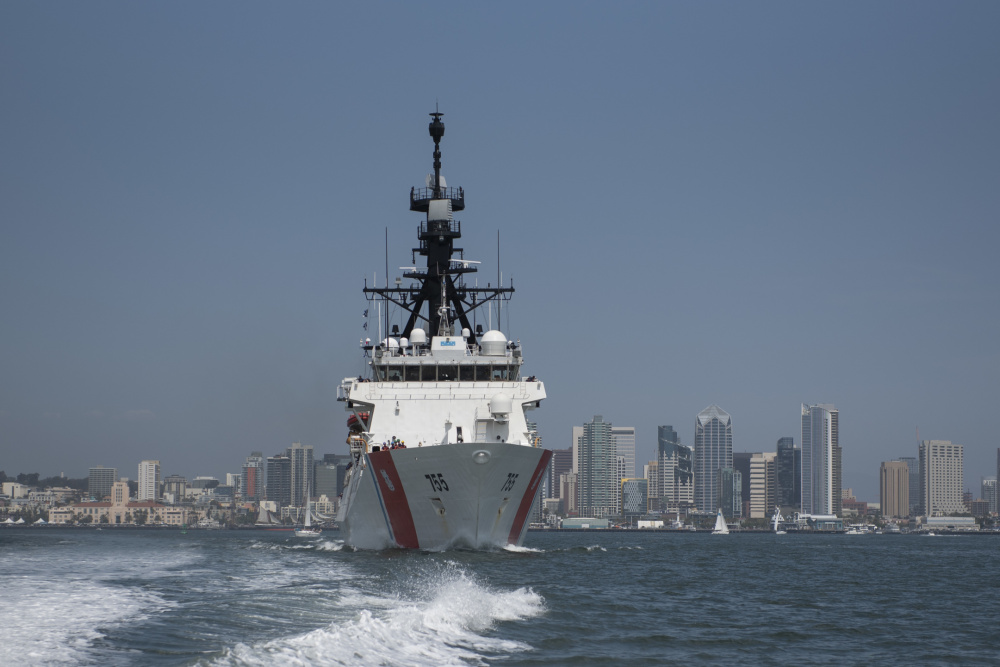
Coast Guard Cutter Munro gets underway July, 23, 2021, for a scheduled deployment in the Western Pacific Ocean. An increased presence throughout the Indo-Pacific strengthens our alliances and partnerships through improved interoperability, which will enhance regional stability, promote rule-based order, and improve maritime governance and security in the region and globally. (U.S. Coast Guard photo by Marine Corps Sgt. Kevin G. Rivas)
Below is a Pacific Area news release. Another unusual deployment though it looks like it may be becoming more routine.

Alameda-based Coast Guard cutter arrives in Western Pacific for months-long deployment
Editors’ Note: Click on images to download high resolution versions. Subscribe here to receive notifications when new photographs from the deployment are added to the DVIDS feature page. ALAMEDA, Calif. – The Legend-class Cutter Munro (WMSL 755) arrived in the Western Pacific Sunday from its homeport in Alameda for a months-long deployment to the region. The crew is operating in support of United States Indo-Pacific Command, which oversees military operations in the region. Operating under the tactical control of Commander, 7th Fleet, the cutter crew plans to engage in professional exchanges and capacity-building exercises with partners and allies and will patrol and operate as directed. “Forward-deployed Naval Forces routinely and seamlessly integrate as one maritime force with a proud heritage of serving and fighting together,” said Vice Adm. Karl Thomas, commander U.S. 7th Fleet. “It is a fitting nod to that heritage that Munro joins us following the U.S. Coast Guard celebration of its 231st birthday on August 4.” The Coast Guard’s deployment to the Indo-Pacific theater aligns with the Integrated All-Domain Naval Power of the Naval Service and increases the traditional influence of sea power regionally. “The U.S. Coast Guard’s unique authorities, capabilities, and missions position us to collaborate on maritime safety and security with partners around the world,” said Vice Adm. Michael F. McAllister, commander, Coast Guard Pacific Area. “An increased presence throughout the Indo-Pacific strengthens our alliances and partnerships through improved interoperability, which will enhance regional stability, promote rules-based order, and improve maritime governance and security in the region and globally.” Coast Guard forces provide expertise within the mission sets of search and rescue; illegal, unreported, and unregulated fishing; maritime environmental response; maritime security; and humanitarian assistance and disaster relief. Deployable Coast Guard cutters, port security units, and advanced interdiction teams are also highly capable in augmenting naval operations in theater. As both a federal law enforcement agency and an armed force, the Coast Guard is uniquely positioned to conduct defense operations and security cooperation in support of combatant commanders on all seven continents. The service routinely provides forces in joint military operations worldwide, including the deployment of cutters, boats, aircraft and deployable specialized forces. The U.S. Coast Guard has a 150-year enduring role in the Indo-Pacific. The service’s ongoing deployment of resources to the region directly supports U.S. foreign policy and national security objectives in the Indo-Pacific Strategy and the National Security Strategy. Commissioned in 2017, Munro is one of four Coast Guard legend class national security cutters homeported in Alameda. National security cutters are 418-feet long, 54-feet wide, and have a 4,600 long-ton displacement. They have a top speed in excess of 28 knots, a range of 12,000 nautical miles, endurance of up to 90 days and can hold a crew of up to 170. Munro is the second cutter named for Signalman First Class Douglas A. Munro, the only Coast Guardsman awarded the Congressional Medal of Honor. National security cutters feature advanced command and control capabilities, aviation support facilities, stern cutter boat launch and increased endurance for long-range patrols to disrupt threats to national security further offshore. Since 2018, three other Coast Guard Cutters – Bertholf, Stratton and Waesche – have deployed to the Western Pacific. |

The Coast Guard Cutter Midgett and the Canadian coast guard ship Sir Wilfrid Laurier conduct a joint maritime security patrol in the Chukchi Sea on July 20, 2021. US Coast Guard photo.
Below is a D17 news release. If Midgett is in the Chukchi Sea, which is North of the Bering Strait and all above the Arctic Circle, this is no normal Alaska Patrol. Midgett also got to rendezvous with USCGC Healy, which is conducting a circumnavigation of North America (more Healy photos here). (I don’t recognize the type boat below, presume it is one of Healy’s boats, any info appreciated.)
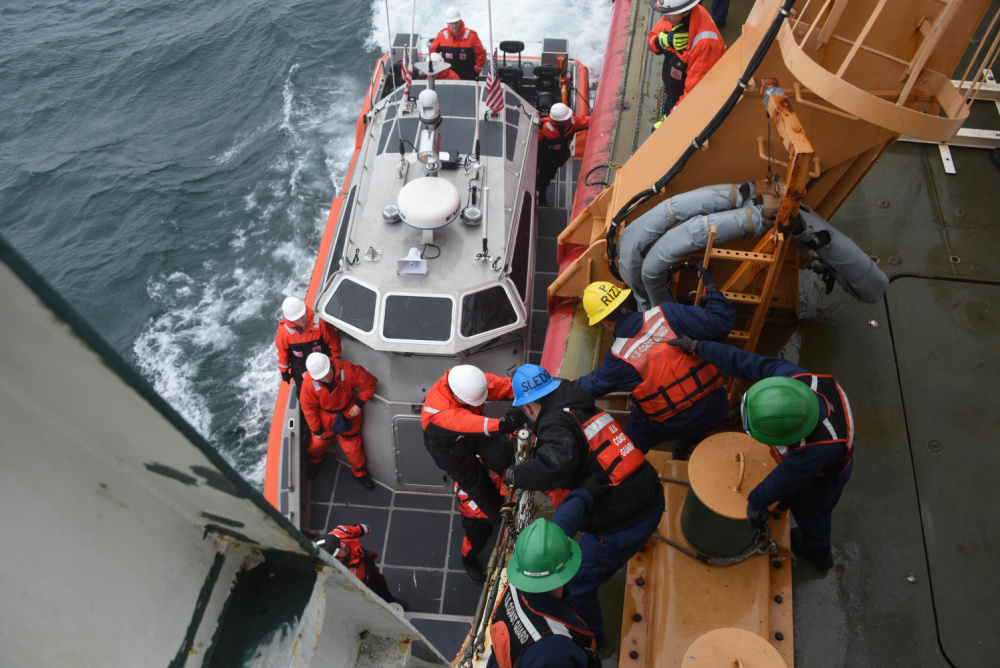
Coast Guard Cutter Healy crew members assist Coast Guard Cutter Midgett crew members while they climb aboard from the cutter boat in the Bering Strait, July 25, 2021. The Midgett is a national security cutter that ensures U.S. presence to assure U.S. sovereignty and resource security in remote Pacific regions. U.S. Coast Guard photo by Petty Officer 3rd Class Janessa Warschkow.
The Russian patrol ship Kamchatka, mentioned in the story, is pictured below. It is a member of the 1066 ton Purga class.
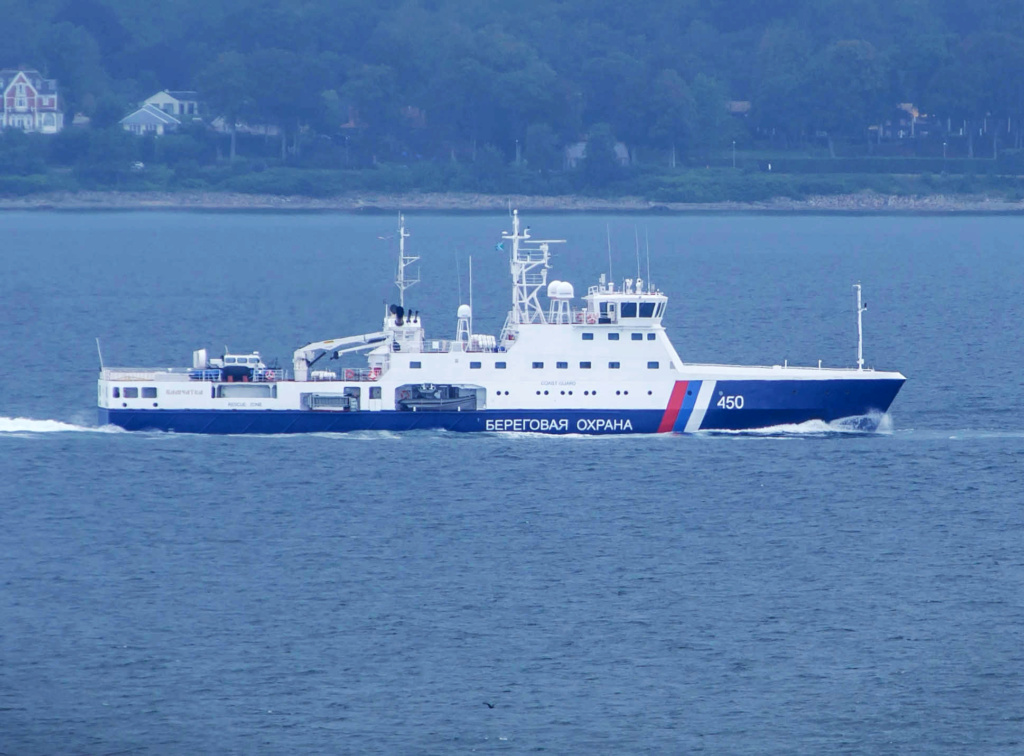
The Kamchatka border patrol ship (serial number 052) of project 22120 of the Coast Guard of the Russian Federal Border Guard Service crosses the Öresund Strait, heading from the Baltic Sea to the North, 08/20/2019 (c) frankmh
| News Release |
U.S. Coast Guard 17th District Alaska |
U.S. Coast Guard patrols U.S. Arctic
JUNEAU, Alaska — Crews aboard Coast Guard Cutters Midgett and Healy patrolled the Bering and Chukchi Seas off the coast of Alaska this summer to demonstrate the Coast Guard’s commitment to ensuring a safe and secure Arctic and to work respectively with Canadian and Russian counterparts on shared maritime interests.
In late July, the crew of Coast Guard Cutter Midgett, one of the Service’s National Security Cutters, conducted combined operations and training with the Canadian coast guard Ship Sir Wilfrid Laurier in the Chukchi Sea, a joint patrol of the U.S.-Russia maritime boundary north of the Diomede Islands with the Russian Border Guard vessel Kamchatka, and a joint transit of the Bering Strait with the Coast Guard Cutter Healy, one of the service’s two operational polar icebreakers. In each case, Coast Guard Air Station Kodiak crews forward-deployed to Kotzebue, Alaska in an HC-130J Hercules airplane supported the operations.
The simultaneous presence of Healy and Midgett in the Arctic region signals the increasing demand for the merged icebreaking and maritime security capability required of future Polar Security Cutters.
Midgett is the Coast Guard’s eighth National Security Cutter and is homeported in Honolulu. Featuring advanced command-and-control capabilities, national security cutters are the flagship of the Coast Guard’s fleet, deploying globally to confront national security threats, strengthen maritime governance, and promote economic prosperity. While National Security Cutters possess advanced operational capabilities, more than 70% of the Coast Guard’s offshore presence is the service’s aging fleet of medium endurance cutters, many of which are over 50 years old and approaching the end of their service life. Replacing the fleet with new Offshore Patrol Cutters is one of the Coast Guard’s top acquisition priorities. The first Offshore Patrol Cutter is scheduled to be delivered in 2022.
Healy is a medium icebreaker capable of conducting a wide range of Coast Guard operations including search and rescue, ship escorts, environmental protection, and enforcement of laws and treaties in the polar regions. Uniquely equipped to conduct scientific operations, Healy is also the Nation’s premiere high-latitude research vessel. Healy is the only U.S. military surface vessel that routinely deploys to the ice-covered waters of the Arctic to provide access and secure national interests related to our maritime borders and natural resources. Check here for photo updates from Healy’s Arctic deployment or subscribe to receive updates in your inbox here.





 Chuck Hill's CG Blog