Advanced Precision Kill Weapon System (APKWS) –the Video

As I have suggested several times, there is a place for this system in the Coast Guard, here, here, and here, as a weapon that would allow even small units like patrol boats and FRCs to quickly and accurately deal with a range of threats, while minimizing the risk of collateral damage inherent in the use of our current weapons, e.g. 7.62mm, .50 cal., 25mm.

These weapons are not exotic. tens of thousands are produced annually.

Interesting to see how simply the pulse repetition frequency code is set to match it to the laser designator.

(I would also argue that the Coast Guard needs to have available laser designators in order to allow us to specifically identify threats for DOD aircraft that might be called in to help the Coast Guard deal with a threat.)

The first place to mount APKWS is on the FRCs going to PATFORSWA.

It is probably possible to mount launchers on the Mk38 gun mount. There is also the four round FLETCHER  launcher (see below) that can be fitted in place of a .50 cal.

Perhaps the Most Well Armed Cutter Sized Corvette in the World

Click on the illustration above for better view

More on the Israeli’s new Sa’ar 6 Corvette from Navy Recognition, particularly in regard to the C-Dome missile system (reporting a range of 250 km). It has been over six years since I did my first post on this class. At the time, I thought the Offshore Patrol Cutters might be close in size, but they are more than twice as large as the Israeli ships. Did a second post in Aug. 2015. and I have posted comments as additional details became available, but it is time for another look.

These will be the largest combatants in the Israeli Navy, but their dimensions are still quite modest:

  • displacement: 1900 tons
  • Length: 90 m (295.2′)
  • Beam: 13.5 m (44.3′)
  • Draft: 3.5 m (11.5)
  • Speed: 27 knots
  • Crew: 70

First of the class of four, INS Magen, has completed sea trials and the German shipbuilder has delivered it to the Israelis, who will install the Israel sourced weapon systems. The remaining ships are expected to follow at six month intervals.

Note, contrary to the labeling on the illustration, the 16 missiles amidships, shown in green, will be Gabriel V anti-ship missiles rather than Harpoons. (Gabriel V will also arm the new Finnish ice-capable corvette.)

Aviation facilities are also surprising. The ships are expected to support and hangar an H-60 ASW helicopter and may also support a vertical take-off Unmanned air system.

These ships are remarkable, for their size and crew strength (only 70), in being capable in all three primary warfare areas, ASW, ASuW, and AAW. Their capabilities exceed those of many frigates and approach those of DDGs four times their size.

With a total of eighty-eight missile launch tubes, assuming they are all filled, it seems these will be the most heavily armed ships of their size in the world.

“Nordic Allies Help Navy Improve Ship Ops in Icy Waterways as Arctic Competition Heats Up” –Military.com

http://www.state.gov/e/oes/ocns/opa/arc/uschair/258202.htm . This map of the Arctic was created by State Department geographers as part of the U.S. Chairmanship of the Arctic Council.

Military.com has a report on the Navy’s increased activity above the Arctic Circle, at least on the Atlantic side. (Still have not seen much from PACFLT.) Remarks are quoted from Adm. Robert Burke, commander of U.S. Naval Forces Europe-Africa and Allied Joint Command Naples. The discussion was primarily about working with allies, but he does not fail to mention the Coast Guard. 

“Responding to a question on whether the Navy needs to have icebreakers or hardened vessels as it increases its Arctic presence, Burke said he would leave the question “up to the force providers,” adding that ship drivers are getting good at maneuvering in the challenging Arctic environment.

“He said also that icebreaking is the U.S. Coast Guard’s “core business … today, anway,” and the Navy and Coast Guard work together in many areas worldwide.

“”We’ve got great partners in the U.S. Coast Guard. … You know, if it stays in their core mission or we do some sort of shared thing, it’s going to work great,” Burke said.”

The Coast Guard, with only two polar icebreakers, has none based on the Atlantic side. We have had some indication the Coast Guard intends to base one or more of its planned three medium icebreakers (aka Arctic Security Cutters) on the Atlantic side.

To put my comment above in context, LANTFLT has much more reason for operating in the high North than PACFLT. On the Atlantic side, Russia’s most important naval bases are above the Arctic Circle, off the Barents Sea. On the Pacific side, the primary Russian naval bases are over 800 nautical miles below the Arctic Circle around Petropavlovsk-Kamchatsky. So the difference is perhaps understandable.

“US Navy helicopters and Coast Guard snipers are firing on suspected drug traffickers ‘daily,’ top admiral says” –Business Insider

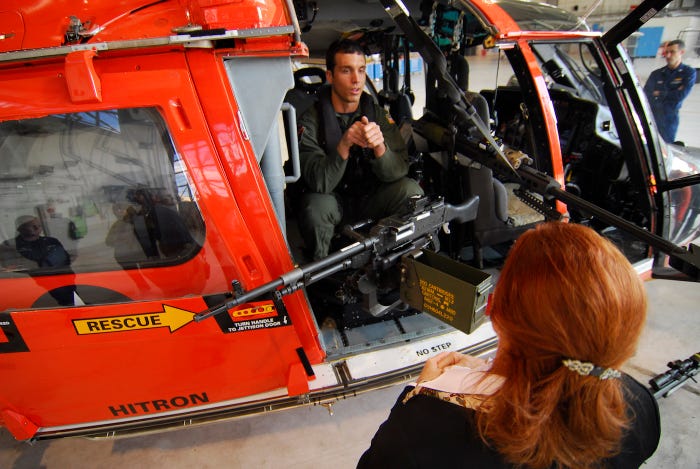
Petty Officer 2nd Class Anthony Phillips, a precision marksman at Helicopter Interdiction Tactical Squadron, displays the weaponry used by a HITRON during missions, February 23, 2010. US Coast Guard/Petty Officer 1st Class Bobby Nash

Business Insider has a story touting the success of the Navy/Coast Guard team effort in drug interdiction. This seems to be a report on Adm. Craig Faller’s (SOUTHCOM) remarks at the Surface Navy Association symposium in mid-January.

There is strong praise for the HITRON personnel.

“Coast Guard HITRON teams, which are sniper teams, have integrated into US Navy helicopters. So our Navy crews are involved in decisions to use … warning shots and disabling fire daily. I mean, it is a daily event,” Faller added. “We average numbers, sometimes large numbers, of events daily, and they’ve done it safely, effectively, completely in compliance with all the law of war and with precision. [I’m] very proud of that.”

I have to believe the “daily” claim is at least a slight exaggeration, since presumably HITRON was involved in all the cases and the report quotes Cmdr. Ace Castle, public affairs officer for US Coast Guard Atlantic Area, as saying they prosecuted 56 in 2020.

In any case, HITRON is getting a workout and proving their value. Worth noting that they and other Coast Guard law enforcement detachments, also serve on foreign ships working for SouthCom, including British, Canadian, Dutch, and French vessels.

“United States and Russia sign Joint Contingency Plan for pollution response in the Bering and Chukchi Seas.” –D17 News Release

Northeast Russia and Alaska are in close proximity. Photo: Shutterstock

Below is a Coast Guard District 17 news release.


United States and Russia sign Joint Contingency Plan for pollution response in the Bering and Chukchi Seas.


News Release

U.S. Coast Guard 17th District Alaska
Contact: Coast Guard Headquarters Media Relations
Email: mediarelations@uscg.mil
17th District online newsroom

United States and Russia sign Joint Contingency Plan for pollution response in the Bering and Chukchi Seas.

WASHINGTON – The U.S. Coast Guard and the Russian Federation’s Marine Rescue Service recently signed the 2020 Joint Contingency Plan of the United States of America & the Russian Federation in Combating Pollution on the Bering & Chukchi Seas.

On Feb. 1, 2021, the Acting Director Andrey Khaustov of the Russian Federation’s Marine Rescue Service (MRS) and the U.S. Coast Guard’s Deputy Commandant for Operations, Vice Adm. Scott Buschman signed the 2020 update to the Joint Contingency Plan (JCP), which is a bilateral agreement focused on preparing for and responding to transboundary maritime pollution incidents. The updated JCP promotes a coordinated system for planning, preparing and responding to pollutant substance incidents in the waters between the U.S. and Russia. The U.S. and Russian Federation have shared a cooperative bilateral agreement on trans-boundary marine pollution preparedness and response in this area since 1989. The newest JCP revision requires joint planning and trans-boundary exercise efforts to be coordinated by a Joint Planning Group led by Coast Guard District Seventeen and is guided by a non-binding two-year work plan. In addition, the updated JCP creates the new International Coordinating Officer role to help facilitate the critical sharing of information during coordinated response efforts.

“This is an important agreement between the U.S and the Russian Federation that ensures coordination between respective authorities and actively promotes the protection of our shared interests in these environmentally and culturally significant trans-boundary waters,” said Vice Adm. Scott Buschman, U.S. Coast Guard Deputy Commandant for Operations. “We look forward to continuing our necessary and productive relationship with the Marine Rescue Service and the opportunity to conduct joint training and exercises in the near future in order to ensure the protection of our nations’ critical natural resources.”

The shared maritime boundary between the U.S. and Russia in the Bering and Chukchi seas has notoriously poor weather conditions and limited resources to respond to pollution incidents. This plan primarily addresses international collaboration matters and as such is meant to augment each Country’s national response system as well as state, regional, and sub-regional (local) plans. In the United States, the operational aspects of the plan fall under the responsibility of the U.S. Coast Guard’s Seventeenth District Commander and Sector Anchorage.

“Alejandro Mayorkas Sworn in as Secretary of Homeland Security” –DHS News Release

Below is a Department of Homeland Security news release.


Today, Alejandro Mayorkas was officially sworn in as the seventh Secretary of Homeland Security. Secretary Mayorkas took the oath this afternoon after the Senate voted to confirm him. As Secretary of Homeland Security, Mayorkas now leads the third largest federal department in the United States. (DHS Photo by Benjamin Applebaum/Released)

February 2, 2021

WASHINGTON – Today, Alejandro Mayorkas was officially sworn in as the seventh Secretary of Homeland Security. Secretary Mayorkas took the oath this afternoon after the Senate voted to confirm him. As Secretary of Homeland Security, Mayorkas now leads the third largest federal department in the United States, which includes the Cybersecurity and Infrastructure Security Agency, Federal Emergency Management Agency, Transportation Security Administration, U.S. Coast Guard, U.S. Customs and Border Protection, U.S. Immigration and Customs Enforcement, U.S. Citizenship and Immigration Services, and the United States Secret Service.

“DHS bears an extraordinary weight on behalf of the American people, the weight of grave challenges seen and unseen,” said Secretary Mayorkas. “It is the greatest privilege of my life to return to the Department to lead the men and women who dedicate their talent and energy to the safety and security of our nation. I will work every day to ensure that they have the tools they need to execute their missions with honor and integrity. The mission of the Department of Homeland Security is to safeguard the American people, our homeland, and our values. The United States is a welcoming and empathetic nation, one that finds strength in its diversity. I pledge to defend and secure our country without sacrificing these American values.”

Secretary Mayorkas is the first immigrant to serve in the role of DHS Secretary.  His parents arrived with him and his sister to the United States as refugees after fleeing Cuba in 1960. Secretary Mayorkas previously served as the DHS Deputy Secretary from 2013 to 2016. Prior to holding that position, he was the Director of U.S. Citizenship and Immigration Services, the agency charged with operating the largest immigration system in the world.

On February 2, 2021, Vice President Kamala Harris swore in Alajandro Mayorkas as Secretary of Homeland Security.

On February 2, 2021, Vice President Kamala Harris swore in Alajandro Mayorkas as Secretary of Homeland Security. Vice President Harris tweeted ‘Congratulations to @AliMayorkas, our new Secretary of Homeland Security. Secretary Mayorkas is a dedicated public servant with a wealth of experience, who will keep America safe while upholding our values.’ (DHS Photo by The White House/Released)

“Coast Guard releases request for proposal for offshore patrol cutter follow-on detail design and production” –CG-9

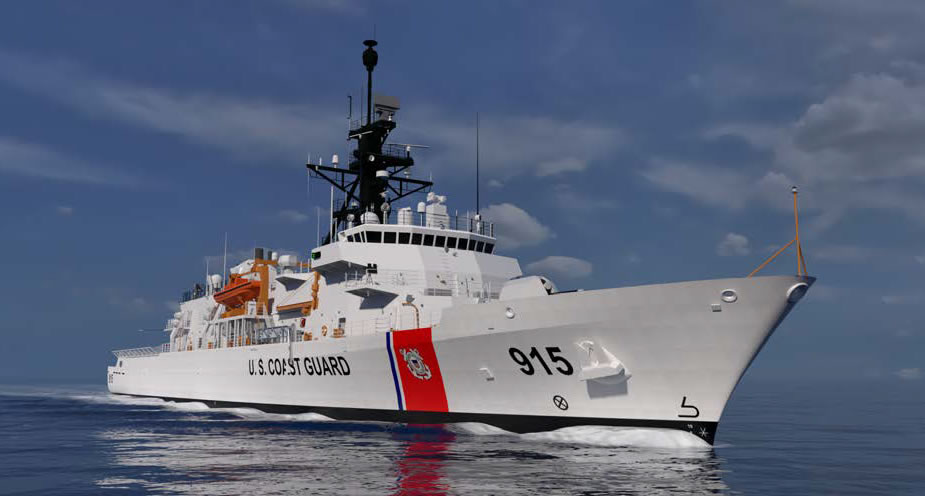
Artists rendering of the future USCGC Argus, from Eastern Shipbuilding Group

The following is reproduced from the Acquisitions Directorate announcement: Interesting to look though some of the linked documents. Shows how complex contracting has become. 


The Coast Guard released a request for proposal (RFP) Jan. 29 for detail design and production of up to 11 offshore patrol cutters (OPCs). The RFP is available here. The competition is open to all interested offerors.

Establishing a new, full and open competitive environment for the OPC program is a key component of the Coast Guard’s strategy to recapitalize its offshore surface capabilities. The RFP was informed by extensive industry engagement, including contracted industry studies with eight U.S. shipyards, an invitation to review and respond to a draft RFP and the establishment of an OPC technical library. The OPC technical library provides updated design information that reflects the current state of OPC acquisition activities to potential offerors.

The deadline to submit responses to the RFP is May 28, 2021. Contract award is scheduled to occur in the second quarter of fiscal year 2022.

The OPC acquisition program meets the service’s long-term need for cutters capable of deploying independently or as part of task groups, and is essential to stopping smugglers at sea, interdicting undocumented migrants, rescuing mariners, enforcing fisheries laws, responding to disasters and protecting ports and waterways. The acquisition of up to 25 OPCs will complement the capabilities of the service’s national security cutters, fast response cutters, and polar security cutters as an essential element of the Department of Homeland Security’s layered maritime security strategy.

For more information: Offshore Patrol Cutter program page

“China Navy deploys its Type 272 icebreaker ship Haibing to carry out 84th ice survey mission”

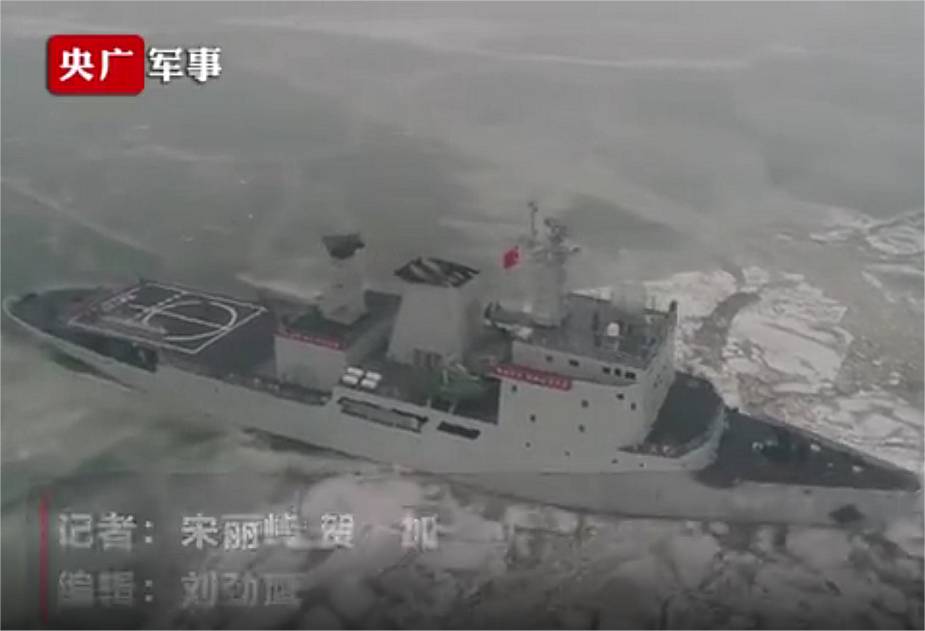
Chinese Navy Type 723 icebreaker ship Haibing. (Picture source China MoD)

Navy Recognition reports,

“According to information published by the Chinese Ministry of Defense on January 29, 2021, the Chinese Navy sent the Type 272 icebreaker ship Haibing (Sea Ice, Hull 722) to the Bohai Sea and the northern waters of the Yellow Sea to perform the 84th ice survey mission on January 25, 2021.”

The accompanying photo (above) is the first I have seen of this ship. An older Global Security post has a description of the vessel and its activities.

Reportedly its specifications include:

  • Displacement: 4,800 tons (probably a light displacement)
  • Length: 103.1 meters (338′)
  • Beam: 18.4 meters (60.4′)
  • Speed: 18 knots

It appears to be smaller, longer, and narrower than the Wind Class icebreakers the US built in the 1940s.

  • Displacement: 6,500 tons full load
  • Length: 269′ (82m)
  • Beam: 63.5′ (19.5m)

Length to beam ratio is narrow for an icebreaker at 5.6:1. There is a finer taper on the bow and stern than you might expect.

Length to beam ratio for US icebreaker designs are:

  • Wind Class: 4.24
  • Glacier: 4.18
  • Polar Star: 4.77
  • Polar Security Cutter: 5.23

Only the PSC, designed for long open ocean voyages, comes close.

This Chinese icebreaker entered service just over five years ago. It is one of a class of two, is unarmed, and it appears its operations have been confined to the Yellow Sea and the Bohai Sea, a Westward extension of the Yellow Sea. It almost certainly has less than 20,000 HP so would be considered a light icebreaker by the USCG.