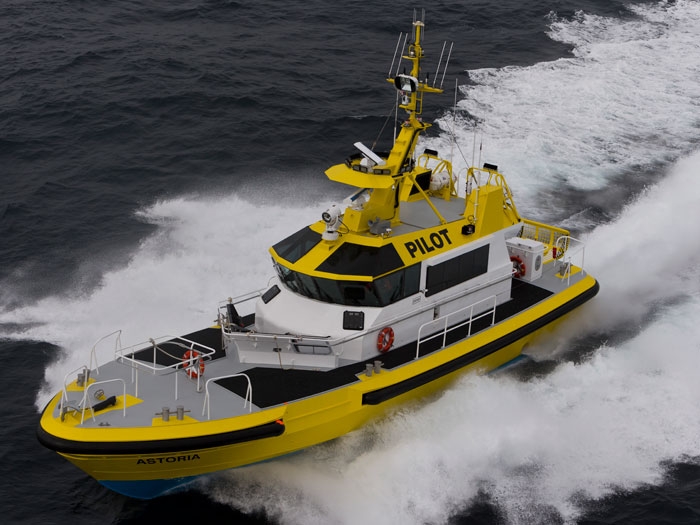
“VIDEO: New pilot boats enter service in Port of Los Angeles” –Marine Log

Just wanted to pass along this video of new pilot boats for Los Angeles found on MarineLog. Requirements for pilot boats can be similar to those for motor lifeboats. As the 52 footers are reaching the ends of their very long lives, with one taken out of service already, these might be worth a look. In some places a motor lifeboat larger than 44, might effectively replace 87 foot Marine Protector class patrol boats as well. Specs are here.

The designer of these boats, Carmarc, in the UK, also designed a larger, self-righting 29 knot 75’6″ pilot boat that was built by Kvichak Marine Industries, Seattle, WA, now Vigor, Ballard, for the Columbia River Bar Pilots. Kvichak Marine was the developer of the Response Boat, Medium, also a Carmarc design.

MARCH 19, 2014 — Seattle headquartered Kvichak Marine Industries has delivered Astoria, a self-righting 75 ft 6 in all-aluminum pilot boat, to the Columbia River Bar Pilots (CRBP) of Astoria, OR.

“Coast Guard Cutter Polar Star conducts research, collects valuable high-latitude data to expand knowledge of remote Arctic region” –D17

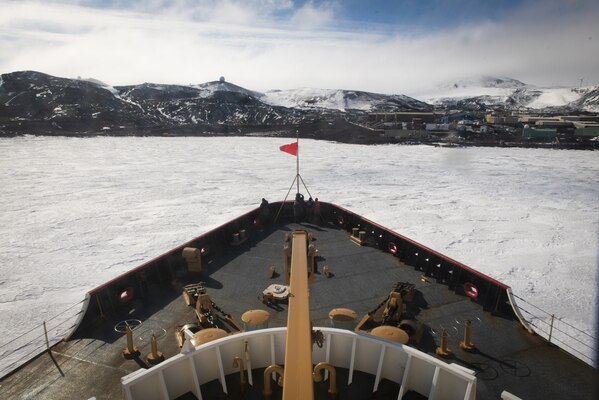
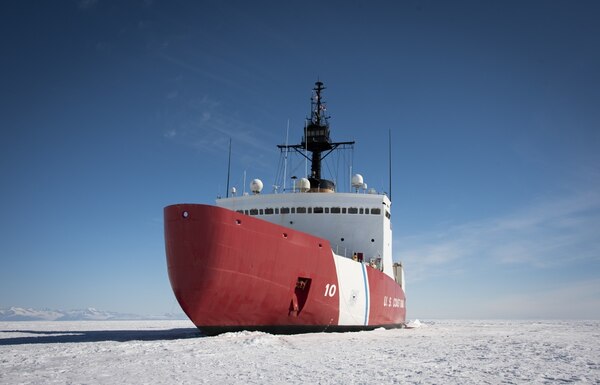
JUNEAU, Alaska – U.S. Coast Guard Cutter Polar Star transits the Gastineau Channel en route Juneau, Alaska, on Feb. 12, 2021. U.S. Coast Guard photo by Chief Petty Officer Jonathan Woods.

Below is a District 17 News release regarding USCGC Polar Star’s unusual Winter Arctic deployment. (I did do some editing to remove repetition in the photo captions.)

united states coast guard


News Release

U.S. Coast Guard 17th District Alaska
Contact: 17th District Public Affairs
Office: (907) 463-2065
After Hours: (907) 463-2065
17th District online newsroom

Coast Guard Cutter Polar Star conducts research, collects valuable high-latitude data to expand knowledge of remote Arctic region

JUNEAU, Alaska - U.S. Coast Guard Cutter Polar Star transits the Gastineau Channel to moor up in Juneau, Alaska, on Feb. 12, 2021, as the crew nears the end of their months-long Arctic deployment.  In addition to Polar Star’s strategic national security objectives, the nation’s sole heavy icebreaker sailed north with scientists and researchers aboard to work in partnership with the U.S. Army Corps of Engineers Cold Regions Research and Engineering Laboratory (CRREL), the National Oceanic and Atmospheric Administration (NOAA), University of Washington, and Woods Hole Oceanographic Institute (WHOI) to gather data and lessen the void of information from the region and better understand how to operate year-round in Arctic waters.  U.S. Coast Guard photo by Chief Petty Officer Kip Wadlow.
JUNEAU, Alaska – U.S. Coast Guard Cutter Polar Star transits the Gastineau Channel to moor Juneau, Alaska, Feb. 12, 2021. U.S. Coast Guard photo by Senior Chief Petty Officer Trevor Bannerman.

JUNEAU, Alaska — The Seattle-based Coast Guard Cutter Polar Star (WAGB 10) arrived in Juneau, Friday, for a logistics stop as the crew nears the end of their months-long Arctic deployment conducting scientific research and protecting the nation’s maritime sovereignty and security throughout the polar region.

In addition to Polar Star’s strategic national security objectives, the nation’s sole heavy icebreaker sailed north with scientists and researchers aboard to work in partnership with the U.S. Army Corps of Engineers Cold Regions Research and Engineering Laboratory (CRREL), the National Oceanic and Atmospheric Administration (NOAA), University of Washington, and Woods Hole Oceanographic Institute (WHOI) to gather data and lessen the void of information from the region and better understand how to operate year-round in Arctic waters.

“The Arctic is cold, dark, and difficult to navigate in the winter,” said Capt. Bill Woityra, the Polar Star’s commanding officer. “Deploying with researchers and scientists aboard has aided in the development, understanding and pursuit of technologies that will mitigate risks and enable future mission performance so that looking forward, the Coast Guard can safely operate continually and effectively in this remote environment.”

Working aboard Polar Star, Shalane Regan, a member of the Coast Guard Research and Development Center (RDC), teamed up with Lt. Lydia Ames, a NOAA Corps officer to assist CRREL researchers by deploying buoys onto the ice where they will, over time, collect and transmit information about ice flow to help fill in data gaps for higher latitude oceans.

The Polar Star crew also aided in a research project concerning water flow regimes in the Arctic, specifically the Chukchi Sea, a study developed by Dr. Robert Pickart of WHOI. The data collected during Polar Star’s patrol will be used to develop a more complete understanding of the hydrology of the dynamic region.

To support Dr. Pickart’s research, WHOI provided 120 Expendable Conductivity-Temperature- Depth (XCTD) instruments to measure temperature and salinity. These profiles of the water column will give a better picture of what water and nutrient flow look like in the Arctic winter. Polar Star crew members deployed the probes every 12 hours when above 65 degrees north.

Additionally, Regan, who is a mechanical engineer and researcher with the RDC Surface Branch, worked with other scientists and researchers on board to find ways to operate most effectively in the frigid Arctic environment.

For technology, Regan brought a 3D printer and Remotely Operated Vehicle aboard Polar Star to evaluate how the systems would react to the Arctic climate and ship life.

“I used the 3D printer to complete many small projects that resulted in large lifestyle improvements for the crew,” said Regan. “Most importantly, the knowledge I was able to gather about larger issues the crew faces, for example, visibility issues due to frost accumulation on the bridge windows, I can take home for my team to develop solutions that will create a better-equipped, mission-ready fleet.”

Another big item the RDC team is focusing on is underway connectivity, specifically in the Arctic region.

To better understand high latitude communications, The Mobile User Objective System (MUOS) was installed on Polar Star to test its abilities at high latitudes in the harsh Arctic winter conditions. Developed for the U.S. Navy by Lockheed Martin, the MUOS is an ultra-high frequency satellite communications system that provides secure connections for mobile forces.

“Looking towards the future, all signs point toward the Coast Guard deploying more platforms to the Arctic, more often and during different seasons of the year,” said Woityra. “The Coast Guard is robustly proficient at summer-time Arctic operations, while winter presents an entirely new set of challenges. Polar Star’s winter Arctic deployment has served to better understand and prepare for the challenges of operating in such a harsh and unforgiving environment.”

The cutter will be visiting Juneau to close out its operational patrol and will be moored downtown through the weekend. Due to COVID-19, the cutter will not be open to the public for tours. 

“New Drone Surveillance System to be Deployed on Canadian Coast Guard Vessels in Trials Funded by DRDC” –Kongsberg Geospatial

Image credit: Kongsberg Geospatial

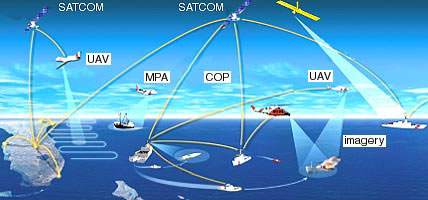
Below is a news release from .Kongsberg Geospatial. It talks about a demonstration of their sensor data management system, called MIDAS, to be conducted with the Canadian Coast Guard, in conjunction with the Martin UAV V-BAT fixed-wing vertical take-off and landing (VTOL) Unmanned Aerial System (UAS).

What really got my attention is that their illustration, above, appears to indicate that they expect to operate the V-BAT from Hero Class Cutters. These cutters are closely related to the USCG Webber class, but are smaller, 14 feet shorter and over three feet narrower. If they do succeed in operating it off the Hero Class, then we should also be able to operate it off the Webber class cutters.

We have talked about V-BAT before, and in fact, it was operated for a short evaluation from USCGC Harriet Lane. You can read about V-BAT here and here.

Sounds like a very interesting demonstration. Perhaps CG R&D could send an observer.


New Drone Surveillance System to be Deployed on Canadian Coast Guard Vessels in Trials Funded by DRDC

Ottawa, CA: Kongsberg Geospatial announced today that it has been selected by Defence Research and Development Canada (DRDC) to conduct trials of a new long-endurance UAV surveillance system for the Canadian Coast Guard. The Martin UAV V-BAT aircraft was selected to provide the unique ability to combine take off and landing from the small confines aboard ship with the long endurance of a fixed-wing aircraft while carrying multiple sensors.

Combining a unique Vertical Take-off aircraft and new sensor data PED solution allows for rapid collection and analysis of sensor data

The aircraft will communicate with the Kongsberg Geospatial sensor data management system, called MIDAS, which allows a range of sensor data, including full-motion video from unmanned systems to be processed and exploited in near real-time by analysts on board Canadian Coast Guard ships. MIDAS provides the capability to compare historical and live data from the mission area, and to examine sensor data with a variety of tools, including motion and object detection, in near-real time. This near real-time analytical capability can greatly enhance the effectiveness of UAVs for a variety of mission types.

The V-BAT Unmanned Aerial System (UAS) provided by Martin UAV is a fixed-wing vertical take-off and landing (VTOL) aircraft specifically designed to operate from very small spaces on ships, land, and nearly any environment. The V-BAT is a long-endurance aircraft capable of carrying multiple sensors, including land and maritime wide area surveillance.

Kongsberg Geospatial’s MIDAS is derived from technologies created for the NATO Alliance Ground Surveillance project which required the storage and retrieval of vast amounts of intelligence data for Intelligence Analysts. The system directly addresses the problem that the vast majority of UAVs have no standards-compliant capability to process, exploit, and distribute (PED) their sensor data where it is being used. MIDAS provides a fully standards-compliant system that allows intelligence analysts to view, process, and analyze sensor data in near real-time, from where the drone is being operated. MIDAS has packaged these capabilities into a tactical and portable form factor to enables those surveillance capabilities to be deployed as a portable system on board a ship, or in a temporary command post.

CINTIQS Military Technology Consulting will be providing consulting services for the planning and conduct of the flight trials and sensor employment to validate systems performance.

The combination of the Martin UAV V-BAT and the Kongsberg MIDAS sensor data management system will allow Coast Guard vessels to significantly expand their surveillance range for search and rescue missions, and for the surveillance of the movement of icebergs, without requiring the use of manned aircraft.

Build Your Own UAS Control System with TerraLens®

Real-Time Geospatial SDK

TerraLens® powers the real-time display in the IRIS UxS™ Ground Control Station

“UAVs are a useful tool, but they only truly effective if they can collect sensor data that results in actionable intelligence”, said Ranald McGillis, President of Kongsberg Geospatial. “Our MIDAS system allows users to fully exploit raw sensor data, and derive useful intelligence at the tactical edge where the UAV is being used. In a search and rescue context, that could mean using infrared sensors, or near real-time motion detection to locate a subject when visibility or weather conditions are poor.”

About Kongsberg Geospatial: Based in Ottawa, Canada, Kongsberg Geospatial creates precision real-time software for mapping, geospatial visualization, and situational awareness. The Company’s products are primarily deployed in solutions for air-traffic control, Command and Control, and air defense. Over nearly three decades of providing dependable performance under extreme conditions, Kongsberg Geospatial has become the leading geospatial technology provider for mission-critical applications where lives are on the line. Kongsberg Geospatial is a subsidiary of Kongsberg Defence & Aerospace.

Media contact: 1-800-267-2626 or reach us by email at info@kongsberggeospatial.com

About Martin UAV: Based in Plano, TX, the mission of Martin UAV is to build the world’s most advanced unmanned systems. Our technology team specializes in building tactical systems from the ground up, addressing the vast capability gaps left by legacy technologies and current government programs of record around the world. With decades of research and development, our platforms offer cutting edge applications and engineering feats unmatched in the government or commercial sectors of today.

About CINTIQS: Based in Ottawa, Canada, CINTIQS is a veteran-owned and operated MilTech (Military Technology) business focused on helping Canadian technology companies solve the problems that matter most to those in uniform. CINTIQS represents the highest concentration of tactical, operational, and strategic-level military intelligence expertise in Canada. In combination with their technical and industry/business depth, the company provides the expertise you need to succeed in the ultra-competitive global defence market.

About the Canadian Coast Guard: Headquartered in Ottawa, the Canadian Coast Guard is the coast guard of Canada. Founded in 1962, the coast guard is tasked with marine search and rescue, communication, navigation and transportation issues in Canadian waters, such as navigation aids and icebreaking, marine pollution response and providing support for other Canadian government initiatives. The coast guard operates 119 vessels of varying sizes and 22 helicopters, along with a variety of smaller craft.

About DRDC: Based in Ottawa, Canada, Defence Research and Development Canada is the Department of National Defence’s and Canadian Armed Forces’ science and technology organization. DRDC develops and delivers new technical solutions and advice for not only DND/CAF, but also other federal departments, and the safety and security communities.

FRC #43 Accepted

USCGC Frederick Hatch (WPC-1143) click on the photo for a larger version of photo.

After the recent look at a Webber class cutter bound for Bahrain, I thought I’d publish a photo of the latest FRC, Frederick Hatch (WPC-1143), provided by Bollinger. There is a lot of stuff on the mast I don’t recognize.

The Next four FRCs off the line, Glenn Harris (WPC-1144), Emlen Tunnell (1145), John Scheuerman (1146), and Clarence Sutphin (1147) will all be going to Bahrain to replace the 110 foot cutters of PATFORSWA, two in Fall 2021 and the last two in 2022. Generally Bollinger has been delivering five Webber class per year, so all four these should be delivered by the end of calendar 2021.

Coast Guard news release here:

Imagery Available: Coast Guard accepts Guam’s third fast response cutter

News Release

U.S. Coast Guard 14th District Hawaii and the Pacific
Contact: 14th District Public Affairs
Office: (808) 535-3230
After Hours: HawaiiPacific@uscg.mil
14th District online newsroom

Coast Guard accepts Guam’s third fast response cutter

USCGC Frederick Hatch USCGC Frederick Hatch USCGC Frederick Hatch

Editors’ Note: Click on images to download a high-resolution version.

SANTA RITA, Guam —The Coast Guard accepted delivery of its newest Sentinel-class fast response cutter (FRC), the Coast Guard Cutter Frederick Hatch (WPC 1143), from Bollinger Shipyards in Key West, FL, Thursday.
 
Frederick Hatch is scheduled to be the third FRC stationed in Guam and will arrive in Santa Rita during the summer. The cutter was placed in commission, special status, and will remain in Florida while the crew completes pre-commissioning trials and maintenance.
 
“The fast response cutters in the Pacific are a game changer for the Coast Guard,” said Cmdr. Josh Empen, deputy sector commander, Coast Guard Sector Guam. “Frederick Hatch will be the third fast response cutter in Guam, joining the Coast Guard Cutters Myrtle Hazard (WPC-1139) and Oliver Henry (WPC 1140) who have already saved mariners in distress at sea, intercepted narcotics, and boarded several vessels to deter illegal, unreported and unregulated fishing in Oceania. These cutters are conducting longer missions over greater distances than the older patrol boats they are replacing.”
 
Replacing the older 110-foot Island-class patrol boats formerly stationed in Guam, the Frederick Hatch represents the Coast Guard’s commitment to modernizing the service’s cutter fleet.
 
FRCs boast a wide array of improvements over its predecessors including advanced command, control, communications, computers, intelligence, surveillance, and reconnaissance systems designed to assist the cutter’s crew with their primary mission to patrol coastal regions.
 
These advanced capabilities greatly improve the Coast Guard’s ability to conduct missions ranging from Search and Rescue to national defense within Guam’s waters while also contributing to joint operations between the United States and its regional partners as they work towards common goals such as the preservation of Pacific fish stocks.
 
“All of our accomplishments to date are due to the tremendous amount of hard work our crew has put in to this process,” said the Lt. Craig Rooke, the Frederick Hatch’s commanding officer. “They continue to amaze me everyday with their great attitude and their tremendous effort that they have been putting into the pre-commission process. I know Frederick Hatch would be proud.”
 
In keeping with the tradition of naming new FRCs after Coast Guard enlisted heroes, the cutter is named in honor of Frederick Hatch, a two time recipient of the Gold Lifesaving Medal.
 
Hatch was awarded his first medal in 1884 while he was a surfman at the Cleveland Life-Saving Station for rescuing the crew of the schooner Sophia Minch during an October gale. During the rescue, Hatch volunteered to attempt to reach two men caught in the aft rigging of the vessel. At great risk to his own life he reached the two men and was able to bring them safely to shore.
 
Later Hatch transferred to the Lighthouse Service where once again he received the Gold Lifesaving Medal for his selfless act of courage as he rescued those on board the schooner Wahnapitae which grounded near the Cleveland Breakwater lighthouse in 1890.
 
Both the Lighthouse Service and the Life-Saving Service would later make up what we now know as the Coast Guard.
 
With the addition of Frederick Hatch’s 24-person crew there will be over 70 new Coast Guard FRC members stationed on Guam along with a projected 100 dependents and family members. Before the FRCs arrival, the Coast Guard presence on Guam was composed of approximately 250 active duty personnel and 40 reservists.

*All times are in Chamorro Time Zone

-USCG-

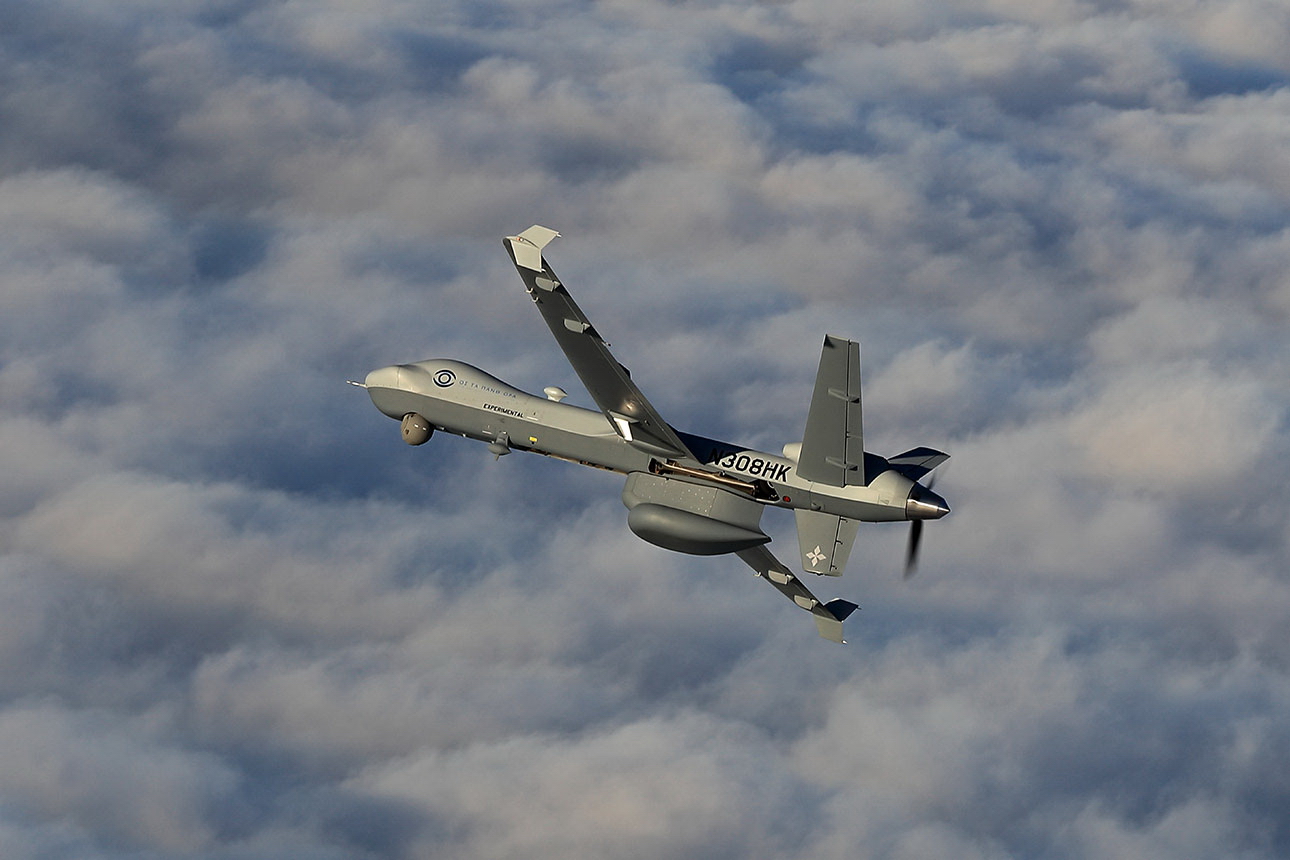
“GA-ASI Plans to Demonstrate Maritime Capability in the United Kingdom” —

MQ-9B Seaguardian during the maritime capabilities demonstration flight over Southern California waters in September 2020. GA-ASI picture.

The Navy League’s on line magazine, Seapower reports that,

“General Atomics Aeronautical Systems Inc. (GA‑ASI) plans to take a company-owned SkyGuardian remotely piloted aircraft to the United Kingdom later this year to undertake a series of operational capability demonstrations for NATO allies, including The Netherlands, the company said in a Feb. 3 release. The U.K.’s Protector program is a derivative of SkyGuardian with a range of U.K. modifications and the Royal Air Force (RAF) is supporting this visit.”

This system is quickly becoming the go-to solution for Maritime Domain Awareness. It is an obvious solution for the Coast Guard’s MDA requirement. The requirement for land based long endurance UAS goes back at least to the Deepwater Program begun in the 1990s. It looks like a Coast Guard version of the Global Hawk may have been identified as a likely solution as early as 2002. Congress has been pushing the Coast Guard to start using land based UAVs.

There might be a question if this would duplicate the Navy’s Broad Area Maritime Surveillance (BAMS) program and its MQ-4C, but it is almost certain the Navy system will never provide all the information the Coast Guard needs. Their priorities are different, for instance, there are no plans for the Navy to base MQ-4Cs in Alaska.

In 2018 the CG-9 reported  “The Coast Guard on March 26 released a draft solicitation for long range/ultra-long endurance (LR/U-LE) unmanned aircraft system (UAS) technology demonstration and flight services requirements. Industry is invited to submit questions, comments and feedback on draft items including the statement of work, proposal requirements and evaluation methodology.” I don’t know what came of that, but there have been several demonstrations since.

CG-9 currently says,

“The Coast Guard has validated a mission need for land-based UAS to significantly enhance ocean surveillance in support of the service’s operations. Coast Guard land-based UAS flight crews are jointly operating maritime-variant Predator UAS (Guardian) on maritime missions with Customs and Border Protection to enhance the Coast Guard’s understanding of potential land-based UAS solutions and support the development of a land-based UAS requirements package.”

It is time to include land based UAS in the Coast Guard budget request. We can start small and grow the capability, but it is time to start. The answer might not be the MQ-9B, but answers are out there.

Somehow I managed to publish this prematurely so this is an updated version. 

“Commandant and Master Chief Petty Officer of the Coast Guard Statement on Extremism” –MyCG

The following from the MyCG web site.
As members of the Coast Guard, we have all voluntarily sworn an oath to support and defend the Constitution, and we share a commitment to our Core Values of Honor, Respect, and Devotion to Duty. We protect the homeland, we advance economic prosperity and other national interests, and when mariners in distress call for help, we proudly and professionally respond without hesitation. We answer the call because it is our duty. It is also our duty to respect those we serve with and we betray this duty if we allow bigotry, racism, or hate to infect our culture and service to America. In a Coast Guard anchored to dignity and respect, there is no place for extremism. Extremism goes against the fundamental principles of the Constitutional oath we share and our Core Values, tears away at unit cohesion, and degrades readiness and mission success.

The rights of freedom of speech and assembly are vitally important but are not unlimited. The Coast Guard will not tolerate extremism of any type. Speech or conduct that advances, encourages or advocates criminal activity, violence, illegal use of force, and efforts to deprive individuals of their civil rights, or any form of harassment or unlawful discrimination based on race, creed, color, sex, including gender identity and sexual orientation, religion, ethnicity, or national origin, among other personal characteristics, will not be tolerated. This applies equally to on-line speech. None of us can be indifferent to extremism.

Military members are subject to discipline and punishment under the Uniform Code of Military Justice if they actively support extremist causes by raising funds, recruiting or training others, taking a visible leadership role, or distributing literature or materials which undermine loyalty to the Constitution, interfere with the performance of duties, threaten discipline, or bring discredit upon the Service. Military members cannot participate in demonstrations or rallies in many circumstances, particularly when the event is a breach of law and order or is likely to result in violence. COMDTINST M1600.2, Discipline and Conduct, provides additional information and guidance. Civilian employees are subject to discipline for conduct that impairs the efficiency of the Federal Service. This may include criminal conduct in or away from the workplace, and other inappropriate conduct in the workplace.

Aligned with recent guidance issued by the Secretary of Defense, we are directing that a service-wide stand-down to confront extremism in the military occur at each unit before 31 March 2021. I expect commanders and supervisors to talk with their crews about this destructive cancer, to lead intrusively, and act when they encounter any indicators of extremism in our ranks. More specific guidance and expectations regarding this stand-down is forthcoming.

As your Commandant and Master Chief Petty Officer of the Coast Guard, we are dedicated to ensuring our Service supports and defends the ideals and institutions created and guaranteed by the Constitution, and that we foster a Service free from hatred, intolerance and extremism. Beyond being an Armed Force, as members of a federal Law Enforcement Agency, we have a special obligation to each other and the citizens whom we serve.

Jason M. Vanderhaden
Master Chief Petty Officer of the Coast Guard

Karl L. Schultz
Admiral, U.S. Coast Guard Commandant

Bahrain Bound FRC gets Upgrades, LRAD and Short Range Air Search

(As we get into this, you may want to click on the photo to get an enlarged view.)

This Spring, the first two Webber class patrol craft are expected to go to Bahrain to start replacing the six 110 foot WPBs of Patrol Force South West Asia (PATFORSWA).  Two more will join them in the Fall and the last two in 2022. Back in 2018, I speculated on what might be done to modify them for duty in this more dangerous area. Apparently the Coast Guard leadership has had a few ideas of their own.

We have some very shape observers among the readers of this blog.

First Andy provided the photo of USCGC Charles Moulthrope (WPC-1141) above and pointed out the Long Range Acoustic Device (LRAD, the gray device mounted near rail on the O-1 deck just this side of the port forward corner of the bridge) and the four round sensors a short way up the mast two on each side. I note these systems were not on the ship when it was handed over by Bollinger (photo below).

The 41st fast response cutter (FRC), Charles Moulthrope, as delivered to the Coast Guard in Key West, Florida, Oct. 22, 2020. It is the first of six planned FRCs to be stationed in Manama, Bahrain. (U.S. Coast Guard photo)

Then Secundius identified the four round sensors on the mast as Sierra Nevada Modi RPS-42 S-Band Radar.

From the Company web site: “RPS-42 is an S-Band tactical hemispheric air surveillance radar system. It is a member of the non-rotating, solid-state, digital radar family Multi-mission Hemisphere Radar (MHR), developed by RADA Electronic Industries Ltd.
“The RPS-42 is a pulse Doppler, software-defined radar platform, that can detect, classify and track all types of aerial vehicles – including fighters, helicopters, UAVs, transport aircraft, etc. at tactical ranges. A single radar platform provides 90º azimuth coverage. Hemispheric coverage is achieved when four radars are employed as a system. Mobile or stationary, the system can be integrated with any C⁴I system and other radars and sensors. The software is able for On-the-Move (OTM) Operation. The radar can operate either as a stand-alone or as part of a large-scale surveillance system.
“The Antenna is an Active Electronically Scanned Array (AESA) based on Galliumnitrid (GaN) Amplifiers. Its diameter is 50.4 cm , the max width is 16.5 cm. (19.8″ x 6.5″ –Chuck)
“The achievable range for detection of the smallest drones (known as Nano UAV) is 3.5 km”

These radars use Galliumnitrid (GaN), the new technology in radar, that allows the AN/SPY-6 to significantly outperform the earlier AN/SPY-1 found on most Aegis equipped warships. (Reportedly a 3000% improvement)

You can get an appreciation of what this is about from this Popular Mechanics article. This Is the ATV-Mounted Jammer That Took Down an Iranian Drone.

There is more here: Light Marine Air Defense Integrated System [LMADIS] (globalsecurity.org)

I’m only guessing, but I would think the FRC would also have the same or equivalent complementary equipment as the LMADIS, e.g. small EO/IR camera, Skyview RF Detection system and Sierra Nevada MODi RF jammer (Photo below, I may be seeing the jammer–pictured below–located above and behind the port side RPS-42 radar arrays, visible between the radar arrays and the tripod legs). The cutters of this class are already normally equipped with electro-optic devices, both on the mast and on the Mk38 gun mount, which can provide a kinetic counter to UAVs.

Sierra Nevada MODi RF jammer. From the company web site, “SNC’s Modi II is the most modern & highly-capable dismounted EMC system in the DOD inventory.”

This was probably what the Commandant was talking about, when he said that Coast Guard PATFORSWA had a counter UAS role in a recent interview.

I am thinking, this radar might also be used on some of our other cutters as well, perhaps the 210s and the six 270s to be FRAMed, to provide them better control of their helicopters on approach in bad weather. The 210s have no air search radar and the 270s will almost certainly lose the Mk92 fire control system which provides their only air search radar currently. Reportedly the radar has a range of up to 30km and an instrumented range of 50km at altitudes from 30ft to 30,000 feet. Apparently the Marines are also using it to direct fire for their short range air defense systems. which includes a 30mm gun and Stinger missiles.

Thanks to Andy and Secundius for kicking this off.

“A homage to sea duty in the Coast Guard – Successes, challenges, and being underway” –MyCG

This from the MyCG website. (Perhaps noteworthy, maybe because the interviewer was a woman, but most of the interviewees were women.)


A homage to sea duty in the Coast Guard – Successes, challenges, and being underway

By Shana Brouder, MyCG Writer

As a sea service, we celebrate the perseverance of our shipmates who serve in the cutter community. While many industries went dark or slowed in response to COVID-19, the missions of the afloat community have continued to protect our Nation’s interests, deterring threats around the globe and in an especially complex maritime environment.

This growing demand has continued amid the COVID-19 global pandemic, where cutter crews are experiencing pre-deployment restrictions of movement, a reduction in liberty port calls, and extended time underway, away from loved ones.

The Coast Guard has increased compensation as they address urgent challenges for the sea-going workforce, while also looking for new ways to thank our members for continuing the traditions of the service. This past year, the Coast Guard increased internet connectivity speeds underway and arranged for wifi internet connectivity inport for deployed cutters, which enable reliable communication with friends and families.

Despite the challenges the pandemic presented, Coast Guard ships interdicted either a go-fast boat or a semi-submersible boat on a near daily basis, sending boarding teams to confiscate contraband and apprehend suspected smugglers. Cutter crews across the enterprise have seen some of the greatest successes in 2020. Crews surged to support an enhanced counter-narcotics operation resulting in a 37% increase in cocaine and other drugs interdicted between April and September of last year.

What is it that keeps our members returning to sea? After interviewing several junior officers, and one commanding officer, three central tenants of sea duty were named: the adventurous nature of the mission, the simple beauty of the sea, and—most importantly—the people.

“Every day on the water presents a new challenge that I’m excited to overcome,” said Lt. j.g. Ryan Brumm, supply officer aboard Coast Guard Cutter Alert, a Medium Endurance Cutter.

Lt. j.g. Matthew Nagle aboard Coast Guard Cutter Munro, a National Security Cutter, discussed excitedly watching aerial footage of the small boats underway from a small unmanned aircraft with his shipmates. “Seeing the live-action video after six months of hard work preparing and testing the hardware was incredible.”

Brumm’s shipmate aboard the Alert, Ensign Erin Mullen, also loves the missions underway. A self-proclaimed ocean nerd, Mullen also discussed her love of nature as a reason she plans to keep returning to sea. “Being on the bridge, seeing thousands of stars reflecting off that calm ocean,” said Mullen. “It really takes your breath away.”

The number one reason given, however, for enjoying sea duty was the friendships formed, “It seems cliché to say,” said Lt. j.g. Brooke Harkrader, assistant navigator aboard the Coast Guard Cutter Munro, “but the reason I love sea duty is because of the people.”

Cuttermen discussed the atmosphere aboard cutters—the comradery found afloat—as a reason they keep returning. As Lt. Cmdr. Laura Foster, commanding officer of the Coast Guard Cutter William Hart, a Fast Response Cutter, puts it: “The reason I’ve gone back to sea so many times is because of the family atmosphere aboard. The comradery among shipmates is unbelievable. I’ve never found it anywhere else.”

Ensign Kimberly Bryon, aboard the Coast Guard Cutter Munro, described her favorite memory underway during an otherwise difficult year, “We were at a port call in Alaska, and because of COVID we decided to stop at these uninhabited islands,” said Bryon. “I and three others spent the day shuttling people to and from the islands. While we didn’t get to go hiking ourselves, I had the absolute best time with the small crew I was working with. The comradery I felt with them was something I really can’t describe.”

While members speak openly of their love of sea duty, there is no doubt life afloat is challenging. “Being underway is the hardest thing you’ll ever do, but it is hands down the most rewarding work,” said Harkrader who, despite struggling with occasional seasickness, plans to stay afloat as long as possible.

Sea duty inconveniences are not insignificant. Like many in the Coast Guard, Foster has to spend prolonged periods of time away from her family. In her most recent trip, she was underway for 144 days. While it can be difficult, Foster doesn’t shy away from the challenge. “I feel honored to be able to take this job, and show other females that it is possible to rise to the position you want, and have a family,” she said.

Pandemic operating conditions have presented challenges to our members afloat, further complicated by social distancing measures advised by the Center for Disease Control (CDC) are not always possible. Those aboard the Munro, for example, faced extra hardships when 19 members from their crew tested positive for COVID-19 prior to going underway. “Everyone’s morale suffers when the workload increases so much,” said Hakrader.

Harkrader, Nagle, and Bryon both applauded the efforts commanding officers took aboard the Munro to keep things underway. The cutter was able to keep operating in a COVID-safe and smart environment, working to push through modified conditions, completing a mission through the waters of Alaska not usually completed by the crew.

Taking into account the challenges posed by the pandemic compounded already demanding life afloat make the successes these crews saw this year nothing short of extraordinary. A short sample of successes cutter forces saw this year, as detailed in Sea Duty Readiness ALCOAST 016/21.

While going to sea may not always be the easiest choice, being underway is a rewarding experience with benefits not found with other duties. “The goodbyes never get easier,” said Foster. “But the hugs you get when you return home never get old.” The Coast Guard is thankful to have members with a passion for sea duty, who see their work as so much more than just a job.

Coast Guard Cutter Successes in 2020:

  • Coast Guard Cutter Tahoma, a Medium Endurance Cutter, participated in Operation Nanook with Canadian, Danish, and U.S. Navy Forces.
  • Coast Guard Cutter Campbell, a Medium Endurance Cutter, participated in the high-latitude Search-and-Rescue Exercise Argus off Greenland, operating alongside Canadian, Danish, and French Naval Forces.
  • Coast Guard Cutter Cheyenne, a river buoy tender, responded to record high flooding on the Mississippi River.
  • Coast Guard Cutter Axe, a construction tender, responded to multiple Gulf Coast hurricanes, that, alongside other black hull cutters, surveyed, serviced, and corrected thousands of aids to navigation, restoring the smooth flow of efficient maritime commerce.
  • Coast Guard Cutter Kimball, a National Security Cutter, recently supported Pacific Island nations in building organic capability and law enforcement expertise to combat illegal, unreported, and unregulated (IUU) fishing.
  • Coast Guard Cutter Oliver Berry, a Fast Response Cutter, just returned to its homeport in Hawaii supporting the Pacific Island Forum Fisheries Agency, a collaborative international organization to promote sustainable fisheries. The cutter traveled nearly 10,000 miles round-trip to strengthen maritime domain awareness within the exclusive economic zone of both the Republic of the Marshall Islands and Federated States of Micronesia.
  • Coast Guard Cutter Bertholf, a National Security Cutter, used its ScanEagle unmanned-aerial system to surveil a group of 350 Chinese fishing vessels and make right-of-approach inquiries near the Galapagos Islands, at the request of Ecuador. They identified 15 potential IUU indicators of that particular fleet.
  • Coast Guard Cutter Bear, a Medium Endurance Cutter, deployed to Cabo Verde and increased partnerships with a key U.S. ally at the request of our National Security Council, on extremely short notice.
  • Coast Guard Cutter Polar Star, a Polar-class icebreaker, sailed for the first time in several years to the U.S. Arctic to project U.S. sovereignty.

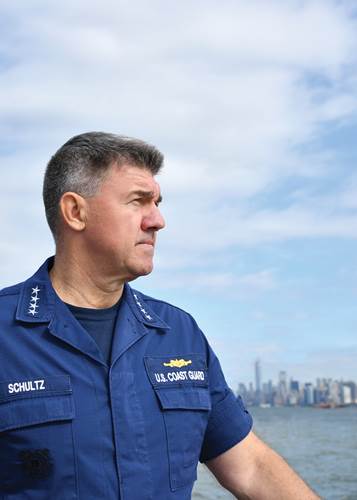
“SEA CONTROL 219 – USCG COMMANDANT ADMIRAL KARL SCHULTZ” –CIMSEC

Coast Guard Commandant Adm. Karl Schultz visits with Coast Guard crews stationed in New York City. U.S. Coast Guard photo illustration by Petty Officer 1st Class Jetta Disco.

(I meant to cover this earlier, but perhaps still worth a listen)

CIMSEC’s Podcast “SEA Control,” had an interview with the Commandant, Dec. 27, 2020. You can find it here.

At first I thought I had heard it all before, but toward the end, there were some surprises.

He talked about  Arctic, Antarctic, and IUU. He talked about the Arctic Strategic Outlook and the IUU Strategic Outlook.

Illegal, Unreported, Unregulated fishing got a lot of attention. He related that it was gaining visibility and had become a national security issue since overfishing has created food security issues for many countries. He pointed to Coast Guard Cooperation with Ecuador in monitoring a fishing fleet off the Galapagos Islands. Internationally he sees a coordination role for the USCG.

Relative to the Arctic he mentioned the possibility of basing icebreakers in the Atlantic and the need for better communications.

He talked about the Tri-Service Strategy and the Coast Guards roles in it, particularly in less than lethal competition.

More novel topics started about minute 38 beginning with Unmanned systems. He talked about the recent CG experiments with unmanned systems and went on to note that the CG will also regulated Unmanned commercial vessel systems.

About minute 41 he talked about the Coast Guard’s role in countering UAS in the Arabian Gulf. He added that we have a lead role in DHS in counter UAS. “We are in the thick of that”

GA-ASI Concludes Successful Series of MQ-9 Demonstrations in Greece

He said the service was looking at MQ-9 maritime “Guardian” (minute 45)

When ask about reintroducing an ASW capability he said that while the Coast Guard was looking at it, the service would have to be cautious about biting off too much. (My suggestion of how the CG could have an ASW mission with minimal impact on its peacetime structure.)

He talked about balancing local and distant missions and concluded that the CG could do both (47), and that the Coast Guard was becoming truly globally deployable (48).

He noted that the first two FRCs for PATFORSWA would transit to Bahrain in Spring, followed by two more in the Fall, and two more in 2022. (49)

He noted technology is making SAR more efficient. “Hopefully we will put ourselves out of the Search and Rescue business.” 50

He talked about the benefits of “white hull diplomacy.” (52)

Asked about our funding for new missions he said it was sometime necessary to demonstrate the value of the mission first, then seek funding. (55)

He also talked about raising the bar on maintenance.