“A Break in the Silence: Anecdote from a U.S. Coast Guard icebreaker’s winter Arctic patrol” –News Release

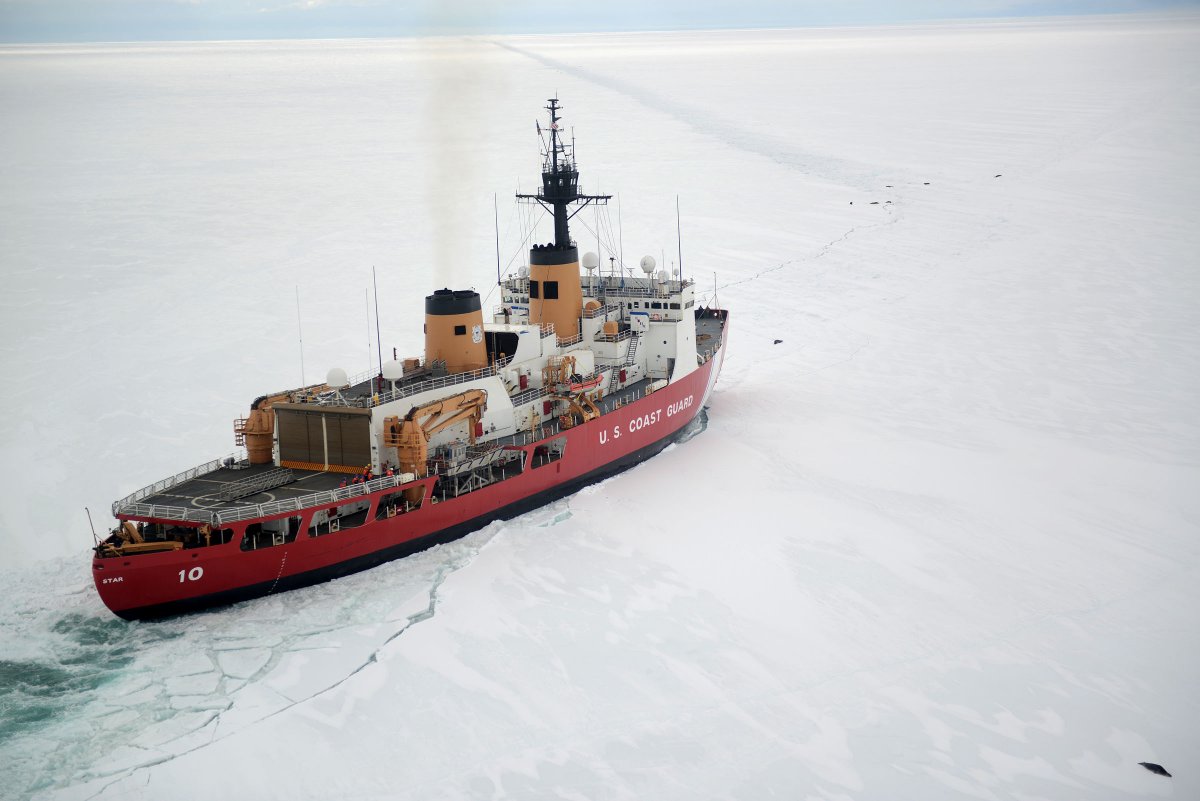
The Coast Guard Cutter Polar Star cuts through Antarctic ice in the Ross Sea near a large group of seals as the ship’s crew creates a navigation channel for supply ships, January 16, 2017. The resupply channel is an essential part of the yearly delivery of essential supplies to the National Science Foundation’s McMurdo Station.US Coast Guard photo by Chief Petty Officer David Mosley

A PACAREA news release. Apparently operating in the Arctic in the Winter still holds some surprises. Nice photos too.

united states coast guard

Feature Release

Jan. 29, 2021
U.S. Coast Guard Pacific Area
Contact: Coast Guard Pacific Area Public Affairs
Office: (510) 437-3375
After Hours: (510) 816-1700
D11-DG-M-PACAREA-PA@uscg.mil
Pacific Area online newsroom

A Break in the Silence: Anecdote from a U.S. Coast Guard icebreaker’s winter Arctic patrol

Co-written by Petty Officer 1st Class Cynthia Oldham & Petty Officer 2nd Class Tedd Meinersmann

Coast Guard Cutter Polar Star Arctic Winter West 2021 Coast Guard Cutter Polar Star Arctic Winter West 2021
Coast Guard Cutter Polar Star Arctic West Winter 2021 Coast Guard Cutter Polar Star Arctic Winter West 2021 Coast Guard Cutter Polar Star Arctic West Winter 2021

Editors’ Note: Click on images to download high resolution version.

On a months-long winter mission to project U.S. presence and sovereignty into the Arctic, and to conduct scientific research in the remote area, the Coast Guard Cutter Polar Star, the nation’s sole heavy icebreaker, is using its one-of-a-kind capability to navigate the dark polar wilderness.

After departing Seattle, crossing the Gulf of Alaska and transiting the Bering Sea’s treacherous waters, where 20-foot swells mercilessly tossed the mighty Coast Guard ship, the resilient crew traversed the Arctic Circle into equally windy, but far calmer, ice-bound waters.

After a few dark days and nights of the Polar Star methodically backing and ramming northbound through the Chukchi Sea’s heavy blanket of sea ice, crewmembers started to chatter about something keeping them up at night.

The polar sailors, many who sleep in staterooms on a lower deck of the ship, were taking collective notice of a persistently clamorous sound.

Though the crew who serves aboard Polar Star are not strangers to ice-serenaded work and slumber, this Arctic patrol was audibly different than prior, more routine icebreaking deployments to the opposite end of the world.  

Polar Star annually travels to world’s southernmost continent in support of Operation Deep Freeze where skilled ice pilots drive the powerful ship through ice up to 21-feet thick. The icebreaking mission opens critical navigation channels for other ships allowing for essential supplies to be delivered to scientists conducting research at McMurdo Station in Antarctica.

When, earlier in 2020, Operation Deep Freeze was cancelled due to COVID-19 safety concerns at the station, the Polar Star crew instead headed north on the Chukchi Sea – farther north than any U.S. surface ship ever travelled in the winter – in support of the Coast Guard’s Arctic Strategy.

Navigating one of the world’s most northern frozen oceans presented the Polar Star crew an auditory experience far different than its southern sister ice. No two crewmembers describe the omnipresent sound of patrolling the Chukchi Sea similarly and creative metaphors for labeling the noise quickly became an amusing way for the crew to make light of the often palpable noise.

Coast Guard Cutter Polar Star Arctic West Winter 2021

Like screeches and bangs from a perpetual car crash, a blaring elephant, freight train, or driving through concrete, freshly broken Arctic sea ice, scraping alongside the Polar Star’s hull, holds the likeness of screaming. It was a mysterious conundrum leaving many of the crew wide-eyed and wondering “why is this Arctic ice so loud?”

Fortunately, the Polar Star deployed north with a handful of scientists and researchers to advise the command and collect Arctic data in an effort to lessen the void of information available from the region. Evan Neuwirth, an ice analyst from the U.S. National Ice Center in Washington, D.C., is aboard Polar Star and proposed a theory about why navigating through Arctic ice is so noisy.

Neuwirth said temperature may be the greatest factor contributing to the sound heard while icebreaking. Sea ice in the winter is generally more dense, cold and brittle than in the summer. When winter Arctic ice strikes or rubs alongside the Polar Star’s exterior, more of the impact energy is transferred to the hull which results in a louder noise. Ice the crew experiences on their southern summer patrols is warmer and softer, making it more likely to compress and crush on impact with Polar Star – resulting in the absorption of energy that would otherwise result in a lot of noise.  

To best understand his theory, Neuwirth said to think of what it would sound like to throw a snowball at the ship’s hull versus a solid chunk of ice.

Coast Guard Cutter Polar Star Arctic Winter West 2021

The winter Arctic air and ice is so cold, often well below zero with the wind temperature factored in, that even after being broken into pieces, the ice chunks remain rock-hard creating the notorious noise made in the process that has, for the most part, been accepted by the crew as part of their unique, historic polar experience.

By experiencing and operating in one of the world’s most remote and harsh environments, the Polar Star crew is gaining critical familiarity of the Arctic necessary to develop and train future polar sailors and advance U.S. interests and power in the region.

As the Polar Star’s understanding of the Arctic grows by the day, one thing the crew knows for sure is that patrolling the frozen winter world above the Arctic Circle is desolate, dark and serene, but from aboard the Coast Guard Polar Star – it’s far from silent.

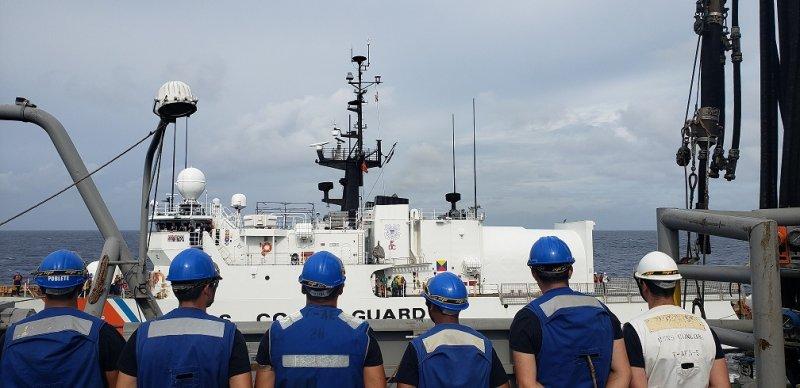
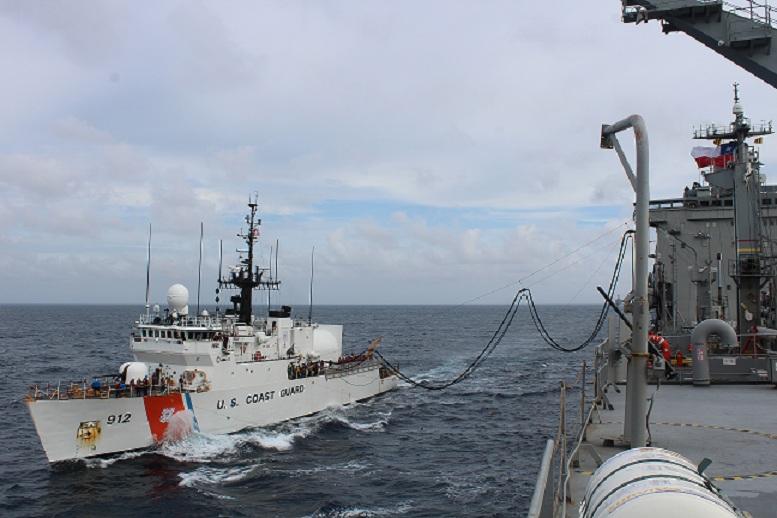
Doing Unreps for Drug Enforcement–Stopping by Chile’s for a Drink

These are a bit old. I had intended to publish them earlier but got distracted. Photos curtesy of Andres Navolari, author of one our most popular posts, Three Nations Share German OPV Design. It was published in 2014 and still getting views. 

USCGC Seneca WMEC-912 refueling from Chilean Navy Oiler Almirante Montt

USCGC Seneca WMEC-912 seen from Chilean Navy Oiler Almirante Montt, the former USNS Andrew J. Higgins. She also replenished USCGC James and USS Comstock.

More info on Seneca’s patrol, “USCGC Seneca returned from a 57 day patrol.

“Indonesia Escorts Seized Tankers to Dock for Investigation” –gCaptain

Iranian-flagged crude oil tanker MT Horse is escorted to Batam, Riau Islands, Indonesia January 26, 2021. Indonesian Coast Guard (BAKAMLA)/Indonesian Navy (TNI AL)/Handout via REUTERS

Something interesting happening in Indonesia. gCaptain reports,

“Wisnu told Reuters on Monday that the ships were “caught red-handed” transferring oil from MT Horse to MT Freya and that there was an oil spill around the receiving tanker.”

Coast Guard Cutter + Navy Reserve + Mission Module = ASW

The US is seriously short of Anti-Submarine Warfare escort vessels, but a little forethought and some cooperation between the Navy Reserve and the Coast Guard could seriously reduce the deficit, without a huge impact on either the Navy or the Coast Guard’s peacetime budget, operations, and manning.

It is a simple concept, a payload/platform solution. The Navy provides the payload. The Coast Guard provides the platform and drives “the truck.” It would allow the Coast Guard to have an important wartime role without significantly increasing its manning or training requirements. The costs to the Navy would be minimal and it would allow them to exploit their reserve pool of trained ASW personnel long before additional ships could be built.

In peacetime, the Coast Guard has been placing detachments on Navy ships. In wartime, Navy detachments could be placed on Coast Guard ships.

The essential elements are:

  • 36 Coast Guard Cutters, 11 National Security Cutters and 25 Offshore Patrol Cutters built, building, or planned.
  • Navy Reserve Helicopter Maritime Strike (HSM) aircraft and crews
  • An ASW mission module for each cutter
  • Navy personnel (active or reserve, officer and enlisted) trained and experienced in operating the ASW mission module equipment and ASW operations

The Threat:

If we have a non-nuclear war with a near peer, e.g. China or Russia, it is almost certain we will need more Anti-Submarine Warfare escort vessels than we currently have. The Chinese have almost 80 submarines  (60 conventional and about 19 nuclear) and they are doubling their capacity for building nuclear submarines. Russia has about 63 submarines, mostly nuclear.

US Navy ASW escorts, we are short:

The Navy’s force level goal is 156 surface combatants, out of the projected fleet of 355. These would include 104 large surface combatants (LSC, cruisers and destroyers) and 52 small surface combatants (SSC, LCS and frigates), but so far, there is no clear path to that goal. The Navy’s fleet will vary over time, but for the foreseeable future it will include less than 120 surface combatants. These include fewer than 90 cruisers and destroyers. A total of 35 LCS are built or funded, but it appears four of those may be decommissioned. Only ten LCS will be equipped as ASW escorts. The FFG(X), now FFG-62 program, is expected to produce 20 FFGs, but that program, is unlikely to produce its first ten ships before 2029.

The “Battle Force 2045” plan, which was never approved by DOD, projects a need for 60 to 70 Small Surface Combatants.

In any case we are going to short of escorts. A little over two years ago, the Military Sealift Command was told that ‘You’re on your own’: US sealift can’t count on Navy escorts in the next big war.

That is really not a good plan. We already have a minimal number of logistics support vessels and only a small pool of American mariners to sail them. Maritime Patrol Aircraft might be able to provide some degree of protection for transiting logistics vessels but one thing they cannot do, is rescue mariners from ships that are inevitably sunk. Coast Guard ships might be able to rescue mariners, but without ASW equipment, they themselves would be vulnerable.

The Mission: 

I would not expect the cutters to be on the forward edge of battle, but by providing escort service from the Continental US to forward logistics bases, they would free more capable assets for areas where the threat level, particularly the air threat, is higher.


The Cutters: 

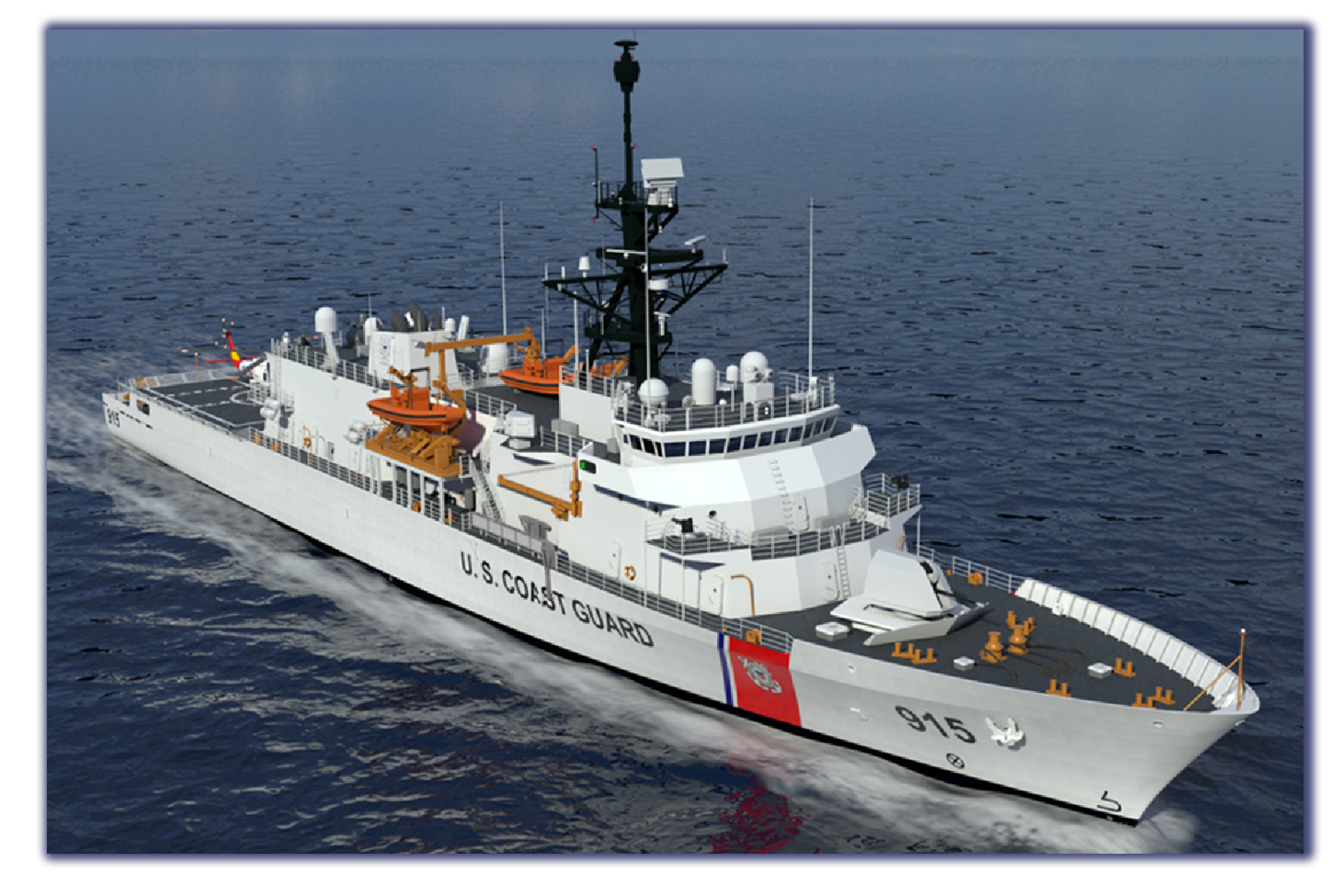
The Coast Guard has or is building two classes of cutters that might be useful as ASW escorts, the Bertholf class National Security Cutters (NSC) and the Argus class Offshore Patrol Cutters (OPC).

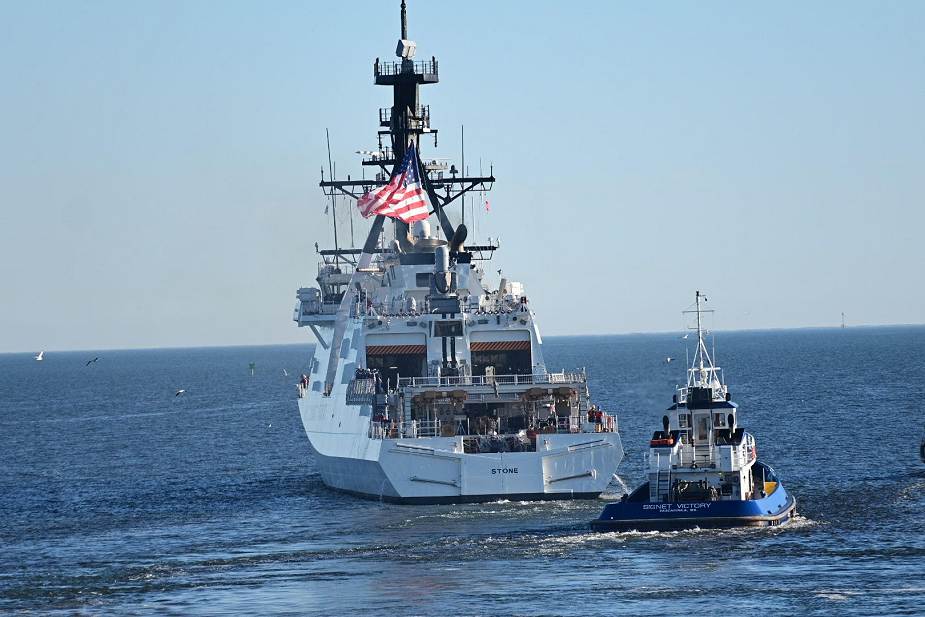
USCGC Stone, the ninth National Security Cutter. Dual helicopter hangars clearly visible.  (Huntington Ingalls photo)

Nine NSCs have already been completed. Two more are building or on order. Though they lack any current ASW capabilities, the Bertholf class National Security Cutters are in many ways already equipped to serve as frigates. A modified version of the design was apparently a contender for the FFG(X) program. They are a bit faster than the new FFGs and have a longer range and greater endurance. They have a flight deck and hangars capable of handling two MH-60s or one MH-60 and UAS. Like the new frigate and the LCSs, they have a 57mm Mk110 gun, but with a better fire control system than found on the LCSs, that includes a SPQ-9B Fire Control Radar. They also have a Phalanx CIWS and a sensitive compartmented intelligence facility (SCIF). They were designed with provision to accept twelve Mk56 VLS and Evolved Sea Sparrow Missiles. Their equipment includes:

  • EADS 3D TRS-16 AN/SPS-75 Air Search Radar
  • SPQ-9B Fire Control Radar
  • AN/SPS-79 Surface Search Radar
  • AN/SLQ-32B(V)2
  • 2 × SRBOC/ 2 × NULKA countermeasures chaff/rapid decoy launchers
  • AN/UPX-29A IFF
  • AN/URN-25 TACAN
  • MK 46 Mod 1 Optical Sighting System (WMSL 750 – 753)
  • MK 20 Mod 0 Electro-Optical Sighting System (WMSL 754 – 760)
  • Furuno X and S-band radars
  • Sea Commander Aegis derived combat system
  • Link-11 and Link-16 tactical data links

The Offshore Patrol Cutters are only slightly less capable than the National Security Cutters. They are about the same size at 4,500 tons full load. Speed is lower at 22+ knots sustained. They also have a 60 day endurance and an over 10,000 mile range. They are designed to support and hangar both a helicopter and a UAS, but while they clearly could hangar a MH-60R, it is not clear if it could also support an MQ-8. It is currently unclear if they will have a SCIF as built, but they have space for one. Their equipment includes:

  • Saab Sea Giraffe AN/SPS-77 AMB multi-mode naval radar
  • AN/UPX-46 IFF
  • AN/URN-32 TACAN
  • MK 20 Mod 1 EOSS
  • Link 22 Tactical Data Link
  • AN/SLQ-32C(V)6 Electronic Warfare System
  • 2 x MK 53 Mod 10 NULKA Decoy Launching Systems

Navy Reserve Helicopter Maritime Strike (HSM) squadron(s):

HSM squadrons fly both the MH-60R and MQ-8 Fire Scout UASWikipedia reports there are currently 18 HSM squadrons. They are now the only provider of shipboard airborne ASW capability. Only one of those is a Reserve squadron. Reportedly the Navy currently has 34 excess MH-60R which could equip virtually all the large cutter currently planned.

The ASW Mission Module:

The Navy apparently intends to equip ten LCS with ASW mission modules. But the new FFG-62 class will share the same ASW equipment including the TB-37U MFTA (Multi-Function Towed Array) which takes the form of a three inch cable towed behind the ship. The LCS ASW module also includes a variable depth sonar, the AN/SQS-62. This may or may not be required for the cutters’ open ocean escort mission. Even 36 complete ASW modules at the current cost of 19.8M would cost less than a single new FFG.

AN/SQS-62 Variable Depth Sonar intended for Littoral Combat ships. Photo Raytheon.

Manning the ASW Modules:

There are at least two possible sources of crews to man the ASW modules:

  • Active duty personnel assigned to rotational crews of LCS and FFGs
  • Navy Reservists

All LCS are now expected to be manned by rotating Blue and Gold crews. A similar scheme is being considered for the FFGs. Upon mobilization it is likely crew rotations will stop. That may mean experienced ASW officers and crew will be available to serve on similarly equipped ASW capable cutters.

As of Sept 30, 2019, the Navy’s Ready Reserve Force included over 100,000 members, 59,658 Selected Reservists (SELRES) and 44,020 Individual Ready Reservists (IRR). Currently I doubt there are organized reserve units prepared to operate ASW mission modules, but that might be a future option that would allow them to operate with cutters during training and exercises, while maintaining their training using simulators. There will certainly be recently separated IRR members, trained in the operation of the relevant systems who could be recalled to active duty.

Conclusion: 

This is a simple low cost way to add about 30% more ASW capable surface combatants to the fleet, putting it much closer to its projected requirements. They may not be ideal ASW escorts, but they may be good enough to make a difference.

“Republic Of Singapore Navy Stands Up New Maritime Security And Response Flotilla” –Naval News

Note the graphic may be distorted here, click on it for a better view. 

Naval News reports that the Singapore Navy has formed a new “Maritime Security and Response Flotilla.”

“As part of the restructured Maritime Security Command, the new MRSF is set up to better trackle evolving maritime threats that have grown in scale and complexity, particularly in the Singapore strait area. According to a recent French Navy report on worldwide maritime piracy and robbery, robbery is on the rise in South East Asia, particularly in the Straits of Singapore and Malacca.”

Aside from a pair of tugs, the primary assets of the new flotilla are four renovated and renamed Fearless Class patrol craft that will fill the function until a new class is completed (expected in 2026).

Perhaps most interesting, are the changes made to the vessels for their new role. These include enhanced communications equipment, a long range acoustic device and laser dazzler system, installation of a fender system, and modular ballistics protection–and a red racing stripe.

The Fearless Class patrol craft: Twelve vessels commissioned 1996-98. All out of service by the end of 2020, replaced by eight Littoral Missions Ships.

  • Displacement: 500 tons fl
  • Length: 55 m (180 ft)
  • Beam: 8.6 m (28.2 ft)
  • Draft: 2.2 m (7.2 ft)
  • Speed: 36 knots
  • Propulsion: 16,860 HP, two KaMeWa waterjets
  • Range 1,800@15 knots

Singapore also has a Police Coast Guard as part of its Police Force with patrol craft of up to 35 meters in length.

Norway’s Coast Guard Jan Mayen-class vessel

Norway’s Coast Guard Jan Mayen-class vessel (Picture source: Vard)

We have some new information on Norway’s three new very large ice capable Arctic patrol ships. Naval News reports they will be equipped with inertial navigation systems and we have the artist’s concept above I had not seen previously.

“We’re very proud to be supporting the Norwegian Coast Guard in securing Norway’s exclusive economic zone (EEZ), internal and territorial waters.”, states Regis Blomme, Sales Director at iXblue. “The arctic zone, in which the new vessels will operate, is a very challenging environment and our Fiber-Optic Gyroscope (FOG) based INS and Netans NDDCS have already proven to offer highly accurate, resilient, and secure navigation in such Northern latitudes. We particularly want to thank Vard for their strong vote of confidence in our technology and look forward to our collaboration with them.”

As we noted earlier,

“Deliveries of the three vessels are scheduled from Vard Langsten in Norway in 1Q 2022, 1Q 2023 and 1Q 2024 respectively. The hulls will be built at Vard’s Tulcea, Romania, shipyard…”

Specifications are:

  • Displacement: 9,800 tons
  • Length: 136.4 meters (447.4 ft) loa
  • Beam: 22 meters (72.16 ft)
  • Draft: 6.2 meter (20.3 ft)
  • Speed: 22 knots.

Note–VARD is also the designer for the Offshore Patrol Cutters.

Bryant’s Maritime Consulting to Cease Daily Blog

“Dennis L. Bryant graduated from the US Coast Guard Academy in 1968 and served 27 years active duty, retiring as a Captain. During that career, he made Arctic cruises back when there was real ice there. He attended law school, served as the USCG Law of the Sea officer, advised on international affairs, and supervised the Coast Guard’s implementation of the Oil Pollution Act of 1990 (OPA 90). After leaving the Coast Guard, he joined a law firm, serving as Senior Maritime Counsel. Since 2009, he has operated an independent consultancy, advising clients worldwide.”

Dennis L. Bryant’s blog “Bryant’s Maritime Consulting” has been on my recommended blogs list for many years. I have tried to read it every week day because it has been such a good source of information. Many of my posts have been prompted by his reports. He reports (quote below) he will no longer maintain his blog after 31 May, but asked if anyone is “interested in picking up the mantle.” Any “M types” interested?

He will be missed.

“After more than 20 years writing and distributing my maritime newsletter and almost 20 years writing a monthly column for Maritime Reporter & Engineering News (MREN), I will be stepping back effective 31 May 2021. I have enjoyed both and have had the opportunity to meet numerous new friends, particularly Greg Trauthwein, MREN’s Editor and Associate Publisher, who has endured my ramblings, which often got far afield. Unfortunately, those missions have become very time-consuming and increasingly expensive. I will be turning my attention more to my family (including my very patient wife of over 50 years), my maritime consulting practice, and to my writing. I have recently completed (if anything is ever completed) a novel and now begin my search for an agent and a publisher. I do not intend to quit paying attention to maritime matters nor closing my maritime consulting practice, but I will quit polluting your in-boxes on an almost daily basis. If anyone is interested in picking up the mantle, please contact me.”

DHS Nominee

DHS nominee Alejandro Mayorkas

This is the President’s nominee for Secretary of the Dept. of Homeland Security, Alejandro Mayorkas. Wikipedia bio here.

He had an interesting early life,

His father was a Cuban Jew of Sephardic background who owned and operated a steel wool factory in Havana. His mother was a Romanian Jew whose family escaped the Holocaust and fled to Cuba in the 1940s. The Cuban Revolution marked the second time his mother would be forced to flee a country she considered home.

He is not new to the Department, having been first Director of U.S. Citizenship and Immigration Services and then Deputy Secretary DHS during the Obama administration. 

“Q&A: Rear Adm. Paul Schlise, Director, Surface Warfare Division, N96, Office of the Chief of Naval Operations” –Seapower

7.62 mm Chain Gun as Coax as optionally installed on 25 mm Mark 38 Mod 3. Image copyrighted by NAVSEA Dahlgren.

The Navy League’s on line magazine has an interview with the Navy’s director N96. Most of it, is not Coast Guard related, although, in the future, we may see some CG applications of the lower powered laser systems being developed and CG personnel may use of some of the simulators being discussed.

There was a paragraph that may have near term significance to the Coast Guard,

“In addition to extended missile ranges, we’re also increasing our close-in battlespace lethality. The updated Mk38 Mod 4 Gun Weapon System provides an updated electro-optical sensor system with combat system integration for improved accuracy and close-in engagements against fast-attack craft and fast inland attack craft threats. In the near future, these guns will be paired with other weapon systems for greater lethality against close- in air threats as well.(Emphasis applied–Chuck)

Since we have versions of the Mk38 Gun Weapon Systems on all our Webber class WPCs and will have them on all our Offshore Patrol Cutters, this could be significant.

I will speculate that he may be referring to adding APKWS to the mount. Weapon systems was plural so Hellfire/JADM and Stinger are also possibilities.

Looking at the China Coast Guard, What Has Xi Wrought?

Photo: William Colclough / U.S. Coast Guard

The photo above, which looks so much like a National Security Cutter, headed a Marine Link report “China Authorizes Coast Guard to Fire on Foreign Vessels if Needed.” It prompted me to look again at the Wikipedia entry for “Equipment of the China Coast Guard.”

According to Wikipedia, the China Coast Guard has very few aircraft, “a handful of Harbin Z-9 helicopters (their version of the Eurocopter AS365 which is very similar to the H-65–Chuck), and a maritime patrol aircraft based on the Harbin Y-12 transport.”

Their total number of personnel is only about a third that of the USCG.

But when you look at their fleet of large cutters, it is a very different story.

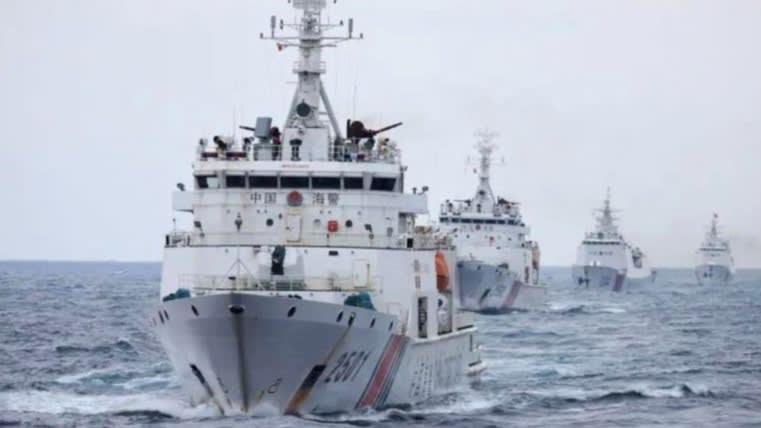
This Chinese coast guard ship is equipped with weapons believed to be 76-millimeter guns. © Kyodo

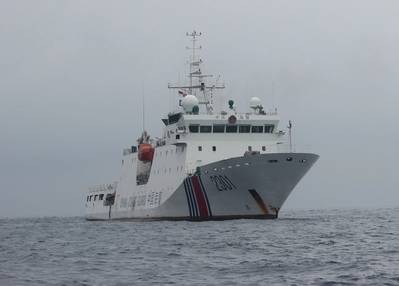
The China Coast Guard (CCG) has about three times the number of large cutters (1,000 tons or larger) as the USCG. They have well over 100, including at least 60 larger than the 270s. This, in spite of the fact that their EEZ, even including their “Nine Dash Lines” claims disputed by Taiwan and other nations is less than a fifth that of the US. Their internationally recognized EEZ is less than 8% of that of the US.

Virtually all these cutters were acquired in the last 15 years. While most CCG cutters are lightly armed, that is changing rapidly, with 76mm guns and 30mm Gatling guns becoming increasingly common. Many of the new cutters are built on the same hulls as PLAN frigates and corvettes.

“As of July 1, 2018, the China Coast Guard was transferred from civilian control of the State Council and the State Oceanic Administration, to the People’s Armed Police, ultimately placing it under the command of the Central Military Commission”

The CCG does not do buoy tending or icebreaking. Primary responsibility for SAR and maritime regulatory activities are invested in other agencies. There is a 25,000 member China Maritime Safety Administration, which has a few large cutters of its own, and a 10,000 member China Rescue and Salvage Bureau with its own cutters.

I think it is fair to say the China Coast Guard is much more focused on its para-military role than the US Coast Guard. Should China attempt to invade Taiwan, I feel sure the China Coast Guard will be transporting troops and providing naval gunfire support. They might even undertake small scale surprise landings own their own, perhaps in multiple locations simultaneously.