“The Nationalized Fleet? Is there any hope for the Navy–Coast Guard ‘National Fleet’ concept?” USNI

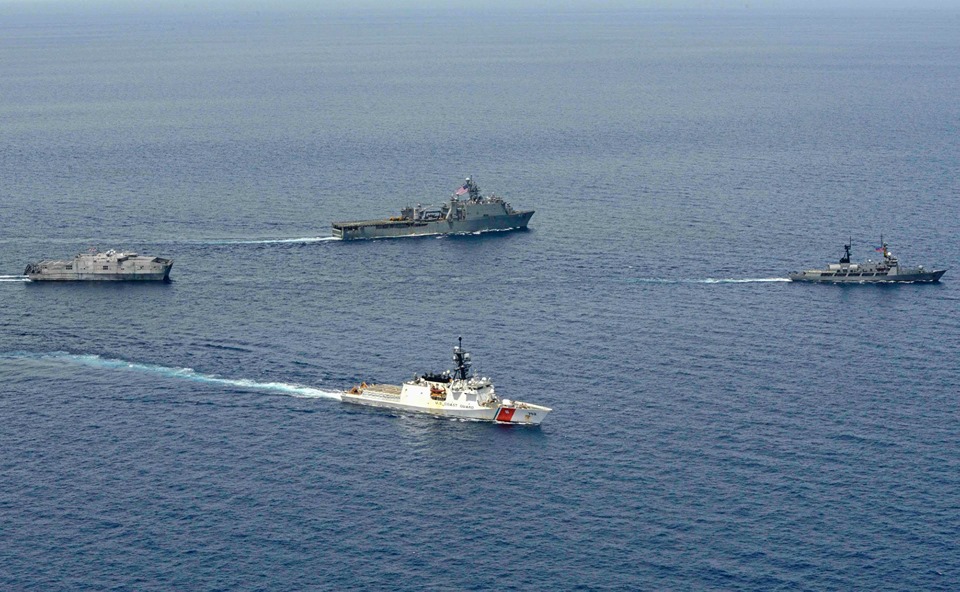
The Philippine Navy’s BRP Andres Bonifacio (PS 17), USS Germantown (LSD-42), USCGC Stratton (WMSL 752) and USNS Millinocket (T-EPF 3) break formation after steaming together this week in the Sulu Sea as part of Maritime Training Activity Sama Sama.

The US Naval Institute Proceedings has a short article about the history of a concept that originated in the Coast Guard more than 20 years ago.

Seemed like a good idea at the time. Still does, but not a lot has come of it. A good idea that has languished due to various parts laziness, inertia, fear, jealousy, and arrogance.

If this is ever going to happen, it will require Congress to push the idea.

An important first step would be to include Coast Guard ships in annual count of “Battle Force” ships that the Navy puts out. It currently includes unarmed MSC ships, including ocean going tugs, so National Security Cutters and Offshore Patrol Cutters would not be out of place.

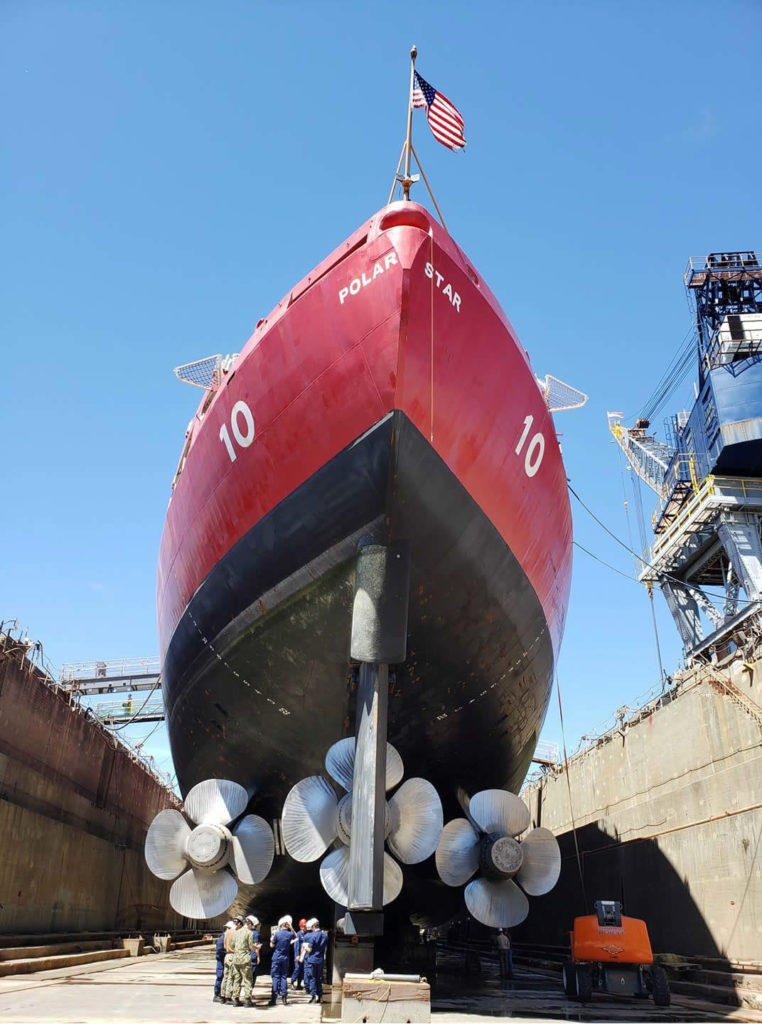
Polar Star Completes Almost Four Months Away From Homeport in the Yard

As with previous Dry Docks, the three pitch propellers were removed, overhauled, and reinstalled. Photo: Official USCG Polar Star Facebook

Naval News reports on the recent availability for USCGC Polar Star.

Much as she has for the last several years, she went into the Mare Island Dry Dock in Vallejo, CA. She spent 16 weeks and two days there completing the first of five planned phased SLEP increments that are expected to keep her in service until service until the second Polar Security Cutter is completed in 2027. Unlike 2019, at least this year she got out of the yard on schedule.

If she is going to spend a majority of her in port time in the San Francisco Bay area, that really should be her homeport.

Customs and Border Protection Air and Marine Gets 16 New Helicopters

Dmitry Shulgin reports that,

Airbus Helicopters, Inc. (AHI) has delivered the first of 16 new H125 helicopters uniquely configured for U.S. Customs and Border Protection (CBP) Air and Marine Operations (AMO). AMO collaborated with AHI as part of a long-term fleet upgrade initiative, and the resulting configuration has led to one of the most advanced, high-tech law enforcement helicopters ever developed.

This light (Max takeoff weight: 2,250 kg (4,960 lb)), single engine helicopter, previously designated the AS350, has enjoyed great success with CBP. Wikipedia notes,

By 1999, the AS350 had become the prime helicopter being used by the United States Customs Service for light enforcement operations; by 2007, the agency had become the single largest operator of the type in the world.

Apparently these are being procured via GSA contract.

“The Coast Guard Needs to Listen—Acoustically” –USNI

Source: WOODS HOLE OCEANOGRAPHIC INSTITUTION

The US Naval Institute Proceedings has an article recommending that the Coast Guard exploit acoustics to enhance its Maritime Domain Awareness.

The author provides some examples of how acoustics have proven this capability in the past.

Using SOSUS,

“In 1961, the Navy successfully tracked the USS George Washington (SSBN-598) during her transoceanic voyage from the United States to the United Kingdom, demonstrating the ability to acoustically track vessels over global distances.”

It has found a limited application within the Coast Guard,

The Coast Guard already is using passive acoustic monitoring to autonomously detect critically endangered North Atlantic right whales and notify nearby mariners. Despite the program’s success, it has not expanded beyond the single Coast Guard facility in Woods Hole, Massachusetts. Leveraging this remote-sensing ability would allow the Coast Guard to reduce its reliance on expensive aircraft patrol hours while providing the same level of service:

It apparently could have been used to monitor fishing activity.

 “A series of experiments supported by the Navy, Coast Guard, and National Marine Fisheries Service were conducted from 1992 to 1995 that explored the possibility of using SoSuS to track vessels fishing illegally. The experiment was a resounding success—results showed that SoSuS could be used to detect, identify, and monitor (this link is to a 468 page pdf — I did not see the article in question–Chuck) individual driftnet and trawling fishing vessels in the Bering Sea and northern Pacific Ocean. Despite promising results, the service failed to move to an acoustic-based enforcement approach.”

While I can find fault with the article, the author’s main thrust that the Coast Guard is not exploiting a part of the spectrum that could help maintain a picture of what is happening offshore is certainly true. Because we no longer have sonar or ASW expertise, we no longer have a window into what acoustic sensors have to offer.

While probably true that the Coast Guard might be able to establish acoustic surveillance over limited areas of special interest, if we are going to have a comprehensive system, we would likely have to ride the Navy’s coat tails.

A Navy system that listens for submarines could also listen for trawlers. It could detect vessels that have turned off their AIS. It might cue us that a terrorist controlled vessel is headed for a US Port; or that a merchant or fishing vessel is laying mines; or that a vessel is doing clandestine monitoring of our submarine operations.

This is also another way to track and identify vessels that may be illegally dumping.

This could even help with SAR. When I was an 8th District RCC controller in the early 70s, we had a tanker explode offshore, only we did not know that it had happened for several days. The day it happened we got a report of smoke. I sent an aircraft to investigate, but we found nothing but the smoke. Smoke was not uncommon, given all the offshore oil wells that flared gas. A few days later we got a report of a missing tanker. We searched and ultimately found its mast above water. It had been cleaning tanks closer to shore than it should have been, and had had a catastrophic explosion that ripped through 25 of its 27 cargo tanks. An acoustic monitoring system would almost certainly have picked that up. Anytime a ship sinks, the collapsing of bulkheads as air filled compartments are crushed should also be heard.

As the author points out, and as we have mentioned many times here, towed arrays on cutters could help us locate low profile drug smuggling vessels (drug subs).


Navy Helo Operates from Munro, RIMPAC 2020

Seems like a lot of significant news releases today. Another one below.

We already know Munro is participating in RIMPAC 2020. What I found most interesting here is this paragraph.

Embarked aboard Munro is a detachment from U.S. Navy Helicopter Sea Combat Squadron 21, who completed over 40 hours of training on board prior to their integration in RIMPAC.

From Wikipedia: 

Helicopter Sea Combat Squadron 21 (HSC-21), nicknamed “Blackjacks”, is an aviation unit of the United States Navy based at Naval Air Station North Island. HSC-21 is made up of five expeditionary detachments that deploy aboard ships including Combat Logistics Force support ships, Hospital Ships and Amphibious Assault ships, among others. HSC-21 flies the Sikorsky MH-60S Seahawk helicopter.

Missions include:

Search and Rescue (SAR)
Logistical Support
Naval Special Warfare (NSW)
Anti-Surface Warfare (ASUW)
Vertical Replenishment (VERTREP)
Medical Evacuation (MEDEVAC)

The MH-60S can be armed with Hellfire, rockets, and forward firing weapons in addition to the door gun and is also expected to conduct mine countermeasures operations.

I am curious both, when and where the helicopter training was conducted and what role the cutter/helo combination will play in the exercise.

(In the previous post, you might have also noticed a photo of USCGC Tahoma doing flight ops with a Danish MH-60R ASW helicopter.)

united states coast guard

News Release

U.S. Coast Guard Pacific Area
Aug. 21, 2020
Contact: Coast Guard Pacific Area Public Affairs
Office: (510) 437-3375
After Hours: (510) 816-1700
D11-DG-M-PACAREA-PA@uscg.mil
Pacific Area online newsroom

Coast Guard Cutter Munro Joins RIMPAC Following 37-day Alaska Patrol

USCGC Munro Alaska Patrol (1) USCGC Munro Alaska Patrol (2)
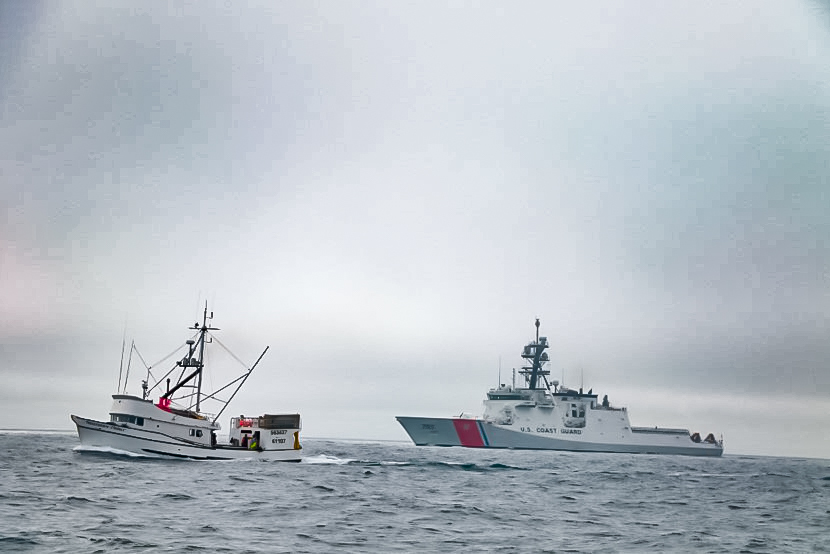
The crew of the U.S. Coast Guard Cutter Munro conducts a boarding of a fishing vessel off the coast of Alaska.  Prior to their participation in RIMPAC, the Munro crew patrolled the maritime boundary line to prevent foreign fishing vessel incursions into U.S. waters.

Coast Guard Cutter Munro (WMSL-755) began participation Monday, August 17, in this year’s exercise Rim of the Pacific (RIMPAC) following a 37-day Alaska patrol.

Ten nations are participating in this year’s RIMPAC, the world’s largest international maritime exercise held biennially in the waters surrounding Hawaii. This marks the 27th iteration hosted by the United States in the series that began in 1971.

Twenty-two surface ships, one submarine, multiple aircraft and approximately 5,300 personnel from Australia, Brunei, Canada, France, Japan, New Zealand, Republic of Korea, Republic of the Philippines, Singapore, and the United States join forces from August 17 to August 31.

This year’s exercise includes multinational anti-submarine warfare, maritime intercept operations, and live-fire training events, among other cooperative training opportunities.

Prior to arriving in Hawaii for RIMPAC, the Munro crew deployed to the waters off Alaska, patrolling the maritime boundary line to prevent foreign fishing vessel incursions into U.S. waters. The crew conducted 11 living marine resource boardings, and oversaw the first Coast Guard operational deployment of an unmanned aerial system in the Bering Sea since 2018.

“I am incredibly proud of Munro’s crew and the work we accomplished in Alaskan waters,” said Capt. Blake Novak, Munro’s commanding officer. “We provided a Coast Guard presence, securing our border and protecting vital natural resources in the Bering Sea. We boarded fishing vessels as far north as the Arctic Circle and along the Aleutian Islands to ensure the U.S. fishing fleets continue to operate safely. Munro has transitioned and prepared to leverage our joint and combined capabilities in the Rim of the Pacific exercise.”

Embarked aboard Munro is a detachment from U.S. Navy Helicopter Sea Combat Squadron 21, who completed over 40 hours of training on board prior to their integration in RIMPAC.

The at-sea-only construct for RIMPAC 2020 was developed to ensure the safety of all military forces participating, and Hawaii’s population, by minimizing shore-based contingents, while striking a balance between combating future adversaries and the COVID-19 threat. RIMPAC provides a unique training opportunity designed to foster and sustain cooperative relationships that are critical to ensuring the safety of sea lanes and security on the world’s interconnected oceans.

Second 270 Goes to the Arctic

As part of the Operation Argus search and rescue exercise, U.S. Coast Guard Cutter Tahoma (WMEC 908) and HDMS Triton (F358), a Royal Danish navy vessel, conducted towing evolutions off Greenland Aug. 18, 2020. Interoperability and rescue responses are vital in the high latitudes of the Arctic. (U.S. Coast Guard photo by Seaman Kate Kilroy/Released)

Below is a press release reproduced in its entirety. This operation seems to represent a significant change in Coast Guard operations. This is the first reference to a Coast Guard “Arctic Patrol” I have seen other than WWII historical references. Significantly this is on the Atlantic side. When I have seen the Coast Guard participate in this exercise in the past, it was with a buoy tender. Here we have participation by two 270 foot WMECs. We talked about this exercise earlier here. It seems to mark a change for the US Navy as well as the Coast Guard with a Navy destroyer participating as well. 

united states coast guard

News Release

U.S. Coast Guard Atlantic Area
Contact: Coast Guard Atlantic Area Public Affairs
Office: (757) 398-6521
After Hours: (757) 641-0763
Atlantic Area online newsroom

U.S. Coast Guard carries out support of joint Arctic missions

As part of Operation Nanook, the U.S. Coast Guard Cutter Tahoma (WMEC 908) maneuvers with vessel from the Royal Canadian navy and coast guard, the Danish navy, and French navy, in the Atlantic Aug. 9, 2020. Strong partnerships are imperative to success in the Arctic. (U.S. Coast Guard photo by Seaman Kate Kilroy/Released) Royal Danish navy members attached to HDMS Triton (F358) ran through search and rescue exercises aboard the Coast Guard Cutter Tahoma (WMEC 908) as part of the joint Arctic Operation Argus, Aug. 20, 2020, off Greenland. The Triton crew dispatched small boat crews to board the Tahoma, responding to the ‘distress call’ made by Tahoma. The scenario included multiple ‘injured’ parties and a pipe casualty exercise. Each ship’s crew shared techniques throughout the engagement, leading to a successful evolution. (U.S. Coast Guard photo by Seaman Kate Kilroy/Released) Coast Guard Cadet 1st Class Rochelle Parocha looks on to the Royal Canadian Navy supply vessel Asterix after guiding in the U.S. Coast Guard Cutter Tahoma (WMEC 908) during approach drills as part of Operation Nanook in the Atlantic in mid-August 2020. Strong partnerships are imperative to success in the Arctic. (U.S. Coast Guard photo by Seaman Kate Kilroy/Released)

 Lt. Cmdr. Matthew Fetzner, Lt. Katy Caraway, and Petty Officer 2nd Class Calvin Christianson, an aviation maintenance technician, crew an MH-65 Dolphin helicopter on search and rescue maneuvers above Greenland, Aug. 19, 2020. The team comprises the aviation detachment aboard U.S. Coast Guard Cutter Tahoma (WMEC 908), taking part in joint Arctic Operations Nanook and Argus strengthening relations with strategic partners. They carried out multiple search and rescue drills involving lost hikers along the Arctic Trail and boaters in distress along Greenland's coast. (U.S. Coast Guard photo by Seaman Kate Kilroy/Released) The HDMS Triton (F358), a Royal Danish navy vessel, approaches Greenland as seen from the U.S. Coast Guard Cutter Tahoma (WMEC 908), Aug. 15, 2020. Both vessel crews are participating in the 10th year of Operation Nanook. (U.S. Coast Guard photo by Seaman Kate Kilroy/Released) As part of Operation Nanook, a Royal Danish navy MH-60 Seahawk Helicopter crew conducts cross-deck maneuvers over the U.S. Coast Guard Cutter Tahoma (WMEC 908) in the Atlantic Aug. 10, 2020. Strong partnerships are imperative to success in the Arctic. (U.S. Coast Guard photo by Seaman Kate Kilroy/Released)

The U.S. Coast Guard Cutter Tahoma (WMEC 908) became the first Coast Guard 270-foot medium endurance cutter crew to cross the Arctic Circle, Aug. 17, 2020. They took part in joint Arctic Operations Nanook and Argus, (U.S. Coast Guard photo by Seaman Kate Kilroy/Released) As part of Operation Nanook, U.S. Coast Guard Cutter Tahoma (WMEC 908) boat-crew participates in a search and rescue exercise with the HDMS Triton, a Royal Danish navy vessel Aug. 17, 2020 off Greenland. Operation Argus part of Nanook, focused on search and rescue interoperability, highlights the importance of cooperation between international partners. (U.S. Coast Guard photo by Seaman Kate Kilroy/Released) As part of the Operation Argus search and rescue exercise, U.S. Coast Guard Cutter Tahoma (WMEC 908) and HDMS Triton (F358), a Royal Danish navy vessel, conducted towing evolutions off Greenland Aug. 18, 2020. Interoperability and rescue responses are vital in the high latitudes of the Arctic. (U.S. Coast Guard photo by Seaman Kate Kilroy/Released)

Editors’ Note: Click on images to view more or download a high-resolution version.

KITTERY, Maine  — The U.S. Coast Guard Cutter Campbell (WMEC 909) will relieve the U.S. Coast Guard Cutter Tahoma (WMEC 908) on Arctic patrol, Sunday near Greenland.  

In mid-July, Tahoma began operations for the overall two-month patrol to the Arctic in support of joint operations Nanook and Argus, to secure the maritime domain, protect resources and strengthen partnerships. 

“I’ve been doing this for more than 33 years and thought I’d seen everything until I saw how positively this crew responded. There’s nothing more humbling than being surrounded by such a great crew. Their families and friends should all be proud of them; that they accomplished something important and accomplished it with style. They represented themselves, their families, their Service, and their country as well as could ever be expected. The finest traditions of the Coast Guard are alive and well within the Tahoma crew,” said Cmdr. Eric Johnson, commanding officer, Tahoma. 

As the Nation’s primary maritime presence in the Polar Regions, the Coast Guard advances our national interests through a unique blend of polar operational capability, regulatory authority and international leadership across the full spectrum of maritime governance.  

“The Coast Guard has been in the Arctic for over 150 years,” said Capt. Thomas Crane, commanding officer, Campbell. “This signature exercise began in 2007. We are committed to enhancing our multinational capability to operate effectively in the dynamic Arctic domain, strengthening the rules-based order through the presence and joint efforts, and adapting to promote regional resilience and prosperity. We are proud to bring USCGC Campbell back to Greenland as the previous Campbell (W32) supported Coastal Operations in and around Greenland during World War II.”

These exercises evaluate interoperability and build relationships between responders to identify shortfalls in communication and coordination of efforts. Each agency holds individual capabilities that complement each other’s efforts and bolsters the overall success of the regional defense and SAR system. The purpose is to continue building and improving operational cohesion between different agencies and the Coast Guard.

Tahoma participated in patrols and mutual exchanges with partners as part of Operation Nanook. Inuit for polar bears, Nanook is an annual joint exercise and the Canadian armed forces’ signature northern operation, which comprises a series of comprehensive, joint, interagency, and multinational activities designed to exercise regional defense and secure our polar regions. The Coast Guard is primarily supporting Nanook-Tuugalik, a defense readiness and security exercise, with multiple foreign partners off Northern Canada involving U.S. Navy 2nd Fleet, Royal Canadian navy and coast guard, the Danish navy, French navy, Royal Canadian air force, and multiple Canadian federal, state, local, and tribal agencies. This year crowns a decade of Operation Nanook.

Both Tahoma and Campbell participated in Operation Argus, a three-day search and rescue exercise in Greenland’s coastal search area with the Danish navy, French navy, U.S. Coast Guard, and Air Greenland. Campbell will also conduct exchanges, fisheries boardings to safeguard resources and protect domestic fisheries and serve as a platform for research and innovation.

“We continue to work with our allies and partners to ensure a safe, secure, and cooperative Arctic, even as our aspiring near-peer competitors maneuver for strategic advantage in the area,” said Vice Adm. Steven Poulin, commander, Coast Guard Atlantic Area. “We are leaning forward, and our persistent presence continues to counter those entities’ efforts as the strategic value, economic, and scientific importance of the Arctic grows.”

Tahoma and Campbell’s home port is the historic Portsmouth Naval Shipyard in Kittery, Maine. Both cutters have a crew of roughly 100 who regularly patrol the Atlantic from Canada to the Caribbean. Like the other Famous-class cutters, they are designed and built for multi-mission operations, including law enforcement, search and rescue, marine environmental protection, and defense readiness.

Due to COVID-19, the service is taking extensive precautions and closely monitoring all operations. As needed, unit schedules adapted to ensure missions occur as planned. Any port calls or personnel exchanges are evaluated for risk and conducted in close coordination with the host nation and relevant agencies.

USCGC Mellon Decommissioned

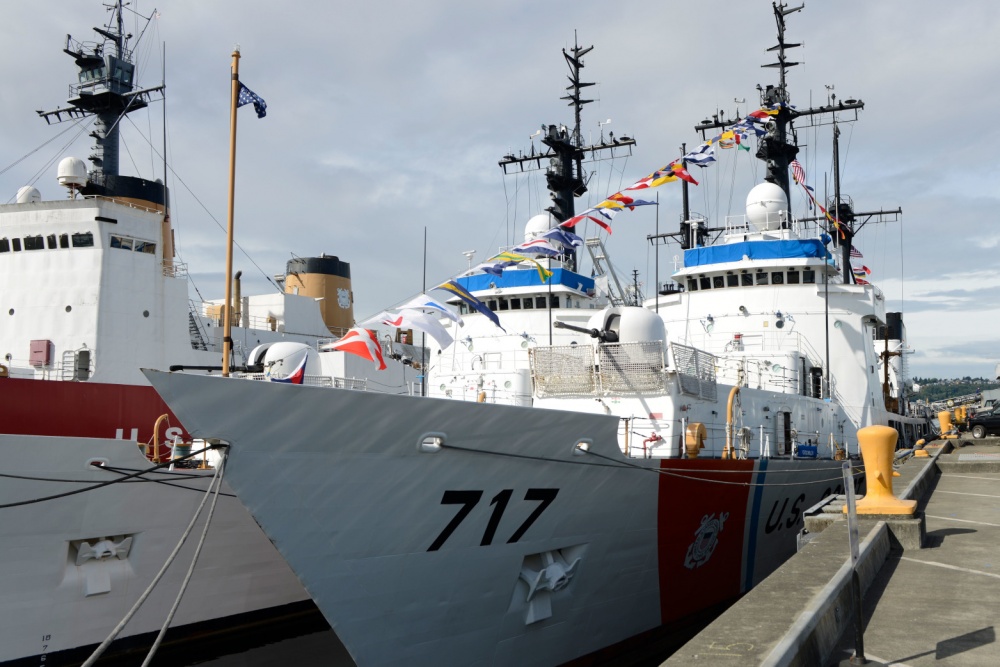
USCGC Mellon [WHEC 717] sits in full dress at the pier before a decommissioning ceremony in Seattle on Aug. 20, 2020. USCGC Mellon was a High Endurance Cutter homeported in Seattle and served as an asset in completing Coast Guard missions around the world for 52 years. (U.S. Coast Guard photo by Petty Officer 3rd Class Michael Clark)

The following is a news release reproduced in its entirety. One less cutter in PACAREA. Only one operational 378 remaining in the Coast Guard. 

united states coast guard

News Release

Aug. 21, 2020
U.S. Coast Guard Pacific Area
Contact: Coast Guard Pacific Area Public Affairs
D11-DG-M-PACAREA-PA@uscg.mil
Pacific Area online newsroom

Coast Guard decommissions cutter after 52 years of service

Coast Guard Cutter Mellon (WHEC 717) completes final patrol Coast Guard high endurance cutter decommissioned after 52 years of distinguished service
Coast Guard Cutter Mellon Decommissioning Ceremony Coast Guard Cutter Mellon Decommissioning Ceremony Coast Guard Cutter Mellon Decommissioning Ceremony

Editors’ Note: Click on images above to download full-resolution photos and videos.

SEATTLE — The Coast Guard decommissioned the Coast Guard Cutter Mellon (WHEC 717) during a ceremony Thursday held at Coast Guard Base Seattle and presided over by Rear Adm. Peter Gautier, the deputy commander of the Coast Guard Pacific Area.

Mellon was one of the Coast Guard’s two remaining 378-foot Hamilton-class high endurance cutters. The fleet of high endurance cutters is being replaced by 418-foot Legend-class national security cutters, which serve as the Coast Guard’s primary long-range asset.

Commissioned in 1968, the Mellon was the third of twelve high endurance cutters built for long-range, high-endurance missions, including maritime security roles, drug interdiction, illegal immigrant interception and fisheries patrols.

“While Mellon’s service to the U.S. Coast Guard now ends, the ship will continue its legacy of good maritime governance after transfer to the Kingdom of Bahrain’s Royal Naval Force,” said Gautier. “I am incredibly confident in the Coast Guard’s future, because in Coast Guard Cutter Mellon’s crew and proud history, I see the attributes that have made our Coast Guard ‘Always Ready’ for more than two centuries.”

Mellon’s keel was laid July 25, 1966, at Avondale Shipyards in New Orleans. Mellon was launched Feb. 11, 1967, and commissioned Jan. 9, 1968. The cutter was named after Andrew W. Mellon, the 49th Secretary of the Treasury from 1921-1932.

Over the past 52 years of service, Mellon’s crews conducted a wide range of diverse operations in all parts of the world. From 1969 through 1972, Mellon’s crews participated in the Vietnam War, performing several naval gunfire support missions and patrolling Southeast Asian waters to prevent the smuggling of weapons into Vietnam. Mellon’s participation in the Vietnam War earned the ship the Navy Meritorious Unit Commendation.

In the late-1970s and 1980s, the Mellon responded to numerous major search and rescue operations, including their assistance in the rescue of 510 passengers and crew members from the burning luxury liner Prinsendam in 1980.

In 1985, the Mellon entered the Fleet Renovation and Modernization program, a dry dock program designed to prolong high endurance cutters’ service life. Mellon was recommissioned March 3, 1989.

Living up to the Mellon’s motto “Primus Inter Pares,” meaning first among equals, the cutter established several Coast Guard firsts, including the first of five Hamilton-class high endurance cutters to have a Harpoon anti-ship missile system installed. Mellon was also the first, and only, Coast Guard cutter to test fire a Harpoon missile.

During Bering Sea patrols, Mellon conducted search and rescue operations and enforced laws and regulations that preserved vital Alaskan fisheries. In the Eastern Pacific, the Mellon’s boarding teams interdicted illegal narcotics trafficked over the high seas.

During the cutter’s last year of service, 20 officers and 160 enlisted crew members patrolled the Bering Sea and the Northern Pacific Ocean near Japan for more than a combined 230 days, collectively conducting 100 safety and fisheries boardings of U.S.-, Chinese-, Korean-, Japanese- and Russian-flagged fishing vessels and participating in five search-and-rescue cases.

“It has truly been an honor to serve as the final commanding officer for Coast Guard Cutter Mellon,” said Capt. Jonathan Musman. “The officers, chiefs and crew for this final year have been truly remarkable and can hold their heads high as they operated Mellon with distinction across the North Pacific on three deployments serving our nation. The reliability of the cutter is a product of years and years of properly taking care of this beloved cutter. The legacy of Mellon has been those fantastic memories that have been made and the knowledge that has passed from one shipmate to another. The future generations of cuttermen were here this last deployment learning, teaching and making their shipboard memories, and they are ready to carry on and continue the Coast Guard’s seagoing heritage.”

“Defense Unit Certifies Five Small Commercial UAS for Government Use” –Seapower

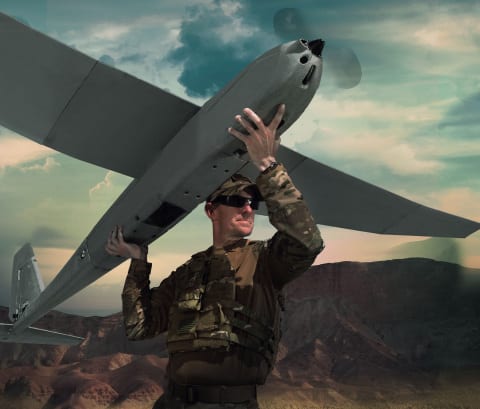
Puma LE (long endurance) unmanned aircraft. Photo from Aerovironment

Come September you will be able to get your small unmanned air system off the GSA schedule.

The Navy Leagues magazine Seapower reports that,

“The Defense Innovation Unit (DIU), a Department of Defense organization that accelerates commercial technology for national defense, announced the availability of five U.S.-manufactured drone configurations to provide trusted, secure small Unmanned Aircraft Systems (sUAS) options to the U.S. government, the Pentagon said in an Aug. 20 release. “

“Russian navy will create an Arctic group of tanker ships of Project 23130” –NavyRecognition

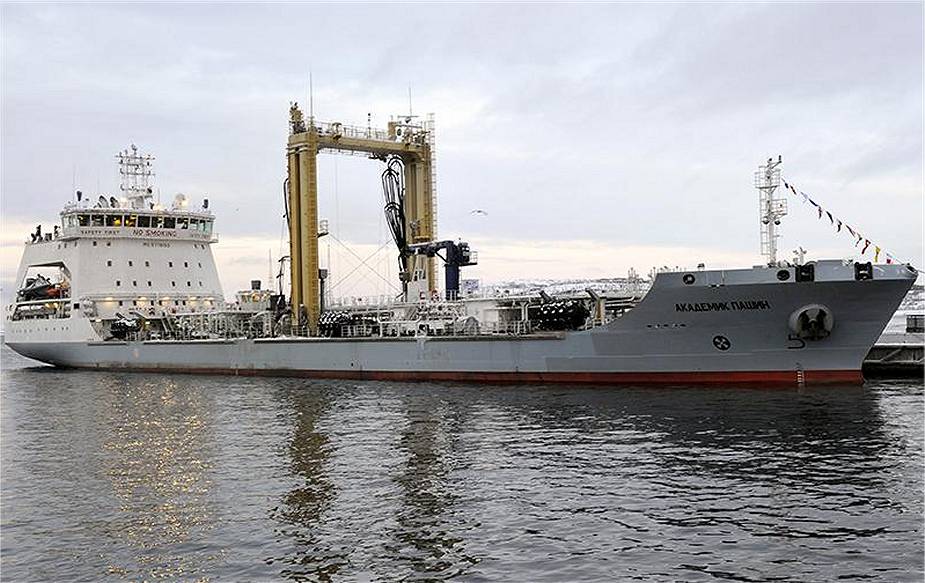
Project 23130 is a series of medium-size replenishment oilers developed by the Spetssudoproect JSC and built by Nevsky Shipyard for the Russian Navy. (Picture source Nurlan Aliyev Twitter account)

NavyRecognition reports that the Russian Navy is building a fleet of six ice-capable underway replenishment tankers. The ships are relatively small,

“Project 23130 tanker has a displacement of 9 thousand tons. It is 130 meters long and 21 meters wide. The maximum speed is 16 knots. The autonomous navigation can last two months. The maximum range is 8 thousand nautical miles. The tanker can operate in 0.8-meter thick Arctic ice.”

But on the other hand the US Navy has nothing comparable.

The article also seems to point to a serious shortage of underway replenishment vessels in the Russian Navy.