IUU Enforcement

As if to prove the new emphasis on IUU is not just a paper exercise, we have a report of a National Security Cutter and a C-130 involved in a multi-national fisheries enforcement operation in the Western Pacific.

united states coast guard

News Release

U.S. Coast Guard 14th District Hawaii and the Pacific
Contact: 14th District Public Affairs
Office: (808) 535-3230
After Hours: HawaiiPacific@uscg.mil
14th District online newsroom

Coast Guard cutter returns to Hawaii after completing multi-country operation targeting illegal fishing in the South Pacific Ocean

Coast Guard Cutter Kimball and Air Station Barbers Point HC-130

Editors’ Note: Click on images to download a high-resolution version.

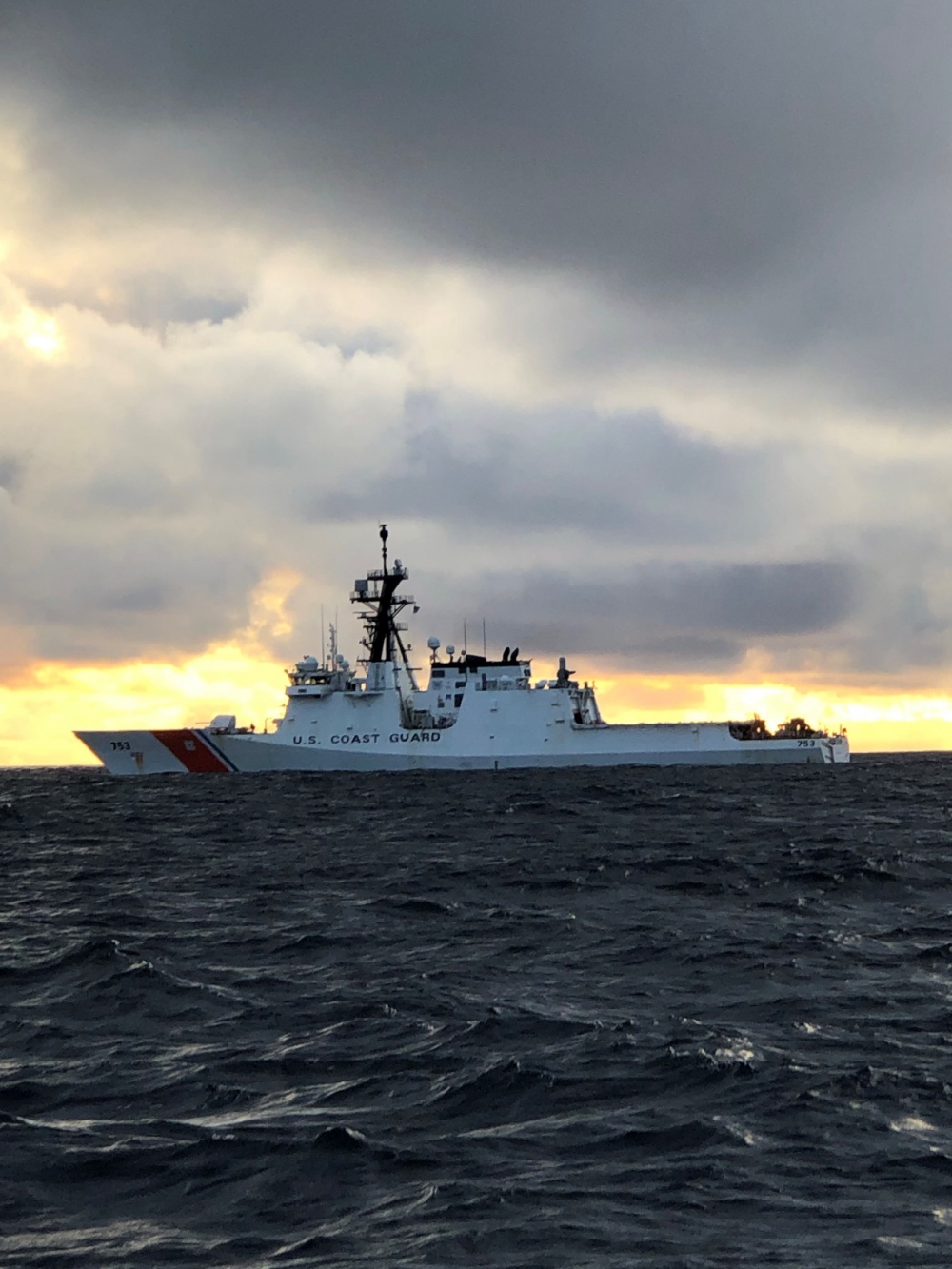
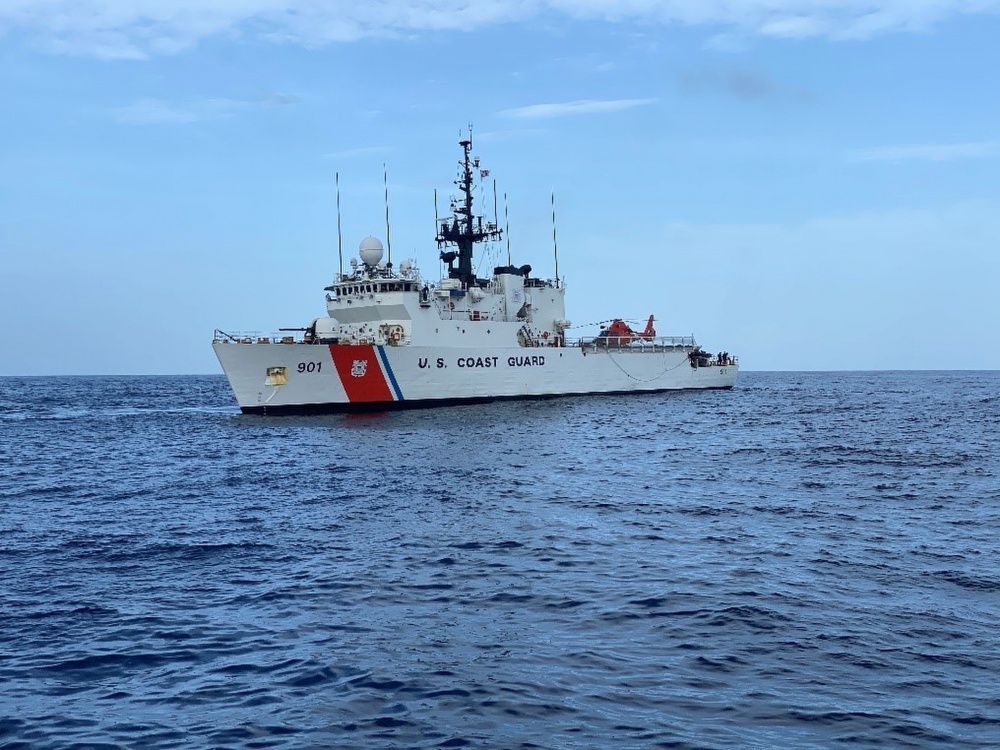
HONOLULU — The Coast Guard Cutter Kimball (WMSL 756) returned to Honolulu Sunday following its nearly two month patrol supporting the multi-country maritime Operation Nasse throughout Oceania.

Operation Nasse is an annual Pacific Quadrilateral Defense Coordination Group operation consisting of assets from the United States, Australia, France, New Zealand, and Pacific Island Forum Fisheries Agency which completed August 23.

“This is the first time the Coast Guard has sent a surface asset to participate during the Pacific Quadrilateral Defense Coordination Group’s operation,” said Lt. j.g. Joseph Fox, an assistant combat systems officer aboard the Kimball. “Service members from the Coast Guard Cutter Kimball and an Air Station Barbers Point HC-130 aircrew conducted joint missions with their multi-national counterparts to achieve the common goal of preventing illegal, unreported, and unregulated fishing in the Pacific.”

The purpose of this year’s operation was to investigate the effect COVID-19 had on fishing activities on the high seas and to identify fishing vessels not complying with the Western and Central Pacific Fisheries Commission (WCPFC) conditions. Illegal, unregulated or unreported (IUU) fishing undermines a nation’s sovereignty, threatens its economic security, and weakens global rules-based order.

Each participating country provided assets to support the operation including flights by RNZAF P3K Orions based out of Auckland, Australian Maritime Border Command Dash 8s based out of Brisbane, and French Guardians from Noumea.

The partner’s cooperation provided a significant reach in surveillance which allowed the French patrol boat “La Glorieuse” and the Kimball to hone in on specific vessels identified as possibly being of interest to confirm their activities were within regulations.

Air and sea surveillance, and maritime intelligence sharing provided an opportunity for the participants to work collaboratively to detect, deter, suppress, and report potential IUU fishing activity.

In addition to Operation Nasse, the crew of the Kimball also conducted a high seas patrol off American Samoa and Fiji.

Working closely with their Fijian counterparts, the crew supported U.S.-Fiji bilateral agreements and enforced partner nations respective Exclusive Economic Zones while promoting legal, sustainable fisheries.

In the Pacific, annual Tuna catch is estimated at over $5 billion and provides a significant percentage of the income of many of the South Pacific Nations. Ensuring that vessels operating on the high seas are complying with WCPFC regulations to protect fish stocks and other marine life resulting in these valuable resources remaining sustainable for future generations.

All asset crews were working to national rules regarding COVID-19 which were implemented to keep all personnel as safe as possible while still being able to achieve many of the operational goals.

Coast Guard IUU Strategy to be Published

Chinese fishing vessel fleet (Photo: The Maritime Executive)

The Coast Guard is coming out with its first ever strategy to counter Illegal, Unreported, Unregulated (IUU) fishing. The Commandant talks about it in a US Naval Institute Podcast.

The Commandant makes it clear the Coast Guard is not going to become the World’s fish cops. Apparently the Coast Guard will look to increased intelligence and information exchange, enforcement modeling/training/capacity building, and working with NGO. There was a suggestion, we might have some law enforcement “fish dets.”

Interestingly one remark was, “We don’t know what we don’t know.” That sounds like the first order of business.

IUU has been a problem in South East Asia and off the East and West coasts of Africa. Increasingly it is becoming serious problem for Latin America.  For a recent example, CIMSEC just published a piece regarding Chile’s response to IUU, “ILLEGAL FISHING IN THE SOUTH PACIFIC: WHAT CAN THE CHILEAN NAVY DO?”

The Commandant kept referring to the recent operation of Bertholf in support of Ecuadorian enforcement efforts. We discussed this earlier here.

This is a serious world wide problem. The US Coast Guard is going to see what they can do.

When the strategy is published, I will provide a link.

Polar Security Cutters and Coast Guard ASW

The US Naval Institute Proceedings web page has a couple of Coast Guard related articles that did not appear in the print version of Proceedings,

I have reproduced my comments on these topics below.


In regard to arming the Polar Security Cutters (the author seemed fixated on cruise missiles. We did discuss this topic earlier here)

There are limits to what we want to put on ships bound for Antarctica, since they have to be open for inspection. On the other hand if we ever do have a near peer conflict involving the Arctic or Antarctic, these will become rare and essential naval auxiliaries. As such they will probably operate with other vessels, including more powerful warships if appropriate, but that does not mean they should not be able to defend themselves against the possibility of leakers. We need to make provision for last ditch defense with systems like SeaRAM.

Meanwhile the fact that they are law enforcement vessels means they should be able to forcibly stop any private or merchant vessel regardless of size. So far it seems they will have at most, 25mm Mk38 Mod3 guns.

The follow on Medium Icebreakers or Arctic Security Cutters, which are unlikely to go to Antarctica, are more likely to be more heavily armed from the start.


Coast Guard ASW (comments were generally surprisingly adverse):

It is a fact that in WWII most U-boats were sunk by aircraft, but about a third (about 230) were sunk by surface vessels, primarily those of our allies Britain and Canada.

Even when surface vessels did not sink U-boats, they often performed valuable service in blocking access to convoys and in rescuing mariners from sunken ships.

US Naval vessels only sank about 38 U-boats. Coast Guard cutters and Coast Guard manned Navy ships were involved in sinking a disproportionate number of those (ten) for various reasons. Most of the US Navy effort went into the Pacific and most of the USN effort in the Atlantic at least through mid-1943, was in escorting high speed troop convoys than largely avoided contact with U-boats.

Circumstances we will face in any near peer conflict may be very different.

The advantages provided by code breaking in WWII are unlikely.

The advantages provided by radar equipped aircraft detecting U-boats charging their batteries or transiting the Bay of Biscay on the surface during the night no longer exists.

The Chinese surface and air threat would divert the most capable USN assets from ASW tasks.

Unlike the Japanese during the Pacific campaign, the Chinese are likely to make a concerted effort to disrupt our logistics train.

We simply do not have enough ASW assets.

Augmenting Coast Guard cutters to allow them to provide ASW escort and rescue services for ships that are sunk by hostile subs, in lower threat areas, is a low cost mobilization option that can substantially increase the number of escorts at low cost.

This could be facilitated by augmenting cutter with USN Reserves. Navy reserve ASW helicopter squadrons could be assigned to fly from cutters.
LCS ASW modules could be placed on cutters and manned by reactivated Navy reservists with LCS ASW module experience.

Our few US merchant ships need to be protected and when inevitably, some are sunk, we need someone to rescue those mariners, because they have become a rare and precious commodity.

The crews of the Coast Guard Cutters Midgett (WMSL 757) and Kimball (WMSL 756) transit past Koko Head on Oahu, Hawaii, Aug. 16, 2019. The Kimball and Midgett are both homeported in Honolulu and two of the newest Coast Guard cutters to join the fleet. (U.S. Coast Guard photo by Petty Officer 3rd Class Matthew West/Released)


In answer to this comment from James M

Add : For (millions)

ASIST : 6.263
Mk 32 SVTT : 3.237
SLQ-25 Nixie: 1.727
AN/SRQ-4 LAMPS III: 4.625
VDS/MFTA combo: 14.802
ASW Combat Suite: 33.684
64.338 total. I am sure something could be arrived at for less. I look at this as what it takes to fit out an NSC the whole way. For one, OPC will never fit that VDS/MFTA on its stern. At best it would be a Nixie, maybe a container towed sonar we don’t yet use, and the mods for MH-60R. It would be good to know the plan for MUSV as it might help the equation. After all, the 64.338 would buy 2 MUSVs without payload. It could also buy an additional FRC.

So, we could equip ASW equip all eleven projected Bertholf class National Security Cutters (NSC) for less than the cost of a single frigate.

Why do you believe the VDS/MFTA would not fit on the Offshore Patrol Cutter? It is fully as large as the NSCs and does not have the boat launch ramp cut into the stern. They are also substantially larger than the LCSs.

OPC “Placemat”

“4 Safety Recommendations Issued Based on Investigation of USS Fitzgerald Collision” –NTSB

Note the classic “Constant Bearing, Decreasing Range.” You may have to enlarge the plot, but there are six parallel bearing lines in the illustration above. 

The NTSB has issued four safety recommendations as a result of the investigation of the collision between collision between US Navy destroyer Fitzgerald and Philippine-flag container ship ACX Crystal in Sagami Nada Bay off Izu Peninsula, Honshu Island,
Japan July 17, 2017

Always important to learn from others, and, the Coast Guard participated in the investigation.

As a result of its investigation the NTSB issued three safety recommendations to the Navy and one to Sea Quest Management Inc., the operator of the ACX Crystal. Two safety recommendations issued to the Navy call for review and revision of fleetwide training and qualification requirements for officers of the deck related to the collision regulations, as well as review and revision of bridge resource management training. The third recommendation to the Navy seeks the broadcast of automatic identification system information when in the vicinity of commercial vessel traffic, at all times, unless such broadcast could compromise tactical operations. The safety recommendation issued to Sea Quest Management Inc., seeks additional training for navigation officers on collision avoidance regulations, radar and automatic radar plotting aids.

You can see the entire NTSB report here. If this proves anything, it is that 13 tired people who sorta know what they are doing, are no substitute for one well rested person who really does know what he or she is doing.

It was a beautiful night, good visibility, sea state 1–2, north winds 11–16 knots, air
temperature 68°F (20°C), and sea temperature 62.6°F (17°C.).

On board the Fitzgerald, the OOD had believed during the approach that the destroyer would clear both crossing vessels (the ACX Crystal and the Maersk Evora, or possibly the Wan Hai 266 and the ACX Crystal). The OOD told investigators that she saw the ACX Crystal’s superstructure about a minute before the collision and she realized the Fitzgerald was not going to clear the containership. According to the OOD, she initially ordered the conning officer to come hard right, however, she cancelled that order before the conning officer could relay the order to the helmsman. The OOD said she then ordered hard left rudder and ahead flank speed. The BMOW, who was standing near the helmsman, stated that the OOD “gave the order all ahead full for 25 knots, and right after that, all ahead flank.” He went on to say that when the OOD gave the order for “hard left rudder” he “just grabbed the wheel” (from the helmsman) and “put it over.”

A review of Fitzgerald engine parametric data indicated that both the port and starboard engine throttle settings were simultaneously advanced by increments at 0130:06, 0130:14, and 0130:22. Engine monitoring data indicated that both engines responded to the requested commands.

At 0130:32, with the Fitzgerald traveling at 22.1 knots and the ACX Crystal at 18.4 knots, the vessels collided. Neither the Fitzgerald nor the ACX Crystal bridge teams sounded any alarms or made any announcements to warn their crews of the impending collision.

What I remembered, from many years ago, was when “in-extremis” both ships should turn right, but apparently that is not viewed as definitive now. Still, it looks like it would have been the best choice here, if you had failed to act early enough to avoid the in-extremis situation in the first place. If you want to review the rules, you can find them here. Rules 7, 8, and 17 apply.

The XO did not trust the OOD, but did not say anything to the CO, when the watch bill for this high traffic transit was planned. Nor did he remain on the bridge during that OOD’s watch.

Fatigue was also a killer, and the constantly rotating watch bill did not help.

“…watchstanding period for each watch team would shift with each cycle of the watch rotation. For example, the watch team that had the 0200–0700 watch would next have the watch from 2200–0200 that evening, and then have the watch from 1700–2200 on the following day. Following this accident and the McCain/Alnic MC collision, which occurred about 2 months later in August 2017, the Navy mandated “circadian watch bill” schedules that followed set watch times each day.”

There was also an inexperienced “conning officer” who relayed orders from the OOD to the helm. This does not seem to have caused the collision, but it could not have helped.

“Coast Guard crew to offload more than 26,000 pounds of cocaine, marijuana worth $390 million in San Diego” –D11 News Release

Below is a news release from D11. I like the reference to the previous off-load. That was two weeks earlier and it tends to give a feel for the size of the problem, that a report of a single off-load does not. Plus there are the year to date totals.

So far in fiscal year 2020, the Coast Guard has made more than 171 interdictions, seized more than 282,000 pounds of cocaine, 57,000 pounds of marijuana and detained more than 391 suspected smugglers in drug transit zones of the Eastern Pacific Ocean and the Caribbean Sea.

The video and photos give a good comparison of the 26 foot (8 meter) over the horizon boat and the 35 foot (11 meter) Long Range Interceptor boats.

Also apparent here is the fact that the Navy “surge” is still primarily DDGs rather than LCS.

I am a little surprised we are still intercepting marijuana.

united states coast guard

News Release

U.S. Coast Guard 11th District PA Detachment San Diego
Contact: Coast Guard PA Detachment San Diego
Office: (619) 278-7025
After Hours: (619) 252-1304
PA Detachment San Diego online newsroom

Coast Guard crew to offload more than 26,000 pounds of cocaine, marijuana worth $390 million in San Diego

Coast Guard intercepts semi-submersible vessel
Coast Guard intercepts semi-submersible vessel Coast Guard intercepts semi-submersible vessel

Editors’ Note: Click on images above to download full-resolution version.

WHO: Director Jim Carroll, Office of National Drug Control Policy, Mr. Robert Brewer, U.S. Attorney, Adm. Karl Schultz, commandant of the United States Coast Guard, Capt. Brian Anderson, Coast Guard Cutter Bertholf commanding officer, and Bertholf crew.

WHAT: The crew of the Coast Guard Cutter Bertholf is scheduled to offload more than 26,000 pounds of cocaine and marijuana seized from suspected drug smugglers in drug transit zones of the Eastern Pacific Ocean.

WHEN: Thursday at 9:30 a.m.

WHERE: 10th Avenue Marine Terminal at 1150 Terminal St., San Diego, CA 92101

Editor’s Note: Media attending this event must RSVP with Coast Guard Public Affairs Detachment San Diego personnel at (619)252-1304 by 8:00 a.m. All media must have government-issued identification and media credentials to gain access. Entry to the terminal will be allowed to escorted media on the day of the event at 8:30a.m. Masks will be required and physical distancing protocols will be in place.

SAN DIEGO — The crew of the Coast Guard Cutter Bertholf (WMSL-750) is scheduled to offload more than 26,000 pounds of seized cocaine and marijuana in San Diego Friday.

The cocaine, worth an estimated $390 million, was seized in international waters of the Eastern Pacific Ocean. The contraband represents 13 suspected drug smuggling vessel interdictions off the coasts of Mexico, Central and South America between late May and late August by the following Coast Guard and Navy ships:

  • The Coast Guard Cutter BERTHOLF (WMSL-750) crew was responsible for two interdictions seizing approximately 6,700 pounds of cocaine.
  • The Coast Guard Cutter STRATTON (WMSL-752) crew was responsible for three interdictions seizing approximately 6,000 pounds of cocaine.
  • The Coast Guard Cutter CONFIDENCE (WMEC-619) crew was responsible for two interdictions seizing approximately 50 pounds of cocaine.
  • The Coast Guard Cutter DECISIVE (WMEC-629) crew was responsible for one interdiction seizing approximately 1,900 pounds of cocaine.
  • The Coast Guard Cutter VENTUROUS (WMEC-625) crew was responsible for one interdiction seizing approximately 1,100 pounds of cocaine.
  • The Coast Guard Cutter TAMPA (WMEC-902) crew was responsible for two interdiction seizing approximately 1,600 pounds of cocaine and 3,650 pounds of marijuana.
  • The USS KIDD (DDG-100) with embarked Coast Guard Law Enforcement Detachment (LEDET) was responsible for one interdiction seizing approximately 500 pounds of cocaine.
  • The USS PREBLE (DDG-88) with embarked Coast Guard Law Enforcement Detachment (LEDET) was responsible for one interdiction seizing approximately 4,400 pounds of cocaine.

The offload from the Bertholf follows the August 27, 2020, offload of approximately 11,500 pounds of seized suspected cocaine and 17,000 pounds of marijuana from the Coast Guard Cutter Hamilton (WMSL-753) in Port Everglades representing 10 interdictions in the same region. So far in fiscal year 2020, the Coast Guard has made more than 171 interdictions, seized more than 282,000 pounds of cocaine, 57,000 pounds of marijuana and detained more than 391 suspected smugglers in drug transit zones of the Eastern Pacific Ocean and the Caribbean Sea.

On April 1, U.S. Southern Command began enhanced counter-narcotics operations in the Western Hemisphere to disrupt the flow of drugs in support of Presidential National Security Objectives. Numerous U.S. agencies from the Departments of Defense, Justice and Homeland Security cooperated in the effort to combat transnational organized crime. The Coast Guard, Navy, Customs and Border Protection, FBI, Drug Enforcement Administration, and Immigration and Customs Enforcement, along with allied and international partner agencies, play a role in counter-drug operations.

The fight against drug cartels in the Eastern Pacific Ocean requires unity of effort in all phases from detection, monitoring and interdictions, to criminal prosecutions by international partners and U.S. Attorneys’ Offices in districts across the nation. The law enforcement phase of counter-smuggling operations in the Eastern Pacific Ocean is conducted under the authority of the 11th Coast Guard District, headquartered in Alameda. The interdictions, including the actual boardings, are led and conducted by members of the U.S. Coast Guard.

The Bertholf is a 418-foot national security cutter, commissioned in 2008 and homeported in Alameda.

Defending the Homeland

Air Force Magazine talks about how decisions are made when it comes to defending the “Homeland”. It is pretty unwieldy now, but there is hope that it can be streamlined.

The Coast Guard needs to be part of this, both as Maritime Domain Awareness sensors, and as potential response assets.

As new systems are designed, we need to make sure the Coast Guard is included.

“British Army drone to fly over English Channel to monitor migrant boats” –Independent

Thales Watchkeeper WK450

Like the US Coast Guard, the UK Border Force conducts Alien Migrant Interdiction Operations. They are reportedly getting some assistance from the British Army in the form of Unmanned Air Vehicles (UAV) being used to patrol the English Channel.

The UAVs are Thales Watchkeeper WK 450s (manufacturer’s brochure here) an improved version of the Israeli Elbit Hermes 450 with the addition of a dual-mode synthetic aperture radar and ground moving target indication system, providing all weather target acquisition.

The Watchkeeper program has not been cheap, about 1.2 billion pounds to provide and support 54 drones, and it has had its problems. They were supposed to have been operational in 2010, but apparently only reached Initial Operational Capability in 2014. Five have crashed. Regarding the current fleet,

“45 Watchkeeper airframes were in service as at 23 July 2020. 13 have flown in the past 12 months and 23 have been in storage for longer than 12 months. Of those flying, 10 have been operated by the Army from Akrotiri in Cyprus and Boscombe Down in Wiltshire, three have been used for test and evaluation. The airframes in storage are held at specific, graduated, levels of readiness. This is commensurate with practices used on other Defence capabilities and assets.”

The airframes are:

  • Length: 19.69 ft (6 m)
  • Span: 34.45 ft (10.5 m)
  • Engine: Winkel rotary, 52 hp
  • Max Speed: 95 knots
  • Operational Radius: 200 km; 108 nm (Line of Sight)
  • Endurance: 16+ hours
  • Service ceiling 18,045 feet (5,500 m)

This means, it is about half the size of the familiar MQ-1 Predator, also a bit slower and their service ceiling is lower.

The British Maritime and Coastguard Agency (MCA) has selected Israel’s Elbit to demonstrate the capabilities of their larger Eblit Hermes 900 UAVs. which has capabilities similar to those of the MQ-1. Meanwhile the RAF is also flying surveillance over the English Channel. 

“New Missions Push Old Coast Guard Assets To The Brink” –Forbes

The crew of the Coast Guard Cutter Bruckenthal participates in a fueling exercise with the Coast Guard Cutter Campbell on the Chesapeake Bay, April 11, 2020. The Coast Guard acquired the first Sentinel Class cutter in 2012, with the namesake of each cutter being one of the service’s many enlisted heroes. (U.S. Coast Guard photo by Petty Officer 3rd Class Isaac Cross)

Forbes evaluates the Coast Guard’s performance and the dangers inherent in its aging fleet.

“With all the new interest, America’s Coast Guard is transitioning from an overlooked national security afterthought into a more significant geopolitical player, befitting what is, after all, the world’s 12th largest naval force.”

But,

“It all looks pretty good so far. America’s Coast Guard can be proud of its current operational record and new strategic potential. But as the geopolitical importance of Coast Guard missions ramp up, so too will the ramifications of mission failure. The Coast Guard has a lot of fragile ships that can break at any time. The stress may already be showing…”

There is a lot of criticism of the 270 foot WMECs here. I have never been a great fan. When they were being built, the Chief Engineer made keeping the cost down a number one priority. He saw cost closely related to length. Contrary to stories that they were supposed to have been longer, in fact the original design was three feet shorter. I heard at the time, that Naval engineers went “down on bended knees” to get an additional three feet of shear on the bow.

USCGC Citrus, 1984, after conversion from buoy tender to WMEC. US Coast Guard photo.

When the 270 program began, the Coast Guard still had 18 World War II vintage WHECs and WMECs

  • Six larger, slightly faster, and much loved 327 foot cutters.
  • USCGC Storis, 230′, but actually a little larger in displacement
  • Three 213′ former Navy rescue and salvage  vessels, Escape, Acushnet, and Yacona
  • Five 205′ former Navy fleet tugs, Chilula, Cherokee, Tamaroa, Ute, and Lipan
  • three converted 180′ buoy tenders, Clover, Evergreen, and Citrus

Twelve of those, including all the 327s, were decommissioned 1980 to 1991. Tamaroa and Citrus were decommissioned in 1994, Escape in 1995, Yacona in 1996, Storis in 2007, and Acushnet hung on until 2011.

210s Courageous and Durable were decommissioned September 2001.

Until the first National Security Cutter, Bertholf, was commissioned Aug. 4, 2008, the only addition to the fleet, after the completion of the 270s, was 283′ Alex Haley, transferred from the Navy in 1999.

So at the end of 1991, the year the last 270 was delivered, we had 47 WHECs and WMECs (12 x 378s, 13 x 270s, 16 x 210s and 6 WWII vintage ships). By the time the first NSC came out, we were down to 41 (12 x 378s, 1 x283, 13 x 270s, 14 x 210s and 1 WWII vintage ship). We are currently at 37 (8 x NSCs, 1 x 378s, 1 x283, 13 x 270s, 14 x 210s) and working toward 36 (11 NSCs and 25 OPCs). I suspect we will the the number drop below that before the OPC program is complete.

USCGC Tahoma (WMEC-908)

While I always felt we would have been better off evolving an improved 327, the 270 was a net improvement. Unlike the ships they replaced, they had a helicopter deck and hangar. Even the 378s did not have a hangar at that point. The 270s introduced the digital Mk92 fire control, 76mm Mk75 gun, SLQ-32 ESM, and Mk36 SRBOC. They were a half knot slower than the 327s, but were substantially faster than the other ships they replaced, none of which were capable of more than 16 knots.

It was perhaps a lost opportunity to build something better, for only a little more money, but they were an improvement. We should have built at least six more to replace the WWII built ships, and maybe another 16 to replace the 210s beginning in 1994 (perhaps a block 2 with a bit more bow). We should have awarded contracts to start replacing the 270s more than a decade ago.

Now that we do have bipartisan support in Congress, we need to translate that into consistently larger Procurement, Construction, and Improvement funding and an accelerated build rate for the OPCs. After all, we currently have only one WMEC less than 30 years old, that just barely. We really should not wait 17 or 18 years to replace them all.


“U.S. Coast Guard, Ecuadorian navy conduct joint patrol off Galapagos Islands” –PAC AREA

Below is a PAC AREA news release, reproduced in full. To put it into context, a huge fleet of Chinese F/Vs has been operating just outside the Ecuadorian EEZ surrounding the Galapagos Islands. Apparently there was enough concern that some might be engaged in Illegal, Unreported, and Unregulated (IUU) fishing that PAC AREA sent a ship to back Ecuadorian enforcement. It is about 540 nautical miles between the Galapagos Islands and mainland Ecuador. For Bertholf, this is not a great deviation from the Pacific drug transit zones. The Ecuadorian cutter seen in the photographs is a Damen Stan Patrol 5009, 50 meters in length and 9 meters in beam. It has a “axe bow.” It is one of two ships of the class ordered in 2014. For such a small vessel, it has unusual endurance, 30 days, and can accommodate up to 32 people. Max speed is 23 knots.  

united states coast guard

News Release

Sept. 3, 2020
U.S. Coast Guard Pacific Area
Contact: Coast Guard Pacific Area Public Affairs
D11-DG-M-PACAREA-PA@uscg.mil
Pacific Area online newsroom

U.S. Coast Guard, Ecuadorian navy conduct joint patrol off Galapagos Islands

VIDEO: U.S. Coast Guard, Ecuadorian navy conduct joint patrol off Galapagos Islands

 PHOTO: U.S. Coast Guard, Ecuadorian navy conduct joint patrol off Galapagos Islands  PHOTO: U.S. Coast Guard, Ecuadorian navy conduct joint patrol off Galapagos Islands  PHOTO: U.S. Coast Guard, Ecuadorian navy conduct joint patrol off Galapagos Islands

Editors’ Note: Click on images to download high resolution version.

ALAMEDA, Calif. – In coordination with the Ecuadorian navy, the Coast Guard Cutter Bertholf (WMSL 750) recently completed a joint patrol to detect and deter potential Illegal, Unreported, and Unregulated (IUU) fishing in the vicinity of the Galapagos Islands.

From Aug. 25-29, Bertholf patrolled over 3,000 square nautical miles of Ecuadorian and international waters and conducted joint operations with the Ecuadorian naval vessel LAE Isla San Cristobal (LG-30), providing persistent presence and surveillance of fishing activity throughout the region.

The joint operation highlights a significant Coast Guard partnership with a South American country to detect, deter and ensure adherence to international maritime norms for fishing.

Information gathered during the operation was shared with Ecuador to strengthen future compliance efforts and gain greater shared awareness of potential IUU fishing activity.

“It was a unique opportunity to sail together with the Ecuadorian navy, and we were impressed by their professionalism and dedication to the fight against illegal fishing,” said Capt. Brian Anderson, Bertholf’s commanding officer.  “This joint operation demonstrates the effectiveness and importance of our international partnerships.”

IUU fishing is a global security, economic, and environmental threat that undermines national sovereignty and weakens the international rules-based order. 

Up to 27 million tons of fish are caught illegally each year, which accounts for 20-30% of total global annual catch. Economic losses from IUU fishing are estimated to be as much as $23.5 billion per year.

“The United States remains committed to the international effort to combat IUU fishing and the illegal exploitation of the ocean’s fish stocks,” said Vice Adm. Linda Fagan, the Pacific Area commander.  “The U.S. Coast Guard will continue to safeguard our national interests and build lasting international partnerships that promote the rule of law and sovereignty for all nations.”