Seapower’s July/August Coast Guard Issue.

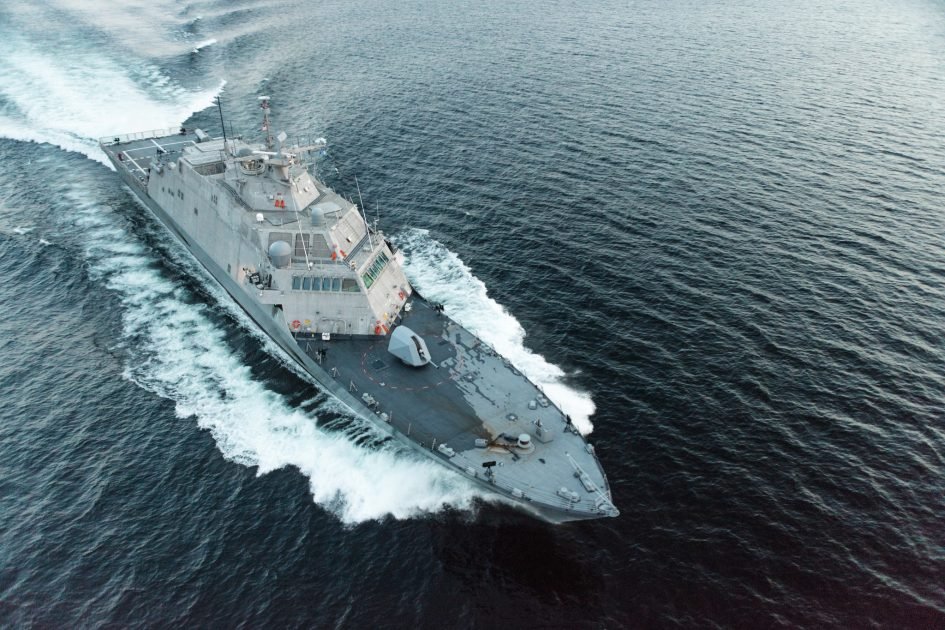
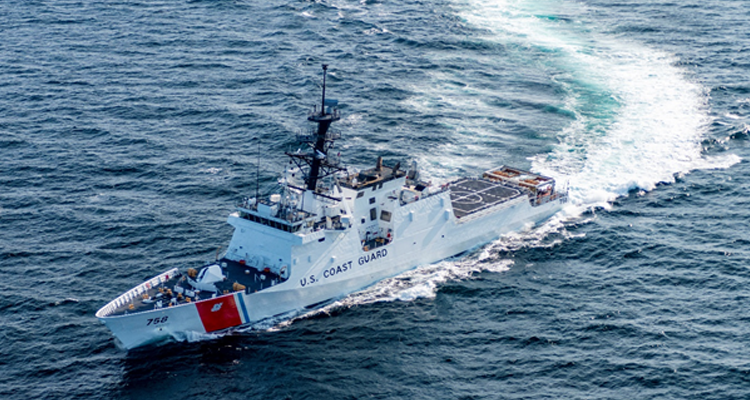
USCGC Stratton (WMSL-752), left, and the U.S. Navy Arleigh Burke-class guided-missile destroyer USS McCampbell (DDG-85) maneuver in formation during Talisman Sabre 2019 on July 11, 2019. US Navy Photo

The July/August issue of the Navy League’s magazine Seapower included a lot of Coast Guard content. I will not try to cover everything included, much of which has already been covered here, but I will mention a few things that stood out for me.

The Commandant’s Interview:

There was an interview with the Commandant, Admiral Schultz, that I found most interesting. There was a fair amount of information that was new to me.

Icebreakers:

Perhaps most significant was a comment regarding the Medium icebreaker.

“We also are looking to build probably a medium breaker, potentially what we’re going to call the Arctic security cutter — a little less capability in terms of icebreaking, but that capability would get us back to being an Atlantic and Pacific icebreaker Coast Guard.(emphasis applied–Chuck)

It may be that, if this ship is intended to transit the St Lawrence Seaway and work part time in the Great Lakes, like Canada’s proposed six “Program Icebreakers,” it would preclude the option of simply building six Polar Security Cutters rather than the three heavy and three medium icebreakers called for in the High Latitude Study. Alternately we might have four heavy Polar Security Cutters (PSC) in the Pacific and two Arctic Security Cutters (ASC) in the Atlantic.

The interview goes on to state, referring to its planned five year long progressive service life extension program, “…we could keep the 44-year-old Polar Star around here probably through the end of the decade if things go well.” (emphasis applied–Chuck)

The Western Pacific:

The Commandant noted that the Coast Guard had advisers in the Philippines, Vietnam, Fiji, and that an additional adviser would go to Malaysia and an attache to Australia to work with Australia and New Zealand. That there would also be an advisor assigned to Guam to work with the Commonwealth of Micronesia and the Federated States of Micronesia.

The Coast Guard is becoming more involved in countering Illegal, Unregulated, and Unreported (IUU) fishing, and will be providing leadership in international forums.

In reference to the forthcoming Tri-Service Maritime Strategy the Commandant said we could expect, “…to see the Coast Guard bring some unique capabilities to that conversation, particularly in the Indo-Pacific region.” 

Unmanned Systems:

Regarding land based systems the Commandant noted, “..we’ve completed prototype deployment of ScanEagle in Puerto Rico and Texas.” and “We teamed with U.S. Southern Command and CBP and employed one of those (MQ-9–Chuck) in an operation out of Panama that proved tremendously successful.”

He also mentions the possibility of using UAS of all sizes and mentioned the possibility of unmanned surface systems as well.

Cyber:

Sighting the FY2021 budget, Admiral Schultz said, “That is one of the biggest growth areas for humans in the Coast Guard here in the past budget cycle or two. There is somewhere north of 150 additional cyber warriors in the budget before the Congress right now.” 

“Insitu’s ScanEagle Performs ISR for Coast Guard”

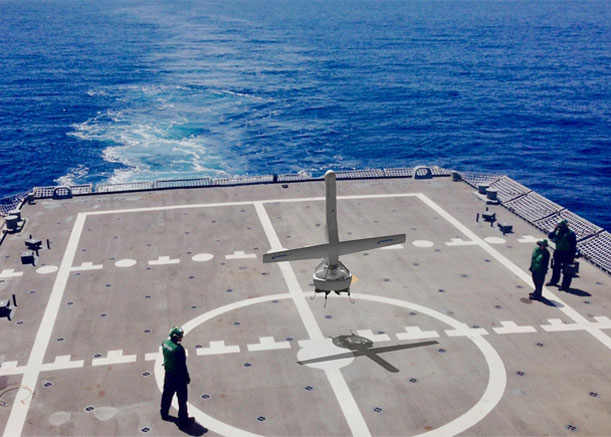
There is a short one page report on the use of ScanEagle. It notes that ScanEagle is currently installed on six National Security Cutters and will be installed on all NSCs.

“A standard pack-out for a deployment of three ScanEagle UASs. The sensor systems include an electro-optical/infrared camera, a laser pointer, a communications relay, an automatic identification system (AIS), and visual detection and ranging (VIDAR)–a surface search capability.”

Interesting that it includes a laser pointer on the Coast Guard aircraft because that is usually used as a designator for laser homing weapons.

“The Era of the New Cutters”

This was a three page story, most of which is familiar to regular readers of this blog, but there was one nugget I had not seen before. “…the Coast Guard still will need to pursue a service-life extension program on six of the ships to ensure sustained fleet capability until the OPC program is finished.”

This almost certainly refers to the service life extension program (SLEP) for 270 foot WMECs. This is, I believe, the first time I have seen a number of ships mentioned, so not the whole class of 13. Notably it is only six so don’t expect a SLEP for 210s. They will soldier on in their current configuration until their long delayed retirement.

“Croatian Brodosplit Shipyard held cutting-steel ceremony of new coastal patrol boats for Croatia Coast Guard” –Navy Recognition

Scale model of the coastal patrol boat for the Croatian Coast Guard. (Picture source Brodosplit Shipyard)

Navy Recognition Reports that first steel has been cut for a new class of patrol boat for Croatian Coast Guard.

The Croatian-made patrol boat will have a length of 43,16 meters (142 feet) and a wide of 8 meters. She will be armed with one 30mm automatic cannon mounted at the front deck and two 12.7mm heavy machine gun, as well as four portable anti-aircraft missiles.

This makes it only slightly smaller than the 154 foot Webber class WPCs. Closer still to the Damen Stan 4207 patrol design (used by at least eleven nations), like the Canadian Coast Guard Hero class.

Two 2525 kW engines would provide 6772HP. That is well under the 11,600 HP of the Webber class, but it should still be good for 24 to 25 knots rather than the 15 knots the report seems to indicate, in apparent confusion with range specification (“…maximum speed of 15 knots with a maximum cruising range of 1,000 nautical miles.”)

Range is notably less than that of the Webber class (2,500 nmi), but Croatia has an EEZ of only 17,211 nautical miles square.

It is unusual in having a CBRN (Chemical, biological, radiological and nuclear) protection system).

Map: Adriatic Sea. Created by Norman Einstein, May 20, 2005.


Offshore Patrol Cutters to be Based in Newport, RI

Artists rendering from Eastern Shipbuilding Group

Below is a Coast Guard Headquarters news release reproduced in its entirety, announcing two Off Shore Patrol Cutters (OPCs) will be homeported at Newport. That the first two OPCs would be based in San Pedro (Long Beach) and the second pair in Kodiak has already been announced, so presumably these are numbers five and six. These would be the first OPCs based on the East Coast, and also the first of the OPCs completed under the not yet awarded second construction contract. Delivery is expected in FY2026 and 2027.

Ultimately I would expect that most basing locations would ultimate support at least three ships. There seems to be a trend in this direction, and it makes sense for engineering and technical support. It also seems to follow a trend of the Coast Guard moving into moorings largely vacated at existing or former US Navy bases, e.g. Charleston, Pensacola, and Corpus Christi.

united states coast guard

 News Release  

U.S. Coast Guard Headquarters
Contact: Headquarters Public Affairs
Office: (202) 372-4630
mediarelations@uscg.mil
Headquarters online newsroom


U.S. Coast Guard announces Offshore Patrol Cutter homeport

WASHINGTON – The U.S. Coast Guard announced today that Naval Station Newport, R.I. will be home to future Offshore Patrol Cutters (OPCs).

“I am excited to announce the homeporting of two Offshore Patrol Cutters at Naval Station Newport, Rhode Island,” said Admiral Karl L. Schultz, Commandant of the U.S. Coast Guard. “NAVSTA Newport provides strategic operational reach and significant logistics support to our Service, helping secure our national interests in the Atlantic. I am grateful to the community and its leadership for their continued support of the U.S. Coast Guard and our families assigned to the region”. 

OPCs are the Coast Guard’s top acquisition priority and will provide the majority of the Coast Guard’s offshore presence, bridging the capabilities of the 418-foot National Security Cutters and the 154-foot Fast Response Cutters. OPCs will conduct missions including law enforcement, drug and migrant interdiction, search and rescue, homeland security, and defense operations. Each OPC will be capable of deploying independently or as part of a Task Group, and be capable of serving as a mobile Command and Control (C2) platform for surge operations such as hurricane, mass migration, or other contingency response operations.  

-USCG-

“General Atomics SeaGuardian UAV To Conduct Validation Flights For Japan Coast Guard” –Naval News

GA-ASI Concludes Successful Series of MQ-9 Demonstrations in Greece

Naval News reports that the Japanese Coast Guard will be testing the General Atomic SeaGuardian beginning in mid-September. There was another demonstration in Greece a few months ago.

“The purpose of the flights is to validate the wide-area maritime surveillance capabilities of RPAS for carrying out JCG’s missions, including search and rescue, disaster response, and maritime law enforcement. The flights are expected to run for approximately two months and will include support from the Japan Maritime Self Defense Force (JMSDF) at its Hachinohe base in Aomori Prefecture.”


The SeaGuardian system will feature a multi-mode maritime surface-search radar with Inverse Synthetic Aperture Radar (ISAR) imaging mode, an Automatic Identification System (AIS) receiver, and High-Definition – Full-Motion Video sensor equipped with optical and infrared cameras….The featured Raytheon SeaVue surface-search radar system provides automatic tracking of maritime targets and correlation of AIS transmitters with radar tracks.

Maybe we ought to ask if we could send an observer.

Why Can’t We Get a Movie Like This?

Forget “Finest Hours” or “The Guardian,” the Chinese have made a real coast guardesque superhero movie, “The Rescue.” Somehow it did not make it onto IMDB, but it did get some love on “Rotten Tomatoes.” There is a review here. It was release in the US, UK, and Canada at the same time it was released in China, January 25, 2020. Maybe it was a victim of COVID-19.

(Does look like maybe they have a nicer “Dilbert Dunker” than we do.)

Thanks to Amanda for bring this to my attention.

Narco Sub, Size XXL

Forbes brings us an article by blogger H I Sutton (Covert Shores), probably the best unclassified source on maritime smuggling technology in the English language, reporting discovery of an exceptionally large self propelled semi-submersible seized by Colombian forces before it could sail. The mystery is why so large and what was it expected to do? My guess–going to the Western Pacific for transshipment somewhere in Oceania.


“NORTHCOM Nominee Supports Building New U.S. Arctic Base for Icebreakers” –USNI

The US Naval Institute News service reports that  Air Force Lt. Gen. Glen VanHerck, nominee to the post of NORTHCOM commander, “told a Senate panel he would support placing a base for the Coast Guard’s new icebreaker fleet in the Arctic.”

That could mean different things. Is it a support base or a home base? There has been talk of a base in the Alaskan Arctic for a while now (here and here). The Alaska Congressional delegation would obvious like investment in additional infrastructure in Alaska.

If the thought is that one or more icebreaker should be homeported at a new port in the Arctic, or anywhere in Alaska, that would be a mistake. The benefits of proximity to the operating are proportional to the number of sorties. The fewer sorties to the operating area, the less important. The Polar Security Cutters will probably have the greatest endurance of any ships in the Coast Guard. They will probably deploy to the Arctic only once or twice a year at most. There are a number of other important considerations.

Where will the ships go into dry dock? Ideally, it should be in their homeport. At least there should be good, reasonably priced, frequent transportation between the homeport and the location of the dry dock.

Where will the crew train? Both as teams and as individuals? A lot of training is done at Naval Bases. How easy is it to get there? There are travel costs to consider.

We should consider the quality of life of both the crew and the dependents. Spouses frequently have careers of their own. Families need or want a second income. Will spouses, who want to work, be able to find a job? A good job, in their career field?

For the next few year we can really only consider what will happen to the first three Polar Security Cutters.

  • For logistics and support reasons, we will want to base all three of the first Polar Security Cutters together.
  • We know the first and second will be used primarily in support of operations in Antarctica.
  • Even when we get three, we would not be able to say that number three will never deploy south.

So basing any of the first three PSCs in Alaska is unnecessary, unwise, and perhaps unworkable.

The Coming Showdown, China vs Japan, Over Islands NE of Taiwan

Image: Facebook

Asia Times offers an analysis of a likely coming confrontation between China and Japan.

“Japan’s Sankei newspaper reports that Beijing has warned the Japanese government that many Chinese fishing boats may soon enter waters near the Japanese-held Senkaku Islands, which China also claims as its Diaoyu Islands.”

The ranking US military representative in Japan says the US will help the Japanese monitor incursions.

“The United States is 100 percent absolutely steadfast in its commitment to help the government of Japan with the situation,” Lieutenant General Kevin Schneider said during an online press conference.

“They (Chinese ships) would go in and out a couple of times a month and now we are seeing them basically park and truly challenge Japan’s administration,” he added.

What is going on?

  • There are likely mineral resources in the EEZ around these islands which China would like to exploit.
  • They would like to turn the South and East China Seas into sovereign Chinese territory to the exclusion of everyone else.
  • The Chinese will always welcome a chance exact a bit of revenge on Japan for the aggression suffered during WWII and earlier.
  • Perhaps most importantly, in the long run, taking over these islands would potentially complete the encirclement of Taiwan with Chinese bases with shore based missiles that could enforce a blockade.

The Chinese may actually have a valid claim to these islands, but they are unwilling to go to an international tribunal with their case, because they cannot add to the legitimacy of tribunal decisions when their other claims would not hold up in international court.

We can expect the Japanese will attempt to use their Coast Guard to deal with this. The Chinese will counter with their own Coast Guard.

We may end up see seeing more ramming than at any time since the Battle of Salamis.

“Japan To Build Six Patrol Vessels For Vietnam’s Coast Guard” –Naval News

Japan Coast Guard(JCG) PL42 Dewa. Photo credit: Wikipedia, No machine-readable author provided. Sizuru~commonswiki assumed (based on copyright claims).

Naval News reports that,

The Vietnamese government signed an agreement with the Japan International Cooperation Agency (JICA) on July 28 to finance a project to build six patrol vessels for the Vietnamese Coast Guard (VCG). The vessels, based on the Aso-class of the Japan Coast Guard (JCG) will be built in Japan.

There are some things that are noteworthy here.

  • Japan has started providing assistance to many of its neighbors and helping to strengthen their coast guards seems to be a favorite method. Helping the Philippines here and here. Malaysia here.
  • In this case it is in the form of a very low interest loan (0.1%) with generous repayment terms, to have ships constructed in Japan (good for the Japanese shipbuilding industry).
  • The speed of construction is also noteworthy, six ship with the last to be delivered Oct. 2025.
  • The cost of each of these 79.0 m (259 ft 2 in) cutters is about the same as that for our Webber class WPCs.

The ASO class has not been built since 2006, but they are smaller and presumably cheaper than the larger classes of Japanese Coast Guard large patrol vessels (PL) that followed. The class was built shortly after the Battle of Amami-Ōshima and apparently incorporated lessons from that engagement including a heavier weapon, the Bofors 40mm/70, and ballistic protection for selected areas of the ship. They are also relatively fast at over 30 knots.

“Watchful Eyes, Task Force Chief: Indo-Pacific Partners Collaborate to Disrupt Traffickers” –Indo-Pacific Forum

Rear Adm. Robert Hayes, director of Joint Interagency Task Force (JIATF) West since April 2019 leads U.S. Indo-Pacific Command’s counterdrug activities

The Indo-Pacific Forum has an interview with Rear Adm. Robert Hayes, director of Joint Interagency Task Force (JIATF) West. He provides a look at the trans-Pacific drug problem including the interdiction of precursor chemicals and Fentanyl.