Second 270 Goes to the Arctic

As part of the Operation Argus search and rescue exercise, U.S. Coast Guard Cutter Tahoma (WMEC 908) and HDMS Triton (F358), a Royal Danish navy vessel, conducted towing evolutions off Greenland Aug. 18, 2020. Interoperability and rescue responses are vital in the high latitudes of the Arctic. (U.S. Coast Guard photo by Seaman Kate Kilroy/Released)

Below is a press release reproduced in its entirety. This operation seems to represent a significant change in Coast Guard operations. This is the first reference to a Coast Guard “Arctic Patrol” I have seen other than WWII historical references. Significantly this is on the Atlantic side. When I have seen the Coast Guard participate in this exercise in the past, it was with a buoy tender. Here we have participation by two 270 foot WMECs. We talked about this exercise earlier here. It seems to mark a change for the US Navy as well as the Coast Guard with a Navy destroyer participating as well. 

united states coast guard

News Release

U.S. Coast Guard Atlantic Area
Contact: Coast Guard Atlantic Area Public Affairs
Office: (757) 398-6521
After Hours: (757) 641-0763
Atlantic Area online newsroom

U.S. Coast Guard carries out support of joint Arctic missions

As part of Operation Nanook, the U.S. Coast Guard Cutter Tahoma (WMEC 908) maneuvers with vessel from the Royal Canadian navy and coast guard, the Danish navy, and French navy, in the Atlantic Aug. 9, 2020. Strong partnerships are imperative to success in the Arctic. (U.S. Coast Guard photo by Seaman Kate Kilroy/Released) Royal Danish navy members attached to HDMS Triton (F358) ran through search and rescue exercises aboard the Coast Guard Cutter Tahoma (WMEC 908) as part of the joint Arctic Operation Argus, Aug. 20, 2020, off Greenland. The Triton crew dispatched small boat crews to board the Tahoma, responding to the ‘distress call’ made by Tahoma. The scenario included multiple ‘injured’ parties and a pipe casualty exercise. Each ship’s crew shared techniques throughout the engagement, leading to a successful evolution. (U.S. Coast Guard photo by Seaman Kate Kilroy/Released) Coast Guard Cadet 1st Class Rochelle Parocha looks on to the Royal Canadian Navy supply vessel Asterix after guiding in the U.S. Coast Guard Cutter Tahoma (WMEC 908) during approach drills as part of Operation Nanook in the Atlantic in mid-August 2020. Strong partnerships are imperative to success in the Arctic. (U.S. Coast Guard photo by Seaman Kate Kilroy/Released)

 Lt. Cmdr. Matthew Fetzner, Lt. Katy Caraway, and Petty Officer 2nd Class Calvin Christianson, an aviation maintenance technician, crew an MH-65 Dolphin helicopter on search and rescue maneuvers above Greenland, Aug. 19, 2020. The team comprises the aviation detachment aboard U.S. Coast Guard Cutter Tahoma (WMEC 908), taking part in joint Arctic Operations Nanook and Argus strengthening relations with strategic partners. They carried out multiple search and rescue drills involving lost hikers along the Arctic Trail and boaters in distress along Greenland's coast. (U.S. Coast Guard photo by Seaman Kate Kilroy/Released) The HDMS Triton (F358), a Royal Danish navy vessel, approaches Greenland as seen from the U.S. Coast Guard Cutter Tahoma (WMEC 908), Aug. 15, 2020. Both vessel crews are participating in the 10th year of Operation Nanook. (U.S. Coast Guard photo by Seaman Kate Kilroy/Released) As part of Operation Nanook, a Royal Danish navy MH-60 Seahawk Helicopter crew conducts cross-deck maneuvers over the U.S. Coast Guard Cutter Tahoma (WMEC 908) in the Atlantic Aug. 10, 2020. Strong partnerships are imperative to success in the Arctic. (U.S. Coast Guard photo by Seaman Kate Kilroy/Released)

The U.S. Coast Guard Cutter Tahoma (WMEC 908) became the first Coast Guard 270-foot medium endurance cutter crew to cross the Arctic Circle, Aug. 17, 2020. They took part in joint Arctic Operations Nanook and Argus, (U.S. Coast Guard photo by Seaman Kate Kilroy/Released) As part of Operation Nanook, U.S. Coast Guard Cutter Tahoma (WMEC 908) boat-crew participates in a search and rescue exercise with the HDMS Triton, a Royal Danish navy vessel Aug. 17, 2020 off Greenland. Operation Argus part of Nanook, focused on search and rescue interoperability, highlights the importance of cooperation between international partners. (U.S. Coast Guard photo by Seaman Kate Kilroy/Released) As part of the Operation Argus search and rescue exercise, U.S. Coast Guard Cutter Tahoma (WMEC 908) and HDMS Triton (F358), a Royal Danish navy vessel, conducted towing evolutions off Greenland Aug. 18, 2020. Interoperability and rescue responses are vital in the high latitudes of the Arctic. (U.S. Coast Guard photo by Seaman Kate Kilroy/Released)

Editors’ Note: Click on images to view more or download a high-resolution version.

KITTERY, Maine  — The U.S. Coast Guard Cutter Campbell (WMEC 909) will relieve the U.S. Coast Guard Cutter Tahoma (WMEC 908) on Arctic patrol, Sunday near Greenland.  

In mid-July, Tahoma began operations for the overall two-month patrol to the Arctic in support of joint operations Nanook and Argus, to secure the maritime domain, protect resources and strengthen partnerships. 

“I’ve been doing this for more than 33 years and thought I’d seen everything until I saw how positively this crew responded. There’s nothing more humbling than being surrounded by such a great crew. Their families and friends should all be proud of them; that they accomplished something important and accomplished it with style. They represented themselves, their families, their Service, and their country as well as could ever be expected. The finest traditions of the Coast Guard are alive and well within the Tahoma crew,” said Cmdr. Eric Johnson, commanding officer, Tahoma. 

As the Nation’s primary maritime presence in the Polar Regions, the Coast Guard advances our national interests through a unique blend of polar operational capability, regulatory authority and international leadership across the full spectrum of maritime governance.  

“The Coast Guard has been in the Arctic for over 150 years,” said Capt. Thomas Crane, commanding officer, Campbell. “This signature exercise began in 2007. We are committed to enhancing our multinational capability to operate effectively in the dynamic Arctic domain, strengthening the rules-based order through the presence and joint efforts, and adapting to promote regional resilience and prosperity. We are proud to bring USCGC Campbell back to Greenland as the previous Campbell (W32) supported Coastal Operations in and around Greenland during World War II.”

These exercises evaluate interoperability and build relationships between responders to identify shortfalls in communication and coordination of efforts. Each agency holds individual capabilities that complement each other’s efforts and bolsters the overall success of the regional defense and SAR system. The purpose is to continue building and improving operational cohesion between different agencies and the Coast Guard.

Tahoma participated in patrols and mutual exchanges with partners as part of Operation Nanook. Inuit for polar bears, Nanook is an annual joint exercise and the Canadian armed forces’ signature northern operation, which comprises a series of comprehensive, joint, interagency, and multinational activities designed to exercise regional defense and secure our polar regions. The Coast Guard is primarily supporting Nanook-Tuugalik, a defense readiness and security exercise, with multiple foreign partners off Northern Canada involving U.S. Navy 2nd Fleet, Royal Canadian navy and coast guard, the Danish navy, French navy, Royal Canadian air force, and multiple Canadian federal, state, local, and tribal agencies. This year crowns a decade of Operation Nanook.

Both Tahoma and Campbell participated in Operation Argus, a three-day search and rescue exercise in Greenland’s coastal search area with the Danish navy, French navy, U.S. Coast Guard, and Air Greenland. Campbell will also conduct exchanges, fisheries boardings to safeguard resources and protect domestic fisheries and serve as a platform for research and innovation.

“We continue to work with our allies and partners to ensure a safe, secure, and cooperative Arctic, even as our aspiring near-peer competitors maneuver for strategic advantage in the area,” said Vice Adm. Steven Poulin, commander, Coast Guard Atlantic Area. “We are leaning forward, and our persistent presence continues to counter those entities’ efforts as the strategic value, economic, and scientific importance of the Arctic grows.”

Tahoma and Campbell’s home port is the historic Portsmouth Naval Shipyard in Kittery, Maine. Both cutters have a crew of roughly 100 who regularly patrol the Atlantic from Canada to the Caribbean. Like the other Famous-class cutters, they are designed and built for multi-mission operations, including law enforcement, search and rescue, marine environmental protection, and defense readiness.

Due to COVID-19, the service is taking extensive precautions and closely monitoring all operations. As needed, unit schedules adapted to ensure missions occur as planned. Any port calls or personnel exchanges are evaluated for risk and conducted in close coordination with the host nation and relevant agencies.

USCGC Mellon Decommissioned

USCGC Mellon [WHEC 717] sits in full dress at the pier before a decommissioning ceremony in Seattle on Aug. 20, 2020. USCGC Mellon was a High Endurance Cutter homeported in Seattle and served as an asset in completing Coast Guard missions around the world for 52 years. (U.S. Coast Guard photo by Petty Officer 3rd Class Michael Clark)

The following is a news release reproduced in its entirety. One less cutter in PACAREA. Only one operational 378 remaining in the Coast Guard. 

united states coast guard

News Release

Aug. 21, 2020
U.S. Coast Guard Pacific Area
Contact: Coast Guard Pacific Area Public Affairs
D11-DG-M-PACAREA-PA@uscg.mil
Pacific Area online newsroom

Coast Guard decommissions cutter after 52 years of service

Coast Guard Cutter Mellon (WHEC 717) completes final patrol Coast Guard high endurance cutter decommissioned after 52 years of distinguished service
Coast Guard Cutter Mellon Decommissioning Ceremony Coast Guard Cutter Mellon Decommissioning Ceremony Coast Guard Cutter Mellon Decommissioning Ceremony

Editors’ Note: Click on images above to download full-resolution photos and videos.

SEATTLE — The Coast Guard decommissioned the Coast Guard Cutter Mellon (WHEC 717) during a ceremony Thursday held at Coast Guard Base Seattle and presided over by Rear Adm. Peter Gautier, the deputy commander of the Coast Guard Pacific Area.

Mellon was one of the Coast Guard’s two remaining 378-foot Hamilton-class high endurance cutters. The fleet of high endurance cutters is being replaced by 418-foot Legend-class national security cutters, which serve as the Coast Guard’s primary long-range asset.

Commissioned in 1968, the Mellon was the third of twelve high endurance cutters built for long-range, high-endurance missions, including maritime security roles, drug interdiction, illegal immigrant interception and fisheries patrols.

“While Mellon’s service to the U.S. Coast Guard now ends, the ship will continue its legacy of good maritime governance after transfer to the Kingdom of Bahrain’s Royal Naval Force,” said Gautier. “I am incredibly confident in the Coast Guard’s future, because in Coast Guard Cutter Mellon’s crew and proud history, I see the attributes that have made our Coast Guard ‘Always Ready’ for more than two centuries.”

Mellon’s keel was laid July 25, 1966, at Avondale Shipyards in New Orleans. Mellon was launched Feb. 11, 1967, and commissioned Jan. 9, 1968. The cutter was named after Andrew W. Mellon, the 49th Secretary of the Treasury from 1921-1932.

Over the past 52 years of service, Mellon’s crews conducted a wide range of diverse operations in all parts of the world. From 1969 through 1972, Mellon’s crews participated in the Vietnam War, performing several naval gunfire support missions and patrolling Southeast Asian waters to prevent the smuggling of weapons into Vietnam. Mellon’s participation in the Vietnam War earned the ship the Navy Meritorious Unit Commendation.

In the late-1970s and 1980s, the Mellon responded to numerous major search and rescue operations, including their assistance in the rescue of 510 passengers and crew members from the burning luxury liner Prinsendam in 1980.

In 1985, the Mellon entered the Fleet Renovation and Modernization program, a dry dock program designed to prolong high endurance cutters’ service life. Mellon was recommissioned March 3, 1989.

Living up to the Mellon’s motto “Primus Inter Pares,” meaning first among equals, the cutter established several Coast Guard firsts, including the first of five Hamilton-class high endurance cutters to have a Harpoon anti-ship missile system installed. Mellon was also the first, and only, Coast Guard cutter to test fire a Harpoon missile.

During Bering Sea patrols, Mellon conducted search and rescue operations and enforced laws and regulations that preserved vital Alaskan fisheries. In the Eastern Pacific, the Mellon’s boarding teams interdicted illegal narcotics trafficked over the high seas.

During the cutter’s last year of service, 20 officers and 160 enlisted crew members patrolled the Bering Sea and the Northern Pacific Ocean near Japan for more than a combined 230 days, collectively conducting 100 safety and fisheries boardings of U.S.-, Chinese-, Korean-, Japanese- and Russian-flagged fishing vessels and participating in five search-and-rescue cases.

“It has truly been an honor to serve as the final commanding officer for Coast Guard Cutter Mellon,” said Capt. Jonathan Musman. “The officers, chiefs and crew for this final year have been truly remarkable and can hold their heads high as they operated Mellon with distinction across the North Pacific on three deployments serving our nation. The reliability of the cutter is a product of years and years of properly taking care of this beloved cutter. The legacy of Mellon has been those fantastic memories that have been made and the knowledge that has passed from one shipmate to another. The future generations of cuttermen were here this last deployment learning, teaching and making their shipboard memories, and they are ready to carry on and continue the Coast Guard’s seagoing heritage.”

“Defense Unit Certifies Five Small Commercial UAS for Government Use” –Seapower

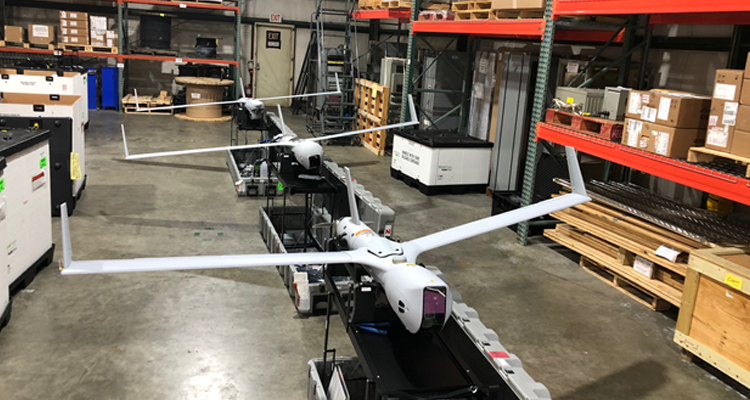
Puma LE (long endurance) unmanned aircraft. Photo from Aerovironment

Come September you will be able to get your small unmanned air system off the GSA schedule.

The Navy Leagues magazine Seapower reports that,

“The Defense Innovation Unit (DIU), a Department of Defense organization that accelerates commercial technology for national defense, announced the availability of five U.S.-manufactured drone configurations to provide trusted, secure small Unmanned Aircraft Systems (sUAS) options to the U.S. government, the Pentagon said in an Aug. 20 release. “

“Russian navy will create an Arctic group of tanker ships of Project 23130” –NavyRecognition

Project 23130 is a series of medium-size replenishment oilers developed by the Spetssudoproect JSC and built by Nevsky Shipyard for the Russian Navy. (Picture source Nurlan Aliyev Twitter account)

NavyRecognition reports that the Russian Navy is building a fleet of six ice-capable underway replenishment tankers. The ships are relatively small,

“Project 23130 tanker has a displacement of 9 thousand tons. It is 130 meters long and 21 meters wide. The maximum speed is 16 knots. The autonomous navigation can last two months. The maximum range is 8 thousand nautical miles. The tanker can operate in 0.8-meter thick Arctic ice.”

But on the other hand the US Navy has nothing comparable.

The article also seems to point to a serious shortage of underway replenishment vessels in the Russian Navy.

Looking for the Next Generation Cutter Boat

Petty Officer 2nd Class Dale Veverka, a boatswains mate, Seaman George Degener, and Petty Officer 2nd Class Joshua Post, a machinery technician, conduct maneuvers on the Coast Guard Cutter Northland’s “over-the-horizon” small boat during transit to Rio De Janeiro, Brazil, April 9, 2008. UNITAS exercise, a multinational naval exercise the helps tests the interoperability of U.S. and foreign naval forces. U.S. Coast Guard photo by PA2 Nathan Henise.

Below is a press release from the Acquisitions Directorate (CG-9):

The Coast Guard released a request for proposal (RFP) Aug. 13, 2020, for the next generation of over-the-horizon capable cutter boats (OTH-V). The RFP is available here.

Proposals are due by noon (EDT) Oct. 12, 2020.

Following on the success of the OTH-IV program, the OTH-V is viewed as an evolutionary step in providing capability for the Coast Guard’s major cutter fleet. The program is designed to expand the service’s mission readiness and meet the Coast Guard’s cutter-based surface prosecution needs for the next decade. With an estimated production of close to 200 boats, the OTH-V will be the primary cutter boat for the Coast Guard’s major cutters.

The acquisition is being conducted in two phases. In the first phase, evaluation of the submitted proposals will result in up to four individual awards. Each awardee will produce a single boat that will be used to demonstrate the boat’s capabilities in selected scenarios. The second phase will update the initial evaluations based on the demonstration, leading to selection of a single best-value boat to move into production.

OTH-V notional characteristics include a top speed of 38 to 42 knots powered by a diesel engine with waterjet and a range of 150 to 200 nautical miles. The boat will carry up to 13 people, with dimensions limited to 26 feet long by 8.5 feet wide, and a performance weight of approximately 8,700 pounds.

The OTH-V will continue to consolidate boat classes, generating efficiencies in training and supportability. The delivery schedule calls for production and deliveries of 12 to 24 OTH-Vs per year starting in 2023.

Cutter boats deployed aboard cutters facilitate mission accomplishment in almost all mission areas, with emphasis on search and rescue, drug interdiction, alien migrant interdiction operations, living marine resources, defense readiness, and ports, waterways and coastal security.

For more information: Boat Acquisition program page. Previous industry engagement materials can be found under the resources tab at the bottom of the page.

Munro Participates in RIMPAC 2020

US Coast Guard Cutter Munro departing from the dock in San Diego. Photo Credit: Tom Brossman

US Naval Institute News Service reports on the start of a scaled down RIMPAC 2020. Among the ships participating is the National Security Cutter USCGC Munro.

Australia has sent a particularly large contingent, second only to that of the US, a destroyer, two frigates, and an oiler. No other countries sent more than two ships.

Brunei’s contribution, KDB Darulehsan (OPV 07) will be interesting. It is the same basic design as the twelve OPVs being built for the Australian Navy. She is reportedly equipped with 4 × Exocet MM40 Block 3. Will be interesting to see if she is shooter during the exercise.

Nice to see the photo below of USS Essex (LHD-2) looking very much like a WWII aircraft carrier, bringing WWII vintage aircraft to Hawaii where they will commemorate the 75th anniversary of the end of WWII.

USS Essex (LHD-2) arrives at Pearl Harbor, Hawaii for RIMPAC 2020 on Aug. 10, 2020. US Navy Photo

“Turkish Coastguard Orders 122 Patrol Boats” –Marine Link

ARES 35, Turkish CG patrol boat. Photo: ARES shipyard

MarineLink reports,

“ARES Shipyard in Antalya, Turkey has been awarded a contract to build 122 patrol boats for the Turkish Coastguard.”

These will be 12-meter Fiberglass Reinforced Plastic [FRP] and carbon composite.

Deliveries are expected over a five year period at a rate of 36 boats per year.

440 kW (590 HP) is routed though water jets provided by HamiltonJet.

“Access to HamiltonJet is unrestricted with the global headquarters and factory in New Zealand complemented by Regional Offices in the USA, UK and Singapore, and our distribution network in over 55 countries worldwide.”

The Turks have a history of making some very fast patrol boats.

Manning Requirements, New Fleet vs Old

W B Young asked a question, wondering if perhaps the crew requirements for the new fleet of patrol cutters might be significantly greater than for the fleet being replaced. I ran the numbers and was surprised by the answer.

The program of record was for 91 new ships (8 NSCs, 25 OPCs, and 58 FRCs) to replace a legacy fleet of 90 ships (12 WHECs, 29 WMECs, and 49 Island class WPBs). Instead it appears we are building a fleet of 100 ships (11 NSCs, 25 OPCs, and 64 FRCs). I will compare the 90 ship legacy fleet with the 100 vessel fleet we are building.

Replacing the WHECs: 

In a recent interview by Seapower Magazine the Commandant was asked, “Does the Coast Guard have enough people to man these new cutter coming online?” He really only talked about the NSC/WHEC comparison, but he did provide crew numbers for each, 178 for the 378s and 128 for the NSCs.

The crews of the Coast Guard Cutters Midgett (WMSL 757) and Kimball (WMSL 756) transit past Koko Head on Oahu, Hawaii, Aug. 16, 2019. The Kimball and Midgett are both homeported in Honolulu and two of the newest Coast Guard cutters to join the fleet. (U.S. Coast Guard photo by Petty Officer 3rd Class Matthew West/Released)

We are replacing twelve 378 foot WHECs with eleven Bertholf class, so:

  • Old Fleet, 12 x 178 = 2136
  • New Fleet, 11 x 128 = 1408

A reduction of 728.

Replacing the WMECs:

The legacy fleet of 29 WMECs included Alex Haley, Acushnet, fourteen 210s, and thirteen 270s. We have pretty good figures for the crew size of these older ships. For the 25 projected OPCs, we have only the figure for accommodations, 126. I have assumed the crew size will be the same as for the 270s, 100, but it might be more like 110.

OPC “Placemat”

Old Fleet total: 2524

  • 270s: 13 x 100 = 1300
  • 210s: 14 x 75 =1050
  • Alex Haley       99
  • Acushnet         75

New Fleet, 25 x 100 = 2500

For a reduction of 24. On the other hand, if the OPC crew is 110, we have an increase of 226.

Replacing the Island class WPBs:

The Coast Guard Cutter Naushon (WPB 1311) 110-foot Island-class patrol boat and crew conduct training in Kachemak Bay near Homer, Alaska, Feb. 16, 2018.(Picture source U.S. Defense Visual Information)

64 Webber class are replacing 49 Island class 110 foot WPBs. Actually we were down to 41 of the 110s before the FRC contract was awarded because of the abortive attempt to lengthen eight of the class by 13 feet. All eight were withdrawn from service in 2006.

The Coast Guard Cutter Donald Horsley conducts sea trials off the coast of Key West, Florida, on April 5. The Donald Horsley is the Coast Guard’s 17th fast response cutter and was commissioned in San Juan, Puerto Rico, on May 20, 2016. (U.S. Coast Guard photo by Eric D. Woodall)

This is where we see a significant increase. The crews of the 110s was nominally 16, though they may have carried more. For the crew of the Webber class WPCs I used 24, though the original crew was, I believe, supposed to have been 22.

  • Old Fleet: 49 x 16 =  784
  • New Fleet: 64 x 24 = 1,536

An increase of 752.

Perfection Achieve?:

So to add it all up:

Old Fleet

  • WHECs 2136
  • WMECs 2524
  • WPBs      784
  • Total     5444

New Fleet

  • NSCs 1408
  • OPCs 2500
  • FRCs  1536
  • Total   5444

Wow, how did that happen, so should be no problem right? Maybe not.

The Timeline: 

Since the this particular Legacy fleet existed, a number of things have happened to reduce the number of afloat billets.

Eight Island class WPBs were decommissioned after the attempt to lengthen them, a 128 billet decrease.

Acushnet was decommissioned, a 75 billet decrease.

378s have been decommissioned faster than NSCs have replaced them. Instead of twelve 378s we now have eight NSCs and two 378s, 24 billets less than the ultimate NSC fleet and 756 fewer than the legacy WHEC fleet.

Billet decreases due to replacement of 378s by NSCs is running ahead of billet increases as a result of replacing 110s with FRCs. About 73% of the NSCs have been commissioned compared to only about 60% of the FRCs.

So we have already seen all the saving we will see from the introduction of the NSCs but not all the increases we expect to see from the introduction of FRCs, I am estimating we will need about 300 additional billets to crew the yet to be completed FRCs.

So the fleet has already seen all the reductions in crew size and for the next few years, we should see an increase in the total number of billets. It appears we will have to add a bit over 500 additional billets to what we currently have.

This may have something to do with the decision to decommission some 87 foot Marine Protector class WPBs without replacement.

A question remains regarding support billets. Will these more complex ships require more support billets ashore?

More perspective. 

The legacy fleet composition used for comparison here represented the Coast Guard fleet during the period after Storis was decommissioned in 2007 and before Acushnet was decommissioned in 2011. If we look back to 2000  we will see that the Coast Guard had all 90 of these ships plus Storis and two more 210s, another 234 afloat billets.

“Closing the Gap at Home: The Future of Intel-Led Policing in the Coast Guard” –USNI Blog

A boarding team from the Coast Guard Cutter Mellon (WHEC 717) approach a fishing vessel on the high seas in January 2019 while patrolling in support of counter-Illegal, Unregulated and Unreported fishing and global security missions. Mellon’s crew is supporting international fisheries on the high seas and enforcement of the Western Central Pacific Fisheries Commission (WCPFC). (U.S. Coast Guard photo by Coast Guard Cutter Mellon)

The US Naval Institute blog has a post by Lieutenant Commander Jeff Garvey, USCG, with a whole raft of recommendations for how to improve Coast Guard law enforcement. It is mostly outside my wheelhouse, other than that I enjoyed a great relationship and enjoyed significant success working with PACAREA LE intelligence. They were a great team. Looks like he may know what he’s talking about.

Basing for Larger Patrol Cutters

W B Young asked,

“I was wondering if they are going to base these two WMSM in R.I., what base/homeport is losing ships to make up for this? What with 25 tentative WMSM replacing 28 current WMEC some homeport(s) were already going to be losing a currently based ship{s}”

Trying to answer this turned out to be a bit more than I wanted to put in just a comment. I am going to look at homeports for the larger patrol cutters, WHECs, WMECs, OPCs, and NSCs, breaking it down by district, as we move toward 36 large patrol cutters (11 NSCs and 25 OPCs).

Keep in mind these changes will not happen quickly. First OPC is not expected to be delivered until 2022 and then only one per year through 2028. Then only two per year, so we are looking at #25 arriving in 2037.

TRENDS:

There are some trends that seem to be playing out here:

  • Fisheries, Alien Migrant interdiction, and D7 drug interdiction are increasingly being done by Webber class WPCs.
  • Ships of a class are increasingly being based in groups of three or more for better support.
  • 210s are being moved South where they are closer to the Caribbean and Eastern Pacific drug interdiction areas and where the weather is less demanding.

LOOKING BACK: 

When I looked at homeports in 2015:

  • There were six large cutters in CGD1, three in Portsmouth, NH/Kittery, ME (two 270s and one 210) and three 270s in Boston.
  • There were nine in D5, six 270s and three 210s.
  • Nine in D7, two NSCs, two 270s, and five 210s.
  • D8, two 210s
  • A total of 26 in LANTAREA
  • In PACAREA, 14 total, three NSCs, seven 378s, one 282, and three 210s (That is really 11 “high endurance cutters” (NSCs, 378s, and Alex Hailey, rated a WMEC but really an HEC) and three 210s).

WHAT WE HAVE NOW

Currently we have 38 large patrol ships, already down two:

  • D1, five 270s
  • D5, Total of eight, six 270s and two 210s
  • D7, no change, Total of nine, two NSCs, two 270s, and five 210s
  • D8, Four 210s
  • LANTAREA total 26
  • PACAREA total twelve, six NSCs, two 378, one 282, three 210s

The LANT total has not changed, but D1 and D5 have each donated a 210 to D8.

PACAREA is down two ships. One from D11 and one from D13.

What we know about the future:

The last two 378s, both in PACAREA, will not last much longer.

Three more Bertholf class NSCs are going to be based in D7 at Charleston. As unlikely as it may seem, this is actually closer to the Eastern Pacific drug transit zone than San Diego.

The First two OPCs will go to San Pedro. The second pair will go to Kodiak. The third pair will go to D1 in Newport, RI.

What will happen to Alex Haley when the two OPCs arrive in Kodiak is not clear, but there is a good chance it has more life in it than many of the 210s. It is newer and more capable than any of them. In many ways it is close to a SLEPed 270. Hopefully it will be kept on.

Six 270s will undergo life extension program renovations. My presumptions are that,

  • These will probably last about a year, but hopefully less for later ship after we acquire some experience.
  • We will do only one at a time,
  • That the crew that brings it to be renovated will be reassigned, and
  • That a new crew will be assigned, much as if it were new construction.
  • After renovation it is likely that the ship will be assigned to a new homeport.

These renovations will need to start relatively soon. We need to complete the project by 2027, if we are going to get at least 10 years service out of all six before the 25th OPC is completed in 2037. (Wonder if perhaps we can install more powerful engines to get a bit more speed.)

The four OPCs going to PACAREA are really replacing four WHECs not WMECs. There used to be 10 WHECs on the West coast. When the two Webber class currently planned to be homeported in Astoria arrive, they may effectively start to replace the West Coast 210s in PACAREA.

PURE SPECULATION: 

This is what I think we will see, as all the WHECs and WMECs disappear and we are left with eleven NSCs and 25 OPCs.

We will certainly see homeport changes as the healthier ships are moved to ports vacated by those being decommissioned.

As their SLEPs are completed, 270s will replace 210s in D7 and/or D8. Those 210 will then be decommissioned or moved to replace other 210s that are decommissioned. Will be interesting to see if we simply decommission a 210 whenever an OPC is commissioned, or will we do a sequence for the first few ships, commission an OPC, but wait until a 270 completes SLEP before decommissioning a 210. It would be a way to maximize cutter days. The SLEP is going to cost us some ship years.

First District will end up with four OPCs. All probably in Newport, RI. Boston and Kittery will probably loose all their large patrol cutters.

Fifth District will end up with six OPCs. All homeported close together in Virginia, in one or two locations.

Seventh District will, we know, have five NSCs in Charleston, I suspect five OPCs for a total of 10 ships. Currently D7 has large patrol cutters based in five ports: Charleston, Mayport, Cape Canaveral, Key West, and St. Petersburg. Likely only two or three will continue to host this class of ship. Charleston is a certainty. My guess is that Mayport and Cape Canaveral will loose their patrol Cutters. Key West and possibly St. Petersburg (less likely) will have OPCs. Charleston could host OPCs as well, which would probably mean none in St Pete.

The Eight District will have four OPCs, probably all in Pensacola.

The number of large cutters in PACAREA will soon drop to 10 but will ultimately work back to 12, a total of six NSCs and six OPCs. Where do those last two OPCs go? Best guess–to San Pedro for a total of four, but it could be two to San Diego (still close to San Pedro) or one each to San Pedro and Kodiak.

Eleventh District will end up eight, four NSCs and four OPCs.

Thirteenth District will end up with no large patrol cutters, but will host three Polar Security Cutters. Could be wrong. Those last two PACAREA OPCs could end up in D13.

Fourteenth District will have two NSCs.

Seventeenth District will have two OPCs.

Readers with rationale why my suppositions are wrong, please weigh in.

The crew of USCGC Kimball (WMSL 756) arrive in Honolulu for the first time Dec. 22, 2018. Known as the Legend-class, NSCs are designed to be the flagships of the Coast Guard’s fleet, capable of executing the most challenging national security missions, including support to U.S. combatant commanders. (U.S. Coast Guard photo by Chief Petty Officer Sara Muir/Released)