The M3E1 is an updated M3, by using titanium, the weapon system is six pounds lighter, 2.5 inches shorter and has an improved carrying handle, extra shoulder padding and an improved sighting system that can be adjusted for better comfort.
We have at least some indication that the Israelis are equipping their Super Dvora MkIII patrol boats with these, or at least something similar.
The US Marine Corps apparently thinks very highly of this weapon because they plan to equip every squad with one. The US Army is only slightly less enthusiastic. The intend to equip every platoon with one.
Essentially it is a man portable shoulder fired artillery piece. The range is relatively short but there have been numerous improvements with more to come. There is already a new confined space round that minimizes the effect of backblast that has been a disadvantage of recoilless rifles.
A new guided round, expected to be demonstrated in 2020, should increase effective range to 2000 meters.
An illustration of HawkEye 360’s first satellite constellation, called Pathfinder, orbiting Earth. HawkEye 360/UTIAS Space Flight Laboratory
Back in November, SpaceX fired off a Falcon 9 Rocket with 64 satellites aboard. Among the 64, along with two for the Coast Guard to improve Arctic communications, were a cluster of three called Pathfinder, intended to look for emissions from vessels that would rather not have their location known, including pirates, smugglers, and particularly vessels engaged in Illegal, Unreported, and Unregulated fishing. According to Business Insider,
“The trio of spacecraft belong to a startup called HawkEye 360, and they’re designed to “see” radio signals from space. The company’s software will take unique radio signals coming from ships to “fingerprint” vessels, track them over time, and even forecast future movements.”
Reportedly the satellites can detect and locate radio frequency signals of at least one watt, including satellite phones, push-to-talk radios, and marine radars.
“In addition to fingerprinting such vessels, HawkEye 360’s machine-learning algorithms will also be able to determine typical activity patterns for a ship and flag any unusual deviation. ”
“In the future, they aim to launch five more three-satellite clusters, which will create a constellation that can map Earth’s radio signals once every 30 to 40 minutes.”
Supposedly, the results will be available commercially. Since the same software will also find military vessels I have to wonder if that data will be scrubbed before release?
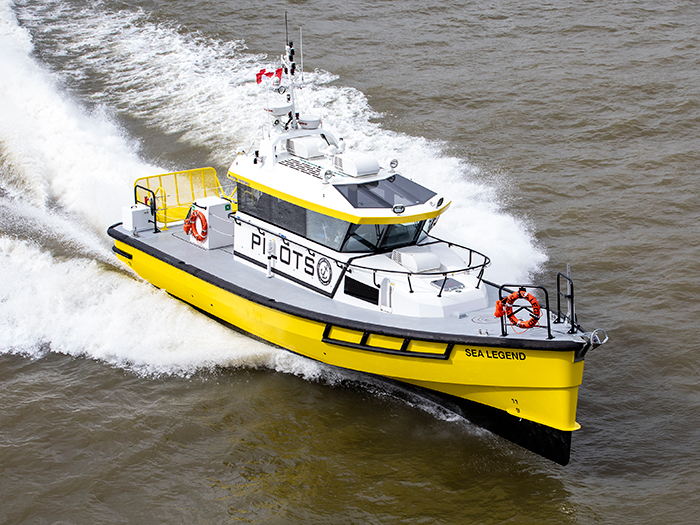
Canada’s Sea Legend Pilotage’s Damen composite FRP hulled Stan Pilot 1605
Another interesting, relatively fast heavy weather boat with an added feature, a man-overboard scoop, built for a Canadian pilot organization.
Plus it is built of composites.
After being built at Damen’s specialist in composite construction, Damen Shipyards Antalya, Turkey, the Stan Pilot 1605 FRP was outfitted at Damen Shipyards Gorinchem, the Netherlands, where Transport Canada was able to inspect the vessel.
According to Damen’s naming convention, the boat has a length of approximately 16 meters (52.5′) and a beam of approximately five meters (16.5′).
The man-overboard recovery system has got to be of interest to a SAR organization.
The scoop is a sophisticated piece of kit that retrieves people from the water and can be used even when the person has lost consciousness. The control for this function is located at the stern, from where the vessel can also be controlled during an emergency.
This reminded me of an earlier post that featured a man in the water recovery system.
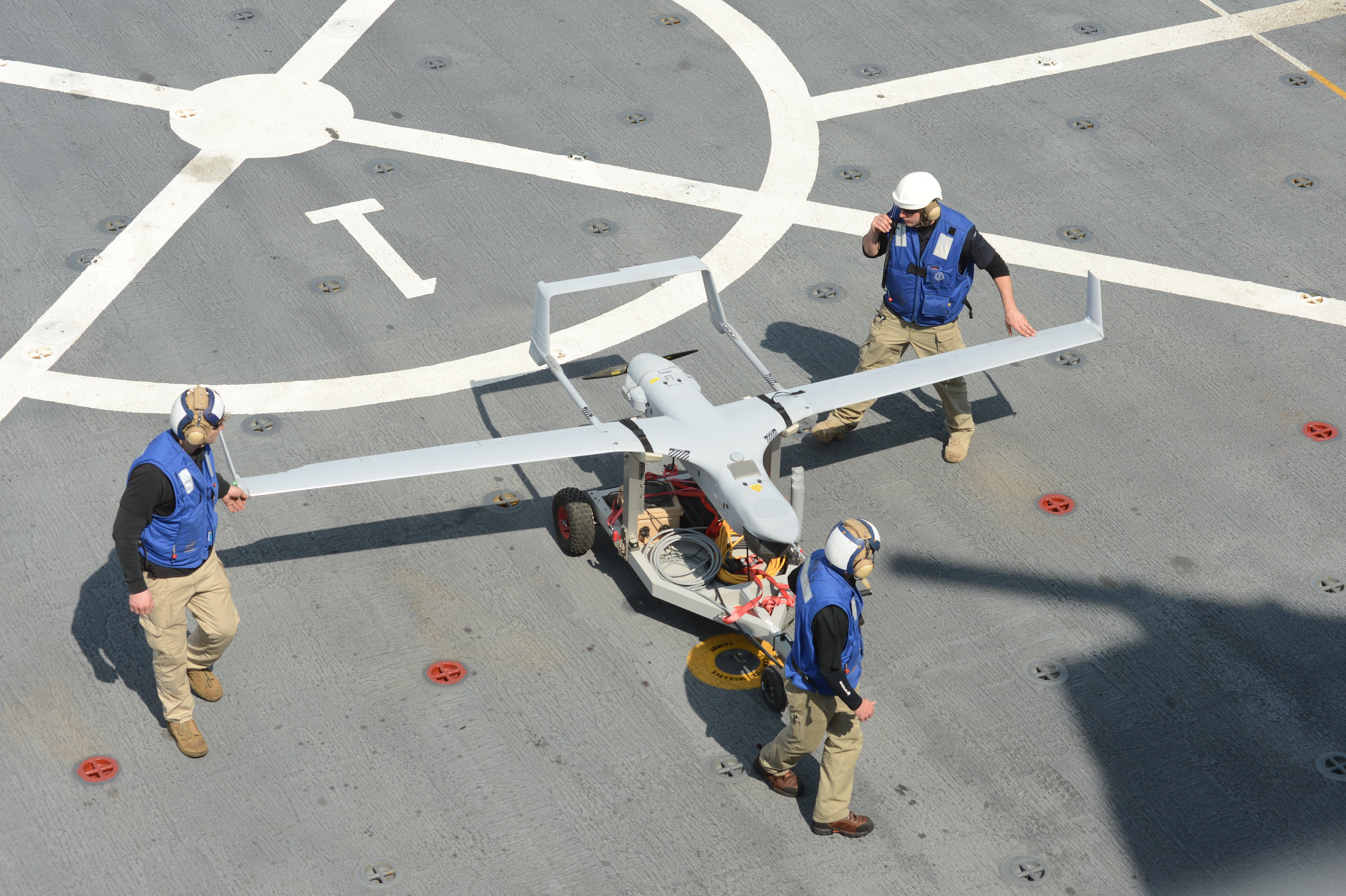
GULF OF MEXICO (Feb. 10, 2013) Members of the RQ-21A Small Tactical Unmanned Air System (STUAS) test team transport the RQ-21A across the flight deck of the amphibious transport dock USS Mesa Verde (LPD 19) after its first flight at sea. (U.S. Navy photo by Mass Communication Specialist 3rd Class Sabrina Fine/Released) 130210-N-NB538-195
The Navy League’s Magazine Seapower reports that “a synthetic aperture/ground moving target Indicator Radar Payload and has been given the prototype designation AN/DPY-2()” for the MQ-21 Blackjack.
The Coast Guard has always wanted their unmanned air system (UAS) to have a radar system and the Scan Eagle that the Coast Guard has contracted for has been tested with a radar from this manufacturer. I am not sure if Coast Guard Scan Eagles are radar equipped, but, if not, it appears that radar equipped small UAS are a definite possibility.
The RQ-21 Blackjack is, like the Scan Eagle, made by Boeing Insitu. It is heavier, 135 lb (61 kg) vs 48.5 lb (22 kg) max takeoff weight, with a correspondingly larger payload weight, but like the Scan Eagle it launches from the same launch and recovery systems.
The radar may be a bit large for Scan Eagle, but apparently not for the Blackjack.
The NSP-5 delivers high-performance capabilities despite its small size, weight and power characteristics. Commercially, the NSP-5 is available in a standard pod configuration that measures 5.4 inches (13.7 centimeters) in diameter and 45.3 inches (115 centimeters) in length, weighs 16 pounds (7.3 kilograms) and consumes 150 watts of power.
An announcement from the Bay Area Chapter of Surface Navy Association:
Bay Area SNA,
Welcome home to WAESCHE as they returned Monday and safe sailing to MUNRO as they just departed!
Much of the Bay Area chapter leadership will be transferring this summer –including me. We will be hosting elections and would like to develop a roster of candidates who would be interested in serving in leadership roles. You will find serving as a member of the Bay Area chapter leadership as a good way to network and impact the lives of the Coast Guard community in the Bay Area. We are consistently one of the most active SNA chapters nationwide and a new leadership team will ensure that we continue to advocate and support the community.
LCDR Chris Klein will stay on as Vice President to support the transition, but we are seeking members to run for President (preferably an O-5 to O-6), Treasurer, Secretary, and Membership Coordinator. We are very interested in bolstering our candidates with members of the enlisted work force in particular. Please consider running for one of the positions and if you know of someone who would be a good addition to the team, please suggest they join the SNA and run for one of the positions as well. Please direct them to the Surface Navy Association site at http://navysna.org/membership/whyjoin.html.
To put your name in the hat for a leadership role in the Bay Area SNA, please just send an email to LCDR Chris Klein no later than 20 April. He will compile an email for members to vote on nominated candidates and compile the results of our e-election.
U.S. Coast Guard Commandant Adm. Karl Schultz testifies before the U.S. Senate Committee on Commerce, Science and Transportation on April 4, 2019. US Coast Guard Photo
Correa said in his opening remarks, “this budget proposal [for the Coast Guard and Transportation Security Administration] is dead on arrival.” He cited the president’s repeated requests on providing money for a border wall between the United States and Mexico at the expense of other Homeland Security programs as the reason.
“The president proposes cutting over a billion dollars from the TSA and Coast Guard budgets to pay for the wall,” Correa said.
Camarc designed 56′ Pilot Boat being built by Vigor for LA Pilots. Source: Vigor
Below you will find a press release from Vigor regarding construction of new Pilot Boats for Los Angeles. I am passing it along because pilot boats like Coast Guard motor surf boats have to deal with nasty weather, so they tend to be similar in many ways. They do provide a pretty good description of these boats.
SEATTLE, WASH., USA – (April 10, 2019) The Port of Los Angeles recently awarded Vigor the contract to build two 56’ pilot boats. Camarc pilot boats are widely acknowledged worldwide as the gold standard for design quality and reliable performance, particularly in more extreme environmental conditions. This smaller boat currently used throughout Europe, Australia and South America delivers the same consistent performance as the larger boats to the US mid-sized market.
The boat features a twin chine heavy weather hull form for excellent seakeeping. The design accommodates multiple heavy fender systems facilitating safer pilot transfers in challenging weather. An articulated rescue davit provides man overboard recovery. The overall design also maximizes the available horsepower and performance from a Tier III (non-catalyst) level engine.
“Vigor is excited to be able to offer these pilot boats to the dedicated professionals of the LA Port Pilots,” said Art Parker, Vigor sales manager. “Camarc has optimized this design to incorporate the significant seakeeping and safety of the larger pilot boats. The American mid-sized market has needed a world-class pilot boat at an acceptable acquisition and maintenance cost. This is without a doubt a proven break-through design.”
Vigor expects to complete construction of the boats by late summer of 2020.
Principal Characteristics
All Aluminum Construction
Accommodates 2 crew/8 pilots
Designer: Camarc Design
Max speed: 27 knots
Cruise speed: 24 knots
Length, Overall: 55 ft – 4 in
Beam, Overall: 16 ft- 5 in
Fender System: Heavy Weather integrated Popsafe fender
Photo: Maritime Enforcement Specialist 2nd Class Joe Kelly, a U.S. Coast Guardsman, demonstrates tactical combat casualty care during a training session at Phoenix Express on March 26, 2019. ARIF PATANI/U.S. NAVY
Stars and Stripes reports on Exercise Phoenix Express 2019 and apparently the Coast Guard was there. It makes sense because this, like Exercise Obangame Express, was a law enforcement capacity building exercise sponsored by U.S. Africa Command (AFRICOM). I have reproduced a Navy news release below.
——-
CASABLANCA, Morocco (NNS) — Exercise Phoenix Express 2019, sponsored by U.S. Africa Command (AFRICOM) and facilitated by U.S. Naval Forces Europe-Africa/U.S. 6th Fleet (CNE-CNA/C6F), concluded with a closing ceremony held at the Royal Moroccan Naval Simulation and Training Center, April 6.
Phoenix Express is designed to improve regional cooperation, increase maritime domain awareness, information-sharing practices, and operational capabilities in order to enhance efforts to promote safety and security in the Mediterranean Sea.
The complexity of today’s security environment and the interconnectedness of a global economy demand that we operate together to deter maritime threats,” said Rear Adm. Matthew Zirkle, Chief of Staff, U.S. Naval Forces Europe-Africa/U.S. 6th Fleet. “An effective global security strategy therefore must be collaborative in order to disrupt the flow of illicit trafficking and prevent the spread of violent extremism.”
This year’s exercise control group was hosted at the Royal Moroccan Naval Simulation and Training Center located in Casablanca, Morocco with training taking place throughout the Mediterranean Sea, to include territorial waters off the coast of northern African nations.
The at-sea portion of the exercise tested North African, European, and U.S. maritime forces abilities to respond to irregular migration and combat illicit trafficking. Additionally, forces participated in a port exercise (PORTEX), which incorporated Moroccan law enforcement into the scenario.
“Exercises like Phoenix Express are about working together to combat threats at-sea that impact safety and security ashore,” said Capt. Matthew Hawkins, U.S. exercise lead for Phoenix Express. “Our modern challenges are far too complex for any one nation to resolve and it is my hope that the scenarios practiced here and the addition of new training like the PORTEX are value added for all participants.”
“Many years after it started Phoenix Express has proven that regional cooperation is the best way to face maritime threats and issues,” said Royal Moroccan Navy Inspector General, Rear Admiral Mostapha El Alami. “AFRICOM and Naval Forces Africa (NAVAF) have spent a lot of time, effort, and energy to bring together most of the maritime states in the Mediterranean basin in order to enhance military cooperation between them and allow them to work as one team.”
“Exercise Phoenix Express is the most enduring event of all the Express-series exercises. It incorporates complex scenarios, which evolve year over year just as the maritime threats we all face continue to evolve,” said Zirkle. “It is my sincere hope that your navies were enriched by this immensely valuable opportunity to operate together.”
Nations who participated in Phoenix Express 2019 included Belgium, Canada, Denmark, Greece, Italy, Libya, Malta, Mauritania, Morocco, Netherlands, Spain, Tunisia, United Kingdom and the United States.
Phoenix Express, sponsored by AFRICOM and facilitated by U.S. Naval Forces Europe-Africa/U.S. 6th Fleet, is designed to improve regional cooperation, increase maritime domain awareness information-sharing practices, and operational capabilities to enhance efforts to achieve safety and security in the Mediterranean Sea.
Kirstjen Nielsen, 6th United States Secretary of Homeland Security, official photo. Photo by Matthew T. Harmon/United States Department of Homeland Security
I also had intended to mention the fact that, if the WPB replacement included provision for stern launch of an 8 meter over-the-horizon boat, as was done with the Webber class FRC, then any mission modules that might developed for the Webber class to take the place of the boat, as discussed in the post, “Webber class Could be the Navy’s Light Duty Pickup Truck,” would probably also be apply to the WPB replacement. These might include anti-ship cruise missiles, Unmanned systems, or small towed array sonar systems.
While the Iran swarming boat attacks are the normal justification for developing the ALaMO round, the emerging threat, unmanned surface vessels (USV) used to make “suicide” attacks may have also been a consideration. As can be seen above, small fast unmanned surface vessels can be hard to kill, and they have proven an effective weapon as can be seen below. One method of attempting to deal with the swarming boat threat has been to have the projectile burst above the boat, showering it with shrapnel. These airbursts could work pretty well against manned boats by killing the exposed boat operators, but the technique is less effective against unmanned craft. It may even be possible to shield critical components of unmanned craft against the effects of shrapnel. This is also a threat the Coast Guard may want to consider since unmanned explosive motor boats are relatively easy to construct.
Video: Houthi attack on Saudi Al Madinah-class frigate using unmanned explosive motor boat.
The new ALaMO projectile may have been developed with this Unmanned Surface Vessel (USV) threat in mind. This suggest to me that the projectile would be designed to home on the heat generated by the craft’s engine. This would work equally well against manned craft. If the ALaMO round is IR homing, then perhaps it would also home on the heat of a larger vessel’s engines as well, making it more useful for countering larger vessels.
If the 57mm Mk110 gun’s projectiles have made it a reliable counter to small, fast, highly maneuverable threats and perhaps some midsized threats, and if it can discriminate between its intended target and other traffic that may be in the area, it may be worthwhile to consider its inclusion in the WPB replacement. I still do not see it capable of countering large or even many medium sized threats. I still think we need to know more about how the round works before we can assume this is correct, but assuming it is correct, can we put this weapon on a vessel this small? I think we can.
This brought to mind how some earlier craft that had had relatively large guns. I will discuss some of the them and point out what I believe were notable features.
Spica Class (Sweden):
Swedish Torpedo Boat T121 “Spica” Photo by Pressbild. “Tidskrift i Sjöväsendet”. 1966. November. Sid 595. Swedish and US public domain
If you look at the Spica class above, it is a bigger than the likely WPB replacement (139 ft loa and 235 tons full load, 40 knots, 12,750 HP). It is 2/3 the size of the FRC, and about 29% more than my assumed maximum (182 tons) for the WPB replacement. It was a steel ship. It was equipped with an earlier version of the same 57mm gun found on the National Security Cutter (NSC) as well as the 9LV combat system which was the basis for the Mk92 Firecontrol system used on the 378 FRAM, and six heavy weight torpedo Tubes. The Torpedoes each weighed approximately 1800 kilos or about two tons, while the gun weighted about seven tons, so the vessel had over 19 tons of weapons. The fire control, ammunition, launchers, and Electronic Warfare equipment would have added to the payload weight. By comparison, if our WPB included the current model 57mm (16,535 lbs/7,500 kg), two Mk54 torpedoes (608 lbs/276 kg each), and eight Longbow Hellfire (108 lbs/49 kg) the total weight of weapons would only be a little over nine tons (18,615 lb/ about 8,461 kg) plus ammunition, launchers, Electronic Warfare equipment, and firecontrol systems. The Over-the-Horizon boat, a primary “weapon,” may add as much as four tons, so the full “weapons load” would be about 13 tons. (I could not find a weight for the Over-the-Horizon boat, but the larger Response Boat, Small weighs a bit over 8 tons.) That is about 68.4% of the weight of systems on the Spica. It is not a complete accounting, but I think it is indicative and I will continue to use this format below.
One thing I liked about this, and the next two designs, is that the bridge and operations rooms are located at or near the center of pitch (which seems to have been done with the FRC as well). This makes it more comfortable for the watch. It also results in a long foc’sle. This allows the gun to be well back from the bow while still being far enough forward of the superstructure to allow a wide arc of fire. That is, it is capable of firing well abaft the beam.
The Norrkoping Class (Sweden):
Swedish Norrköping class fast attack craft (missile and torpedo) HMS Ystad R142, 3 September 2010 Photo by Reedhawk
The Norrkoping class was derived from the Spica class and sometimes referred to as the Spica II class. It gained a little weight, being 143 ft loa and 255 tons (41 knots, 12,750 HP). Initially it was armed like the Spica class, but subsequently the four of the torpedo tubes aft of the superstructure were replaced by four RBS-15 missiles. These weigh in at about 800 kg or 1760 lb. Consequently the weapons load is almost a ton lighter than that of the Spica, but still over 18 tons plus ammunition, launchers, Electronic Warfare equipment, and firecontrol systems. At the same time the missiles were installed, the 9LV system’s radar was replaced by the Sea Giraffe which is the radar installed on the Independence class LCS and planned for the Offshore Patrol Cutter (OPC), US designation AN/SPS 77 V(1). This radar is also used on the Swedish Visby class corvettes completed 2002 to 2015.
Willemoes Class (Denmark):
A danish navy Willemoes-class fast attack craft (missile + torpedoes) HDMS Sehested (P547) as a museum ship at the Holmen naval base. Photo by Flemming Sørensen
The Willemoes class were similar, slightly larger vessels (46 m/150 ft 11 in loa and 260 tons full load, 40 knots, 12,750 HP). Originally they were equipped with four torpedo tubes in addition to the Oto Melara 76mm gun. The after pair of torpedo tubes was replaced by launchers for eight Harpoon Anti-Ship missiles (1,523 lb / 691 kg with booster). Its weight of weapons after installation of the Harpoons was just over 15 tons, plus ammunition, launchers, Electronic Warfare equipment, and firecontrol system (also a 9LV).
The unique feature of this class was that they had small diesel engines for cruising at up to 12 knots.
The Storm Class (Norway:
The Storm Class, (120 ft loa, 138 tons, 30 knots, 7200 HP) is illustrated above, fully armed and launching a Penguin missile, and below in a later configuration after removal of missiles and transfer from the Norwegian Navy to Lithuania. It is considerably smaller than the vessels above, at the lower end of what I expect the WPB replacement to displace, but still capable of mounting considerable weaponry, in this case six Penguin anti-ship missiles, and 76 and 40 mm guns. The missiles weighed 385 kg (849 lb). The 40 mm weighed about 3.5 tons. I was unable to find the weight of this 76mm gun. It would not have weighed as much as the Oto Melara, but it has to be at least 6 tons, so a total weapons weight was at least 12 tons.
Lithuanian Naval Force, Norwegian built, Storm class patrol boat P33 “Skalvis”. Missiles removed. Photo by Ministry of National Defence Republic of Lithuania
Conclusion:
If we chose to do so, it appears we could build something like a slightly scaled down version of the Spica that could mount a 57mm Mk110 forward and still provide an 8 meter Over-the-Horizon boat aft. The firecontrol could be as simple as the electro-optic unit from the Mk38 Mod2 or as capable as the SeaGiraffe which would give us a true all weather capability. In addition, it could probably mount tubes for two light weight torpedoes and eight Longbow Hellfire in vertical launchers. (I would think the Hellfires offset to one side, at the back of the superstructure. Foot print for a 2×4 cluster of missiles would likely be only about 4 x 3 feet.) I know the torpedoes are an unconventional approach, but it seems the surest way to stop a large ship and supposedly the Mk46 Mod5 and later torpedoes have an anti-surface capablity.
Replacing the Marine Protector class WPBs with vessels equipped like this would give the Coast Guard a robust and truly capable Ports, Waterways, and Coastal Security capability.







 Chuck Hill's CG Blog