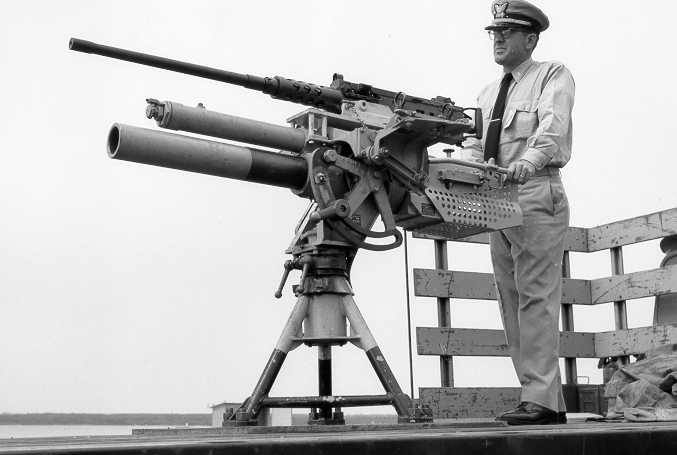
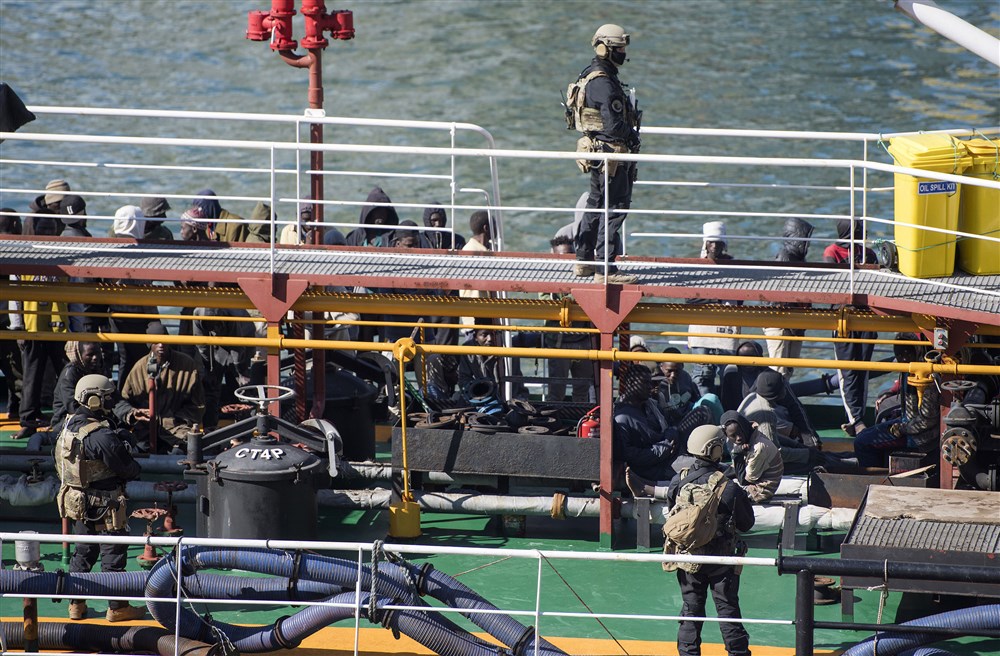
The 87 foot WPB Replacement, an Addendum

The discussion on earlier posts, “The 87 Foot WPB Replacement –Response Boat, Large –Interceptor” and “57mm ALaMO Round” has prompted some additional thoughts that seem to require more than a comment, mostly regarding the 57mm Mk110 and its new ALaMO guided projectile.

I also had intended to mention the fact that, if the WPB replacement included provision for stern launch of an 8 meter over-the-horizon boat, as was done with the Webber class FRC, then any mission modules that might developed for the Webber class to take the place of the boat, as discussed in the post, “Webber class Could be the Navy’s Light Duty Pickup Truck,” would probably also be apply to the WPB replacement. These might include anti-ship cruise missiles, Unmanned systems, or small towed array sonar systems

While the Iran swarming boat attacks are the normal justification for developing the ALaMO round, the emerging threat, unmanned surface vessels (USV) used to make “suicide” attacks may have also been a consideration. As can be seen above, small fast unmanned surface vessels can be hard to kill, and they have proven an effective weapon as can be seen below. One method of attempting to deal with the swarming boat threat has been to have the projectile burst above the boat, showering it with shrapnel. These airbursts could work pretty well against manned boats by killing the exposed boat operators, but the technique is less effective against unmanned craft. It may even be possible to shield critical components of unmanned craft against the effects of shrapnel. This is also a threat the Coast Guard may want to consider since unmanned explosive motor boats are relatively easy to construct.

Video: Houthi attack on Saudi Al Madinah-class frigate using unmanned explosive motor boat. 

The new ALaMO projectile may have been developed with this Unmanned Surface Vessel (USV) threat in mind. This suggest to me that the projectile would be designed to home on the heat generated by the craft’s engine. This would work equally well against manned craft. If the ALaMO round is IR homing, then perhaps it would also home on the heat of a larger vessel’s engines as well, making it more useful for countering larger vessels. 

If the 57mm Mk110 gun’s projectiles have made it a reliable counter to small, fast, highly maneuverable threats and perhaps some midsized threats, and if it can discriminate between its intended target and other traffic that may be in the area, it may be worthwhile to consider its inclusion in the WPB replacement. I still do not see it capable of countering large or even many medium sized threats. I still think we need to know more about how the round works before we can assume this is correct, but assuming it is correct, can we put this weapon on a vessel this small? I think we can.

This brought to mind how some earlier craft that had had relatively large guns. I will discuss some of the them and point out what I believe were notable features.

Spica Class (Sweden):

Swedish Torpedo Boat T121 “Spica” Photo by Pressbild. “Tidskrift i Sjöväsendet”. 1966. November. Sid 595. Swedish and US public domain

If you look at the Spica class above, it is a bigger than the likely WPB replacement (139 ft loa and 235 tons full load, 40 knots, 12,750 HP). It is 2/3 the size of the FRC, and about 29% more than my assumed maximum (182 tons) for the WPB replacement. It was a steel ship. It was equipped with an earlier version of the same 57mm gun found on the National Security Cutter (NSC) as well as the 9LV combat system which was the basis for the Mk92 Firecontrol system used on the 378 FRAM, and six heavy weight torpedo Tubes. The Torpedoes each weighed approximately 1800 kilos or about two tons, while the gun weighted about seven tons, so the vessel had over 19 tons of weapons. The fire control,  ammunition, launchers, and Electronic Warfare equipment would have added to the payload weight. By comparison, if our WPB included the current model 57mm (16,535 lbs/7,500 kg), two Mk54 torpedoes (608 lbs/276 kg each), and eight Longbow Hellfire (108 lbs/49 kg) the total weight of weapons would only be a little over nine tons (18,615 lb/ about 8,461 kg) plus ammunition, launchers, Electronic Warfare equipment, and firecontrol systems. The Over-the-Horizon boat, a primary “weapon,” may add as much as four tons, so the full “weapons load” would be about 13 tons. (I could not find a weight for the Over-the-Horizon boat, but the larger Response Boat, Small weighs a bit over 8 tons.) That is about 68.4% of the weight of systems on the Spica. It is not a complete accounting, but I think it is indicative and I will continue to use this format below.

One thing I liked about this, and the next two designs, is that the bridge and operations rooms are located at or near the center of pitch (which seems to have been done with the FRC as well). This makes it more comfortable for the watch. It also results in a long foc’sle. This allows the gun to be well back from the bow while still being far enough forward of the superstructure to allow a wide arc of fire. That is, it is capable of firing well abaft the beam.

The Norrkoping Class (Sweden):

Swedish Norrköping class fast attack craft (missile and torpedo) HMS Ystad R142, 3 September 2010 Photo by Reedhawk

The Norrkoping class was derived from the Spica class and sometimes referred to as the Spica II class. It gained a little weight, being 143 ft loa and 255 tons (41 knots, 12,750 HP). Initially it was armed like the Spica class, but subsequently the four of the torpedo tubes aft of the superstructure were replaced by four RBS-15 missiles. These weigh in at about 800 kg or 1760 lb. Consequently the weapons load is almost a ton lighter than that of the Spica, but still over 18 tons plus ammunition, launchers, Electronic Warfare equipment, and firecontrol systems. At the same time the missiles were installed, the 9LV system’s radar was replaced by the Sea Giraffe which is the radar installed on the Independence class LCS and planned for the Offshore Patrol Cutter (OPC), US designation AN/SPS 77 V(1). This radar is also used on the Swedish Visby class corvettes completed 2002 to 2015. 

Willemoes Class (Denmark):

A danish navy Willemoes-class fast attack craft (missile + torpedoes) HDMS Sehested (P547) as a museum ship at the Holmen naval base. Photo by Flemming Sørensen

The Willemoes class were similar, slightly larger vessels (46 m/150 ft 11 in loa and 260 tons full load, 40 knots, 12,750 HP). Originally they were equipped with four torpedo tubes in addition to the Oto Melara 76mm gun. The after pair of torpedo tubes was replaced by launchers for eight Harpoon Anti-Ship missiles (1,523 lb / 691 kg with booster). Its weight of weapons after installation of the Harpoons was just over 15 tons, plus ammunition, launchers, Electronic Warfare equipment, and firecontrol system (also a 9LV).

The unique feature of this class was that they had small diesel engines for cruising at up to 12 knots.

The Storm Class (Norway:

The Storm Class, (120 ft loa, 138 tons, 30 knots, 7200 HP) is illustrated above, fully armed and launching a Penguin missile, and below in a later configuration after removal of missiles and transfer from the Norwegian Navy to Lithuania. It is considerably smaller than the vessels above, at the lower end of what I expect the WPB replacement to displace, but still capable of mounting considerable weaponry, in this case six Penguin anti-ship missiles, and 76 and 40 mm guns. The missiles weighed 385 kg (849 lb). The 40 mm weighed about 3.5 tons. I was unable to find the weight of this 76mm gun. It would not have weighed as much as the Oto Melara, but it has to be at least 6 tons, so a total weapons weight was at least 12 tons.

Lithuanian Naval Force, Norwegian built, Storm class patrol boat P33 “Skalvis”. Missiles removed. Photo by Ministry of National Defence Republic of Lithuania

Conclusion:

If we chose to do so, it appears we could build something like a slightly scaled down version of the Spica that could mount a 57mm Mk110 forward and still provide an 8 meter Over-the-Horizon boat aft. The firecontrol could be as simple as the electro-optic unit from the Mk38 Mod2 or as capable as the SeaGiraffe which would give us a true all weather capability. In addition, it could probably mount tubes for two light weight torpedoes and eight Longbow Hellfire in vertical launchers. (I would think the Hellfires offset to one side, at the back of the superstructure. Foot print for a 2×4 cluster of missiles would likely be only about 4 x 3 feet.) I know the torpedoes are an unconventional approach, but it seems the surest way to stop a large ship and supposedly the Mk46 Mod5 and later torpedoes have an anti-surface capablity.

Replacing the Marine Protector class WPBs with vessels equipped like this would give the Coast Guard a robust and truly capable Ports, Waterways, and Coastal Security capability.



Army is Pushing Future Vertical Lift Forward

Bell’s V-280 prototype

A recent DefenseNews post reports that the Army has issued a Request for Information (RFI) (read it here) for a Future Long Range Assault Aircraft (FLRAA) to be fielded by FY2030. This would be a replacement for their H-60 Blackhawks.

There are some details of what they expect.

Price: “… roughly $43 million per unit.”

“FLRAA — at a minimum — to have a 95% maximum rated power to perform a 500 feet per minute vertical rate of climb from a hover-out-of-ground effect. The helicopter should be able to fly at 6,000 feet in 95 degree heat with 12 passengers.objective requirements for the aircraft to maintain 100% maximum continuous power in a 500 feet per minute vertical climb.”

Range: Threshold 1,725 nautical miles one way without refueling. Objective 2,449.

Speed: Threshold 250 knots, objective cruise speed goal of 280 knots.

There could be a “competitive down select by FY2022.”

“Coast Guard Cadet Exchange Building Partnerships in the Pacific” –USNI

U.S. Coast Guard Academy cadets with their hosts at the Korean Coast Guard Academy in 2018.

The US Naval Institute has an article by a Coast Guard Academy cadet, Drew Cheneler, who, along with three others, had an eight day exchange tour with the South Korean Coast Guard. He relates his experience and came away with a suggestion.

“The Coast Guard should consider establishing a Pacific office in South Korea, to improve joint training in maritime inspections and investigations and support efforts to combat China’s illegal and gray-zone maritime activities. The IMTB has working relationships with other Pacific partners, including the coast guards of Bangladesh, Indonesia, and the Singapore Police. Bangladesh, Sri Lanka, and the Philippines have received transfer of former U.S. Coast Guard high-endurance cutters, as well.

“Making these arrangements less ad hoc through the opening of such offices only makes sense, as they would not be a direct, offensive threat to China or anyone else. A regional Pacific IMTB office would train foreign partners in maritime safety, natural resource protection, and maritime mobility. It would improve prevention of and response to fatal maritime accidents.”

S. Korean CG traing ship Badaro

The 87 Foot WPB Replacement –Response Boat, Large –Interceptor

USCGC Barracuda (WPB-87301) USCG photo

The oldest of the 87 foot Marine Protector Class WPBs is now 21 years old. It is not too early to start thinking about what will replace them. Of the 73 “Marine Protector” class patrol boats, Four were commissioned in 2008 and four in 2009, but the rest were commissioned 1998-2005. That means we really should see the first of the new class by 2023 (that is not going to happen) and certainly not latter than 2028.

We should expect these replacements to be larger, faster, and much better armed, but still about half the size of the Webber class.

Environment:

Much has changed since the Marine Protector class was conceived. Our world in the last years of the 20th century, was really a very peaceful place. It was after the collapse of the Soviet Union, before the terrorist attack of 9/11/2001, and before the reemergence of Great Power competition. The Department of Homeland Security did not exist. The Russians seemed more friendly and their fleet appeared to be rotting away. The Chinese were trading partners and they were still militarily backward. It was a unipolar world. It now looks a lot less friendly.

Concept of Operations:

Currently the Marine Protector class vessels are spread along the East, Gulf, and West Coast with none in the Ninth or 17th Districts and only one in the 14th District. In most places there is only one boat of the type, meaning at some times there is no ready WPB in that port, and it is impossible to maintain an immediate response capability. 

Looking at the vessels that bracket the patrol boats in size, we have the Webber class WPCs and the Response Boat, Medium.

As noted, the “Fast Response Cutters,” unlike the 110s they nominally replace, are being used more like Medium Endurance Cutters at least in the Seventh, Eleventh, and Fourteenth Districts. Rather than sitting in port waiting for a call, they are out patrolling and are, in many cases, far from their homeports. It is not clear to me how much, if any, standby the Webber class are being assigned, but despite their larger number, it seems they will be assigned to fewer ports than the 110s they replace and so, to some extent at least, the WPB replacement may have to provide SAR coverage where the FRCs do not. In any case having a WPB replacement that approaches the capability of an FRC on standby, could relieve the FRCs of any need for short response time standby, allowing them more time to patrol.

At the small end, we have Response Boat, Medium. These boats appear both faster and more seaworthy than the 41 footers that were in place when the Marine Protector class were conceived. This should allow them to take on some of the less demanding duties the 87 footers were expected to handle when they were conceived.

This suggest that the replacement will likely push the capability envelop outward.

Size:

Every time we have a replaced a class, from WHECs, to WMECs, to the 110s, to the WLBs, the ships have gotten bigger. NSCs are  50% larger than the 378s. The OPCs are almost four times larger than the 210s, and twice the size of the 270s. The FRCs are more than twice as large as the 110s. The current 225′ WLB is twice as large as the 180s they replace, so it would not be surprising if the Marine Protector class replacement were twice as large, it might even be expected. Being one and half to twice as large would equate to 136 to 182 tons full load, or roughly 100′ (30.5 meter) to 130′ (39.6 meter) in length, not too much different from the Island class cutter, 110 feet (33.5 meter) loa and 168 tons. That is still only about half the size of the 353 ton Webber class.

Lurrsen FPB38. Something like this 122 foot meter (37.2 meter) 205 ton German built Bahrain Navy Patrol Boat is likely the upper limit in size.

Speed:

Assuming these are “Response” vessels, rather than patrol vessels, dash speed will be important. Speeds close to 40 knots are attainable and not unreasonable. It could probably be achieved in these smaller vessels using the same 20 cylinder engines used in the Webber class, perhaps even with the 16 cylinder version of these engines (about 9,600 HP total). The ship should also be able to maneuver smoothly at slow speeds. Slow speed maneuvering has presented some challenges on both the 110s and the FRCs. A hybrid powerplant could facilitate that and allow long slow cruises as well. Another way to do this might be using two significantly smaller diesels for cruise augmented a small gas turbine using a centerline waterjet for sprint speeds, for instance a pair of 3000 HP diesels and the GE LM500 (6,130HP).

The Crew

While our vessels have increased in size substantially, the crew size has increased no more than about 50% if at all. NSCs actually have smaller crews than the WHECs they replace. The OPCs’ crew size will probably be similar to that of the 270s and less than 50% larger than that of the 210s. The FRCs’ crews are about 50% larger than those of the 110s. The crews of the 225 foot WLBs are considerably smaller (50) than those of the 180s (80). The Coast Guard will want to avoid the additional cost of a substantially larger crew even if the vessel is larger and more capable. The crew, assuming it is conventionally manned, is unlikely to be larger than 15 and might be as few as 10, but I would expect the CO to be an O-3. In any case the Coast Guard will want additional berthing available. (Additional explanation below as to why the crew might be as large as 18.)

Range and Endurance: 

The 87 footers have a nominal range of 882 miles at 10 knots and a five day endurance. This is considerably less range, but the same endurance as the FRCs (5 day endurance/2500 mile range at 14 knots). The Island class were also rated to have a five day endurance and, in fact, a greater range than the FRCs. Given what I see as the likely missions of the class, a five day endurance is probably more than adequate. I would expect they might be required to sprint out 200 to 300 miles at 30+ knots, loiter for perhaps 24 hours, and then return to port at cruise speed, or possibly with a vessel in tow.

The Ship’s Boat:

The 8 meter over-the-horizon boat and a stern ramp like that on the Webber class would probably work here as well.

The Homeland Security Mission:

This is the area that will require a departure from the thinking behind our previous 82 and 87 foot patrol boats. The Homeland Security mission requires that the Coast Guard be ready to immediately counter any unconventional maritime attack. I interpret this, as a need to be able to destroy or at least forcibly stop any vessel, no matter how determined the crew may be to resist, and no matter how large, fast, or maneuverable the vessel may be. We need to be able to deal with small fast highly maneuverable vessels, medium to large merchant ships and everything in between.

We are not prepared to do this.

This class is unique in that, of all the classes of Coast Guard vessels, it is most likely to be both available to immediately respond to attack on its homeport while being large enough to mount the weapons needed to counter the full range of threats.

In almost every port we have vessels that are equipped with 7.62mm and .50 caliber machine guns, but while these may be sufficient to dissuade law breakers without ever firing a shot, they are probably insufficient for dealing with any but the most modest terrorist attack that might be delivered by suicidal crews, using heavier weapons, and vessels of almost any size.

The 25mm ups our game a little, but it, like the machine guns, has the potential of spreading collateral damage. It would also have limited utility against targets much larger than a small boat, although use of the APDS (armor piercing discarding sabot) round (basically a non-explosive, sub-caliber arrow of very dense material) would increase its penetrating power.

Our 57mm guns are decent anti-aircraft guns, but they are very light for dealing with surface targets. None of the ships equipped with 57mm (or 76mm) maintain standby in port, and when they get underway they do not hang around the ports that we might want to protect.

To deal with the range of potential threats, I would suggest, in addition to a gun (presumably the 25mm Mk38 mod2/3), we need to arm the class with Hellfire to deal with small, fast, highly maneuverable targets and either Naval Strike Missile or light weight torpedoes to deal with the larger targets. Lest I be accused of overloading these vessels with weapons let me point out that vessels of similar size have been equipped with a 40mm gun, six anti-ship missiles, two heavy weight torpedo tubes, and small anti-air missiles.

Hauk class patrol boat, HNoMS Lom (P993), 120 feet loa, 160 tons full load. Photo by Inge

Hellfire

There are other missiles that might be considered, but Hellfire has been selected for the LCS and the planned FFG. They are produced in very large numbers. Hellfire could be effective against vessels up to about 100 tons and multiple hits have at least a small chance of disabling much larger ships. It should be possible to have the Hellfires mounted on the Mk38 mod2/3, if not a small footprint vertical launch system should be possible. This is #1 on my wish list.

Naval Strike Missile (NSM)

This is again a weapon selected for the LCS and FFG. It has very long range, over 100 miles, but it would take a lot of coordination to provide the targeting to exploit its range. It is a relatively small anti-ship missile so it might not actually stop large targets. Multiple hits would of course help, but I doubt we would have more than two mounted on the WPB replacement, although they could likely mount four.

Light Weight Torpedo

We could probably place two light weight torpedo tubes on this class in a manner similar to my suggestion for mounting on the Webber class without a great deal of impact on the design of the WPB. Like the NSM this is not a weapon that will sink a large ship, but, hitting below the keel, preferably homing on the propellers, it is more likely than the NSM to effectively stop even a very large ship. For this reason, I favor it over the NSM. Also it would, in most cases, sink ships of up to about 1000 tons.

Ready 24/7

If we want to have at least one of these on immediate standby in every major port, we will need to man and operate them differently in terms of basing and manning. We could base them in pairs and have each crew split into blue and gold teams, either of which could operate the ship and its weapons for short periods, say 24 hours. The ships could swap off standby duties to allow maintenance stand-down. With a crew of 16-18, each blue and gold team could consist of eight or nine members each team headed by a command qualified Lieutenant. This could allow two four-person watches or three three-person watches depending on the requirements of the ship. The Officer rotation might be over two years, with the incoming officer serving first as both XO and head of his underway team. After a year this officer would fleet-up to the CO slot. Newly arrived XOs would have to join the ship during its down time and complete underway familiarization on a sister ship to ensure that when the ship rotates to standby status, both officers are capable of taking her out. 

Other users:

These ships might also be of interest to the Navy and could be offered to other nations as well through Foreign Military Sales.

High Latitude Challenges from Russia and China

Map of the Arctic region showing shipping routes Northeast Passage, Northern Sea Route, and Northwest Passage, and bathymetry, Arctic Council, by Susie Harder

Two recent articles, first from the Institute for the Study of War, a discussion of how the Russians appear to be following the lead of the Chinese in the South and East China Seas by militarizing the Arctic and attempting to thwart the concept of innocent passage just as they have at the Kerch Strait connecting the Sea of Azov to the Black Sea.

Keep in mind the Navy had asked the Coast Guard to provide an icebreaker to conduct a Freedom of Navigation Exercise in the Arctic, but the Coast Guard felt it would be unable to provide because of the state of the icebreaker fleet.

It also considers the apparent frienemy relationship between Russia and China. Russia needs China’s investment, but distrust China’s long term motivation.

Thanks to Sven for bringing this to my attention

Second, an article from the US Naval Institute discussing Chinese ambitions in the Arctic and Antarctica, “China’s Activities in the Polar Regions Cannot Go Unchecked.”

Apparently they are planning a permanent airport in Antarctica.

“Beijing claims the new airfield would support scientific research and economic tourism. But like many overseas Chinese facilities, it could be quickly, easily, and covertly repurposed for military use.”

‘The Chinese government currently spends more than any other state on new Antarctic infrastructure—bases, planes, and icebreakers intended to underpin China’s claimed Antarctic resource and governance rights.”

In the Arctic, China is making,

“strategic investment in infrastructures and resources that may serve military or security as well as commercial purposes (but which often make little economic sense), and scientific research that advances both military and commercial interests.”

It appears the Chinese, in addition to their interests in the Arctic for transportation and resource exploitation, may be positioning themselves to make extensive claims in Antarctica when the current treaty system expires in 2048 or if it should be annulled earlier.

Frankly I feel we are going to see a land rush in 2048, with all the craziness that can bring.

ALCOAST 098/19 COMDTNOTE 1321 SUBJ: WOMEN’S RETENTION STUDY AND HOLISTIC ANALYSIS

Below you will find an ALCOAST regarding the Women’ Retention Study.

united states coast guard

R 291500 MAR 19
FM COMDT COGARD WASHINGTON DC//DCMS//
TO ALCOAST
UNCLAS//N01321//
ALCOAST 098/19
COMDTNOTE 1321

SUBJ: WOMEN’S RETENTION STUDY AND HOLISTIC ANALYSIS UPDATE TWO
A. COMDT COGARD WASHINGTON DC 180851 DEC 18/ALCOAST 419/18
B. COMDT COGARD WASHINGTON DC 011425 JUN 18/ALCOAST 214/18
C. COMDT COGARD WASHINGTON DC 161410 FEB 18/ALCOAST 068/18
D. Coast Guard Strategic Plan 2018-2022

1. Background. The Office of Diversity and Inclusion (CG-127), in partnership with the RAND Corporation’s Homeland Security Operational Analysis Center (HSOAC), have completed the Women’s Retention Study and Holistic Analysis (WRSHA). As part of the study, RAND convened regional focus groups across the Coast Guard, and thanks to the outstanding support from participants and unit leadership, a total of 1,010 women and 127 men participated in 191 focus groups. The level of participation and response from the field yielded comprehensive feedback that provided vital insight into the study.

2. Final Report. The findings and recommendations have been released and the full study can be found at: https://www.rand.org/pubs/research_reports/RR2770.html. Breaking down barriers to retention and creating an inclusive workplace is an all-hands on deck effort. The report does indicate that sexual assault, sexual harassment, and other cultural concerns continue to exist within our Service. These behaviors are inconsistent with our core values, and have no place in the Coast Guard. I strongly encourage all members to read the report and discuss the findings at your upcoming Leadership and Diversity Advisory Council (LDAC) meetings and in other similar venues.

3. RAND Research Methods. The research team used quantitative statistical analysis, reviewed studies and trends across the civilian sector and the Department of Defense (DoD), and gathered qualitative insight through focus groups with our active-duty workforce. The focus groups provided enhanced understanding of the data and potential barriers to female retention. They also included a sample of active-duty men to understand male perspectives on retention and to assess whether certain factors are unique to women or are broad-based workforce retention barriers.

4. RAND Findings. The research team identified three factors that most prominently influenced female retention:

a. Work Environment: Leadership, Gender Bias and Discrimination, Weight Standards, Sexual Harassment and Assault, and Workload and Resource Issues.
b. Career Concerns: Advancement, Assignments, and Civilian Opportunities.
c. Personal Life Concerns: Spouses, Children, Pregnancy and Breastfeeding, and Other Personal Life Factors.

5. RAND Recommendations. Based on the findings, the study proposed recommendations for initiatives aimed at improving female retention in the Coast Guard and addressing barriers contributing to the retention gender gap. These recommended initiatives are intended to address concerns from all female members, regardless of marital and parental status. In many cases, they will have broad-reaching effects that impact our entire workforce. RAND recommendations fall under three overarching categories: 

a. Update Coast Guard Personnel Management Systems to Better Meet the Needs of the Coast Guard’s Current and Future Workforce.
b. Develop and Implement a Communication Plan to Ensure All Members Are Aware of Relevant Policies and Priorities and Strengthen Leadership Education to Foster Inclusive Work Environments.
c. Promote Accountability and Monitor Effectiveness by Establishing and Tracking Relevant Metrics.

6. PRTF. In January 2019, the Personnel Readiness Task Force (PRTF) began their work at Coast Guard Headquarters. Consistent with the Commandant’s Strategic Intent to “Maximize Readiness Today and Tomorrow,” this study and the PRTF are part of the ongoing effort to recruit, train, support, and retain a Mission Ready Total Workforce that reflects the diversity and best talent of our Nation. Chartered by the Vice Commandant, this nine-member team will remain in place until August 2020 and will serve as workforce advocates for the organization. As announced by the Commandant in his State of the Coast Guard Address, the PRTF and the Coast Guard’s Senior Leadership team will explore forward-leaning policy changes to address the recommendations of the Women’s Retention Study, including using surge staffing to backfill members on parental leave, easing the existing tattoo policy, removing the single parent disqualifiers, and revising outdated weight standards that disproportionally affect women. The PRTF will provide the workforce regular communication on their progress to action this study and their efforts to improve organizational readiness.

7. Other Implementation Actions. In addition to addressing the above recommendations, the PRTF will also address the key study findings of leadership, gender bias and discrimination, and sexual harassment and assault as they develop implementation actions. Additionally, in June 2018, senior leadership launched a collection of initiatives, Early Action Items (EAIs), to address issues of greatest importance to our people. As just a few examples, we have aligned co-location tour completion dates for O4/E6 and below, instituted deferment options of TDY/TAD for one year post-partum, and removed gender specific pronouns and member names from OERs and EERs. The EAIs were our decisive first step in ensuring our service is Ready, Relevant, and Responsive to meet the needs of the nation.

8. POC. Direct questions about the WRSHA to COMDT (CG-127) at: 2018randstudy@uscg.mil.

9. VADM M. McAllister, Deputy Commandant for Mission Support, sends.

10. Internet release is authorized. Additional information on the study can be found at https://www.rand.org/pubs/research_reports/RR2770.html

National Vietnam War Veterans Recognition Day

Coast Guard 82 foot WPB and Navy Swift Boat on River in Vietnam

Naval History and Heritage Command tells me its National Vietnam War Veterans Recognition Day. Who knew there was such a thing? They are a Navy command, but they also have a lot of Coast Guard history available.

There are several pieces on the Coast Guard participation in the Viet Nam war on my heritage page. Unfortunately a number of Coast Guard sourced links were broken when the Coast Guard changed its internet provider. I’m hoping some day we will see these again, but there are still a number of good links.