“Joint Bomber Patrol Over the Pacific: The Russo-Chinese Military Alliance in Action” –Eurasian Daily Monitor

CSR Report RL33153 China Naval Modernization: Implications for U.S. Navy Capabilities—Background and Issues for Congress by Ronald O’Rourke dated February 28, 2014. Page 8 – Figure 1. Jin (Type 094) Class Ballistic Missile Submarine Source: Photograph provided to CRS by Navy Office of Legislative Affairs, December 2010.

The Jamestown Foundation’s Eurasian Daily Monitor reports on the implications of growing alliance between Russia and China reflected in their recent joint bomber patrols intercepted off S. Korea and Japan.

There is an interesting aspect to this growing alliance that might suggest more reason for US military construction and activity in the Arctic, which, in turn, may require more icebreaker support.

“Russian military expert Alexander Shirokorad…Building on earlier Russo-Chinese missile- and air-defense cooperation that necessarily involved the transmission of highly classified information between them…openly advocates for joint Russo-Chinese air- and missile-defense infrastructure in the Arctic. Unexpectedly, however, he also advances an entirely new concept of allowing Chinese nuclear-armed submarines to gain critical support from Russian Arctic ports. It is difficult to gauge to what degree Shirokorad’s article was meant to have been a justificatory trial balloon. But the piece clearly takes on additional significance when looked at in the context of the Pentagon’s annual report on China, which explicitly warns that Beijing may eventually start deploying nuclear submarines in the Arctic.”


“Hellenic Coast Guard Testing Tethered Aerostat for FRONTEX Mission” –Naval News

Aerostat being tested by the Hellenic Coast Guard for FRONTEX.

Naval News reports that the Hellenic Coast Guard is doing something of a 28 day comparison test between land based and Aerostat based surveillance systems on the island of Samos.

Putting a radar at 1000 meters should provide a radar horizon of about 70 nautical miles and allow detection of a 50 foot high target at up to 79 miles.

USCGC Robert Ward (WPC-1130) Makes First Eastern Pacific Transit Zone Drug Bust by an FRC

A Coast Guard Cutter Robert Ward crew member inspects and prepares to test suspected contraband seized from a suspected drug smuggling boat in international waters of the Eastern Pacific Ocean, July 16, 2019. Commissioned March 2, 2019, Robert Ward’s interdiction marks the first drug interdiction in the Eastern Pacific Ocean by a Fast Response Cutter. U.S. Coast Guard photo.

A recent press release suggests that we will be seeing new, different, smaller ships engaged in drug interdiction in the Eastern Pacific drug transit zone. This could be precedence for a new kind of operation. I will only quote a part of it.

SAN DIEGO, Calif. — The crew of the Coast Guard Cutter Steadfast (WMEC-632) is scheduled to offload more than 26,000 pounds of seized cocaine in San Diego Friday.

The cocaine, worth an estimated $350 million, was seized in international waters of the Eastern Pacific Ocean. The contraband represents six suspected drug smuggling vessel interdictions and the recovery of floating cocaine bales by the crews of two Coast Guard cutters off the coasts of Mexico, Central and South America between late June and mid-July.

Six of the interdictions were carried out by the Steadfast’s crew, one of the Coast Guard’s oldest cutters commissioned in 1968. One interdiction was by the crew of one of the service’s newest ships, the Coast Guard Cutter Robert Ward (WPC-1130) commissioned in March, and is not only the cutter’s first drug bust, but the first drug bust by a Coast Guard Sentinel-class fast response cutter in the Eastern Pacific Ocean. (emphasis applied–Chuck)

We have had a problem having enough ships on scene to take advantage of all the intel available. I have long suggested that the FRCs might be used in the Eastern Pacific, possibly with a supporting vessel. The Navy used one of their Cyclone class PCs for drug interdiction in the Eastern Pacific in 2018, confirming that the use of these smaller vessels was probably viable.

I had really expected Atlantic Area to do this first, since they have so many Webber class in the Seventh District (19, soon to be 20 FRCs), and they got them first (since 2012). Still the Eastern Pacific Transit Zone is a Pacific Area show, perhaps that is why it is PACAREA, using the Robert Ward, only the second West Coast CONUS FRC, commissioned little over four months ago, that took the initiative.

It looks like the Steadfast may have provided some support to the Robert Ward. This might have been facilitated by the fact that Steadfast is also a PACAREA asset.

Hopefully, if there were no unanticipated problems, this will be the start of a pattern of successful FRC deployments to the transit zone. To take full advantage of the concept, we really need Atlantic Area participation. They have far more assets and are actually closer to the transit zone. Excluding FRCs in the 14th and 17th Districts (Hawaii and the Western Pacific and Alaska) PACAREA has only four WPCs. They could maintain perhaps one FRC in the Transit Area continuously, while LANTAREA could maintain at least three and probably more.

Something we really should look at is, what is limiting the endurance of the vessels to five days? For a vessel of this size, it should be more like ten days. Feedback on the post linked above, suggest they are limited by “their very small dry-stores and refrigerator units, and the crew’s laundry.” Perhaps a ShipAlt is in order.

“Cutter Bertholf’s Indo-Pac Deployment Highlighted Coast Guard’s National Security Role” –USNI

The U.S. Coast Guard Cutter Bertholf (left) moves in formation with Philippine coast guard vessels Batangas (center) and Kalanggaman during an exercise on May 14. U.S. Coast Guard/Chief Petty Officer John Masson

This piece from Naval Institute News Service is worth a read. It is an illustration of what the Commandant was talking about here.

“Schultz: Coast Guard Expanding Western Pacific Operations” –USNI

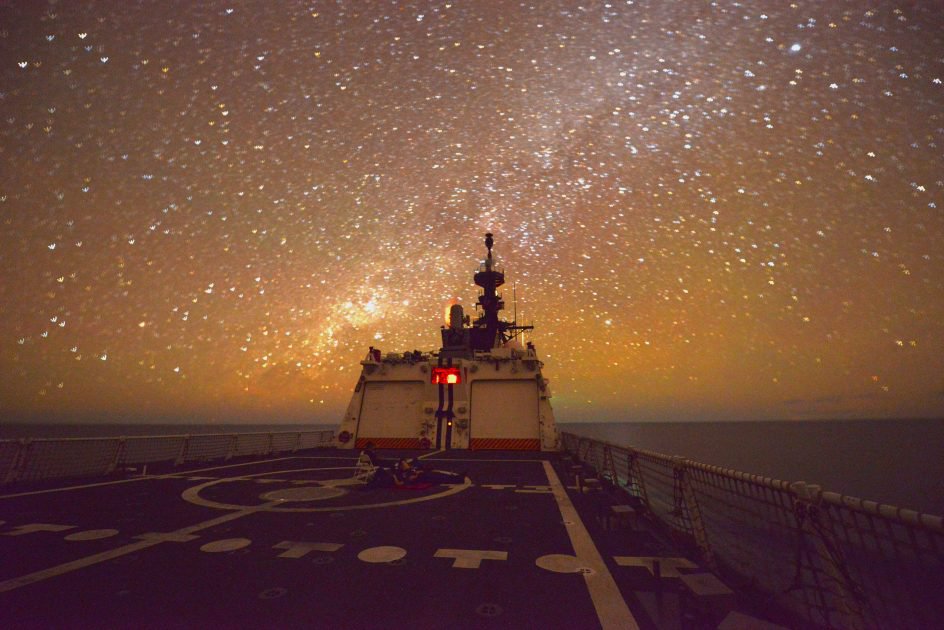
USCGC Bertholf (WMSL-750) crew members observe the stars from Bertholf’s flight deck as the cutter and crew patrol the South China Sea on April 21, 2019. US Coast Guard Photo

The US Naval Institute News Service is reporting,

KUALA LUMPUR – The U.S. Coast Guard will increase its presence and deployments to Asia – particularly around Oceania and U.S. Pacific territories – and test out a new operational deployment concept in the region, service head Adm. Karl Schultz told reporters on Thursday.

We have been seeing this happening. The Coast Guard has begun spending more time in and around the Western Pacific, particularly around US Western Pacific territories and Oceania.

The reference to use of a buoy tender as a mothership to support patrol craft operations looks like a test to see how useful the proposed basing of three Webber class cutters in Guam might be.

The Commandant suggested that the tender might partner with Australian, New Zealand, or Japanese vessels as well. He promised,

““In the face of coercive and antagonistic behavior, the United States Coast Guard offers transparent engagement and partnership,…”

There is no reason this should not work, hopefully it will lead to similar multi-unit operations in the Eastern Pacific drug transit areas where the Webber class could augment larger cutters.

“Let the Coast Guard Helm Alaskan Command’s Maritime Component” –USNI

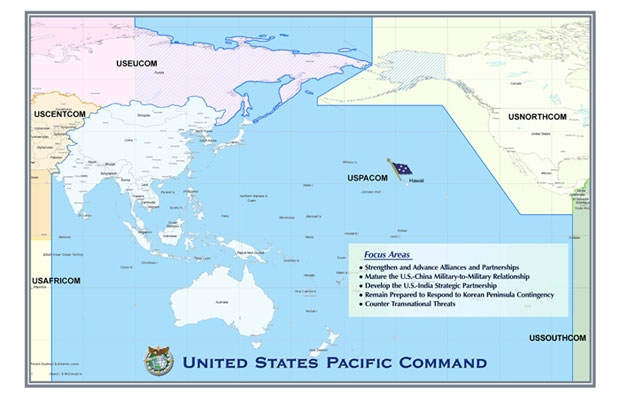
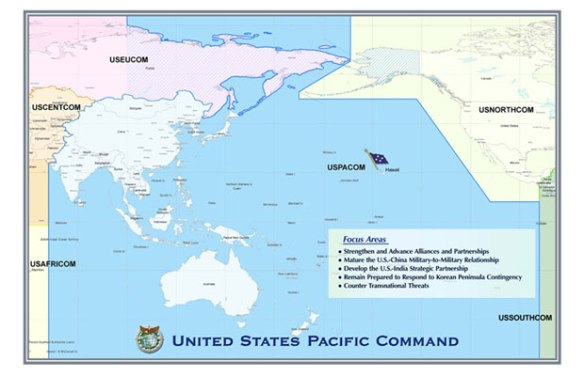
PACOM Area of Responsibilty

Two officers, one Army and one Air Force, both with experience in Alaska Command, find that the organization of naval support for the Command is problematic and suggest that making CCGD17 the Naval Component Commander is the solution.

In 2014, the subunified Alaskan Command was reassigned from Pacific Command to NorthCom. Alaskan Command owns the joint force activities in the land and air domains over Alaska and the Arctic and coordinates with Naval Forces Northern Command (NavNorth)—based some 4,500 miles from Alaska—for maritime joint operations. The Alaskan Command commander also is responsible to North American Aerospace Defense Command (NORAD) for the Alaskan region’s air defense and identification zone (ADIZ), which extends to the North Pole and along the eastern border of Russia. Currently, the maritime warning responsibilities in the Arctic are held at NORAD headquarters in Colorado, and maritime domain awareness responsibilities are retained with the NavNorth Commander in Norfolk, Virginia.

With three different chains of command, none of which own surface vessels around the waters of Alaska, Alaskan Command’s ability to conduct homeland defense is at risk because of a cumbersome command-and-control structure beset with the challenges of distance and limited expertise in operating in the Arctic. There is a more effective command-and-control structure to protect the homeland in the Arctic: establishing the U.S. Coast Guard as the Joint Force Maritime Component Commander of Alaskan Command.

This is recognition of a problem we looked at before, and my conclusion was that Alaska should be reassigned to PACOM. Short of that there is another alternative I will get to below, and they do seem to have a good workable proposal for a Joint Inter-Agency Task Force (North)

There has been almost no cooperation between the Navy and Alaska Command. That may be starting to change. In May the Navy conducted Exercise Northern Edge 2019. The Navy talked about this a relearning how to operate in the Arctic, but as far as I can tell, they never got into the Arctic. Apparently the Carrier Strike Group stayed in the Gulf of Alaska, but at least they did work with the Air Force in Alaska.

Admittedly the US Navy has limited capability in the Arctic.

“…the Navy’s minimal involvement in the region is for good reason: the Navy has limited Arctic capability, apart from submarines and patrol aircraft. Essentially, there are no current requirements levied on the U.S. Navy necessitating an Arctic presence.”

That also might be changing. It is not unlikely that the Navy will return in at least some fashion to Adak as it has in Iceland..

“Last year, the Navy indicated it would like to begin flying submarine-hunting P-8 Poseidon aircraft from Adak Island hundreds of miles off the Alaskan coast in the Aleutian island chain, which would put US aircraft at the westernmost airfield that can handle passenger aircraft in the United States.”

Joint Force Maritime Component Commander

To be the Naval Component Commander you have to be ready for high end conflicts as well as the more routine requirements. Submarines and Maritime Patrol Aircraft are critical assets for success in any major conflict in the Arctic. They are also forces the Coast Guard is not ready to command.
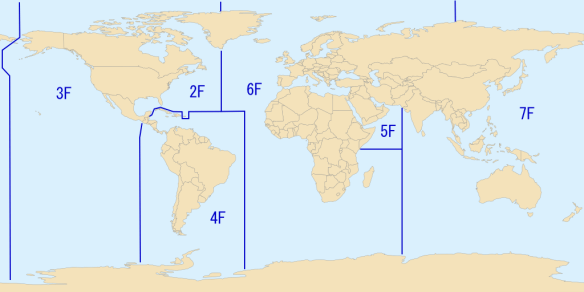
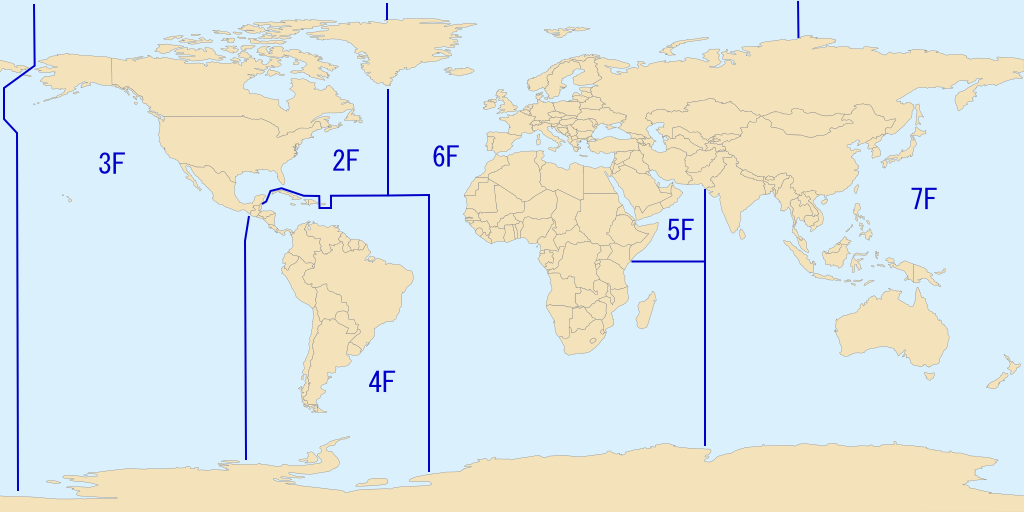
US Navy Fleet Organization

Surely that Maritime Component Commander should be Third Fleet. Additionally, as I noted earlier, It makes no sense to divide the Bering Sea and the Chukchi Sea between 3rd Fleet and 7th Fleet. Third Fleet should assume responsibility for all of PACOM’s Arctic waters including the entire Bering Sea and the Aleutians. (7th Fleet already has more than enough to do in the Western Pacific and Indian Ocean.)

Joint Inter-Agency Task Force (North):

Meanwhile it would make sense for the Coast Guard to participate in formation of a Joint Inter-Agency Task Force (North) for the purpose of Disaster Relief/Humanitarian Assistance, response to major SAR cases, and dealing with possible Russian, or even Chinese, Gray Zone operations in the Arctic.

“OCEA Launched Largest Aluminum OPV in the World for Philippine Coast Guard” –Naval News

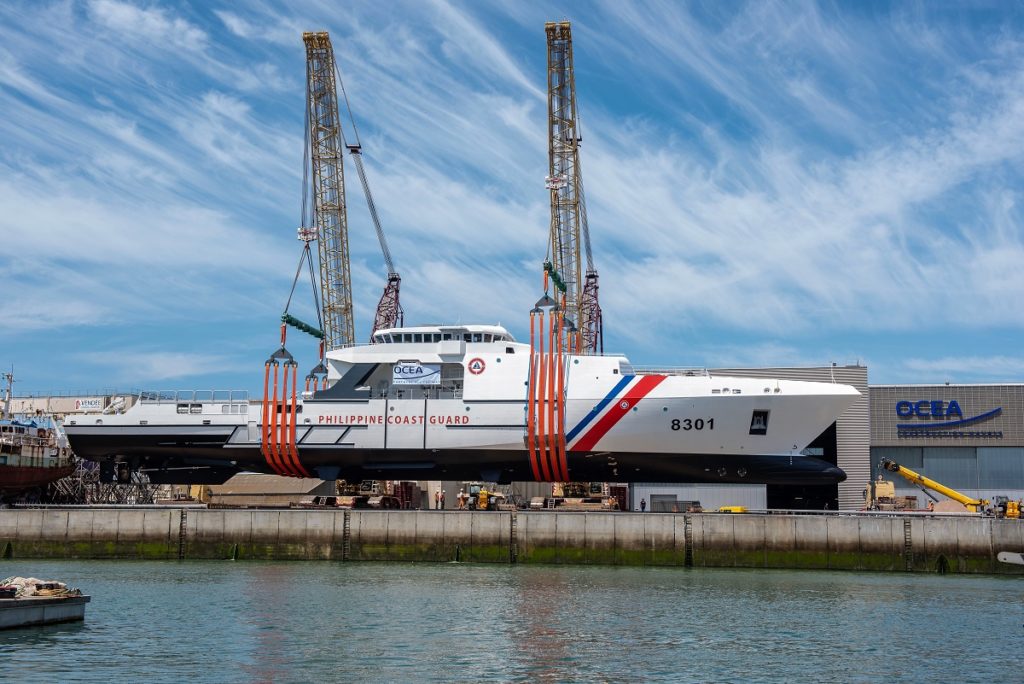
OPV270. OCEA photo

Naval News reports that the French shipyard OCEA has launched the largest aluminum offshore patrol vessel ever constructed. It is going to the Philippine Coast Guard as part of a package deal that also included four much smaller patrol boats. The shipyard claims substantial lifecycle saving in fuel and maintenance as well as lower emissions due to the choice of building materials. (Note the underwater body on the after third of the ship. It looks unusual.)

Choice of an aluminum hull and superstructure does bring on discussion of the possible dangers of using aluminum, frequently blamed for serious damage due to fire including USS Belknap (CG-26) and loss of British type 21 frigates HMS Antelope and HMS Ardent and the destroyer HMS Sheffield during the Falklands War.

There are real issues with the use of aluminum, since it softens, melts, and looses its structural integrity at lower temperatures than steel, as seen on HMS Amazon when it had a fire in 1977, but losses as a result of structural aluminum have frequently been exaggerated. Problems with cracking of aluminum superstructures have been largely as a result of the different expansion rates of mixed steel and aluminum construction.

In the case of Belknap, the collision severed fuel lines running outboard on the carrier and dumped huge amounts of fuel onto the ship, feeding the fire, while ammunition cooked off. Nevertheless the ship was saved by extraordinary DC effort.

The loss of Antelope and Ardent were evaluated to have not been the result of their Aluminum superstructure.

The Sheffield actually employed steel rather than aluminum in both its hull and superstructure, so aluminum construction played no part in her loss.

OPV 270 main specifications

  • Overall length : 84.00 m (275.5′)
  • Range : 8000 nm @ 12 kts
  • Endurance : 5 weeks
  • Speed : 22.0 knots
  • Crew : 40 persons
  • Passenger and VIP : 26 persons
  • Survivors : 35 persons

British Royal Navy adds Missiles to 30mm Gun Mount

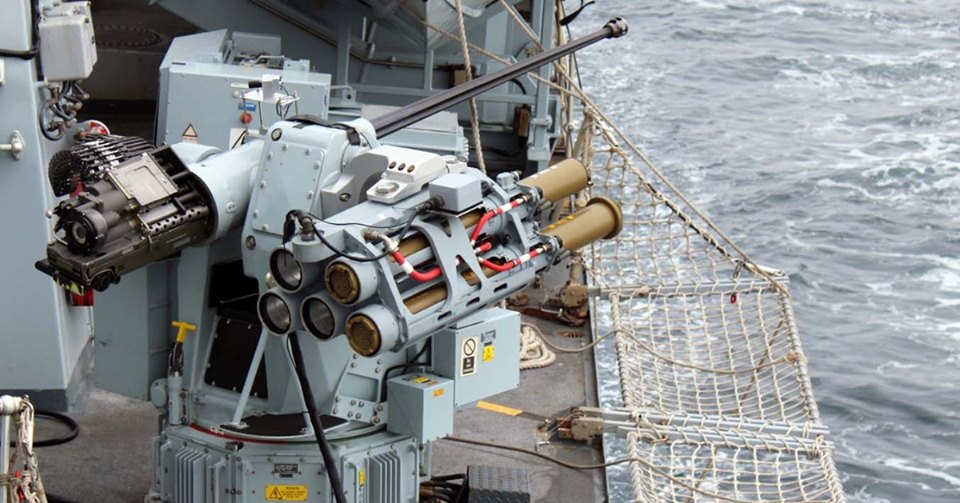
Martlet Light Multirole Missile launchers mounted on 30mm gun mount

Britain’s Royal Navy reports they have successfully tested the “Martlet” Light Multirole Missile from their 30mm DS30M auto cannon mount, a mount similar to the Mk38 Mod2/3 used by the Coast Guard on the Webber class and planned for the Offshore Patrol Cutter.

This is certainly not the first time we have seen missile launchers attached to a gun. The Israelis have been doing it for years using the Typhoon gun mount which is the basis for the current 25mm Mk38s as used on the Webber class. .

Spike LR Missile launched from a Typhoon weapon station on an Israel Navy Super Dvora Mk 2. A similar configuration was recently tested by the US Navy, from an unmanned surface vessel (USV-PEM). Photo: RAFAEL

The dimensions of the British missile and American APKWS and Hellfire are provided for comparison.

  • Martlet LMM: Length: 51 in. (1.3 m), Diameter: 3 in. (76 mm), Weight: 28.6 lb (13 kg), Range: 8,000 meters
  • APKWS: Length: 73.8 in (1.87 m), Diameter: 2.75 in (70 mm), Weight: 32 lb (15 kg), Range 5,000 meters
  • Hellfire: Length: 64 inches (1.6 meters), Diameter: 7 inches (180 mm) (17.8 cm), Weight: 100–108 lb (45–49 kg), Range: 8,000 meters

The Martlet has the option of proximity fusing and Laser Beam Rider guidance (in addition to semi-active and IR homing), that probably makes it more effective against air targets, particularly smaller ones like drones. It has been used successfully against a target drone. It also has a longer range than APKWS, but is probably more expensive. Its biggest disadvantage from our point of view is that it is not in the USN inventory.

I am not advocating for this particular weapon, but both Israel and the Royal Navy have seen the wisdom of combining missiles with auto cannon.

  • It minimizes manning requirements in that a single operator can control both missiles and guns.
  • It minimizes space requirements
  • It eliminates the need to pass the targeting information from one fire control to another as the target enters gun range.

Unlike separate systems it probably also means you cannot engage two targets simultaneously.

We need a gun for the signaling, the proverbial shot across the bow, but it is not the best way to neutralize a threat. In an installation like this, the missile is more accurate, has longer range, and is less likely to cause collateral damage.

My feeling is that the Coast Guard would be better off with Hellfire than APKWS. We probably will not have to engage a large number of small targets as the Navy might, but our targets might be larger and this might be the largest weapon available to us. Either APKWS or Hellfire would be an improvement over what we have. The nominal effective range of the 25mm Mk38 is 2,700 yards (2,457 m). The APKWS would double this and the Helfire would triple the effective range. Either would allow us to engage from outside the likely effective range of any improvised weapon system that might be used in a terrorist attack, which I estimate would not exceed 4,000 yards.

When the Mk38 Mod3 was announced, there were indications BAE intended to add a capability to launch APKWS from the mount. I am still hoping.

New Paint Technology

Some things you may take for granted and never expect to change, but Marine Log brings us a report on new paint technology that reportedly lowers deck temperature for even darker colors (like our gray decks).

The temperature difference between, for example, a deck coated with conventional paint system and one with Ever Cool can be up to about 28°C (50.4°F–Chuck), with the specially formulated coating reflecting up to 80% of the sun’s heat, even from colored coatings.

This isn’t just about keeping your flip-flops from melting to the deck, it also means lower auxiliary loads on the air-conditioning systems and generators. It may even mean a lower IR signature.

“US Builds Global Coalition to Protect Gulf Shipping” –Global Security

USCG Monomoy (WPB-1326) and Adak (WPB-1333), elements of PATFORSWA

Global Security reports that the US is attempting to build a coalition to escort merchant ships through the Straits of Hormuz.

We would almost have to assume that the WPBs of PATFORSWA would be involved.

It would not be surprising to see the Coast Guard contribute up to six already commissioned Webber class WPCs in the near future. These could ultimately replace the current 110s stationed in Bahrain rather than waiting for FRCs specifically procured to replace the PATFORSWA WPBs, but for the duration of escort mission, they would augment them.

I would like to see some modifications done to these vessels before they go, but it is a question of urgency.

The Webber class could make the trip on their own bottoms if needed, especially if escorted by an National Security Cutter.