“Sailors, Coast Guardsman Remember Firebolt Shipmates”–Navy News Release

MANAMA, Bahrain (April 24, 2018) Vice Adm. Chris Aquilino, commander of U.S. Naval Forces Central Command, salutes as Sailors and Coast Guardsmen participate in a wreath laying ceremony to honor Coast Guardsman Damage Controlman 3rd Class Nathan B. Bruckenthal, Signalman 2nd Class Christopher E. Watts and Boatswain’s Mate 1st Class Michael J. Pernaselli who perished while conducting maritime security operations in the Northern Arabian Gulf on April 24, 2004. Firebolt is assigned to Commander, Task Force 55, in the U.S. 5th Fleet area of operations in support of maritime security operations to reassure allies and partners and preserve the freedom of navigation and the free flow of commerce in the region. (U.S. Navy photo by Mass Communication Specialist 1st Class Mark Meredith/Released)

The following is a Navy news release. I believe there is an error in that I believe there was a second Coast Guardsman on the RHIB when the incident occurred. 

Story Number: NNS180424-30Release Date: 4/24/2018 4:26:00 PM
By Mass Communication Specialist 1st Class Mark Meredith, U.S. Naval Forces Central Command Public Affairs

MANAMA, Bahrain (NNS) — Sailors and Coast Guardsmen gathered for a wreath laying memorial service and 5k run at Naval Support Activity Bahrain April 24 to remember and honor their fallen shipmates who made the ultimate sacrifice 14 years ago.

The service honored Coast Guardsman Damage Controlman 3rd Class Nathan B. Bruckenthal, Navy Signalman 2nd Class Christopher E. Watts and Navy Boatswain’s Mate 1st Class Michael J. Pernaselli who perished while conducting maritime security operations in the Northern Arabian Gulf April 24, 2004.

Coast Guard Patrol Forces Southwest Asia (PATFORSWA) Commodore, Capt. Clinton Carlson was the guest speaker and spoke to the service and dedication of the men who lost their lives.

“At the time, I was a young lieutenant, assigned to Port Security unit 311 in San Pedro, California,” he said. “For the 311 Sailors, the attack was personal. This was family, and for me it was one of those days that I will always remember where I was because my Coast Guard, and the nature of my service had changed forever.”

On April 24, 2004, Firebolt was in the vicinity of the Khawr Al Amaya Oil Terminal in Iraq, with the mission of defending the terminal against attack. A suspicious dhow was spotted nearby, and Firebolt deployed a rigid-hull inflatable boat (RHIB) manned by six Sailors and a U.S. Coast Guardsman to investigate the vessel. The dhow, realizing the RHIB was in pursuit, sped toward the oil terminal. The RHIB maneuvered into position to intercept the vessel, but the dhow exploded in an apparent suicide attack. Minutes later, two other dhows exploded prematurely in what was an attempted coordinated attack on Iraq’s offshore oil infrastructure. Though the crew of the RHIB had successfully protected the oil platform, the wake created by the explosions capsized the small boat, claiming the lives Pernaselli, Watts and Bruckenthal, who was the first Coast Guardsman to die in action since the Vietnam War.

The commanding officer of Firebolt, Lt. Cmdr. Roger Young, also gave remarks, stressing the sacrifice the service members made for their shipmates.

“I am pleased to report that the memory of our shipmates has not been forgotten and their sacrifice likely spared the lives of countless other Sailors onboard every warship that sailed the Arabian Gulf,” said Young. “Their sacrifice serves as a reminder that the threat we face is real and that no mission is routine.”

The memorial honoring the legacies of these brave service members stands across the courtyard from the PATSFORSWA headquarters, and features the service members’ rating badges, a folded flag and a life ring from Firebolt.

This year’s memorial service holds particular significance for the Coast Guard, as they took delivery of the USCGC Nathan Bruckenthal, a 154-foot patrol craft, in March 2018.

“Their devotion to duty and selfless sacrifice continue to serve as shining examples to all of us who strive to make the world more secure,” said Capt. Carlson. “They remind us that no mission is routine and that true security has been hard-earned through challenging naval operations among U.S. and allied forces through the years.”

U.S. 5th Fleet area of operations encompasses about 2.5 million square miles of water area and includes the Arabian Gulf, Gulf of Oman, Red Sea and parts of the Indian Ocean. The expanse comprises 20 countries and includes three critical choke points at the Strait of Hormuz, the Suez Canal and the Strait of Bab al Mandeb at the southern tip of Yemen.

PATFORSWA’s mission is to command, train, equip and provide mission ready Coast Guard forces to conduct maritime security operations in U.S. Central Command’s (CENTCOM) area of responsibility.

Thanks to Bryant’s Maritime Blog for bringing this to my attention. 

Addendum

Thanks to Bill Wells we can add an addendum. There was a second coastguardsman on the RHIB when the explosion occurred, BM1 Joseph Ruggiero. His story is  here. There is a video here.

“Restructure the Coast Guard Reserves into Support Roles”–USNI

The US Naval Institute Blog has a post recommending a restructuring of the Coast Guard Reserve, written by LCdr. Daniel L. Tavenier, USCG. His opening paragraph,

The time has come to examine and consider restructuring the role of Coast Guard Reserves within the service. Currently, there is not enough time for reservists to adequately serve operational roles unless they were active duty for at least two years following accession. Reservists have brought much to the table as far as their civilian skill sets and experience go, but we cannot pretend they are able to achieve proficiency in certifications to the level of an active duty member. There has been a role for reservists to operate, but history has proven those instances are few and far between. As budgets shrink, the entire reserve program needs to be significantly modernized. This includes expanding the maritime security and safety teams (MSSTs) role to cover overseas missions and decommissioning port security units (PSU) that are staffed with 130 reserves and only six active duty members. PSU staffing models are not set up to meet the high-level, tactical certifications required for outside continental U.S. (OCONUS) operations. MSSTs have undoubtedly filled overseas duties at much less expenditure.”

Along the way he also recommends that we “Ditch the MAW” (Mounted Automatic Weapon), i.e., remove the M-240 machinegun from the small boats that do Ports, Waterways, and Coastal Security (PWCS).

This is way outside my wheelhouse, so I am going to leave evaluation and comments to the readers. If you have strong feelings about this, you might want to comment on the original USNI blog post. Duplicate comments are of course also welcomed here.

The Pentagon Is Making a Ray Gun to Stop Truck Attacks–DefenseOne

Wonder if this might work on boats as well?

DefenseOne reports

The Defense Department’s Joint Non-Lethal Weapons Program, or JNLWD, is pushing ahead with a new direct energy weapon that uses high-powered microwaves to stop cars in their tracks without damaging the vehicle, its driver, or anyone else.

The jammer works by targeting the car’s engine control unit causing it to reboot over and over, stalling the engine. Like an invisible hand, the microwaves hold the car in place. “Anything that has electronics on it, these high-powered microwaves will affect,” David Law, who leads JNLWD’s technology division, said in March. “As long as the [radio] is on, it holds the vehicle stopped.”

I also have to wonder if it would work on old style ignition systems without computers and sophisticated electronics.

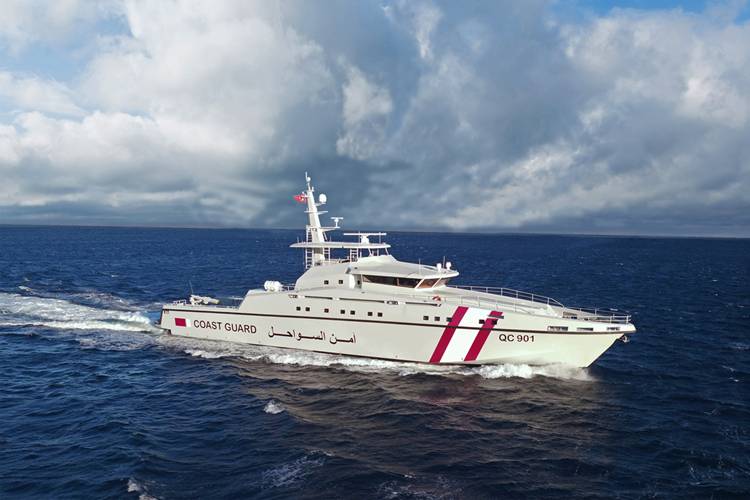
Saudis Buying 39 High Speed (45 knot) 106 foot Patrol Boats–WPB Replacement?

NavyRecognition is reporting award of a contract for 39 high speed 32.2 meter vessels that will probably be going to the Saudi Coast Guard.

In view of the need to replace the 87 foot Marine Protector class in the not too distant future, (The oldest, USCGC Barracuda (WPB-87301) was commissioned 20 years ago today, 24 April 1998.) this class might be worth a look. It is an example of the possible.

This is a CMN (French) design. CMN his a long history of building high speed vessels including the Israeli SA’AR 1, 2, and 3 missile boats and the widely used La Combattante series of fast attack craft.

Characteristics are reported as follows:

Length Overall : 32.20 m (105.6 ft)
Beam Overall : 7.00 m (23 ft)
Maximum draught : 1.40 m (4.6 ft)
Maximum speed : 43 Knots
Range at 12 Knots : 800 NM
Range at 33 Knots : 580 NM
Crew : 12
Fuel : 21 m3
Fresh water : 1 m3
Hull & Superstructure : Aluminium
Classification : Bureau Veritas

4.8 m outboard RHIB mounted on stern ramp

Three diesel engines

Three Waterjets : Two steering & one booster

Two main generators

Yes, it is larger than the Marine Protector class 87 foot WPBs by 19 feet, but the Webber class are 44 feet longer than the 110s they replaced, so the gap between new generation vessels would be greater than the previous generation 48 feet vice 23 feet.

Range, endurance, and crew size are similar to that of the Marine Protector class.

If you have been reading this blog for a while, you know I think the Webber class WPCs are, and are being used as, more small cruising cutter than as a “Fast Response Cutter” sitting in port waiting for a SAR call. These could be the real “fast response cutter,” and in many cases, they could beat a helicopter to the scene.


Mexico Naval Upgrades–Eight MH-60R

Navy photo. MH-60R “Knighthawk” helicopters conducts an airborne low frequency sonar (ALFS) operation during testing and evaluation

The Defense Security Cooperation Agency has released the following notice of approval for the sale of eight MH-60R ASW helicopters with associated equipment and weapons for the Mexican Navy valued at $1.2B.

Media/Public Contact:
pm-cpa@state.gov
Transmittal No:
18-06

­­­WASHINGTON, Apr. 19, 2018 – The State Department has made a determination approving a possible Foreign Military Sale to Mexico of MH-60R Multi-Mission Helicopters for an estimated cost of $1.20 billion.  The Defense Security Cooperation Agency delivered the required certification notifying Congress of this possible sale on April 18, 2018.

The Government of Mexico has requested to buy eight (8) MH-60R Multi-Mission Helicopters, equipped with:  twenty (20) T-700 GE 401 C engines (16 installed and 4 spares); sixteen (16) APS-153(V) Multi-Mode radars (8 installed, 8 spares); ten (10) Airborne Low Frequency Systems (ALFS) (8 installed and 2 spares); fourteen (14) AN/APX-123 Identification Friend or Foe transponders (8 installed and 6 spares); twelve (12) AN/AAS-44C Multi-Spectral Targeting Systems Forward Looking Infrared Systems (8 installed, 4 spares); twenty (20) Embedded Global Positioning System/Inertial Navigation Systems (EGI) with Selective Availability/Anti-Spoofing Module (16 installed and 4 spares); thirty (30) AN/AVS-9 Night Vision Devices; one thousand (1,000) AN/SSQ-36/53/62 Sonobuoys; ten (10) AGM-114 Hellfire missiles; five (5) AGM-114 M36-E9 Captive Air Training missiles; four (4) AGM-114Q Hellfire training missiles; thirty eight (38) Advanced Precision Kill Weapons System (APKWS) II rockets; thirty (30) Mk -54 Lightweight Hybrid Torpedoes (LHTs); twelve (12) M-240D machine guns; twelve (12) GAU-21 Machine Guns (an improved .50 cal. evolved from the M2–Chuck).  Also included are twelve (12) AN/ARC-220 High Frequency radios; spare engine containers; facilities study, design, and construction; spare and repair parts; support and test equipment; communication equipment; ferry support; publications and technical documentation; personnel training and training equipment; U.S. Government and contractor engineering, technical and logistics support services; and other related elements of logistical and program support.  The total estimated value is $1.20 billion.

This proposed sale will support the foreign policy and national security of the United States by helping to improve the security of a strategic regional partner.  Mexico has been a strong partner in combating organized crime and drug trafficking organizations.  The sale of these aircraft to Mexico will significantly increase and strengthen its maritime capabilities.  Mexico intends to use these defense articles and services to modernize its armed forces and expand its existing naval and maritime support of national security requirements and in its efforts to combat criminal organizations.

The proposed sale will improve Mexico’s ability to meet current and future threats from enemy weapon systems.  The MH-60R Multi-Mission Helicopter will enable Mexico to perform anti-surface and anti-submarine warfare missions and secondary missions including vertical replenishment, search and rescue, and communications relay.  Mexico will use the enhanced capability as a deterrent to regional threats and to strengthen its homeland defense.  Mexico will have no difficulty absorbing this equipment into its armed forces.

The proposed sale of this equipment and support will not alter the basic military balance in the region.

The principal contractor will be Lockheed Martin Rotary and Mission Systems in Owego, New York.  There are no known offset agreements in connection with this potential sale.

Implementation of this proposed sale will require the assignment of additional U.S. Government and/or contractor representatives to Mexico.

There will be no adverse impact on U.S. defense readiness as a result of this proposed sale.

This notice of a potential sale is required by law and does not mean the sale has been concluded.

All questions regarding this proposed Foreign Military Sale should be directed to the State Department’s Bureau of Political Military Affairs, Office of Congressional and Public Affairs, pm-cpa@state.gov.

Indonesia Uses Google to Stop Fish Pirates

The Indonesian Navy and the Ministry of Maritime Affairs and Fisheries blow up an illegal fishing vessel near Tanjung Batumandi, Pangandaran, West Java, on March 14, 2016. Photo credit: REUTERS/Adeng Bustomi/Antara Foto

gCaptain reports Indonesia has had great success in using Google to crack down on Illegal, Unreported, and Unregulated (IUU) fishing.

“After hunting down violators and blowing up their boats in public spectacles, Pudjiastuti’s approach has become more sophisticated. In a global first, the minister has teamed up with Google to use satellites to spot illegal fishermen from space. It’s paying off: Indonesia’s fish stocks have more than doubled in two years, and an industry plundered by foreigners for decades is once again contributing to economic growth, which Widodo has pledged to boost to 7 percent.

“See Also: Scientists Use AIS Data to Map Global Fishing Activity in Extraordinary Detail

“In a sprawling archipelago of 17,000 islands, the potential is vast. While fishing currently accounts for just 2.6 percent of Indonesia’s gross domestic product, that portion has grown about 40 percent since Pudjiastuti started her role. At that time, there were some 10,000 foreign vessels fishing illegally in Indonesia’s territory. She says they’re now all but gone.

Here is an earlier post on the Google system.

Antarctic Resupply at McMurdo–After the Icebreaker

MSC M/V Ocean Giant at the ice pier, McMurdo Station

The Military Sealift Command has given us a three part series on their operations to resupply McMurdo Station

“Military Sealift Command’s Expeditionary Port Unit 114 Gets Operation Deep Freeze 2018 Underway On Time”

“Military Sealift Command Chartered Ship Arrives in Antarctica in Support of Operation Deep Freeze 2018”

“MSC Operation Deep Freeze 2018 Fuel Delivery Operations begin at McMurdo Station With Arrival of M/T Maersk Peary

Thanks to Lee for bringing this to my attention. 

Coast Guard to Recieve Two Satellites, Launch Expected This Year

Cube shaped satellite, 100mm (3.9″) on a side. This photo shows the Norwegian student satellite NCUBE2 ready for shipment to the Netherlands for integration with the ESA student satellite SSETI-Express, photographer, Bjørn Pedersen, NTNU.

National Defense is reporting that the Air Force is building two “Polar Scout” SAR satellites for the Coast Guard, expected to be launched this year.

An earlier post referenced a Acquisitions Directorate report on this R&D Center project.

These satellites, or “cubesats,” are capable of detecting transmissions from emergency position indicating radio beacons (EPIRBs), which are carried on board vessels to broadcast their position if in distress. The Coast Guard will deploy the cubesats in cooperation with the Department of Homeland Security (DHS) Science and Technology Directorate’s Polar Scout program, the Air Force Operationally Responsive Space Office, and the National Oceanographic and Atmospheric Administration (NOAA).

These two satellites will only provide intermittent coverage of EPIRB signals from the polar regions so more satellites may follow.

This appears to be first fruit of a growing cooperation between the Coast Guard’s R&D Center and the Air Force Research Laboratory which has been formalized by a recent Memorandum of Understanding (MOU) signed by the heads of the two organization on April 12, 2018.