Another Very Different Candidate for “Cutter X”

mrv-80-image-04
Click on photo to enlarge

The Australian Navy has had problems with their Armidale class patrol boats. These little ships, similar to the Coast Guard’s Webber Class WPCs (Fast Response Cutters), have been sent great distances to enforce Alien Migrant Interdiction Operations. They are really are not up to the task, so Australia has been planning a larger class. In addition to the fourteen Armidale patrol vessels, they hope to use the same class to also replace six Huon-class minehunter, two Leeuwin-class survey vessel, and four Paluma-class survey motor launch.

This projected class of 20 larger ships is referred to as the Offshore Combatant Vessel.

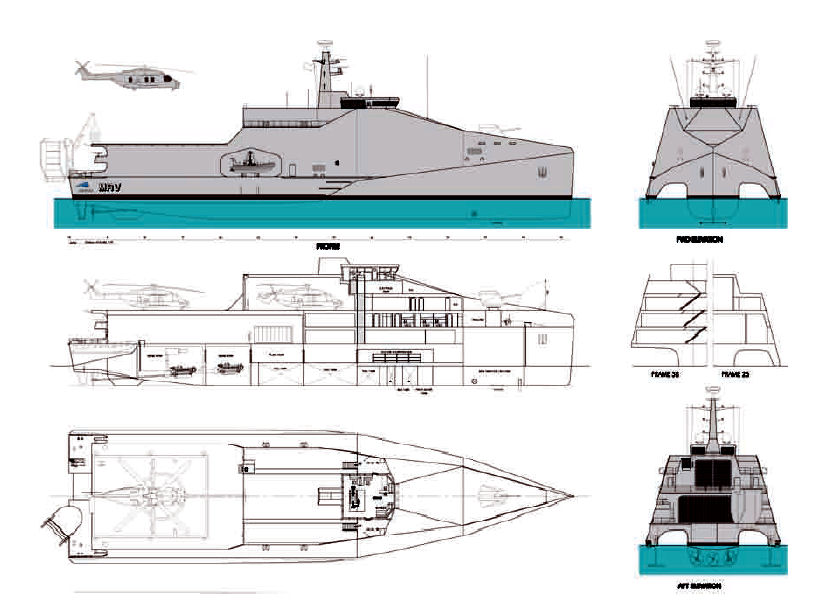
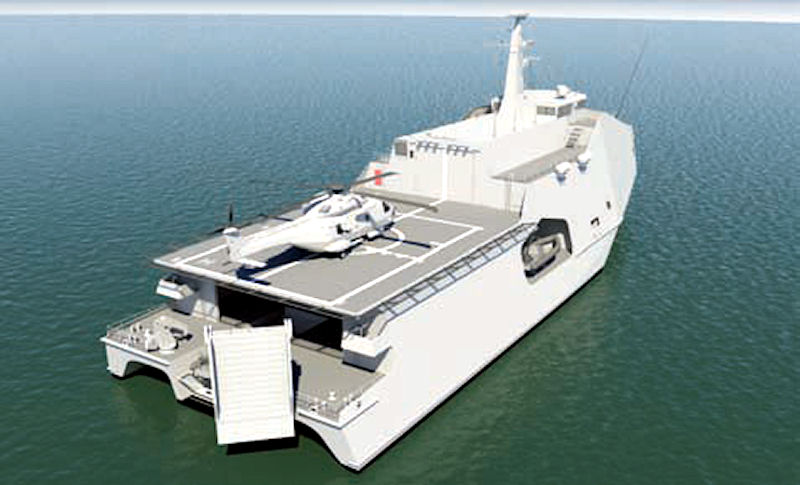
No design has been chosen yet as far as I can tell, but Austal is a local firm (with a shipyard in the US as well) that probably has an inside track. Their design referred to as a “Multi-Purpose Vessel,” is a bit unusual, but it might be appropriate to use as a USCG cutter to fill the space between the Offshore Patrol Cutter (OPC) and the Webber class WPCs, that I have been referring to as “Cutter X.”

It looks a bit like a scaled down Independence class LCS, not surprising since the Independence class are also made by Austal. It, like the Independence design, is a trimaran hull with lots of clear helicopter operating area and a hangar, as well as a large open area under the flight deck for modular systems, or perhaps in our case transporting migrants. Looks like they could also be very useful for Humanitarian Assistance Disaster Response (HADR) Mission.

Austal 80 meter Multi-Role Vessel

Austal 80 meter Multi-Role Vessel


Click on photo to enlarge

Length overall 80 meters (262.5 feet)
Length (waterline) 78.8 meters
Beam (moulded) 21.1 meters (69.2 feet)
Depth (moulded) 6.7 meters
Hull draft 3.2 meters (10.5 feet)
Mission deck 500m2 (5382 sq.ft.)
Flight Deck area 290m2 (3122 sq.ft.)
Hangar 1 x NH-90 (a 23,370 lb gross weight helicopter) or similar
Complement 35
Crew accommodation 87 berth
Endurance 28 days
Range 4,500nm @ 12 knots
Speed (max) 26 knots
Main engines 3 x MTU 20V 4000 @ 4,300kW at 2,170 rpm Diesel engines
(Same engines used in the Webber class)
Propulsion 3 x fixed pitch propellers
Weapons and Sensors •Standard 25mm stabilized naval gun
(the artist concept actually shows a 57mm)
•4 x .50 cal general purpose machine gun mounts

Austal 80 meter Multi-Purpose Vessel

Austal 80 meter Multi-Purpose Vessel

Click on photo to enlarge

Thanks to JamesWF for reminding me of this design.

FY2016 Budget–First Look

We now have access to the proposed Coast Guard Budget for FY2016 in several levels of detail in the form of pdfs. These range from a one page “fact sheet” to over 500 pages of Congressional justification.

FierceHomelandSecurity, also gives us a quick overview including how it fits in the larger Department budget. The Department’s budget is up 7.3% while the Coast Guard budget is up by only 1.6%.

The good news is that the budget has increased, the bad news is that all the increase can be accounted for by the increase in retired pay. In real terms, it is another cut, though not a big one.

In support of the DHS’s strategic objectives, the FY 2016 Budget provides for the acquisition of six Fast Response Cutters, continues to invest in pre-acquisition activities for an affordable Offshore Patrol Cutter and funds vessel sustainment projects for two 140’ WTGB Icebreaking Tugs and a 225’ Seagoing Buoy Tender.  The budget also continues sustainment and conversion work on legacy fixed and rotary wing aircraft, missionization of the C-27J aircraft received from the Air Force, and investment in Command, Control, Communications, Computers, Intelligence, Surveillance, and Reconnaissance (C4ISR) systems.

It is a bit surprising that the cut in the AC&I account is not larger than it is, considering the Coast Guard is not ready to fund any new large ships in 2016. The NSC program is just finishing up and there is a small amount for that and some money to prep the OPC program, but no new starts for major cutters.

The six Webber class “Fast Response Cutters” puts the program back on track to continue delivering four per year since only two were included in 2015. This program will be with us until far into the future, with the last delivered in 2026 at the current rate.

Major Renovations for the 140 icebreaking tugs have already begun. The Acquisition Directorate, CG-9, is reporting work on the second vessel, Penobscot Bay has begun. Looks like C-27J integration is getting a boost.

I still wonder when we will start doing something about the inland fleet.

The Old (Coast) Guard Was Tougher

Recently saw this on Bill Wells FaceBook page and thought it might be worth opening a discussion. I am republishing it here with his permission.

The current Coast Guard, and that of the immediate past, has relieved officers and enlisted men from command for any number of reasons. The “Relief for Cause,” or the “Loss of Confidence” reasons can mean anything and usually do. However, there is no legal process, the officer or enlisted man has little recourse and their careers as over. Many of the cases have devolved into using the “failure to abide by the Core Values.” It must be remembered that Core Values were implanted as part of the now defunct Total Quality Management System. The initial use of the values were to provide a guide for organizational conduct as shown in the Business Dictionary that defines Core Values as, “A principle that guides an organization’s internal conduct as well as its relationship with the external world. Core values are usually summarized in the mission statement or in a statement of core values.”

However, since inception the Core Values have been used as a hammer for punitive, extra-legal functions. The Coast Guard’s Core Values of Honor, Respect, and Devotion to Duty are claimed to have come from the Coast Guard’s history, but no one has pointed to that source. It is more faith and a belief system gone wrong. When first adopted no one could define just what the three words meant to the Coast Guard at large. So, explanatory paragraphs became additions to the words but these only confused the issue because the additional wording contained more core values, rules, and philosophical sloganeering. Still seeing the troops did not understand the additions, the Coast Guard added Twenty-Eight Competencies of leadership that all circled back to the Core Values providing more confusion.

So, how was the Old Guard tougher? They followed the prevailing rules. For example, in 1913 the Treasury Department charged Captain Horace B. West, USRCS, at a General R. C. S. Court with:

Neglect of Duty with six specifications.
Violating lawful regulations with eight specifications.
Conduct unbecoming an officer and gentleman with four specifications.

All these charges sound series until the reasons for the charges are known. West was found guilty on ‘neglect of duty’ and violating regulations and not guilty for unofficer-like conduct. His crimes consisted solely of his apparent dislike for paper work. West failed, according to the New York Times, to make “reply to several reports and communications transmitted to him from the Treasury Department. Although, the USRCS had had a service motto, “Semper Paratus,” since 1896, he was not charged being in violation of it and all it could have referenced was he was not ready to do paper work. The charges were not his first brush with not filing paperwork. In 1905, while in command of the cutter Woodbury at Portland, ME., he failed to submit assistance reports and for not having officers comply with a General Order. The assistance reports were more important because they provided the statistical data the Treasury Department used to justify the existence of the USRCS.

His sentence consisted of a suspension from the service for six months on half pay. A vacation of sorts and he resumed full service and his command with no real adverse effect on his career. Of course, West understood it all. He was an 1880 graduate of the Revenue Cutter School of Instruction (later the Coast Guard Academy).

The Treasury Department of West’s era would have never relieved him for cause. If they had specific charges and proof they brought the person to a legitimatize trial to exact that pound of flesh. Using the sloganeering of core values does little to inspire confidence in the ability of the Coast Guard’s leadership to address situations in a fair and military manner. Perhaps it is time to look at the Core Values and see that they do represent the Service beyond being a punitive cat o’ three tails.

Coast Guard Budget and Charlie Hebdo

Defensenews reports,

“When the Hill passed its spending bill in December, it excluded DHS, instead putting the agency under a three-month continuing resolution while the Republican-controlled Congress sought to challenge President Barack Obama’s executive order on immigration.

“Asked about the DHS funds days after the Paris attacks, newly re-elected House Speaker John Boehner, R- Ohio, said “I don’t believe that the funding of the department is in fact at risk.” Meanwhile, Senate Appropriations Committee member Sen. John Hoeven, R-N.D, indicated “more has to be done” to prevent such attacks, which could include an increase of funds.” (Emphasis applied–Chuck)

Should the Coast Guard play the terrorism card in a push for increased funding?
I hate to push fear as a justification for funding but keep a couple of things in mind.

  • If the electorate and their representatives are afraid, maybe they are right, maybe there is a threat.
  • Funding for Coast Guard counter-terrorism capabilities is a lot more relevant to the threat than funding for Navy high end warships, Air Force F-35s, or Army theater ballistic missile defense systems.
  • Improvements that help the Coast Guard deal with terrorism, including better comms, better Maritime Domain Awareness, and better sensors can also help the Coast Guard do a better job on their other missions.

The Department of Homeland Security seems to have a fixation on terrorism that the Coast Guard seems to have viewed with some skepticism. As a result while Departmental funding has continued to increase, Coast Guard funding has actually declined. We have been out of step with Department priorities.

Perhaps it is time to embrace the Department’s priorities.

It does seem the world is becoming a more dangerous place.

The house is pushing a bill that would have DHS strengthen the southern border including more aircraft.

Are they really worried about the right threats? Really, we should be talking about what we should be afraid of, and that should include the introduction of a nuclear device which most likely to come by sea.

The Pentagon wants $350B to modernize Nuclear deterrents, new SSBNs, new ICBMs, and new nuclear bombers, none of which will have any deterrent effect on terrorists. And after all will $350B for deterrence be any more effective than $320B?

Perhaps it would make sense to spend $1B more a year on the Service that is most likely to be on the line if terrorists attempt to bring a weapon of mass destruction into the US, when most of that money is expected to be spent over the long term anyway.

If the Coast Guard is going to embrace counter terrorism as a priority, the service needs to act like it believes a terrorist attack is a possibility and ask to be armed appropriately to deal with terrorist threats, a 7.62 mm machine gun on a 25 foot boat will not cut it.

It the Coast Guard is to have a creditable capability, it will need small highly accurate missiles like Griffin, Hellfire, or Brimstone to deal with relatively small, fast, highly maneuverable threats and light weight torpedoes to deal with larger, hard to stop threats. We also need to get modern reliable patrol vessels or aircraft armed with these weapons spread out geographically to cover all our ports.

Maritime Domain Awareness?

The Acquisitions Directorate is reporting purchase of equipment to complete the Nationwide Automatic Identification System. US regulations will require most vessels in US waters 65 foot and longer to participate.

This should be a boon to SAR. It has the potential to help the Coast Guard in many ways. Still we should not forget, the information is only as good as the cooperation of the participating vessels. Vessels that choose not to cooperate by either not transmitting, or by transmitting bogus data, for whatever reason, will either not show up at all or will be improperly identified.

100th Anniversary of the Formation of the Coast Guard

The Coast Guard Compass notes the 100th anniversary of the consolidation of the Revenue Cutter Service (USRCS) and the Life Saving Service (USLS) to form the Coast Guard, noting the roles of Bertholf and his Lifesaving Service compatriot Sumner Kimball. Bertholf, of course, already has a cutter named for him and USCGC Kimball (WMSL-756) will be the seventh in the Bertholf class.

Office of Naval Research, “Naval Future Force Science and Technology Expo”

Don’t often mention “trade shows.” I don’t think I ever have, but this is one that the CG might want to attend.

What: Naval Future Force Science and Technology EXPO
When: Feb. 4-5, 2015
Where: Walter E. Washington Convention Center in Washington, D.C.

Among the things the Coast Guard might benefit from are developments in Maritime Domain Awareness, ship design and survivability, and developments in unmanned systems.

Perhaps not immediately applicable to the Coast Guard, but looks like they will also have a good discussion on development of electromagnetic railguns. These might have the advantage for the Coast Guard of being effective ship stoppers, while having the advantage of requiring no explosives be carried on the ship–a good reason for the new ships to have robust generator capacity.

Small Warship Survivability

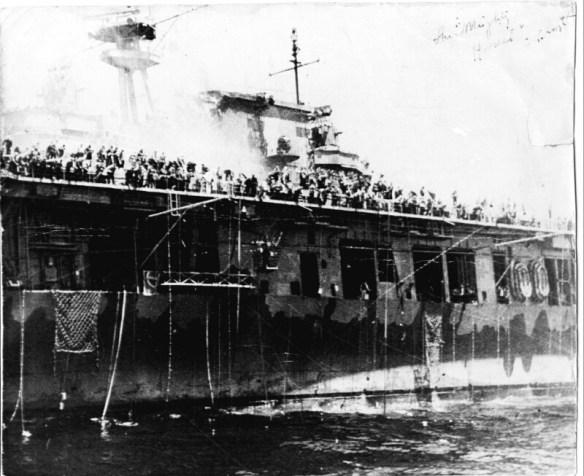
USS Hornet (CV-8) abandon ship

(USS Hornet (CV-8) as the crew abandons ship

There has been a lot of discussion lately about the survivability of the LCS and smaller combatants in general. A recent US Naval Institute News opinion piece contends,

“Small warships are historically unsurvivable in combat. They have a shorter floodable length, reduced reserve buoyancy and more likely to be affected by fire and smoke damage than larger combatants. In both World Wars, losses in ships below 3000 tons in displacement far exceeded those of larger vessels.

“In World War II, for example, the U.S. lost a total of 71 destroyers and 11 destroyer escorts — all under 3400 tons displacement and less than 400 feet in length.

“By comparison, only 23 larger ships were lost. Part of that figure is undoubtedly due to their operational employment, but in simple terms of engineering and physics, larger ships are inherently more survivable than their smaller counterparts.”

In the Coast Guard we once had a saying, “In our obscurity is our security.” I think that should be kept in mind when we consider the survivability of small surface combatants. No, they cannot take as much damage as major surface combatants, but the enemy gets a vote, and he will be less “excited” by the presence of smaller vessels, while he will normally choose to put more effort into destroying larger, more threatening ships. As in land warfare, tanks are more survivable than infantrymen, but they don’t necessarily last longer.

To look at how this factor might influence survivability, I looked at how many of the ships that were in commission at the beginning of World War II were sunk as a result of enemy action. My source is the “Summary of War Damage to U.S. Battleships, Carriers, Cruisers, Destroyers, and Destroyer Escorts” which is accessible here. The figures there do not correspond to those quoted above, rather they report 58 destroyers and 9 destroyer escorts sunk, along with 26 larger surface combatants, all listed by name. (The USNI post may have included constructive losses that were not actually sunk or losses to other than enemy action, and does not include the three battleships salvaged although they were out of action most of the war.)

If we look only at the US fleet at the beginning of the war, it included 233 major surface combatants of which 46 or 19.7% were sunk by enemy action during the course of the war. If we break it down by class it looks like this:

Type: Number in Commission, Dec. 7, 1941/Number sunk/% lost to enemy action
Aircraft Carriers (CV): 7/4/57.1%
Escort Carrier (CVE): 1/0/0%
Battleships (BB): 17/5/29.4% (of the 5 sunk, all were at Pearl Harbor, 3 were salvaged)
Heavy Cruisers (CA): 18/7/38.9%
Light Cruisers (CL): 19/1/5.3%
Destroyers (DD): 171/29/17%

(There were no Destroyer Escorts in commission at the beginning of the war.)

If we lump  all the cruisers together, 8 of 37 were lost or 21.6%

If we lump the lone escort carrier together with the fleet carriers then four of eight were sunk or 50%

Additionally three destroyers were lost to weather in a hurricane. They were not ballasted properly, because of the exigencies of impending combat operations.

Clearly, at least looking at the World War II experience, the US Navy did not loose a higher percentage of smaller ships. If anything it appears the opposite is true. A smaller percentage of smaller ships were lost (17% vs 27.4%). More small ships were lost simply because there were many more of them. Undoubtedly some of the DDs and DEs that were sunk, would have survived the damage they received, if they had been bigger, but presumably there would also have been fewer of them. If the decision criteria were an equal chance of being sunk, then probably taking greater risk with smaller ships is both reasonable and unavoidable.

I will note that the probability of personnel loss on small ships is probably higher because they are more likely to sink quickly and catastrophically, while larger ships are more likely to sink slowly.
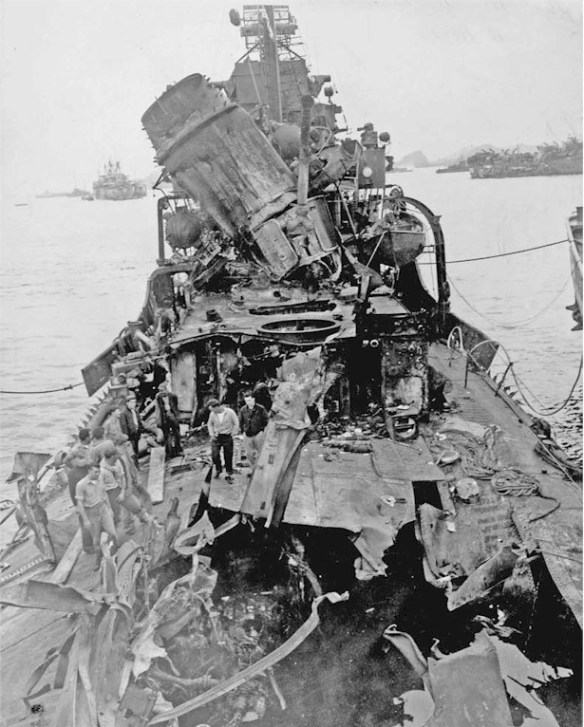
USS_Newcomb_Damage_1945

Photo: USS Newcomb DD 586 was hit by as many as five kamikaze on 6 April 1945 as she was screening for the cruiser USS St. Louis off Okinawa. She survived but was not repaired.

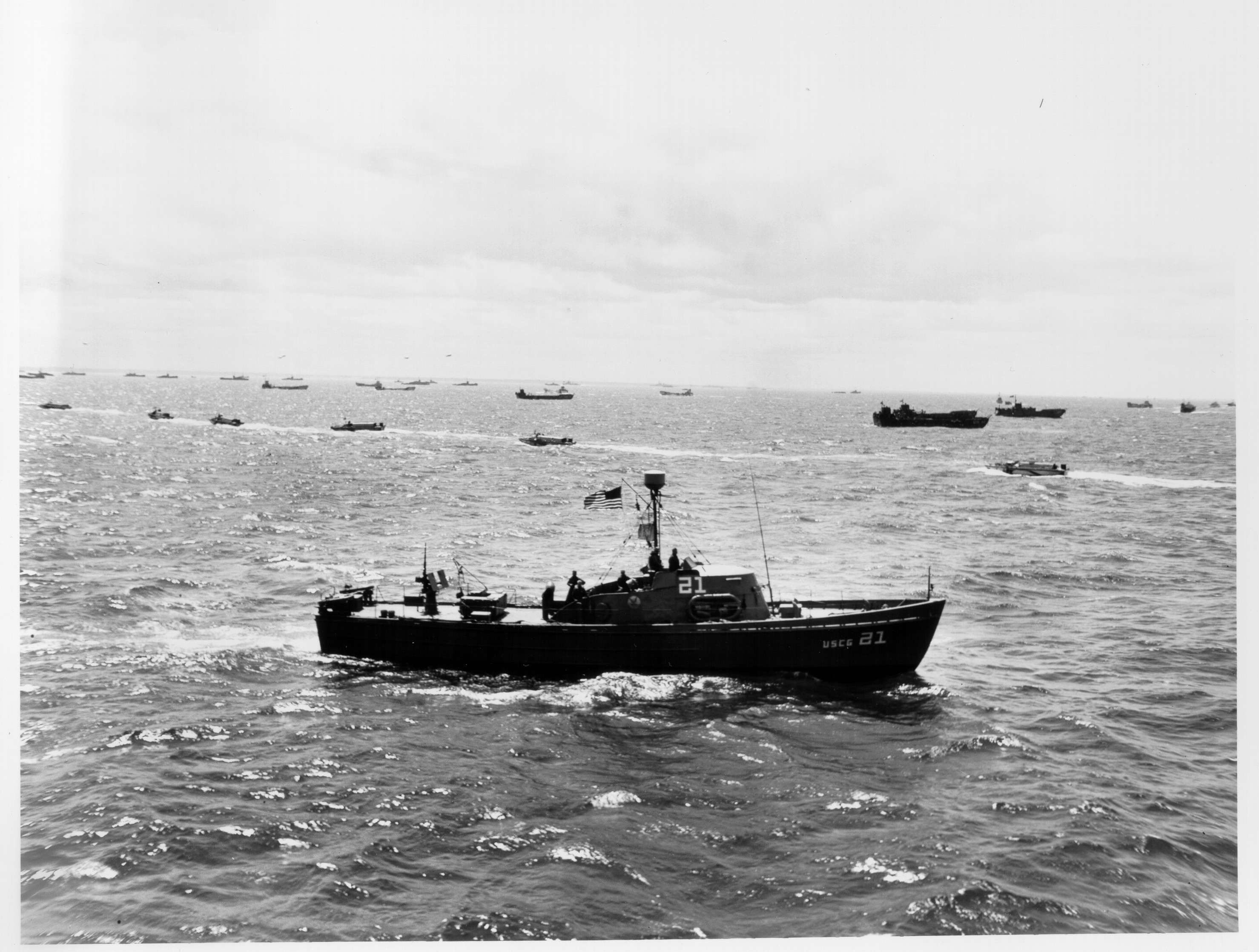
I will add a bit of anecdotal evidence. As part of Operation Overlord, the Normandy Invasion, 60 US Coast Guard 83 foot patrol boats were assigned to rescue those unlucky enough to find themselves in the water or sinking. 30 went to the American beachheads and 30 went to the British and Canadian beachheads. Being wooden hulled and gasoline powered, they certainly would not have been considered “survivable.” Apparently they were in the thick of it, because they rescued 1438 men from the water and sinking craft. In spite of all the fire from shore, not a single boat was sunk and not a single crewmen was killed. Apparently the German gunners were too busy with the landing craft hitting the beach and the warships that were shelling them. They simply were not a priority target.

ResFlot1_CG21

USCG 83 ft patrol boat, probably June 1944. Photographer unknown.

CG-83527

No caption.  No date listed; probably June 1944.  No photo number.  Photographer unknown.

No caption.
No date listed; probably June 1944.
No photo number.
Photographer unknown.

One of the proudest achievements in Coast Guard history was the performance of the sixty 83 foot gasoline powered, wooden hull patrol boats of Rescue Flotilla One, that saved 1,438 American and Allied lives during the Normandy landings in June 1944. An average of approximately 24 rescued for each boat.

"Crew of CG-16 pointing to the tally board of 126 rescued soldiers."  Photo courtesy of Terry Hannigan. (NOT AN OFFICIAL USCG PHOTOGRAPH)

“Crew of CG-16 pointing to the tally board of 126 rescued soldiers.”
Photo courtesy of Terry Hannigan.
(NOT AN OFFICIAL USCG PHOTOGRAPH)

There is at least one vessel of this class, CG83527, still in near original condition.

She’s in Everett, WA. Unfortunately the boat is not currently open to the public. The caretaker organization is having a hard time keeping the boat up. They need some help. Dan Withers, Cell: 206-947-2303, danwithers@q.com, is heading the organization.

At some point, I hope we will have this vessel, or another of its class, at the new Coast Guard museum being built at New London.

The 83-foot Coast Guard cutter USCG 1 off Omaha Beach on the morning of D-Day, tied up to an LCT and the Samuel Chase

The 83-foot Coast Guard cutter USCG 1 off Omaha Beach on the morning of D-Day, tied up to an LCT and the Samuel Chase