This Day in Coast Guard History, March 5

Based on the Coast Guard Historian’s timeline, https://www.history.uscg.mil/research/chronology/
With inspiration from Mike Kelso

March 5

1881  The crew of Life-Saving Station No. 10, Ninth District (Louisville), won acclaim with a dangerous rescue at the wreck of James D. Parker, a well-known river boat lost in the Indiana chute of the Ohio Falls.  She was a stern-wheel steamer of over 500 tons owned by the Cincinnati and Memphis Packet Company and bound from Cincinnati to Memphis.  Her crew numbered 50, including the captain, and she had 55 passengers on board, a number of whom were women and children.

From 1881 to 1972 “… the Louisville Lifeboat Station was in operation at Louisville, Kentucky.  The station was located just above the falls of the Ohio River and was authorized by an act of Congress on 2 March 1881.  It was the only permanently located floating lifeboat station in the world.

“During the floods of 1883-1884, the surfmen of the station ‘rescued and took to places of safety over 800 imperiled persons, men, women and children–among them many sick and infirm–and supplied food and other necessities to more than 10,000.’ [USLSS Annual Report, 1883]. “

This Day in Coast Guard History, February 4

Based on the Coast Guard Historian’s timeline, https://www.history.uscg.mil/research/chronology/
With inspiration from Mike Kelso

March 4

Algonquin, no caption/date; Neg. No. 148-2; Marine Photo Shop-Joe D. Williamson photo.

1907  Congress appropriated $30,000 for installing wireless telegraphs on not more than 12 revenue cutters.  USRC Algonquin as the first cutter fitted with the new technology with money appropriated from this act.

1915  Secretary of the Treasury was authorized by Congress to detail cutters to enforce anchorage regulations in all harbors, rivers, bays, and other navigable waters of United States.

USCGC Yamacraw, c. 1914.

1917  Ten crewmen of CGC Yamacraw perished in the line of duty while trying to rescue the crew of the grounded steamer Louisiana near Ocean City, Maryland.  The Treasury Department labeled their loss “the most disastrous incident of this kind ever recorded in the annals of the Coast Guard, or of either of its forbears, the Revenue-Cutter Service and Life-Saving Service.”  The Coast Guardsmen who gave up their lives were:  Gunner Ross Harris, Master-at-Arms R. J. Grady, Quartermaster M. L. Kambarn, Seaman G. V. Jarvis, Ordinary Seaman M. L. Austin, Ordinary Seaman D. Fulcher, Ordinary Seaman R. L. Garrish, Ordinary Seaman R. E. Simmons, Ordinary Seaman T. L. Midgett, and Boy First Class J. A. Dugger.

1925  An Act of Congress (43 Stat. L., 1261), for the first time, provided for disability retirement within the Lighthouse Service.

The U.S. Coast Guard SAR aircraft Arcturus (USCG)

1929  Congress appropriated $144,000 for seaplanes and equipment for Coast Guard.

1952  An air detachment consisting of three helicopters and necessary personnel established as the first unit of its type on a test basis (at AIRSTA Brooklyn) began operating in support of port security operations.

1977  ENS Janna Lambine, USCG, graduated from naval aviation training at NAS Whiting Field, Milton, Florida, becoming the first female pilot in the Coast Guard.

This Day in Coast Guard History, March 3

Based on the Coast Guard Historian’s timeline, https://www.history.uscg.mil/research/chronology/
With inspiration from Mike Kelso

March 3

USRC Louisiana

1819  Congress authorized the revenue cutters to protect merchant vessels of United States against piracy and to seize vessels engaged in slave trade.  The cutters Louisiana and Alabama were built shortly thereafter to assist in the government’s efforts against piracy.

1837  An Act of Congress (5 Stat. L., 181, 185) laid down certain restrictions, by providing that the construction of the large number of new lighthouses, lightships, etc., for which this law was appropriating the necessary funds, would not be begun until examined by Board of Navy Commissioners.  They reported to Congress those cases where the “navigation is so inconsiderable as not to justify the proposed works.”  The Navy detailed 22 officers to this duty and, before the end of the year, their recommendations resulted in the deferment of the construction of 31 lighthouses already appropriated for.

Revenue Cutter Washington rejigged as a brig in 1838 or 39. This is the ship that intercepted La Amistad.

1839  Congress directed that Revenue Captain Ezekial Jones, commanding the revenue cutter Washington in the Seminole War, be allowed the same pay as a lieutenant in the Navy would receive for like services.

1845  Congress authorized the President to appoint six engineers (later amplified by Act of February 4, 1863) and six assistant engineers, one of each to be assigned to each revenue steamer then in the service.  Engineers were to receive the same pay as first lieutenants and assistant engineers the same pay as third lieutenants.

1845  Congress directed no person be appointed as a revenue cutter officer “who does not adduce competent proof of proficiency and skill in navigation and seamanship.”  This was the first official underway qualifications established for the service.

1845  The duties of the Fifth Auditor of the Treasury as Superintendent of Lights was first put on a statutory basis by an Act of Congress (5 Stat. L., 752. 762), which prescribed that “the Fifth Auditor of the Treasury, shall continue to superintend the several matters and things connected with the lighthouses, beacons, buoys, and public piers, as heretofore, of the United States, and to perform all the duties connected therewith, under the direction of the Secretary of the Treasury, until otherwise ordered by law.”

1847  Congress appropriated $5000 “for furnishing lighthouses on the Atlantic Coast with means of rendering assistance to shipwrecked mariners.”  This was the first federal appropriation for rendering assistance to the shipwrecked from shore.

1849  The Office of Commissioner of Customs was created.  The local Collectors took over control of the revenue cutters within their jurisdictions.

1859  An Act of Congress (11 Stat. L., 423, 424) authorized the Lighthouse Board to use its own discretion in the discontinuance as necessary of such lighthouses as might become useless by reason of changes in commerce, alteration in channels, or other causes.

1873  Signal Corps of Army established a storm signal service for benefit of seafaring men at several life-saving stations and constructed telegraph lines as a means of communication between the stations.

1875  Secretary of the Treasury was authorized by Congress to acquire by donation or purchase the right to use and acquire sites for life saving and lifeboat stations.

1885  Congress authorized Secretary of the Treasury to detail officers and men of Revenue Marine Service to duty under the commissioner of Fish and Fisheries Division of the Bureau of Fisheries when they could be spared for such duty.

1899  An Act of Congress (30 Stat. L., 1121, 1152) required that, whenever a vessel, raft, or other craft was wrecked and sunk in a navigable channel, it became the duty of the owner to immediately mark the sunken craft with a suitable buoy or beacon during the day and a lighted lantern at night.  Previously, the Lighthouse Establishment had been authorized by Congress to place, when considered necessary, a lightship or other suitable warning of danger on any wreck or temporary obstruction to the entrance of any harbor or in the channel of any bay or sound.

Coast Guard Yard, Curtis Bay, MD.

1905  Congress authorized the Secretary of the Treasury to acquire a suitable site in the state of Maryland upon which to establish a depot for the Revenue Cutter Service; this station became the Coast Guard Yard.

1915  An Act of Congress (38 Stat. L., 926, 928) provided for cooperation between the Lighthouse Service and the Forest Service in the management of the forest land on lighthouse reservations.

1918  By Act of Congress (38 Stat. L., 928), the protection afforded the aids to navigation maintained by the United States government was extended to those established and operated by private individuals.

The Life Line, by Winslow Homer, 1884, depicts a breeches buoy in use during a rescue operation.

1947  The SS Oakey S. Alexander reported being in distress 22 miles east of Portland, Maine, with a hatch stove in and shipping water.  CGC Cowslip immediately proceeded on orders from Portland to assist.  When she began breaking up, the ship’s commanding officer decided to beach at Cape Elizabeth.  Cowslip arrived on the scene but was unable to approach the beached vessel because of heavy seas.  All 32 crewmembers, however, were removed safely from the ship by Coast Guardsmen from the Cape Elizabeth Light and Lifeboat Station using a breeches buoy.

“U.S. Coast Guard Year in Review” –USNI

NTSB drone image of Francis Scott Key Bridge and Cargo Ship Dali, 26 March 2024

The US Naval Institute’s March 2025 issue of Proceedings provides a look back at Coast Guard activities in 2024. The service, Active, Reserve, Auxiliary and Civilians, has much to be proud of. Just to hit the some highlight,

There was good news on the recruiting front. Even as the military as a whole continues to struggle, the Coast Guard met its recruitment goals for active duty, reservists, and officers for the first time since 2007—though it remains about 10 percent down in total force numbers. 

SAR as always deserves a headline:

…saved more than 5,800 lives and $132 million in property across 14,000 cases.

U.S. Coast Guard Cutter Harriet Lane returns to home port after 79-day patrol, April 9, 2024. (U.S. Coast Guard photo by Senior Chief Petty Officer Charly Tautfest)

New Capabilities:

  • Cyber defense teams including new Reserve teams
  • The first new air station in 25 years at Ventura, CA.
  • Medium Endurance Cutter USCGC Harriet Lane (photo above) moved to the Pacific to support IUU fisheries enforcement and presence in the Western Pacific.
  • Three more FRCs in Guam for a total of six and more FRCs in Alaska.
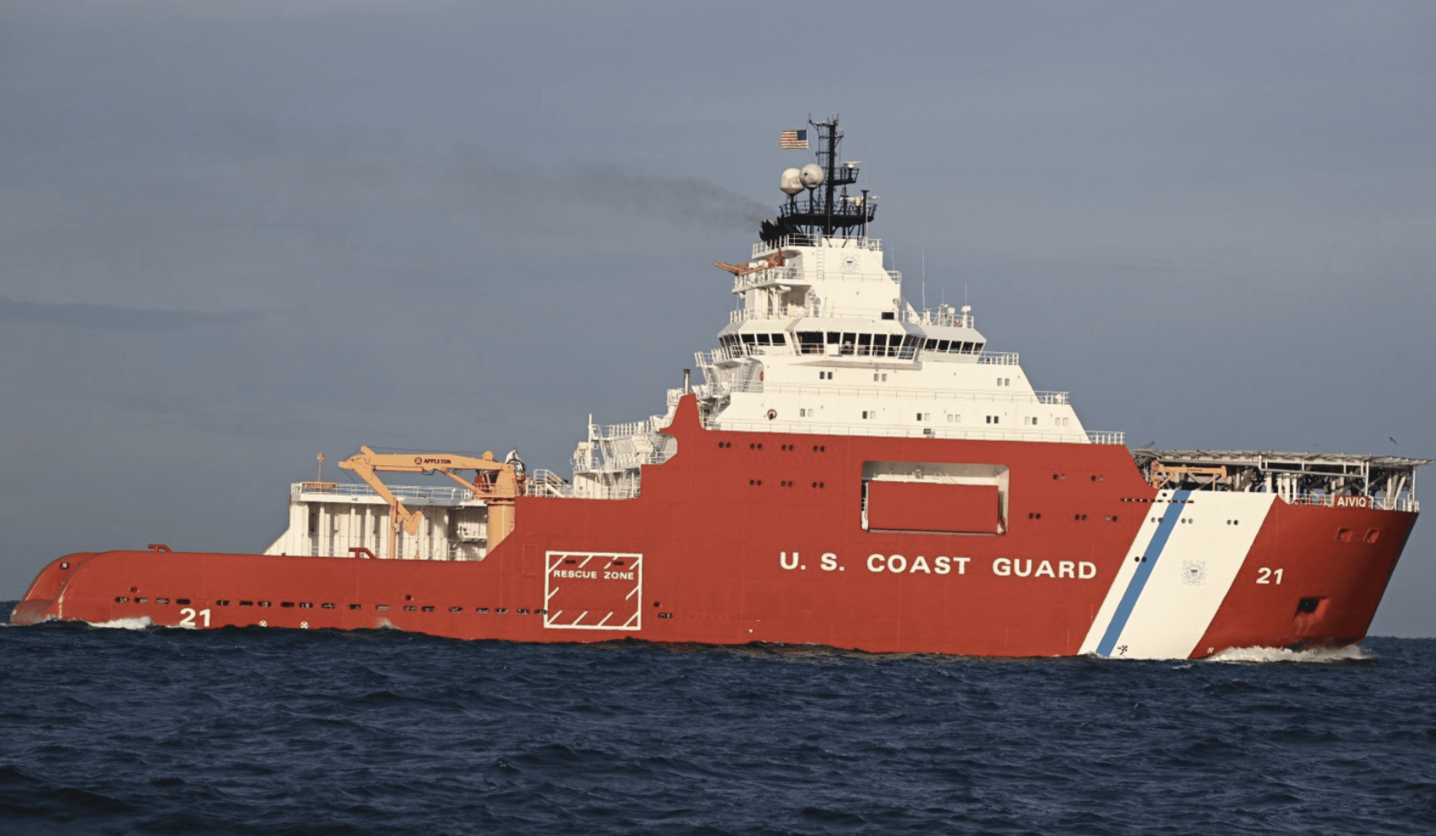
  • Purchase of medium icebreaker M/V Aiviq, now USCGC Storis (photo below).

There was this cautionary note. As I have noted before, cutters spend more time underway than their Navy counterparts, yet we hear constantly that Navy ships are overworked. Only recently have complaints about shortages of maintenance for Coast Guard ships become common. (Still no complaints about too much time underway.)

“As we celebrate Coast Guard Cutter Smilax [WLIC-315], with 80 years of commissioned service, we must also note that we deploy our cutters, boats, and aircraft as much or more than our fellow services and keep them for longer, driving up maintenance costs.” He indicated the capital investment budget needs to bump from its current $1.4 billion to an estimated $3 billion, and the annual overall budget request needs to increase from its current $14 billion to $20 billion by 2033.

This Day in Coast Guard History, March 2

Based on the Coast Guard Historian’s timeline, https://www.history.uscg.mil/research/chronology/
With inspiration from Mike Kelso

March 2

Coast Guard Cutter Stratton fires its MK 110 during a gunnery exercise in the Bering Sea April 28, 2021. Routine training and live-fire exercises provide opportunities to evaluate and improve procedures, test capabilities and maintain proficiency. U.S. Coast Guard photo courtesy Ensign Molly Dolan.

1792 Congress authorized the revenue cutters to fire on merchant ships that refused to “bring to.”

1799  Congress authorized revenue cutter officers to board all ships of the United States within four leagues of the U.S., if bound for the U.S., and then search and examine them, certifying manifest, sealing hatches, and remaining on board until they arrived in port.  They were also authorized to search ships of other nations in United States’ waters and “perform such other duties for the collection and security of the Revenue” as directed by the Secretary of the Treasury.

1799  Congress authorized cutters and boats to be “distinguished from other vessels by an ensign and pendant” with the marks thereon prescribed by the President of the United States, to fire on vessels who refused to bring to after the pendant and ensign had been hoisted and a gun fired as a signal, masters to be indemnified from any penalties or actions for damages for so doing, and be admitted to bail if anyone is killed or wounded by such firing.  On August 1, 1799, Secretary Oliver Wolcott, Jr., prescribed that the ” ensign and pennant’’ should consist of “Sixteen perpendicular stripes, alternate red and white, the union of the ensign to be the arms of the United States in dark blue on a white field.”  There were sixteen states in the Union at that time.

SOUTH CHINA SEA (July 31, 2024) – Independence-class littoral combat ship USS Mobile (LCS 26) conducts a Maritime Cooperative Activity with Philippine Navy’s Gregorio del Pilar-class patrol ship, BRP Ramon Alcaraz (PS 16), former CGC Dallas) in the South China Sea, July 31, 2024. Mobile, part of Destroyer Squadron 7, is on a rotational deployment operating in the U.S. 7th Fleet area of operations to enhance interoperability with allies and partners and serve as a ready-response force in support of a free and open Indo-Pacific region. (U.S. Navy photo by Naval Aircrewman Tactical Helicopter 2nd Class Diego Chavez)

1799  Congress authorized the President to sell cutters unfit for service and the Secretary of Treasury to apply an unexpended balance of proceeds in the purchase and construction of revenue cutters.  (This authority was revoked March 3, 1845).

1807  Congress passed the “Act Prohibiting the Importation of Slaves” (2 Stat. 426).  The act outlawed the importation of slaves into the United States.  It went into effect on January 1, 1808.  The Revenue Marine enforced the law on the high seas.

1845  Congress reined in President John Tyler’s zealous use of the presidential veto, overriding it with the necessary two-thirds vote.  This marked Congress’ first use of the Constitutional provision allowing Congressional veto overrides and represented Congress’ parting gift to Tyler as he left office.  About two weeks earlier, Tyler had vetoed a Congressional bill that would have denied him the power to appropriate federal funds to build revenue-cutter ships without Congressional approval.  With the override, Congress insisted that the executive branch get the legislature’s approval before commissioning any new military craft.

1868  By Act of Congress (15 Stat. L., 249), the Lighthouse Board was “authorized, when in their judgment, it is deemed necessary, to place a light-vessel, or other suitable warning of danger, on or over any wreck or temporary obstruction to the entrance of any harbor, or in the channel or fairway of any bay or sound.”

1889  Congress authorized the Secretary of Treasury to keep rivers clear to afford marine species access to their spawning grounds.

1912  The Revenue cutter Hartley seized the vessel Morning Star in Oakland Creek and arrested her crew for carrying 21 “contraband” Chinese migrants.

1978  Mexican authorities requested Coast Guard assistance after severe rainstorms caused significant flooding in Baja.  Two HH-3Fs from AIRSTA San Diego began evacuating people for Ensenada.  An HC-130 from AIRSTA San Francisco and a third HH-3F from San Diego joined the flood relief operations.  As of March 8th, Coast Guard aviation units had flown 59 sorties and 77 flight hours, transported 349 persons to safety, and delivered 74,600 lbs. of relief supplies in operations covering Ensenada, Tijuana, Santa Ynes, San Quintin, Punta Colnett, Camalu, Guadlupe, El Rosario, and La Mission.  Through the Mexican Secretary of Defense and the Governor of Baja California, the President of Mexico relayed his personal appreciation and that of the Mexican people to all Coast Guard personnel involved.

2015  CGC Diligence returned to its homeport of Wilmington, North Carolina, following a 46-day patrol in the Caribbean Sea and Atlantic Ocean.  During the patrol, Diligence was diverted to conduct a search and rescue mission of four Italian sailors aboard the 30-foot sailing vessel Algeria, which became disabled off the Coast of Panama.  The four sailors had been underway on the Algeria for more than a month navigating from Italy to Costa Rica when the vessel became disabled. Diligence traveled more than 175 miles to Algeria’s location and then towed the sailing vessel to safety in Chiriqui Grande, Panama.  During the patrol, the crew aboard Diligence conducted search and rescue operations off the coast of Panama, drug interdiction operations in the vicinity of Honduras, Nicaragua, Costa Rica, and Panama, and alien migrant interdiction operations in the Straits of Florida.  Diligence patrolled in support of the Joint Interagency Task Force South’s Operation Martillo in the Western Caribbean Sea from Honduras to Columbia.

Coast Guard Cutter Polar Star (WAGB 10) visited Palmer Station, a United States research station on the Antarctic peninsula, March 3, 2023, after completing a successful deployment in support of Operation Deep Freeze 2023. This was the Coast Guard Cutter Polar Star’s first visit to Palmer Station in 35 years. Operation Deep Freeze is one of many operations in the Indo-Pacific in which the U.S. military promotes security and stability across the region. (U.S. Coast Guard photo by Petty Officer 3rd Class Aidan Cooney)

2023  CGC Polar Star (WAGB 10) and crew departed the Antarctic region March 2, after 67 days below the Antarctic Circle in support of Operation Deep Freeze 2023. Polar Star and crew broke a 17-mile channel through fast ice and conducted over 1,600 hours of ice breaking operations to create a navigable route for cargo vessels to reach McMurdo Station. Polar Star and crew executed more than 60 hours of ice escorts for cargo vessels through difficult pack ice conditions. “Though sea ice around the Antarctic continent overall has been determined to be at one of the lowest in recent history, the sea ice in McMurdo Sound was observed to be at the highest concentration on record dating back to at least 2012,” said LCDR Don Rudnickas, the onboard ice analyst. “The pack ice conditions this year were difficult and made icebreaker support critical not only for establishing the fast ice channel, but for the close escort through pack ice of three of the four cargo vessels resupplying McMurdo Station.” While operating in Antarctica, Polar Star and crew made two logistical stops at McMurdo Station. After the first stop in McMurdo, the cutter and crew assisted in moving a 30,000-ton aging and degraded ice pier from Winter Quarters Bay to make way for a modular causeway system that was installed for the season. The cutter also provided an ice escort to motor vessel Ocean Giant and crew, who delivered the 65-ton MCS that was offloaded, assembled, and used as a pier to replace the traditional ice pier used for cargo operations. “The Antarctic region is a harsh and challenging environment to operate in,” said LCDR Benjamin Litts, operations officer. “Despite the inhospitable conditions, our crew adapted and tirelessly performed at the highest level to ensure mission success.” Before departing the Antarctic Region, the cutter also visited Palmer Station, the United States’ research facility located on the Antarctic Peninsula. Polar Star personnel went ashore to meet with the station manager and staff, tour the facility, and shared camaraderie in one of the most remote regions on the planet. This was the first visit from a U.S. Coast Guard icebreaker to Palmer Station since 1987.

1 March 1968, During the Tet Offensive, the Coast Guard Fought in the Most Significant Naval Battle of the Vietnam War

Androscoggin, WPG/WHEC-68 Provided courtesy of former Androscoggin crewman William C. Bishop. He noted: “I believe this picture was taken after we left the ship yard in 66 or 67 steaming through the Chesapeake Bay after the midship superstructure was added before our deployment to Viet Nam in 67.” USCGC Minnetonka and Winona were the same class.

57 Years ago, multiple Coast Guard units fought in the largest and perhaps most successful naval engagement of the Vietnam War.

The Tet Offensive had been launched 30 January 1968. As the fighting dragged on North Vietnam sailed four 100 foot trawlers South load with supplies for the VietCong.

Waiting for them were units assigned to Operation Markettime–South Vietnamese Navy, US Navy, 82 foot patrol boats of Coast Guard Squadrons One and 255 foot WHECs of Coast Guard Squadron Three.

The following is quoted from a Wikipedia post, Action of 1 March 1968” which includes a map showing where the actions took place and footnotes. 

The action of 1 March 1968 was a co-ordinated attempt by four North Vietnamese trawlers to resupply the Viet Cong and the efforts of Operation Market Time elements to stop them during the Vietnam War. On 28 February 1968, United States Navy SP-2H Neptune aircraft on routine patrol detected a North Vietnamese SL class naval trawler heading towards the South Vietnamese coast from north of the DMZ. By the next morning, three more trawlers were discovered and units of Operation Market Time were deployed for a surprise interception. The suspect trawlers did not fly flags so it was not until the start of the engagement that their origin was discovered. The trawlers were steel-hulled vessels, 100 feet long and armed with 57-millimeter recoilless rifles and machine guns. All four vessels were loaded with weapons and ammunition intended to be delivered to the Viet Cong. American and South Vietnamese forces that engaged in action included the United States Coast Guard cutters Androscoggin, Point Grey, Point Welcome, Winona, Point Grace, Point Hudson, Point Marone, the swift boats USS PCF-18, USS PCF-20, USS PCF-42, USS PCF-43, USS PCF-46, USS PCF-47 and USS PCF-48, two South Vietnamese navy junks and one patrol boat. Two U.S. Army helicopter gunships also participated in combat as well as aircraft used to fire flares.


Background:

The United States Navy, South Vietnamese navy, and the U.S. Coast Guard, operating under the authority of the South Vietnamese government, established a blockade of South Vietnam designated Operation Market Time to prevent infiltrations of personnel, munitions and equipment by the North Vietnamese government. A twelve mile wide restricted zone existed along the entire South Vietnamese coast and ships assigned to Market Time had the authority to stop and search any vessel within the zone for contraband material and check the identity papers of any person on a detained vessel.

“Action off Bo De River”
“The trawler designated in U.S. Navy records as An Xuyen Province Trawler… was first sighted on 28 February approximately 150 miles east southeast of Vũng Tàu holding a southeasterly course. On the evening of the 29th she changed to a westerly course and USCGC Winona started a covert surveillance. The trawler crossed the 12-mile limit at 0120 1 March and began a run for the beach near the mouth of the Bo De River at 0200. A blocking force placed near the mouth of the river consisted of several Navy PCF’s and the Coast Guard cutters Point Hudson, Point Grace, and Point Marone. Winona fired warning shots eight miles off the coast which were ignored so she opened up with her 5-inch/38 caliber gun after receiving return fire from the trawler. The trawler exploded in a huge fireball after taking several direct hits and sank approximately seven miles off the beach. Winona was struck by several pieces of debris from the explosion, however only minor injuries were sustained by the crew during the action.

(“Damage controlman first class Thomas Lisk was on board at the time, and reported that a round penetrated the hull and bounce repeatedly around the room but fortunately neither he nor any shipmates were injured.” –Chuck)

Action off Nha Trang

The trawler designated Khánh Hòa Province Trawler…was first sighted by Market Time aircraft on 29 February approximately 90 miles east northeast of Nha Trang with a southwesterly course. Surveillance was continued by Market Time vessels until she crossed the 12-mile limit 28 miles northeast of Nha Trang. Ignoring warning to heave to for boarding, the trawler continued on towards the beach. A South Vietnamese Navy patrol boat opened fire on the trawler and it quickly changed course and returned fire. Assisted by a U.S. Air Force AC-47 gunship, swift boats PCF-42, PCF-43, PCF-46, PCF-47, PCF-48and two SVN junks sortied to help the patrol craft chase the trawler to a cove where it ran aground in the Hon Heo Secret Zone.  At 0230, 1 March, five 81-millimeter mortar rounds from PCF-47 were direct hits and the trawler exploded with a massive explosion due to the munitions aboard. Fourteen dead North Vietnamese sailors were recovered the following morning. Rifles, machine guns and rocket launchers; along with considerable ammunition and explosives were recovered from the sunken trawler. The salvage operations extended over 12 days and included the recovery of a 14.5 millimeter antiaircraft gun and 68 cases of ammunition.[1]

Action off Tha Cau River

Forty miles from Chu Lai and six miles off the coast, USCGC Androscoggin intercepted a third trawler designated in U.S. Navy records as the Quảng Ngãi Province Trawler. Androscoggin signaled the trawler to identify itself at 0112 but there was no response so Androscoggin shot 5-inch star shells into the air to illuminate the trawler. It was then that the trawler was positively identified as an SL class North Vietnamese trawler so the Androscoggin opened fire at 0120 with 5-inch high explosive naval gunfire and .50 caliber machine guns. The trawler returned fire with a recoilless rifle, laid a smoke screen and turned into Androscoggin’s direction but one of the cutter’s shells hit the after starboard side, so the trawler turned reversed course and headed for the shore. As a result of a civilian junk passing through the battle area the Market Time ships had to cease fire. Two United States Army helicopters were directed to engage the trawler with rockets and miniguns at 0129 and after their attack a reduction in the amount of fire coming from the trawler was noticed. At 0140 Point Grey, Point Welcome, PCF-18 and PCF-20 were ordered to take the trawler under fire with mortars and machine guns at close range because the trawler had moved too close to shore for Androscoggin to maneuver. Point Welcome struck the trawler twice with 81-millimeter rounds. The trawler then grounded 50 yards off the mouth of the Tha Cau River at 0210. At 0220, the North Vietnamese tried to scuttle their ship and failed but a second attempt at 0235 succeeded in destroying the vessel in a 500-foot fireball. The explosion caused some damage to the pilothouse of Point Welcome and the deck was littered with debris but no casualties were reported.

Other Action on 1 March

USCGC Minnetonka shadowed the trawler designated as the Bình Định Province Trawler…but soon after being detected, the trawler turned around and headed back out to sea without being engaged. It was apparently headed for the Lo Dien area 42 miles north of Qui Nhơn. The trawler never got any closer to the coast than 30 miles and after she reversed course was monitored by aircraft until she approached the coast of the People’s Republic of China.

While on Market Time patrol duties on 1 March, USS Persistent discovered an abandoned junk at anchor 52 miles southeast of Da Nang. After a search of the area failed to locate persons in the water, the junk was boarded and items were found of a Communist Chinese origin including a Communist Chinese flag. The junk was hoisted on board Persistent and delivered to Da Nang for further inspection.[1]

Aftermath: 

The destruction of three of the four trawlers and the turning back of the fourth demonstrated that Operation Market Time was an effective net for the interception of supplies destined for resupply of the Viet Cong. Except for the 1 March trawlers and one other instance in the days after Tet 1968 no other trawlers were spotted between July 1967 and August 1969. The North Vietnamese were forced to use the Ho Chi Minh trail through Laos or the neutral port of Sihanoukville in Cambodia to ship supplies to the Viet Cong. With the closing of the port at Sihanoukville to Communist shipping in August 1969, attempted North Vietnamese trawler traffic into South Vietnam resumed. Of 15 trawlers detected by Market Time assets from August 1969 to late 1970, one was sunk, 13 were turned back and only one got through. In 1970, ten out of eleven trawlers were either sunk or were turned back.

This Day in Coast Guard History, March 1

Based on the Coast Guard Historian’s timeline, https://www.history.uscg.mil/research/chronology/
With inspiration from Mike Kelso

 March 1

1876  Nuova Ottavia, an Italian vessel, grounded near the Jones Hill North Carolina Life-Saving Station.  The rescue attempt by the crew of that station resulted in the loss of seven surfmen, the first deaths in the line of duty since the service began using paid crews in 1870.  Among the dead was African-American Surfman Jeremiah Munden, the first African-American surfman to die in the line of duty.

1902  The first regular light stations in Alaska were established at Southeast Five Finger Island and at Sentinel Island.  Both were on the main inside passage between Wrangell Strait and Skagway.

1927  The U.S. Lighthouse Service put into effect a system of broadcasting radio weather reports by four lightships stationed along the Pacific Coast.

1933  In the interest of administrative economy and efficiency, the 13th and 14th Lighthouse Districts were consolidated with the 15th Lighthouse District.  Also, the aids to navigation on the entire Mississippi River system were placed in charge of a civilian lighthouse engineer as superintendent.  This relieved the Army engineers detailed for that duty.  The offices at Rock Island, Illinois and Cincinnati, Ohio were discontinued, and all the river work was placed under a single office at St. Louis, Missouri.

1975  The Coast Guard issued regulations that became effective on March 1, 1975 that required an emergency position indicating radio beacon (EPIRB) on small passenger vessels engaged in ocean and coastwise service.

1977  The Coast Guard began enforcement of the Fishery Conservation and Management Act with 19 cutters and 17 aircraft patrolling within the 200-mile Fishery Conservation Zone.

2003  Administrative control of the Coast Guard transferred to the newly created Department of Homeland Security from the Department of Transportation, where it had served since April 1, 1967.

Courtesy Photo | USCGC Escanaba (WMEC 907) and USCGC Richard Snyder (WPC 1127) practice maneuvering with the Royal Canadian Navy’s HMCS Goose Bay (MM 707) in the Davis Strait on Aug. 13, 2021. In Operation Nanook, the U.S. Coast Guard seeks to work collaboratively with other international partners to enhance collective abilities to respond to safety and security issues in the High North through the air and maritime presence activities, maritime domain defense, and security exercises. (Photo courtesy Royal Canadian Navy)

2015  Her Majesty’s Canadian Ships Goose Bay and Shawinigan, in collaboration with the U.S. Navy and in support of the U.S. Coast Guard, assisted in seizing more than 1000 kg of cocaine while patrolling in the Caribbean Sea, as part of Operation CARIBBE.  Following the initial search of a suspect vessel by a boarding team from USS Kauffman, HMCS Goose Bay was tasked to conduct an additional inspection.  A subsequent boarding and search of the suspect vessel by the USCG LEDET embarked with HMCS Goose Bay, supported by HMCS Shawinigan, resulted in the seizure of 1017 kg of cocaine.

Coast Guard Cutter Alex Haley (WMEC 39) transits inbound Dutch Harbor while on patrol in the Gulf of Alaska. As the only major cutter homeported in Alaska, Alex Haley’s primary missions are search and rescue, international/domestic fisheries enforcement, and homeland defense. (U.S. Coast Guard Photo by Lt. j.g. John Walsh)

2015  CGC Alex Haley returned to Kodiak, Alaska, following a successful 70-day deployment patrolling more than 10,800 miles throughout the Bering Sea and Aleutian Islands.  Alex Haley,  the “Bulldog of the Bering,” departed Kodiak on December 1, 2014 and spent 70 days conducting law enforcement and community outreach operations in the Bering Sea and Aleutian Islands.  During the deployment, Alex Haley’s crew performed 41 at sea domestic fisheries enforcement boardings and covered more than 5,000 square miles in search efforts for the sunken Korean fishing vessel 501 Oryong.

SAN FRANCISCO. The Coast Guard Cutter Waesche transits through the San Francisco Bay for the first time en route to its homeport of Alameda, Calif., Feb. 28, 2010. The Waeshe is the second Legend Class Cutter and is scheduled to be commissioned in May.(U.S. Coast Guard photo by Petty Officer 3rd Class Kevin Metcalf)

2015  CGC Waesche returned to homeport at Coast Guard Island in Alameda following a 79-day, 13,000 nautical-mile patrol in the Eastern Pacific Ocean.  Since its departure on December 12, 2014, Waesche patrolled international waters off the coast of Central America, disrupting Transnational Organized Crime networks through joint inter-agency counter-drug operations, seizing nearly 1,400 lbs of cocaine with an estimated value of more than $22 million.  During the last four weeks of its deployment, crewmembers aboard Waesche spent time off the coast of San Diego completing rigorous proficiency exercises geared toward sharpening the unit’s readiness to conduct the many operations that are vital to the Coast Guard’s military, homeland defense, and law enforcement missions. Many of these exercises included helicopter operations, gunnery, shipboard firefighting and damage control, and medical training. Additionally, they practiced national defense scenarios to ensure seamless integration with partners from the Department of Defense.

This Day in Coast Guard History, February 28

Based on the Coast Guard Historian’s timeline, https://www.history.uscg.mil/research/chronology/
With inspiration from Mike Kelso

February 28

1867  As ordered by the Treasury Department, each officer of Revenue Cutter Service, while on duty, was entitled to one Navy ration per day.

1871  Congress passed 16 Stat. 458 which addressed shortcomings in previous legislation regarding the inspection and certification of steamboats and their crews.  This Act established the Steamboat Inspection Service (SIS) within the Department of Treasury headed by a Supervisory Inspector General answerable to the Treasury Secretary.  The Act also provided SIS inspectors with greater authority over more aspects of the maritime field.

1942  Certain duties of the former Bureau of Marine Inspection and Navigation were transferred to the Coast Guard temporarily by Executive Order 9083.  The transfer was made permanent on July 16, 1946.  Also, the U.S. Maritime Service was transferred to the Coast Guard from the War Shipping Administration on this date.

California officials have added a C-130 Hercules cargo plane to the firefighting fleet of the California Department of Forestry and Fire Protection, the state’s primary firefighting agency. (Courtesy Cal Fire/TNS)

1963  With the arrival of the ferry crew on this date to accept delivery of the HC-130B CGNR 1351 at Marietta, Georgia, the Coast Guard completed its program for the procurement of 12 long range, long endurance, four engine landplanes.  The aircraft were assigned to Air Station Elizabeth City and Air Detachments Argentia, San Francisco, and Barbers Point.

2004  Coast Guard units responded to an explosion aboard the 570-foot Singapore-flagged tanker Bow Mariner off the coast of Chincoteague, Virginia.  The Bow Mariner was carrying 6.5 million gallons of industrial ethanol when it exploded and sank.  The Coast Guard rescued six survivors.

USCGC Steadfast (WMEC 623)

2015  CGC Steadfast returned to its homeport of Astoria after a two-month Joint Interagency Task Force (JIATF) deployment.  Steadfast partook in multiple Coast Guard missions ranging from search and rescue, to counter-narcotics, to securing U.S. borders through enhancement of international relations, and coordination with other cutters and aircraft allowing the U.S. to stop drug trafficking before it reaches U.S. borders.  While returning from patrol off the coast of Central America, Steadfast offloaded approximately 725 kilograms of cocaine in San Diego.  The seized cocaine is worth an estimated wholesale value of more than $23 million.  The offload is a result of a successful drug interdiction in the Eastern Pacific Ocean on January 23, 2015.  While on a routine patrol, a maritime patrol aircraft working in conjunction with JIATF assets detected a suspicious go-fast vessel south of El Salvador.  Using information provided by the aircrew, Steadfast was able to vector the cutter’s Over-the-Horizon boat to intercept and conduct a law enforcement boarding of the suspect vessel.  Once aboard the go-fast vessel, the Coast Guard boarding team found 16 bales of contraband hidden throughout the 35-foot vessel that tested positive for cocaine.  The Coast Guard took three suspected smugglers into custody.  This seizure is one of many interdictions in the Eastern Pacific in recent months due to an increased presence of Coast Guard cutters in support of the Western Hemisphere Strategy.  The Western Hemisphere Strategy has been implemented by the Coast Guard and various other government agencies to protect U.S. borders by stopping illicit trafficking at the source.  Steadfast’s interdiction was part of Operation Martillo, which is one component in the United States government’s whole-of-government approach to countering the use of the Central American littorals as transshipment routes for illicit drugs, weapons, and cash.  Prior to the visit to San Diego, Steadfast participated in a North American Maritime Security Initiative (NAMSI) exercise off the coast of Ensenada, Mexico, February 21-22, 2015.

“USCG Polar Security Cutter Program Offers DOGE An Easy ‘Win’”–Forbes

Forbes’ always perceptive Craig Hooper takes a look at the Polar Security Cutter program and finds it ripe for cancellation, “years late, wildly over-budget, and both the budget and the schedule are at risk of slipping even further into the red…”

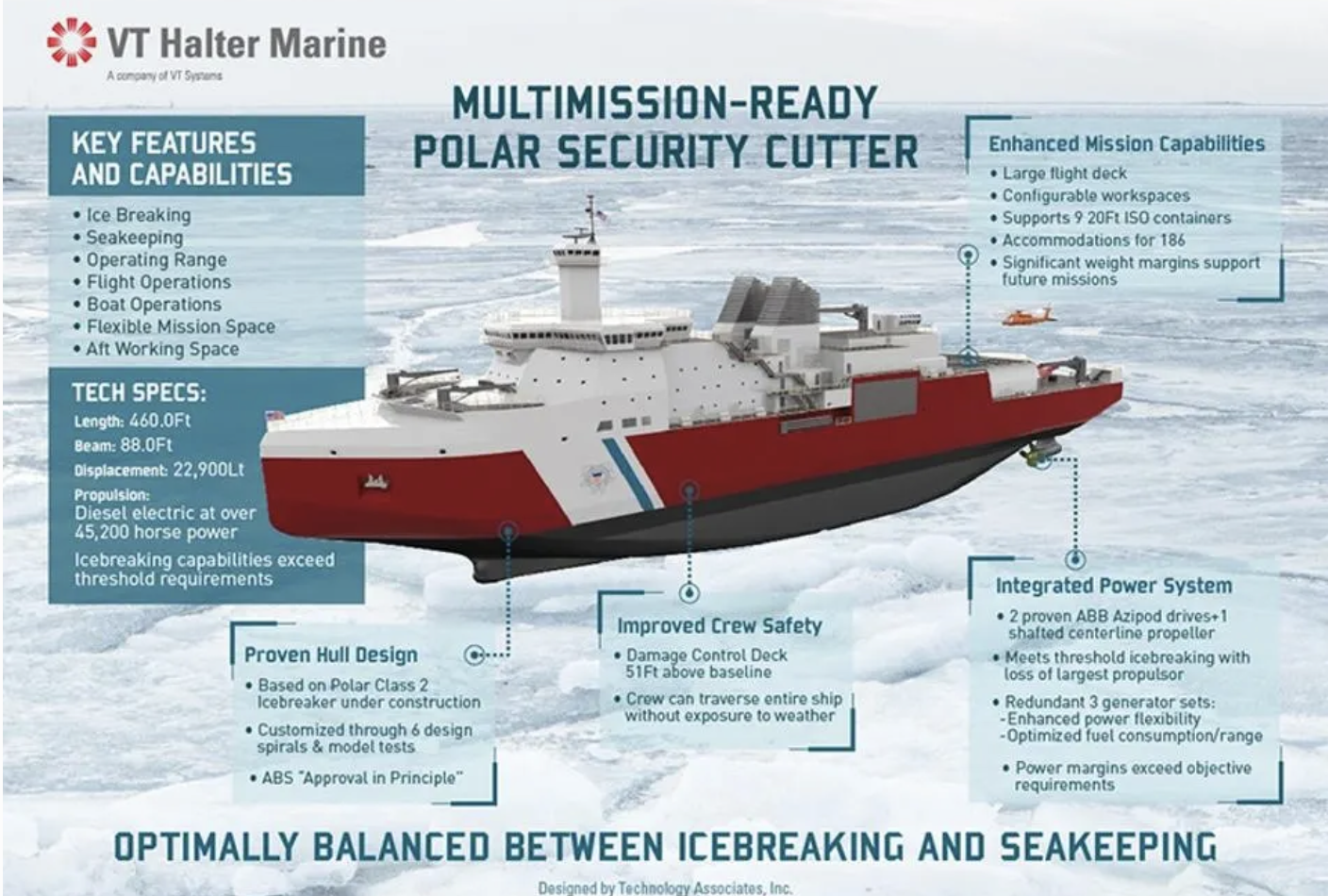
I still want to know who decided that the Coast Guard should award this critically important contract to a relatively inexperienced and less than fully successful shipyard even though they had failed to offer a proven design as had been required by the original solicitation and apparently repeatedly lied that the design was building (See the graphic from VT Halter above, “Proven Hull Design”).

I don’t know enough to agree that the Polar Security Cutter contract should be cancelled, but I do think Hooper would agree that it is time to start procurement of the Medium Icebreakers we know we need, even if the first is to be built in a foreign yard.

Given his comments on the Offshore Patrol Cutter (OPC) program in the same article, I think he might also agree that the Coast Guard should be looking at an alternate design for a medium endurance cutter replacement to be built in lieu of at least some of the planned OPCs.

The first OPC has yet to be delivered, and the costs are likely to increase. If the PSC aligns with the OPC’s ugly performance trends, starting PSC construction with this amount of design uncertainty puts the Coast Guard at real risk of an even bigger fiasco…Sadly, these Coast Guard tastemakers don’t reflect that the building rate–as it is now–appears unable to meet the positively glacial building pace set by years-late and massively over-budget Offshore Patrol Cutter.

Thanks to Paul for bringing this to my attention. 

“Strengthening Pacific Security: U.S. Shiprider Agreements” –Real Clear Defense

Following efforts with Kiribati partners, the USCGC Oliver Henry (WPC 1140) crew transit in the Republic of Marshall Islands Exclusive Economic Zone during the next leg of their expeditionary patrol on Feb. 24, 2024. Underway in support of Operation Blue Pacific, the cutter crew showcased the effectiveness of the U.S. and RMI maritime bilateral agreement, conducting a shared patrol with shipriders emphasizing collaborative efforts in maritime safety, security, and stewardship in terms of resource protection. (U.S. Coast Guard photo)

Real Clear Defense provides an overview of the nature and importance of Coast Guard ship rider agreements with Pacific Island nations.

U.S. Coast Guard Forces Micronesia Sector Guam Commander Capt. Nicholas R. Simmons and the Honorable Joses R. Gallen, Secretary of Justice, Federated States of Micronesia, signed an expanded shiprider agreement allowing remote coordination of authorities, the first of its kind aboard the USCGC Myrtle Hazard (WPC 1139) in Guam, on Oct. 13, 2022. The agreement will enable to U.S to act on behalf of the FSM to combat illicit maritime activity and to strengthen international security operations. (U.S. Coast Guard photo by Chief Warrant Officer Sara Muir)

Fijian navy Sub-Lt. Opeti Enesi looks out from an Air Station Barbers Point HC-130 Hercules over the Fijian Islands, Dec. 8, 2018. The Hercules aircrew was providing support for a Fijian navy patrol boat during law enforcement operations. (U.S. Coast Guard photo by Petty Officer 3rd Class Matthew West/Released)