Unfunded Piority List

The US Naval Institute has published an online copy of the DOD’s unfunded priority list. The Navy’s list runs pages 9-13 of the 49 page document reproduced there.

Which got me to thinking, where is the Coast Guard’s unfunded priority list? Do we have one? If not, shouldn’t we? The FY2015 budget proposal includes only two Fast Response Cutters. First on the list, four more. The additional 14 C-27Js still leave us four Maritime Patrol Aircraft short of the program of record. Four more C-144s (or C-27s) please. There is a documented requirement for three heavy and three medium icebreakers. Lets fix the Polar Sea. To do all its statutory missions, the Coast Guard Fleet Mix Study  indicated we need nine National Security Cutters not eight and not 25 Offshore  Patrol Cutters but 57. We are not ready to order the OPCs yet, but a ninth NSC is something we could use right now. Plus the Coast Guard needs replacements or rebuilds for the inland fleet of tenders and the 65 foot icebreaking tugs. Incidentally the Fleet Mix Study says the Coast Guard need 65 Maritime Patrol Aircraft (listed as C-144s in the study) not the 36 in the program of record or the 32 in the works currently.

The Commandant has been saying the Coast Guard needs $2.5B a year in AC&I. Why not tell Congress how we would spend it. If I remember correctly, Congress has in fact asked for this. The Coast Guard would be remiss in not providing it.


Changes in the Fleet

Defense Industry Daily has an update on the status of the National Security Cutter (NSC) program. The seventh (Kimball) has been ordered and they report how the previously ordered cutters are progressing.

HII receives a $497 million fixed-price, incentive-fee contract from the U.S. Coast Guard to build WMSL 756, the 7th Legend Class National Security Cutter. Construction is expected to begin in January 2015, and delivery is scheduled for some time in 2018.

Ingalls has delivered the first 3 NSCs. WMSL 753 Hamilton is 81% complete and will deliver in Q3 2014; WMSL 754 James is 52% complete and will launch in April 2014; and WMSL 755 is scheduled for launch in the Q4 2015.  Sources: HII, “Ingalls Shipbuilding Awarded $497 Million Contract for Seventh U.S. Coast Guard National Security Cutter”.

Hamilton will be the first of two NSCs expected to be based in Charleston. Note the contract prices quoted are not the full cost of the ships.

Gallatin is being transferred to the Nigerian Navy, making this the second 378 transferred there. This leaves the Coast Guard with ten “high endurance cutters”, seven 378s and three NSCs, all on the West Coast.

The eighth Fast Response Cutter (FRC) has been commissioned and the ninth has been delivered.


Littoral Operations Center, a Coast Guard Role?

MarineLink is reporting,

“The Naval Postgraduate School (NPS)in Monterey has established a new Littoral Operations Center (LOC) to focus on these threats and opportunities and is hosting a series of workshops this week to examine littoral operations…The LOC will conduct and promote the study of U.S. Navy and allied partner nation policy, strategy and technology necessary to deal with conventional, irregular and criminal threats in these crowded and cluttered coastal waters and their adjacent lands,” said LOC Director, NPS Senior Lecturer Dr. Kalev Sepp.”

This looks like something the Coast Guard should be involved in.

Decommissioning the 110s

File:USCGC Mustang (WPB-1310).jpg

Photo: USAF photo, USCGC MUSTANG (WPB 1310), underway at Port Valdez, Alaska, while providing harbor security during Exercise NORTHERN EDGE 2002.

The Coast Guard recently commissioned its eighth Webber Class Fast Response Cutter, and it has accepted the ninth. Since these are replacements for the 110 foot Island class, we should not be surprised that Island class cutters are being decommissioned.

This is the first I have heard about since the decommissioning of the 123 conversions: USCGC Bainbridge Island (WPB-1343).

The FY2015 budget provides for decommissioning eight 110s.

The Coast Guard plans on 58 Webber class, so presumably they would want to retain enough 110s to provide a total of 58 larger patrol craft with the 110s filling in until replaced by the new ships. It does not look like this will happen. Since the decommissioning of eight Island class as a result of the failure of the 123 conversion, there have been 41 Island class WPBs. Adding the Webber class WPCs currently commissioned that gives the Coast Guard a total of 49 large patrol craft. It appears the total will not exceed 49 at any time in the foreseeable future.

If 110s are decommissioned at the same rate Webber class are built, the number may stabilize at 49. If on the other hand the Coast Guard is unable to keep these older vessels going, the total is likely to drop. If that happen, as little as I like the idea of multiple crews, perhaps it is time to look at multi-crewing the Webber Class. .

Navy Department Budget, a Comparison

Here is an overview of the Navy Department’s FY2015 budget request: http://www.finance.hq.navy.mil/FMB/15pres/DON_PB15_Press_Brief.pdf A much shorter summary of the Coast Guard’s FY2015 budget proposal can be found here: http://www.fiercehomelandsecurity.com/story/papp-budget-falloff-results-smaller-coast-guard/2014-03-12

The Navy Department’s FY2015 budget authorizes 698,259 positions (323,600 Navy, 182,700 Marines, and 191,959 civilians). The Navy’s budget is down, but it is still $148B. Its equivalent of the Coast Guard’s AC&I budget (Procurement plus Infrastructure) is $39.9B.

By comparison the Coast Guard budget request includes 49,093 positions, a total budget of $9.8B, and $1.08B for AC&I.
In terms of personnel the Coast Guard is roughly 7% or one fourteenth the size of the Navy Department (and about one eighth the size of the Navy itself). If its budget were proportional, the Coast Guard would have an AC&I budget of $2.81B and a total budget of $10.41B.
There is not much difference in the per capita budget overall, but the difference in investment is huge. An equivalent AC&I budget would be 160% greater than the current request.  (The difference in the R&D budgets are even more significant.)
As similar organizations, I think this is a clear justification, of the Commandant’s assertion, that the Coast Guard really needs an AC&I budget of $2.5B to get healthy. If anything, after years of underfunding, it needs more.

New Budget Process

Fiercehomelandsecurity is reporting that the Department (DHS) is initiating a new budget process, that would make it more top down.

DHS is building a process where it will define its mission and objectives, then determine what resources it needs and look across components to avoid overlaps and inefficiencies.

“My impression is that the DHS budget process is too stovepiped,” Johnson told the House Appropriations subcommittee on homeland security, during a March 11 hearing.

Johnson, a former general counsel for the Defense Department who took over at DHS in December, said he used the DoD budget process as a model.

Perhaps this is what is needed to make the Department a bit more coherent in its approach to its missions. Perhaps it would be too much to hope for, but perhaps the Department will see that Customs’ Aviation and Marine units largely unnecessarily duplicate Coast Guard assets.

I don’t have any problem with the Department defining mission and objectives or eliminating  overlaps and inefficiencies. I do think they might be out of their depth in determining what resources it needs.

The new Secretary comes from the DOD and looks to their process as a model, but DOD is not necessarily the most efficient of organizations. DOD staff over and above the armed services themselves, is grossly inflated and part of the reason is that there is a lot of second guessing of the services expertise by an ever growing civilian bureaucracy, a model DHS cannot afford to duplicate.

Bird’s Eye View for Ships

 Photo:  Valkyrie Virtual Mast System model   Kelsey D. Atherton 

ThinkDefence reports L3 is resurrecting an old idea to extend the horizon distance for  surface vessels. Their “virtual mast” puts sensors at high altitude without the need for a helicopter or UAV. Popular Science has a bit more detail, reporting that the proposed system could fly as high 5,000 feet. Sensors at that altitude would have a radar and visual horizon of 76 nautical miles.

Not sure how they would warn off air traffic that might otherwise hit the cable or the autogyro.

Historical Note: During WWII German U-boats used a similar unpowered tethered autogyro to take a lookout aloft, but their altitude was much more limited.

Intercept at Sea, Israeli Style

I’ve seem several reports of the Israeli seizure of a Panamanian flag vessel, the KLOS-C, reportedly transporting long range rockets and perhaps other weapons being shipped by Iran to terrorists in Gaza. But NavyRecognition’s is the first report I’ve seen that actually showed the seizure. They also the show the reported route of the weapons.

The intercept point looks to be a bit over 700 miles from the nearest Israeli port. Apparently the crew of the Panamanian ship is claiming they had no idea what they were carrying.

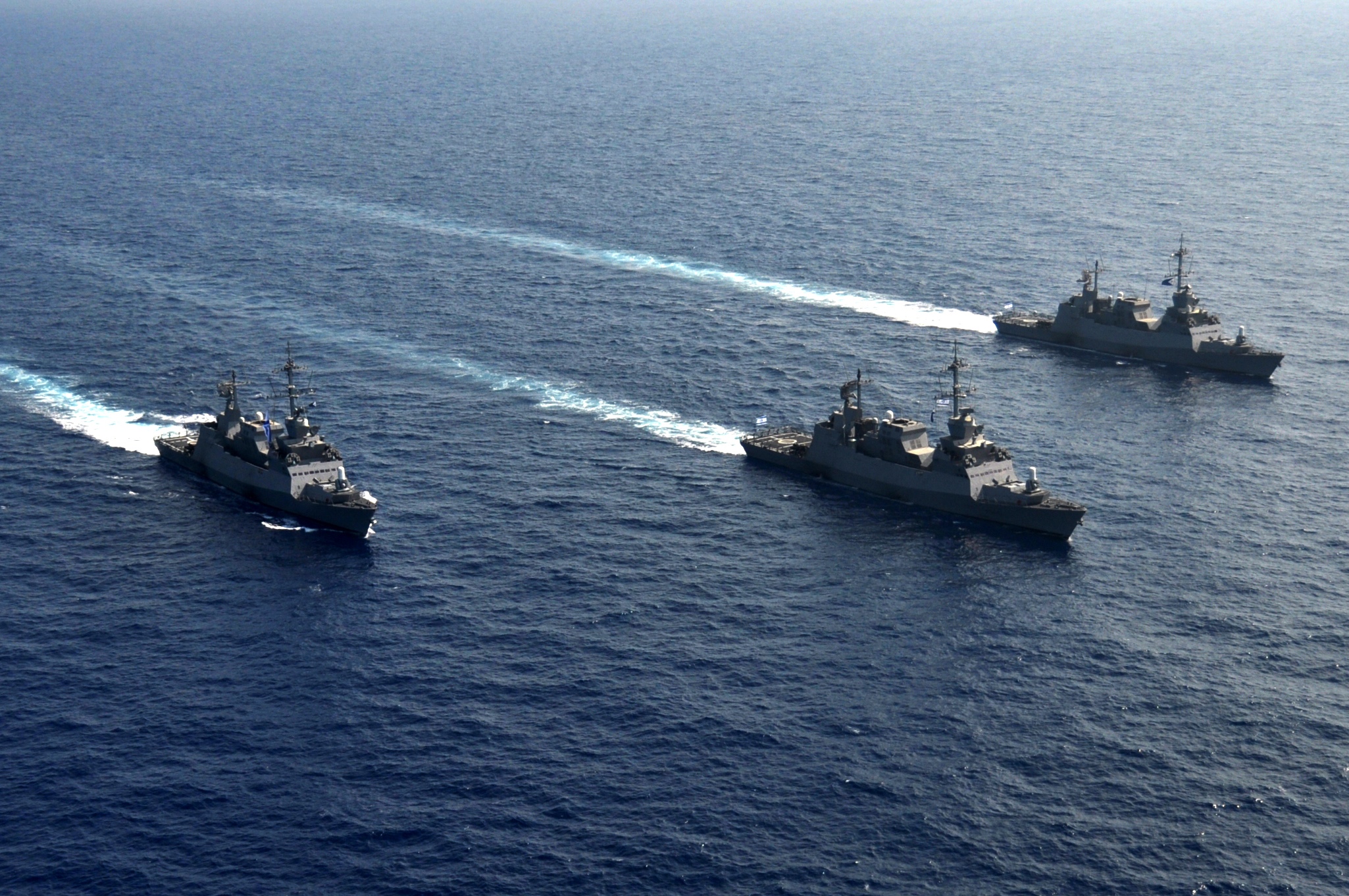
It is interesting to see the forces the Israeli Navy used to make this seizure. They did not scrimp. They apparently made the boarding using three RHIBs and they had at least two surface combatants on scene, a Sa’ar 5 corvette (1,275 tons full load, larger than a 210, but smaller than a 270) and a missile boat, which appears to be a Sa’ar 4.5 (488 tons full load, about a third larger than an FRC). From the video it is obvious they had an aircraft on scene, possibly a helicopter from the Sa’ar 5. It may have been overkill in this case but both of the two Israeli vessels carried anti-ship missiles and a CIWS. The Sa’ar 5 corvette is also equipped with short range AAW missiles, and the missile boat has a 76 mm.

File:Three Sa'ar 5 Class Missile Corvettes Going For a Cruise.jpg


Photo: Israeli Sa’ar 5  corvettes. Israeli Defense Forces photo

File:Saar45nirit011.jpg


Photo: Sa’ar 4.5 missile boat, Israeli Defense Force photo