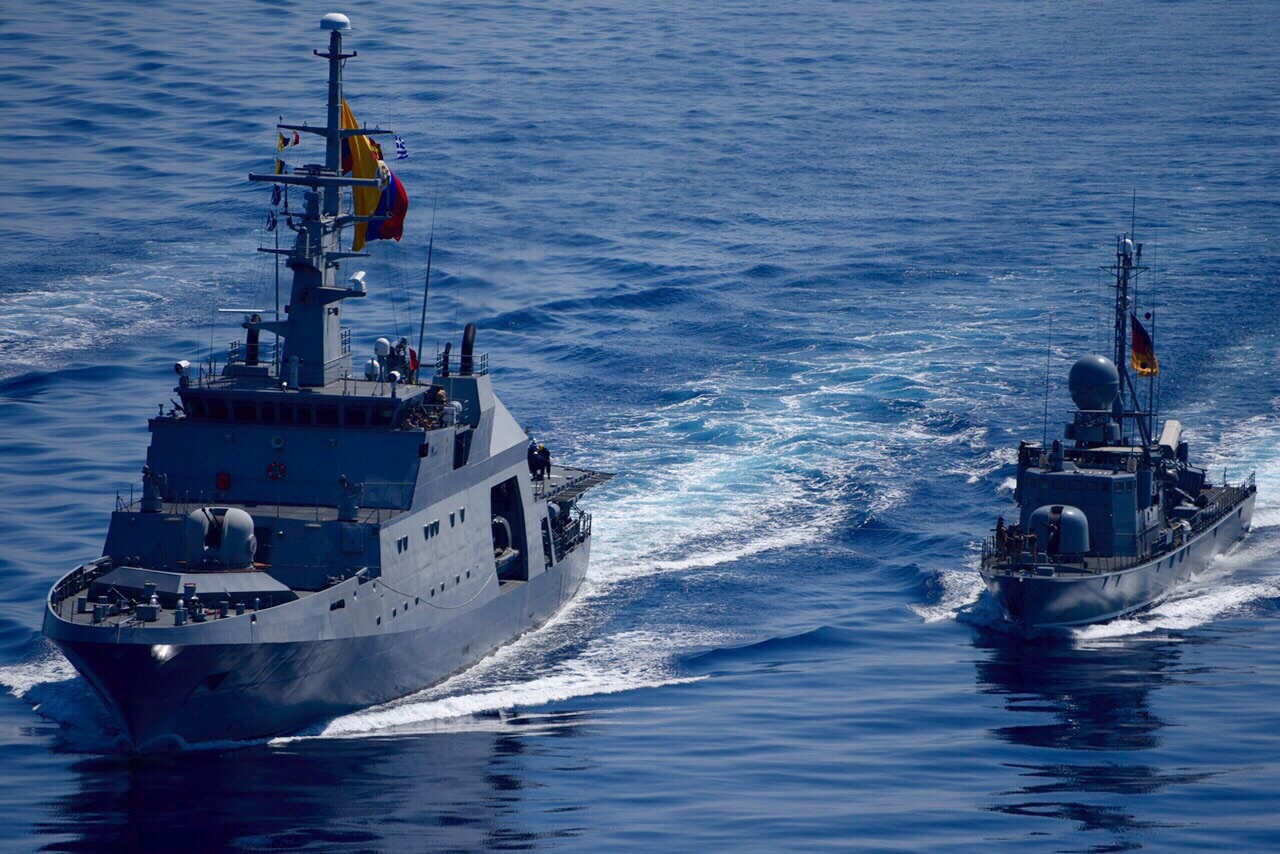
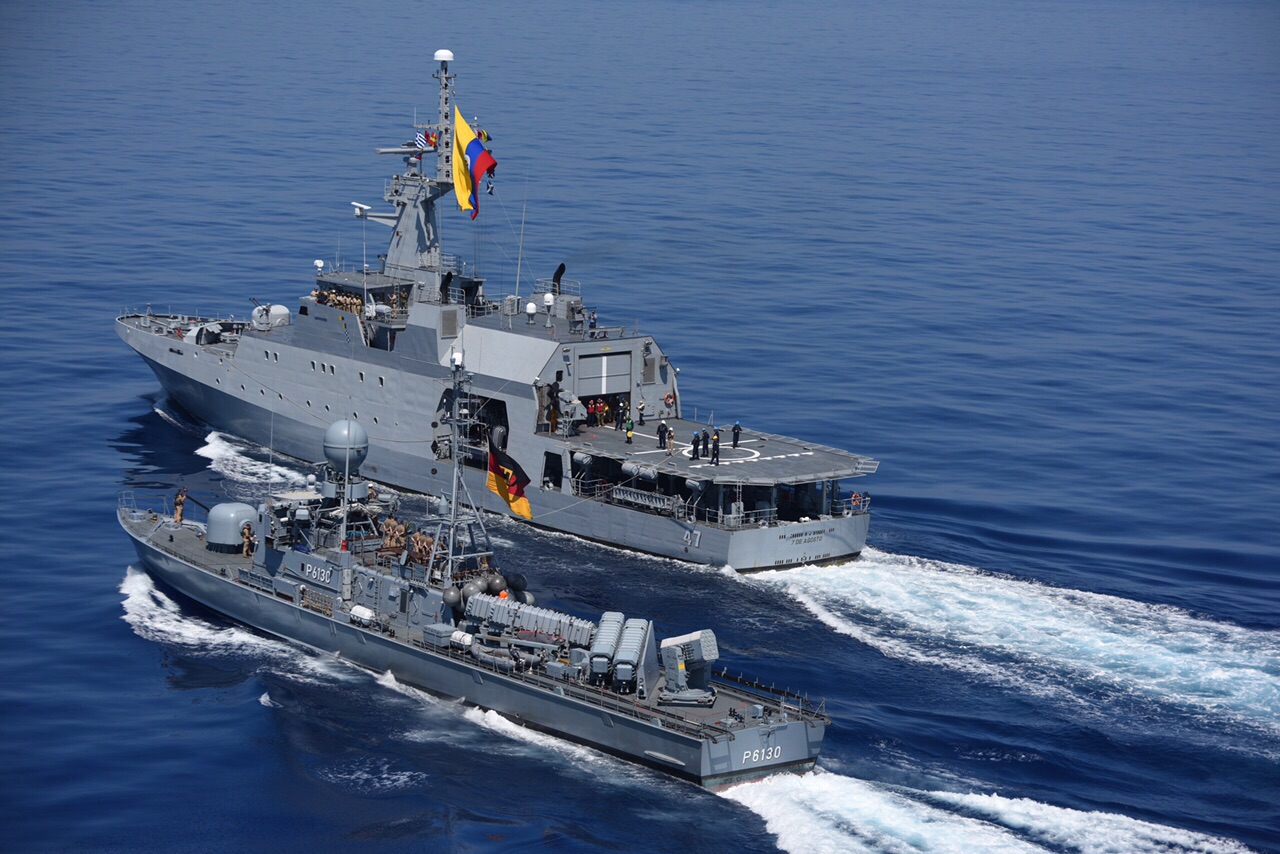
Photos: Chilean Navy photos of OPV Toro, 2012, note 40mm forward
We have a guest post today, Andres Tavolari, a 1st Lt in the Chilean Marine Corp Reserve talks about the recent christening of the third of a series of five ships that the US Coast Guard would consider Offshore Patrol Cutters. Not only have these ships supported SouthCom missions, Colombia and Argentina are also building ships of this class so cutters are likely to encounter and perhaps work with these or similar ships in their counter drug operations. Of the three countries Chile’s program is the most advance. Chuck
On last April 1st, was christened the third Fassmer-80 OPV for the Chilean navy. Named “Marinero Fuentealba” after a sailor who died trying to rescue the crew of a stranded ship on a storm in 1965, the new OPV will be delivered to the Navy in August 2014. This is the third ship of a class of five for the Chilean navy, which are built in the ASMAR shipyard, Talcahuano, Chile, a German design selected among several bidders (Fincantieri, Vosper Thornycraft, Kvaerner Masa Marine, Damen and Fassmer). The detailed engineering was done by ASMAR which did 50,000 hours of modeling on the ships’ systems and components. The ships are classified as LRS +100 A1 LMC UMS.
The original design was modified in several aspects, most importantly, the addition of a hangar for a medium size helicopter. With an overall length of 80,60 meters (264′), a waterline length of 74,40 (244′) and a moulded beam of 13,00 meters (42.6′), the Chilean Fassmer 80 OPV have a full load displacement of 1728 tons. With such a displacement, at 12 knots, their range is 8.000 nautical miles with accommodations for 60 persons including 20 passengers and the helicopter crew. The endurance is 30 days, carrying 298 m3 of fuel oil, 48 m3 of fresh water and 20 m3 of helicopter fuel. Two 12V26 Wärtsilä engines, delivering 4.080 KW (5,471 SHP each) @ 1.000 rpm, work on two 4 blades controllable pitch propelers. At 80% MCR the speed is 20 knots. The first 2 ships are armed with a 40 mm gun taken second hand from German Type 148 missile boats, and with up to six .50 machine gun, although normally four are embarked. The third ship, the “Fuentealba” will be armed with a 76 mm Oto Melara gun also from a Type 148 missile boat. Some sources indicate its secondary armament will be up to 6 x 20 mm guns (probably old Oerlikon 20mm/70). This third ship has an ice strengthened hull and a different communications set, details have not been released yet. With these modifications “Fuentealba” will cost 43% more than the first two ships of the class, whose cost was less than $50M US each. The flight deck and hangar are optimized for medium helicopters. Normally an AS-365 N2 Dauphin helicopter, similar to the MH-65, will be embarked. Typically it will be used for MIO and rescue operations.
There are two single points davits for two locally built 7,40 meters RIBs which can be launched and recovered while sailing at up to 12 knots. Under the flight deck is a working space with enough space for up to three 20 foot container sized units. There are four hatches in the flight deck permitting an easy access to the work deck. It is served by a Palfinger Marine PK 60000M crane installed on the flight deck. On the work deck and stern are the necessary fittings for towing other ships, towing being one of the main mission of this class of ships in Chilean service. Notably the second ship in the class (OPV 82 “Toro”) has, on the stern, 2 racks for depth charges!! Although an old weapon, several Chilean navy ships have been equipped with depth charges, as useful weapons for warning shots against submarines.
The Chilean Fassmer 80 OPVs have a Sperry Marine integrated Bridge System, an integrated communication system and an unmanned machinery space, remotely controlled. They are also equipped with the Mobile Maritime Command and Control System “SMC MM” and the ARIES fire control system for the 40 mm gun. Both systems are developed locally by SISDEF and DESA CHILE. It is most probable that the “Fuentealba” will be equipped with the SAETA fire control system, developed by DESA CHILE for the Chilean SA’AR missile boats armed with 76 mm guns.
The Chilean OPVs are operated by the Dirección General del Territorio Marítimo (DIRECTEMAR), a special branch within the Chilean Navy. The missions carried out by this ships are: coast guard, fishery protection, search and rescue, contamination control, training and support of isolated communities. Nevertheless, the first two ships have also deployed to international exercises and operations, such as UNITAS, PANAMAX and MARTILLO, the last one in combination with forces of the US Southern Command for fighting drugs smuggling in the Caribbean. The Colombian navy has received 2 slightly modified ships build locally by COTECMAR and has contracted a third ship, planning to build as many as 6, for operating 3 in the Pacific and 3 in the Caribbean (Argentina is also planning at least four-Chuck). Main modifications are a different mast, a different 40 mm gun, a telescopic hangar for a Bell 412 helicopter and a stern ramp. The stern ramp was considered less important for the Chilean Navy, which opted for improved towing capacity of towing ships and additional space for supporting isolated communities rather than the improved ability to deploy a boat quickly when chasing “go-fast” boats, since this is not a threat in Chilean waters. The OPV “Fuentealba” will be deployed to the Third Naval Zone, with homeport in Punta Arenas, on the Magellan Strait.
Thanks to Andres for his contribution. I noted this in the German Navy blog “Marine Forum” Daily News, 8 April, “CHILE – PERU Probably related to their ongoing dispute over Pacific Ocean sea areas, both the Chilean and Peruvian navy have (temporarily?) removed hull numbers and names from nearly all naval vessels, rendering identification difficult.” Hopefully this will be resolved amicably. Chuck
Addendum:

Photos provided Andres Tovalari. Colombian Navy OPV “7 de Agosto” sailing along a German Navy missile boat. Ship is currently part of Operation Atalanta countering piracy in the Indian Ocean.
As noted here,
“With 85 sailors on board, 7 de Agosto is armed with a 40 mm Oto Melara 40L70 twin gun, a 20 mm Oerlikon GAM-BO1 gun, and two Thor T-12 Remote Controlled Weapons Stations (RCWS). The T-12 RCWS includes a .50-calibre M2HB machine gun linked to a Controp SHAPO maritime day/night observation system.”
It is less obvious, but she also has a stern boat ramp as well.