The Coast Guard has issued its “Arctic Strategy.” It is a 48 page pdf. I have added it to the reference section, and you can see it here:
Coast Guard Arctic Strategy, 2013
“The U.S. Coast Guard Arctic Strategy documents our intent to pursue three key objectives: Improving Awareness, Modernizing Governance, and Broadening Partnerships.”
This aligns with the National Strategy for the Arctic Region which specifically calls for
• Enhance Arctic Domain Awareness – We seek to improve our awareness of activities, conditions, and trends in the Arctic region that may affect our safety, security, environmental, or commercial interests. The United States will endeavor to appropriately enhance sea, air, and space capabilities as Arctic conditions change, and to promote maritime-related information sharing with international, public, and private sector partners, to support implementation of activities such as the search-and-rescue agreement signed by Arctic states.
• Preserve Arctic Region Freedom of the Seas – The United States has a national interest in preserving all of the rights, freedoms, and uses of the sea and airspace recognized under international law. We will enable prosperity and safe transit by developing and maintaining sea, under-sea, and air assets and necessary infrastructure. In addition, the United States will support the enhancement of national defense, law enforcement, navigation safety, marine environment response, and search-and-rescue capabilities. Existing international law provides a comprehensive set of rules governing the rights, freedoms, and uses of the world’s oceans and airspace, including the Arctic. The law recognizes these rights, freedoms, and uses for commercial and military vessels and aircraft. Within this framework, we shall further develop Arctic waterways management regimes, including traffic separation schemes, vessel tracking, and ship routing, in collaboration with partners. We will also encourage other nations to adhere to internationally accepted principles. This cooperation will facilitate strategic partnerships that promote innovative, low-cost solutions that enhance the Arctic marine transportation system and the safe, secure, efficient and free flow of trade.
The national strategy also repeatedly calls for various forms of partnerships and like the Coast Guard’s own strategy calls for the US to accede to the UNCLOS treaty.
If you have been paying attention to the Arctic Shield Exercises I don’t think you will find much unexpected in the stratgey. (More on Arctic Shield here.)
The Coast Guard does not expect to make major investments in infrastructure in the Arctic for at least ten years, and will undertake to serve the region with mobile assets–ships and seasonal assignment of aircraft.
The use of mobile assets and seasonal presence, supplemented by existing shore-based infrastructure, will be the preferred strategy for Coast Guard operations during periods of peak activity.
The strategy is light on specifics, we are reminded it is a strategy, not an implementation plan, but there are three specific items called for that will require additional funding:
- A new heavy icebreaker
- An Arctic Fusion Center to advance Maritime Domain Awareness, and
- An Arctic Center of Expertise at the Academy
The Projected environment:
This strategy assumes that recent decreases in Arctic ice mass will continue over the next 10 years. Even so, while previously unreachable areas will be increasingly open to vessel traffic, the remaining permanent ice cover, the continued winter ice cover, and hazards from ice floes and smaller ice remnants will continue to pose challenges to regional civilian, industrial, and military operations. Through efforts to discover and exploit offshore oil and gas reserves, the energy industry will deploy oil rigs, offshore supply vessels, barges, and tankers in Arctic waters. Cruise ship traffic will increase in areas that are unique and of commercial value to the recreational tourism industry, often in areas that are remote and challenging to render aid. The three strategic priorities of this Arctic strategy draw upon the Coast Guard’s strengths as a military, multi-mission, maritime service, leveraging authorities and partnerships, flexible operational capabilities, and relevant expertise within the international community to achieve an integrated, coherent approach to maritime operations and regional governance.
Improving Awareness:
The U.S. government requires effective understanding of maritime activity in the Arctic region in order to enforce maritime sovereignty and address threats as early as possible. Accurate awareness requires greater collection and sharing of maritime data, as well as increased cooperation in analyzing and disseminating near-real-time information. The Coast Guard will work with DHS, Department of Defense, other interagency partners, state, tribal, and local governments, the private sector, advocacy groups, academia, and the international community to improve maritime intelligence and information-sharing. Improvements require proper infrastructure for sensing, collecting, fusing, analyzing, and disseminating information. Improved awareness is critical for ensuring preparedness to respond to contingencies and is consistent with strategic priorities delineated in the National Strategy for Maritime Security and the National Plan to Achieve Maritime Domain Awareness. As long as there is maritime activity in the Arctic, the Coast Guard must maintain appropriate presence to monitor, regulate, and respond to threats and hazards. Effective presence on shore and at sea enables the awareness necessary to focus resources on highest risks and threats.
Modernizing Governance:
The safety, security, and economic well-being of the United States rely upon sound governance of the world’s oceans. To advance U.S. interests in the region, the Coast Guard must work with other Federal, state, tribal, and local government entities, international counterparts, relevant industries, and other stakeholders to promote maritime safety, security, and environmental responsibility in the Arctic region. Notable efforts include active participation in international organizations, such as the Arctic Council and the International Maritime Organization, and continued support of accession to the 1982 Convention on the Law of the Sea.
Broadening Partnerships:
Limited operational resources and expanding maritime risks underline the need for increasing collaboration in the region. The Coast Guard must foster domestic and international partnerships to specifically increase coordination, enhance efficiency, and reduce risk. Mutually beneficial relationships with and among our international, interagency, state, tribal, local, and other partners are essential for mission success. The Coast Guard must also collaborate with academia and non-governmental partners to incentivize Arctic research and expand the base of Arctic-related literature.
The Video: The Commandant introduced the new strategy at a meeting of the Center for Strategic and International Studies. You can watch the Video here.
If you have read the strategy there is nothing new in the prepared remarks but you might still want to watch the Q & A beginning at approx 25:30.
Commentary:
g Captain is reporting traffic on Russia’s Arctic Northern Sea route may experience a 30 fold increase in the next eight years. Much of that will pass close to US territory during the transit between the Arctic and Pacific Oceans. While the Coast Guard may not be ready to invest in new infrastructure it is not too early to start evaluating where it should be.
—Growing the Infrastructure:
The Coast Guard’s go slow approach (at least partly dictated by funding) is in contrast to the aggressive development by its Russian counterpart. Perhaps ironically the former socialist republic see this as a profit making opportunity, charging fees for transit of the route.
As the Commandant noted in the video the US has had reason to develop Arctic infrastructure before. Much work was done in support of the Distant Early Warning Network (DEW Line) when the US was concerned about Soviet bombers attacking the US via polar routes. Perhaps some of this infrastructure can be reactivated.
The Coast Guard might consider working with Navy SeaBees in the Arctic Shield exercises, to complete small dual use infrastructure projects that might serve both the Coast Guard and local economic development. Even a little work each year could result in substantial cumulative improvement considering the extremely limited facilities currently available. It could serve both as training for the Seabees in operating in the Arctic, and resource development for the Coast Guard at minimal cost.
I also wonder about the current state of the former Naval Air Station Adak.
—A Footnote:
Members of Congress from Alaska are interested in creation of a deepwater port in the Arctic.
The Alaska Native News in reporting on the prospects for the Coast Guard Reauthorization Act noted that it included a provision, “Requiring the Coast Guard to consult with other federal, state and local entities to determine what improvements are necessary to make the ice-free harbor at St. George, Alaska a fully functional harbor throughout the year.”

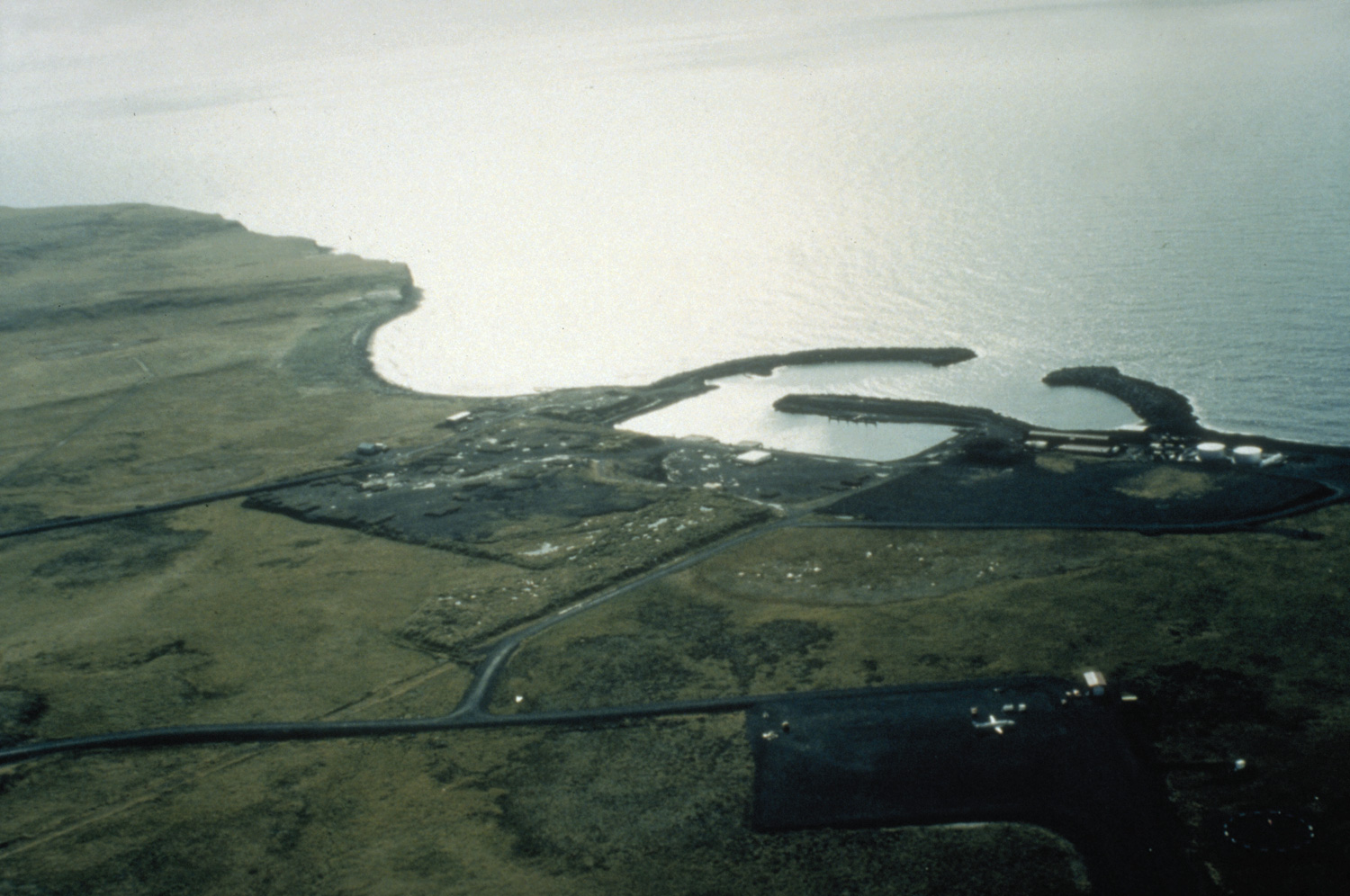
Photo: St. George Island Harbor, part of airport visible in the foreground. U.S. Army Corps of Engineers Digital Visual Library
The island is somewhat centrally located in the Bering sea, on the continental shelf, about 376 miles NE of Adak, about 194 miles NNW of Dutch, but still almost 550 miles south of the Bering Strait. It has a population of about 160 and is roughly a triangle with its long side running East West. The longest distance across the island running almost exactly East/West is less than 13 statute miles.The small harbor and 4,980 foot runway are on the South West side less than three statute miles from the village of St. George located on approximately at the center of the North side of the triangle.
Nearby St. Paul appears to have better facilities, and there was at one time a Coast Guard LORAN-C transmitter station on St. Paul.
You can get a pretty good feel for what the island is like here and here. Still If we were looking for a place to put a Fast Response Cutter in the Bering Sea, it might work.


 Chuck Hill's CG Blog