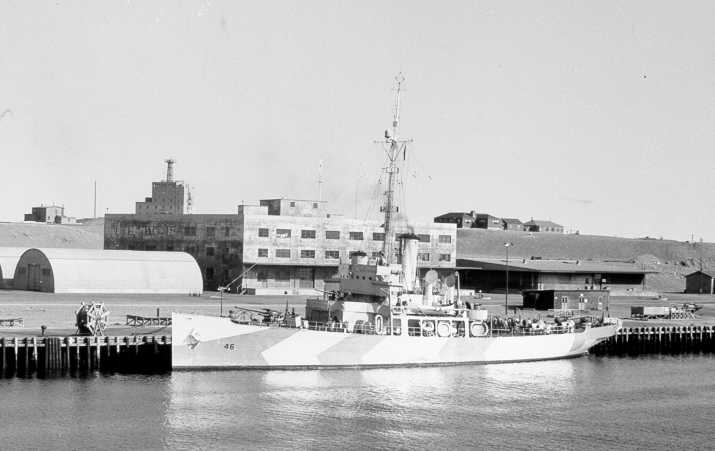
Seventy two years ago today, 24 May 1941, the crew of the Cutter Modoc on Greenland Patrol got a nasty shock. The tale is told by coasties who there on the Alaska/Bering Sea Patrol web site.
There isn’t a direct link, so hopefully they will forgive me for quoting their story in its entirety.
“VE VAS DERE, CHARLIE!”, OR
SAGA OF THE CGC MODOC’S
ENCOUNTER WITH THE GERMAN BATTLESHIP BISMARCK
by VADM T. R Sargent (Ret), ’38, and CAPT B M. Chiswell (Ret)
There have been few references to the presence of a United States Coast Guard Cutter in the immediate vicinity of the German Battleship BISMARCK during that famous chase by the British Fleet in 1941. Most historians pass the incident as inconsequential since the United States was not at war at that time. A group of us, who were present on that occasion, however have a somewhat different view…
The CGC MODOC, out of Wilmington, North Carolina, had been assigned to the Greenland Patrol as COMGREPAT long before all the talent arrived some years later.
Shortly before this incident, the Danish government had turned Greenland over to the U.S. as a Protectorate. The basic mission involved the security of the mine at Ivigtut on the southwest coast.
Cutters NORTHLAND and GENERAL GREENE were also assigned, doing double duty as Greenland Patrol and International Ice Patrol. After departing from St. Johns, Newfoundland, about May 20, 1941, MODOC was ordered to proceed and search for survivors of a British convoy, which had lost many ships to the Nazi wolfpack in the Battle of the Atlantic.
LCDR Harold Belford was Commanding Officer; LCDR Robert H. Furey, XO; LT Emmet T. Calahan, Navigator; and LTJG George R. Boyce, LTJG Victor E. Bakanas, LTJG R. E Bacchus, ENS J. A. Cornish, ENS H. E. Sanders and ENS Benjamin M. Chiswell constituted the Deck Watch Officers.
The “Make Her Go” group consisted of LCDR Walter Anderson, Engineering Officer with LTJG Robert Wilcox and ENS Thomas R. Sargent as assistants. LT William Stimpson, USPHS, was the ship’s doctor.
As far as is known, one is still working, some are enjoying retirement, and some are no longer with us.
Whither we were and whither we were going only Spike Calahan knew — at least convinced us he knew-but at least the sun rose broad on the starboard bow so our course was generally northeasterly. The search proved fruitless as we were continually buffeted by heavy North Atlantic seas and snow squalls reducing visibility to zero and life expectancy on MODOC’s forecastle head to about the same.
Sunday, May 24th, 1941, dawned as a fairly good day considering that our position was slightly south but well east of Cape Farewell, Greenland. Visibility rose to about six miles and the seas, for a change, were relatively calm.
Observing Sunday routine, MODOC piped a matinee movie on the mess deck at about 1400. All hands not on watch settled down to at least the twentieth showing of Lana Turner, Betty Grable, et al. The late Bub Boyce and Dick Bacchus had the deck and Tommy Sargent was on watch in the engine room.
Toward the end of the watch a huge gray shape appeared in the evening dusk on the starboard horizon. In short order, it was properly classified as a battle wagon — of unknown nationality and intentions. Even Ben Chiswell, the Communications Officer, had no knowledge of BISMARCK’s escape from Norway and subsequent pursuit by the British fleet.
Our enterprising quartermaster of the watch (Art Gibbs), a QM1 reduced from QMC for false economy reasons, leapt to the flying bridge. cranked up the powerful carbon-arc signal light and commenced flashing “AAs”-the international signal meaning “What ship?” or “Identify yourself.” BISMARCK did not deign to reply. She just crossed our bow and passed down our port side two miles off.
We even tried to contact her by radio to determine if she had spotted any debris but upon reflection realized she was too smart to break radio silence and reveal her position.
When the huge ship had dropped astern about three or four miles, Dick Bacchus-fresh out of Norfolk, Virginia, where a Naval Air Station had been close by, was heard to exclaim “Hey, there’s an airplane”; then, as an afterthought, “Hey, that’s a land plane”; then, as a double take as he remembered our position relative to the nearest land, “My God, that is a land plane!”
That triggered the sounding of the General Alarm. Midst much grumbling about missing the rest of the movie, to general quarters we went to man the two five inch guns mounted fore and aft and the three inch fifty which was the quote anti-aircraft battery unquote.
We hastened to set our watertight integrity; (we closed both screen doors), secured U.S. flag horizontally and vertically to establish our neutrality, and settled down to watch developments. It didn’t take long. Suddenly seven British swordfisher torpedo planes were using us as a point of departure flying low over our masthead, wagling their wing tips, and heading for that distant gray shadow.
Well, a Fourth of July display like nothing ever before seen soon embellished evening twilight! Those of us not accustomed to warlike intentions were enjoying the show when a couple of brilliant flashes and tremendous explosions brought us back to reality.
As if to solidify the perception, a lookout suddenly cried “Sail ho — broad on the starboard bow, “then “Holly Jesu Cristo, lots of sails ho!” The entire Home Front appeared about equidistant from us as we were from the BISMARCK. We quickly learned we were being caught in the middle is all about.
Earlier, Tommy Sargent had anticipated that maneuvering would probably be demanded so the fireroom had been alerted for steam requirements and they were ready. (You can see why he made three stars.) In view of the fact that at time we were not mad at anybody except whoever it was that had neglected to tell us about a strange battleship-the Old Man decided he would not stand and fight.
He gave orders to make flank speed and no black smoke. For a vessel launched in 1921 requiring forced draft, that had to be a real accomplishment; and so it was. The engineers moved, the vessel moved and soon we were getting the hell out of there.
Tommy Sargent remembers her speed at 14.7 knots, even though the speed curve showed 14.5 kts maximum when Ben Chiswell’s Old Man had been her skipper in 1921. Anyway she squatted her stern down in the water and slithered out of the line of fire.
Soon the fire fight was over. Visibility dropped and BISMARCK limped away in the darkness. Though severely wounded she was to later lead the chase further and force more fighting before finally being done in.
Meanwhile, MODOC-headed in the opposite direction and moving faster than she ever had in her lifetime-soon raised Cape Farewell, rendezvoused with the CGC NORTHLAND, and again took up the search for survivors.
No doubt, MODOC played a vital role in the discovery of the BISMARCK as the German admiralty revealed in a news release shortly after the encounter. Due to the serious damage suffered in the engagement which we watched, BISMARCK was apprehended by the British fleet several days later. Her destruction was a severe blow to the German war effort. Certainly, history has not given full due to the saga of the USCGC MODOC.
Postscript
Two days later (26 May 1941) the CGC GENERAL GREENE, having joined in the search for convoy survivors, also became a witness to this dramatic sea battle. This is reported in Willoughby’s “U.S. Coast Guard In World War II” as follows: On the same day, GENERAL GREENE’s officers saw four large battleships speeding northward; they heard heavy gunfire and observed thick smoke. The British ships had caught up with BISMARCK. Hit many times and barely holding her own, the latter had received the following message from Berlin: “All our thoughts are with our victorious comrades. Hitler.” From BISMARCK went the reply: “Ship unmaneuverable; we shall fight to the last shell. Lutjens.” It was at this time that the British battleship HOOD blew up with all hands as a result of a salvo from the invisible BISMARCK which touched off her magazines. On the 27th, BISMARCK was southwest of Ireland attempting desperately to make a French port. Her guns were silenced, her mast blown away, and smoke and flames poured skyward. She finally turned over and sank, with only 110 survivors out of a crew of 2,400.
We should probably thank the professionalism of the two German crews for not engaging the little cutter. For a better balanced but less personal view of the events you may want to check out the story here.


 Chuck Hill's CG Blog