25 New Russian 650 ton Patrol Vessels

Photo: Alex (Florstein) Fedorov

The Russian Federal Security (FSB) Coast Guard (successor organization to the Maritime Boarder Troops of the KGB), has begun a program of 25 ships that they rate as “second rank patrol ships” (WMEC?). They are reportedly designed “for protection of Russian sea border in the Black Sea and would maintain security of Winter Olympics 2014 in Sochi.”  They will replace ships built in the Soviet era.

Ships of the class are pictured here (broken link–Chuck) in the second, third, and forth photo. Below that are photos of an ice strengthened patrol vessel that appears to be based on an oil industry supply vessel.

Lead ship of the project, Rubin (501), laid down Sept 3, 2007, launched June 26, 2009, which was handed over to Black Sea/Azov Frontier Service Dept in Sept 2010 “has completely satisfied all expectations.”

“…in Oct 2011 unmanned helicopter system Horizon Air S-100 (this may be the Schiebel (Austria) S-100) that is also deployed on the French OPV L’Adroit–Chuck) designed for search, detection, and identification of small-size fast-speed sea targets at the distance of 150 km from the platform was effectively tested on board Rubin. Besides, ships of this project are equipped with automated control system, advanced navigation and comm equipment. Crew living conditions are unusually comfortable; there are sauna and swimming pool on board.

Full displacement of the Project 22460 patrol ship is about 650 tons, length is 62.5 meters (205′), beam is 11 meters (36′), draft is 3.8 meters (12.5′), full speed in quiet water is up to 30 knots, operating range is 3,500 miles, endurance is up to 30 days. Armament includes one 30-mm six-barreled gun mount AK-630 and two 12.7-mm machine guns. The crew is 20 men. The ship is equipped with stern inclined slip for rigid inflatable boat, a heliport for light helicopter like Ka-226(a helo a bit smaller than the H-65–Chuck) or UAV, and a quick-mounted folding hangar.

The second ship, Brilliant, and was laid down May 12, 2010, and the third, Zhemchug, is currently under construction. Construction on the remaining ships is expected to continue through 2020.

While these ships are reported to be only 650 tons full load, the dimensions are close to or exceed those of a 210 (210.5’x34’x10.5′) so I find it hard to believe they are not close to 1,000 tons full load.

The AK-630 gun is a real beast, a six barrel 30 mm similar to the GAU-8 Avenger, the gun on the A-10 tank killer aircraft, which is also used as part of the Dutch developed “Goalkeeper” CIWS. Close in, it could be very effective in an anti-surface role as well.

Photo added Jan. 2022 More info on this class here.

Communication of Post-Government Employment Restriction Can Be Strengthened–GAO

The GAO has issued a report on the Coast Guard’s program to ensure flag officers and Senior Executive Service (SES) personnel understand the restrictions on their post retirement employment.

“Of the 40 former high-ranking Coast Guard officials (Admirals or Senior Executive Service members) who separated from the Coast Guard from 2005 through 2009, 22 have been compensated by Coast Guard contractors. Twelve of these officials were compensated in 2010 by major Coast Guard contractors—contractors that received at least $10 million in Coast Guard contracts in 2010. One of the 12 officials was assigned by a major Coast Guard contractor to work on a program for which the individual previously had official responsibility. According to a Coast Guard ethics opinion, this individual was permitted to work for the contractor. Coast Guard and contractor documentation does not specifically indicate whether any of the other 11 officials were assigned to work on programs for which they previously had official responsibility. Based on the information provided on official roles and responsibilities, we did not find any evidence these former officials represented themselves to the government in violation of post-government employment restrictions.”

The good news here is they found no evidence of wrong-doing, they only recommended that additional instruction be provided.  It is not clear if this constituted an actual evaluation of the compliance with restrictions on employment by retired personnel.

(Thanks to Lee for the lead)

Chinese F/V Captain Stabs Two S. Korean Coast Guardsman, Killing One

The Telegraph reports that, in a recent incident between Chinese Fishermen and the South Korean Coast Guard, two officers attempting to arrest the captain of the vessel were stabbed with broken glass when the Captain resisted arrest. One officer later died of his wounds. Incidents between Chinese F/Vs and the S. Korean Coast Guard have become common.

“As the competition between Korean and interloping Chinese fishermen has intensified, the South Korean coastguard has been put under pressure to act. So far this year, 470 Chinese ships have been seized for illegal fishing, a near 30 per cent rise”


Wanted: Descendents of the Heroes

Bollinger is hoping to honor the namesakes for the fourteen Fast Response Cutters currently under contract, by hosting a fleet dedication in New Orleans at the D-Day museum on March first and second, 2012.

They would like to host one or two representatives from each of the families. The fourteen ships are:

They have been able to contact the families of Bernie Webber, William Flores, and Richard Dixon, but need help locating the others.

If you can help please e-mail: sales@Bollingershipyards.com

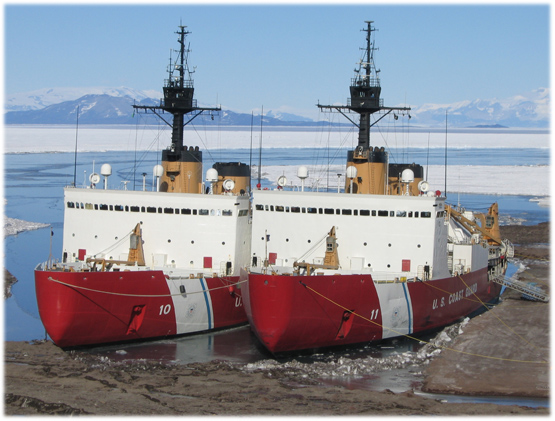
Is Polar Sea Salvageable?

MarineLink.com reports testimony before Congress suggest that it might be possible to economically repair the Polar Sea (WAGB-11) in addition to the already planned repair of the Polar Star (WAGB-10).

Have to consider the source but,

“We do believe there is a need to build new heavy icebreakers, and we urge Congress and the Administration to work together to quickly authorize and fund such a project,” Whitcomb testified. But, he added, “for just over 1 percent of the  cost of a new vessel, and at a two-year versus ten-year minimum horizon, the United States of America would have a second fully functioning heavy icebreaker able to complete vital missions under our own flag for at least a decade or  more. “The hulls and frames of the Polar Star and the Polar Sea are perfectly sound and capable,” Whitcomb added. He estimated it would take $11 million to replace Polar Sea’s engine and bring the icebreaker to an operational level…Whitcomb is chief operating officer of Vigor Industrial, whose subsidiary Vigor Shipyards is restoring the Polar Star…”

Actually there was testimony from a second source.

The vessel was extensively overhauled in recent years, so other additional upgrades would be minimal, retired Coast Guard icebreaker commanding officer Rear Adm. Jeffrey Garrett told the committee.

I presume the Coast Guard has already looked at the possibility? Maybe there is just a perception that the Polar Class are money pits that will take funds from other programs?

File:SeaStar.jpg

US Coast Guard photo

CGA takes Second Consecutive SSC Collegiate Championship

Obviously there is some interest in competitive shooting at the Coast Guard Academy and they must have some good coaching as well.

The Academy not only took first place in the Scholastic Steel Challenge, their second and third teams took third and fifth place.

“The Scholastic Steel Challenge is a national team-oriented youth shooting program developed by the Steel Challenge Shooting Association and funded in part by a grant from the National Shooting Sports Foundation. The program is open to young men and women ages 12 to 20 and offers them the opportunity to compete as a four person team for a national title in the action pistol discipline of speed shooting.

“Earlier this year the program was expanded to offer college teams the opportunity to participate in the competition format.”

(Thanks to Robert Stoner for the lead.)

Bureacracy in the Navy?

There is an interesting conversation going on over at Tim Colton’s Maritime Memos, with Mr. Colton commenting on Governor Romney’s critique of the Navy’s bureaucracy and Reagan era Secretary of the Navy John Lehman coming to Governor Romney’s support.

The argument has some bearing on how the Coast Guard’s own procurement organization should be structured.

“GOVERNOR ROMNEY ON NAVAL SHIPBUILDING

“’While the output has declined, the bureaucracy at the DOD has increased. There is enormous waste. Let me give you an example that was reported to me by former Secretary of the Navy John Lehman. During World War II we built 1,000 ships a year. And there were 1,000 people in the Bureau of Ships. That’s the purchasing department, if you will. In the 1980s we built 17 ships per year, and we had 4,000 people in purchasing. Today we build nine ships a year. Guess how many people are in purchasing? Twenty-five thousand people.’

“Well, not really.

“First, if you define a ship as a large, oceangoing, commissioned vessel or submarine, as we do today, and you count them in the year in which they were delivered, the peak year was 1943, when about 550, not 1,000, were delivered.  Remember that a significant number of the simpler designs of naval ships, both new construction and conversions, came out of the merchant shipbuilding program, which was managed by the U.S. Maritime Commission, not by BuShips.  On the other hand, BuShips also bought several thousand landing ships, minesweepers, subchasers and other small vessels, plus tens of thousands of small craft – patrol craft, landing craft and yard craft.  So this comparison is not apples-to-apples.

“Second, the ships built in WWII were much, much simpler than the ships we build today, and were almost all built in very long runs of a small number of standard designs, requiring much less supervision than today.  In those days, as today, there was a three-way split of the work among BuShips, the shipbuilders and a bunch of third-party contractors.  Is that split the same today as it was then?  No.  Does today’s NAVSEA have the same scope of responsibilities as the BuShips of WWII?  No.  In addition, it’s hard to imagine that BuShips operated with only 1,000 people, because the Maritime Commission had almost 15,000 at its peak, of whom about 5,000 were directly concerned with the shipbuilding program.  One suspects that BuShips may have had an authorized strength of 1,000 and supplemented this with several thousand contractors, or folks posted in from other departments.  (Does anyone know the correct numbers?)  In any case, the number of NAVSEA employees involved in ship procurement today is about 3,000, not 25,000.  So this comparison is not apples-to-apples either and, in addition, the figures quoted are not accurate.

“Aren’t politics wonderful?  November 9, 2011.

(The Navy’s own figures indicate they had 6,768 ships active at the end of WWII. Of these, about 1,600 were over 1,000 tons. Not only were many of these ships relatively simple and/or standard designs replicated many times, but also construction quality was in many cases sub-standard, which would not have been accepted in peacetime. –Chuck)

“SECRETARY LEHMAN RESPONDS

“John Lehman has sent me the following response to my comment on Governor Romney’s remarks about naval shipbuilding:

"'Yes Really.

” ‘On VJ Day, 1945, there were 5100 ships (defined as greater than 150’ length on the waterline) in commission in the US Navy. All but about 180 had been delivered between 1941 and 1945. While it included many capital ships (115 aircraft carriers),the bulk was made up of “small boys,” destroyers, DE’s, and amphibs, LCS, LCI, LST, etc.( but not counting thousands of Higgins boats and other craft). Thus the average output over the 4 1/2 years was about 1000 per year. Buships had an authorized strength of roughly 1000. Much of the work now done by Navsea in its Supships, field activities and especially in OSD and the Defense agencies, was done by contractors in WWII. Thus when the war was over the overhead disappeared. Now that it is done in-house, and especially in the OSD/Defense Agency house, overhead never disappears, but grows every year. Hence the DBB Pentagon report of last June listing a total of 750,000 civilian employees.

"'The Navy is correct in saying that the current Navsea headquarters currently employs 3,127 full time equivalents (FTEs) Governor Romney is correct in using the 24,000 figure which includes not only headquarters staff but staffs that report to Navsea headquarters, though located outside the beltway, and staffs that are now located in Defense agencies such as Defense Logistics Agency. These are functions that were in the past performed by small offices in Navy headquarters and outside contractors, that have now been subsumed into much larger staffs in the Defense Department. The actual numbers of Navsea workers is well over 50,000. The 24,000 number is an attempt to compare apples (as performed in WWII) to apples (as currently performed). Most of this growth is a consequence of the constant expansion of the DoD bureaucracy.'

“I could argue about some of these numbers but I won’t.  Not everyone would agree, but, in my view, John Lehman was the most effective SECNAV of the last 30 years.  President Romney’s SECDEF?  November 21, 2011.”

I certainly share Mr. Colton’s respect for former Secretary Lehman.

I can’t begin to say what the proper mix of in-house expertise and contracting out is, its probably a moving target anyway, but we have tried contracting out, essentially without in-house expertise as oversight–we know that does not work. In the coming budget battles, you can be sure there will be pressure to cut Acquisitions Directorate (CG-9) staff. The Commandant has said he will resist the temptation to disproportionately cut staff to maximize operations.

The system the Navy used in the first half of the 20th century was highly regarded. My understanding is that it was structured to provide a creative tension between the desirable, the possible, and the affordable represented by the operators, the engineers, and the budgeteers. There was enough in-house expertise within the engineering branch to prepare preliminary ship designs and reasonably accurate cost estimates upon which decisions could be based.

CG-9 still has unmanned air systems and two more classes of ships to procure, a new heavy icebreaker and an Arctic Patrol Cutter/medium icebreaker, in addition to the National Security Cutter, Offshore Patrol Cutter, and Fast Response Cutter. Let’s hope the service finds the right balance.