Navaltoday.com is reporting, “Northrop Grumman Corporation has completed core capability development of the Nationwide Automatic Identification System (AIS) and delivered it to the U.S. Coast Guard to begin formal government testing prior to deployment.”
This system is likely to have a major impact on the way the Coast Guard does several of its missions including SAR and MEP in addition to Ports, Waterways, and Coastal Security. Read the full report here.
According to a CNN report, Chinese fishing vessels are exercising equal opportunity exploitation of other nation’s resources, and apparently the Chinese media does not understand why any one would take offense.
Russia seized two Chinese F/Vs and detained 36 fishermen for unauthorized operations in their EEZ, but only after a Russian vessel fired on and rammed one of the two during a three hour chase.
“An editorial in China’s People’s Daily condemned the firing on the vessel, calling the move ‘reckless.'”
“SAFE Boats International (SAFE) was recently selected to build the U.S. Coast Guard’s new Cutter Boat-Over the Horizon-IV (CB-OTH-IV). The contract calls for up to 101 boats procured over 7 (seven)-years. The CB-OTH-IV will act as a multi-mission, cutter-launched law enforcement vessel and the Coast Guard will begin taking delivery in early 2013. At 26-feet in length, the CB-OTH-IV is capable of speeds in excess of 40 knots and is based off of the SAFE 250 Center Console. It seats 5 (five) crew members and features a 480hp inboard diesel engine with a water jet, encrypted communications equipment, a state-of-the-art navigation system with a custom radar arch, a forward-facing weapons mount as well as SAFE’s patented hull design, XDR Collar system and mountable ballistic protection.”
The specs for the Offshore Patrol Cutter have not been made available to the general public, but the Commandant recently remarked that he hoped to repeat the success of the Webber Class Fast Response Cutter (FRC) procurement by doing something similar with the Offshore Patrol Cutter (OPC) in terms of using a parent craft approach (sorry can’t find the link).
Last time the acquisitions Directorate (CG-9) published a list of shipbuilders interested in the OPC project there were twelve, Austal, BAE, Bath Iron Works, Bollinger, Derecktor, Eastern Ship Building Group, Marinette Marine, General Dynamics NASSCO, Northrop Grumman, Todd Pacific, Signal International, and VT Halter Marine. Some of these ship builders are very experienced and are more than capable of starting a design from scratch, but others either already have international partners or, having no experience in building this type of ship, are likely to seek a partner.
What similar designs have been built recently that might be adapted to create an OPC?
The OPCs are much more complex than the FRCs and even in that case, there were substantial changes to the parent craft required to create the Webber class. Speed was increased substantially, compartmentation was improved, and it was more heavily armed, so we should not expect a carbon copy of any existing design.
Many of these designs have all their propulsion machinery in a single compartment. At least one appears to have all its ship’s service generators in one compartment. (I believe the OPC spec rules out both of these vulnerabilities, but these are things that can be changed.) Other changes are also likely to be required to comply with American Bureau of Shipping (ABS) Rules for Building and Classing Naval Vessels (NVR).
Very few meet the range requirement. Even fewer are equipped with an icebelt.
Still it might be interesting to see what is currently on the market.
For reference I am going to provide the length and beam (in meters) of the some familiar ships.
Perry Class FFG (long hull) 139×13.7
National Security Cutter 127×16
Hamilton Class WHEC 115×13
327 foot WHEC 100×12.5
Alex Haley 86×15
270 foot WMEC 82×12
210 foot WMEC 64×10.4
Of these the 327 at 100×12.5 might serve as a sort of benchmark in that we know from experience with these ships, it is possible to create a very comfortable and seaworthy ship of this size, while smaller ships have not been totally satisfactory for the service envisioned.
The FFG also serves as a benchmark in that it shows that a ship with a 13.7meter beam can have a hanger that can house two H-60s, not a requirement for the OPC, but perhaps a good option, particularly with the Navy increasing the size of the Firescout to that of a full size helicopter.
It appears that international partners could include:
Damen (Netherlands)
Navantia (Spain)
DCNS (France)
BAE (UK)
Fassmer (Germany)
Blohm + Voss MEKO (Germany)
Hyundai (S. Korea)
STX (S. Korea, France Finland, Romania, Canada and US)
Some of these builders have more than one design that might be considered.
Damen
Damen appears particularly well placed, having provided the parent craft for the Fast Response Cutter. They have two potential parent craft, the Holland Class (108×16) and the Sigma series (Ship Integrated Geometrical Modularity Approach) of corvettes and light frigates.
As suggested by the illustration above, Thales already has an interest in offering the Holland class as the OPC. It was shown off recently in Key West. It shares many of the characteristics of the OPC including an emphasis on seakeeping and ballistic protection for key areas of the ship. At 3,750 tons, it is also the largest ship we will discuss in this post and probably the most expensive. Reportedly the mast and its associated sensors account for a sizable fraction of the ship’s cost, but also provide almost Aegis like capability. Its combined electric or diesel (CODELOD) propulsion system make loitering and slow cruise operations particularly economical. Still they would need greater range, possibly greater speed and an ice belt to satisfy the requirements for the the OPC, so might end up even larger.
Of the Sigma series, the Indonesian variant (105×13) looks closest to the OPC. Eight ships have been built or are building for Morocco and Indonesia, and apparently four more are planned for Vietnam. They appear to emphasize warship characteristics but are not built to naval standards and when the Netherlands decided to build their own offshore patrol vessels they rejected the Sigmas in favor of the Holland class. It is shorter ranged and its inclusion of only two very powerful diesels does not appear likely to be economical. Still the size looks right; it is “modular,” perhaps modifications are possible.
Navantia
Navantia, a very large and active builder of warships, including Aegis equipped frigates and LHDs for the Spanish and Australian Navies, has been very active in producing offshore patrol vessels recently.
They are producing a series of series of nine multipurpose ships for the Spanish Navy identified as Buque de Acción Marítima or “BAM” (93.9×14.2). “Modular design enables the ships to be modified for purposes outside main missions such as hydrographic research, intelligence gathering, diving support and salvage operations.” As built they have the range required for the OPC. They have a hybrid propulsion system, but speed is only a little over 20 knots.
They have also produce two classes of four each for the Venezuelan Navy. The largest of these are the 2400 ton Guaiquerí class patrol vessels (99×13.6)
Photo: Venezuelan OPV built by Navantia. via Wikipedia
They don’t have the range required, only 3500 nmi, or of course an icebelt, but otherwise they appear very close to the OPC including a 25 knot top speed.
If Navatia could combine the speed of the Guaiquerí with the range and economy of the BAM, they might have a winner.
DCNS
Obviously DCNS also has an interest in the OPC project. They have been pushing their Gowind family of vessels as both OPCs, corvettes and light frigates. The L’ Adroit (87×11) is probably too small to meet the OPC requirements, but the larger version (107×16) beginning offered to Malaysia appears much closer.
Gowind model at Boustead stand during DSA 2012
(picture: Navy Recognition)
BAE
A BAE design (90.5×13.5) built for Trinidad and Tobago, has been sold to Brazil and they expect to build five more of the ships, while a very similar BAE design, HTMS Krabi, is being built in Thailand. These ships don’t meet the range requirement, don’t have a hanger, and are limited to a 7 ton helicopter. Could the design be modified?
BAE also have in their portfolio the Lekiu_class_frigate (106×12.75) which does have a hangar. Two were completed for Malaysia in 1999. Two more of an updated design are proposed. These ships have a powerful CODAD (Combined Diesel and Diesel) powerplant that is good for 28 knots. Reduced power could still satisfy the OPC requirement.
Fassmer
Fassmer (Germany) appears to be primarily a builder of work boats and small craft, but they have had success with their 80 meter OPV design being adopted by Argentina, Chile, and Colombia for construction in country.
They have proposed some larger designs (pdf), but I’m not sure they bring much additional experience to the table.
Blohm + Voss “MEKO”
Blohm + Voss is a warship maker with experience going back a hundred years. They have a series they refer to as MEKO that includes a range of designs that have been built for several countries. These include six “MEKO 100” 98×14.3 design built for Malaysia and MEKO 200 series that includes 25 ships built for five different countries including CODAD as well as CODAG versions. (More pictures here)
Blohm & Voss may be the most successful exporter of warships in the last 50 years.
Hyundai (S. Korea)
Hyundai is primarily a commercial ship builder, but they might choose to offer a variant of their recently completed Inchon Class frigate (114×14).
STX (S. Korea)
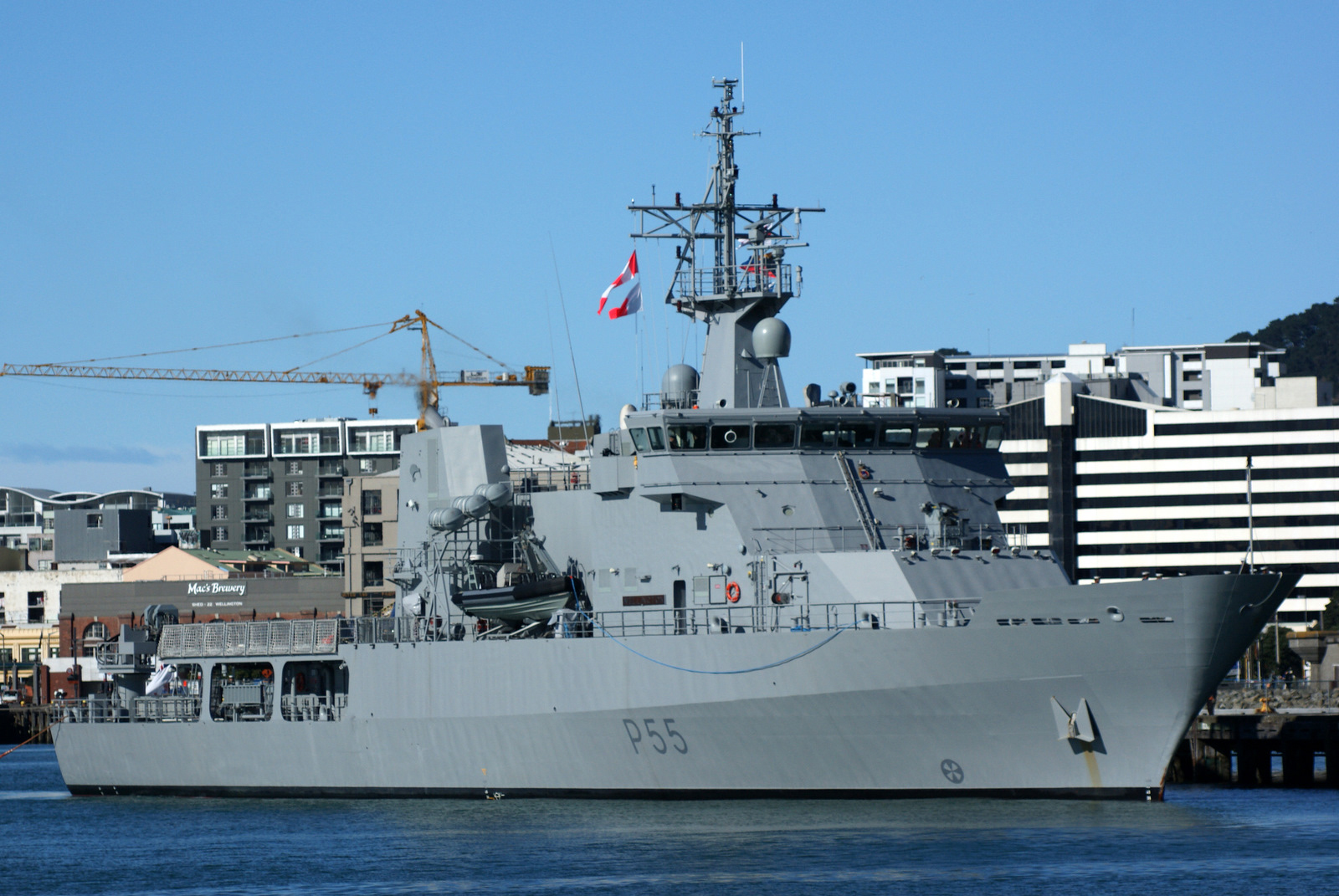
STX (S. Korea, France Finland, Romania, Canada and US) is an extremely successful commercial ship builder with divisions all over the world. They have built cutters for the S. Korean Coast Guard and warships for France and Finland. The New Zealand Protector class (85×14) was designed by their Canadian division. It is unique in having an icebelt, but reportedly the ship turned out heavier than intended and the icebelt is lower than it should be.
Others
An outside chance is a design based on the Turkish Milgem (100×14.4).
MILGEM Photo: Turkish Naval Forces
I’m still a fan of the Danish Thetis (112×14.4) although I don’t think it will be in the running. It is a simple but roomy ship but the yard that built it is now out of business, so it has no advocate.
Photo: Thetis
Another way to approach the problem might be to consider the 327 or 378 as parent craft.
Canada has taken its first concrete step toward providing six to eight ships to patrol its arctic waters.
“The Public Works department says Irving will use the $9.3 million to analyze a preliminary Arctic vessel design already put together by another company and determine how much work will be required before actual, detailed design work can commence.
We have talked about this program before, here and here. Tom C gave us this pdf which was dated February 2012
Some of the Navy units that the Coast Guard most commonly works with are being reorganized.
The Ports, Waterways, and Coastal Security (PWCS) mission the Coast Guard does in the US, when required outside the US, is a Navy responsibility, although they frequently seek Coast Guard assistance.
The Navy has decided to reorganize the way they do this mission, by combining at least to some extent, the organizations that do river and coastal missions.
They are also getting some new platforms to allow them to operate further from shore, including the new 85 foot patrol boat we talked about earlier.
There isn’t an exact correspondence between the way the Coast Guard defines the PWCS mission and the mission set for this new organization, but there are a lot of similarities and we can expect that there will be opportunities to train and exercise together.
Recently a rather ordinary looking Norwegian coast guard cutter came to the port of Hamburg and created something of a stir. This little craft KV Barentshav (also here), seemed unremarkable, but its power plant was unusual. In addition to diesel, it could be powered by Liquified Natural Gas.
It has been a long time since we saw a shift in fuel for ships, from coal to oil. Now it seems we may be seeing the beginnings of another shift. The big drivers are reduced fuel cost and reduced emissions. The Norwegians seem to be the leaders here, but the US Coast Guard is not totally unfamiliar, particularly the M side of the house. the Dec 2011 issue of Marine Safety Engineering (pdf) had an article predicting that predicted that natural gas fuel vessels were coming soon.
This issue highlights another technology that is becoming more important every day, and that is the increased use of liquefied natural gas (LNG). Whereas, we previously considered LNG as a cargo, new MARPOL regulations for reduced emissions are now making it an attractive fuel source. It is extremely clean burning and is much lower cost than similarly clean diesel fuel. Marine Safety Engineers are leading the charge in establishing the appropriate safety standards needed for LNG fueled vessels, which not only includes the vessels themselves, but also bunkering facilities and waterways risk management.
Based on the current forecasts, natural gas delivered for production of LNG is now at least 70% less expensive on an energy equivalent basis than marine residual fuel and 85% less expensive than marine distillate fuel. EIA currently projects that this relative price advantage will continue, and even increase, through 2035.
LNG does require approximately twice the volume for the same energy content and the infrastructure for its distribution is still limited. Currently engines designed to burn LNG are built by Wartsila, Rolls-Royce, and Mitsubishi. Some of these engines are duel fuel, burning either LNG or conventional diesel fuel.
Considering
the US has ample supplies of natural gas,
it may be less than half the cost on a per energy unit basis,
that its use reduces maintenance costs,
LNG is more environmentally friendly, and
the possibility of duel fuel makes this option more practical.
Perhaps the Coast Guard may want to think about powering some of its assets with LNG. When the replacement for the 87 foot WPB is planned, it might be worth a look. They fit the profile of good candidates for LNG since they will normally return to the same base to be refueled. Extending usage to road vehicle and support equipment would amortize the cost of providing the infrastructure and make this option even more attractive.
As we have noted earlier, I believe there is a need to validate the Coast Guard’s ability to forcibly stop a medium to large vessel being used as a terrorist weapon. To do that the .50 cal., Phalanx 20mm, 25 mm, 57 mm, and 76 mm ought to be tested to confirm their ability to penetrate the side of a substantial ship, and go on to penetrate the cylinders of a truly large diesel engine (they can go to over 30 liters per cylinder).
(U.S. Navy photo by Mass Communication Specialist Seaman Leonard Adams/Released)
The Navy is restarting its SINKEX program. Perhaps they could be persuaded to allow some controlled testing, with the objective of developing doctrine with regard to effective ranges and choice of ammunition.