If the Coast Guard ever decides they want to take the H-60 to sea, this may be the appropriate version.
Taking the H-60 to Sea
Reply

If the Coast Guard ever decides they want to take the H-60 to sea, this may be the appropriate version.
Earlier the GAO advised that the “Deepwater” program was unachievable, now we have this from the Coast Guard leadership. Nationaldefensemagazine.org reports:
“The Coast Guard does not have a firm date for when it will release a request for proposals for the final piece of its ship modernization program, the Offshore Patrol Cutter. But it does know that building an affordable ship is of great importance….”
“‘We are dedicated to meeting those minimum requirements. We think we can get within an affordable range using commercial practices’ rather than methods used to build combatant ships, Korn (RAdm. John Korn, Chief of Acquisitions) said. Among the initial industry proposals submitted were ideas to reduce costs, he added.”
(I hope that statement does not mean we are totally abandoning the intention to generally comply with American Bureau of Shipping, Naval Vessel Rules–the ABS NVR.)
There are two things this report seem to suggest.
 Disclaimer: The conceptual renderings posted on this website are for artistic display purposes only and do not convey any particular design, Coast Guard design preferences, or other requirements for the OPC.
The procurement is already well behind previously published milestones, which would have seen the first ship funded in 2015 and delivered in 2019. These milestones included releasing a draft “Request for Proposal” in April-June 2011 and a “Pre-Solicitation Conference” thirty days later. In reality this does not necessarily mean substantial delays. The timeline for planning is still relatively generous.
Some limits on the design are already planned to keep the price of these ships down. Quoting further:
“The Coast Guard has already made some decisions as far as what the ship will not feature. Gas turbine engines and a system to launch small boats from the stern are two ideas that have already been scrapped, he said. Other Coast Guard ships may have these capabilities, but they would be too costly for the OPC, Korn said.”
I’m not sure if there is a need to further reduce the cost of the OPC or if they are just selling the idea that it already incorporates reduced cost, but it does sound like they need to go further. Earlier I commented on the draft specification. The two engineroom requirement with a 50/50 split in power available seemed particularly arbitrary and unnecessary, although some form of redundancy would seem wise. A diesel electric or hybrid system would appear to offer the possibility of long range, better fuel economy (particularly at low speed), low noise, reduced manning and training requirement, and lower maintenance costs, as well as improved survivability.
An Integrated propulsion and ship service electrical system similar to the one on the Lewis and Clark class T-AKEs (and most cruise ships) could permit a design with only four diesel engines (one forward, one aft, and two in the main machinery space). With azipods providing propulsion, including a drop-down unit in the bow, and the ability to use generators forward and aft, as well as those in the main engineering space for propulsion, the ship would have three compartment redundancy for both propulsion and ship service power while minimizing manning and watch standing requirements. Looking to the future, integrated power makes large amounts of power available throughout the life of the ship. This power can be reallocated to sensors or to accommodate future combat systems.
The Coast Guard has had a long history of using diesel-electric propulsion including the 180 WLBs and has already used azipods in the Mackinaw.
In seeking to make these ships affordable, there are some things that should not be compromised.
The program is at a crossroad, and to some extent, so is the service. Is the Coast Guard a military force or not? If we don’t consider armed conflict in our planning, we might as well be civilians. We can dumb down these ships to little more than 270s, maybe less in some respects, or we can make a pitch a better, more capable ship that can contribute to the national defense, at the same time they better fulfill genuine needs in peacetime.
At a time when the Navy is likely to be cut, while naval challenges are growing; spending a tiny fraction of what additional Navy ships would cost, to make sure these are credible low end combatants, makes an awful lot of sense, particularly when, mostly, all we are only really talking about is providing a little extra space, that also enhances their peacetime utility. The nexus of a desire to strengthen naval forces while cutting costs is a perfect rationale for funding units that can do double duty.
Related:
There is an informational video here about a catamaran work boat. That may be interesting, but what I found most surprising was the system they have for lifting a man out of the water. It is shown near the end. A single crewman can both drive the boat and scoop an unconscious person out of the water. Not enough here to say it is a good idea, but certainly an unusual approach.
Thanks to Lee for the heads-up.
Coast Guard’s Acquisitions Directorate has published a new poster showing both existing and planned Coast Guard air and surface assets. You can find it here.
Canadian media reports Denmark has told China that they support China’s application for permanent observer status on the eight member Arctic Council (Canada, Russia, Denmark, Finland, Iceland, Sweden and the United States).
As a great maritime trading nation, China certainly has an interest in the possibility of shortening the shipping route between Europe and Asia, but their interest goes beyond that:
“Wright ( University of Calgary history professor David Wright)… points out that Chinese scholars are examining Canada’s claims of historical sovereignty over the Arctic, especially in regard to the Northwest Passage. China, he says, wants the Arctic, with its sea passages, oil and natural gas wealth, minerals and fishing stocks, to be international territory or the ‘shared heritage of humankind.’…Such a view is contrary to Canada’s insistence on its territorial sovereignty of the Arctic islands and the waterways between them.” (emphasis applied)
This morning CGBlog passed the mark of a quarter million hits. Thanks to our readers and especially to those who provide constructive comments that add so much to the site.
This milestone was reached more than six weeks earlier than last year.
The Navy commissions its first “airship” in fifty years. Interesting to see a renewed interest in lighter-than-air aircraft in the Army (here, here, and here), Air Force (here and here), and now the Navy. The Navy’s airship appears to be the same blimp involved in the Deepwater Horizon response.
The Cutterman website and coastguardchannel.com are sharing a link to a story with many elements of Douglas Munro‘s rescue of Marines from a beach on Guadalcanal.
Troops were trapped, having been ambushed and surrounded, their backs to the sea. Unless rescued by boat, death seemed certain.
This time the troops were nine South Vietnamese soldiers; the enemy, an estimated two Viet Cong platoons (about 60 men); the boat that came to their rescue, the Point Banks’ small boat, a 13’4″ Boston Whaler armed with a single M-60 machine gun. The Coast Guardsmen were Gunner’s Mate First Class Willis J. Goff and Engineman Second Class Larry D. Villarreal. They made the trip twice, overloading the boat each time. Both were awarded the Silver Star for their actions. GMCM Bill Wells tells the story:
http://www.berthdeck.com/Articles/PointBanksHeroes.pdf
Sounds like two more potential Fast Response Cutter names.
The Naval Institute has a good review of recent developments in the Russian Arctic, written by Captain Lawson Brigham, USCG (ret.).
Looks like the Russians are opening up this formerly closed area for commerce and exploitation. Moreover they have settled their boundary dispute with Norway and their handling of hydro-carbon deposit that straddles the new Russia-Norway EEZ boundary will provide precedence for handling other similar situations. The infrastructure appears to be growing rapidly and year round operations are planned.
(Note the US and Canada still have an outstanding dispute over a boundary line in the Arctic.)
As noted previously, Somali pirates seem to be having a harder time this year. Additionally we continue to see both increased acceptance of the efficacy of armed security guards and increasing piracy in the Gulf of Guinea.
Eaglespeak shows how the piracy problem off Somalia has increased in recent years with an animated display of attacks on a yearly basis from 2005 to Oct. 2011 that dramatically shows both the increasing number of attacks and the progressively greater geographic distribution of attacks.
The good news is that while the number of attacks is up, the number of seizures is down from this time last year. “Only 24 vessels were hijacked this year compared with 35 for the same period in 2010.”
It is probably premature, but the Somalia Report is suggesting we may be seeing an end to piracy in the region as we have come to know it. Others are not convinced.
Since the last report, it has been a bad couple of weeks for Somali pirates. Looking at the NATO data base, there have been six attacks, but none have been successful. In fact, the period has been a net loss for pirates with one of their previously seized mother ships, the 100-ton fishing dhow Hibid Fidi, being recaptured by British commandos, freeing its Pakistani crew. A few days earlier Brits from the RFA Fort Victoria, with support from a USN helicopter from the frigate USS De Wert, broke up an attack on an Italian vessel, the 56,000-ton bulk carrier Montecristo. The vessel’s crew of 23 had taken shelter in the ship’s citadel. Meanwhile Somali authorities claim to have captured 15 would be pirates.
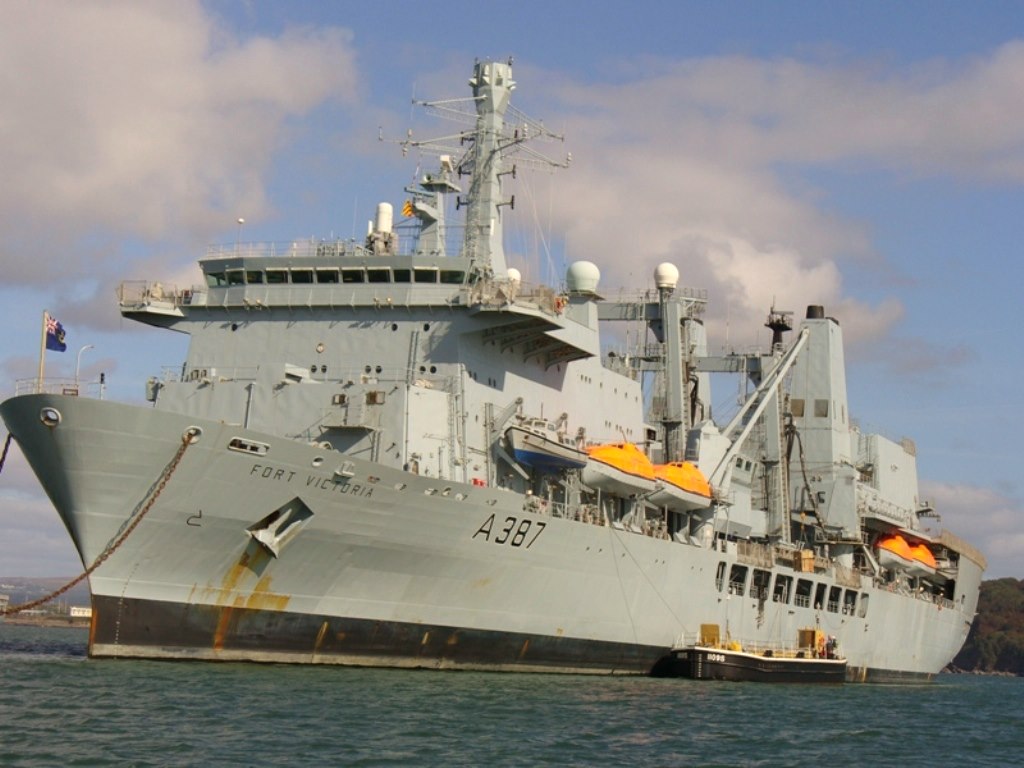
Royal Fleet Auxiliary Fort Victoria, from Wikipedia Commons, by User:Sreejithk2000
Use of the Fort Victoria, an underway replenishment ship, shows again that, at least for this type of sea control, you do not necessarily need a frigate, any armed vessel with a helicopter, boats, and space for an armed boarding team can do the job.
There is more information on the Montcristo attack here including information that the crew may have been steering the ship toward assistance from inside the citadel.
Armed Security Teams: There is more evidence of the acceptance of private armed security teams. A Japanese Company is hiring private security, while the Japanese government considers placing military teams on Japanese flag ships, and Italy is forming ten teams of six soldiers each to guard Italian Flag ships.
Gulf of Guinea: Here the motivation and methods appear to be different, but the area is becoming increasingly dangerous. 19 attacks have resulted in eight tankers have been hijacked in 2011 compared with none in 2010. The attacks below reflect only the last two weeks. From the Office of Naval Intelligence’s Piracy website:
1. NIGERIA: Vessel (JOAN CHOUEST) attacked by pirates on 17 October near the offshore Oso oilfield, near Bonny. (Open Source)
2. NIGERIA: Offshore tug/supply vessel (WILBERT TIDE) boarded by pirates on 17 October while underway near the offshore Oso oilfield, near Bonny. The Bangladeshi master was kidnapped as 20 armed men from two speedboats boarded the vessel. (Open Source)
3. NIGERIA: Product Tanker (CAPE BIRD) was hijacked by pirates on 8 October approximately 90 nm south of Lagos, Nigeria, and was released on 13 October. No further information on whether a ransom was paid or the cargo of oil was stolen. (Open Source)
There is some indication of how piracy can work in an area where there is still a viable national government.
Ghana has ordered two 46 meter patrol boats from China (very similar in size to the Fast Response Cutter) in an effort to beef up their anti-piracy forces.
 Chuck Hill's CG Blog