Interesting discussion of the future of rotary winged aircraft here. How does greater range and twice as fast sound?
Future Helicopters
6

Interesting discussion of the future of rotary winged aircraft here. How does greater range and twice as fast sound?
The Seventeenth District Commander had a nice piece in the Juneau Empire on 17 April talking about why building the Bertholf Class “National Security Cutters” (NSC) is important to Alaska. I’m a lot more worried about getting the Offshore Patrol Cutters started than I am about finishing the Bertholf Class. Right now it appears we are going to limp along funding an NSC every other year, but I feel we see far too little of this sort of effort to advocate for the needs of the service to the general population.
The first quarter of 2011 saw record numbers of pirate attacks, 142 of which 97 of the attacks (70%) occurred off the coast of Somalia, up from 35 in the same period last year. Attackers seized 18 vessels worldwide, including three big tankers, and captured 344 crew members. Pirates murdered seven crew members and injured 34 during the quarter.
But there have been some potentially important developments.
For the first time The FBI has indicted one of the men behind the pirates after capturing him in Somalia. “Mohammad Saaili Shibin, a/k/a “Khalif Ahmed Shibin,” a/k/a “Shibin,” of Somalia, was indicted on March 8, 2011, by a federal grand jury in Norfolk, Va., in association with the alleged pirating of an American yacht, the S/V Quest, and taking hostage four U.S. citizens, who were ultimately killed before their release could be secured. The indictment remained sealed until Shibin made a court appearance on April 13, 2011. Fourteen co-conspirators were indicted the same day and are awaiting a jury trial currently scheduled to begin on Nov. 29, 2011.”
Where to imprison pirates has been problematic for most countries leading to a “catch and release” approach, but the UN is working with elements in Somalia to open three prisons for convicted pirates. One is open now and two more are planned, but the new prison will only accept pirates from Somaliland, the most stable of three regions in Somalia. The second prison is planned for Puntaland, location of the third has not been chosen. The UN Security Council is also looking for ways to set up Somali courts to try those accused of piracy.
Operationally there has also been some good news.
 nd boarded a Iranian F/V being used as a pirate mother-ship, freeing 18 hostages and taking 15 suspected pirates into custody after a firefight that result in the wounding of three suspected pirates.
The Finnish Navy minelayer and command ship FNS Pohjanmaa, 1,450 tons (left), seized a Dhow that was being used as a pirate mother ship on April 6 and after an investigation, destroyed it on April 9. 18 suspected pirates were detained. Continue reading
The Coast Guard has had a major role in protecting the two offshore oil terminals through which flow most of Iraq’s oil exports. This is the source of most of the Iraqi government’s capital. 110 foot WPBs and Navy patrol craft have been protecting these critical assets almost since the end of the second Iraq War, but supporting them has been a frigate or destroyer normally supplied by an allied navy, most commonly British. This support is coming to an end. The British have made their last planned deployment in support of the operation.
 The MarineLog reports Bollinger Shipyards, Inc. has appointed former Master Chief Petty Officer of the Coast Guard, Charles “Skip” Bowen as Program Manager for the FRC “Sentinel” Class Patrol Boat building program at Bollinger’s Lockport facility. Bowen was Master Chief Petty Officer of the Coast Guard, from 2006 to 2010.
US Coast Guard photograph
Here is more evidence that laser weapons are on the way, although the video does not look that impressive. We have already seen video of lasers taking out air targets, which has to be more demanding, so the fact that lasers can start a fire on a boat should not be surprising.
What caught my attention was this statement, “Lasers can address a number of emerging threats, enabling the fleet to maintain freedom of operation, yet with a very low cost of operation. Lasers will offset the use of higher cost kinetic defenses for a number of these threats, substantially reducing the total cost of ship defense.” –Lasers are the low cost option?
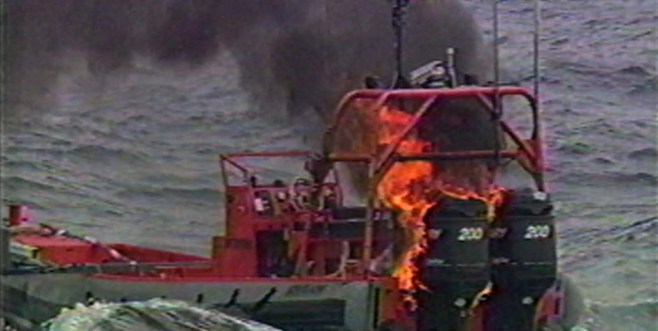
The press release says that the system, “tracked and damaged moving, remotely piloted, unmanned small boats traveling at representative speeds and ranges.” In the video the boat’s engines appear to be idling, there is no attempt at evasion, and the range is not stated. Also the clip does not appear to be continuous, so the time required is not clear. Even apparently edited, it takes some time before the fire breaks out. Presumably the fire was only as large as it was because the engines were running, bringing gasoline to the fire.
Still, I can see some circumstances where a weapon that can be turned down to less than lethal settings, and be applied very precisely, might be useful.
Lasers do seem to have a future within the lifetime of the ships the Coast Guard is planning now. Perhaps it would be prudent to make sure that they have the electrical generating capacity to use these weapons. This seems another reason to look closely at diesel electric or at least hybrid propulsion for the Offshore Patrol Cutters. As the captain of the Starship Enterprise might say, the command may be, “Divert power to the shields.”
Here is a UAV that is already in use by the Navy. The ScanEagle, is so small it could operate routinely from the Webber Class WPCs.
Wing Span 10.25 ft (3.12m)
Length 6.5 ft (1.98m)
Max Take Off Weight 44-48.5 lb. (22 kg)
Max speed 80 knots
Cruise speed 50 knots
Ceiling 10,000 ft
Max endurance: 15 hours
In it’s “dual bay” configuration the sensor package can include a synthetic aperture imaging radar in addition to video. It can use standard diesel fuel, but it won’t use much since the engine is less than two horsepower.
It was reportedly used during the Maersk Alabama piracy incident in April 2009 (the first of three times pirates attempted to take the ship).
I think its worth a closer look, like perhaps a deployment on a 210.

The first African-American woman to join the Coast Guard in 1945, Olivia Hooker, 96 (she retired at age 87), provided some prospective as she met with service men and women of the current generation. “I have seen a lot of progress,” check out her story here.
Yesterday was a bad day for the Libyan Coast Guard (here, here, and here). You have to have some sympathy for sailors who find themselves so over-matched, the largest vessel was smaller than a 110, but we can also recall that Qaddafi’s forces also tried to attack the US Coast Guard using SCUD missiles in 1986.
On the subject of “What Does It Take to Sink a Ship?”, this approximately 106 foot long, 116 ton vessel was hit by missile with a 300 pound warhead and still it managed to limp to shore, where it beached itself.
The Acquisition Directorate has given us another illustration of an OPC conceptual design, apparently the same design used earlier.

Acquisition Directorate’s Disclaimer: “The conceptual renderings posted on this website are for artistic display purposes only and do not convey any particular design, Coast Guard design preferences, or other requirements for the OPC.”
We should see a draft “Request for Proposal” (RFP) in the next three months.
Meanwhile the list of companies interested in building the ships has grown to twelve: Austal, BAE, Bath Iron Works, Bollinger, Derecktor, Eastern Ship Building Group, Marinette Marine, General Dynamics NASSCO, Northrop Grumman, Todd Pacific, Signal International, and VT Halter Marine. (Click on “List of Interested Companies” here for more detail).
A previous more detailed update from November 2010 here.
 Chuck Hill's CG Blog