Welcome Home Vietnam Vererans Day, March 30, 2011

Marines Blog, the official blog of the US Marine corps reports, “The U.S. Senate passed a resolution on March 7, 2011, declaring March 30 ‘Welcome Home Vietnam Veterans Day.’ The resolution currently awaits a decision by the House. This day will be recognized across the U.S. as a day of commemoration, a day to pay the proper respect to the veterans who sacrificed so much during the war.”

A bit overdue, the entire post is worth a read.


Name Changes at Military Sealift Command

The Military Sealift Command (MSC) has changed some of their organizational titles, apparently without any real change in organization. Here are the changes.

Former Name New Name
Sealift Logistics Command Atlantic (SEALOGLANT) Military Sealift Command Atlantic (MSCLANT)
Sealift Logistics Command Pacific (SEALOGPAC) Military Sealift Command Pacific (MSCPAC)
Sealift Logistics Command Europe (SEALOGEUR) Military Sealift Command Europe and Africa (MSCEURAF)
Sealift Logistics Command Central (SEALOGCENT) Military Sealift Command Central (MSCCENT)
Sealift Logistics Command Far East (SEALOGFE) Military Sealift Command Far East (MSCFE)


“In addition, MSC’s six ship support units now carry “MSC” before their command names: For instance, Ship Support Unit San Diego is now Military Sealift Command Ship Support Unit San Diego, or MSC SSU San Diego. MSC’s five other ship support units are in Naples, Bahrain, Singapore, Guam and Yokohama.”

We have been assured that, “This name change is the result of an extensive strategic communication effort led by MSC headquarters.”

(Reference)

Creative Tension in Ship Construction

As the Coast Guard builds it’s Acquisitions Directorate it may be useful to consider some ship building history. It’s almost two years old now, but Norman Friedman reflected on the “creative tension” that once characterized both American and British naval ship building in the July 2008 issues of USNI proceedings.

“In the past, warship procurement was very much a triangular process, marked by what might be called creative tension. The points of the triangle were the operational navy, the professional in-house designers, and the programmers responsible for paying for the fleet. Typically the operational navy (Office of the Chief of Naval Operations or OPNAV in our Navy) thought of what it would like, without much feeling for the technological (or cost) implications of what it wanted. Its ideas were reflected in tentative (“single-sheet”) ship characteristics. The Preliminary Design section of Naval Sea Systems Command sketched a corresponding ship. In effect it estimated what the stated requirements would cost and whether they were practicable at all. Continue reading

MANPADS (Man Portable Air Defense Systems)–Will We See These?

A recent post concerning the unexpected presence of high tech Russian made SA-24, man portable anti-aircraft missiles in no-fly zone over Libya had an interesting side note, “Venezuela, for example, is buying thousands of SA-24s, and international watchdog groups worry that they will end up in the hands of narco-traffickers and insurgent groups.”

Actually I’m a bit surprised we haven’t seen more instances of terrorist or criminal organizations using high tech weapons. Perhaps criminals recognize that this could provoke unwanted additional attention.

(Video of the weapon in operation here)

Piracy, Indian Navy and Coast Guard Score Again

For the forth time this year, the Indian Navy and Coast Guard has taken down a pirate mother-ship. Responding to an attack in progress on the merchant ship MV Maersk Kensington, they not only foiled the attack, they went on to capture 16 pirates and free the 16 crewmen being held as hostages on the mother-ship, a previously pirated Iranian trawler. Eaglespeak has the details and pictures. The Indians seem to have an effective ROE.

Previous incidents were reported here, here, and here. Just an impression, but I suspect the Indians have figured out if you target the fuel drums on the mother ships, everyone will quickly abandon ship.

Towed Array Sonar–A Tool for Drug Interdiction

The use of “Self Propelled Semi-Submersibles” (SPSS), semi-submersibles that run with only a snorkel above water, and true submersibles by drug smuggling organizations represents a serious challenge to efforts to interdict drug trafficking. SPSS and snorkels are difficult radar and visual targets. They can be detected, but sweep widths are dramatically reduced. True submersibles are invisible to radar and only rarely visible from the air, when the water is clear and calm, and even then, only at relatively short distances.

Source: “Introduction to Naval Weapons Engineering

There is a way to detect these vessels at ranges greater than typical radar ranges against even normal surface contacts. Passive Acoustic Towed Arrays routinely make detections beyond the radar horizon. Direct path detection ranges vary a lot. They are typically inside the radar horizon, but there are common phenomenon that make detection at extended ranges possible. These include the deep sound channel, bottom bounce, surface ducting and convergence zone (all explained here. You can skip the math and go down to “Propagation Paths” that starts about a third of the way down). These conditions frequently allow detection at well over 60 miles. These conditions are also recognizable and predictable. Passive acoustic detection is not as unambiguous as radar, in that passive sonar does not provide range, but it does give other information radar does not, that can aid in classification. In the past, success with passive systems has been highly dependent on the skill of the operator, but reportedly newer systems like the Multi-Function Towed Array (MFTA), planned for the Littoral Combat Ship, provide computer assistance that makes them much more intuitive. Range can sometimes be inferred from knowledge about the water conditions, and it can also be deduced by target motion analysis. Whatever information can be gleaned from the passive contact can be used to cue a helicopter to search a specific area.

Because this sensor is passive, it permits searches without betraying own ship’s position. It is not too hard to believe that drug runners who can build submarines are sophisticated enough to use Electronic Support Measures (ESM) to detect and identify Law Enforcement units  based on their radar emissions. A towed array gives the commander the option of searching a large area while going passive electronically.

It would be reasonable to expect that the Navy would pay for these systems, just as they did sonar systems in the past, so that they could be available for military operations. The Offshore Patrol Cutters should incorporate provision for this system in their design. (Previous related posts here, here, and here.)

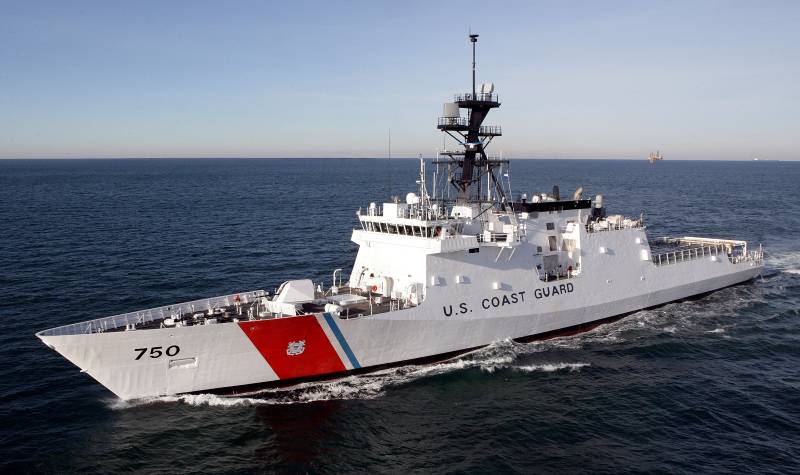
The Commandant Answers–the National Security Cutters: Multiple Crewing, Build Rates, OPC Compared

The Commandant has been good enough to answer three more of our questions, and we expect to hear more in the near future. Today we hear more about the National Security Cutter (NSC).

File:USCG National Security Cutter BERTHOLF (WMSL-750).jpeg
USCG National Security Cutter BERTHOLF (WMSL-750)

Will the Coast Guard implement the National Security Cutter multi-crewing plan referred to as the Crew Rotation Concept?  Has the concept been adequately tested?  If the plan is workable, would it be implemented on smaller vessels? Continue reading