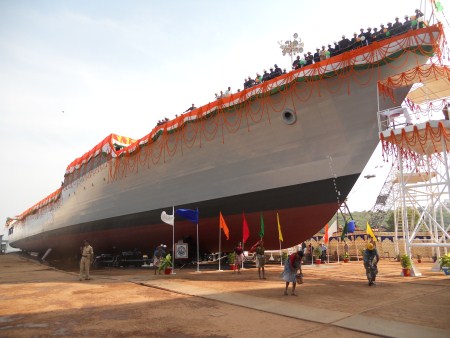
Today, I’ll finish giving my answers to the questions I posed earlier.
My answer to the most basic question, “Why do we need them?” or in fact any large cutters, is here.
What missions will not get done if the program is canceled?
- Drug Interdiction
- Migrant Interdiction
- Defense Readiness
- Other Law Enforcement (foreign fisheries enforcement)
- Living Marine Resources (domestic fisheries enforcement)
These missions are largely accomplished by the ships the OPCs are intended to replace and will be impacted severely if the OPC program is canceled.
“Ports, Waterways, and Coastal Security” could also be adversely effected if the current terrorist threat levels take a turn for the worst.
Marine Safety and offshore SAR will also be adversely effected. Large cutters check compliance with commercial fishing vessel safety regulations on board U.S. vessels in isolated areas like the Western/Central Pacific and Bering Sea/Aleutian Islands. Additionally, flight deck equipped cutters with higher sea state capabilities are often essential for offshore SAR.
Are those tasks worth doing?
I have my own doubts about the efficacy of doing maritime drug interdiction, so I am not a fan of sending ships to operate off of Colombia, but that is only a small part of the drug enforcement effort, which is only a part of what these ships do. On patrol in the US EEZ, they are multi-mission resources, and if they are not involved in drug enforcement, they will be doing something else useful.
Frankly, I don’t think we have properly prepared for the possibility of our enemies using a medium to large ship to make an unconventional attack on a US port. Neither the ships we have now, nor the ships that we are building have weapons that can reliably stop a ship from reaching its objective. Nevertheless, adding the weapons that can do that, is easier and quicker than building ships. The ships are needed in any case, to hopefully intercepts inbound threats and make a determination if they are hostile before they get to our ports. (This likely requires attempting to stop and board the vessel.) The larger cutters, as opposed to patrol boats, are likely to make that determination further from the ports, giving us a better chance of successfully stopping an attack.
Offshore fisheries are already among the most dangerous professions in the US, I don’t think we want to make it any more dangerous.
Migrant Interdiction and Fisheries Patrols appear worthwhile, but ultimately the law makers are going to have to decide if the laws they have created are worth enforcing.
What can they do that you can’t do with the 154 ft Hero class fast response cutters (FRC)?
The new Fast Response Cutters are likely to prove unexpectedly useful, even so, they are certainly at a disadvantage compared to the OPC. Much less endurance. Much greater stress on the crew in even moderately bad weather. No helicopter facilities. Only one smaller, less capable ship’s boat. Smaller crews means less depth in the boarding teams, and less experience. OPCs can do boardings in more severe weather. The FRCs will also not have access to some of the intelligence resources that the OPC will have. In some limited circumstances, particularly operating in company with larger cutters, I think the FRCs will prove useful as a patrol asset, but bottom line, they are designed to “respond’ not to patrol.
Why don’t we let the Navy provide the ships, and “You can just put a detachment on board to do law enforcement missions.”
The Navy has been saying that they do not have as many ships as they need. They have about 288 and have repeatedly expressed a need for 313. Using Navy ships to do Coast Guard missions distracts them from their normal operations. Any navy ship used to replace an OPC is likely to cost more both to procure and to operate and will not have the benefit of the more focused and experienced Coast Guard Crew that routinely executes these missions.
Senators and Representatives will ask, “What’s in it for my constituents?”
- For those concerned about the loss of American productivity, the program preserves the nation’s ship building infrastructure, including smaller yards that can’t build some of the more complicated Navy ships. Using more than one yard could foster competition while broadening political support for the program. Completion of these ships might allow a smaller shipyard to develop the skills and credibility to compete for more complex Navy contracts.
- For those concerned about unemployment, the program can be thought of as a jobs program that also creates long lasting resources.
- For environmentalists, these ships police fishing, protect endangered species, and support environmental policy.
- For those concerned about terrorism and the National defense, in times of crisis these larger cutters will protect US ports from covert attack, freeing Navy ships for offensive roles.
- For those concerned about the epidemic of drugs in the US, they help to curb the importation of illegal drugs.
- For those concerned who advocate globalization, these ships insure that our part of the “global commons” are safe for commerce and the exploitation of our resources.
Why do they need to be so big and complicated?
The current concept is not much more complex than the 270s, and only slightly larger. Most of the additional complexity is to allow the ships to take advantage of intelligence resources which should also make them more efficient and effective. I can even save fuel by pinpointing where the ship should be going instead of more random patrolling. Increasing size has only a small impact on life cycle costs, but it will make the ships much more capable than the smaller ships they replace.
Aren’t the current ships doing the job? Why can’s you build a simpler ship like the 210?
We can build simpler ships, but depending on our choices they could be unable to catch up with a modern merchant ships, unable to use available intelligence information, unable to make a meaningful defense contribution, unable to use modern sensors, unable to function in severe weather, and unsurvivable in more demanding situations.
Do you really need that many?
25 is really is not that many. In fact it may not be enough. Even building 25 ships as planned the total fleet of large cutters is expected to drop from 43 to 33. The waters off the South Pacific islands and the rapidly expanding Arctic waters are already under served. The US has the largest EEZ in the world, but with only 33 ships, assuming 17 ships underway, their average patrol area would be over 200,000 nautical miles square.
Why don’t you buy Littoral Combat Ships and get economies of scale?
The average cost of Offshore Patrol Cutters are expected to be considerably less than the marginal cost of additional LCS. Perhaps more importantly, the LCS don’t have the endurance we expect from the OPC and their maintenance and operating costs is likely to be considerably higher (bigger ships, more complex and exotic propulsion). The LCS-1 FREEDOM class cannot use their diesels for more than cruising, and have to switch to very thirsty Gas Turbines for higher speeds. The LCS-2 INDEPENDENCE class trimarans have better diesel cruise performance, but their extreme beam, 104 feet, may be problematic for basing at existing Coast Guard facilities and will certainly be more expensive to dry dock.
The LCS manning concepts are yet to be proven and require unusually skilled crews that absorb a disproportionately large percentage of outstanding petty officers to man them, while providing little opportunity to “growing” junior enlisted into the highly qualified petty officer they require. That would have a more severe impact on a small service where these ships would constitute a much larger percentage of the total fleet.