This Day in Coast Guard History, January 10

Based on the Coast Guard Historian’s timeline, https://www.history.uscg.mil/research/chronology/
With inspiration from Mike Kelso

January 10

United States Revenue-Marine revenue cutter USRC Wolcott (1873) at her home port, Port Townsend, Washington.

1889 RC Wolcott made the first-ever at sea seizure of both a smuggling vessel and drugs, and the arrest of its crew, after stopping the British sloop Emerald with 400 lbs of opium and 12 undocumented Chinese aliens at the entrance to Port Discovery Bay, WT.

USCGC Cape Cross (WPB-95321)

1977 CGC Cape George (WPB-95306) received a mayday broadcast from the motor tankship Chester A. Poling.  The 281-foot tankship was breaking in half in high seas and sinking approximately eight miles ESE of Gloucester Harbor, Massachusetts, with seven POB.  CGCs Cape GeorgeCape CrossFirebushDecisive, and boats from CG Station Gloucester, Point Allerton, and Merrimack River, and aircraft from Air Station Cape Cod all responded.  Cape George arrived on scene and rescued two persons stranded on the bow section.  A CG HH-3F rescued the first person from the stern of the tankship and a second crewman fell off the stern while attempting to jump into the rescue basket.  At this time the stern section rolled over, throwing the remaining three survivors into the frigid seas.  CGC Cape Cross (WPB-95321) moved in and rescued two of the crewmen while the HH-3F rescued a third.  The six survivors were taken to Gloucester Station and transferred to a local hospital. (Report of the investigation here.)

“Top Ten Navies by Aggregate Displacement, 1 January 2025” –Analysis and diagram by Phoenix_jz

This is becoming an annual thing. I do not know but he has produced a version of the graphic above annually and provides brief additional analysis. I just pass it along. You can check out the entire accompanying discussion here.

The graphic above will be hard to read unless you click on it to enlarge.

Again, the author also listed Navies 11–20 in the comments, “No.11 to 20 are as follows for 1 January 2025;”

  • 11: Indonesia – 330,200t
  • 12: Taiwan – 276,166t
  • 13: Egypt – 232,046t
  • 14: Spain – 229,373t
  • 15: Germany: 226,952t
  • 16: Australia: 216,594t
  • 17: Greece – 189,184t
  • 18: Brazil – 163,805t
  • 19: Chile – 161,404t
  • 20: Canada – 143,242t

Note, Coast Guards are not included in this analysis. This leads to some distortion since navy operated Offshore Patrol Vessels (OPVs) and patrol craft are counted as combatants, but coast guard operated OPVs and patrol craft are not counted at all. The US, China, Russia, Japan, India and South Korea all have substantial sea-going coast guards, notably the UK and France do not. The Indian Navy in particular has a large number of Navy operated OPVs and patrol craft.

Just for reference the US Coast Guard’s projected eleven NSC and 25 OPC program alone would amount to 173,000 tons not to mention icebreakers, buoy tenders, and patrol craft. The total projected 64 Fast Response Cutters would add 23,360 tons.


Hello all!

The fourth edition of my top ten navy list arrives with 2025! For those unfamiliar, here are links to 20222023, and 2024, with a general explainer for the whole concept in that first 2022 edition.

The long and short of it is that this graph reflects a personal tracker I keep of almost every large and moderately sized navy, and calculates the aggregate displacement of these navies. It’s not a perfect way to display the size of navies – far from it in fact – but it is at least more representative than counting numbers of hulls alone, in my opinion.

To break down what each of these categories mean;

  • Surface Warships is an aggregate of all above-water warships and major aviation and amphibious assault platforms. This category includes CVNs, CVs, CVLs, LHDs, LHAs, LPDs, CGs, DDGs, FFGs, corvettes, OPVs, CPVs, lighter patrol craft, and MCM vessels.
  • Submarines is what it says on the tin – SSBNs, SSGNs, SSNs, SSKs, and for select nations where applicable (and where information is available), special purpose submarines. Please note dedicated training submarines are counted separately.
  • AORs includes all major fleet replenishment vessels (coastal vessels do not count, however).
  • Other Auxiliaries is a very wide net that essentially captures everything else. Special mission ships, support vessels, minor amphibious assault vessels (LSDs, LSTs, LCAC’s, LCM’s, LCU’s), training vessels, tugs, coastal support vessels, hydrography ships – all essential parts of navies, but generally often paid less attention to as they’re not as flashy as the warships proper.

Interesting trends in data that I thought I would share for various navies, and thoughts and observations otherwise;

The USN’s position remains unimpeachable, and record a slight increase in both overall tonnage (+11,983t, or 0.16%) and numbers of vessels (net +2), commissioning an LPD, a destroyer, an SSN, and three LCS against the decommissioning of four Ticonderoga-class ‘cruisers.’ It is interesting to note that with these commissioning’s, there are only two more LCS – one of each class – and two remaining Flight IIA Burke’s left to enter service before the torch is entirely passed to the Flight III Burke (ten of which are currently building or fitting out) and other future platforms. Only nine of the venerable Ticonderoga-class remain in service.

The PLAN (China–Chuck), no one will be surprised to hear, increases in displacement again this year, though the on-paper 74,350t (+2.56%) from last-years figure does include some ‘fluff’ – I corrected the displacement of the Type 055 up 1,000t and split off the Type 052D’L’ (12) from the Type 052D’s, which netted +9,800t for the PLAN from thin air. 2024 was a relatively light growth year for the PLAN, with only a two new major warships entering service – the first Batch IV Type 052D and the first Type 054B. That being said, several ships are in advanced stages of trials and likely follow in very early 2025 (the second Type 054B and two other Batch IV Type 052D). There is also an addition of at least one new Type 039C SSK – though for full transparency, while I have three vessels listed presently, there is probably ±2 boat margin of error given the difficulty with tracking individual PLAN boats with open-source data. The rest of the increase comes from the auxiliary category in general, with the most notable of these being a second Type 927 ARS (submarine rescue ship, different from the AGOS formerly dubbed Type 927 but now Type 816). I have also struck a pair of Type 053 variants that have clearly left service.

Despite the modest growth, 2024 has been a big year for PLAN-related shipbuilding, crowned by the launch of the Type 076 LHD – a unique catapult-equipped amphibious assault ship – but one that has also seen the launch of the second Type 055 Batch II (with two more in build) and two more Type 052DL destroyers. Additionally, three Type 054AG frigates have been launched – a new, lengthened variant of the Type 054A, able to handle the Z-20 helicopters (also accommodated by the Type 055 and 052DL destroyers). The production of these additional ships and the absence of additional Type 054B builds has been a curious development that may signal the 054B as more of a transitional design, like the original Type 054 frigates, instead of a design the PLAN intends to produce at large scale (as with the Type 054A).

What is more consequential than any of these, however, is the continued launches of what is generally believed to be Type 093B SSNs from Bohai. 2024 may have seen up to three launches this year, indicating a similar pace of 2-3 boats per year as last year. This would mean that since the spring of 2022, five to seven Type 093B have been launched, compared to four American SSNs in the same period. It remains to be seen if these SSNs will just be built in a limited number, as has been the case in the past, or if the PLAN is adopting a more continuous production model for their SSN fleet (as practiced by the United States).

The VMF  (Russia–Chuck) has also seen a very slight uptick in 2024, of 3,605t (+0.17%). Combat losses in 2024 were less severe for the Russian navy than in the first two years of the Russo-Ukrainian War, but still notable. In 2024, Ukrainian forces sank two corvettes, an OPV, and an LST in the Black Sea. Despite this, arguably the largest blow Russian naval forces suffered this year was the collapse of the Assad regime in Syria and the naval base it allowed Russia at Tartus. While Russia appears to be sounding out Libyan National Army under Gen. Haftar to use Tobruk as a base (Cyrenaica, Libya), this will not be able to replace the facilities that had been built up at Tartus.

Russia’s most notable additions to its fleet this year include a fifth Yasen-M SSGN, a second Lada-class SSK, and a new Project 21180M icebreaker. Three new corvettes entered service, though this did not offset losses given the retirement of six other corvettes in addition to combat losses. The growth in the submarine force has been offset by retirements of not just aging Project 877 Kilo’s, but also the first of the deeply unsatisfactory Lada-class.

The British Royal Navy sees a reduction for a third year in a row, with 2025 looking to include an even sharper decline given cuts announced late this year. 2024 reductions include two Type 23 frigates (Argyll and Westminster) and all but the last Sandown-class MCM (HMS Bangor). This equals a drop of 11,072t tons (-1.25%).

An additional Type 23 frigate, as well as both Albion-class LPDs and the two Wave-class AORs will be decommissioned in early 2025. This is more a reduction on paper than in practice given the condition of the vessels, which had little to no chance of ever returning into service. It should be noted that while this is a cut in platforms, the up to £500M the British MoD expects to save on maintenance and refit costs for these vessels over the next five years will remain within the MoD for investment in other programs.

Perhaps the most perilous malfeasance facing the Royal Navy at present is the plight of the Royal Fleet Auxiliary, which for want of pay raises competitive with commercial shipping continues to hemorrhage mariners.

This Day in Coast Guard History, January 8/9

Based on the Coast Guard Historian’s timeline, https://www.history.uscg.mil/research/chronology/
With inspiration from Mike Kelso

January 8

Satellite map of Johnston Atoll (Kalama Atoll), U.S. Territory in the North Pacific Ocean. NASA satellite image modified for mapping. by Wikipedia user Surfsupusa.

1958  The Coast Guard LORAN Station at Johnston Island began transmitting on a 24-hour basis, thus establishing a new LORAN rate in the Central Pacific.  The new rate between Johnston Island and French Frigate Shoal gave a higher order of accuracy for fixing positions in the steamship lanes from Oahu, Hawaii, to Midway Island. In the past, this was impossible in some areas along this important shipping route.

(A LORAN station operated from Johnston Atoll until June 30,1992. There was considerable nuclear testing that contaminated Johnston Island and the rest of Johnston Atoll 1958 to 1963 and Bioweapons testing 1965-1968. There was also contamination from Agent Orange storage 1972-1977.)

2015  The U.S. and Canadian Coast Guards commenced Operation Coal Shovel seasonal domestic ice breaking operations in the southern part of Lake Huron, Lake St. Clair, the St. Clair and Detroit River systems, Lake Erie, and Lake Ontario.  The mission of Operation Coal Shovel was to quickly reopen the Great Lakes maritime transportation system for the movement of commercial vessels that may become beset in the ice.  The previous winter of 2013-2014 presented some of the harshest ice conditions ever recorded in the Great Lakes.  At one point during March 2014, 92.5 percent of the Great Lakes were covered by ice; this was the highest percentage of ice coverage seen since 1979.  Operation Coal Shovel 2013-2014 started in December 2013 and lasted for a total of 128 days.

January 9

1844  The first published and systematic annual report of the Revenue Marine Bureau was transmitted to Congress on January 9, 1844 by the head of the Bureau, Revenue Captain Alexander Fraser, the service’s first “Commandant.”  The report noted that the Revenue Marine consisted of 15 revenue schooners varying in size from 60 to 170 tons.  The cutters were stationed at Eastport, Portland, Boston, Newport, New York, Delaware Bay, Baltimore, Norfolk, Charleston, Savannah, Key West, Mobile, New Orleans, and Lake Erie.  The report also noted that the number of personnel of the Revenue Marine consisted of 20 captains, 20 first lieutenants, 20 second lieutenants, 20 third lieutenants, 45 petty officers, 7 pilots, 30 stewards, 15 cooks, and 323 seamen.

Coast Guard manned LSTs 67, 66.18, 202, and possibly others unload on Leyte. Coast Guard photo. 

1945  Coast Guardsmen participated in the liberation of Luzon in the Philippines.  Sixteen Coast Guard-manned vessels and seven other Navy vessels with partial Coast Guard crews took part in the offensive.

1952  SS Pennsylvania broadcasted that she had sustained a 14-foot crack in her port side.  A tremendous sea was running, and the wind exceeded 55 miles per hour.  The master advised that the vessel was foundering and that 45 men were abandoning ship in four lifeboats 665 miles west of Cape Flattery, WA.  The Coast Guard used all the facilities at its command in the area, as well as coordinating the use of U.S. Navy, Air Force, and Royal Canadian Air Force facilities in an attempt to locate and rescue the survivors of the vessel.  Fifty-one aircraft from all services and 18 surface vessels participated in the search.  Some of the debris was located, including one over-turned lifeboat, but no survivors were found.

This Day in Coast Guard History, January 7

Based on the Coast Guard Historian’s timeline, https://www.history.uscg.mil/research/chronology/
With inspiration from Mike Kelso

1877  The French steamer Amerique grounded off Sea Bright, New Jersey.  Saved were 189 persons, rescued by the Life-Saving Service crew.  Despite their efforts, three died.

First Reel of the 1948 Academy Award winning documentary “The Secret Land.” Coast Guard icebreaker USCGC Northwind featured. 

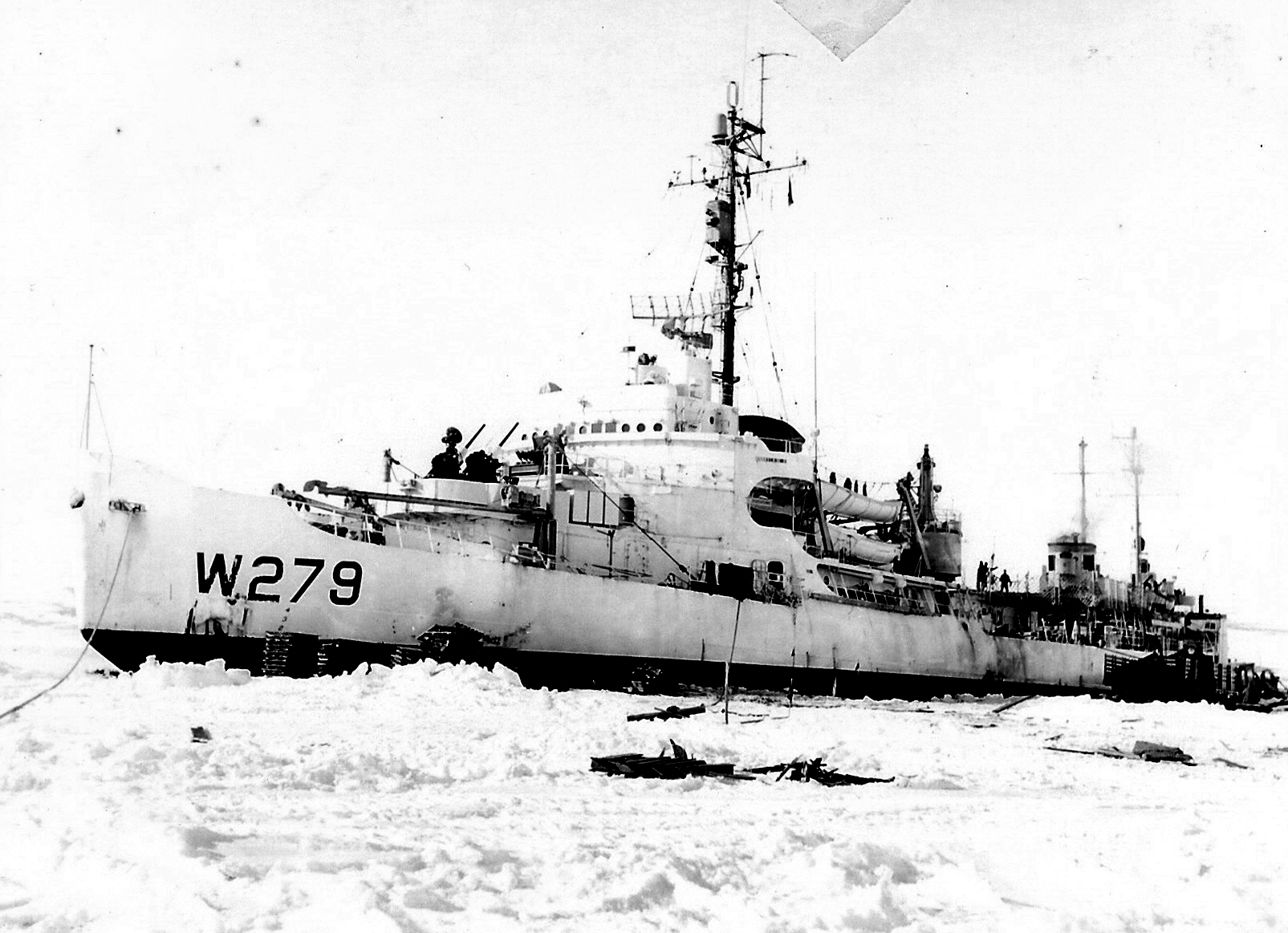
1947  During Operation Highjump, Coast Guard icebreaker USCGC Northwind rescued submarine USS Sennet (SS-408) and Navy supply ships USSYance and USS Merrick that had been stuck in Antarctic ice.

Sennet (SS-408) in the Antarctic Ocean during Operation HighJump, 1946

A portrait of Coast Guard Lt. Colleen Cain by Leonora Rae Smith.

1982  LT Colleen A. Cain, the Coast Guard’s first female HH-52 helicopter pilot, died in the line of duty when HH-52 CG-1420, on which she was co-pilot, crashed into a mountainside 50 miles east of Honolulu.  The pilot, LCDR H. W. Johnson, and aircrewman AD2 D. L. Thompson, were also killed.

CG 1420, source: http://www.heligraphx.com

1994  The barge Morris J. Berman, carrying a cargo of 750,000 gallons of oil, struck a reef off Puerto Rico.  Coast Guard units, including the National Strike Force, responded.

Barge MORRIS J. BERMAN incident, San Juan, Puerto Rico, January 1994. The MORRIS J. BERMAN barge off the coast of San Juan, Puerto Rico. NOAA photo

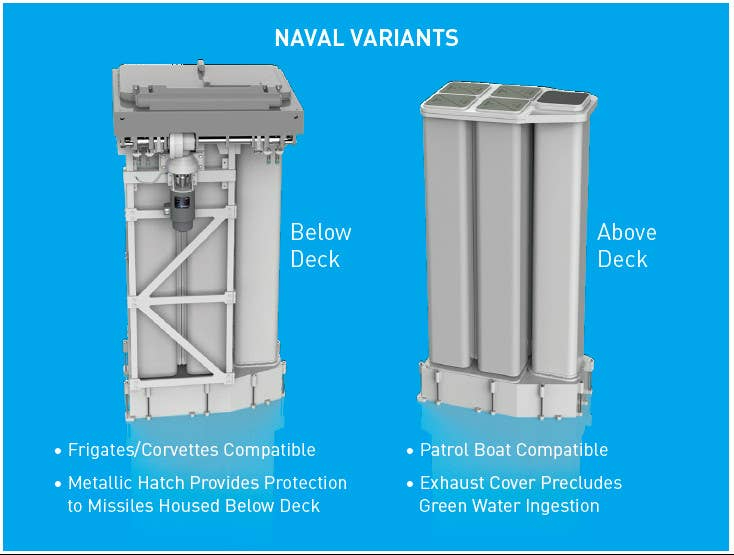
70mm Guided Rockets–Big Stick for Small Ships

70

Lets face it, the US Coast Guard is not always ready–not Semper Paratus.

The Coast Guard is not ready to reliably counter a terrorist attack on US ports using Kamikaze air and surface craft (manned or unmanned) or using a medium to large ship. The Coast Guard simply does not have the weapons.

The 57mm Mk110 might be useful against kamikaze drones, but the vessels they are mounted on are either not likely to be in the vicinity of the threat or they will not be capable of getting underway and on scene fast enough to deal with the threat.

Even the 57mm probably isn’t going to stop a medium to large ship under the direction of dedicated terrorists before it completes its mission and again there is doubt large cutters will be in the right place at the right time.

We need weapons that can deal with these threats on widely distributed craft at least as small as the Webber class WPCs. The WPCs do have a 25mm gun but unfortunately that gun does not support an air-burst round that would be needed to deal with Unmanned Air Systems, and it is far too small to expect success against medium to large ships.

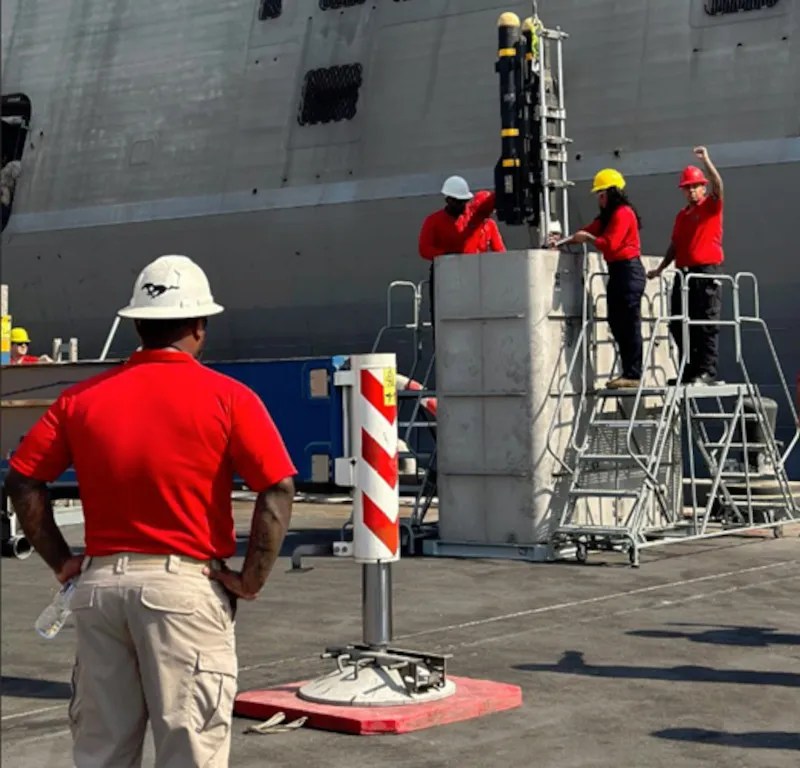
APKWS is a proven system against UAS and while it is probably not going to succeed against a medium to large ship, at least has a limited capability. Their warhead is up to three times the size of that of a 57mm projectile.

There are alternatives that could also deal with UAS and that might do better against surface threats:

  • The 25mm could be replaced with a more capable gun. Some would fit in the existing mount.
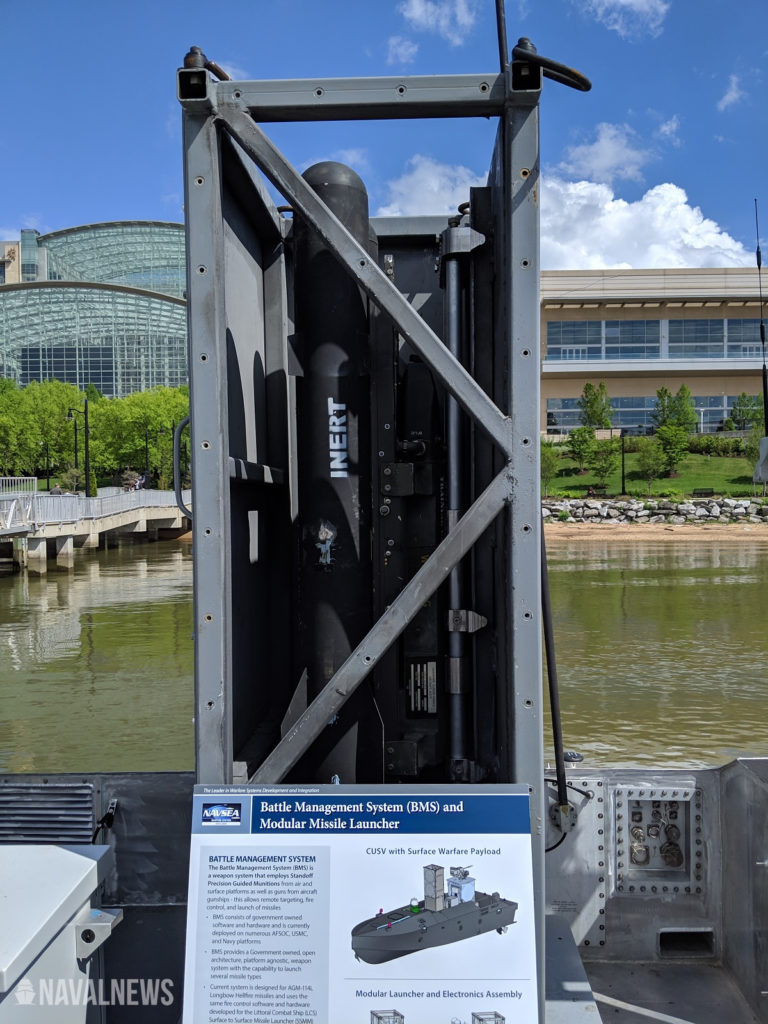
  • Hellfire and its replacement the AGM-179 JAGM would offer greater range and a larger warhead but, while still relatively small, are heavier and much more expensive. They are still my favored solution.
  • Adaptations Army or Marine Short Range Air Defense system that use a remote weapon station combining missiles with a 30mm gun capable of firing air-burst ammunition (either the high velocity 30mmx173 Mk44  Bushmaster II or the lighter but lower velocity 30mmx113 M230).

APKWS is in the US Navy inventory, but there it is used primarily as an air to ground weapon. It is a semi-active Iaser homing weapon so requires use of a laser designator. It can be as simple as the L3 Harris VAMPIRE system which provides a complete system–weapons, launcher, designator, and detection–that fits on a pickup truck.

APKWS is not the only guided 70mm rocket system. South Korea has developed the “Poniard” Korean-Low cOst Guided Imaging Rocket (K-LOGIR).

This is a fire-and-forget system allowing multiple simultaneous engagements. It is also claimed to have advantages in periods of restricted visibility.

The Weapon has already been exported. Here is a report on an earlier test was done by 4th Fleet.

This Day in Coast Guard History, January 5/6

Based on the Coast Guard Historian’s timeline, https://www.history.uscg.mil/research/chronology/
With inspiration from Mike Kelso

January 5

1883  At 1 o’clock in the afternoon the crew of the Quoddy Head Station discovered a schooner at anchor.  The weather was bitter cold, with a gale from the northwest.  The men got the station’s boat out and pulled to the vessel.  She proved to be Clara Dinsmore from Boston.  There were four men on board, one of them a passenger.  With her sails iced up and splitting, she was in need of assistance.  The keeper took charge and got the vessel under way with the sails she had left and beat her up the bay to her destination at 6 o’clock in the evening.

1975  The “Very Large Crude Carrier (VLCC)” Showa Maru ran aground in the Straits of Malacca, eight miles from Singapore Harbor, resulting in a major oil spill.  At the request of the Japanese Government, 10 Coast Guardsmen from the National Strike Force were sent to Singapore aboard a Military Airlift Command aircraft.  In addition to the team, four pumping subsystems of the Coast Guard’s Air Deliverable Anti-Pollution Transfer System (ADAPTS) were also airlifted to the scene. The governments of Singapore, Indonesia and Malaysia concurred in the request for assistance.  This incident marked the second time in a year that the Strike Force responded to the request of a foreign government for assistance, the first being a request by the Chilean government to assist after the grounding of VLCC Metula in the Strait of Magellan in August 1974.

January 6

SS Washington, New York Harbor

1934  The United States Line SS Washington came within inches of ramming the new Light Vessel No. 117 on the Nantucket Station.  The liner scraped the lightship’s side, shearing off davits, a lifeboat, antennas, etc.  Five months later the lightship was sunk by the White Star Line RMS Olympic when it rammed the lightship, killing seven of the lightship’s crew.

“L.S. #117.” Photo No. 43; 26 February 1931; photograph by “G.E.E.” LV 117, on station soon after her commissioning in 1930. This photo was taken three years prior to her fateful rendezvous with the Olympic.

1973  The Coast Guard Academy at New London, Connecticut, announced that its cadets were served “meals for the first time by female civilian employees.”  The Academy had “recently become the first of the nation’s service schools to contract their food services to a civilian company.”  Previously, Coast Guard personnel had done the serving.

This Day in Coast Guard History, January 4

Based on the Coast Guard Historian’s timeline, https://www.history.uscg.mil/research/chronology/
With inspiration from Mike Kelso

 44355 was on display at the Bayview Park. Bayview Park is located across from the Long Beach Township Municipal Buildings on Long Beach Boulevard. She was moved to the Tuckerton Seaport (NJ) around 2014.

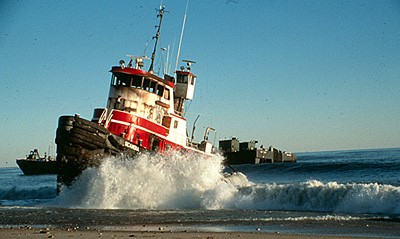
1980  Coast Guard forces narrowly averted an environmental disaster when the 300-foot barge Michelle F, with more than 2.8 million gallons of No. Six industrial fuel aboard grounded one-half mile offshore from the Brigantine Wildlife Refuge.  Much of her cargo was offloaded before she was successfully refloated.

“I was a coxswain at Coast guard station Beach Haven with the 44355 in January of 1980. The oil barge Michelle f broke loose from its tugboat and went ashore in Little Egg inlet. I was asked to go out and save the crew on that barge in a northeastern storm with 20 ft seas. Coast guard 44355 was there to rescue the crew in that snowstorm. The barge was grounded in the inlet it was almost completely submerged. It took us two tries but we safely got the barge crew off. My crew and myself were awarded the Coast guard medal for extraordinary heroism.”–Matthew Greer uscg ret

The Coast Guard Cutter Healy breaks ice around the Russian-flagged tanker Renda 250 miles south of Nome Jan. 6, 2012. The vessels are transiting through ice up to five-feet thick in this area. The 370-foot tanker Renda will have to go through more than 300 miles of sea ice to get to Nome, a city of about 3,500 people on the western Alaska coastline that did not get its last pre-winter fuel delivery because of a massive storm. If the delivery of diesel fuel and unleaded gasoline is not made, the city likely will run short of fuel supplies before another barge delivery can be made in spring. (AP Photo/US Coast Guard – Petty Officer 1st Class Sara Francis) NY112

2012  CGC Healy, under the command of CAPT Beverly Havlik, embarked on an Arctic domestic icebreaking mission to escort the Russian tanker vessel Renda through 800 miles of Bering Sea pack ice to deliver 1.3 million gallons of fuel to ice-bound Nome, Alaska.  After 10 days of intense, close aboard ice escorting, the two vessels safely arrived on 14 January 2012 and began a successful 60-hour, over-the-ice fuel transfer while hove to in the ice 468 yards offshore of Nome.

China CG, Japan CG, Philippine CG, Different Answers to Choice of Weapons

This Chinese coast guard ship 2501 is equipped with weapons believed to be 76-millimeter guns. © Kyodo

A recent large-scale transit of the Miyako Strait by three PLAN frigates and three China Coast Guard frigates has caused some alarm in Japan and raised questions about the armament on Japan Coast Guard cutters. (“China tests maritime blockade strategy in Miyako Strait“}

Ryukyu Islands. The Miyako Strait is located between Miyako and Okinawa

Meanwhile we see increasingly aggressive deployment of heavily armed China Coast Guard vessels in the Philippine EEZ. (“Chinese Warships, Aircraft Deploy in Strength to Scarborough Shoal“)

The Chinese, Japanese, and Philippine Coast Guard have each taken different paths in their choice of how to arm their large coast guard vessels.

Changing with the Geopolitical Situation:

China: China Coast Guard (CCG) was formed in 2013 by the consolidation of four existing agencies. At that time none of their vessels were armed with anything larger than crew served machineguns 14.5mm or smaller. July 1, 2018, the China Coast Guard was transferred from the civilian control to the People’s Armed Police. The Coast Guard Law of 1 February 2021 allows CCG ships to use lethal force on foreign ships that do not obey orders to leave Chinese waters. In parallel with this increased militarization, the China Coast Guard expanded dramatically growing into the largest fleet of cutters in the world, with several times more ships than the US Coast Guard. Four frigates or 22 corvettes that have been transferred from the PLA Navy to the CCG have retained much of their gun armament. Their newer cutters are relatively well armed. Typical armament for cutters now includes a 76mm and two 30mm guns. While this armament is typical of many Offshore Patrol Vessels world-wide, it offers significantly greater range and lethality that that of the Japan CG and particularly the Philippine Coast Guard.

Chinese H/PJ-17 30mm

Japan: Prior to the December 2001 “Battle of Amami-Ōshima” in which the Japan CG engaged and ultimately sank a North Korean spy ship disguised as a fishing vessel, most Japanese CG cutters were typically armed with 20mm Gatling guns, the same gun used in the Phalanx Close In Weapon System (CIWS), but with a much simpler fire control system. Though they significantly outnumbered the N. Korea vessel they had considerable trouble dealing with the improvised armaments on the N. Korean Vessel that included at least one recoilless rifle and heavy machine guns. This led Japan to recognize a need for more powerful, longer ranged weapons. Even so, even the largest Japanese Coast Guard cutters, and some are very large, carry no weapons larger than 40mm. The 20mm Gatling guns still seem to be the base armament for their smaller cutters and is the secondary armament for large cutters.

Japanese 20 mm/76 Gatling Gun. Note the camera for remote targeting. JMSDF Photograph.

Philippines: The Philippine Coast Guard is in the unique position of being, in terms of personnel, larger than the Philippine Navy even including Philippine Marine Corps, and in terms of personnel, larger than the China CG. The Philippine Coast Guard was born out of the Philippine Navy in 1967 and it was completely separated in 1998. Despite this military background the Philippine CG is a police and public service organization rather than a military service. Like the Philippine military, much of its history involved suppression of internal unrest. Until 2020 their largest ships were two buoy tenders and still none of their vessels carry weapons larger than .50 caliber machine guns. More large cutters are building, but currently they have only three. The Philippines seems to be determined to show that they are the innocent party being bullied.

Why Arm Cutters?:

No existing cutters were built with the threat of Unmanned Air Systems in mind. This is likely to have an effect on future cutters.

Weapon choices are determined on the basis of expectations of who or what the cutters will have to deal with:

  • fishermen, smugglers–small arms will serve
  • domestic terrorists that might employ small vessels–something a bit heavier, with a premium on accuracy and limited danger of collateral damage, putting guns in remote weapon stations helps, but something that has a very high probability of hit on the first round like APKWS would be better.
  • state sponsored terrorists, revolutionary groups, hostile maritime militia that can employ even large ships–how they will be armed is unpredictable, but opposing cutters need to be at least equal to the most dangerous widely available weapons that are easily tacked on.
  • coast guard of other states in disputed waters–the cutters need to be armed with weapons of equal effective range so that they cannot be intimidated.
  • armed aggression by the military of another state–cutters needed to be armed or at least rapidly upgradeable for the missions they are expected to perform.

For some states the coast guard is the only navy they have, and the coast guard needs to be prepared to assume that role. In other countries, notably the UK and France, their navy also does coast guard type missions that require larger vessels. For other states, like the US, the coast guard is a significant naval auxiliary.

Why Not to Arm Cutters?:

First of course, weapons may incur costs to various degrees–procurement, maintenance, man-days of training, ship-days of training, increased cost to build a ship that can support armaments.

Weapons change how the organization views itself. Is it a military service or a law enforcement agency or exclusively a service provider like Canada’s Coast Guard?

Weapons change how others, including other nations, see the service. International law enforcement cooperation is much easier to achieve than military cooperation. It is easier for a country to trust a Coast Guard cutter in their waters than a haze gray “battleship.” I do think this presumption of trust worthiness has more to do with reputation than the actual armament and that some types of weapons look aggressive while others do not.

Is there an optimum level of weapons for Japan and Philippine Coast Guard cutters?:

The concern in Japan seems to be that with weapons that have greater range, the China Coast Guard can strike with impunity. That seems unlikely to happen as a result of a decision by higher-ups unless they want to provoke a major conflict. That is not an advantageous way to willfully initiate a war, but wars frequently result because one side underestimates the resolve of their counterparts on the other side. An overzealous midgrade CCG officer might see an opportunity to strike a blow that his Japanese or Philippine counterpart could not answer, or China’s national command authority might see using the possibility of just a few shots to inflict some damage on a Japanese or Philippine cutter as just a small step up from ramming.

In any case, leaving the impression that the opposition can inflict significant and lethal damage on your ship, with impunity, does not seem like a good idea.

The one thing guns can do that missiles cannot, is fire warning shots. Larger guns can fire more impressive warning shots at greater ranges than smaller guns. That is a consideration, but once weapons are fired it becomes a smaller step to fire for effect. Even so, a weapon that can fire an impressive warning shot at a range outside the effective range of most improvised armament seems essential. That seems to point to at least a 40mm gun.

The most obvious answer is that Japan and the Philippines should arm their cutters the way most similar vessels are armed, with one 57 or 76mm caliber gun and one or two 20 to 40mm autocannon. This has become almost a worldwide standard for Offshore Patrol Vessels.

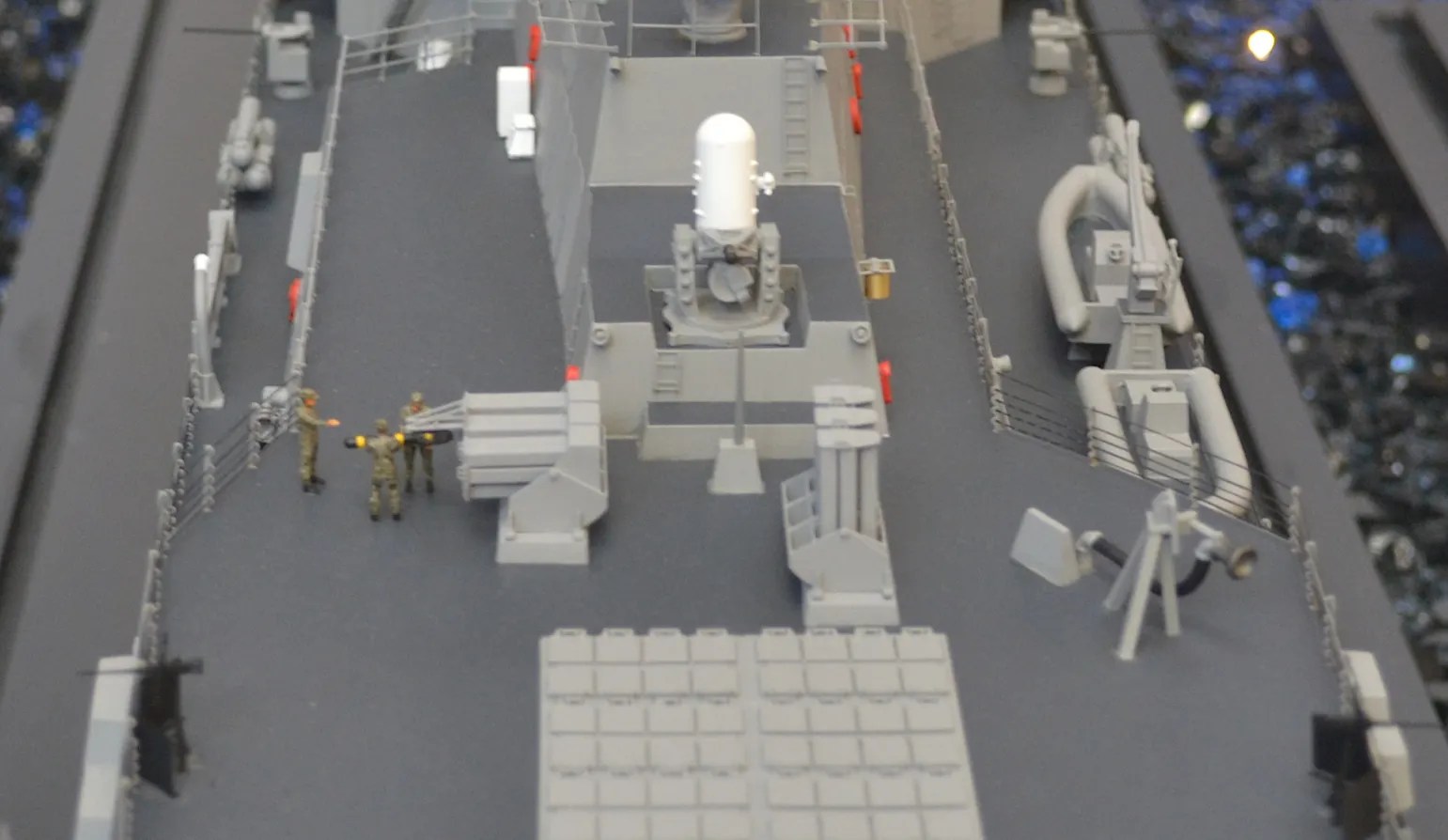
There is another alternative that might serve them better, that is to create ambiguity or doubt in the mind of the opposition by installing VLS that could support different types of munitions or have none at all. Are they armed with loitering munitions, Hellfire, Spike ER, Spike NLOS, Sidewinders, short range anti-drone (UAS) weapons, or anti-ship cruise missiles or is a bluff? What is their range? How lethal are their weapons? No way of knowing. 


The Day in Coast Guard History, January 3

Based on the Coast Guard Historian’s timeline, https://www.history.uscg.mil/research/chronology/
With inspiration from Mike Kelso

January 3

1882  The watch at Station No. 13, Second District, Massachusetts, reported at about 4 p.m., the collision of two schooners, two and a half miles east southeast of the station. Launching the surfboat, the crew proceeded to the vessels. The smaller vessel, the British schooner Dart, was boarded first. She was out from Saint John, NB and bound for New York with a cargo of lumber and a crew of four persons. The vessel was badly damaged, having her bowsprit, jib boom, and headgear carried away. The life-saving crew at once set to work. They cleared away the wreck and weighed her anchor, which had been let go in the collision. By this time, the steamer Hercules, of Philadelphia had come alongside and Dart’s master arranged for a tow to Vineyard Haven. The life-saving crew ran the hawser from the schooner to the steamer and sent them on their way. The other schooner, in the meantime, had sailed away.

CDR Frank Erickson, USCG, the first US Naval Aviation helicopter pilot.

1944  CDR Frank Erickson received an official commendation after he piloted a Sikorsky HNS-1 helicopter that carried two cases of blood plasma lashed to the helicopter’s floats from New York City to Sandy Hook, New Jersey, for the treatment of Navy crewmen of the Navy destroyer USS Turner, which had exploded and burned off New York harbor.  Having performed that heroic deed in violent winds and snow that grounded all other aircraft Erickson became the first pilot in the world to fly a helicopter under such conditions.  It was also the first “lifesaving flight” ever performed by a helicopter.

2003  CGC Boutwell departed Alameda in preparation for supporting Operation Iraqi Freedom.  The cutter began operations in the Arabian Gulf on February 14, 2003.  Prior to the start of Operation Iraqi Freedom, her crew conducted maritime interception boardings to enforce U.N. sanctions against Iraq.  At the outbreak of hostilities and throughout the conflict, she operated in the strategically critical and politically sensitive Khawr Abd Allah and Shaat Al Arab Waterways, providing force protection to the massive coalition fleet, securing Iraqi oil terminals, and preventing the movement of weapons, personnel, or equipment by Saddam Hussein’s regime or other guerilla or terrorist forces.

The Coast Guard Cutter Polar Star (WAGB 10) enjoys brief ice liberty on the frozen Bering Sea in below freezing temperatures, Saturday, Jan. 30, 2021. The 45-year-old heavy icebreaker is underway to project power and support national security objectives throughout Alaskan waters and into the Arctic, including along the Maritime Boundary Line between the United States and Russia. U.S. Coast Guard Photo by Petty Officer 1st Class Cynthia Oldham From USCGC Polar Star Facebook

2014  CGC Polar Star received a request from the Australian Maritime Safety Authority on January 3, 2014 to assist the Russian-flagged Akademik Shokalskiy and Chinese-flagged Xue Long, reportedly ice-bound in the Antarctic.  The Russian and Chinese governments also requested assistance from the United States.  After resupplying in Sydney, Polar Star was en route to the stranded vessels on January 4th, enduring 50 knot winds, 20 foot seas and 40 degree rolls. The Coast Guard icebreaker left its homeport of Seattle in December 2013 to support Operation Deep Freeze. The ship’s mission was to break a channel through the sea ice of McMurdo Sound to allow the resupply and refueling of the U.S. Antarctic Program’s McMurdo and Amundsen-Scott South Pole stations.  Polar Star was released by the Australian Maritime Safety Authority from SAR duties on January 7, 2014, following confirmation that both stricken vessels were free from the Antarctic ice due to a favorable change in wind conditions. The Coast Guard Pacific Area command center received confirmation from the Australian Maritime Safety Authority that both ships broke through the heavy ice, rendering assistance from the Polar Star no longer necessary.

This Day in Coast Guard History, January 2

Based on the Coast Guard Historian’s timeline, https://www.history.uscg.mil/research/chronology/
With inspiration from Mike Kelso

1892  The British schooner H. P. Kirkham wrecked on Rose and Crown Shoal.  The crew of seven was rescued after 15 hours of exposure.  The lifesaving crew that rescued them was at sea in an open boat without food for 23 hours.

“Surfman Roland H. Perkins, one of the crew, who came down with consumption from the ordeal and battled with pneumonia a few months before the rescue, died a couple of months after receiving his medal.”

Andy Lee Howay born mid-flight on a Coast Guard HU-25, January 2, 1986.

1986  Andy Lee Howay was born in flight at 12,000 feet over Gaylord, Michigan aboard Coast Guard HU-25 CGNR 2110 out of Air Station Traverse City.  He was born two months premature and weighed 3.5 pounds upon birth.  Aboard the aircraft were CAPT Martin Niemeroff, USPHS and an obstetrics nurse from Munson Medical Center.  Andy attended the retirement ceremony for CGNR 2110 in 2013.

HU-25 CGNR 2110 Photographer: Glenn Chatfield
Notes: At Cedar Rapids, IA