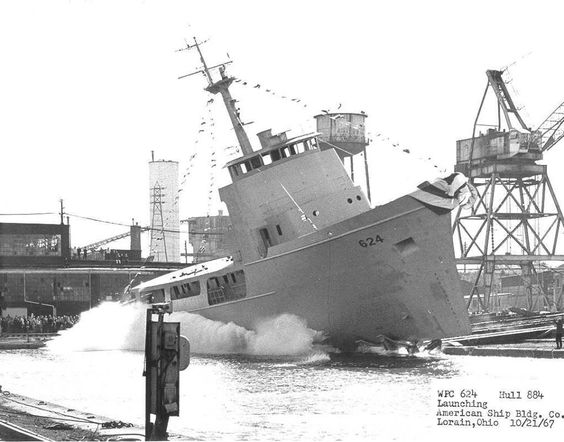
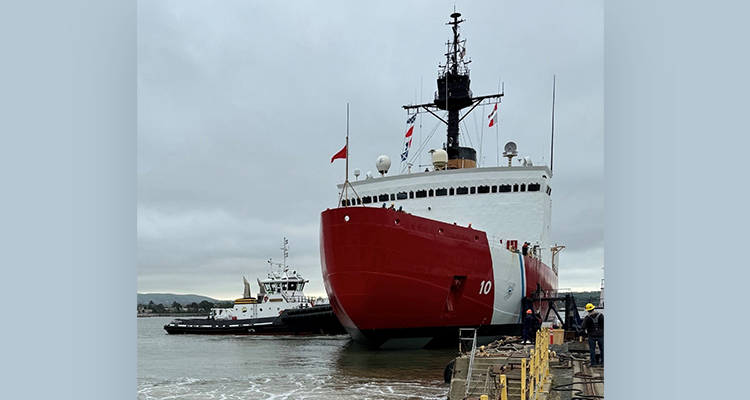
Changing of the Guard, WPC for WMEC

USCGC ALERT departing Astoria

Passing this along from the “Coast Guard Sea Duty Veterans” Facebook page. The post was by Bill James.


On Friday, 10 May, Cutter ALERT sailed beneath the Astoria-Megler bridge, crossed the Columbia River Bar, and proceeded south enroute to her new homeport of Cape Canaveral, Florida.
Simultaneously, the newly built CGC DAVID DUREN, one of the two 154’ USCG Sentinel Class cutters proceeded northward on its journey from Key West to its new homeport of Astoria, OR.
This Thursday, 16 May, the two cutters passed close abroad in the Eastern Pacific Ocean. DAVID DUREN rendered passing honors and ALERT returned the salute, thereby properly relieving ALERT’s 30-year watch to the first of two Sentinel Class Cutters to be stationed in Astoria.

USCGC DAVID DUREN (WPC-1156) Renders Passing Honors

Japan to Build Five Large Cutters for Philippine Coast Guard

Japanese built Philippine Coast Guard cutter BRP Melchora Aquino

The EurAsian Times reports that Japan and the Philippines have finalized their largest security agreement to date.

“The US $507 million project is funded by an Official Development Aid loan from the Japan International Cooperation Agency. Around $425 million will be utilized in constructing five 97-meter-long multi-mission response vessels (MRRV) and a five-year integrated logistics support package…The patrol vessels are expected to be delivered between 2027 and 2028.”

The Philippine CG already has two ships of this type. We talked about this class earlier. Final specs, if there are no changes, from NavyRecognition,

“The MRRV has a length of 96.6 meters (317 feet–Chuck), a maximum speed of not less than 24 knots, and has a complement of 67 crew members. She has a two 6600 kW (6.6MW) diesel engines.”

That is about 17,700 HP. By comparison, the OPCs, which are longer and twice as heavy. will have 19,520 HP.

It appears the Philippine Coast Guard still has not armed their cutters with anything larger than .50 caliber machine guns. This class does have water cannon. Their Japanese counterparts are armed with either 20mm Gatling guns or Bushmaster II 30mm chain guns in Remote Weapon Stations.

Meanwhile the Philippine Navy is also buying Offshore Patrol Vessels, six from S. Korea. They will be much more heavily armed.

“EASTERN SHIPBUILDING GROUP COMMENCES PHASE II OF MAJOR INFRASTRUCTURE IMPROVEMENTS” –News Release

Future USCGC Argus at launch Eastern Shipyard

Below is a news release from Eastern Shipbuilding Group. Hopefully these improvements will shorten construction times for the remaining Eastern built OPCs. It will almost certainly put Eastern in a better position to bid on the last group of OPCs which should be built at a rate of at least two completions per year.

If nothing else, any increase in US shipbuilding capabilities is good news.

Eastern has had their share of difficulties with the OPC program. Hopefully they will surprise us with increasing success on the three ships that follow the future USCGC Argus.


15 May, 2024

EASTERN SHIPBUILDING GROUP COMMENCES PHASE II OF MAJOR INFRASTRUCTURE IMPROVEMENTS

PANAMA CITY, FL – Eastern Shipbuilding Group, Inc (ESG) is proud to announce the commencement of phase two of a significant infrastructure improvement project at its Nelson Street government shipbuilding facility. This phase includes the construction of 1,000 linear feet of additional bulkhead and berthing space, installation of associated heavy weather mooring infrastructure, the extension of the launch facility by 120 feet to increase the total launch way length to over 500 feet, and the final dredging of vessel berthing spaces and the shipyard turning basin. These enhancements will significantly increase ESG’s capability to construct and deliver multiple ships per year, supporting future Department of Defense (DOD) shipbuilding goals.

“This infrastructure improvement project represents a major investment in our government shipbuilding capabilities,” said Joey D’Isernia, Chairman and CEO of ESG. “The increased capacity and shipyard enhancements will allow us to better support the Navy’s initiative to expand the shipbuilding industrial base in order to meet the demands of the national defense strategy.”

The addition of 1,000 linear feet of bulkhead will provide ESG with more berthing space to better support construction programs that require multiple vessel deliveries per year. The extension of the launch way by 120 feet will enable ESG’s Nelson Street government shipyard to accommodate larger vessels more than 500 feet, expanding its capacity to construct a variety of ships to meet the evolving needs of the U.S. Navy and other government agencies. The project is expected to be completed in the summer of 2025.

ESG is known for its expertise in designing and constructing a wide range of complex vessels, including U.S. Coast Guard Offshore Patrol Cutters, the newest U.S. Army Corps of Engineers Medium Class Hopper Dredge, fully automated multipurpose offshore support vessels, and the most technologically advanced modern factory trawlers. The expanded capacity resulting from this infrastructure improvement project will further strengthen ESG’s position as a leader in the shipbuilding industry.

Where Will the Remaining FRCs Go?

“The Coast Guard currently operates 55 FRCs throughout the United States and in support of U.S. Central Command. U.S. Coast Guard graphic.”

The graphic above was part of the Acquisition Directorate’s announcement of the exercise of a contract option for two more FRCs, numbers 66 and 67.

It specifically lays down the locations of 49 FRCs as currently assigned to Coast Guard Districts. This has prompted me to speculate on where the remaining cutters will be going.

It is a good graphic, but some might not recognize Puerto Rico (7) and Guam (3) which have been lumped together below Texas. There is also an issue with the number of ships assigned to Mississippi, in that one of the two (Benjamin B. Dailey WPC-1123) is no longer active having suffered a catastrophic fire. It has been placed in storage and may never be repaired.

As noted in the graphic, six are also assigned to PATFORSWA, homeported in Bahrain and attached to 5th Fleet.

Of the remaining 12 cutters, we know two (1156 and 1157) will go to D13 at Astoria, and two (1158 and 1159) will go to D17 at Kodiak. Another is expected to go to Seward, AK. I happen to run across information that USCGC MARVIN PERRETT (WPC-1164) will be going to Base Long Beach. That leaves us with six FRCs where I was unable to identify future homeports.

If you look at how many are assigned to each district, patterns seem to emerge. It seems they are being based in groups of three, allowing at least one of the three to be underway almost all the time. Also, six is the most common number assigned to a district, just as six are assigned to PATFORSWA. This would make some sense in that it would allow the district to generally keep two units underway at all times.

There are no Fast Response Cutters assigned to District 9 (Great Lakes), but they do have six Bay class 140-foot icebreaking tugs which can function as patrol vessels.

The future laydown as currently identified is as follows:

  • D1: six in Boston. Total 6
  • D5: three in Cape May, NJ and two in Atlantic Beach, NC. Total 5
  • D7: one in St. Pete, six in Miami, six in Key West, and seven in San Juan, PR. Total 20
  • D8: one in Pascagoula, MS and three in Galveston. Total 4
  • D11: five in Long Beach (San Pedro). Total 5
  • D13: two in Astoria, OR. Total 2
  • D14: three in Honolulu and three in Guam. Total 6
  • D17: three in Ketchikan and two in Kodiak. Seward is also identified as a future homeport. Total 6 
  • PATFORSWA: Total 6

That is a total of 60 FRCs in nine groupings of which four have or are projected to have 6 FRCs. That leaves six additional FRCs to be distributed plus any future additional FRCs. My guesses would be.

  • D5: one more in Atlantic Beach, NC for total 6
  • D8: two more in Pascagoula, MS for total 6
  • D11: one more in Long Beach, CA for total 6
  • D13: one more in Astoria, OR for total 3
  • D14: three more somewhere for total 9

That would require only two more FRCs to be funded in the future.

If you look at the projections, including a total of nine in D14, that suggests 38 in LANTAREA and only 24 in PACAREA, despite the fact that about 84% of the US EEZ is in PACAREA.

There is probably ample justification for an additional three in D14, to bring them up to a total of 12. D14 includes about 43% of the entire US EEZ and also includes the three Compact of Free Association nations with a combined EEZ about half that of the entire US EEZ. D14 vessels are also likely to spend much more time in transit to patrol areas and maintenance facilities so they are likely to need at least one spare cutter to add to the rotation.

“U.S. COAST GUARD AWARDS BOLLINGER SHIPYARDS TWO FAST RESPONSE CUTTERS” –Bollinger News Release

U.S. Coast Guard Cutters Stratton (WMSL 752) and Bailey Barco (WPC 1122) rendezvous in Beaver Inlet near Dutch Harbor, Unalaska, Alaska, Feb. 28, 2024. Both cutters conducted joint cutter boat training and formation steaming while on patrol in the Bering Sea and Gulf of Alaska for fisheries enforcement, safety of life at sea, and sovereignty projection. (U.S. Coast Guard courtesy photo)

Below is a Bollinger Shipyards news release. This is significant because it goes beyond the 65 FRCs that might have been justified by any interpretation of the DEEPWATER based “Program of Record,” which included 58 FRC, to which were added six additional FRCs for PATFORSWA. One FRC was essentially destroyed by a fire in a dockyard. I can only assume the additional two will either augment the three currently in Guam or will go into a new homeport somewhere in the Western Pacific.

As it stands the Coast Guard has ten NSCs, 24 WMECs, and 56 FRCs for a total of 90 vessels. While the number of vessels over 1000 tons full load is down substantially, the total is much the same as the fleet the program of record was intended to replace. Essentially FRCs have replaced not only 49 smaller WPB110s but also some WMECs.

Total displacement for the fleet is up from the fleet being replaced. I believe manning requirements are also up and both total displacement and manning requirements will rise considerably as OPCs are commissioned and replace WMECs.


U.S. COAST GUARD AWARDS BOLLINGER SHIPYARDS TWO FAST RESPONSE CUTTERS

LOCKPORT, La., — (May 13, 2024) – The U.S. Coast Guard has exercised a contract option to award Bollinger Shipyards (“Bollinger”) two additional Sentinel-Class Fast Response Cutters (FRC). This announcement brings the total number of FRCs awarded to Bollinger up to 67 vessels since the program’s inception. To date, the U.S. Coast Guard has commissioned 55 FRCs into operational service.

“We’re incredibly proud of our long history supporting the U.S. Coast Guard that now stretches four decades,” said Bollinger Shipyards President and CEO Ben Bordelon. “Our unique experience building for the Coast Guard is unparalleled and has shown time and time again that we can successfully deliver the highest quality and most capable vessels. We look forward to continuing our partnership with the Coast Guard.”

Both FRCs will be built at Bollinger’s Lockport, La. facility that supports over 650 direct jobs in Lafourche Parish out of the nearly 4,000 shipbuilders supporting Bollinger’s 13 facilities across Louisiana and Mississippi.

Bordelon continued, “This program isn’t just an economic benefit for our region, but a national security priority that continues to enjoy the support of a bipartisan, bicameral coalition in the United States Congress. That being said, these additional vessels allow for the continued prosperity and economic wellbeing for over 650 families in South Louisiana. The hardworking men and women of Bollinger Shipyards take tremendous pride in every single vessel we build and deliver for the U.S. government knowing we’re helping to keep our homeland safe.”

The FRC program has had a total economic impact of over $2 billion since its inception in material spending and directly supports more than 650 jobs in Southeast Louisiana. The program has indirectly created 1,690 new jobs from operations and capital investment and has an annual economic impact on GDP of $202 million, according to the most recent data from the U.S. Maritime Administration (MARAD) on the economic importance of the U.S. Shipbuilding and Repair Industry. Bollinger sources over 271,000 different items for the FRC consisting of 282 million components and parts from 965 suppliers in 37 states.

The FRC is one of many U.S. Government shipbuilding programs that Bollinger is proud to support. In addition to the construction of the FRC, Bollinger is contracted to build the Polar Security Cutter (PSC) for the U.S. Coast Guard, the Towing, Salvage and Rescue Ship (T-ATS), the Auxiliary Personnel Lighter (APL), the newest oceanographic survey ship (T-AGS 67) and the Mine Countermeasures Unmanned Surface Vessels (MCM USV) for the U.S. Navy. Bollinger is also building three Regional Class Research Vessels (RCRV) for the National Science Foundation through Oregon State University. Bollinger also supports the nuclear-powered ballistic missile submarine program by building various platforms for General Dynamics-Electric Boat.

ABOUT THE FAST RESPONSE CUTTER PLATFORM

The FRC is an operational “game changer,” according to senior Coast Guard officials. FRCs are consistently being deployed in support of the full range of missions within the United States Coast Guard and other branches of our armed services. This is due to its exceptional performance, expanded operational reach and capabilities, and ability to transform and adapt to the mission. FRCs have conducted operations as far as the Marshall Islands—a 4,400 nautical mile trip from their homeport. Measuring in at 154-feet, FRCs have a flank speed of 28 knots, state of the art C4ISR suite (Command, Control, Communications, Computers, Intelligence, Surveillance, and Reconnaissance), and stern launch and recovery ramp for a 26-foot, over-the-horizon interceptor cutter boat.

ABOUT BOLLINGER SHIPYARDS

Bollinger Shipyards (www.bollingershipyards.com) has a 78-year as a leading designer and builder of high-performance military patrol boats and salvage vessels, research vessels, ocean-going double hull barges, offshore oil field support vessels, tugboats, rigs, lift boats, inland waterways push boats, barges, and other steel and aluminum products from its new construction shipyards as part of the U. S. industrial base. Bollinger has 13 facilities, all strategically located throughout Louisiana and Mississippi with direct access to the Gulf of Mexico, the Mississippi River and the Intracoastal Waterway. Bollinger is the largest vessel repair company in the Gulf of Mexico region.

“U.S., Japan, Korea Coast Guards sign trilateral agreement to increase maritime cooperation” –News Release

U.S., Japan, Korea coast guards sign trilateral agreement to increase maritime cooperation
Mr. Kishimori Hajime, deputy Consul General of Japan (left), Japan coast guard Vice Adm. Watanabe Yasunori, Japan coast guard vice commandant for operations, U.S. Coast Guard Vice Adm. Andrew Tiongson, commander, U.S. Coast Guard Pacific Area, and Hyunchul Kang, deputy Consul General of the Republic of Korea, pose with a signed trilateral agreement at Coast Guard Island, Alameda, Calif., May 9, 2024. Japan, Republic of Korea and U.S. coast guards gathered to finalize a trilateral letter of intent, which will drive the three nations to work together to advance maritime safety, security and prosperity in the Indo-Pacific. (U.S. Coast Guard photo by Master Chief Petty Officer Charly Tautfest)

Below is a PACAREA news release.

Like the US Coast Guard, Japan and South Korea have been attempting to help SE Asian nations strengthen their maritime security and law enforcement organizations so that they can deal with what is essentially state supported, state sponsored, and state coordinated theft of their resources.

This should at least allow better coordination and avoid unnecessary duplication. The Philippines and Vietnam are likely to be primary beneficiaries.

We probably have things to learn too. The Japanese and S. Korean Coast Guards are both large and have a lot of experience countering violent resistance.

A picture taken on November 16, 2011 from a South Korean helicopter shows Chinese fishermen wielding sticks to stop an attack by South Korean coastguard commandoes armed with clubs aboard rubber boats during a crackdown on alleged illegal fishing in South Korean waters in the Yellow Sea off the southwestern coast county of Buan. South Korea’s coastguard mobilised 12 ships, four helicopters and commandoes for a special three-day crackdown on illegal fishing by Chinese boats this week. REPUBLIC OF KOREA OUT AFP PHOTO / DONG-A ILBO (Photo credit should read DONG-A ILBO/AFP/Getty Images)

Thanks to Paul for bringing this to my attention. 


May 12, 2024

U.S., Japan, Korea Coast Guards sign trilateral agreement to increase maritime cooperation

ALAMEDA, Calif – U.S. Coast Guard, Japan Coast Guard and Korea Coast Guard representatives displayed continued commitment to enhance maritime expertise and promote regional cooperation by signing a trilateral letter of intent, Thursday.

This agreement aligns trilateral cooperation between Japan, the Republic of Korea and the United States to include capacity-building efforts to Association of Southeast Asian Nations and Pacific Island countries. The letter of intent advances a joint statement between the three nations’ leaders, which was held at Camp David in August 2023.

U.S. Coast Guard Vice Adm. Andrew Tiongson, Commander, U.S. Coast Guard Pacific Area, met Japan Coast Guard Vice Adm. Watanabe Yasunori, Japan Coast Guard Vice Commandant for Operations, to finalize a trilateral letter of intent, which was previously signed by Korea Coast Guard Oh Sang Kwon, Deputy Commissioner of the Korea Coast Guard. Oh signed the letter of intent in April with the understanding that the agreement would be finalized upon Watanabe’s May visit to U.S. Coast Guard Pacific Area command.

Mr. Hyunchul Kang, Deputy Consul General of the Republic of Korea, attended the trilateral signing on behalf of the Korea coast guard, and Mr. Kishimori Hajime, Deputy Consul General of Japan, presented brief remarks as well.

“This trilateral agreement between U.S., Japan and Korea Coast Guards is the lynchpin that will drive our coast guards to work together to advance maritime safety, security, and prosperity in the Indo-Pacific,” said Tiongson. “It will enhance our multilateral operations with each other, as well as other trusted partners in the region.”

The agreement specifically recognizes the important of efforts to conserve maritime resources, combat illegal, unreported and unregulated fishing and search and rescue response efforts.

“US Coast Guard Cutter Eagle to Depart on Annual Summer Cruise” –Seapower

The Navy League’s online magazine, Seapower, reports the start of USCGC Eagle’s summer training program and their planned port calls.

“Eagle’s 2024 full summer schedule includes port visits to:   

  • May 11: Departs from New London 
  • May 25 – May 28: Santo Domingo, Dominican Republic 
  • June 4 – June 7: Cartagena, Colombia 
  • June 14 – June 17: San Juan, Puerto Rico 
  • June 24 – June 27: Bridgetown, Barbados 
  • July 7 – July 10: Hamiliton, Bermuda 
  • July 18 – July 21: Halifax, Nova Scotia 
  • July 26 – July 29: Portsmouth, New Hampshire 
  • Aug. 2 – August 5: Rockland, Maine 
  • Aug. 9 – August 12: Boston, Massachusetts 
  • Aug. 16: Returns to New London 

Eagle is scheduled to return to New London on Aug. 16. 

Helicopter vs USV

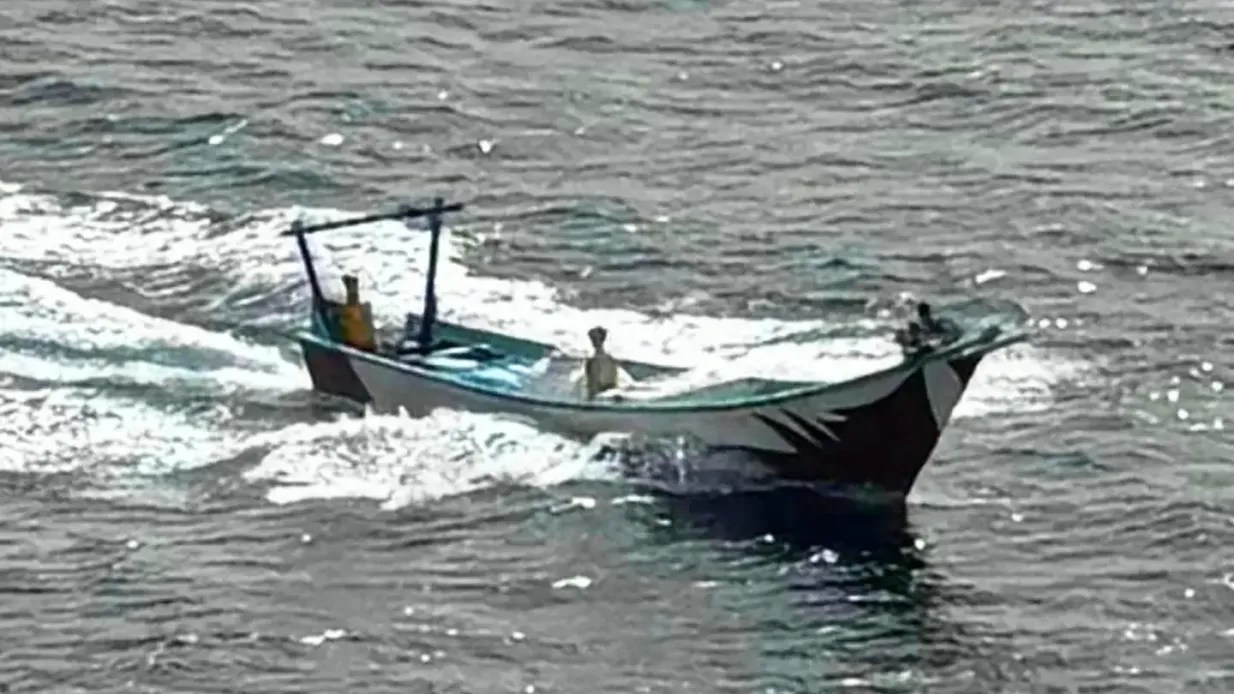
The War Zone reports what may be a first, an Uncrewed Surface Vessel apparently engaged an armed helicopter that was attempting to destroy it.
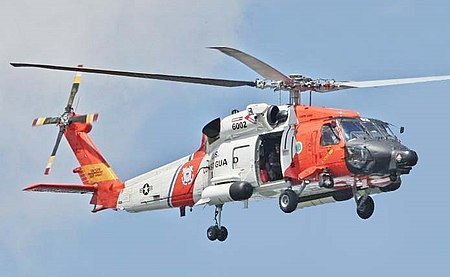
This may have some relevance for the Coast Guard in that at some point a Coast Guard helicopter might be called upon to destroy a USV being used in a terrorist attack.
It appears in this one-on-one engagement the helicopter had the advantage, being able to remain behind the USV out of the missiles field of view.
The USV had two launch rails, but both were pointed forward. Had one been pointed forward and the other aft, the helicopter would have had a much harder time staying out of the missile field of view.
Had it been two USVs vs a single helicopter, while the helicopter chased one USV it could be targeted by the other. The USV might employ something like the “Thatch Weave” that US Navy pilots employed against the more maneuverable Japanese Zero.
It is possible the missiles on USVs were never intended to be used against aircraft. The intention might have been to employ them against a surface target as a way to reduce the effectiveness of the defense, as the USV approached the target.
The article suggests that because the engagement occurred during the day, that the USV was attempting to bait the helicopter, but it might be that a long transit required some daytime transit to reach a distant port before sunrise.

“Korea Coast Guard to transfer 3,000-ton ship to Ecuadorian Navy” –The Korea Time

Korea Coast Guard’s decommissioned KCG3001 vessel that will be transferred to the Ecuadorian Navy / Courtesy of Korea Coast Guard © Provided by The Korea Times

The Korea Times, via MSN reports,

“The Korea Coast Guard’s (KCG) first 3,000-ton vessel, which was deployed in 1994, will be transferred to Ecuador after completing 30-years of service in Korea.

The KCG signed a memorandum of understanding with the visiting Ecuadorian Defense Minister Giancarlo Loffredo on Thursday for the transfer of the decommissioned KCG3001 vessel at its headquarters in Incheon.

The Korean Navy has transferred a total of eight Pohang class corvettes and 13 Chamsuri class patrol boats to nine different navies/coast guards. This is the first incident I have seen where a Korean CG vessel has been transferred.

The South Korean Coast Guard reportedly has about the same number of large CG cutters as the USCG, despite having an EEZ only about 2.7% that of the US. The donated vessel is 30 years old. Currently the oldest S. Korean CG cutter is reportedly 36 years old. None of the others are over 28 years old.

The cutter being donated is identified as 3,000 tons, but that is only a rough category and reflects light displacement not full load.

Ecuador can certainly use the reinforcement. 


“Today’s patrol boats now tackle different missions across locations” –Workboat

Today’s Force Protection boats purposely have less horsepower than their predecessors. MetalCraft photo.

WorkBoat reports on four different patrol boats from three different manufacturers, being made for the Navy, Santa Barbara (CA) Harbor Patrol, and the Palm Beach (FL) County Sheriff’s Department.

They are very different boats, but each has interesting characteristics.

Thanks to Eaglespeak for bringing this to my attention.