OPV to OPC

The specs for the Offshore Patrol Cutter have not been made available to the general public, but the Commandant recently remarked that he hoped to repeat the success of the Webber Class Fast Response Cutter (FRC) procurement by doing something similar with the Offshore Patrol Cutter (OPC) in terms of using a parent craft approach (sorry can’t find the link).

Last time the acquisitions Directorate (CG-9) published a list of shipbuilders interested in the OPC project there were twelve, Austal, BAE, Bath Iron Works, Bollinger, Derecktor, Eastern Ship Building Group, Marinette Marine, General Dynamics NASSCO, Northrop Grumman, Todd Pacific, Signal International, and VT Halter Marine. Some of these ship builders are very experienced and are more than capable of starting a design from scratch, but others either already have international partners or, having no experience in building this type of ship, are likely to seek a partner.

What similar designs have been built recently that might be adapted to create an OPC?

The OPCs are much more complex than the FRCs and even in that case, there were substantial changes to the parent craft required to create the Webber class. Speed was increased substantially, compartmentation was improved, and it was more heavily armed, so we should not expect a carbon copy of any existing design.

Many of these designs have all their propulsion machinery in a single compartment. At least one appears to have all its ship’s service generators in one compartment. (I believe the OPC spec rules out both of these vulnerabilities, but these are things that can be changed.) Other changes are also likely to be required to comply with American Bureau of Shipping (ABS) Rules for Building and Classing Naval Vessels (NVR).

Very few meet the range requirement. Even fewer are equipped with an icebelt.

Still it might be interesting to see what is currently on the market.

For reference I am going to provide the length and beam (in meters) of the some familiar ships.

  • Perry Class FFG (long hull)     139×13.7
  • National Security Cutter         127×16
  • Hamilton Class WHEC           115×13
  • 327 foot WHEC                     100×12.5
  • Alex Haley                                86×15
  • 270 foot WMEC                       82×12
  • 210 foot WMEC                       64×10.4

Of these the 327 at 100×12.5 might serve as a sort of benchmark in that we know from experience with these ships, it is possible to create a very comfortable and seaworthy ship of this size, while smaller ships have not been totally satisfactory for the service envisioned.

The FFG also serves as a benchmark in that it shows that a ship with a 13.7meter beam can have a hanger that can house two H-60s, not a requirement for the OPC, but perhaps a good option, particularly with the Navy increasing the size of the Firescout to that of a full size helicopter.

It appears that international partners could include:

  • Damen (Netherlands)
  • Navantia (Spain)
  • DCNS (France)
  • BAE (UK)
  • Fassmer (Germany)
  • Blohm + Voss MEKO (Germany)
  • Hyundai (S. Korea)
  • STX (S. Korea, France Finland, Romania, Canada and US)

Some of these builders have more than one design that might be considered.

Damen

Damen appears particularly well placed, having provided the parent craft for the Fast Response Cutter. They have two potential parent craft, the Holland Class (108×16) and the Sigma series (Ship Integrated Geometrical Modularity Approach) of corvettes and light frigates.

As suggested by the illustration above, Thales already has an interest in offering the Holland class as the OPC. It was shown off recently in Key West. It shares many of the characteristics of the OPC including an emphasis on seakeeping and ballistic protection for key areas of the ship. At 3,750 tons, it is also the largest ship we will discuss in this post and probably the most expensive. Reportedly the mast and its associated sensors account for a sizable fraction of the ship’s cost, but also provide almost Aegis like capability. Its combined electric or diesel (CODELOD) propulsion system make loitering and slow cruise operations particularly economical. Still they would need greater range, possibly greater speed and an ice belt to satisfy the requirements for the the OPC, so might end up even larger.

File:Kri-diponegoro-1600-1200.jpg

Mr Wim Kosten,maritimephoto.com Source: Maritimephoto.com

Of the Sigma series, the Indonesian variant (105×13) looks closest to the OPC. Eight ships have been built or are building for Morocco and Indonesia, and apparently four more are planned for Vietnam. They appear to emphasize warship characteristics but are not built to naval standards and when the Netherlands decided to build their own offshore patrol vessels they rejected the Sigmas in favor of the Holland class. It is shorter ranged and its inclusion of only two very powerful diesels does not appear likely to be economical. Still the size looks right; it is “modular,” perhaps modifications are possible.

Navantia

Navantia, a very large and active builder of warships, including Aegis equipped frigates and LHDs for the Spanish and Australian Navies, has been very active in producing offshore patrol vessels recently.

File:Rayo P42.jpg

They are producing a series of series of nine multipurpose ships for the Spanish Navy identified as Buque de Acción Marítima or “BAM” (93.9×14.2). “Modular design enables the ships to be modified for purposes outside main missions such as hydrographic research, intelligence gathering, diving support and salvage operations.” As built they have the range required for the OPC. They have a hybrid propulsion system, but speed is only a little over 20 knots.

They have also produce two classes of four each for the Venezuelan Navy. The largest of these are the 2400 ton Guaiquerí class patrol vessels (99×13.6)

File:PC-21 Guaiqueri 14 de Mayo 2011 Foto Capitán Ted.jpg

Photo: Venezuelan OPV built by Navantia. via Wikipedia

They don’t have the range required, only 3500 nmi, or of course an icebelt, but otherwise they appear very close to the OPC including a 25 knot top speed.

If Navatia could combine the speed of the Guaiquerí with the range and economy of the BAM, they might have a winner.

DCNS

Obviously DCNS also has an interest in the OPC project. They have been pushing their Gowind family of vessels as both OPCs, corvettes and light frigates. The L’ Adroit (87×11) is probably too small to meet the OPC requirements, but the larger version (107×16) beginning offered to Malaysia appears much closer.

Navy Recognition team who was attending the DSA 2012 Defense exhibition in Kuala Lumpur, Malaysia was able to gather fresh information regarding the future Gowind corvettes of the Royal Malaysian Navy. While the negotiations are still ongoing, signature of the contract should happen soon according to an official from Boustead. The same person gave us an updated list of systems that will likely be found on those new corvettes.

Gowind model at Boustead stand during DSA 2012
(picture: Navy Recognition)

BAE

A BAE design (90.5×13.5) built for Trinidad and Tobago, has been sold to Brazil and they expect to build five more of the ships, while a very similar BAE design, HTMS Krabi, is being built in Thailand. These ships don’t meet the range requirement, don’t have a hanger, and are limited to a 7 ton helicopter. Could the design be modified?

BAE also have in their portfolio the  Lekiu_class_frigate (106×12.75)  which does have a hangar. Two were completed for Malaysia in 1999. Two more of an updated design are proposed. These ships have a powerful CODAD (Combined Diesel and Diesel) powerplant that is good for 28 knots. Reduced power could still satisfy the OPC requirement.

Fassmer

Fassmer (Germany) appears to be primarily a builder of work boats and small craft, but they have had success with their 80 meter OPV design being adopted by Argentina, Chile, and Colombia for construction in country.

They have proposed some larger designs (pdf), but I’m not sure they bring much additional experience to the table.

Blohm + Voss “MEKO”

Blohm + Voss is a warship maker with experience going back a hundred years. They have a series they refer to as MEKO that includes a range of designs that have been built for several countries. These include six “MEKO 100” 98×14.3 design built for Malaysia and MEKO 200 series that includes 25 ships built for five different countries including CODAD as well as CODAG  versions. (More pictures here)
Blohm & Voss may be the most successful exporter of warships in the last 50 years.

 Hyundai (S. Korea)

Hyundai is primarily a commercial ship builder, but they might choose to offer a variant of their recently completed Inchon Class frigate (114×14).

STX (S. Korea)
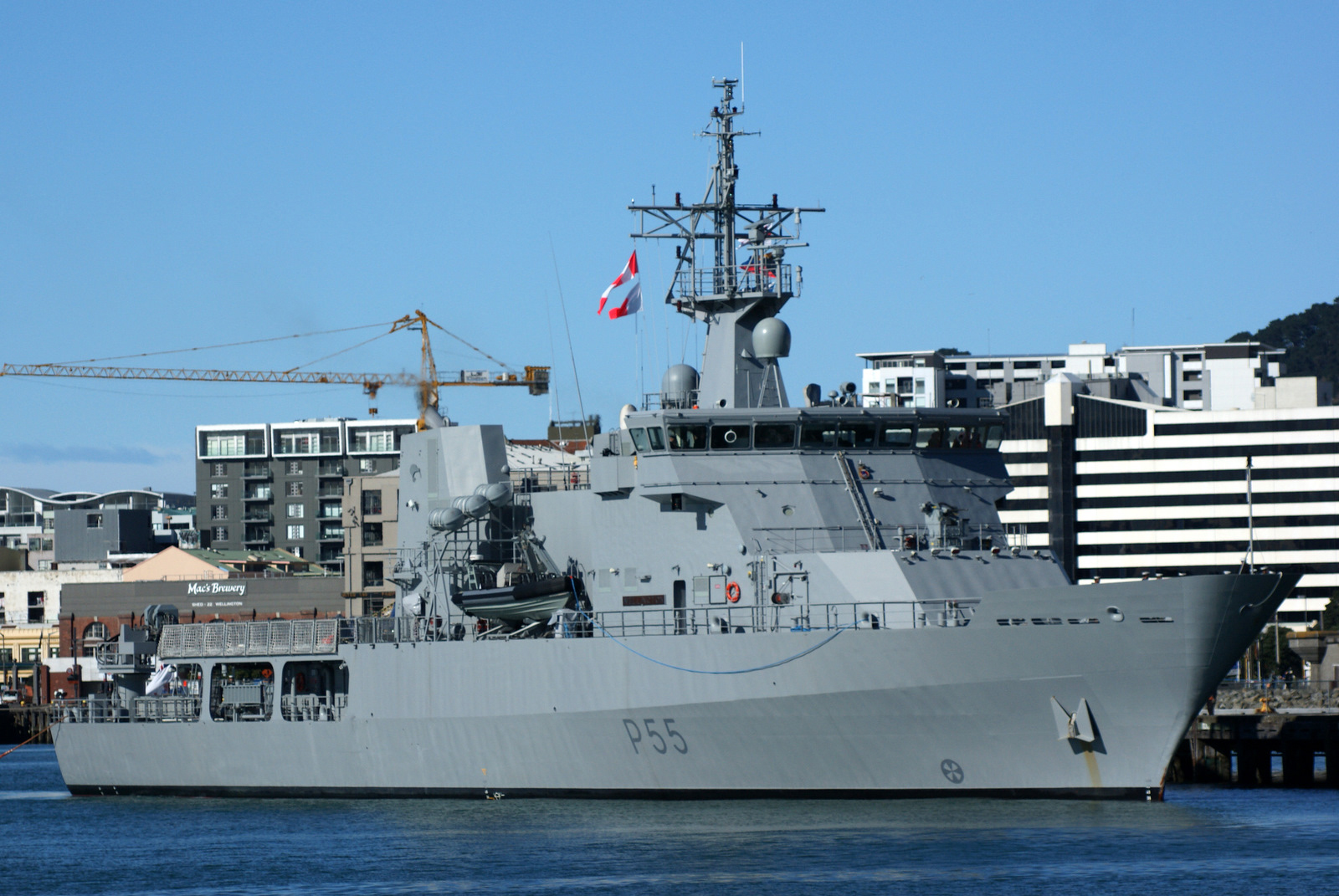
File:HMNZS Wellington.JPG

STX (S. Korea, France Finland, Romania, Canada and US) is an extremely successful commercial ship builder with divisions all over the world. They have built cutters for the S. Korean Coast Guard and warships for France and Finland. The New Zealand Protector class (85×14) was designed by their Canadian division. It is unique in having an icebelt, but reportedly the ship turned out heavier than intended and the icebelt is lower than it should be.

Others

An outside chance is a design based on the Turkish Milgem (100×14.4).

File:TCG Heybeliada (F-511) -1.jpg

MILGEM Photo: Turkish Naval Forces

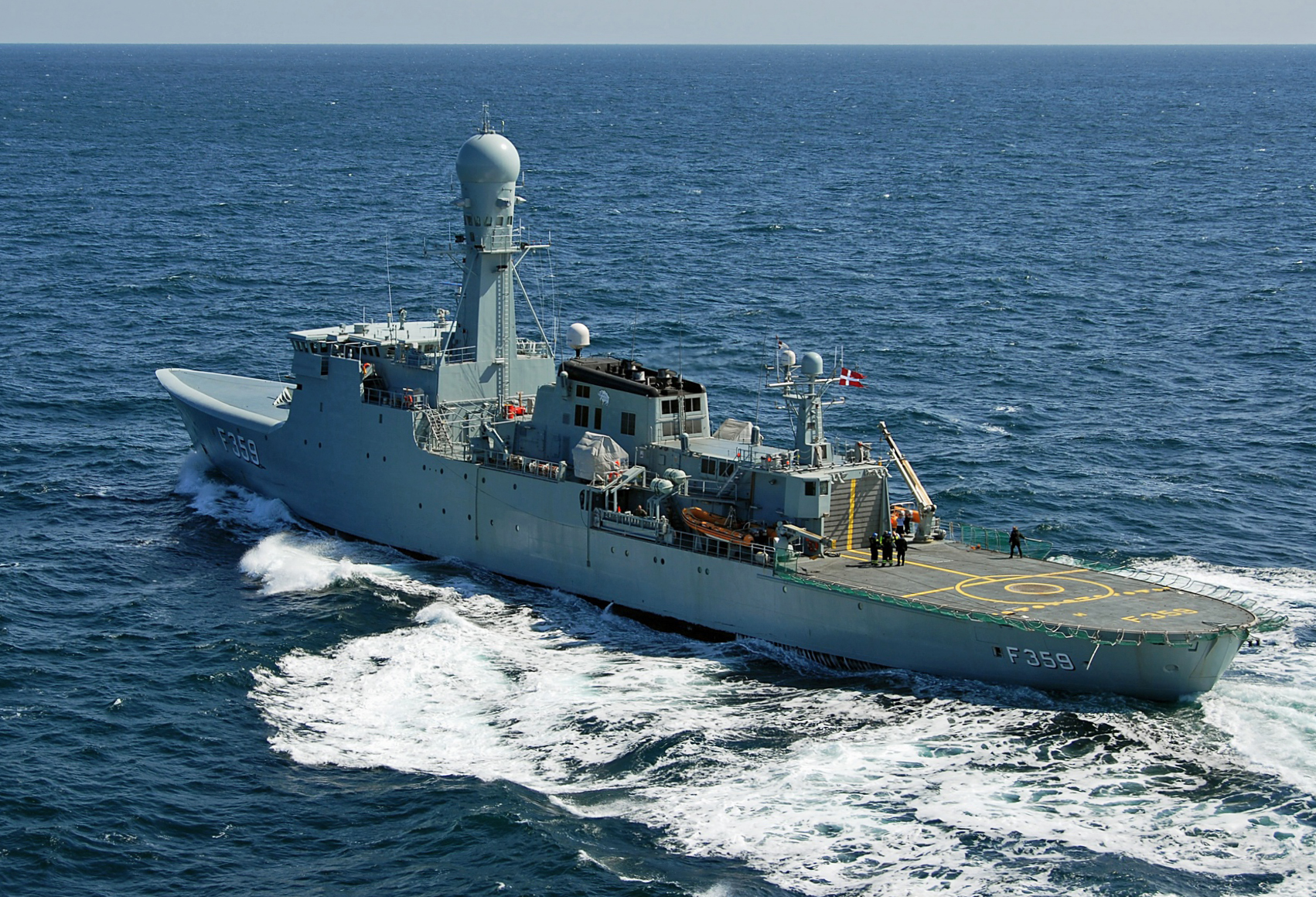
I’m still a fan of the Danish Thetis (112×14.4) although I don’t think it will be in the running. It is a  simple but roomy ship but the yard that built it is now out of business, so it has no advocate.

https://i0.wp.com/upload.wikimedia.org/wikipedia/commons/d/da/HDMS_Vaedderen_%28F359%29.jpg

Photo: Thetis

Another way to approach the problem might be to consider the 327 or 378 as parent craft.

LNG powered Cutter

Recently a rather ordinary looking Norwegian coast guard cutter came to the port of Hamburg and created something of a stir. This little craft KV Barentshav (also here), seemed unremarkable, but its power plant was unusual. In addition to diesel, it could be powered by Liquified Natural Gas.

It has been a long time since we saw a shift in fuel for ships, from coal to oil. Now it seems we may be seeing the beginnings of another shift. The big drivers are reduced fuel cost and reduced emissions. The Norwegians seem to be the leaders here, but the US Coast Guard is not totally unfamiliar, particularly the M side of the house. the Dec 2011 issue of Marine Safety Engineering (pdf) had an article predicting that predicted that natural gas fuel vessels were coming soon.

This issue highlights another technology that is becoming more important every day, and that is the increased use of liquefied natural gas (LNG). Whereas, we previously considered LNG as a cargo, new MARPOL regulations for reduced emissions are now making it an attractive fuel source. It is extremely clean burning and is much lower cost than similarly clean diesel fuel. Marine Safety Engineers are leading the charge in establishing the appropriate safety standards needed for LNG fueled vessels, which not only includes the vessels themselves, but also bunkering facilities and waterways risk management.

Looking at cost, a study of the possible application of this technology to the marine transportation industry is available here: http://www.cleanskies.org/?publication=natural-gas-for-marine-vessels-u-s-market-opportunities (pdf). The study notes,

Based on the current forecasts, natural gas delivered for production of LNG is now at least 70% less expensive on an energy equivalent basis than marine residual fuel and 85% less expensive than marine distillate fuel. EIA currently projects that this relative price advantage will continue, and even increase, through 2035.

LNG does require approximately twice the volume for the same energy content and the infrastructure for its distribution is still limited. Currently engines designed to burn LNG are built by Wartsila, Rolls-Royce, and Mitsubishi. Some of these engines are duel fuel, burning either LNG or conventional diesel fuel.

Considering

  • the US has ample supplies of natural gas,
  • it may be less than half the cost on a per energy unit basis,
  • that its use reduces maintenance costs,
  • LNG is more environmentally friendly, and
  • the possibility of duel fuel makes this option more practical.

Perhaps the Coast Guard may want to think about powering some of its assets with LNG. When the replacement for the 87 foot WPB is planned, it might be worth a look. They fit the profile of good candidates for LNG since they will normally return to the same base to be refueled. Extending usage to road vehicle and support equipment would amortize the cost of providing the infrastructure and make this option even more attractive.

OPC, Design for Wartime, Build for Peacetime

As noted in the post “GAO Responds to Fleet Mix Studies, Part 1, The Report,” the Department of Homeland Security “Cutter Study” raised the possibility of an austerely equipped Offshore Patrol Cutter (OPC) possibly deleting some equipment or capabilities of the ship as currently planned including:

  • Sensitive Compartmentalized Information Facility (now referred to as the Ship’s Signals Exploitation Space or SSES)
  • Air Search and Fire Control Radars
  • Electronic Warfare Support Measures
  • Berthing space (114 instead of 122)
  • Weapons suite (e.g., 25mm gun instead of 57mm)

This got me to thinking. What do these ships really need, both for their peacetime functions and for possible wartime roles? I hope the Department’s suggestion presages a return to CNA (Center for Naval Analysis) to do a more formal evaluation of the effects of these changes. Until then, I’ll venture some comments on these proposed deletions, then go on to talk about how the ships might be equipped first for war, then for peace.

Continue reading

Offshore Patrol Cutter Update, June 2012

Several documents have emerged recently that provide more information on the proposed Offshore Patrol Cutter (OPC), also known as the Maritime Security (Cutter), Medium (WMSM). This builds on information previously published (here, herehere, here and here).

The Request for Proposal included a projected build schedule for the first 11 ships.

  • FY 2016 Detail Design
  • FY 2017 OPC#1 Construction begins
  • FY 2018 OPC#2
  • FY 2019 OPC#3
  • FY 2020 OPC#4 and #5
  • FY 2021 OPC #6 and #7
  • FY 2022 OPC #8 and #9
  • FY 2023 OPC #10 and #11

There is a notation that the average cost of units 4-9 shall be $276M in FY2016 dollars. (Looks like there might be potential for a multi-year contract here.)

One of the big surprises to me (found in the Fleet Mix Study) was that the OPCs are expected to essentially take over all Alaska Patrols.

The draft Request for Proposal (RFP) also includes a requirement to equip all of them “to operate in areas of broken plate, pancake, and sea ice ranging from 10 to 30 inches thick.” Along with this, came a requirement to be able to operate an ice capable small boat as well. OPCs are also to have automated topside de-icers.

These characteristics combined with the Commandant’s affirmation that the ships should be capable of boat and helicopter operations in state five seas mean these ships will be very much more capable than the WMECs they are nominally replacing, and at least to some degree, that they are taking over duties previously assigned to 378s.

Towing ability to 10,000 tons is required, same as the 378s.

The ships are expected to be able to do Fueling at Sea (FAS), Replenishment at Sea (RAS), Vertical (Helicopter) Replenishment or VERTREP, and to refuel smaller vessels (apparently reflecting an expectation of sustained operations with WPCs or WPBs at locations remote from their bases).

Minimum ranges was specified as 7,500 nautical miles. (This is a reduction from 8,500 miles). Typical operations as outlined in the Concept of Operations (CONOPS) were 14 days between refueling, 21 days between replenishment, and 45-60 day patrols. It also stated there would typically be a four to six week inport “Charlie” (stand-down/maintenance) period after each patrol; a six to seven week dockside availability every two to three years; and a seven to eight week drydocking every four to five years. “In addition, the cutter will undergo 3-4 weeks of training and evaluation every 10-24 months.”

An expectation that the ships might operate with Expeditionary Strike Groups (ESG) was apparently a recent addition. This helps establish a floor for the ships’ maximum speed, since all the units typically operating in an Expeditionary Strike Group (LHAs, LHDs, LPD, LSDs) have speeds of 20 to 24 knots. When the current generation of LSDs is replaced in the not too distant future, all will do 22+ knots. Of the three ships that typically make up an ESG, the largest (LHAs or LHDs) all do at least 24 knots and frequently act as small aircraft carriers. If the OPCs are to be fast enough to stay with these ships and hopefully maneuver around them, then 25 knots appears to be a minimum rather than a nice to have.

The crew is not to exceed 100, but additional birthing must also be available for a 5 person AvDet and a 5-11 person “Signals Intelligence Support Element,” “and possibly others.”

There was reference to ballistic protection, that I had not seen before.

“The WMSM will provide increased protection for (sic.) small caliber weapons and shrapnel fragmentation around the bridge, CIC, and magazine spaces.”

The ships are to be built the American Bureau of Shipping Naval Ship Rules, but will not have explosive or underwater shock hardening.

Again we do not have access to the draft specifications, but we can deduce some details of the proposed equipment from the Allowance Equipage List included in the Draft RFP. All the systems below are referenced. (In a few cases there may be duplicate listing if different nomenclature is used for the same system.) The outfit, in most respects, repeats or even improves on that of the National Security Cutter:

Communications:

  • Military SAT com
  • Tactical Data Link System
  • IFF
  • SBU (presumably “Sensitive but Unclassified”) Network
  • SIPRNET (Classified Network)
  • NIPRNET (Unclassified Network)
  • Entertainment System

Sensors:

  • TSR-3D RARAD System, a multimode surface and air surveillance and target acquisition radar
  • Electro-Optic/Infrared Sensor system
  • RADIAC

Armament:

  • Mk 48 mod 1 Gun Weapon System (pdf), which includes the Mk 110 57mm gun, AN/SPQ-9B  Surface search and Fire Control Radar, Electro-Optical sensor system Mk 20 mod 0, the Mk 160 GCS Mod 12, and Mk 12 Gun Computer System
  • Mk 15 mod 21-25 CIWS (Phalanx)
  • Mk 38 mod 2 25 mm
  • Gun Weapon System (.50 cal.) SSAM
  • Four crew served .50 mounts including Mk 16 and Mk 93 mod 0 or mod 4 mounts
  • Mk 46 optical sight

Electronic Warfare:

  • Mk 53 Decoy launcher
  • AN/SLQ-32 (v)2

Navigation:

  • Encrypted GPS
  • Electronic Chart Display and Information System

Intelligence:

  • Ships Signals Exploitation Space (A change from SCIF (Sensitive Compartmented Information Facility))
  • Special Purpose Intel System

Aviation:

  • Hangar for helicopter up to and including Navy and Coast Guard H-60s
  • Facilities for the support of unmanned Aerial Systems (UAS)
  • TACAN
  • Visual Landing Aids

Coast Guard Releases Draft Request for Proposal for the OPC

Today the Coast Guard released a draft “request for proposal” (RFP) for the construction of the Offshore Patrol Cutters.

They also indicate they expect to meet with industry the week of July 9, request feedback by July 16, and that they will issue the RFP in September.

There is an awful lot of material here to absorb, but one thing I did notice immediately was the apparent intention to make all the OPC ice strengthened. “The discussion of operating environments was expanded to include Arctic climates. An ability to operate in areas of broken plate, pancake, and sea ice ranging from 10 to 30 inches thick was added. However, the summary states that the WMSM will not conduct ice breaking as a mission (page iii).”

There will be more I’m sure.

GAO Responds to Fleet Mix Studies, Part 1, The Report

In my post, Irresponsibly Rebuilding the Fleet-a Look at the Future, I talked about why it was essential that the Coast Guard build at least two Offshore Patrol Cutters (OPC) a year, when it finally starts building them in 2016. My concern is that there is still no wide spread support for funding the Coast Guard’s “Program of Record” which includes 25 OPCs in addition to eight National Security Cutters and 58 Fast Response Cutters.

Conceptual Rendering of the OPC

The Coast Guard has recently gone public with similar concerns.

Studies are playing an important part in the effort to build consensus on what the Coast Guard’s fleet of Cutters should look like in the future and how to get there. May 28 of this year, we looked at the Executive Summary of the Offshore and Aviation Fleet Mix Study completed in 2009, but only recently made public. The Coast Guard completed a second phase of its Fleet Mix Study which looked at the effects of two funding levels on the procurement process in May 2011 and the Department of Homeland Security completed a “Cutter Study” in August 2011.

May 31, 2012 GAO released a report to Congressional Committees titled “Observations on the Coast Guard’s and the Department of Homeland Security’s Fleet Studies” [PDF] along with briefing slides provided on April 20, 2012. I’m going to quote GAO’s report and slides extensively.

GAO saw there objectives as to:

  • “(1) What are the key results of the Coast Guard’s Fleet Mix Studies and DHS’s Cutter Study with respect to recapitalization and operations?
  • “(2) How useful are these studies to DHS, the Office of Management and Budget (OMB), and the Coast Guard for informing recapitalization decisions?” Continue reading

Offshore and Aviation Fleet Mix Study Published

The Coast Guard has made public the Executive Summary of its Offshore and Aviation Fleet Mix Study. “FierceHomelandSecurity” has published a short summary of the content.

They also provided a direct link to the “Executive Summary” (a 24 page pdf). It is heavy with acronyms, and there is no list of acronyms attached to the Executive Summary, although there is probably one in the full study. I’ve attached a list of those I found, at the end of the post for those who might want a little help going through the summary.

“This initial phase of the FMA (Fleet Mix Analysis-ed.) is intended to address offshore surface and aviation capabilities. Follow-on FMA phases will assess capabilities needed for coastal and inland missions as well as emerging missions, such as Arctic operations and those of the Deployable Operations Group (DOG).

“ES.5.1  SCOPE:

“The FMA explored the projected Fleet mix requirements to meet the CG’s 11 statutory missions in FY2025. Mission requirements were based on nine Mission Performance Plans (MPPs) and an assessment of critical activities, such as training and support, which consume asset mission availability.

“The FMA included all CG aviation (fixed- and rotary-wing), all white-hull cutters (FRC up to NSC), and all applicable C4ISR systems.

“The FMA focused on activities in the offshore and aviation operating environment. Offshore and aviation are defined in the FMA as being generally 50+ nautical miles offshore and/or requiring extended presence. The FMA also considered missions within 50 nautical miles that consume air asset availability.

“The FMA used the 2007 CG Fleet, as defined in the 2007 Modeled CONOPS (Concept of Operations-ed.) and the “Deepwater” POR (Program of Record-ed.) as Baselines for comparative performance and cost analysis.

“ES.5.2  ASSUMPTIONS

“Preliminary Operational Requirements Document (P-ORD) thresholds were used for the OPC (Offshore Patrol Cutter-Chuck).

“The OPC and NSC will operate 230 days away from homeport (DAFHP). No specific crewing method is assumed (i.e., crew rotation concept [CRC]).

“The HC-144A will operate at 800 programmed flight hours (PFH) per year. (This is a reduction from previous assumption–Chuck)

“U.S. Navy out-of-hemisphere (OOH) (2.0 OPC/NSC) and Joint Interagency Task Force South (JIATF-S) (7.0 OPC/NSC) support was consistent with the FY2010 demand.

“Additional acquisition/next generation platforms have the same capabilities and cost as the FMA Baseline Fleet mix cutters and aircraft (e.g., the next-generation short range recovery (SRR) helicopter is an MH-65C).

“ES.5.3  CONSTRAINTS:

“The High Latitude regions of the ice shelf and Deployable Operations Group (DOG) mission requirements were not considered.

“No specific MDA performance measures have been established to model.

“87-ft coastal patrol boat (CPB), 225-ft seagoing buoy tender (WLB), Department of Defense (DoD)/Department of Homeland Security (DHS), and foreign asset contributions were considered, but force level requirements for 87-ft CPB, 225-ft WLB, DoD/DHS and foreign assets were not assessed.

“Additional shore facilities (e.g., schools, berthing, simulators/training aids, etc.) beyond those directly associated with platforms (e.g., piers, hangars, etc.) are not included in costs.

“”The need for non-operational/shore billet increases commensurate with the projected increases in operational manning was not assessed and is not included in costs.

“All cost estimates are rough order of magnitude (ROM) and are not budget quality.

“Additional specific assumptions utilized for modeling, simulation, and costing are included in their respective chapters of the final report.

“ES.3  Methodology:

“The Fleet Capacity Analysis (FCA) combined information developed in the mission validation phase, the capability definition phase, and a Warfare Analysis Laboratory Exercise (WALEX) to produce an objective Fleet mix and incremental Fleet mix alternatives. To develop the objective Fleet mix, the FMA used three independent teams with unique force projection tools or methodologies – the Database Enhanced Center for Naval Analysis (CNA) IDS Asset Assessment Tool (CIAAT) Model (DECMv2), the Mission Effectiveness Asset Needs Model (MEAN), and a qualitative analysis by a panel of CG SMEs – to develop a force structure that was aligned with MPP capability and capacity targets. Each team applied their methodology using a common set of asset characteristics and mission demands to develop a zero-based force mix (capable of meeting all mission requirements) projection. The results from these independent projections were considered as three “lines of position” (LOPs) and were consolidated to form a conceptual “fix.””

Seven Alternative Fleets:

The Study looks at seven levels of effort: Continue reading

Chinese to commission 36 cutters in three years

While the Coast Guard will perhaps soon be commissioning four 353 ton Webber Class Fast Response Cutters a year, and has been averaging one large cutter every two years, it looks like the Chinese Maritime Surveillance Administration (CMS) will have commissioned 36 new cutters from 2010 to 2012 including seven 1500 ton class, fifteen 1000 ton class and fourteen 600 ton class “to better protect China’s maritime interests.” This is a huge, rapid expansion of their assets. (Also the tonnage ratings the Chinese provide tend to be light displacement, so they understate their size.)

This is only one of several Chinese agencies that do Coast Guard type task. Other agencies are also building ships. These agencies use relatively few air assets, and these ships are less sophisticated. But as Stalin was reported to say, quantity has a quality all its own.

To put this in perspective, China’s recognized EEZ is 877,019 km2 . They claim approximately 3,000,000 km2 additional, disputed by other nations, or about 3,877,019 km2 in total. The US EEZ is 11,351,000 km2 so even considering all their claimed EEZ, it is only a slightly more than a third the size of our own.

Draft Technical Package for the Offshore Patrol Cutter Released

The Acquisitions Directorate (CG-9) has issued the draft technical package for the Offshore Patrol Cutter. It was announced on the Federal Business Opportunity website, March 12, 2012.

“The red-lined draft System Specification contains all of the changes that the Coast Guard incorporated as a result of industry comment. This document will be automatically distributed to those companies and individuals that received the draft OPC specification released in May 2011. The other draft documents will be available on the USCG OPC website at: http://www.uscg.mil/acquisition/OPC/default.asp

A two step Acquisition process is expected. First, three contractors will be selected to develop their preliminary designs into fully detailed contract proposals. They will compete for the final award which will include the first OPC and all documentation. It may (and probably will) also include options for follow-on ships. So far, the Coast Guard is saying they will maintain their flexibility regarding who will build follow-on ships.

On the Acquisitions directorate website, you can down load hundreds of pages of technical requirements for the contractors, but don’t expect to find updated information on the specification of the ships. As noted above, revised draft specifications were sent to companies and individuals that received the draft OPC System Specification released in May 2011. Hopefully the Acquisition Directorate will release at least some basic information in the near future.

Still going through the documents yields some useful information of more general interest. The list of Government furnished Equipment (GFE) and Government Furnished information (GFI) tells us about much of the equipment the vessels are expected to carry. (I will not list all the normal items included on every cutter.)

Armament:

  • Mk 48 mod 1 Gun weapon system
  • Mk 110, 57mm gun system
  • Electro Optical Site Sensor (EOSS), MK 20 MOD 0
  • 25mm, MK 38 MOD 2
  • Two SSAM gun systems, (remotely operated .50 Caliber)

Sensors:

  • IFF, AN/UPX-29A
  • AN/SLQ-32B(V)2 (and Mk 53 NULKA decoy system)
  • Multi-Mode Radar (air as well as surface? AN/SPQ-9?)
  • Encrypted GPS
  • CBRN monitoring

Boats: 2 x 7m OTH IV (apparently no 11m boat)

Aviation:

  • TACAN
  • Visual Landing Aids (VLA)
  • Glide Slope Indicator (GLI)
  • Wave Off Light Assembly (WOLS)

The Mk48 Mod 0 (www.dtic.mil/ndia/2011gunmissile/Thursday11660_Aswegan.pdf) is apparently the system on the National Security Cutter. Perhaps, the Mk48 mod 1 is simply an improvement, but unlike some of the other components of the system, the AN/SPQ-9 radar is not called out specifically, so this system may not have a radar. It may be that the “multi-mode radar” refers to the AN/SPQ-9. Hopefully that is the case.

A quick scan through the other documents shows that the Coast Guard has not ruled out the possibility of hybrid or integrated diesel-electric propulsion.

“One Line Diagram. During Contract Design the Contractor shall provide the Electric-Drive Propulsion System One Line Diagram (if an Electric Propulsion System or IDE is provided). [235-01-2219]”

Other included systems are:

  • Two encrypted computer networks including one for classified material.
  • Television systems for both monitoring security and entertainment and training.
  • UHF MIL SAT COM Equipment
  • A crane for loading stores
  • A bow thruster
  • An unmanned air system (UAS)

It appears there may also be a SCIF (Sensitive Compartmented Information Facility).

Generally it appears, a much more sophisticated ship that the WMECs they are replacing.

(illustration: French shipbuilder DCNS concept)

The Case for Big(ger) OPCs

File:HDMS Vaedderen (F359).jpgUSCG Photo: HMDS Vaedderen, at 3,500 tons, a relatively large but simple, ice strengthened Offshore Patrol Vessel of the Thetis Class, with StanFlex modular payload capability

Considering the new Navy destroyer program, GAO identified problems that come from trying to put too much, into too small a hull. They call this problem design density. While perhaps less of a problem for the Coast Guard, this also applies to cutters like the proposed Offshore Patrol Cutter (OPC).

It may be counter-intuitive, but size alone is not necessarily a significant determinant of cost. As we noted earlier, the new largest ships in the world do not really cost that much. In fact, they cost less than the National Security Cutter (NSC), and probably less than the OPC. The GAO report indicates for a given capability, a smaller hull may actually cost more, because the density of systems may make design, construction, and maintenance more difficult. Additionally GAO notes it may lead to shorter hull life as it seems to have in some Navy ships. Certainly it is easier to provide good range and sea keeping if we use a larger hull. Both the crew and the machinery are likely subject to less motion. Larger hulls also mean more underway maintenance may be possible, because it is easier to get to the machinery.

This also goes a long way to explain why the NSC is larger than the 378s, the Fast Response Cutters are larger than the 110s, and why hopefully the the OPCs will be larger than the 210s and 270s. There is also the long term advantage of the vessels being able to take on new and unforeseen future roles, as we saw with the 327s.