Was Libya’s Sinking of a Tanker “Fake News?”

I have begun to suspect that the report of the Libyan Coast Guard sinking the Tanker GOEAST may have been more propaganda than reality.

Compare the Libyan video above with the video of USCGC ANACAPA sinking a much smaller derelict Japanese fishing vessel Ryou-Un Maru.

The Tanker was probably 20 times as large as the fishing vessel and had a crew on board and operating pumps to address flooding. USCGC ANACAPA began the operation at 13:00 and the RYOU-UN MARU sank at 18:15. It appears that the F/V may have been hit 100 times by 25mm projectiles, and at one point the ANACAPA used a hose to pour water into the fishing vessel.

.

On the video, the Libyan patrol boat fires no more than 20 rounds from its 30mm and I believe it was less than 15. At no time was there sustained fire directed at the tanker. The longest burst was perhaps four rounds.

At the end of the video, the tanker is pumping water, but it is also upright with no significant list and it appears to be making way. I am positive the tanker is underway at least as late as five minutes into the five minute 44 second video.

Perhaps things happened later, but if they recorded the opening shots, it seems they would have recorded the sinking.

This might have been an attempt at deception by the Libyans to discourage smuggling.

It might have been that the patrol boat skipper had been instructed to sink the tanker, and when he failed, he lied about the result of the attack.

It may be that a government information officer simply assumed that because they fired at the ship, that it was sunk. Capsized and sunk does make a much better story than shot at, was annoyed, and sailed away.

It is not impossible the entire thing was theater staged with the cooperation of the tanker, although I think that very unlikely.

Certainly the tanker’s owners may have reasons not to debunk the story.

  • They don’t want to confirm they were smuggling.
  • The report may discourage competing smuggling organizations.
  • They may even rename and reflag the tanker and file a bogus insurance claim.

Certainly, there was nothing in the video to indicate that this ship was sunk.

A final note. The patrol boat is seen firing into both sides of the tanker. If you want to sink a ship, it is usually better to concentrate as much damage as possible on one side. It is more likely to make the ship list and ultimately capsize. As the list increases holes initially made above water start to submerge and take on water.

Libyan Coast Guard Sinks Tanker

We have reports from NavalToday and Maritime-Executive that the Libyan Coast Guard, using a 30mm auto-cannon, opened fire on and sank a Russian owned, Comoros-flagged oil products tanker, the GOEAST, believed to have been smuggling Libyan oil.

It is not the first time the Libyan Coast Guard has used deadly force, and apparently not the first time the GOEAST’s parent company has been accused of smuggling.

I found this particularly interesting because it seemed to contradict my long held belief that the Coast Guard is unlikely to be able to forcibly stop, much less sink, a medium to large merchant ship in a timely manner with gun fire if it were employed in a terrorist attack. There are many questions about the sinking for which I have not seen answers. What might this incident say about our own ability to stop a terrorist attack using a merchant ship?

The GOEAST was a small and elderly tanker. Admittedly a terrorist organization is more likely to have control of a ship like this, than a larger and more modern vessel. It displaced 9700 tons and was built forty years ago in 1977. It would have been considered relatively large in WWII, but not now. We don’t know its state of maintenance, but it was probably poor. We don’t know how it was loaded, incomplete or asymmetrical loading, and the resulting free surface effect may have contributed to its loss. We don’t know how long it took to sink or how long it could steer and make way. Even after being damaged, could it have completed a terrorist mission before sinking?

The actions of the Libyan Coast Guard were probably an excessive use of force. We have no information about what happened to the crew of the amount of pollution that resulted. Whatever the justification for the attack on the GOEAST, it is good to see a degree of success in using a relatively small gun to stop a sink a ship, but there are reasons why we may not be able to take much comfort in this example.

The Libyan Coast Guard vessel appears to have been a former Italian Bigliani II  class patrol boat equipped with a twin Oto Melara-Mauser 30mm gun.

The Bigliani IIs are not big ships. They are 84.7 tons full load and 27 meters (88.6 feet) in length, 6.95 m (22.8 feet) of beam, with a draft of 1.26 m (4.13 feet). That is actually  slightly smaller than our 91 ton full load 87 foot Marine Protector class WPBs. This illustrates that even our small patrol boats could carry much heavier weapons.

The 30mm gun, visible in the video has a relatively high rate of fire, but that is largely irrelevant for our purposes (unless we are being shot at) since even our 180 round per minute chain guns can exhaust their ammunition in only a few minutes.

The 30mm gun fires common NATO rounds which include the armor piercing fin stabilized discarding sabot (APFSDS-T) round that A-10 Warhogs use against tanks. Compared to our 25mm gun’s corresponding APDS-T round, the 30mm has a higher muzzle velocity and weighs 71.6% more. This long rod tungsten penetrator is more likely to be able to disable a ship than even our 57mm rounds, which may penetrate the hull but will likely explode before reaching the engine.

The tanker was not returning fire, which could have kept the patrol boat at a distance, and radially reduced the accuracy of fire.

I still have doubts about the ability of a gun to reliably stop a medium to large merchant ship with a determined crew. There are other alternatives, but an upgrade to a 30mm gun on our patrol boats and larger vessels would certainly increase our chances of success.

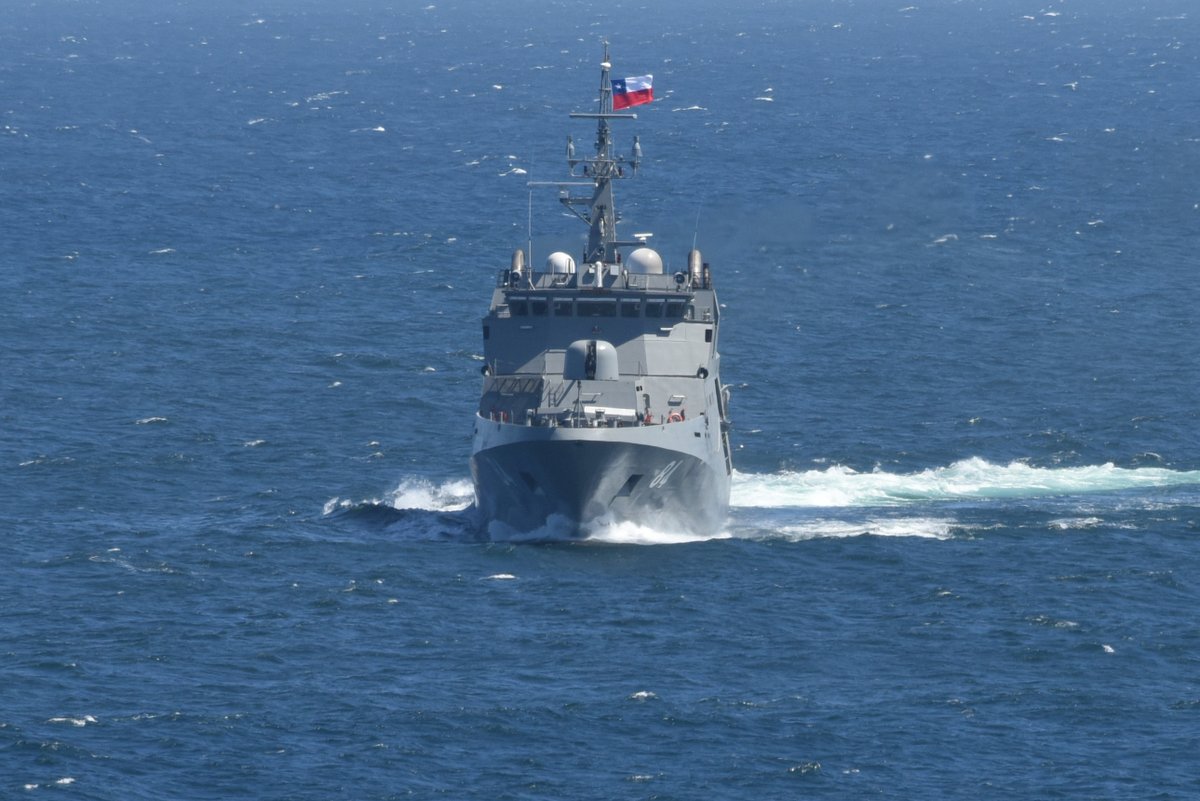
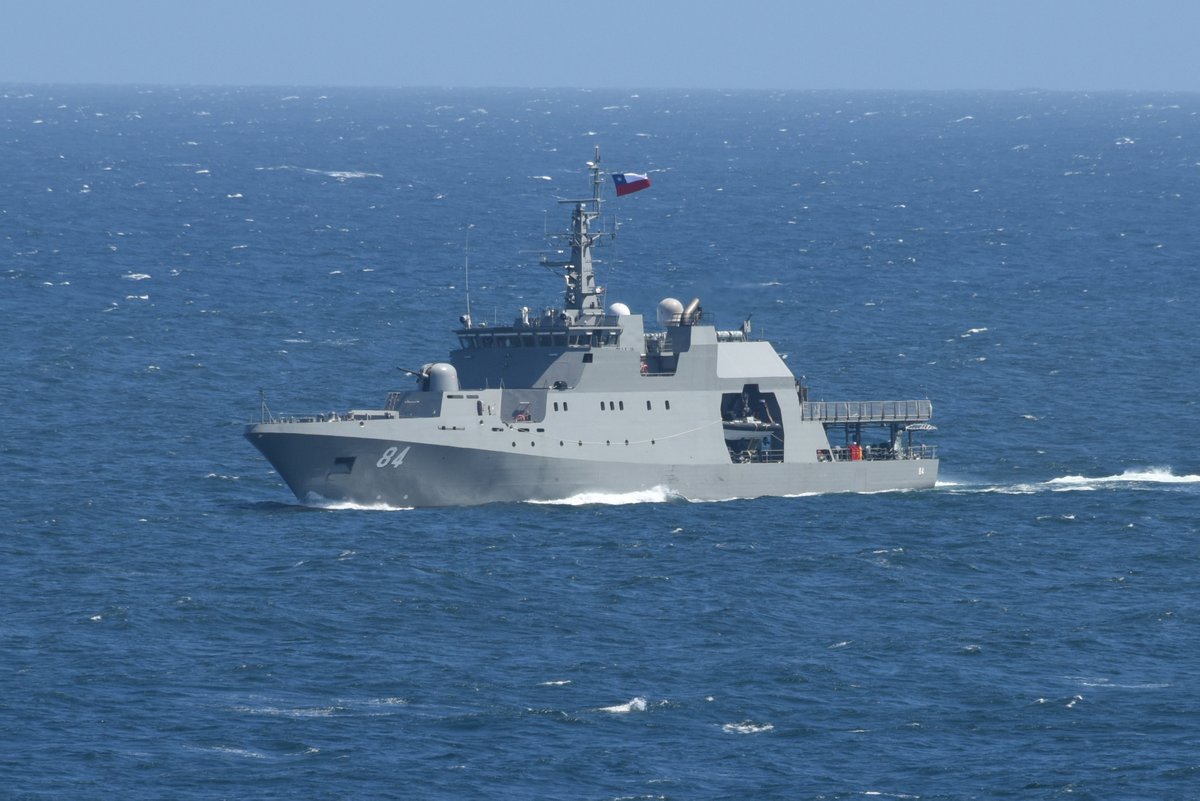
New Photos of Chile’s Fassmer-80 OPV

, Andres In April 2014 a guest author, Andres Tavolari, provided one of our most popular posts, about a multi-national program to build OPVs to a German design, the 264 foot Fassmer-80. Andres has provided pictures of the latest Chilean vessel of this class, OPV-84 “Cabo Odger” which is to be the forth of a projected six. It is slightly larger than the first ships of the class at 1771.6 tons. She is also ice strengthened and is equipped a recycled 76mm and different radar and communications systems.

This class is one of three contenders for Australia’s OPV program.

Mk38 mod3, Different, but not so Much

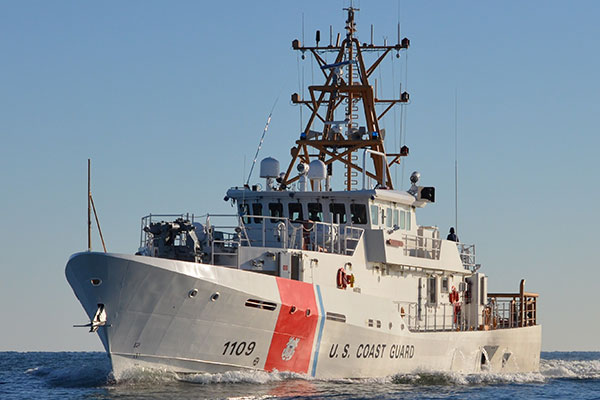
USCGC Kathleen Moore (WPC-1109), Don’t expect future WPCs to look much different.

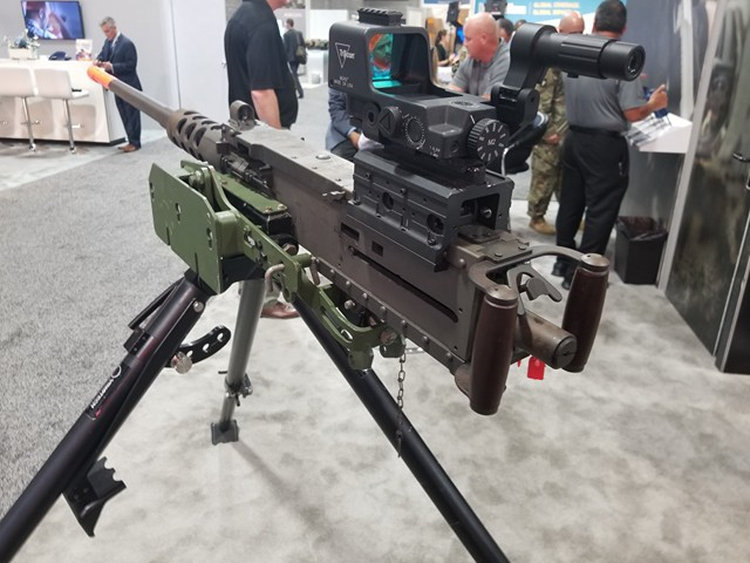
In October 2015 I reported that the Coast Guard would be getting a new gun mount, the Mk38 Mod3, and at that time it appeared that the gun would be substantially different from the Mk38 Mod2 that was being mounted on the Webber Class WPCs.
 –
DefenseMediaNetwork reports the Mk38 Mod3 offers a number of improvements over the Mod2 currently being fitted to the Webber class, including more ready ammunition on the mount (500 rounds vice 165), a coaxial .50 cal. gun (there was already a plan (pdf) to add a coaxial 7.62mm to the Mod2 version), higher elevation (75 degrees vice 40), better weather protection and serviceability, and the ability to simultaneously track up to three targets. There are also improvements to the search function of the ElectroOptic sensor that should make the system more useful in peacetime roles. They also report that BAE and Israeli manufacturer, Rafael, are considering adding the “Advanced Precision Kill Weapon System” APKWSII guided 70mm rocket system to the mount. In fact Israeli versions of this system already support surface to surface and surface to air missiles.
It now appears the only improvements will be in the electro-optics and in fact the gun mount itself will be identical to the Mk38 Mod2.
Slides from a NAVSEA presentation, in fact, list the Mk38 Mod2 gun mount as a component of the Mod3.
A data sheet on the Mk38 Mod3 indicates there is an option to add a coaxial 7.62mm chain gun with up to 750 rounds on the mount, but otherwise the mount is identical to the existing Mod2 installations, e.g., no greater elevation limits, no more ammunition on the mount, as already anticipated, no 30mm gun, and nothing regarding adding APKWSII guided rockets to the mount. There is no indication yet that the Coast Guard intends to add the 7.62mm machinegun to the mount.

“The Mk 38 MGS is a low cost, stabilized self-defense weapon system that dramatically improves ships’ self-defense capabilities in all weather conditions, day or night. Installed aboard 14 different classes of U.S. Navy ships and U.S. Coast Guard cutters, it is used extensively by the U.S. military as well as by NATO forces.

“A major upgrade to the Mod 3 is the system’s advanced electro-optical/infrared (EO/IR) sensor which provides 330-degree surveillance capability and three fields of view. The superior optics allow sailors to monitor the seas and respond to threats even in extremely low light conditions with the benefits of a low contrast, low light level color day camera and an eye-safe laser range finder. (emphasis applied–Chuck)

“While the EO/IR sensor system is integrated with the Mod 3’s state-of-the-art fire control system, the Mk 38 Mod 3 is unique from other naval weapons because its surveillance system moves separately from the gun system, preventing adversaries from easily knowing they have been detected.

“The Mk 38 Mod 3 also provides a range of 2.5 kilometers and selectable rates of fire from single to 180 rounds per minute, and fires all U.S. Navy-approved 25mm ammunition. It can be remotely operated from the combat information center or other protected ship structures, allowing operators to remain safe and out of harm’s way.”

I am disappointed that we will not see the additional improvements, but the improvements in the optics that make the system useful as more than a weapon system are certainly welcome.

We still really need a system on our WPBs and WPCs capable of forcibly stopping medium to large merchant ships with an effective range of at least 4000 yards.

Thanks to Luke for bringing this to my attention. 

Coast Guard Buying Up to 16,000 Personal Locator Beacons

gCaptain has reported that the Coast Guard will recommend that all lifejackets on ocean-going vessels be equipped with Personal Locator Beacons.

“In the United States Coast Guard’s upcoming El Faro investigation report, Captain Jason Neubauer USCG, Chairman of the Marine Board of Investigation, will recommend that all Personal Flotation Devices on oceangoing commercial vessels be outfitted with a Personal Locator Beacon.”

“The investigation report does not call for a second EPIRB equipped with GPS, as some marine safety experts have called for, but takes the additional step of recommending that PLB’s be attached to all lifejackets aboard oceangoing commercial vessels.”

Apparently the Coast Guard is taking the lesson to heart. Intelligent-Aerospace reports the Coast Guard has let a $3 million indefinite-delivery/indefinite-quantity contract with options for up to 16,000 McMurdo Fast Find 220 Personal Locator beacons.

According to the manufacturer,

The McMurdo FastFind 220 is small and light enough for you to carry on your person at all times. Using advanced technology, the FastFind 220 transmits a unique ID and your current GPS co-ordinates via the Cospas-Sarsat global search and rescue satellite network, alerting the rescue services within minutes. Once within the area, the search and rescue services can quickly home in on your location using the unit’s 121.5Mhz homing beacon and flashing LED SOS light.

These PLBs are available from a variety of sources including on-line for $190-$300. 16,000 PLBs for $3M would average $187.50 each.

Considering what we do, this looks like a good investment. Presumably every aircraft, boat, and cutter crewman will have one of these on their lifejacket or perhaps their work uniform.


“Designing the New National Security Multi-Mission Vessel” for State Maritime Academies

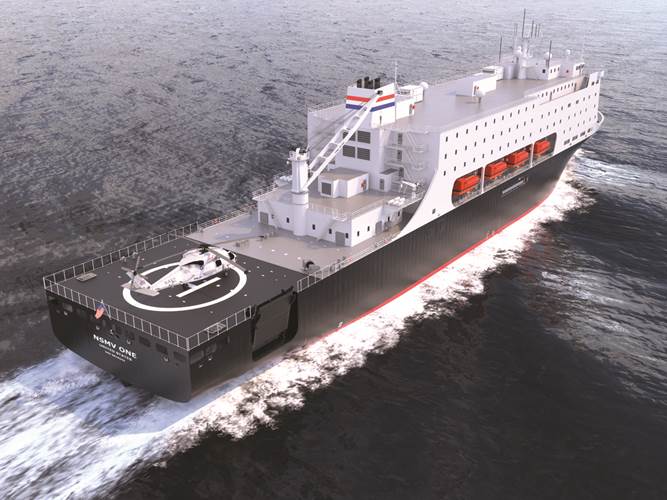
MarineLink reports MARAD is planning a new class of ships to serve as training ships for the five State Maritime Academies (SMA). Additionally these ships are expected to be available to respond to Natural Disasters. The new design is being referred to as the National Security Multi-Mission Vessel (NSMV).

NSMMV Humanitarian Assistance Disaster Response facilities will be concentrated at the sternHerbert Engineering Corp (HEC) prepared a conceptual level design for the NSMV.

DESIGN PARTICULARS
Length o.a.: 159.85 m (524.5 ft.)
Beam: 27 m (88.6 ft.)
Draft: 6.5 m (21.4 ft.)
Design service speed: 8 knots/15% sea margin
Cruising Speed: 12 knots
Propulsion: Diesel Electric
Propulsion engines: 4 x Diesel Generators
Total installed Power: 15,680 kW
Propellers: 1 propeller, fixed pitch
Rudders: 1 flap type rudder on centerline
Fuel: Single fuel – marine gas oil (MGO), max Sulfur content 0.1%
Bow Thruster: retractable combi type – tunnel thruster in up position, azimuthing thruster in down position, “Take Home” source of power, 1450 kW
Stern Thruster: Tunnel type, 890 kW
Fuel Consumption: 60 tons/day @ 18 knots,  26 tons/day at 12 knots
Fresh Water (including sanitary water): 35 gal/day per person for 700 = 93 tons + 5 tons Ship Service FW = 98 tons/day
Fuel range: About 11,000 nm range @ 18 knots design speed with 10% remaining fuel
Food & Stores: 60 days food storage for 700 persons, 297 sq. m. (3,200 sq. ft.) reefer provisions,  240 sq. m. (2,580 sq. ft.) dry provisions
Propulsion motors: 2 x 4,500 kW propulsion motors. Motors in separate watertight compartments.
Electric Power: 6,600 V main power generation, 440 V ship service electric power, 120 V lighting and accommodations
RoRo deck: RoRo space aft with length of about 40 m (130 ft), width inside framing of 24 m (80 ft), clear height of at least 4.7 m (15.3 ft). Usable deck area is about 1,000 sq. m. (10,700 sq. ft.). Suitable for about 10 x 40 ft trailers with 26 autos or about 49 autos/light trucks.
Total container capacity: about 64 TEU for two high.
Crane: 1 x Jib Boom type with 35 MT SWL x 24 m outreach
RoRo ramp: 20 ft. wide watertight wide side ramp with 40 ton capacity

(Image: Herbert Engineering / MARAD)

Navy’s new 40 foot Force Protection Patrol Boat

Navy 40 foot PB(X) to be built by Metal Shark

The Navy has recently awarded Metal Shark a contract for a new “force protection” patrol boat.

The basic information is:

LOA: 43′ 11″app
HULL LENGTH: 40’ 3″
BOA: 11’ 10″
Metal Shark claims the boat is optimized for normal patrol speeds of 10-12 knots while capable of economical operation at higher speeds of 35+ knots.
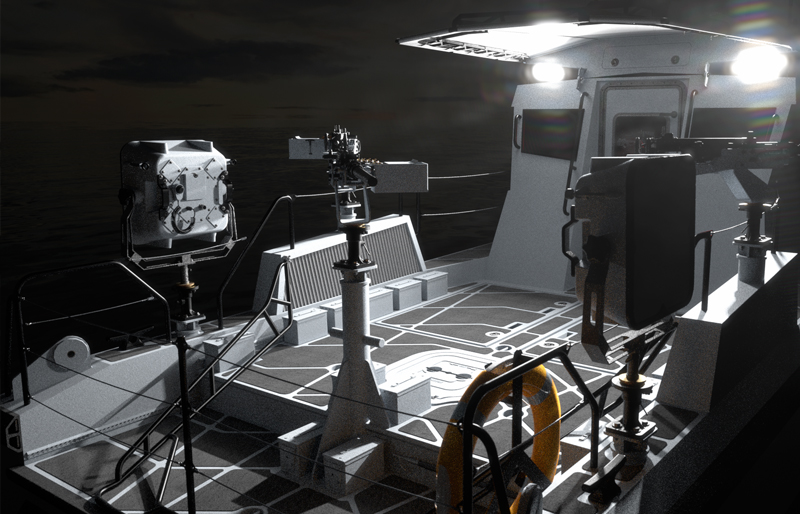
It appears the expected weapons fit is a .50 caliber in a remote weapons station forward and three crew served .50 calibers aft. Two LRAD (long range audio devices) also appear to planned.

PB-X aft, LRAD and .50 cal.

Undoubtedly there will be comparisons drawn between these and the Coast Guard boats that also do escorting duties. After all, the Coast Guard probably does many more escort missions as part of the Ports, Waterways, and Coastal Security mission than the Navy ever will. The Coast Guard escorts passenger vessels, hazardous cargoes, Navy surface ships, and even Fleet Ballistic Missile Submarines.
Our closest comparable boat is the Response Boat, Medium. The RB-M may be a bit faster. It appears that this new Navy boat may be better equipped for the escort mission than the RB-M or even most 87 foot WPBs. The LRAD looks like a good idea to warn away the innocent, and if the use of deadly force is necessary, the Navy boat looks like it will have heavier weapons and the remote weapon station means greater accuracy and less chance of collateral damage.
I have quoted the Metal Shark news release below. In addition there is a lot more information about the boat here.

October 2, 2017: Metal Shark Wins U.S. Navy PB(X) Patrol Boat Contract

Jeanerette, LA – October 2, 2017: Louisiana-based shipbuilder Metal Shark has been awarded the contract to produce the U.S. Navy’s next-generation patrol boat, the PB(X).

This award is the culmination of a multi-year process by the Navy to select the replacement for the fleet of force protection boats currently in use with Navy Expeditionary Combat Command’s Coastal Riverine Forces (CRF). Subject to annual appropriations, the Navy intends to replace approximately 100 to 160 of its existing 25-foot and 34-foot CRF patrol boats with the larger and more modern PB(X) platform over the next fifteen years.

The Navy has placed an initial, immediate order for eleven of the new vessels. Under the terms of the award, potentially worth over $90 million, Metal Shark will build up to 50 PB(X) vessels for the Navy, along with trailers, spares and training packages, and technical support.

“PB(X) was one of the most challenging and most sought-after U.S. military boat procurement opportunities in recent history; the result of a years-long process pitting Metal Shark’s engineering and manufacturing capabilities against multiple leading U.S. naval architect firms and nearly all of our competitors,” said Metal Shark’s CEO Chris Allard. “The award of PB(X) to Metal Shark is the result of a tremendous team effort and I couldn’t be more proud of our people.”

The winning PB(X) design is a 40-foot, welded-aluminum pilothouse patrol boat designed by Metal Shark’s in-house engineering team. Leveraging its extensive experience with military patrol craft of similar size, Metal Shark designed a bespoke craft ideally suited to accommodate all mission parameters.

Immediately identifiable thanks to its chiseled, angular profile and a unique faceted hull, the PB(X) is powered by twin diesel inboards and water jets. Metal Shark designed a moderate aft deadrise, wide-waterplane, sharp-entry hull form that not only achieves 35+ knot sprint speeds while displaying superb dynamic stability in a range of conditions, but also offers enhanced handling and greatly reduced operating cost at the 10-15 knot escort and cruise speeds where the vessel will spend the bulk of its operational life. The PB(X) features ballistic protection and can be armed with a range of crew-served and remotely operated weapons systems.

In order to fully optimize the hull and propose a more mature design, Metal Shark built a PBX running prototype hull, designated PB(X)-P1, which was extensively tested in a wide range of operating conditions. This test platform became the basis for Metal Shark’s resistance, powering, and weight testing, and determined the final configuration proposed to the Navy.

“The testing of PB(X)-P1 validated our design choices, mitigated our areas of concern, and resulted in a design proven to perform exactly as expected under real-world loads and conditions,” explained Mr. Allard. “We made this up-front investment to eliminate any and all potential concerns and to deliver a thoroughly tested and proven, next-generation patrol boat platform to the U.S. Navy.”

The PB(X) will be built at Metal Shark’s Jeanerette, Louisiana production facility, which specializes in the rapid, serialized assembly of military patrol boats. Other significant military fleet builds currently underway at the facility include ongoing production of the Navy’s 32’ Force Protection Boat – Medium (FPB-M) and 26’ High Speed Maneuverable Surface Target (HSMST), and the U.S. Coast Guard’s 29’ Response Boat – Small (RBS).

This is the second major U.S. Navy contract awarded to Metal Shark in 2017. In June, Metal Shark was selected to build up to thirteen Near Coastal Patrol Vessels (NCPVs), for the Navy. These 85’ patrol boats are being produced at Metal Shark’s Franklin, Louisiana waterfront shipyard.

“Winning PB(X) is a crowning achievement for us, but there’s a lot of work ahead,” said Mr. Allard. “The Navy is a long-standing customer we’re extremely familiar with and whose needs we understand intimately. We are eager and ready to commence PB(X) production and to begin supplying the world’s greatest Navy with the world’s most advanced patrol boat.”


Metal Shark PBX Prototype