More Than One Way to Crack Down On IUU Fishing

Navigateum.com reports that more than twenty insurance companies have responded to a UN request.

They agreed to “not knowingly insure or facilitate the insuring of vessels that have been officially blacklisted for their involvement in IUU (Illegal, Unregulated, Unreported–Chuck) fishing.”

gCaptain reports

“Microsoft Corp. co-founder Paul Allen…will spend $40 million to develop a system that uses satellite imagery and data-analysis software to help countries spot and catch unlicensed fishing boats.

“Illegal fishing accounts for about 20 percent of the world’s catch, costing up to $23.5 billion a year, according to the World Wildlife Foundation, … the risk of hunger and joblessness in an industry that provides employment for more than 1 in 10 of the world’s people..”

About 90 percent of the world’s fishing grounds are being harvested at or beyond sustainable limits. Some species, such as the southern bluefin tuna, are threatened with extinction. Shrinking supplies off the central and western coast of Africa have raised concerns about future food shortages there. In the Mediterranean and Black seas, catches have fallen by a third since 2007.
SkyLight, which will be broadly available in the first half of next year, takes multiple data sources from satellite images, to shipping records to information manually collected by officials standing on docks, and uses machine learning software to track and predict which vessels might be operating illegally.
The service is cloud-based and will enable different countries to communicate and share information as boats move from one country’s waters to the next, a challenge currently.

Sounds like SkyLight could be very useful to the Coast Guard, particularly in the Western Pacific where the US has a huge part of its Exclusive Economic Zone, but very few Coast Guard resources.


GAO Reports

Would like to call attention to a couple of GAO reports. Have to admit, I have not read the full reports, the first is 51 pages, the second, 61.

Regarding the first GAO report, it has now been seven years since I last saw a public statement of how the Coast Guard uses its assets and how well we reach our goals. More information, and more transparency would be good. We should not be afraid to say some goals are not being met because we simply do not have the asset. Some performance measures probably should be classified, but that does not apply to most of what we do. That is what classified annexes are for.

Regarding the second report, closing stations is one way to save money, but it is not the only way. It forfeits the advantages of proximity and redundancy. Analytically a two hour response time may be appealing, but some times it is really not good enough. We have experienced a number of natural disasters recently, I suspect we have benefited from having some overlap in our SAR capabilities. Perhaps we should look at scaling down staffing where there is overlapping capabilities rather than eliminating facilities all together.

Coast Guard: Actions Needed to Enhance Performance Information Transparency and Monitoring

What GAO Found

The U.S. Coast Guard’s (Coast Guard) performance goals generally align with its 11 statutory missions. However, GAO found that the goals representing 5 of the 11 missions do not fully address all related mission activities. For example, despite the Coast Guard’s mission to interdict all illegal drugs, the agency’s two performance goals related to that mission are for cocaine interdiction only, excluding many other substances. Developing new goals to address missions, or describing how existing goals sufficiently assess mission performance, could better convey the Coast Guard’s progress in achieving its missions to decision makers and the public. The Coast Guard also does not report all of its performance goals in publicly available documents, limiting congressional and public awareness of the Coast Guard’s ability to meet its missions.

The Coast Guard and the Department of Homeland Security (DHS) have processes intended to ensure the reliability of performance data for the seven selected goals that GAO reviewed. However, the Coast Guard does not consistently document its data limitations for internal and external audiences. For example, the Coast Guard did not document limitations with its performance goal regarding the number of detected incursions of foreign fishing vessels violating U.S. waters. While the Coast Guard reported taking steps to address data limitations with two of the seven selected performance goals that GAO reviewed, the extent of such limitations are not clearly documented. Assessing the extent to which performance data limitations are documented could provide greater transparency regarding the reliability of these data.

Additionally, for the same selected seven goals, GAO found that the Coast Guard documented an explanation for why it did or did not meet each performance goal reported to DHS, as well as corrective actions for each unmet goal. However, the Coast Guard’s corrective actions were not measurable and did not include time frames for implementation. For example, the Coast Guard did not report measurable actions or time frames for evaluating whether additional resources were needed to address its cocaine interdiction goal. The Coast Guard also did not document its efforts to monitor whether the corrective actions it developed for unmet performance goals were implemented or evaluate whether they had the intended effect. Documenting these efforts could enable the Coast Guard to determine whether these actions have been implemented, if they have mitigated any performance gaps, and continue to plan and prioritize its operations to target performance gaps, which is consistent with federal standards for internal control.

RECOMMENDATIONS

The Commandant of the Coast Guard should either develop new performance goals to address mission activity gaps, or explain in the Coast Guard’s Annual Performance Report (APR) why certain aspects of mission performance are measured while others are not. (Recommendation 1)

The Commandant of the Coast Guard, in coordination with the Secretary of Homeland Security, should make the Coast Guard’s future Annual Performance Reports publicly available on the Coast Guard’s website. (Recommendation 2)

The Commandant of the Coast Guard, should coordinate with the Secretary of Homeland Security, and assess the extent to which documentation on performance data reliability, including Performance Measure Definition Forums and DHS and Coast Guard APRs, contain appropriate information on known data reliability limitations, and update these documents, as needed, based on the results of the assessment. (Recommendation 3)

The Commandant of the Coast Guard should develop and document, in its APR or elsewhere, corrective actions for unmet performance goals that are measurable and include time frames for implementation. (Recommendation 4)

The Commandant of the Coast Guard should document, in its APR or elsewhere, its efforts to monitor and evaluate the implementation of corrective actions for unmet performance goals. (Recommendation 5)
Coast Guard: Actions Needed to Close Stations Identified as Overlapping and Unnecessarily Duplicative

SAR Coverage

What GAO Found

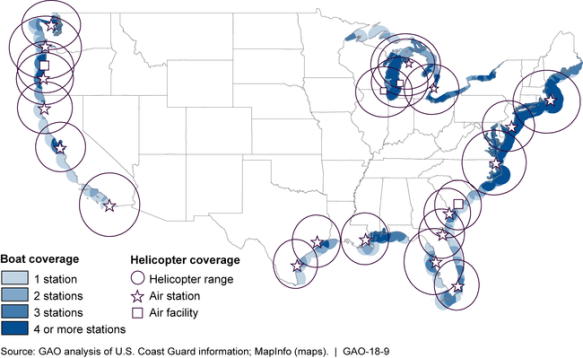
GAO found that the U.S. Coast Guard has a sound process for analyzing its boat stations that includes clear and specific steps for analyzing the need for stations using terms that can be readily defined and measured. In 2013, following this process, the Coast Guard and its contractor identified 18 unnecessarily duplicative boat stations with overlapping coverage that could be permanently closed without negatively affecting the Coast Guard’s ability to meet its 2-hour search and rescue (SAR) response standard and other mission requirements. The process was designed to ensure the Coast Guard met or exceeded requirements to maintain SAR coverage and to account for such factors as boat downtime and surge capacity to respond to certain incidents. Further, the boat station analysis did not consider potential SAR responses by the Coast Guard’s air stations and facilities, which can provide additional overlapping coverage. Coast Guard officials said that the closures would, among other things, help improve operations by consolidating boat station caseloads to help ensure personnel were active enough to maintain training requirements.

In 2017, the Coast Guard affirmed that its leadership believes the 2013 study remains valid, but so far the agency has not taken actions to implement the closures identified by its sound process. Instead, the Coast Guard is recommending conversion of some year-round stations to seasonal stations that would operate during the summer. Coast Guard officials stated that seasonal closures are preferable to no action, given its limited resources, the significant overlapping SAR coverage, and potential to improve operations. However, permanently closing unnecessarily duplicative stations may better position the Coast Guard to improve its operations. It could also achieve up to $290 million in cost savings over 20 years, if stations were permanently closed.

RECOMMENDATIONS

The Commandant of the Coast Guard should establish and follow a sound air station optimization process similar to its process for analyzing boat stations to allow it to comprehensively analyze its need for air stations and air facilities and determine what changes may be needed. (Recommendation 1)

The Commandant of the Coast Guard should establish a plan with target dates and milestones for closing boat stations that it has determined, through its 9-step process and subsequent analysis, provide overlapping search and rescue coverage and are unnecessarily duplicative. (Recommendation 2)

The Commandant of the Coast Guard should take action to close the stations identified according to its plan and target dates. (Recommendation 3)

 

New Icebreaking/Buoy Tending Tug

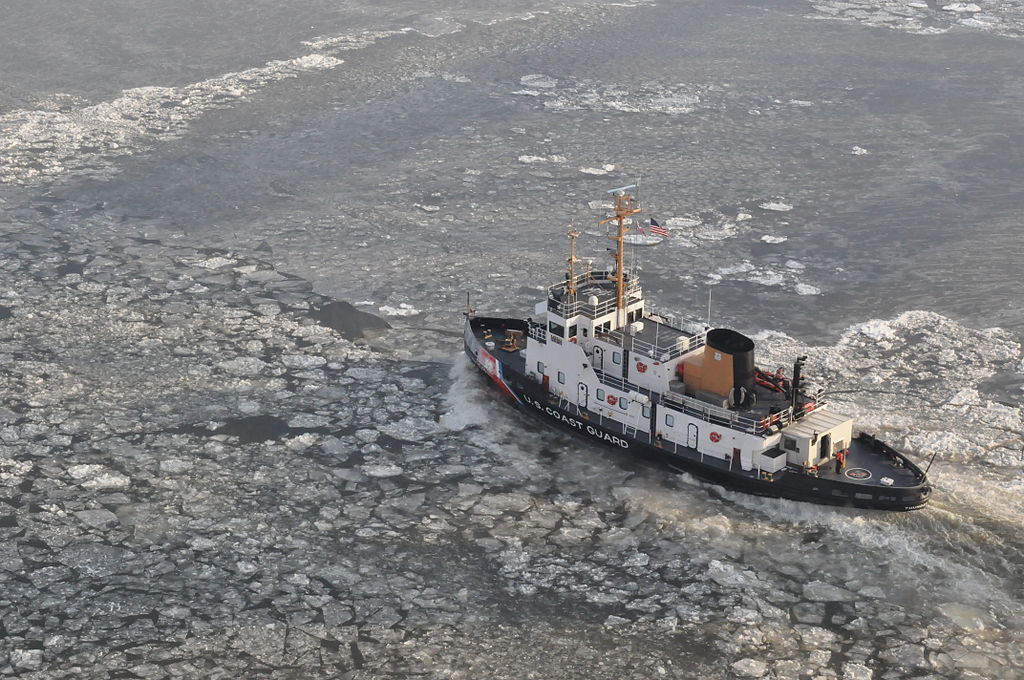
USCGC Thunder Bay (WTGB-108)

MarineLog reports Gulf Island ship is building an icebreaking/buoy tending tug for the Saint Lawrence Seaway Development Corporation. $18.14 million (About a third the cost of a Webber class WPC). It is expected to be 118′ x 45′ x 16′, all-steel, with an ice-breaking bow, powered by two controllable-pitch Z-drive propulsion units, each driven by a high-speed diesel engine. Crew of 14.

Sounds like a type the Coast Guard might be interested in.

The Coast Guard’s domestic icebreaker tugs are 140′ x 37′ 5″ x 12′ 6″. These ships are up to 36 years old. The Coast Guard’s 65 foot tugs, that also do some domestic icebreaking are all at least 50 years old. Clearly our tugs are getting long in the tooth.

It is certainly not clear how good this new little ship will be either as an icebreaker or as a buoy tender, but sounds like it will be worth a look.

Adding a three or four more small icebreakers in the Great Lakes might be a reasonable substitute for the often called for second icebreaker for the Lakes. If they could help with buoy tending, so much the better.


Interview with Commandant

https://1yxsm73j7aop3quc9y5ifaw3-wpengine.netdna-ssl.com/wp-content/uploads/2017/10/102017-dhs-15.mp3?_=1

Federal News Radio has an interview with the Commandant. There is a short written summary here or you can listen to it on their page or above. Some interesting developments with regard to drug interdiction in the Eastern Pacific. Sea story about actual employment of a sea based Unmanned Air System.

Interestingly he again refers to Russia arming Icebreakers so I think perhaps we may see some movement to arm or at least make provision for arming our new icebreakers.

Guided Weapons Made Easy

APKWS launcher to be produced by Arnold Defense. Expected ready for production 2018.

Army Times is reporting that Arnold Defense is showing a system developed to allow the mounting of up to four Advanced Precision Kill Weapon System (APKWS II) 70mm laser guided rockets virtually anywhere there is a “universal gun mount,” including maritime applications. That sounds like the mounts for our .50 caliber machine guns.

APKWS is a kit that adds semi-active laser homing guidance to any Hydra rocket, a common unguided rocket normally used in large number for area suppression.

The launcher for up to four rockets, called Fletcher, is 6.5 feet long and has an empty weight of only 30 pounds. Each of the 2.75″ rockets when equipped with APKWS kits weighs about 32 pounds depending on warhead chosen, for an all up weight of about 158 pounds.

Range is at least 5,000 yards in surface to surface mode. The effect of a hit is similar to that of a 3″ (76.2 mm gun). This seems to be the weapon we need to quickly and reliably take out threats based on small, fast, highly maneuverable vessels with less likelihood of collateral damage than gun systems. It would probably deal effectively with larger vessels up to about 100 tons.

APKWS is in the Navy supply system. A contract in 2016 for the purchase of 5000 kits at a total cost of $133M yielded a unit cost of $26,600 and since then the unit price has reportedly deceased as production has increased. BAE is working up to a capacity of building 20,000 APKWS kits a year. They have already completed over 10,000. Arnold claims to have produced over 1.1 millilon rocket launchers since 1961.

The light weight offers several advantages. It would not have to be mounted all the time. It should be easy to remove and remount the launchers, or to move them between platforms. We would not necessarily need to load up all four tubes or have two launchers.

We would need to make sure the back blast points in a safe direction, perhaps mounting the launcher(s) on the stern. We would also need laser designators, but they readily available, and we probably should have them anyway, as a way of designating targets when we need to get help from our sister services.

Canada’s Coast Guard Construction Plans

Canada’s Next Generation Combat Vessels

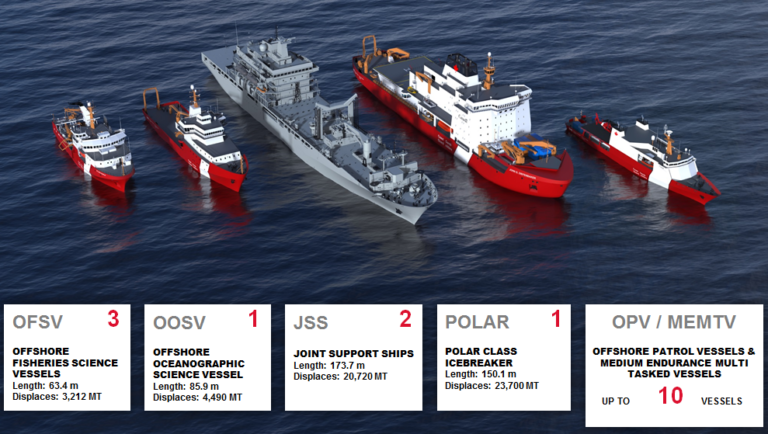
The illustration above comes from the Canadian ship builder Seaspan. Under Canada’s new National Shipbuilding Procurement Strategy, their Vancouver shipyard will be building all of the Canadian government’s” non-combat vessels, including all their Coast Guard vessels.

There are details here I had not seen previously about their new icebreaker:

  • Length: 150.1 meter
  • Displacement: 23,700 metric tons

Their three new Offshore Fisheries Science Vessels:

Offshore Fisheries Science Vessel (interesting underwater body)

  • Length: 63.4 m
  • Displacement: 3,212 MT

An Offshore Oceanographic Science Vessel:

  • Length: 85.9m
  • Displacement: 4,490 MT

and “…up to five new Medium Endurance Multi–Tasked Vessels and up to five Offshore Patrol Vessels…” I have seen no details on these ships since we first heard about them four years ago. (Anyone seen anything concrete?) Only the cost, $3.3B (Canadian) seems firm. Even the number is simply an upper limit. If there are specifications, they must be keeping them open and close to the vest. This follows the example of the Canadian Navies Arctic Offshore Patrol Ship (AOPS) where the price seemed to have been set and the numbers given as six to eight.  At least now we have a conceptual view in the illustration at the top. Its not clear if there will really be a difference between the OPVs and the MEMTVs. Obviously they will have a helo deck and probably a hangar. I will guess that these will be designed by either Vard or Damen and will be about 1800 tons full load and 80 to 90 meters in length. Like all Canadian Coast Guard Cutters they have no permanently installed weapons, but should they decide to change policy and arm these, and it has been discussed, it probably would not be to difficult to add a gun of up to 76mm

Thanks to Lee for bringing this to my attention.

USCGC Polar SeaThe US Naval Institute reports the Coast Guard has issued a draft Request for Proposals for a new Heavy Icebreaker with options for two more.

Certainly good news to see the process moving along, but it is also important to remember what it is not.

It is only a draft. “Responses to the draft RFP are due Dec. 11, and the Coast Guard and Navy will release a final RFP early next year, to support a Fiscal Year 2019 contract award.”

Like all of our contracts so far, there is no apparent consideration of a block buy that would lock Congress into funding the entire program–three ships in this case. Perhaps an astute shipbuilder will include that in their ultimate response, in case the Congress wants to commit for all three.

Unfortunately I can’t comment on the draft because of its limited distribution. Hopefully because,

“…Polar icebreakers enable the U.S. to maintain defense readiness in the Arctic and Antarctic regions; enforce treaties and other laws needed to safeguard both industry and the environment; provide ports, waterways and coastal security; and provide logistical support – including vessel escort – to facilitate the movement of goods and personnel necessary to support scientific research, commerce, national security activities and maritime safety.”

They will be provided with the means to be upgraded to allow them to exercise both self-defense and a modicum of offensive capability.


RRS Sir David Attenborough–the UK’s Access to Antarctica

RRS Sir David Attenborough. Proto from Rolls-Royce

Thought I had posted about this ship earlier, but when I went to add an update from MarineLink on installation of the engines, I found that was not the case. RRS Sir David Attenborough is perhaps most famous as the subject of a social media search for a ship name that resulted in the most votes going to Boaty McBoatface.

It is expected to provide logistics support to support a British presence in Antarctica as well as break ice to a thickness of 1.5 meters at a minimum speed of 3 knots.

  • Displacement: 15,000 Gross Tons (only a little smaller than USCGC Healy, a little larger than Polar Star)
  • Length: 128.9 meters (423 feet)
  • Beam: 24 m (79 ft).
  • Draft: 7 m (23 ft)
  • Integrated propulsion and ship service engines/generators:  two 3,600 kW (4,800 hp) 6-cylinder Bergen B33:45L6A and two 5,400 kW (7,200 hp) 9-cylinder Bergen B33:45L9A main diesel generators, a 885 kW (1,187 hp) harbor generator and two 2,500 kW battery systems.
  • Propulsion motors: four 2,750 kW (3,690 hp) for 11,000kW or 14,760 HP (about half that of USCGC Healy and less than 20% that of Polar Star on turbines)
  • Range: 19,000 nautical miles (35,000 km; 22,000 mi) at 13 knots
  • Accommodations for 90 with a crew of 28.
  • Facilities to land a helo, but I have seen no indication of a hangar.

The ship will be owned by the British Natural Environment Research Council, to be operated by the British Antarctic Survey. It is expected to enter service in 2019.


Fire aboard USCGC Brant (WPB-87348)–No Injuries

Fire damage, USCGC Brant (WPB-87348), Gulfport, MS, 18 Oct., 2017. Looking at the aft port corner of the superstructure.

The 87 foot WPB USCGC Brant (WPC-87348) has suffered a fire while berthed in Gulfport MS. Two were aboard, but there were no injuries.

This is the CCGD8 news release:

NEW ORLEANS – Members from Gulfport Fire Department and a Coast Guard member extinguished a fire aboard Coast Guard Cutter Brant, which was moored in Gulfport, Mississippi, Wednesday.

At approximately 5 a.m., two Coast Guard members who were aboard the cutter became aware of the fire, located on the port-aft area of the vessel, and took initial actions to put out the fire using an on board fire extinguisher.

Members from Gulfport Fire Department arrived on scene at 5:05 a.m. and extinguished the fire.

The two Coast Guard members on board the vessel were evaluated by emergency medical services and have been released.

“We are thankful no one was hurt in the fire,” said Cmdr. Zachary Ford, the head of the response department at Coast Guard Sector New Orleans. “Without the quick response and actions taken by the Gulfport Fire Department, this incident could have been much worse.”

The cause of the incident is under investigation.

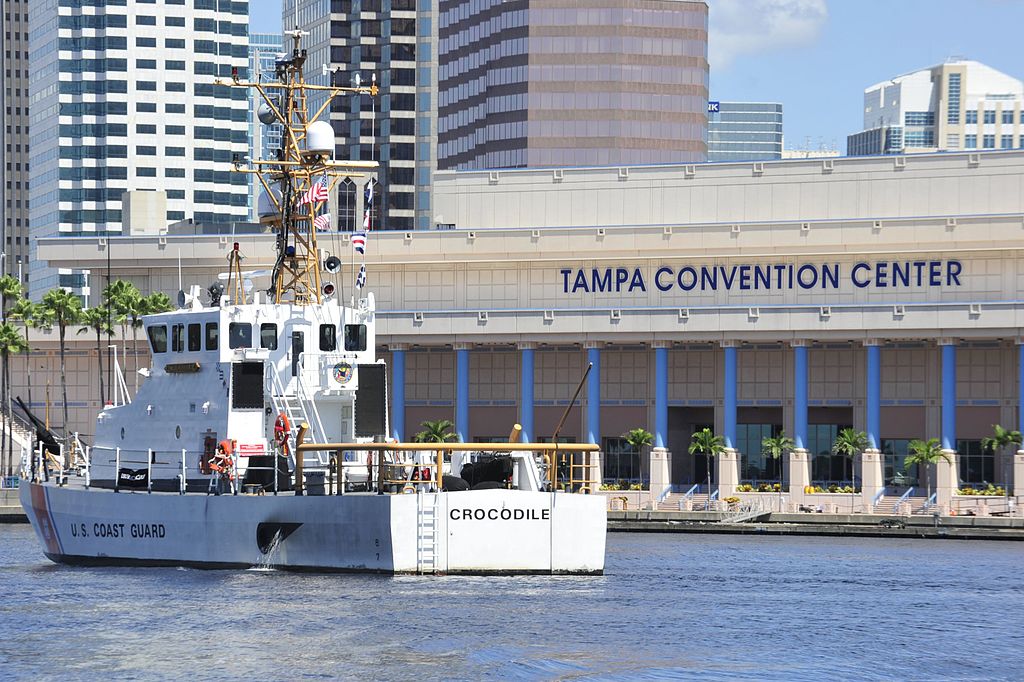
Below is a photo of a sister ship, USCGC Crocodile. I understand this started as an electrical fire in the engineroom.

USCGC Crocodile. the area of damage is clearly visible to the left of the ladder leading to the bridge. Damage seems to have been in a trunk leading down to the engine room. There may have been additional damage below deck.